The AML alert review process is the first-line work of a bank's suspicious activity program: for each alert the monitoring system raises, a Level 1 analyst compares the activity with what the bank knows about the customer, its counterparties and its history, then closes the alert with a written reason or escalates it to an investigator. The decision takes minutes; gathering the facts from four or five systems takes most of the half hour an alert typically costs, which is why the number of alerts each analyst can review, and therefore the staffing a queue needs, is set by the gathering, not the judgement. FinCEN enforcement orders show what happens when the arithmetic is ignored: analysts clearing 100 alerts a day without reading the documents, a 17-month backlog, 70,000 alerts past their benchmark. Botminds' AML Alert Triage assembles and cites the evidence for each alert, has a second agent argue for escalation, and leaves a named analyst to close or escalate every one.
This guide is for the head of the financial intelligence unit who staffs the desk, the BSA officer who answers for it and the operations lead who runs its queues. The worked figures come from a fictional US regional bank with about 42,000 alerts a month and 220 Level 1 analysts, as it runs through the solution.
The Level 1 desk in the public record
4.8M
SARs filed with FinCEN in fiscal 2025, up from 4.3 million in 2022
100
alerts a day reviewed by each of three analysts at a bank FinCEN fined $8 million
30days
to file a SAR after initial detection, 60 if no suspect is identified
70,000+
backlogged detection alerts at one large bank in 2018
What is the AML alert review process?
It is the second of five components the FFIEC examination manual uses to describe suspicious activity monitoring: producing alerts, managing them, deciding whether to file, completing and filing the SAR, and monitoring continuing activity. The manual expects a bank's procedures to name who is responsible for each (FFIEC BSA/AML Examination Manual, Suspicious Activity Reporting). GAO describes the same chain in four steps: identify unusual activity, review and investigate alerts, decide, and complete and file (GAO-24-106301).
At Level 1, review means asking whether the activity has an ordinary explanation for this customer. That takes the alert's scenario and transactions, the customer's profile and expected activity, a year of statements, every counterparty with its screening result, and the history of earlier alerts. The FFIEC expects alert staff to have "access to account systems and account information, including CDD and EDD information," and expects the conclusion to be written down.
One alert through the Level 1 review, step by step
Agent
Read what firedStates the scenario, the rule crossed and the transactions in one sentence.
Agent
Answer three questions, with citationsIs this normal for this customer? Who are the counterparties? Has it happened before? Each answer cites the system it came from.
Never: Never proposes a closure under 85% confidence
Agent
Argue for escalationA separate challenger looks for reasons to escalate; no closure is proposed unless it finds none.
Never: Cannot be turned off
A person decides
Decide and attestThe analyst checks the evidence, then closes under a reason code or escalates, with the rationale under their name.
A person decides
Record the detection date on escalationThe date the bank first had reason to suspect, with a reason, for Level 2 to confirm.
A person decides
QC sampleA different analyst passes or reopens sampled closures, with a reason code.
How many alerts can one analyst review per day?
As many as the minutes per alert allow at the care the bank's procedures require, which no regulation states as a number. At the sample bank, a time study of 1,150 alerts found a median of 38 minutes worked by hand, of which 6 went on deciding and writing. An analyst with about six hours of queue time therefore clears nine or ten alerts a day, which is what the bank's analysts reported.
A Level 1 alert's minutes: most go to fetching, not deciding
- Read3
- Customer profile7
- 12 months of activity9
- Counterparties, 314(a)9
- Prior alerts4
- Decide and write6
- Check evidence2.6
- Decide and write1.5
Enforcement records show both ends of the range failing. At CommunityBank of Texas, FinCEN found three analysts reviewing alerts for the whole bank, and fined it $8 million.
Those three BSA analysts each reviewed an average of 100 case alerts per day, which meant that BSA analysts often did not review supporting documents (cash deposit slips, wire transcripts, check images, etc.), although all of this information was readily available.
FinCEN, In the Matter of CommunityBank of Texas, 2021
At the other end, Shinhan Bank America had "a team of only seven to nine employees" responsible for all alerts from its monitoring system, a backlog at one point of "over 10,000 alert events," and after a scenario failure, "a 17-month backlog of alerts" to review (FinCEN, Shinhan Bank America, 2023). High throughput without care and care without throughput are the same finding: the desk was not staffed for its volume.
The staffing arithmetic: alerts, minutes and analysts
The number of Level 1 analysts a bank needs is alert volume times minutes per alert, divided by productive minutes per analyst, plus QC and absence. Every term is measurable, and the one most banks never measure is minutes per alert by step. Without it, a staffing request is an opinion and a backlog is a surprise.
Level 1 capacity, worked on the sample bank's month
Daily alert volume
42,000 alerts ÷ 21 working days
About 2,000 alerts a working day.
Analyst-days needed, by hand
2,000 × 38 min ÷ 360 productive min
About 211 analyst-days a day before QC, absence and training: close to the 220 analysts the bank employs, with no slack.
Analyst-days needed, evidence assembled
2,000 × 4.1 min ÷ 360 productive min
About 23 analyst-days a day on the same alerts, before QC and the harder escalations.
Headroom for a surge
Capacity ÷ volume
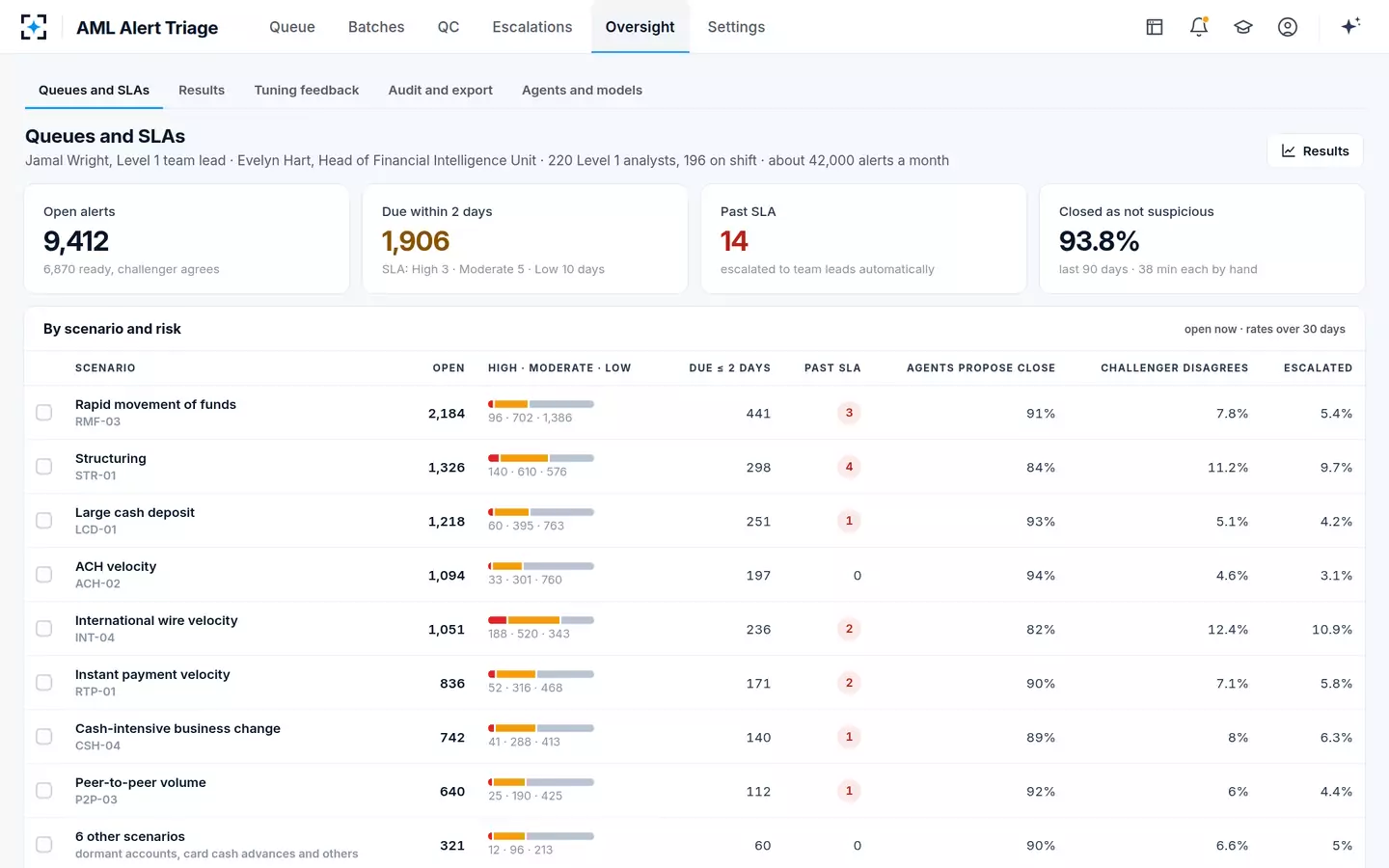
By hand the desk runs at about 96% of capacity, so a new scenario or a seasonal spike turns into a backlog within days.
The last term matters most. A desk sized to its average volume has no room for the month a scenario misfires or a new product launches, and the TD Bank order shows where that leads: in 2018 the program "registered over 70,000 backlogged detection alerts and roughly 3,000 aged subpoena responses and further investigation cases, with less than 60% of alerts falling within benchmarks for timely detection." The response FinCEN quoted from the bank's head of AML was to "identify opportunities to scale back review or investigative rigor" (FinCEN, TD Bank, 2024). Cutting care is the one lever the arithmetic offers when minutes per alert cannot move.
Service levels by risk band, and who owns the late ones
The FFIEC sets no minutes-per-alert standard; it asks that review happen within a reasonable period under written procedures the bank follows. Banks turn that into service levels by risk band, so a queue that ages becomes visible before it becomes a finding. The sample bank decides high-risk alerts within 3 calendar days, moderate within 5 and low within 10, and escalates anything past its service level to the team lead.
The sample bank's Level 1 settings, and why each exists
| Setting | Sample bank | Why it matters |
|---|---|---|
| Decide within, from the alert date | High 3 · Moderate 5 · Low 10 calendar days | Turns "reasonable period" into a measurable promise |
| Past-SLA alerts go to | Team lead | A named owner for every late alert |
| Propose a closure only at confidence of | 85% or more | Below it, the analyst starts with no proposal |
| Challenger must agree before a closure is proposed | Required; cannot be turned off | Every proposed closure has been argued against |
| Like-alert batches | Low and moderate risk only, at most 25, matching scenario, reason code, evidence and risk | Speed where alerts are truly alike, never on high risk |
| QC sampling | 5% risk-weighted; 20% of batch-signed closures; 100% for new analysts' first 60 days; 100% of closures against the challenger | Checks concentrate where errors are likeliest |
Open alerts by scenario and risk, with what is due and what is late
Level 1 and Level 2: where the hand-off sits and why the date matters
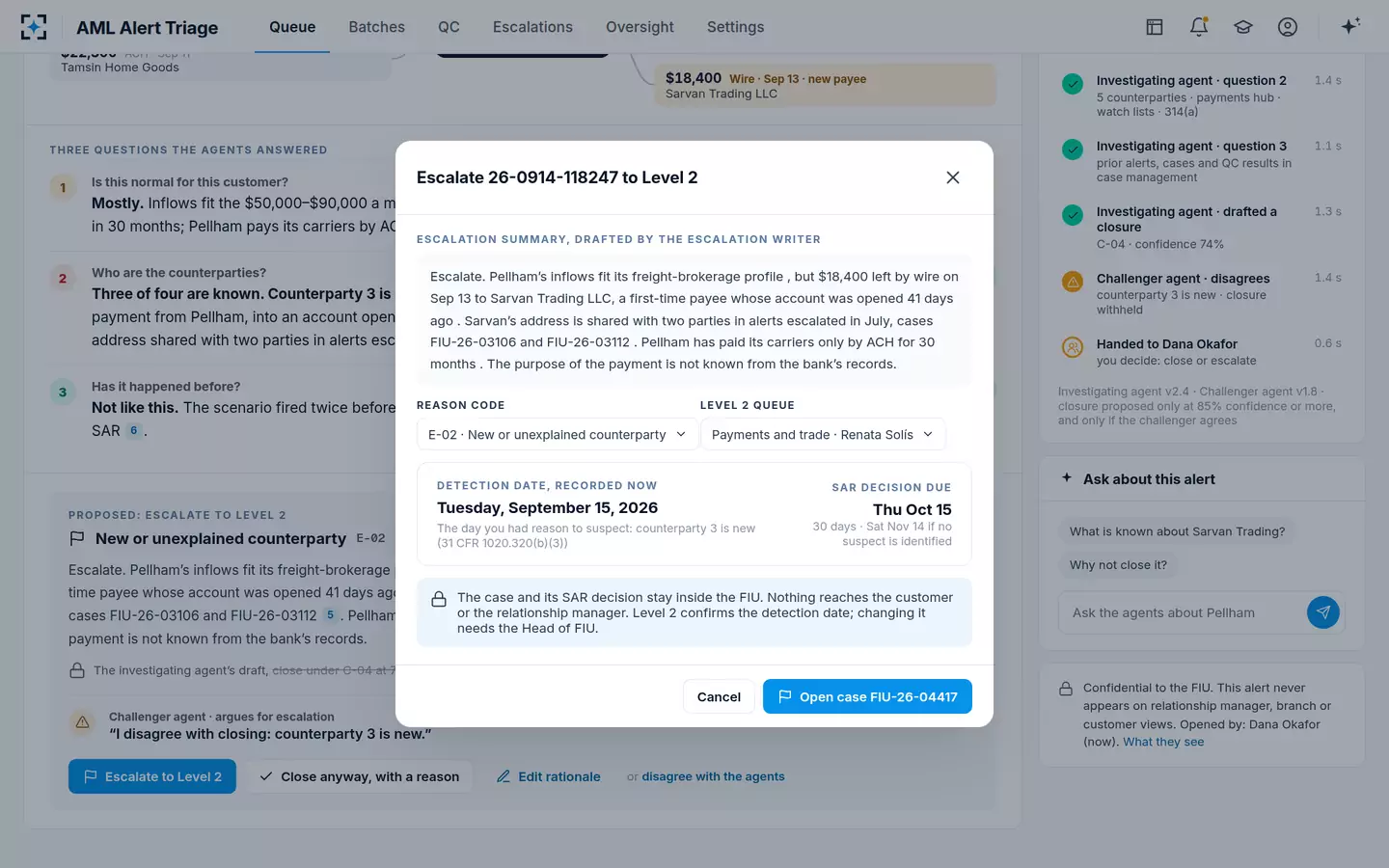
Level 1 decides whether an alert deserves investigation; Level 2 investigates and recommends whether to file. The split is a staffing convention, and the FFIEC notes that smaller banks may have one or two people do several tasks, from reviewing monitoring reports to completing the SAR. What the split must not lose is the date. The SAR rule gives 30 calendar days from "the date of initial detection of facts that may constitute a basis for filing" (31 CFR 1020.320(b)(3)), and the FFIEC says an alert firing is not that date; the clock starts once a review determines the activity is suspicious.
That makes the escalation a timestamped decision, not a transfer. At the sample bank, the Level 1 analyst records a proposed detection date with a reason at escalation, Level 2 confirms it or asks to change it with a reason, and the head of the FIU approves any change. The SAR filing timeline, worked on one case follows that date to the filing decision.
An escalation carries its detection date and the reason for it
Quality control: checking the closures that matter
QC exists because the closure is the decision examiners can test after the fact, and a closure with no reason, or a reason the evidence contradicts, is a finding. Effective sampling is risk-weighted rather than flat: the sample bank checks 5% of closures weighted by risk, 20% of those signed in batches, every closure by an analyst in their first 60 days, and every closure made against the challenger agent's objection.
The QC analyst's work changes when each sampled closure arrives pre-checked against its evidence. In one sample case, the pre-check flagged a rationale claiming every counterparty was known when one had first been paid 17 days before the alert. The QC analyst reopened it with a reason, and it went to a different analyst. No analyst checks their own work. What a closed alert must show an examiner sets out the written reason item by item.
What do examiners test in the alert review process?
The process, by pulling alerts. The FFIEC directs examiners to judge whether the bank's SAR decision-making process is effective rather than second-guess single calls, and the OCC's community bank procedures, in force for examinations from February 2026, name a sample of suspicious activity alerts and a conversation with staff about the investigation process among the tests (OCC Bulletin 2025-37). The FFIEC also expects staffing in proportion to the bank's risk profile and transaction volume, and training that is thorough and ongoing.
What an examiner pulls, and what the file should show
| Examiner question | Weak answer | Strong answer |
|---|---|---|
| Was each alert reviewed in a reasonable time? | Average age only | Age by risk band against written service levels, with named owners of late alerts |
| Why was this alert closed? | Free text: "activity consistent" | Reason code, cited evidence, the analyst's attestation |
| Are like alerts closed alike? | Not measured | Closure reasons by scenario and analyst, with outliers reviewed |
| When did the bank detect the activity? | Reconstructed at SAR time | Recorded at escalation with a reason; changes approved |
| Is the desk staffed for its volume? | Headcount | Minutes per alert, capacity against arrivals, backlog trend |
| Were staff diverted? | Not tracked | Hours by activity, so loans to fraud work are visible |
The last row comes from the OCC itself, which warned in 2025 that some banks were lending BSA staff to other risk work, such as fraud investigations, in ways that could disrupt the continuity of BSA operations (OCC Semiannual Risk Perspective, Spring 2025). One expectation was relaxed: the October 2025 SAR FAQs confirm a bank need not document a decision not to file a SAR, and that a short statement usually suffices where it does (FinCEN SAR FAQs, October 2025). That is about the filing decision; a Level 1 closure still needs its reason under most banks' procedures.
Where agents change the arithmetic, and where they must not
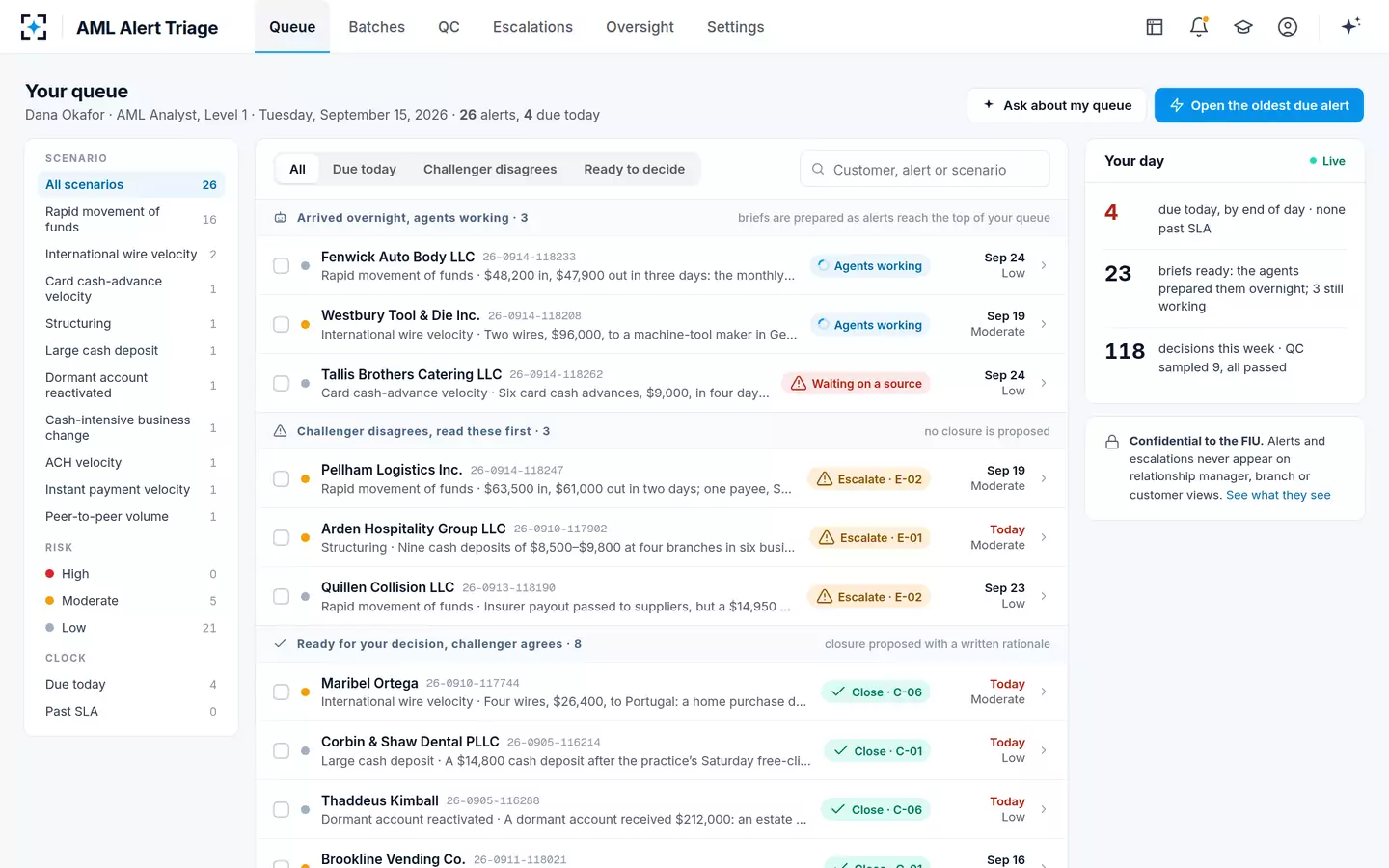
Agents change the minutes per alert by doing the gathering; they must not change who decides. In AML Alert Triage the investigating agent answers the three questions with a citation for every statement, the challenger argues for escalation and cannot be switched off, and a named analyst closes or escalates. Like alerts can be signed as a batch only when scenario, reason code, evidence and risk all match, only for low and moderate risk, and never more than 25 at once.
The analyst's queue, sorted by what the agents found
The result, on the sample data, is a desk that has capacity to spare rather than one running at 96%. What a bank does with that capacity is a management choice: absorb growth, tune scenarios with the evidence the closures produce, or redeploy people to Level 2. The AML operating model with agents works through those choices, and threshold tuning covers turning repeated closures into evidence for tuning.
Questions people ask
How many alerts should an AML analyst clear per day?
No regulation sets a number. It follows from minutes per alert at the care the bank's procedures require; at a 38-minute median by hand, about nine or ten a day. FinCEN has penalised a bank whose analysts cleared 100 a day without reading the supporting documents.
What is the difference between Level 1 and Level 2 alert review?
Level 1 triages alerts and closes or escalates each one; Level 2 investigates escalations and recommends whether to file a SAR. The split is a convention, not a legal term, and smaller banks often combine both in one or two people.
Does an alert start the SAR 30-day clock?
No. The FFIEC says the period starts when a review determines the activity is suspicious, not when the system flags it. Banks still record that determination with a date and reason at escalation, because a late SAR is judged against it.
What service levels do banks set for alert review?
Banks set their own, usually by risk band. The sample bank in this guide gives high-risk alerts 3 calendar days, moderate 5 and low 10, and sends anything late to a team lead. The FFIEC asks for a reasonable period under written procedures that are followed.
How much of an alert review can be automated?
The gathering: profile, statements, counterparties, screening and prior alerts. On the sample data, that took the median alert from 38 minutes to 4.1. The decision, the attestation and the detection date stay with named people, and QC checks a risk-weighted sample.
What causes AML alert backlogs?
Volume growing faster than the minutes available to review it: too few analysts, a scenario that misfires, a new monitoring system, or staff lent to other work. FinCEN orders describe all four, including a 17-month backlog after one scenario failed and over 70,000 backlogged alerts at another bank.