An AML operating model is the design of a bank's suspicious activity program as work: which steps exist, who performs each, who decides, how decisions are checked, and how the whole is staffed and measured. Adding AI agents to it is a decision-rights question before it is a technology question. The rules put the judgement on whether activity is suspicious, the date the bank first suspected it, and the duty to keep it confidential on the bank and its people; examiners test how those people decide. What agents can take is the gathering that fills most of a Level 1 analyst's day. Botminds' AML Alert Triage is built on that split: agents assemble and cite the evidence for each alert and argue for escalation, and a named analyst closes or escalates every one, with QC, Level 2 and the head of the financial intelligence unit each keeping their decisions.
This guide is for the BSA officer and the head of the FIU who own the design, and the chief compliance officer who answers for it to the board. The worked figures come from a fictional US regional bank with about 42,000 alerts a month and 220 Level 1 analysts, as it runs through the solution.
Decision rights in an AML operating model with agents
| Step | Agents may | People decide | Who |
|---|---|---|---|
| Gather evidence for an alert | Pull profile, statements, counterparties, screening and prior alerts, each cited | Whether the evidence is enough | Level 1 analyst |
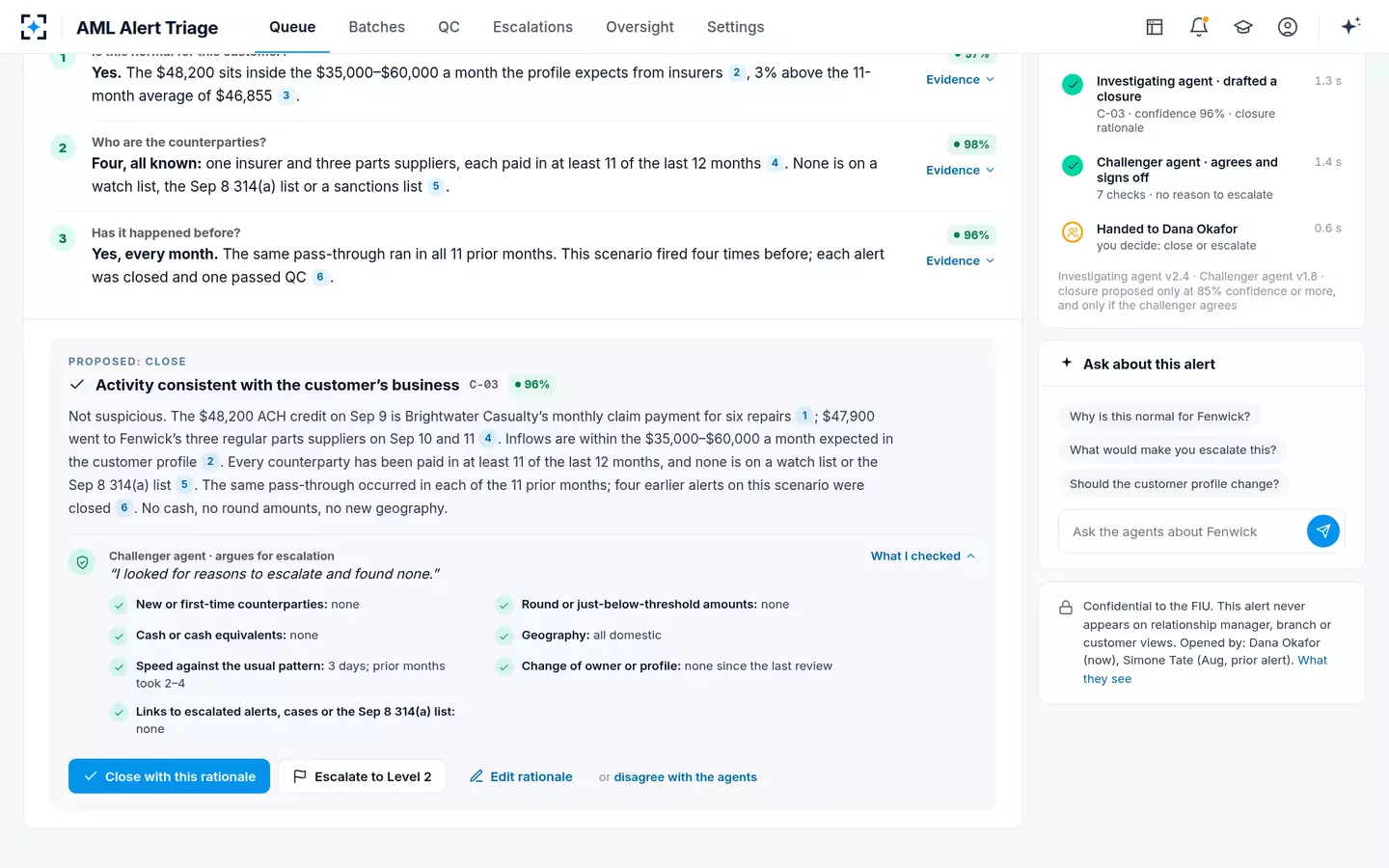
| Propose a disposition | Draft a closure at 85% confidence or more, or an escalation | Close or escalate, with an attested rationale | Level 1 analyst |
| Challenge a closure | Argue for escalation; withhold the proposal if it finds a reason | Override the challenger, with a reason QC always checks | Level 1 analyst |
| Record the detection date | Propose the date and its reason at escalation | Confirm it; approve any change | Level 2; head of FIU |
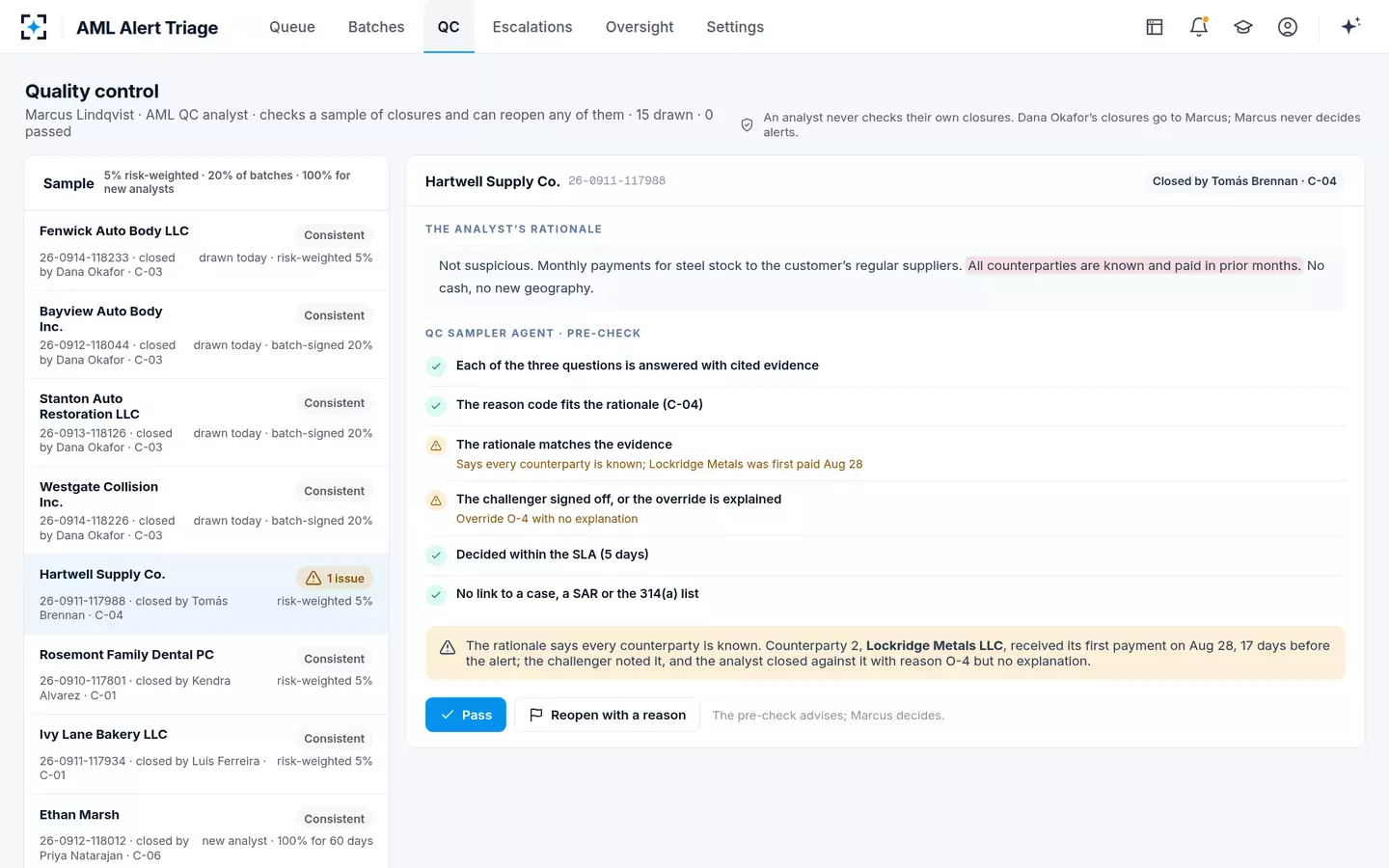
| Check quality | Pre-check sampled closures against their evidence | Pass or reopen, with a reason | QC analyst |
| Decide to file a SAR | Assemble the case file and draft | File or not | Named decision maker or committee |
| Change thresholds or settings | Propose tuning from repeated closures | Approve, with a new version | Head of FIU; BSA officer |
What is an AML operating model?
It is the bank's answer to the FFIEC's expectation that procedures name who is responsible for each part of suspicious activity monitoring: producing alerts, managing them, deciding whether to file, completing and filing, and monitoring continuing activity (FFIEC BSA/AML Examination Manual). A target operating model adds the rest of what makes it run: the levels and teams, their service levels, the escalation paths, the quality checks, the data each seat needs, and the measures management watches.
The FFIEC also says what an examiner will test. The decision to file is "an inherently subjective judgment," and examiners are directed to judge whether the bank's decision-making process is effective rather than second-guess single calls. An operating model is therefore graded on its process: whether each decision has an owner with the authority, the evidence and the time to make it, and whether someone checks.
Where the FIU sits, and who checks it
The program rule fixes two roles that any operating model must place: "designation of an individual or individuals responsible for coordinating and monitoring day-to-day compliance," usually the BSA officer, and "independent testing for compliance to be conducted by bank personnel or by an outside party" (31 CFR 1020.210(a)(2)). Everything else, including where the financial intelligence unit reports, is the bank's design.
A common design places alert review and investigations under the BSA officer within compliance, with the business lines that open and serve accounts responsible for customer due diligence and referrals, and internal audit or an outside firm performing the independent test. Some large banks put Level 1 review in a first-line operations function, with compliance setting the procedure and checking the output. Either can work. What fails is a design where the same unit sets the procedure, performs the work and grades it, because then no one outside the work has seen whether the decisions hold up.
Agents add a fourth question: who owns them. In a defensible model the FIU head owns each agent's job description and settings, as part of the procedure; technology owns its operation; and the independent tester reviews agent outputs the same way it reviews analyst decisions, by sampling closures and escalations and reading the evidence behind each. An agent that no one in the FIU can describe in its own words is not under the FIU's control.
Which decisions must stay with people?
Three, under the rules as they stand. The judgement that activity is suspicious, which the SAR rule places on the bank when it "knows, suspects, or has reason to suspect" (31 CFR 1020.320) and the FFIEC expects procedures to assign to named people or a committee. The detection date, because the 30-day filing period runs from initial detection, which the FFIEC treats as a determination after review, not the moment an alert fires. And confidentiality, because a SAR and "any information that would reveal the existence of a SAR" may not be disclosed, which makes the people handling alerts accountable for what leaves the FIU.
The Wolfsberg Group, an association of global banks that publishes financial crime standards, puts the accountability point plainly: institutions "are responsible for their use of AI/ML, including for decisions that rely on AI/ML analysis, regardless of whether the AI/ML systems are developed in-house or sourced externally" (Wolfsberg Principles for Using AI and ML in Financial Crime Compliance). Its five principles add proportionate use, design and technical expertise, openness and transparency, and a legitimate purpose. None of them contemplates software deciding alerts on its own.
Nothing in the 2025–26 regulatory direction changes that. FinCEN's April 2026 proposed program rule encourages innovation but names no required technology, accepting that new tools will not suit every institution (FinCEN, proposed AML/CFT program rule, April 2026; the guide to the proposed program rule covers it). A bank that let agents decide alerts would be answering for those decisions with no supervisory framework to point to.
The seats in the model, before and after agents
Every seat keeps its decision and loses most of its fetching. The people below are the ones an examiner will interview; what changes is how they spend the day.
Five seats in the AML operating model, and what each keeps
Today
Nine or ten alerts a day, each a search across four or five systems before any judgement starts.
With agents
Opens each alert with three cited answers, a proposed decision and a challenger's objections.
Still theirs: Closing or escalating every alert, and the rationale under their name
Today
Re-reads a flat sample days later against a general checklist.
With agents
Works a risk-weighted sample, each closure pre-checked against its evidence.
Still theirs: Passing or reopening, and coaching
Today
Rebuilds the facts of each escalation and works out when the bank first suspected.
With agents
Receives the summary, the evidence and the detection date recorded at escalation.
Still theirs: The investigation, the SAR recommendation, confirming the date
Today
Balances queues from spreadsheets; learns of late alerts after the fact.
With agents
Sees ageing by scenario and risk, and owns every alert past its service level.
Still theirs: Assignment and escalation
Today
Learns about backlogs and inconsistencies from monthly reports and QC findings.
With agents
Sees decisions, overrides and queue age daily, with tuning proposals backed by closures.
Still theirs: The procedure, date changes, tuning approval, the examiner conversation
How the work mix changes, and what that does to staffing
At the sample bank, a time study of 1,150 alerts found a 38-minute median by hand, of which 6 minutes went on deciding and writing. With the evidence assembled and cited, the median on the sample data was 4.1 minutes, of which 1.5 went on deciding and 2.6 on checking the evidence. Deciding goes from about a sixth of each alert to more than a third.
Agents take the gathering; deciding becomes a larger share of each alert
By hand, median 38 min
- Gathering facts · 84%
- Deciding and writing · 16%
With the evidence assembled, median 4.1 min
- Checking the evidence · 63%
- Deciding and writing · 37%
What a bank does with the freed time is the operating model's real choice. At about 2,000 alerts a working day, the sample bank's 220 analysts run near full capacity by hand. On the sample data the same alerts need a small fraction of that time. A bank can absorb alert growth without hiring, move experienced analysts to Level 2 and QC where judgement is scarcest, invest in tuning, or reduce reliance on contractors. The AML alert review process works the capacity arithmetic step by step.
What regulators have penalised: thin desks, not tools
The enforcement record behind this question describes banks with too few skilled people, and none of it penalises a bank for giving analysts better tools. USAA Federal Savings Bank had assessed that it needed 178 permanent positions; "As of early 2021, the Bank had 62 vacant positions, including the head of the Bank's Financial Intelligence Unit (FIU)," and it "supplemented approximately 76% of its compliance staffing needs with third-party contractors" (FinCEN, USAA FSB). Shinhan Bank America "had five different BSA compliance officers in 2019 alone" (FinCEN, Shinhan Bank America, 2023). At TD Bank, the 2018 backlog passed 70,000 detection alerts (FinCEN, TD Bank, 2024).
The bank's BSA Officer and staff lacked sufficient skills and expertise to effectively manage the bank's BSA/AML program.
OCC, News Release 2026-89, on Bank of America, October 13, 2026
That October 2026 action carried a $750 million penalty, which the OCC called the largest in its history, and it found the bank "knew for years that it was failing to escalate potentially suspicious activities to investigators." The OCC had warned in 2025 that some banks were moving BSA staff into fraud work in ways that could disrupt BSA operations (OCC Semiannual Risk Perspective, Spring 2025). The lesson for the operating model is that expertise is the scarce input. A design that uses agents to stretch thin staff further, rather than to put skilled people where judgement is needed, repeats the failure in a new form.
The controls that keep agents inside the model
Agents become part of the control environment, so they need controls of their own. The Wolfsberg principles ask that "the severity of potential financial crimes risk should be appropriately assessed against any AI/ML solutions' margin for error," and that institutions validate "the use and configuration of AI/ML regularly." In practice that means each agent's job and limits are written down, every statement is traceable to its source, a second agent argues the other side, people check a sample, and changes go through the same approval as any other procedure change.
Two ways to add AI to alert review, and which one an examiner can test
AI as a decider: A score below a cut-off, unseen by anyone
AI as an evidence assembler: A named analyst, with an attested rationale
AI as a decider: A score and a model version
AI as an evidence assembler: Three cited answers, the challenger's checks, the decision
AI as a decider: Below-the-line testing after the fact
AI as an evidence assembler: QC on a risk-weighted sample, all overrides checked
AI as a decider: Implicit in the score's timestamp
AI as an evidence assembler: Recorded at escalation with a reason, confirmed by Level 2
AI as a decider: Diffuse across model owners
AI as an evidence assembler: Named person on every decision
Controls an AML operating model needs before agents go live
- A written job and limits for each agent
What it reads, what it may propose, what it must never do.
- A citation for every statement
Each value opens its source in the system of record; opening it is logged.
- A challenger that cannot be switched off
No closure is proposed until a second agent has looked for reasons to escalate.
- Confidence floors and batch limits as settings
Proposals only above the floor; batches only for like, lower-risk alerts.
- Risk-weighted QC, including every override
And no one checks their own work.
- Versioned prompts and models, tested before release
A new version runs on past alerts and its results are compared before it goes live.
- Need-to-know access and no tipping off
Nothing about alerts or cases reaches relationship manager, branch or customer views.
- Five-year retention of every action
Who, what, when, why and which evidence, under 31 CFR 1010.430.
The proposal and the challenger, before the analyst decides
A vendor's agent is still the bank's control
Buying agents rather than building them moves the work, not the responsibility. The Interagency Guidance on Third-Party Relationships (Federal Reserve, FDIC and OCC, June 7, 2023) states that "a banking organization's use of third parties does not diminish its responsibility to meet these requirements to the same extent as if its activities were performed by the banking organization in-house." For suspicious activity monitoring, the requirements are the SAR rule, the program rule and the confidentiality rule, so an agent supplied by a vendor is held to the standard of the analyst it supports.
The guidance organises the relationship as a life cycle: planning, due diligence and selection, contract negotiation, ongoing monitoring, and termination. For agents in alert review each stage has a concrete question. Due diligence: can the vendor show how each statement an agent makes is traced to its source, and how a new model version is tested before release? Contract: does the bank receive notice before any change to the models or prompts that touch its alerts, and keep the right to test the change on its own past alerts first? Monitoring: which measures does the bank receive, at what frequency, and can it reproduce them from its own trail? Termination: does every rationale, citation and decision stay with the bank in a form it can read without the vendor's software, for the five years 31 CFR 1010.430 requires?
Confidentiality deserves its own line in the contract. Alert and case data can reveal that a SAR exists, so the bank should know where that data is processed, who at the vendor can see it, and whether any of it is used to train models that serve other customers. A vendor that cannot answer those three questions in writing has not yet earned a place in the FIU.
How should a bank sequence the change?
Prove it on past alerts, then on a slice of live work, then widen; move each seat's work only when its checks are in place. The order matters because the model is examined as a process, and a bank needs evidence at each stage that decisions are as good or better than before.
A rollout sequence for agents in alert review
| Stage | What runs | Evidence before moving on |
|---|---|---|
| 1. Back-test | Agents run on a past month of closed and escalated alerts, with no live effect | Agreement with past decisions by scenario; every disagreement read by QC |
| 2. Shadow | Agents prepare briefs on live alerts; analysts work as before and compare | Citation accuracy, challenger catch rate, analyst feedback |
| 3. One scenario, one team | Analysts decide from the briefs on a low-risk scenario | QC pass rate, overrides, time per alert, no rise in late alerts |
| 4. Widen by risk band | More scenarios and teams; batches for like, low-risk alerts | Same measures by band; tuning proposals reviewed |
| 5. Redeploy capacity | Freed time moved to Level 2, QC or tuning by plan | Backlog, escalation quality and SAR timeliness trends |
Each stage leaves an artefact an examiner can read: the back-test comparison, the shadow results, the QC record. Agentic AI for transaction monitoring traces one alert through every agent step, and transaction monitoring software for banks covers what to keep from the existing engine.
Service levels built backwards from the 30-day clock
The only deadline in the rules is the SAR's: no later than 30 calendar days after initial detection of facts that may constitute a basis for filing, extendable by 30 more only to identify a suspect (31 CFR 1020.320(b)(3)). Every internal service level in the operating model is a share of that budget, or a protection of the moment before it starts, so the sensible way to set them is backwards from filing.
An illustrative budget for a regional bank, to show the method rather than a rule:
- Level 1: an alert decided within five business days of generation, with any alert past ten owned by the team lead by name. This protects the detection date, because an alert that sits unread can hold facts the bank will later be judged to have had.
- Hand-off: an escalation accepted by Level 2 within two business days, with the proposed detection date confirmed at acceptance.
- Investigation: a recommendation by day 20 of the clock, with any case past that point escalated to the FIU manager.
- Decision and filing: the decision maker's approval by day 25, leaving five days for the filing team to complete and submit.
Two design rules follow. Service levels are measured on the oldest items, not the average, because the average hides the cases that miss. And the levels are reviewed whenever alert volume or mix changes, since a Level 1 target that held at 2,000 alerts a day can break at 2,400 with the same staff. Agents change the arithmetic of the first step most; the later steps still depend on the number of investigators and approvers, which is why freed Level 1 time is often best spent there.
Measures the FIU head should watch
The operating model is working if decisions stay sound while time per alert falls and nothing ages. The useful measures are the ones that would show the opposite first: overrides of the challenger rising, QC reopen rates by analyst or scenario, the share of alerts past service level, the time from escalation to Level 2 acceptance, changes to detection dates, and late SARs. Each can be read from the trail the solution keeps, without a separate survey.
Quality control: closures pre-checked, the decision still a person's
Questions people ask
What is a target operating model in AML?
It is the designed future state of the AML program as work: the steps, levels and teams, who decides what, service levels, escalation paths, quality checks, data and measures. It turns the FFIEC's expectation that procedures name who is responsible for each part of suspicious activity monitoring into an organisation that can be staffed and tested.
Can AI close AML alerts without a person?
A bank can configure tools to suppress or auto-close, but it remains responsible for each decision, and examiners test the decision-making process. AML Alert Triage is built so that a named analyst closes or escalates every alert and nothing is suppressed.
Will AI reduce AML headcount?
It reduces the minutes each alert needs; whether that reduces headcount is the bank's choice. The enforcement record suggests skilled capacity is scarce, so many banks will redeploy freed time to Level 2, QC and tuning rather than cut it.
Who is accountable if an agent gets an alert wrong?
The bank, and within it the person who decided. That is why the model records which statements came from agents and which from people, keeps a named analyst on every decision, and has QC check every closure made against the challenger.
How should a community bank apply this model?
With fewer seats but the same decisions. One or two people may cover Level 1, Level 2 and QC, so the controls that matter most are a challenger on every closure, a recorded detection date and an independent periodic review of a sample of closures.
Do regulators require banks to use AI in AML?
No. FinCEN's April 2026 proposed program rule encourages innovation but names no required technology. What examiners require is an effective process with clear decision rights and sufficient skilled staff, whatever tools support it.