AI in AML transaction monitoring covers three different jobs: detecting unusual activity, deciding which alerts a person sees and in what order, and helping the person who reviews them. The first two decide what gets looked at; the third decides how well it gets looked at. The most expensive failure in the public record, Bank of America's, came from the second job done badly: an automated scoring layer that rescored and suppressed alerts with weights nobody had adequately tested, so reportable activity never reached an investigator. This guide sets out how AI is used today, what went wrong there, what regulators have said, and how to validate any score that stands between an alert and a person. Botminds' AML Alert Triage takes the third path: agents add cited reasons to every alert, a challenger argues for escalation, and nothing is hidden from the analyst who decides.
Two uses of AI on the alert queue, and what each risks
AI that decides what people see: Scores it, then rescores, suppresses, groups or delays it below a review line.
AI that explains what people see: Gathers the evidence, answers fixed questions with citations, proposes a disposition.
AI that decides what people see: Only alerts above the line; the rest may never reach a person.
AI that explains what people see: Every alert reaches a named analyst.
AI that decides what people see: Silently: reportable activity scored too low is never investigated.
AI that explains what people see: Visibly: a wrong rationale sits on the screen, where a challenger, the analyst and QC can see it.
AI that decides what people see: Below-the-line sampling against a false-negative tolerance set in advance.
AI that explains what people see: Back-testing proposals on closed alerts; QC sampling; counting overrides by reason.
AI that decides what people see: Bank of America: about 150,000 alert groups touched by rescoring logic when it was removed in 2023.
AI that explains what people see: Every decision with its evidence, challenger view and decision-maker, kept five years.
How is AI used in AML transaction monitoring?
Banks use AI in monitoring to detect anomalies and networks, to score and prioritise alerts, and increasingly to help investigators gather and summarise evidence. Treasury's December 2024 report recorded respondents describing AI used "for AML/CFT and sanctions compliance, including analyzing large sets of data, detecting anomalies, flagging suspicious activities, and verifying customer identities under Bank Secrecy Act (BSA) obligations" (US Treasury, AI in Financial Services, 2024). An earlier Treasury study found institutions using "graph-based analytics to, among other use cases, detect anomalous and suspicious activity and flag for further investigation", while stressing that a person still has to verify what the analytics flag (US Treasury, March 2024).
The Wolfsberg Group describes the main architectures: machine-learning algorithms "may be used as booster models to augment a rules-based system, or, in some cases, be used as the primary detection tool itself", and can also provide "secondary name screening to reduce false positives" or "auto-populate case management systems" (Wolfsberg Statement on Effective Monitoring, 2024). The federal agencies listed the same use in their 2021 request for information on AI: "identifying transactions for Bank Secrecy Act/anti-money laundering investigations" (Interagency RFI on AI, March 2021).
The distinction that matters for risk is not rules versus machine learning. It is whether the AI's output decides which alerts a person ever sees.
What went wrong at Bank of America: a score that hid alerts
Bank of America's "Event Processor", first implemented in 2010 through a "proof of concept", scored every alert with weighted risk factors, grouped them by customer, and sent a group to an investigator only when its combined score reached 20 points. It was built to solve a staffing problem, in the bank's own words quoted by FinCEN and set out below (FinCEN, Bank of America consent order, October 2026). The system was a weighted scoring model rather than machine learning, which is exactly why its lesson applies to any score.
FinCEN found the weights "largely unsubstantiated", with no consistent relation to how often each kind of alert led to a SAR. Among 14 alert types, one with a SAR yield of 30.03% carried a weight of 6 points, while another with a similar yield of 27.69% carried only 2. Risk factors such as high intensity drug trafficking areas and cash structuring carried 1 point each despite SAR yields above 50%.
Worse, the system could make alerts disappear. It "automatically 'rescored' some risk factors to zero", and these rules were developed "in an 'ad-hoc and subjective fashion.'" Suppression lists were created because "events generated on these entities would be considered false positives which would create noise within investigation cases". When the bank removed the logic in December 2023, about 150,000 alert groups had triggered it. Its own 2022 validation report had already shown rescored risk factors with high SAR yields.
Risk factors Bank of America rescored to zero, and how often they actually led to SARs
The result was a $1.2 billion FinCEN penalty, with $750 million credited to the OCC's own penalty, "the largest in OCC history" (OCC, October 2026), and a lookback that found nearly 8,900 unfiled SARs on almost $4 billion of activity. The OCC added that "more than a year after the 2024 Order, the bank still failed to escalate potentially suspicious activities to investigators for review."
There were not enough investigators to work all of the alerts that were being generated by detection channels.
FinCEN, quoting Bank of America's records, Consent Order No. 2026-03
Can AI suppress AML alerts?
No rule forbids it, but a suppressed alert is a decision not to investigate, and the bank must be able to show it was right. That means testing the suppression the way a threshold is tested: sampling what was suppressed, working the sample, and comparing the result with a tolerance for missed activity set in advance. Bank of America did not; its "tests of EP did not include specific coverage of these rescoring rules".
Some suppression collides with the regulations directly. The bank rescored structuring alerts to zero for customers on its currency transaction report exemption list. The exemption rule states that it leaves a bank's SAR obligations entirely intact (31 CFR 1020.315(h)). An exemption from one report is not an exemption from monitoring.
Imprecise models cost customers too. Treasury recorded one respondent's view that "the use of imprecise AI models to detect suspicious activity has led to an increase in improperly closed bank accounts, and that banks do not have processes to appeal the decision or require timely return of frozen funds" (US Treasury, 2024). That is one respondent's claim, not a Treasury finding, but it names the second kind of harm a score can do when no person reviews it.
What did regulators say about AI in AML?
US regulators have encouraged AI in AML since 2018 while leaving banks to govern it. The statements have shifted in 2024 to 2026, and several pages online still describe documents that have since been withdrawn or rescinded.
What US regulators have said about AI in AML monitoring, and the status of each
| When | Document | What it says about AI | Status, October 2026 |
|---|---|---|---|
| Dec 2018 | Joint statement on innovative efforts (Fed, FDIC, FinCEN, NCUA, OCC) | AI that finds more will not be assumed to show old processes deficient; pilots are not grounds for criticism | In force |
| Mar 2021 | Interagency request for information on AI | Names flagging transactions for BSA/AML investigations as a use case | Request only; no rule followed |
| Apr 2021 | Interagency statement on model risk for BSA/AML systems | How BSA/AML systems may or may not be models; coverage over efficiency | Rescinded April 17, 2026 |
| Jul 2024 | FinCEN AML/CFT program proposal | Machine learning or AI as a way to reduce false positives | Withdrawn April 2026 |
| Dec 2024 | Treasury report on AI in financial services | AI widely used for AML/CFT; one respondent links imprecise models to wrongly closed accounts | Report |
| Feb 2026 | Treasury Financial Services AI Risk Management Framework | Voluntary framework adapting NIST’s to banks of every size | Voluntary |
| Apr 2026 | FinCEN AML/CFT program proposal and agency companions | Names machine learning and GenAI; no added enforcement risk solely for responsible use | Proposed; comments closed June 9, 2026 |
| Apr 2026 | Revised model risk guidance (OCC 2026-13, SR 26-2, FDIC) | Statistical models in scope; generative and agentic AI out of scope; AI request for information planned | In force; request not yet published |
Read together, the documents say three things. Banks may use AI and should not be penalised for trying it responsibly; the 2018 statement adds that adopting an innovative approach does not, of itself, raise what supervisors expect of the bank's BSA/AML program (Joint Statement, 2018). A statistical score that affects which alerts are investigated is a model, subject to model risk management where that guidance applies. And the newest forms, generative and agentic AI, have no supervisory framework yet. Agentic AI for transaction monitoring follows what that gap means for an agent-assisted alert.
Is machine learning allowed for transaction monitoring?
Yes. The FFIEC manual has described adaptive "intelligent" monitoring systems for years, the 2018 joint statement encourages AI-based monitoring, and FinCEN's April 2026 proposal would name machine learning among innovative approaches whose responsible use carries no extra enforcement risk. What is required is evidence that it works for the bank's risks, and governance proportionate to what it decides.
The Wolfsberg Group's principles set the bar plainly: weigh the severity of the financial crime risk against the AI tool's margin for error (Wolfsberg Principles for AI and ML in Financial Crime Compliance, 2022). A model that orders the queue can tolerate a wide margin, because every alert is still worked. A model that removes alerts can tolerate very little, because its errors are invisible. The Wolfsberg statement of 2024 adds that banks "will need to document clearly and analyse ML models against the crystallised outcomes of detection to demonstrate how these solutions can continue to mitigate financial crime risk".
How do you validate an AI alert score?
Validate it against what it is allowed to change. If a score only orders the queue, test that high scores really are riskier. If it can delay, group or suppress, test what happens below its line, with a tolerance set before the test. Bank of America's failures map almost one-to-one onto the steps below.
Validating an alert score that can decide what people see
- Ground every weight in evidence
Weights tied to measured outcomes such as SAR yield by risk factor, not “stakeholder judgment”; Bank of America’s were not.
- Set a false-negative tolerance first
The share of reportable activity the bank accepts below the line, approved before testing.
- Sample below the line, far enough
Have investigators work alerts the score kept from review, and compare their SAR yield with the tolerance.
- Test every suppression and rescoring rule
Each needs its own sampled test; Bank of America’s tests did not cover its rescoring rules at all.
- Check legal carve-outs
No suppression for CTR-exempt customers’ structuring alerts; exemptions do not reach SAR duties.
- Watch for drift
Re-test as yields move; Bank of America’s below-the-line yields rose for years before it acted.
- Make overrides and outcomes visible
Report what the score kept from people, and what it would have found, to the BSA Officer and the board.
- Act on findings
A validation finding without a dated remediation is a record of knowledge, which is how FinCEN read Bank of America’s.
The threshold side of this work, including above- and below-the-line testing, is in transaction monitoring threshold tuning. Whether a vendor's claimed reduction in false positives means anything is a separate question, taken up in AML false positive rates.
What to ask an AI transaction monitoring vendor
Ask what the AI is allowed to change, then ask to see the evidence for that change on your own data. Can its output remove, delay or group an alert so that no person reviews it, and if so, what does below-the-line testing on your closed alerts show? Can every score or recommendation be explained in terms an examiner would accept, with the data behind it? What happens to customers it flags: who decides on any action, and how is a wrong decision reversed?
Then ask how it is governed after go-live: who can change a weight, a threshold or a prompt; how changes are versioned and approved; how performance is monitored for drift; and what the export to an examiner contains. Treasury's voluntary Financial Services AI Risk Management Framework, released in February 2026, gives a structure for those questions that adapts the NIST framework to banks (US Treasury, 2026). A vendor that can answer them on screen has thought about the Bank of America case. One that answers with a false-positive reduction percentage has not.
Where Botminds' AML Alert Triage stands: reasons on every alert, nothing hidden
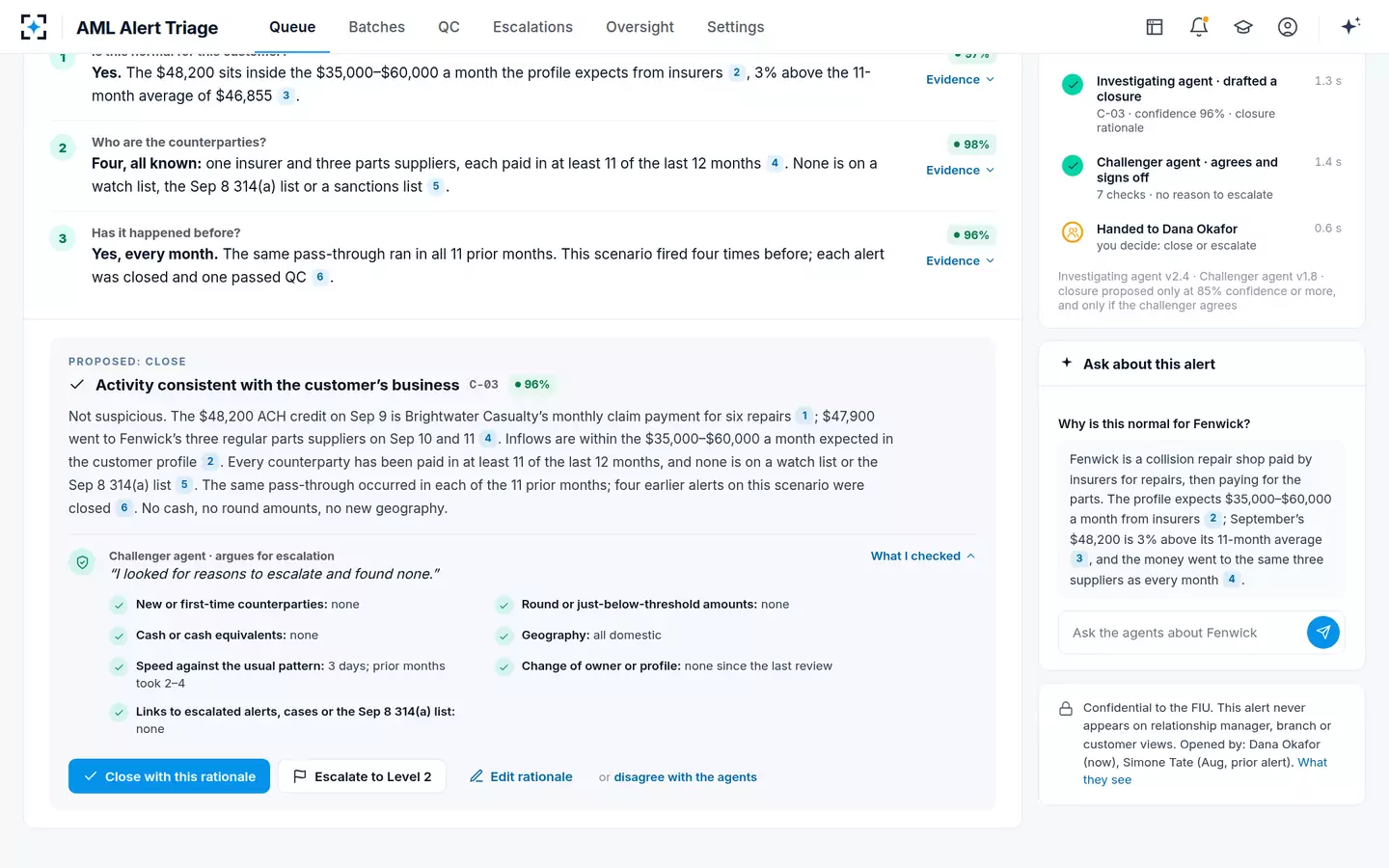
Botminds' AML Alert Triage uses AI only on the third job: helping the person who decides. Every alert the monitoring system produces reaches a named Level 1 analyst. An investigating agent answers three questions with citations, is this normal for this customer, who are the counterparties, has it happened before, and drafts a disposition; it proposes a closure only at 85% confidence or more. A challenger agent on a separate model family looks for reasons to escalate and must agree before any closure is proposed. The agents never change an alert, its score or its scenario.
Take the sample bank in Botminds' sample data, Corvane National Bank, a fictional regional bank with about 42,000 alerts a month. An analyst looking at a rapid-movement alert on Fenwick Auto Body LLC can ask the agents directly why the activity is normal for this customer, and the answer comes from the alert's own evidence, with citations she can open.
The analyst asks why, and the answer cites the alert's own evidence
Each citation opens the source. The customer profile's expected-activity passage, read by the investigating agent read-only, appears with the question it answered, and opening it is logged. If the profile needs to change, the agents draft the update for the KYC team's own approval rather than editing it.
A citation opens the passage in the system of record
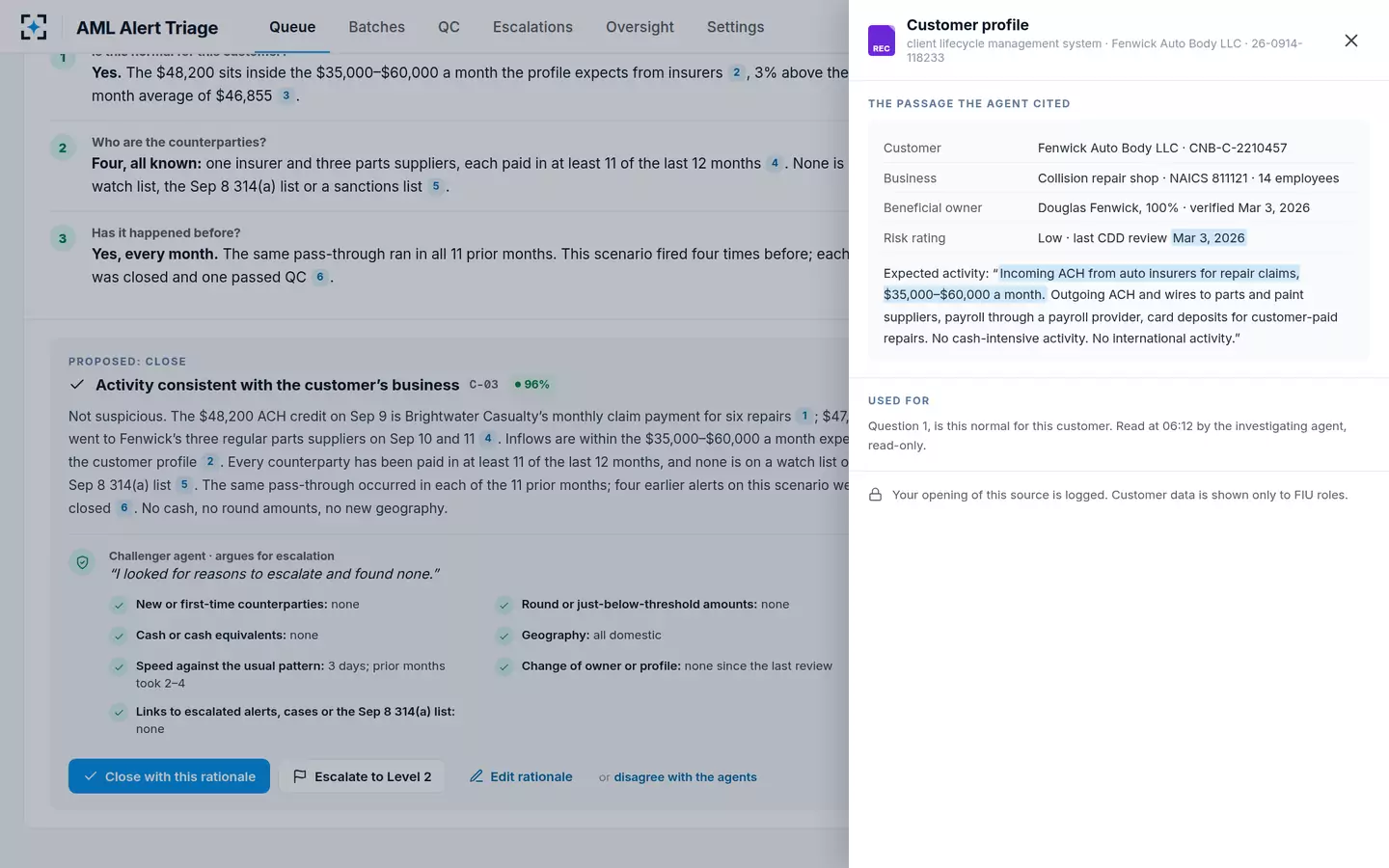
The design follows from the Bank of America case. A score that hides alerts fails silently; a rationale on the screen fails where people can see it. Faster review of every alert, rather than fewer alerts reviewed, is how the solution aims to take the staffing pressure that built the Event Processor without inheriting its risk.
Questions people ask
What is AI-driven transaction monitoring?
Monitoring in which statistical or machine-learning models, rather than only fixed rules, decide what activity alerts or how alerts are prioritised. The FFIEC calls these intelligent systems; they learn from customer history or peer groups, and where they are statistical models they fall under model risk management.
Was Bank of America's Event Processor artificial intelligence?
FinCEN describes it as an interconnected model system that scored alerts with weighted risk factors, not as machine learning. Its lesson applies to any score, AI or not, that decides which alerts reach investigators.
Does using AI in AML increase regulatory risk?
Not by itself, on the agencies' stated position; FinCEN's April 2026 proposal would say so in regulation. The risk comes from untested decisions made by the AI, as Bank of America's untested rescoring shows.
Should AI scores be used to auto-close AML alerts?
Only with the testing a threshold gets, including below-the-line samples against a tolerance set in advance, and with the bank able to explain each closure. Many banks instead use scores to order the queue, which leaves every alert reviewed.
What is the difference between AI that ranks alerts and AI that suppresses them?
Ranking changes the order in which people see alerts; suppression changes whether they see them at all. A wrong rank delays a review, while a wrong suppression can mean a SAR is never filed, which is why the second needs far stronger evidence.