Will AI replace AML analysts? Not the analyst, but a large part of the work. The decision at the heart of the job, whether a customer's activity is suspicious enough to escalate or report, is a judgement the Bank Secrecy Act places on the bank, and banks place on named people; examiners test how those people decide. What AI does well is the part that takes most of a Level 1 analyst's time: opening the customer profile, a year of statements, the counterparties and the earlier alerts, and assembling them into something to decide on. Botminds' AML Alert Triage hands that gathering to agents and keeps the decision with the analyst. This guide sets out which tasks move, which stay, what the labour data says about the occupation, and the skills that matter in the job that is left.
Four seats around an alert: before agents, with agents, and what stays theirs
Today
Spends most of each alert finding facts across four or five systems; nine or ten alerts a day.
With agents
Opens each alert with the evidence gathered and cited, a proposed decision and a challenger’s objections.
Still theirs: Closing or escalating every alert, the rationale and the signature.
Today
Re-reads a sample of closures days later against a checklist.
With agents
Reviews a risk-weighted sample, each closure pre-checked against its evidence.
Still theirs: Passing or reopening, and coaching the analyst.
Today
Rebuilds the facts of each escalation and works out when the bank first had reason to suspect.
With agents
Receives the summary, the evidence and the detection date recorded at escalation.
Still theirs: The investigation, the SAR recommendation and confirming the date.
Today
Learns about backlogs and inconsistencies from monthly reports and QC findings.
With agents
Sees decisions, overrides and queue age daily, with tuning proposals backed by evidence.
Still theirs: The procedure, any change to a detection date, and the answer to the examiner.
Will AI replace AML analysts?
No. AI will change what AML analysts spend their time on, and in some banks it may change how many are needed for a given volume of alerts, but the role exists because a person must make and own the call. The SAR rule makes the bank responsible when it knows, suspects or has reason to suspect that a transaction is reportable (31 CFR 1020.320). The FFIEC describes the decision as "an inherently subjective judgment" and tells examiners to test the process by which people make it (FFIEC BSA/AML Examination Manual).
Nothing in the regulatory direction of 2025 to 2026 points toward taking people out. FinCEN's April 2026 proposal encourages innovation but deliberately names no required technology, accepting that new tools will not suit every institution, smaller ones above all (FinCEN, 91 FR 18704, proposed; see the guide to the proposed program rule). The revised model risk guidance of April 2026 leaves generative and agentic AI outside its scope entirely. A bank that let software decide alerts on its own would be answering for those decisions with no supervisory framework to point to.
What the rules keep with people
Three things stay with people under the rules as they stand. The judgement: whether activity is suspicious is a determination the FFIEC treats as subjective and expects a bank's procedures to assign to named people or a committee. The date: the 30-day filing period runs from initial detection, which the FFIEC says is a determination after review, not the moment an alert fires, so someone must make and record that determination. And the secret: a SAR is confidential, and so is anything that would show one exists (31 CFR 1020.320(e)), which makes the people who handle alerts accountable for what they disclose.
The Wolfsberg Group's principles for AI in financial crime compliance list "accountability and oversight" and "design and technical expertise" among the five elements of responsible use (Wolfsberg Principles, 2022). Both are human jobs: someone has to own each AI-assisted decision, and someone has to understand the tools well enough to know when they are wrong.
What parts of AML work can AI automate? The gathering
The tasks AI handles well are the ones that fill the day without requiring judgement: finding the customer's expected activity in the profile, pulling twelve months of statements, listing counterparties and checking each against watch lists and the latest 314(a) list, retrieving earlier alerts and how they closed, and drafting the rationale from all of it. In Botminds' sample data, the sample bank's time study of 1,150 alerts found a 38-minute median by hand, of which only six minutes went on deciding and writing.
AI takes the gathering; deciding becomes a far bigger share of each alert
By hand, median 38 min
- Gathering facts · 84%
- Deciding and writing · 16%
With the agents’ brief, median 4.1 min
- Checking the evidence · 63%
- Deciding and writing · 37%
Look at what the second bar keeps. Checking the evidence is not gathering it: the analyst opens the citations she doubts and confirms the answers to three questions. The decision, now more than a third of the time, is the work the analyst was hired for. What a transaction monitoring analyst does all day breaks the by-hand minutes down system by system.
Will AI replace compliance jobs? What the labour data says
The official projections show growth, not decline. The Department of Labor's O*NET profile for compliance officers gives 436,400 jobs in 2025, a 2025 median wage of $80,730, projected growth of 3% to 4% from 2025 to 2035, and 32,700 projected openings (O*NET 13-1041). Financial examiners, a group whose reported job titles include BSA/AML officer, held about 70,000 jobs in 2025, are projected to grow 9% to 2035, and 44% of them work in credit intermediation (BLS Occupational Outlook Handbook; O*NET 13-2061).
The occupations around AML work, in the federal labour data
436K
compliance officers employed in 2025 (436,400), projected to grow 3% to 4% to 2035
O*NET 13-1041
$81,100
2025 median wage for the group that includes financial crimes investigators and fraud analysts
O*NET 13-2099.04
9%
projected growth in financial examiner jobs, 2025 to 2035; about 4,500 openings a year
BLS OOH
14,050
compliance officers in credit intermediation, May 2023, with a mean wage of $82,310
BLS OEWS
Projections are not promises, and none of these series counts Level 1 AML analysts separately; no federal source does. They do show that the work AI touches sits inside occupations the government expects to grow. Within them, the mix of tasks will shift, and the entry-level task most exposed is the one a new analyst learns first: assembling an alert's facts by hand.
Is AML a good career?
It is a career with a clear ladder and work regulators insist on, and AI is moving it toward the judgement end. O*NET files investigative AML work under fraud examiners, investigators and analysts, whose tasks include "maintain knowledge of current events and trends in such areas as money laundering and criminal tools and techniques", with sample titles such as "Financial Crimes Investigator, Financial Investigator, Fraud Analyst" (O*NET 13-2099.04). The typical path runs from Level 1 alerts to Level 2 investigations, quality control, tuning and analytics, FIU management and the BSA Officer role.
The demand side has been visible in enforcement records for years, and it is mostly demand for experienced people. The OCC warned in 2025 that banks were pulling BSA staff into fraud investigations, which could affect the continuity of BSA operations (OCC Semiannual Risk Perspective, Spring 2025). The analysts who will be most valuable are the ones who can do what the agents cannot: weigh an explanation, notice what is missing, and defend a decision to an examiner.
What skills does an AML analyst need now?
The skills that matter shift from finding information to judging it. An analyst working with agents needs to read a cited brief critically, recognise when a confident rationale is wrong, write a closure or escalation that an examiner can follow, and understand the scenarios well enough to say what would make an alert normal.
Skills for an AML analyst working alongside agents
- Typologies and red flags
What each scenario is looking for and why, including FinCEN advisories and their SAR key terms.
- Reading a customer’s profile against activity
Knowing what a repair shop, a freight broker or a payroll account should look like, in numbers.
- Checking evidence, not re-gathering it
Opening the citations that matter and spotting a statement the source does not support.
- Arguing the other side
Taking the challenger’s objections seriously, and recording a reason when overriding them.
- Writing for an examiner
Short, specific rationales with numbers, names and dates under the right reason code.
- Knowing the clock
The 30-day filing period from detection, and why the detection date must be recorded with a reason.
- Confidentiality
What can never be disclosed about an alert, a case or a SAR, inside the bank or out.
- Feeding back
Flagging patterns closed again and again so tuning and QC can act on them.
Technical depth helps at the next level. Tuning and analytics roles need enough statistics to design a below-the-line test, and anyone supervising AI-assisted work needs to understand what each tool may and may not do. Agentic AI for transaction monitoring traces those limits on one alert.
How is AI changing AML jobs? The new work around the agents
AI adds work as well as removing it. Someone must review the agents' proposals, check the closures that went against a challenger, sample batch-signed decisions, read the override reasons, and turn repeated closures into tuning proposals. Those are quality and judgement tasks, and in Botminds' AML Alert Triage each is assigned to a person: the QC analyst decides on every sampled closure, the Head of FIU approves tuning proposals and any change to a detection date, and administrators propose settings changes that the BSA Officer approves.
The QC analyst's work: closures pre-checked, the decision still theirs
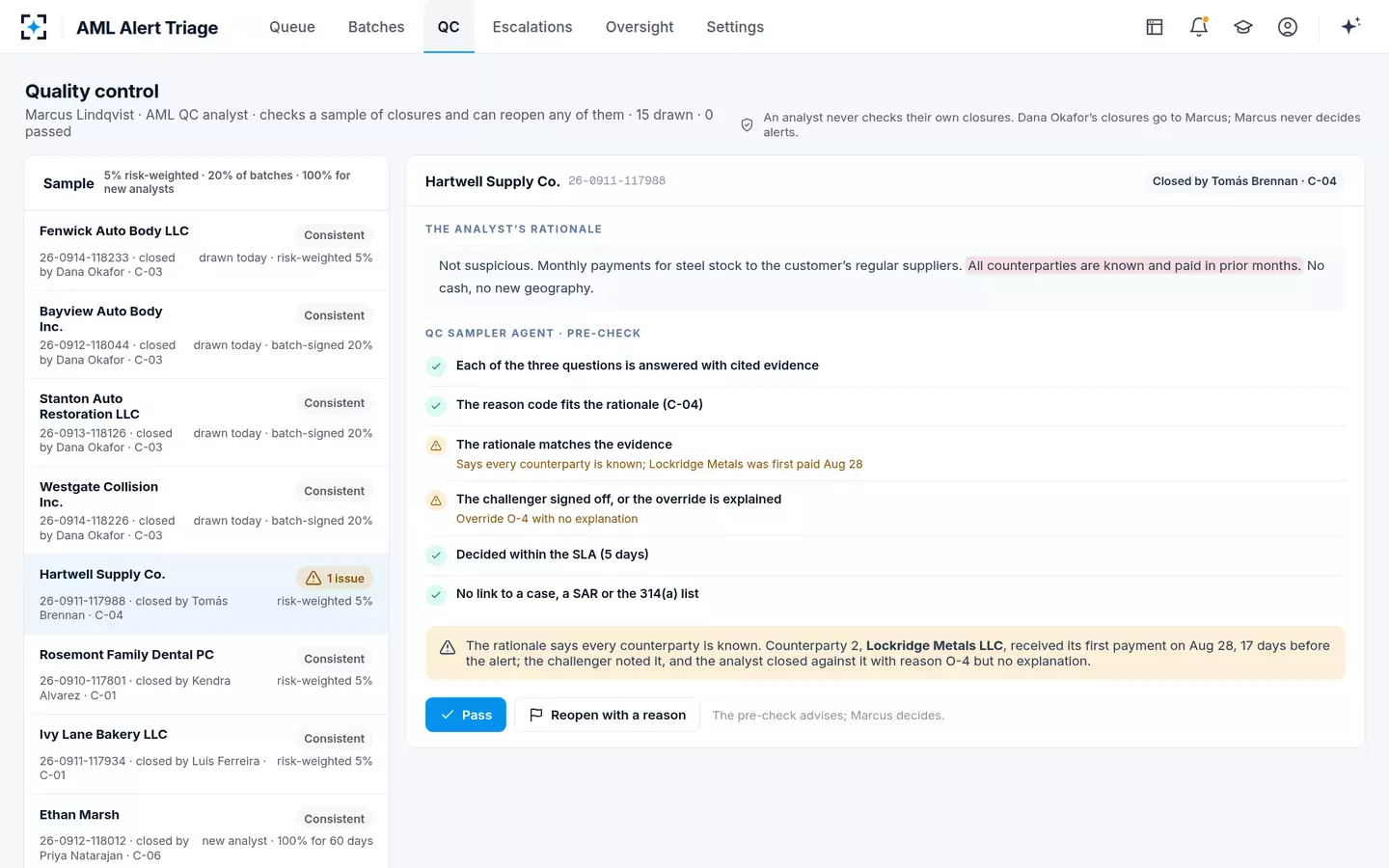
The QC seat shows how the job changes. Before, a QC analyst re-read a sample days later against a general checklist. With agents, each sampled closure arrives pre-checked against six points, and the QC analyst's time goes on the ones that fail: here, a rationale claiming every counterparty is known when one was first paid 17 days before the alert. How a closure should be written to pass that check is in AML alert disposition.
Regulators penalise thin desks, not automation
The enforcement orders behind this guide describe banks with too few skilled people; none of them penalised a bank for giving its analysts better tools. At USAA Federal Savings Bank, "as of early 2021, the Bank had 62 vacant positions, including the head of the Bank's Financial Intelligence Unit (FIU). Additionally, USAA FSB supplemented approximately 76% of its compliance staffing needs with third-party contractors" (FinCEN, USAA FSB, 2022). At TD Bank, AML employees reported that contractors delivered "sub-par, shoddy, and incompetent work that has created even more confusion" (FinCEN, TD Bank, 2024). Shinhan Bank America "had five different BSA compliance officers in 2019 alone" (FinCEN, Shinhan Bank America, 2023).
The bank's BSA Officer and staff lacked sufficient skills and expertise to effectively manage the bank's BSA/AML program.
OCC, on Bank of America, October 2026
The pattern argues for AI that makes experienced analysts more effective, not for AI that replaces them. The banks above did not fail because people made decisions; they failed because there were not enough people with the time and skill to make them well. Agents that do the gathering give that time back.
The analyst's seat in Botminds' AML Alert Triage
In Botminds' AML Alert Triage, a named analyst decides every alert. Take the sample bank's Tuesday as an example: Dana Okafor, a Level 1 analyst at Corvane National Bank in Botminds' sample data, opens a rapid-movement alert on Fenwick Auto Body LLC. The agents have answered three questions with citations, proposed a closure under the bank's reason code C-03, and a challenger agent has looked for reasons to escalate and found none. She closes it, with an attestation that she reviewed the evidence for all three questions, in 1 minute 52 seconds.
The decision, the rationale and the attestation are the analyst's
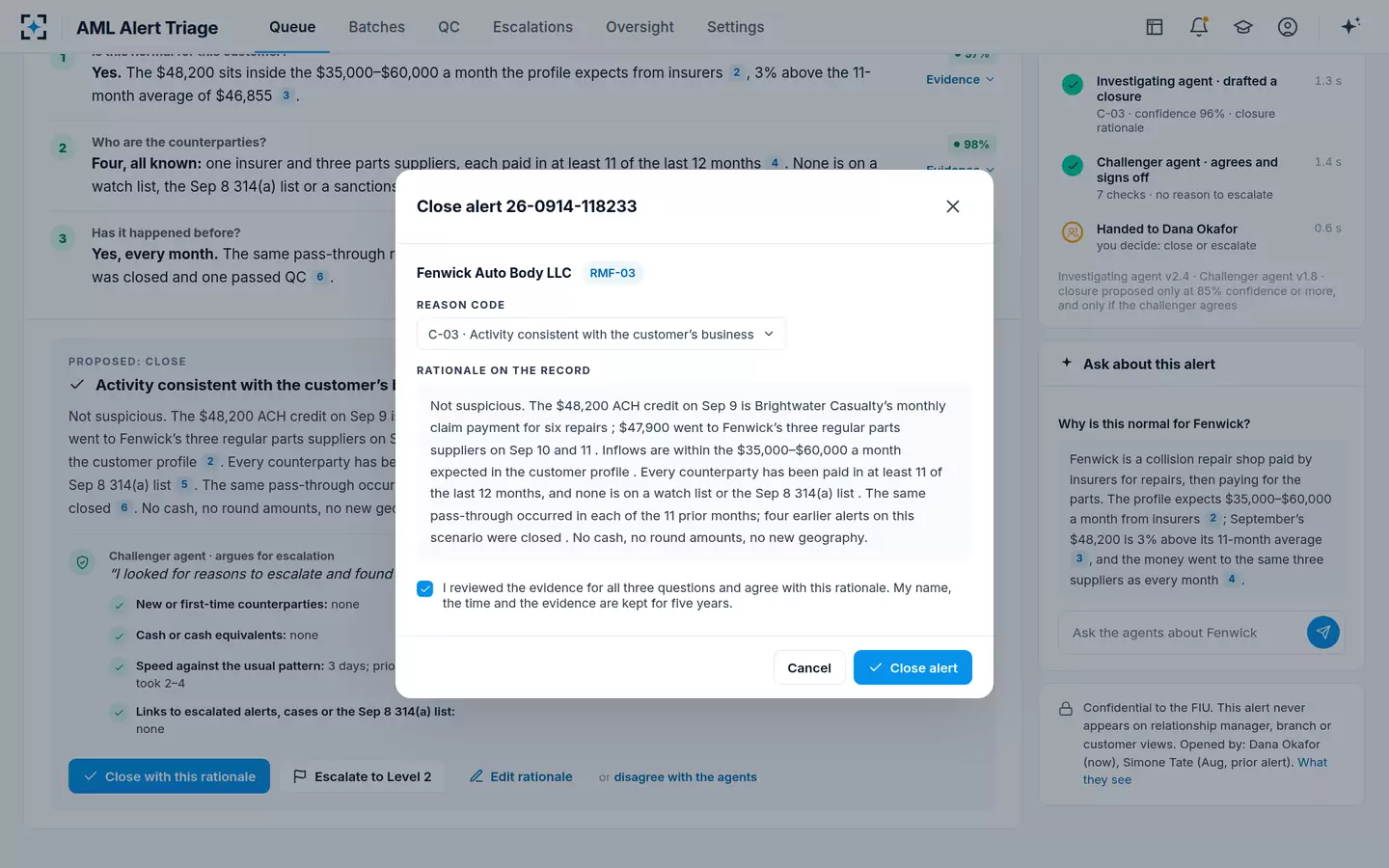
On the next alert the challenger disagrees, a counterparty is new, and she escalates. Her judgement is spent where it is needed, and her name is on every decision. That is the honest answer to whether AI replaces the analyst: it replaces the hunt, and leaves the call.
Questions people ask
Will AI replace compliance officers?
The federal projections say no: O*NET projects compliance officer employment to grow 3% to 4% from 2025 to 2035, with 32,700 openings. The BSA requires a designated person responsible for day-to-day compliance, and FinCEN's 2026 proposal would require that person to be based in the United States.
Will AI replace KYC analysts?
The same split applies: AI can gather documents, compare data and draft risk summaries, while decisions on customer risk and onboarding stay with people under the bank's procedures. In AML Alert Triage, a proposed change to a customer profile goes to the KYC team's own maker-checker approval.
Are entry-level AML jobs disappearing?
No federal data series tracks Level 1 AML roles separately, so nobody can say from public data. The task most exposed is manual fact-gathering, which is a large share of entry-level work; the judgement and documentation skills around it are becoming the core of the role.
Who is responsible if an AI agent gets an alert wrong?
The bank. That is why AML Alert Triage keeps a named analyst on every decision, records which statements came from agents and which from people, and has QC check every closure made against the challenger agent.
What should an AML analyst learn to stay relevant?
Typologies and red flags, customer-profile analysis, clear rationale writing, the SAR timing and confidentiality rules, and enough data literacy to question a tool's output. Those are the skills an agent-assisted desk relies on people for.