AML false positive rates, the share of transaction monitoring alerts that turn out not to be suspicious, are probably the most repeated statistic in financial crime compliance, and the least examined. The usual figure is a single, very high percentage range presented as industry fact. Trace it through the sources that cite it, and every path leads back to one vendor white paper from 2019, repeated by central-bank publications and then by everyone else. No US regulator, academic study or non-profit standard-setter has published a measured, industry-wide false positive rate. What the research does measure is narrower: one bank's labelled data, synthetic experiments, and the structural reasons the "true" rate cannot be known. This guide sets out that evidence, and how Botminds' AML Alert Triage, which prepares and challenges every alert before a Level 1 analyst decides, treats the many alerts that close.
How one estimate became an industry fact: the citation chain
- 2019A software vendor’s white paper
The original source of the figure, published by a company that sells AML software. It is not a measurement by a regulator, a university or a non-profit.
- Aug 2019BIS Financial Stability Institute, FSI Insights No 18
Repeats the figure as what rule-based measures "are shown to generate", in a footnote citing the vendor paper.
- May 2023BIS Innovation Hub, Project Aurora
Repeats it as "estimated", citing the vendor paper and FSI Insights No 18, which cites the vendor paper.
- 2023Peer-reviewed review, IEEE Access
Gives an even higher share, sourced to an article by a consulting firm.
- 2024Peer-reviewed interview study, 8 AML specialists
One interviewee calls a similar range "industry-standard". It is an opinion, reported faithfully as one.
- May 2025GAO, citing the International Monetary Fund
Says false positives are "the vast majority" of alerts, and gives no number.
What is a false positive in AML?
In AML monitoring, a false positive is an alert on activity that, once reviewed, is not suspicious: the alert is closed and no SAR is filed. The Wolfsberg Group's glossary gives the statistician's definition, "an instance incorrectly classified as positive", and its opposite, a false negative, "an instance incorrectly classified as negative" (Wolfsberg Statement on Effective Monitoring, 2024).
The everyday meaning and the statistical one are not the same thing, and the gap is the point of this page. A closed alert records that the bank found an explanation. It does not prove the activity was innocent. Some closed alerts are wrong in ways no one ever learns, and some activity never alerts at all. So the "false positive rate" a bank can measure is really a closure rate: the share of alerts it decided not to escalate.
What is the false positive rate in AML?
Nobody knows the industry-wide figure, and no regulator or independent study claims to have measured it. The most careful government statement is GAO's in 2025: "AI may also reduce false positives, which constitute the vast majority of money laundering and terrorist financing alerts, allowing institutions to focus on genuinely suspicious cases, according to the International Monetary Fund" (GAO-25-107197). "Vast majority" is supportable. A precise percentage is not.
The measured numbers that do exist are specific to one dataset each. In one undisclosed bank's data, summarised in a peer-reviewed review, 500,000 flagged transactions across 400,000 accounts were analysed and 3% of them were "deemed truly suspicious and labeled as positives" (Jensen and Iosifidis, IEEE Access, 2023). That is one bank, reported second-hand, and its labels have the problem described below. It is still more than the famous figure has behind it.
What has actually been measured, and on what
3%
of 500,000 flagged transactions labelled truly suspicious, in one undisclosed bank’s data
Peer-reviewed review, second-hand
40%
roughly, fewer false positives from machine learning than rules, monitoring each bank in a silo
BIS Project Aurora, synthetic data
75%
roughly, fewer false positives with a national view of transaction data
BIS Project Aurora, synthetic data
None
measured US industry-wide false positive rate from a regulator, academic or non-profit source
As of October 2026
Where the familiar statistic comes from
The chain is short and documented. The Bank for International Settlements' Financial Stability Institute wrote in August 2019 that "financial institutions traditionally relied on rule-based AML/CFT measures, which are shown to generate false positive alerts" at the familiar rate, and footnoted a March 2019 white paper by a software vendor titled "Disrupting status quo in AML compliance" (BIS FSI Insights No 18). In 2023 the BIS Innovation Hub's Project Aurora wrote that "it is estimated" that the same share of all alerts are false positives, citing that vendor paper and the 2019 BIS paper, which cites the vendor paper (BIS, Project Aurora).
Academic sources have not broken the chain. A 2023 peer-reviewed review gives a still higher share and sources it to an article by a consulting firm (IEEE Access). A 2024 peer-reviewed interview study of eight AML specialists reports one of them saying the "industry-standard" is in the familiar range and "slightly improving now" (Oztas et al., Future Generation Computer Systems). That is a practitioner's estimate, honestly reported. It is not a measurement, and the paper does not claim it is.
None of this means the claim is wrong in spirit. Most alerts do close; GAO and the IMF say so, and every analyst knows it. It means a BSA Officer who puts a precise figure in a board pack or a business case is citing a vendor, through two intermediaries. That matters most when the figure is used to justify suppressing alerts, which is exactly the argument the precise number tends to be recruited for.
What is a true positive in AML, and why are the labels incomplete?
A true positive is an alert on activity that is in fact suspicious, which in practice means an alert that led to a SAR. The trouble is that the SAR is the bank's own judgement, not a verdict. Researchers at IBM Research and ETH Zurich who built a benchmark dataset argue that synthetic data can beat real data for testing detection models for exactly this reason: its labels are complete, and real data's are not (Altman et al., NeurIPS 2023 Datasets and Benchmarks).
The outcome side is just as thin. FinCEN rarely tells a bank what happened to a SAR, GAO has found that law enforcement agencies largely do not track their use of BSA reports, and the agencies themselves acknowledged in 2021 that monitoring systems are hard to test for lack of realised outcomes. So every "true" and "false" label in a bank's data is provisional: a closed alert may have been laundering no one found, and a filed SAR may describe activity that was entirely lawful.
The ground truth labels are complete, whilst many laundering transactions in real data are never detected.
Altman et al., Realistic Synthetic Financial Transactions for Anti-Money Laundering Models, NeurIPS 2023
False positive vs false negative: the error regulators punish
Banks complain about false positives; regulators penalise false negatives. The large monitoring penalties of recent years are about activity a bank failed to detect or report, and several began with a decision taken to reduce alert volume.
Two kinds of error, and which one appears in consent orders
False positive: An alert on activity that, once reviewed, is not suspicious.
False negative: Suspicious activity that never alerts, or alerts and is closed in error.
False positive: The analyst who clears it, the next day.
False negative: Often nobody, until a lookback, a subpoena or an examiner.
False positive: Analyst time per alert, and customer friction if the bank asks questions.
False negative: Late or missing SARs, lookbacks, penalties and monitorships.
False positive: TD Bank barred scenario changes unless they kept or lowered false-positive volume.
False negative: Bank of America: nearly 8,900 unfiled SARs found once its review line was lowered.
False positive: Closure rate by scenario and reason code.
False negative: Below-the-line sampling against a tolerance set in advance.
The TD Bank order shows the false-positive argument at its most costly. When the bank considered updating its high-risk jurisdiction scenarios, AML management approved only changes that would not increase false positives (FinCEN, TD Bank consent order, 2024). Bank of America's monitoring system was built partly because there were too many alerts for its investigators, and FinCEN found that rules it used to rescore or suppress alerts as false positives kept reportable activity from investigation (FinCEN, Bank of America consent order, 2026). In both cases the effort to cut false positives produced false negatives.
Why are AML false positives so high?
Because monitoring is designed to over-include. A rule fires on a pattern that suspicious and innocent customers share, such as cash just under the reporting line or money that leaves soon after it arrives, and only the context around the customer separates them. Thresholds are set low enough to catch structuring just under the $10,000 reporting line, which guarantees that legitimate customers who deposit $9,000 will alert too.
Three more forces push the rate up. Supervisory pressure: the Wolfsberg Group describes banks "ensuring that no historical SAR/STR is 'left behind,' which results in ineffective and over-alerting monitoring programmes", and warns that "aiming for 100% recall, or 'No SAR/STR left behind', is likely to lead to an ineffective system" (Wolfsberg, 2024). Stale customer data: one specialist in the 2024 interview study explained that "KYC doesn't get updated as often, so unfortunately what happens is you over-alert or you under-alert on some people" (Oztas et al., 2024). And segmentation: one threshold across very different customers fits none of them.
Can machine learning reduce AML false positives?
In experiments, yes; in measured US bank production, the public evidence is thin. The strongest result is the BIS Innovation Hub's Project Aurora, which ran rule-based monitoring and five machine-learning models over a synthetic dataset built to resemble a national payment system. "Most supervised machine learning models reduce the number of false positives, compared with the rule-based model. The reduction is approximately 40% when monitoring is done in silos, whereas it is approximately 75% when undertaken with a national view of transaction data" (BIS, Project Aurora, 2023).
Project Aurora, on synthetic data: share of money launderers each approach detected
Read the result for what it is. The data was synthetic, and the biggest gains came from pooling data across banks, which US law permits only within limits. Peer-reviewed researchers note "little scientific literature on statistical and machine learning methods for anti-money laundering" and "the need for more public data sets" (Jensen and Iosifidis, 2023), and FinCEN's own innovation programme reported that a "lack of anonymized" financial crime data constrains "industry's ability to properly train and test applications using AI and machine learning" (FinCEN Innovation Hours report, 2021).
US supervisors have encouraged trying. The 2018 joint statement on innovation says the agencies will not automatically treat a bank's existing processes as deficient because a pilot finds more (Joint Statement, 2018), and Treasury's 2024 review of AI recorded respondents saying AI is "widely used" for AML/CFT (US Treasury, December 2024). FinCEN's 2024 program proposal named machine learning as a way of "reducing false positives"; that proposal was withdrawn in April 2026 and replaced by a new one that is still only proposed (89 FR 55428, withdrawn).
How to reduce false positives in transaction monitoring without losing coverage
Reduce them by making each alert more precise, not by making fewer alerts reach people. Four levers do that, and each comes with a test that proves coverage held.
Refresh the customer data the rules compare against. A profile that says what the customer actually does turns many alerts into one-line closures and makes the rest stand out. Segment before tuning. Separate thresholds for cash-intensive businesses, payroll accounts and retail customers cut alerts that one shared threshold creates. Tune with below-the-line testing. Raising a threshold is legitimate only with evidence about what it stops seeing; threshold tuning, set, tested and written down sets out the method. Score or rank with care. A model that orders the queue is low-risk; one that removes alerts from view must be tested like a threshold, which is the lesson of AI in AML transaction monitoring.
There is a fifth lever that does not reduce the count at all: reduce the cost of each false positive. If an alert that will close can be closed in two minutes with its evidence cited, instead of 38 minutes of searching, the business case for suppressing it weakens, and the bank keeps the coverage. That is the lever Botminds' AML Alert Triage pulls.
How Botminds' AML Alert Triage handles the alerts that close
In Botminds' AML Alert Triage nothing is suppressed: every alert is read by the agents and decided by a named Level 1 analyst. What changes is how quickly a closable alert can be closed, and how well the closure is documented. An investigating agent answers three questions with citations (is this normal for this customer, who are the counterparties, has it happened before) and proposes a closure only at 85% confidence or more. A challenger agent on a separate model family then looks for reasons to escalate, and must agree before any closure is proposed.
A proposed closure, and the challenger's search for reasons to escalate
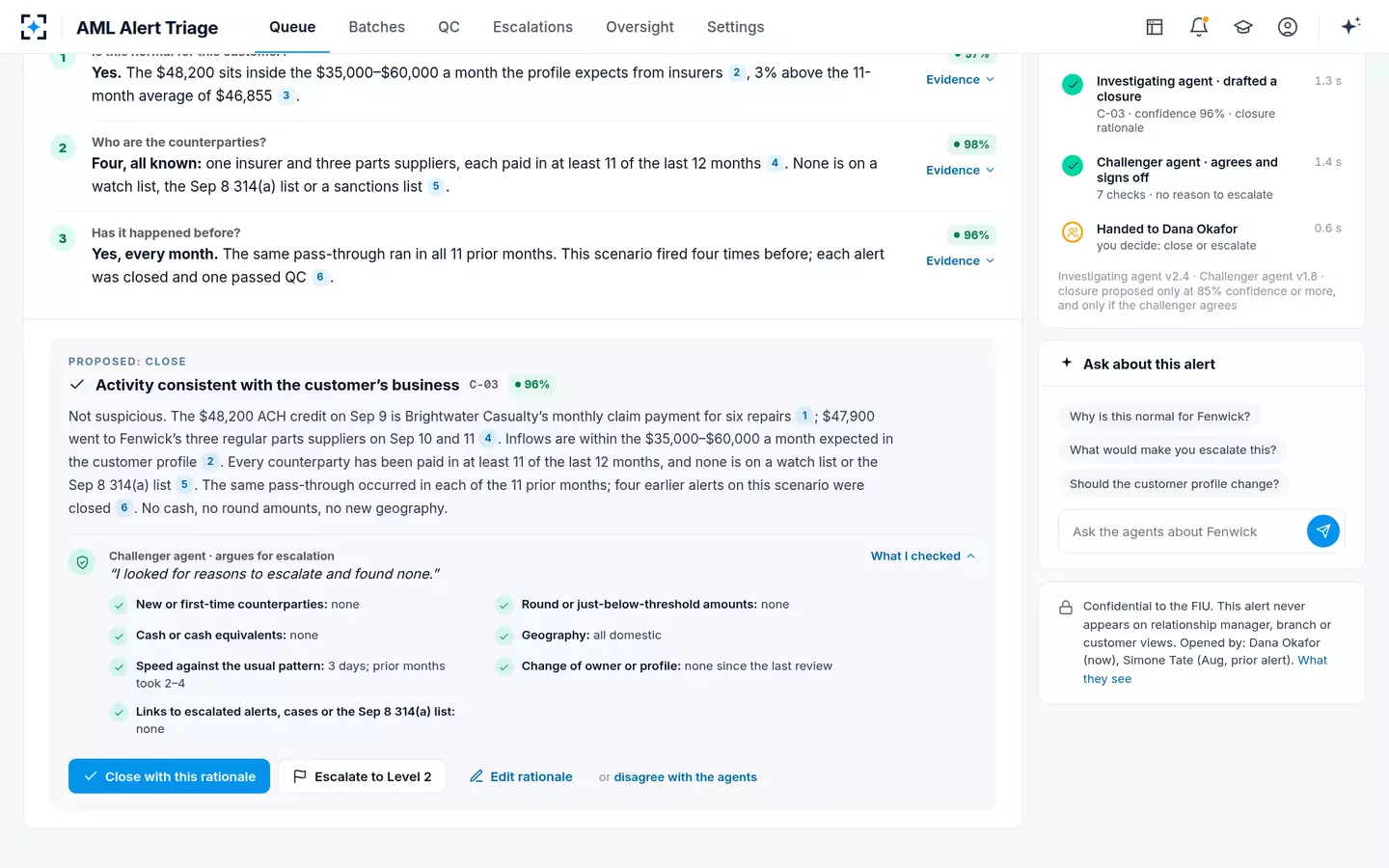
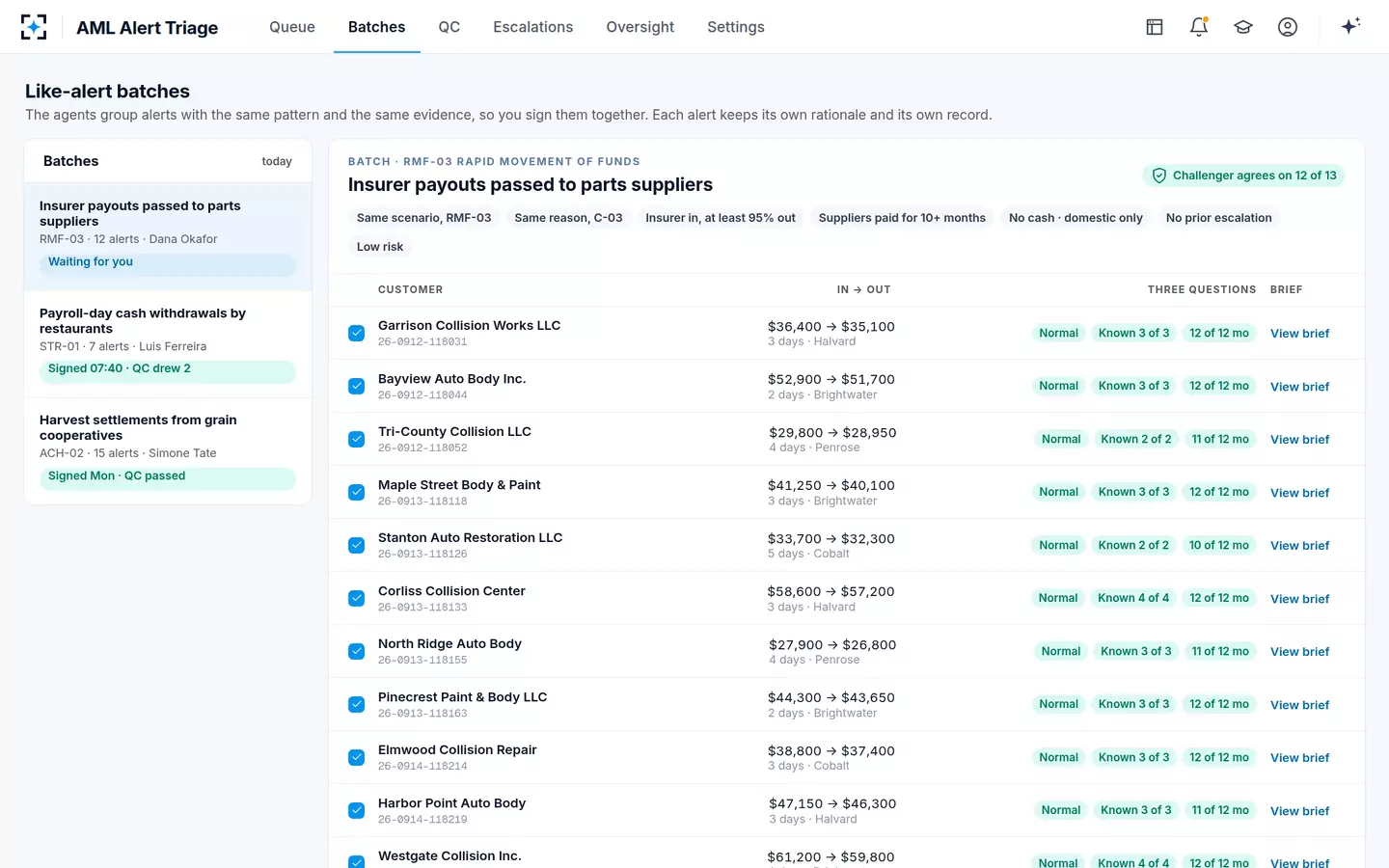
Take the sample bank as an example. Corvane National Bank is a fictional regional bank with about 42,000 alerts a month in Botminds' sample data. On one Tuesday, twelve alerts with the same pattern, insurer payouts passed on to regular parts suppliers, were grouped into a like-alert batch the analyst signed together, each keeping its own rationale. The challenger removed a thirteenth: a $14,950 wire to a payee first seen that month. That is the distinction a false-positive rate cannot draw: twelve alerts that were routine, and one that looked routine and was not.
Routine alerts signed together, the exception sent back
The tuning analyst agent closes the loop. When alerts are closed again and again for the same reason, it writes a proposal for the Head of the financial intelligence unit with the evidence and the expected effect, recommends no change where SARs were filed, and never changes a scenario itself. What to report to the board in place of a false-positive rate is set out in the alert to SAR ratio.
Questions people ask
Why do vendors quote such a precise AML false positive rate?
Because a precise number sells a product that promises to cut it. The figure most often quoted traces to a 2019 vendor white paper, repeated by two BIS publications; no regulator, university or standard-setter has published a measurement behind it.
Is a high false positive rate a regulatory problem?
Not in itself. Examiners look at whether alerts are worked properly and on time; the 2021 interagency statement accepted that monitoring favours coverage over efficiency. A high rate becomes a problem when it produces backlogs or rushed closures, as at TD Bank and USAA.
What is the difference between a false positive and a defensive SAR?
A false positive is an alert closed as not suspicious. A defensive SAR is the opposite error of judgement: a report filed to avoid criticism rather than because the activity is suspicious, which the Wolfsberg Group says is unlikely to give law enforcement anything useful.
Does a closed alert prove the activity was legitimate?
No. It records that the bank found an explanation at the time. Researchers note that much laundering in real data is never detected, so some closures are wrong in ways no one learns; that is why closures should keep their evidence.
Can sharing data between banks reduce false positives?
In Project Aurora's synthetic experiment, machine learning cut false positives by about 75% with a national view of transactions, against about 40% bank by bank. In the US, information sharing between institutions runs through section 314(b), which is voluntary and limited in scope.