Money mule vs money laundering is a question of part and whole. Money laundering is the process of moving criminal money so that its origin is hidden; a money mule is a person, and an account, through which that money moves. The UK Financial Conduct Authority puts it in one line: "Money mule activity is a form of money laundering in which a person transfers or receives criminal funds on behalf of others." In a bank the distinction becomes an org chart. The fraud team sees the scam, the victims and the money that can still be recovered; the BSA/AML team sees a suspicious account and a 30-day reporting clock. Botminds' Money Mule Detection is built for the hand-off between them: agents trace the money and draft both the fraud team's freeze and notices and the BSA team's sealed referral, and people decide each.
The difficulty is that one account sits in both worlds at once. Each team has its own questions, its own clock and its own rules about what the customer may be told, and a mule case lost between the two is usually lost at a hand-off, not at a decision.
From the first mule account to the SAR: each stage and who owns it
Agent
Trace the first mule accountThe receiving bank’s monitoring raises the alert; agents trace every payment in and out and what is still reachable.
Never: Freezes or moves money.
Agent
Follow the layeringMoney moves on to second- and later-generation mules in smaller payments. Agents find linked accounts by device, address and senders.
Never: Links on a surname alone.
A person decides
Freeze, notify and returnThe fraud team decides the freeze and what goes back to each sending bank; a manager checks.
A person decides
Exit the accountsThe fraud team closes the accounts with neutral letters and re-open guards; a manager checks.
A person decides
Decide the SARThe BSA Officer decides whether and what to file, from a sealed referral, within 30 days of detection.
Is being a money mule money laundering?
Yes, in substance and often in law. Regulators describe muling as laundering: the FCA calls it "a money laundering technique where an individual - a 'money mule' - moves the proceeds of crime on behalf of criminals" (FCA, January 2025). The FBI says mules "are recruited to assist criminals with laundering proceeds from illegal activity", and lists the federal charges they risk: "Mail Fraud, Wire Fraud, Bank Fraud, Money Laundering, Transactional Money Laundering, Prohibition of Unlicensed Money Transmitting Business, and Aggravated Identity Theft", with "fines reaching $1,000,000 and up to 30 years in prison" (FBI, I-120321-PSA).
The legal hinge is knowledge. US money laundering law, as FinCEN summarizes it, "includes knowingly conducting or attempting to conduct a financial transaction with proceeds from SUA", a specified unlawful activity, and the fraud offenses on that list include "mail fraud, wire fraud, bank fraud" (FinCEN Section 314(b) Fact Sheet, 2026). That is why the type of mule matters to prosecutors, and why law enforcement warns people before it charges them.
What is the difference between a money mule and money laundering?
A money mule is an instrument; money laundering is a process. The mule receives a victim's money and passes it on, once or many times; laundering is the whole chain that turns a scam payment into money the criminal can spend without it being traced. The FCA's 2025 review describes the chain in generations: "First-generation mules receive money directly from the fraud victims, the subsequent recipients are referred to as second-generation mules, and so on", and calls the movement "the layering process to conceal the illicit origins of funds" (FCA, 2025).
Its 2026 analysis of 140 traced cases found where the chain usually ends: most cash-outs happened between the second and fifth mule account, most often at the second, and by then the money had been split into smaller payments that drew less attention (FCA, September 2026; the hop-by-hop picture is in money mule networks). The first mule account is where the money is still whole and still traceable to named victims, which is why the receiving bank is where fraud and laundering meet.
Money mules in the laundering chain, in the UK regulator's numbers
2nd–5th
mule account where fraud proceeds are usually cashed out, most often the second
140
fraud cases traced through mule accounts by an FCA cell of 22 firms in 2025
656,600
customers offboarded as suspected mules by 35 UK firms, 2023 to 2025
Who handles mule accounts, fraud or AML?
Both, and the split works only if it is written down. The fraud team is usually first: it sees the alert, the victims' recalls and the money that can be saved, and it decides the freeze, the notices to sending banks, the return and the exit. The BSA/AML team owns the SAR, its 30-day clock and its confidentiality. The Federal Reserve Financial Services risk officer survey even files mule detection under both headings, in a section called "Finding Mule Accounts and Anti-Money Laundering (AML)", where 58% of institutions said they find mule accounts through "Rules-based analysis in AML review of payment types" (FRFS Risk Officer Survey, 2026; the survey says it is not independent academic research, with a margin of error of ±6%).
The two teams look at the same account and ask different questions. The comparison below is what each needs from the case, and where the case breaks if one team waits for the other.
One mule account, two questions
The fraud team's view: Where is the victims’ money, and how much can still be stopped?
The BSA team's view: Is this suspicious activity we must report, and about whom?
The fraud team's view: Minutes: the money leaves the account within the hour.
The BSA team's view: 30 calendar days from initial detection; 60 if no suspect is identified.
The fraud team's view: The victims and their banks; the account holder, who may be a victim too.
The BSA team's view: The subjects of the report, and law enforcement who will read it.
The fraud team's view: A freeze, notices to sending banks, a return plan, an exit.
The BSA team's view: A SAR, or a documented decision about one; supporting papers kept five years.
The fraud team's view: Any hint of a report in a letter, branch note or call script.
The BSA team's view: The SAR and any information that would reveal it exists.
Where a mule case gets lost between fraud and AML
It gets lost at five hand-offs. First, the alert: a fraud alert worked as fraud may never reach the BSA team, and a transaction monitoring alert worked as AML may never reach the people who can recall money. Second, the clock: the 30 days start at the bank's initial detection, so a referral written up a week later has already spent a quarter of them. Third, the evidence: the fraud team's case notes are the SAR's best source, and the supporting documentation kept with a SAR counts in law as filed with it (31 CFR 1020.320(d)), so what the fraud team writes becomes part of the filing.
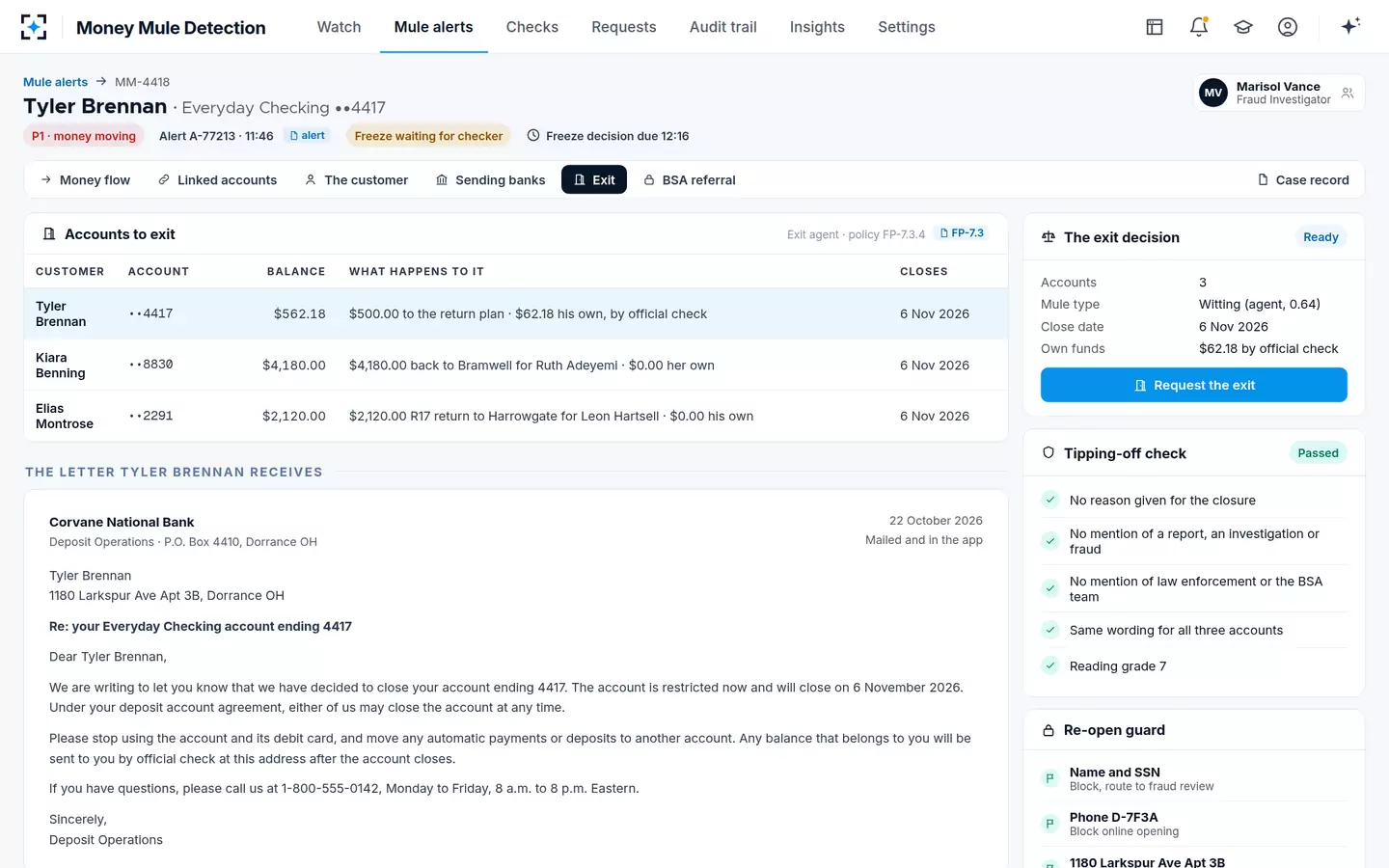
Fourth, the customer: the exit letter, the branch note and the contact-center script are written by the fraud side, and each must avoid revealing a SAR. A joint statement of September 2, 2026 confirms a bank may tell a customer that a closure may be connected with suspected fraud or other suspicious activity, but no one may disclose a SAR or anything that would show one exists (Joint Statement on SAR Confidentiality). Fifth, the other banks: notices to sending banks may carry the money but never the report.
One owner for each step of a mule case
| Step | Owner | Checked by | Clock |
|---|---|---|---|
| Trace the money and find linked accounts | Fraud investigator (agents draft) | FIU analyst on networks | Minutes |
| Freeze every linked account | Fraud investigator | Fraud operations manager | Target 30 minutes on money still moving |
| Notices and return to sending banks | Fraud investigator (agents draft) | Fraud operations manager | Same day |
| Exit, letters and re-open flags | Fraud investigator (agents draft) | Fraud operations manager | By the closure date |
| Referral to the BSA team | Fraud investigator (agents draft) | Received sealed by the BSA Officer | Within the 30 days, as early as possible |
| SAR decision and filing | BSA Officer | BSA team; internal audit samples | 30 days from detection |
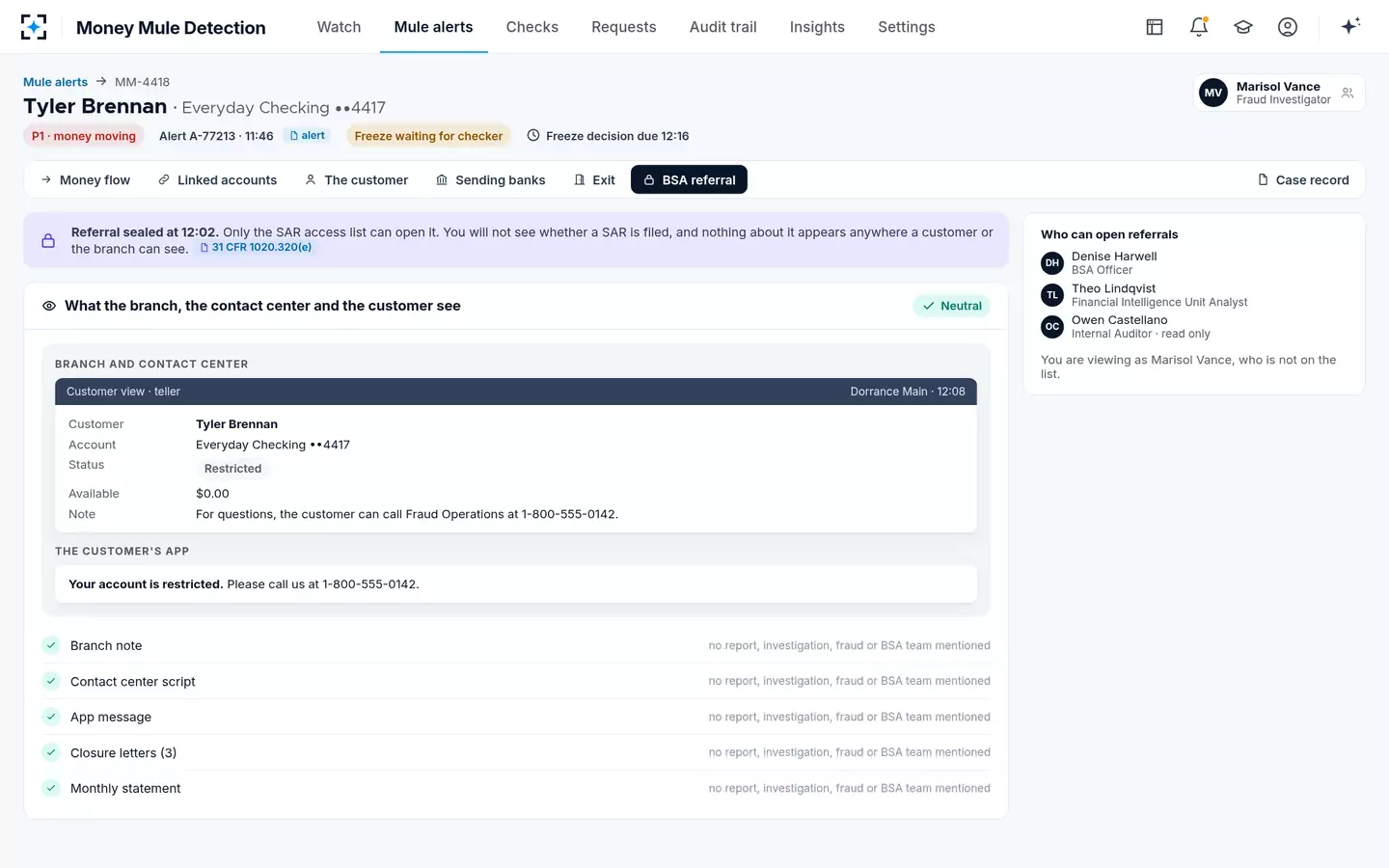
The handover: a sealed referral for the BSA team, a neutral status for everyone else
What SAR is filed for a money mule?
A standard SAR, usually under the fraud categories. FinCEN's 2020 mule advisory asked institutions to use the key term "COVID19 MM FIN-2020-A003" and to select SAR field 34(z), "Fraud - other", for pandemic-era mule schemes, and encouraged fields such as 34(l), "Fraud- Mass-marketing", or 38(d), "Elder Financial Exploitation", where they fit (FinCEN Advisory FIN-2020-A003). For fraud the bank regulators' thresholds apply: a filing is due once violations add up to $5,000 with a suspect identified (12 CFR 21.11(c)). How the narrative should read is covered in our guide to writing a SAR narrative.
One account can lead to more than one filing: the receiving bank on its customer, and a sending bank may file on the payment its own customer was deceived into making. Banks sharing under 314(b) "may work together to file joint SARs", and may discuss a joint SAR among themselves, though 314(b) never lets them reveal any other SAR (FinCEN, 2026).
Is a money mule account a funnel account?
Sometimes, but the terms describe different patterns. FinCEN defines a funnel account as "An individual or business account in one geographic area that receives multiple cash deposits, often in amounts below the cash reporting threshold, and from which the funds are withdrawn in a different geographic area with little time elapsing between the deposits and withdrawals" (FinCEN Advisory FIN-2014-A005). A scam mule account more often receives electronic payments from victims and pays them out by P2P, card or cash. Where a mule account takes cash deposits in distant branches, it is both. The difference matters for which red flags and which SAR typology fit; our AML series compares funnel and pass-through accounts.
Do money mules get charged with money laundering?
Some do, usually those who knew. The FBI lists money laundering among the federal charges mules face. In practice US law enforcement starts with warnings: in the fourth Money Mule Initiative, announced December 3, 2021, agencies served about 4,670 warning letters on people whose accounts were helping fraud schemes, filed civil or administrative actions against 11 people, and criminally charged more than 30 "for their roles in receiving and forwarding victim payments or otherwise laundering fraud proceeds" (U.S. Department of Justice, 2021). In the campaigns announced in 2019, 2021, 2023 and 2024, warning letters far outnumbered criminal charges.
What is layering in money laundering, in a mule case?
Layering is moving money through enough accounts and forms that its origin is hard to follow. In a mule case it is visible minute by minute: in a sample case from Money Mule Detection, on fictional people, $18,400.00 from three retirees arrived in one student's account in a morning and left within 47 minutes as a $7,400.00 cash kiosk withdrawal, four P2P payments to new recipients at two banks and a $1,500.00 prepaid card load. Each of those P2P recipients is a second-generation mule in the FCA's terms. How money mules work follows that morning step by step.
The exit letter: the fraud team's decision, written so it reveals no report
A written split between fraud and AML for mule cases
- Name who opens the case on each kind of alert
Fraud alert, AML alert, a recall from another bank, an IC3 request.
- Start the SAR clock at detection, and show it
The BSA team should see the days left the moment the case opens.
- Send one referral, complete and sealed
Subjects, timeline, money flow and evidence, with the fraud team’s decisions attached.
- Check every customer-facing text for tipping off
Letters, branch notes, call scripts, app messages and statements.
- Keep notices to banks to the money
Amounts, times, parties and returns; never the report.
- Give networks to one owner
An FIU analyst merges related alerts so two teams do not work one ring twice.
How the referral, the notices and the exit are drafted and checked is on the Money Mule Detection page; who reports what, to whom and by when is in how to report a money mule.
Questions people ask
Is money muling a crime if you didn't know?
It can be. The FBI says mules face prison sentences, fines or community service "even if unwitting". Money laundering charges generally turn on knowledge, which is why law enforcement sends warning letters first and prosecutes those who carry on.
Who investigates money mules, the fraud team or the AML team?
Usually the fraud team investigates the money and the victims, and the BSA/AML team decides on the SAR. Larger banks add a financial intelligence unit to expand networks. What matters is that each step has one named owner and a clock.
What is the difference between a money mule and smurfing?
Smurfing is splitting cash into amounts under a reporting threshold, often by several people; FinCEN's funnel account advisory describes deposits "kept below $10,000" for that reason. A money mule receives and forwards criminal money, usually electronic payments from scam victims; one person can do both.
Does a money mule account have to be reported to FinCEN?
If the activity meets the SAR rules, yes: for fraud, $5,000 or more where a suspect is identified, or $25,000 or more regardless, within 30 days of initial detection. The bank must not tell the customer or anyone else that it filed.
Can the fraud team see whether the BSA team filed a SAR?
That depends on the bank's own access rules. In Money Mule Detection the referral is sealed from the fraud team once sent, only the SAR access list (the BSA Officer, an FIU analyst and an internal auditor, read only) can open it, and the investigator is told they will not see whether a SAR is filed.