Mule account detection using machine learning means training a model on past mule accounts so it can score new ones: how money arrives and leaves, how old the account is, which devices sign in, who sends money and who receives it. The score is useful, and it is one task of about a dozen in a mule case. Someone still has to trace every payment in and out, find the other accounts the same people control, decide whether the customer knew, freeze what is left, tell the sending banks and write the referral. Botminds' Money Mule Detection is an agentic solution built for that remainder: agents trace, link, weigh and draft, each step cited to its source, and the investigator and a checker decide. This page goes task by task: what a model can take, what an agent can take, and what must stay with a person.
The reason to split the work this way is time. Most banks still find mule accounts late and by hand, and the money is usually gone by then. The question for a buyer is not whether a model can score an account, but how many minutes stand between the score and a decision someone can defend.
Where a mule review's hand time goes, and how much of each task agents take
Pulling every payment in and out
- Agents · 95%
- Person · 5%
Finding sibling accounts
- Agents · 87%
- Person · 13%
Contacting the sending banks
- Agents · 80%
- Person · 20%
Exit letters and SAR referral
- Agents · 70%
- Person · 30%
Weighing witting or unwitting
- Agents · 60%
- Person · 40%
A second person’s check
- Agents · 60%
- Person · 40%
How does machine learning detect mule accounts?
A machine learning model detects mule accounts by learning, from accounts a bank has already confirmed, which combinations of behavior come before muling, and then ranking new accounts by how closely they match. Typical inputs are inbound and outbound flows, the speed money leaves, account age, stated income, device and login data, and the counterparties on each side. The UK Financial Conduct Authority, reviewing firms' controls in 2023, saw the shift: "Investing in machine learning systems helps reduce the inherent risks of static rules-based systems, which fraudsters can bypass as they continuously change their tactics and approach" (FCA, October 2023).
The same review names the limits that matter to a buyer. Models "require historical data to accurately understand a customer's normal behaviour", which is exactly what a new account does not have. Some firms "were not able to explain the workings of machine learning tools", and analysts were "often uncertain about the specific criteria that triggered alerts". The FCA's conclusion is not that rules are better. It is that a model has to be understood by the people who act on it.
The academic literature says the same in other words. Dal Pozzolo and colleagues, working with a card issuer's 75 million transactions, describe three conditions every fraud model lives with: concept drift, class imbalance, and verification latency, meaning that investigators confirm only a small share of transactions in time to teach the model (IEEE Transactions on Neural Networks and Learning Systems). Mule detection has all three, and the third is the hardest: a mule label arrives when an investigator confirms it, often after the money has gone.
What data is used to detect money mules?
The data that finds mules is the data that shows money arriving where it does not fit and leaving faster than it should. FinCEN's red flags describe the pattern in the customer's own account: payments that do not fit the customer's history, a balance that stayed low until the scheme began, and a so-called employer who asks the customer to take in money and pass it on (FinCEN Advisory FIN-2020-A003). The FCA found that firms that caught mules early relied on "unexpected or unexplained deposits", money spread through networks of accounts within minutes of landing, movement to other countries and rapid cash withdrawal (FCA, January 2025).
Three sources are routinely missing. The first is income: the FCA found firms "not collecting or recording information on customers expected annual income or business turnover" at opening, which leaves a model nothing to compare a $9,500 wire against. The second is inbound monitoring: some firms watch outbound payments closely and incoming money barely at all, so they see the mule only as money leaves. The third is other banks' data, which section 314(b) now explicitly allows registered institutions to share, from "device identification numbers" to sets of accounts that share the same or near-identical identifying details (FinCEN Section 314(b) Fact Sheet, 2026).
Most mule detection is still manual, and late
71%
of institutions rely on manual review of the account holder at opening
36% use automated review
28%
screen received transactions in real time for fraud or money laundering
~1 in 2
say they find mule activity only after losses (the report gives 51% and 49%)
A mule case is a dozen tasks, and only one of them is prediction
Scoring decides which account to look at. Everything after it decides what happens to the money. A typical case runs through these tasks: score the alert; trace every payment in and out across wire, ACH, P2P, card and cash; mark any leg a late feed hides; find accounts sharing the device, address or senders; weigh whether the customer is unwitting, witting or complicit; decide the freeze; check it; draft a notice to every sending bank and confirm what each may receive under 314(b); propose the return; draft the exit and run a tipping-off check on every letter; build the referral for the BSA team; and keep the trail an examiner will sample.
A model trained to predict mules helps with the first task and, as a graph model, with the fourth. The others are assembly, drafting and judgment. Assembly and drafting are where agents, which can call systems, read what comes back and write, change the arithmetic of a case. Judgment is where they must stop.
Who does each task in a mule case with Money Mule Detection
Agent
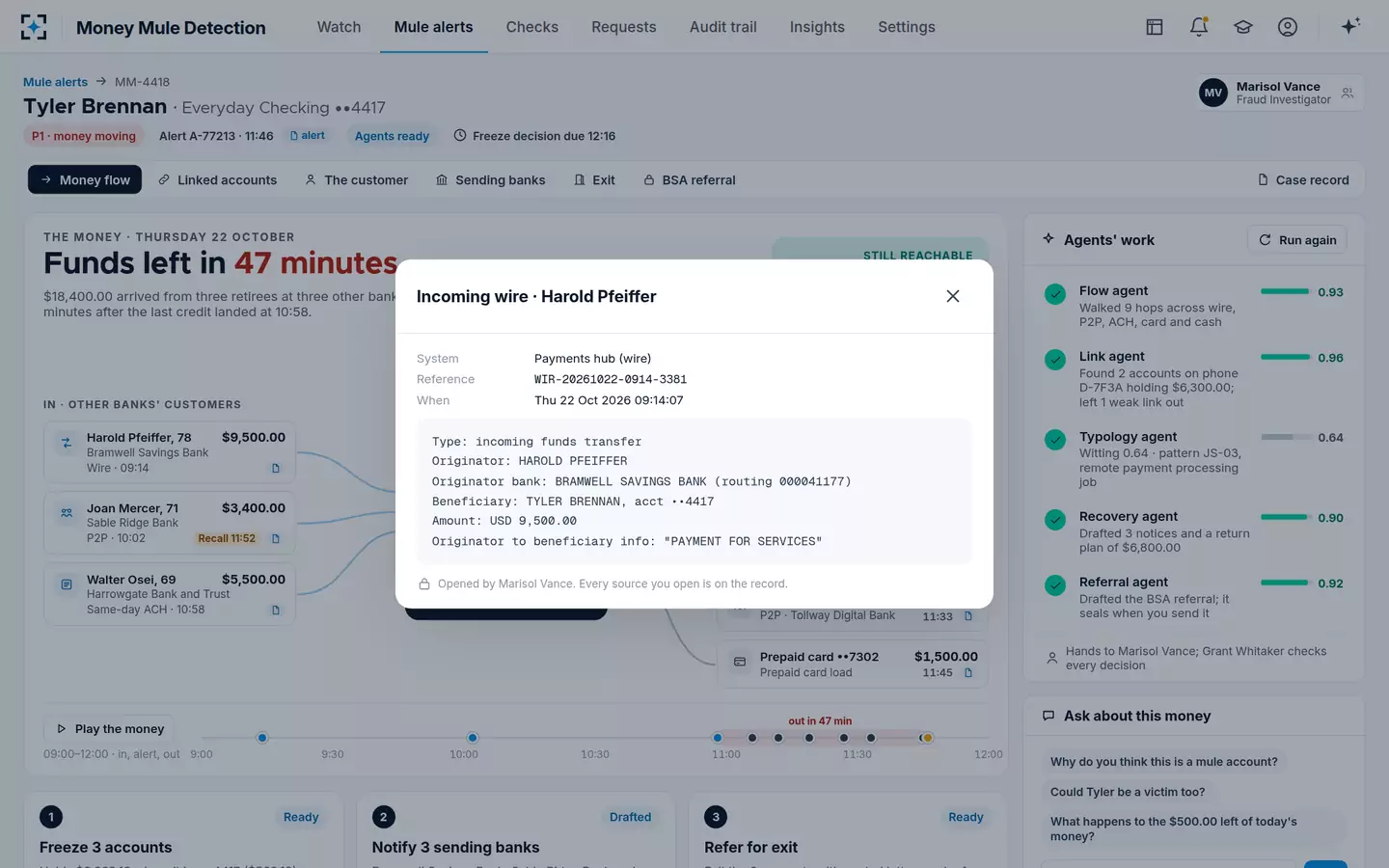
Trace the moneyWalks every hop in and out of the alerted account, in time order, with the source behind each leg; works out the exit time and what is still reachable.
Never: Freezes or moves money; guesses at a leg a late feed hides.
Agent
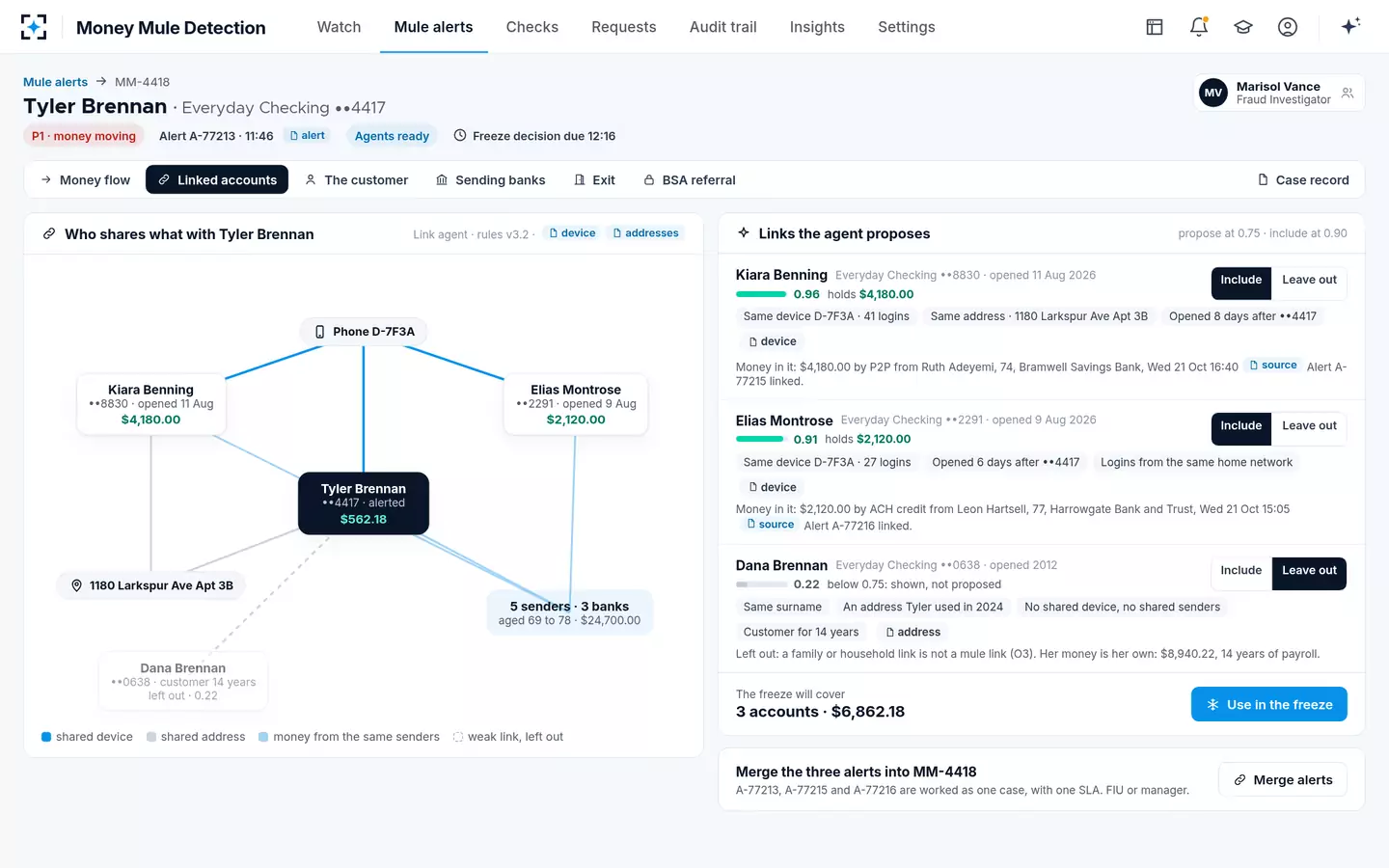
Link the accountsFinds accounts sharing a device, an address, a phone or the same senders, each link with its evidence and a confidence.
Never: Links on a surname or a protected characteristic alone.
Agent
Weigh the mule typeScores unwitting, witting and complicit with every signal cited; says “unclear” below 0.70.
Never: Writes a type on anything the customer sees.
A person decides
Decide the freezeThe investigator requests a freeze of every linked account with a reason code.
Agent
Draft notices, return and exitDrafts a notice to each sending bank, checks 314(b) registration, proposes a return plan, drafts neutral letters and checks them for tipping off.
Never: Sends, returns money or closes an account.
A person decides
Check every decisionA manager approves or returns each freeze, notice, return and exit; the maker cannot check their own.
A person decides
Decide the SARThe BSA Officer receives the sealed referral and decides whether and what to file.
Can AI freeze a mule account?
It can, technically, and it should not decide to. The clearest US precedent is a consent order, not a rule. In July 2022 the CFPB found that Bank of America acted unfairly when it froze prepaid debit card accounts on the strength of a fraud filter's result alone, a filter the Bureau called flawed, in a program where the bank had changed its practice "to solely rely on an automated fraud filter"; the bank paid a $100 million penalty to the CFPB and the OCC fined it $125 million (CFPB, Bank of America, N.A., 2022). The case was about benefit cards, not mules, but the lesson carries: an automated signal may start a freeze review; it may not be the whole of it.
A mule freeze also hits two sets of people. A frozen account may belong to a deceived customer, and the money in it belongs to someone else's customers. Who decided, on which evidence and with which reason code, is what the bank will be asked by the account holder, the sending banks and the examiner. In Money Mule Detection the agents never freeze, move money, send notices, close accounts or file SARs, and a different person approves each request.
The agents weigh the mule type; the investigator records it
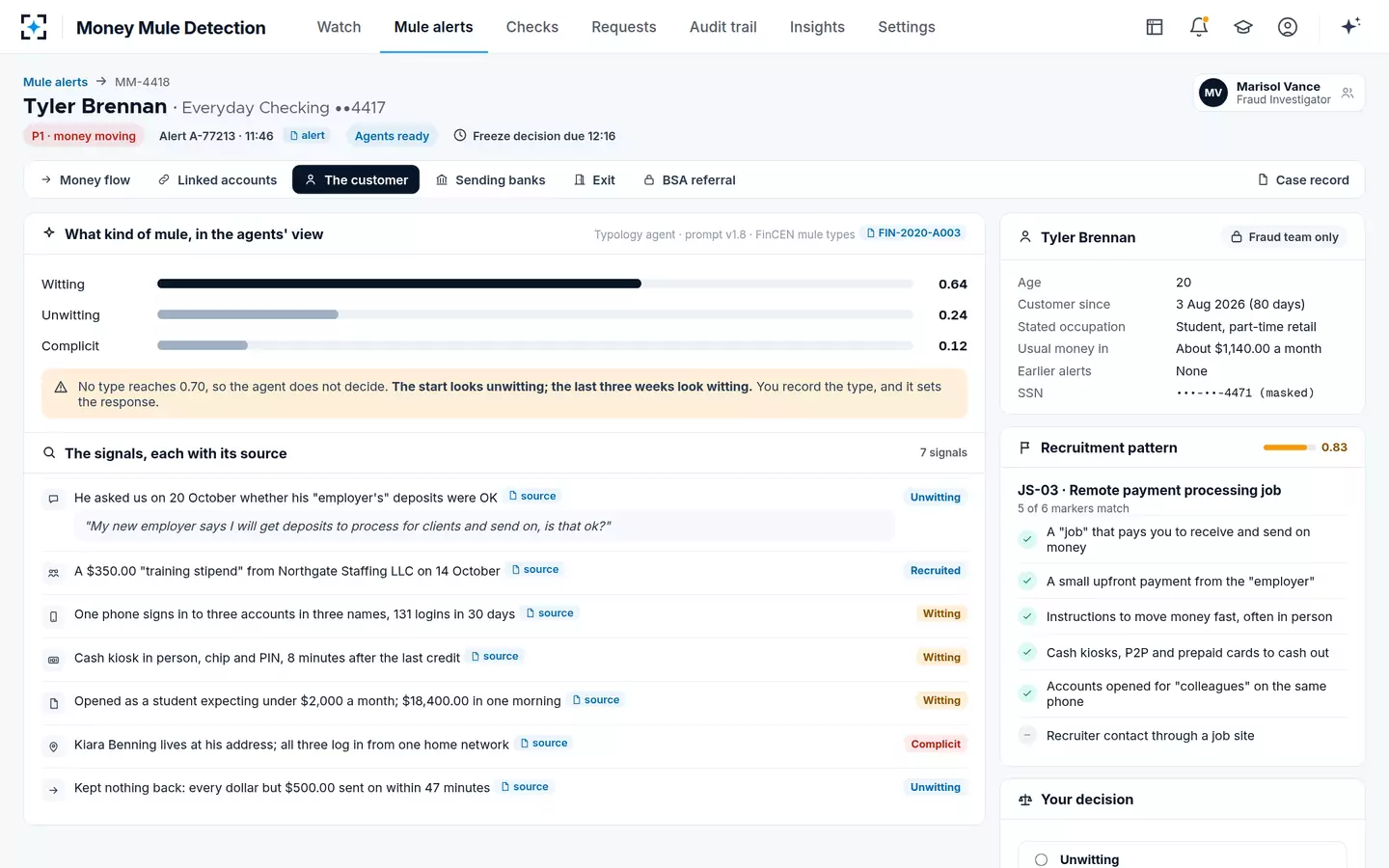
How do you explain a mule score?
You explain a mule score by showing the evidence behind it, not the model's weights. An investigator who is told an account scored 0.91 can do nothing with the number. An investigator who is shown that $18,400.00 arrived from three first-time senders aged 69 to 78 and $17,900.00 left within 47 minutes, each payment opening the system entry it came from, can defend a freeze to a manager, a sending bank and an examiner.
The FCA found the opposite in practice: analysts "uncertain about the specific criteria that triggered alerts" and "poor narratives and rationale" on closed alerts. It also found that firms using a commercially available mule detection tool "do not treat alerts raised through the detection tool as a clear indicator of muling activity on their own" (FCA, January 2025). That is the right instinct, and it means the expensive part of the case is still the corroboration. A tool that hands over the corroboration, cited, is worth more than a better score.
What an investigator receives: a score, or a case ready to decide
A mule score: An alert with a number and a few top features.
An assembled mule case: The money drawn in and out, with the exit time and what is still reachable.
A mule score: Pulled by hand from the payments hub, P2P gateway, card processor, core and device data.
An assembled mule case: Each leg, link and signal opens the source it came from, and opening it is logged.
A mule score: Found if someone runs the queries.
An assembled mule case: Proposed with evidence and confidence; weak links shown and left out with a reason.
A mule score: Not addressed, or a guess in a free-text note.
An assembled mule case: Weighed with each signal cited; the investigator records it.
A mule score: Written from scratch: freeze request, notices, exit, referral.
An assembled mule case: Drafted and checked for tipping off; a person requests, another approves.
What are the limits of machine learning for fraud?
The limits are labels, drift and context. Labels: a model learns from confirmed mules, and confirmation is slow and partial; in the Federal Reserve Financial Services survey about half of institutions said they identify mule activity only after losses (FRFS, 2026), so the training set is weighted toward the mules that were caught late. Drift: recruiters change scripts and cash-out routes, and the FCA saw firms slow to change their monitoring rules even after they had spotted a new mule trait. Context: a score sees transactions, not the secure message in which a twenty-year-old asked his bank whether his new employer's deposits were all right.
One more limit is easy to miss: a model is only as good as the alerts people work. Reviewing a widely used tool, the FCA found firms investigated alerts at the first account but paid less attention to alerts further down the chain, even where the risk was plain (FCA, January 2025). Researchers use machine learning to study mules as well as to catch them: Hong and Lee used six classifiers on 543 apprehended mules in South Korea to map how recruitment channels vary by age, education and employment (Deviant Behavior, 2023). Neither use replaces a person deciding a case.
What is graph analytics for mule detection?
Graph analytics treats accounts, devices, addresses and payments as a network and looks for structures one account cannot show: several accounts on one phone, many senders converging on one account, money fanning out to new payees. The FCA flagged one structure as "a typical mule characteristic": several customers on one device for no evident reason, where an account holder may have handed control to a "mule herder" (FCA, October 2023). A graph finds the ring. It does not say who knew. Our guide to how mule accounts are detected runs one case through rules, scores, graphs and agents.
Linking accounts on the same phone, with the weak link left out
Do regulators allow AI in fraud decisions?
US regulators allow it and expect it to be governed; none has approved a model deciding freezes on its own. The revised model risk guidance of April 17, 2026 (OCC Bulletin 2026-13, Federal Reserve SR 26-2) covers statistical models such as a mule score, excludes "deterministic rule-based processes", and leaves generative and agentic AI outside its scope because both are new and changing fast (OCC Bulletin 2026-13). The agencies promised a request for information on AI; as of October 2026 it had not been issued.
So a bank adopting agents for mule work is governing them under its own controls: versioned prompts, rules and thresholds, back-tests, a person deciding, a second person checking, and an audit trail. The 2018 joint statement on innovation still helps: the agencies said pilot programs "should not subject banks to supervisory criticism even if the pilot programs ultimately prove unsuccessful" (Joint Statement on Innovative Efforts, 2018), though it was written for BSA/AML compliance, not fraud decisions as such.
Every leg of the money opens its source
What to ask before you buy machine learning for mule detection
Ask what happens after the score. A vendor demonstration usually shows detection; your investigators live in the hour after it. Run the questions below on a sample of your own past mule cases, with the outcomes held back.
Eight questions for a mule detection vendor
- Does it monitor money coming in, not only going out?
The FCA found firms that watched only outbound flows saw mules after the money left.
- What does it do with a new account that has no history?
A model that needs months of behavior cannot score an account opened last week.
- Can an investigator see why, in your systems’ own words?
Each signal should open the payment, login or message it came from.
- Does it find the other accounts, and say why each is linked?
Device, address, phone, senders; with a confidence, and never on a surname alone.
- Who decides the freeze, and who checks it?
An automated signal alone deciding a freeze is the pattern the CFPB found unfair in 2022.
- What does it draft for the sending banks and the BSA team?
Notices that respect 314(b) status; a referral that never leaks into a customer letter.
- How is a rule or threshold changed, and back-tested?
Versioned, approved by someone other than its proposer, tested on past cases first.
- What will internal audit be able to sample?
Who decided, when, why and on which evidence, for people and agents alike.
Price is the other half of the decision, and it is best measured in hours between the credit and the freeze; our page on money mule account detection tools works that out. Why the mule type gets its own decision, and how to measure whether two investigators would record the same one, is in types of money mules. How the seven agents divide the work is on the Money Mule Detection page.
Questions people ask
Is AI used to detect mule accounts?
Yes, increasingly, though most institutions still lean on manual review: in the Federal Reserve Financial Services survey, 71% relied on manual review at account opening and 36% on automated review. The FCA reported that most UK firms it reviewed were adopting new technology, including machine learning, while some could not explain how their tools worked.
Can machine learning tell an unwitting mule from a complicit one?
Not reliably on its own. The definitions turn on what the person knew, which payments only partly show. A model can weigh signals that point each way and say when no type is clear; the type should be recorded by an investigator who has read the customer's own messages and history.
What is the difference between a rules-based and a machine learning mule detection system?
Rules fire on conditions someone wrote, such as a large inbound payment to a new account followed by fast outflows; they are easy to explain and easy to evade. Machine learning ranks accounts on patterns learned from past cases; it adapts better but needs history and governance. Under the 2026 model risk guidance, deterministic rules are not "models" and a statistical score is.
Does a machine learning model need data from other banks?
It helps, because mules spread money across institutions. Section 314(b) lets registered institutions share device identifiers, IP addresses and account details about suspected fraud, but in the Federal Reserve survey 23% of institutions were not enrolled and only 18% shared regularly.
How long does it take a mule detection model to learn?
It depends on how many confirmed cases a bank has and how quickly they are confirmed. The FCA noted that the learning period "can take time, particularly for new customers or those with limited transaction history", and mule accounts are often new.