The types of money mules, as the FBI and FinCEN define them, are three: unwitting mules who do not know they are part of a criminal scheme, witting mules who ignore the warning signs or are willfully blind, and complicit mules who know their role and take part. The type matters because it decides the bank's response: a deceived customer may be warned and kept under restriction, a witting one exited, a complicit one exited and reported with everything the bank has. The difficulty is that every definition turns on what the person knew, which no transaction shows. Botminds' Money Mule Detection, an agentic solution for fraud teams, weighs the three types with each signal cited and leaves the decision to an investigator. This page is about the step after that: measuring whether two investigators would record the same type, and writing down what moves a case from one type to the next.
Two investigators, 44 cases: they agree three times in four, and kappa says that is only moderate
- Same type (33)
- Witting vs unwitting (7)
- Complicit vs witting (4)
What are the types of money mules?
The three types come from the FBI and are repeated by FinCEN. The FBI's Internet Crime Complaint Center defines a money mule as anyone who moves money for someone else or on their instructions, and splits mules by complicity (FBI, I-120321-PSA, 2021). FinCEN's 2020 advisory uses the same three and adds what moves each: the unwitting mule is "motivated by his/her trust in the actual romance, job position or proposition", the witting mule "by financial gain or an unwillingness to acknowledge his/her role", the complicit mule "by financial gain or loyalty to a criminal group" (FinCEN Advisory FIN-2020-A003). The UK's Financial Conduct Authority uses two, "knowingly involved" and "unknowingly involved", folding witting into the first (FCA, 2023).
The types of money mules in the regulators' own words
| Type | FBI / IC3 (2021) | FinCEN (2020) | FCA (2023) |
|---|---|---|---|
| Unwitting | “not aware that they are involved in a bigger criminal scheme” | “unaware that he or she is part of a larger criminal scheme” | Unknowingly involved |
| Witting | “ignore warning signs of criminal activity or are willfully blind” | “chooses to ignore obvious red flags or acts willfully blind” | Knowingly involved |
| Complicit | “aware of their role as a money mule and complicit in the larger criminal scheme” | “aware of his/her role as a money mule and is complicit in the larger criminal scheme” | Knowingly involved |
What is the difference between a witting and unwitting money mule?
The difference is what the person chose not to see. An unwitting mule believes the story: a romance, a job, a prize, a stranger in trouble. A witting mule has seen enough to know something is wrong and carries on. The FBI's definition of witting mules names the evidence a bank can hold: "They may have received warnings from bank personnel but continue to open multiple accounts." It also says how most of them start: "These individuals generally begin as an unwitting mule" (FBI, 2021).
That sentence is the practical line for an investigator. Unwitting and witting are not two kinds of people; they are often two points in one person's story, and the bank's own warning can be the moment that separates them. What a warning should say, and why it has to be dated, is the subject of the money mule warning letter.
What is a complicit money mule?
A complicit money mule knows the money is criminal and moves it anyway, usually for a cut, often across several accounts. The FBI's description adds behavior a bank can see: complicit mules "might regularly open bank accounts at various institutions with the intention of receiving illicit funds or openly advertise their services as a money mule and actively recruit others" (FBI, 2021). Recruitment is visible in research too: a Dutch study found 43 Instagram accounts "most likely used to recruit money mules" (Bekkers et al., Deviant Behavior, 2022), and a survey of about 2,000 Dutch 16- to 25-year-olds linked past approaches by recruiters with "attitudes in favour of money muling" (European Journal of Criminology, 2025).
Complicit cases are usually the easiest to type because the evidence is active: recruiting, opening accounts in other names, coaching others. The hard line is the one below it.
Banks see every type, and deceived customers most often
How do banks decide if a money mule knew?
Banks decide from the person's own words and conduct set against the money: what they told the bank, what they were told, whether they were warned, whether they kept a cut, how many accounts they used and whether they cashed out in person. No single signal settles it, and many point both ways. The FCA, reviewing how UK firms file mules to the National Fraud Database, admitted the difficulty: firms struggle to show conclusively that a customer took part willingly (FCA, January 2025). The standard of proof that review applies is set out in unwitting money mule.
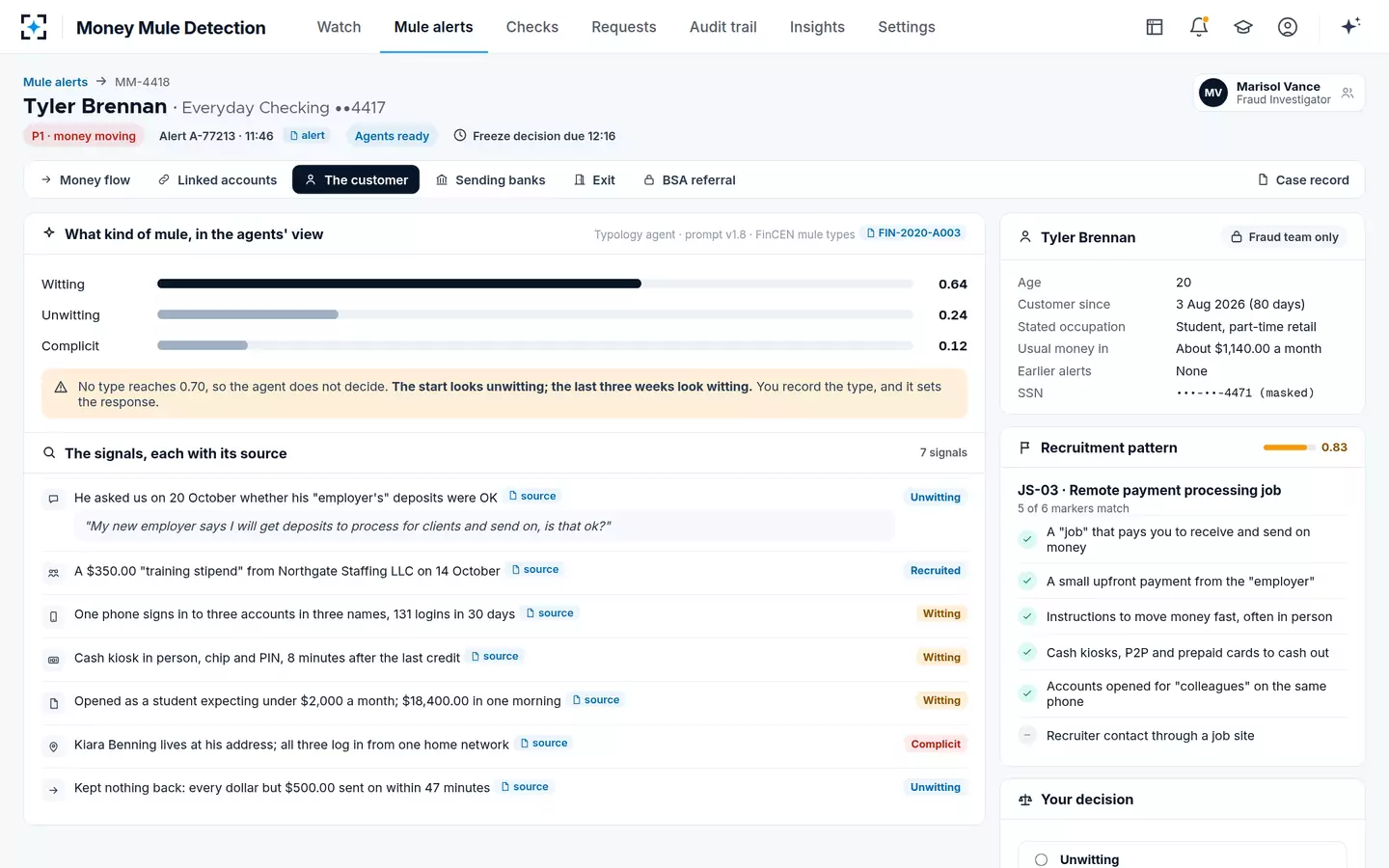
Take a sample case from Money Mule Detection, on fictional people. A twenty-year-old student's account receives $18,400.00 from three retirees in one morning and sends $17,900.00 on within 47 minutes. Two days earlier he had asked the bank, in a secure message, whether his new employer's deposits were all right. The signals sort like this.
One customer, seven signals, pointing both ways
Points to unwitting: Asked the bank on 20 October: “My new employer says I will get deposits to process for clients and send on, is that ok?”
Points to witting: Kept going after asking, without waiting for an answer that the deposits were safe.
Points to unwitting: A $350.00 “training stipend” from a staffing company, the classic hook of a fake remote job.
Points to witting: Accepted payment for moving other people’s money.
Points to unwitting: One account in his own name, opened 80 days earlier.
Points to witting: One phone signs in to three accounts in three names, 131 logins in 30 days.
Points to unwitting: Kept nothing back: every dollar but $500.00 sent on.
Points to witting: Used a cash kiosk in person, with chip and PIN, 8 minutes after the last credit.
Points to unwitting: —
Points to witting: Another linked account holder lives at his address; all three log in from one home network.
How often do two investigators agree on the mule type?
Few teams know, because few measure it. The test is simple: give two investigators the same closed cases, have each record a type without seeing the other's, and count. Percent agreement is the obvious number and it flatters, because two people choosing among three types will agree some of the time by chance. Jacob Cohen's kappa, published in 1960, corrects for that: it is observed agreement minus chance agreement, divided by one minus chance agreement (Cohen, 1960).
In the worked example at the top, two investigators agree on 33 of 44 cases, 75%. Chance alone, given how often each uses each type, would produce 38%. Kappa is 0.60. On the bands usually attributed to Cohen, 0.41 to 0.60 is "moderate"; McHugh, writing for clinical laboratories, argues the scale is too lenient and that "any kappa below 0.60 indicates inadequate agreement among the raters" (McHugh, Biochemia Medica, 2012). A fraud team does not need a laboratory's standard, but it does need to know which side of that line it is on before a type drives an exit.
The matrix matters more than the number. In the example, seven of eleven disagreements are witting against unwitting, the decision between a warning and an exit. Four are witting against complicit, which changes little in the bank's response. A team with that pattern does not need more training on complicit cases; it needs a written rule for the warning line.
A mule type that two investigators would record differently is not a finding about the customer. It is a finding about the bank's procedure.
Can an unwitting mule become witting?
Yes, and it is the usual path: the FBI says witting mules "generally begin as an unwitting mule". What changes is knowledge, and the usual source of knowledge is a warning. Law enforcement treats it the same way. In the fifth US money mule campaign, announced in May 2023, prosecutors in two districts charged people who had kept moving money after law enforcement warned them, including one who "opened 11 bank accounts at seven separate financial institutions" (U.S. Department of Justice, May 22, 2023).
For an investigator the consequence is a date. The same person may be unwitting on 14 October and witting on 22 October, and the type recorded should say as of when and why. A type without a date is a label; a type with a date and its evidence is a decision someone can review.
Does the mule type change what the bank does?
It should, though no US rule says how. The SAR obligation does not depend on the type: the activity is reportable whoever knew what. What changes is the account and the conversation. Banks already vary widely: in the Federal Reserve Financial Services survey, 58% of institutions suspended mule accounts for review before closing, and 34% left some open while filing SARs (FRFS, 2026). Leaving an account open under watch only makes sense for a customer the bank believes was deceived and has now been told.
A workable split: an unwitting customer is restricted, told plainly that the account received money from a scam and must not be used to move it, and kept under watch or exited if it happens again; a witting customer is exited with re-open flags; a complicit customer is exited, and the referral to the BSA team says why the bank believes they knew. Our page on the unwitting money mule works through those routes.
Write down what moves a case from one type to the next
The way to raise agreement is to replace judgment calls with written rules where the evidence allows it, and to leave the rest visibly to judgment. The rules below are a starting point a team can adopt and test against its own disagreements.
Rules that move a case between mule types
- A dated warning, then more of the same
Unwitting becomes witting. The warning must be on file with its date and wording.
- Several accounts in different names on one device
At least witting. Ask whether the person controls them or handed over their own.
- Recruiting others, or advertising the service
Complicit, on the FBI’s own description.
- The customer asked the bank before the money moved
Evidence of unwitting at that date; it does not cover what happened after.
- A cut kept, or cash taken in person within minutes
Weighs toward witting; on its own it does not prove knowledge.
- Family or household links
Never a mule link by themselves. A relative sharing an old address is not evidence.
- No type reaches the bar
Record “unclear”, say what would settle it, and restrict rather than guess.
How Money Mule Detection keeps the mule type a person's decision
In Money Mule Detection the typology agent weighs the three types with every signal cited and names the recruitment pattern from the bank's own library, but it says "unclear" below 0.70 and never writes a type anywhere the customer can see it. The investigator records the type; overriding the agent needs a reason code. That gives a team the raw material for the agreement test above: every case carries the agent's weights, the investigator's call and the reason for any difference.
What kind of mule: the agent's weights, the signals and the investigator's decision
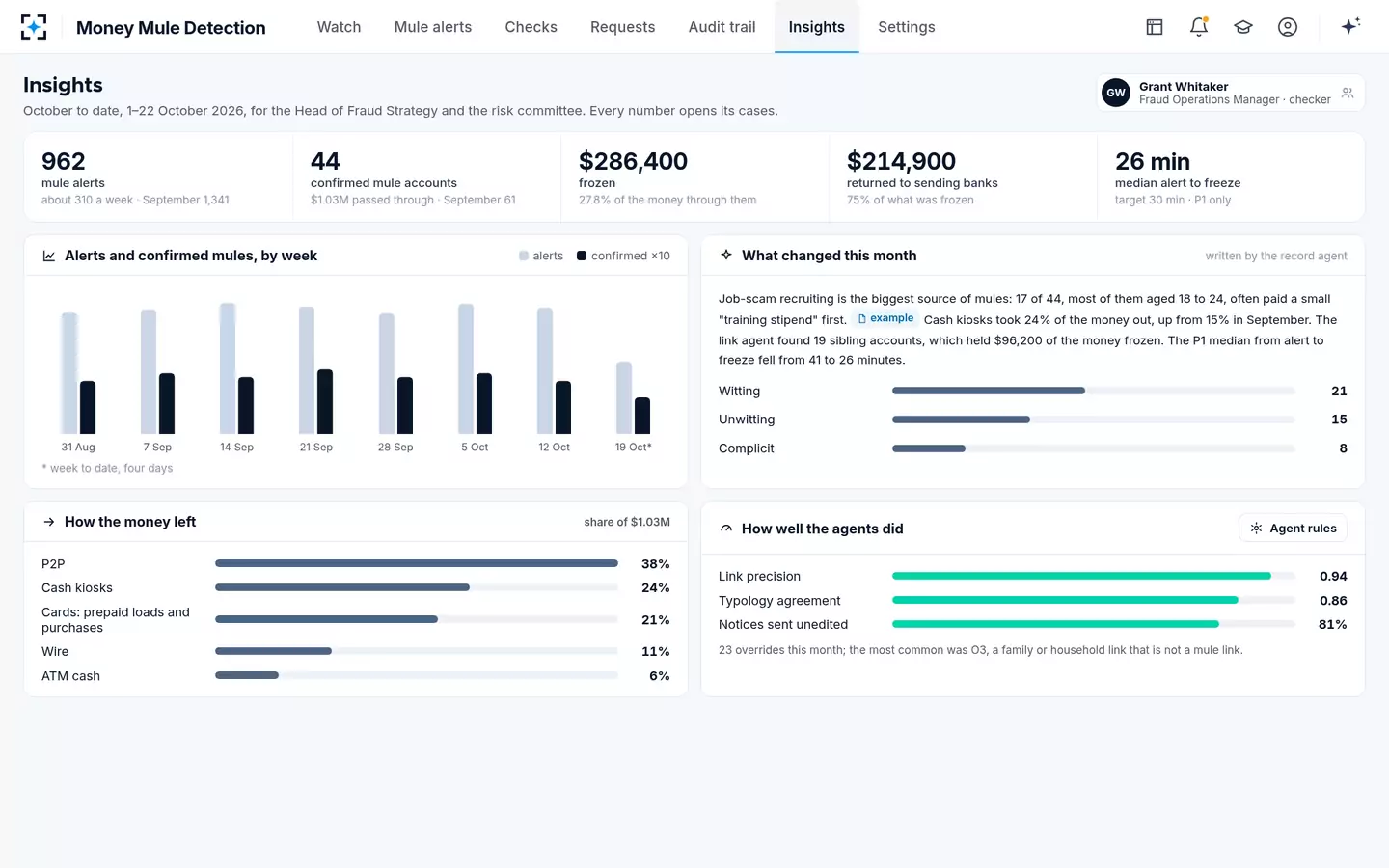
Over a month the same data becomes a team measure. On the sample program's insights screen, 44 confirmed mule accounts from 1 to 22 October split 21 witting, 15 unwitting and 8 complicit, and job-scam recruiting accounts for 17 of the 44. The screen also reports a typology agreement score of 0.86 for the agents; a team running the two-person test should define, for its own number, who is compared with whom and whether chance agreement is removed.
The mule program in a few numbers, including how the types split
Questions people ask
What are the 3 types of money mules?
Unwitting, witting and complicit. Unwitting mules do not know they are part of a scheme; witting mules ignore the warning signs or are willfully blind; complicit mules know their role and take part. The definitions are the FBI's, repeated in FinCEN's 2020 advisory.
Is an unwitting money mule still breaking the law?
They can still face consequences. The FBI's notice says people acting as money mules face prison sentences, a fine or community service, "even if unwitting". In practice, US law enforcement has sent thousands of warning letters to people it believed were unknowingly helping fraudsters, and prosecuted those who carried on.
What is a money mule typology?
A typology is a recurring pattern of how mules are recruited and used: the fake remote job that pays a "stipend", the romance that turns into requests to forward money, the overpayment scam. FinCEN's 2020 advisory names good-Samaritan, romance and work-from-home schemes. A bank's typology library lets investigators match a case against known patterns.
Should the mule type appear on the customer's file?
On the internal case file, yes, with its date and evidence. On anything the customer, the branch or the contact center can see, no: a type implies a suspicion the bank may have reported, and SAR confidentiality forbids revealing that a report exists.
How do you measure agreement between fraud investigators?
Have two investigators type the same closed cases independently, then compute percent agreement and Cohen's kappa from the matrix. Kappa removes the agreement expected by chance; the matrix shows which line, usually witting against unwitting, causes the disagreements.