Mule accounts, the accounts that receive criminal money and pass it on, are detected in four ways, and the mix a bank chooses is its money mule detection model: rules that fire on conditions someone wrote, machine learningscores trained on past mule accounts, graphs that link accounts by shared devices, addresses and payments, and agents that assemble the evidence for a person to decide. The first three detect; the fourth works the case. The right choice depends less on accuracy claims than on what your investigators must explain to a manager, a sending bank, a customer and an examiner. Botminds' Money Mule Detection is an agentic solution in the fourth category. Below, one sample case runs through all four.
One mule case, four money mule detection models
Rules: Conditions someone wrote: amount, account age, speed of outflow
Scores: Patterns learned from past confirmed mule accounts
Graphs: Shared devices, addresses, payees and senders across accounts
Agents: The alerted account’s money in and out, linked accounts, the customer’s own history, each from its source
Rules: Fires on a large inbound wire to an 80-day-old account, if the rule watches money coming in
Scores: Ranks the account high: $18,400 in one morning against about $1,140 a month
Graphs: Finds one phone signing in to three accounts in three names
Agents: Draws all nine legs, the 47-minute exit, $6,862.18 still reachable and two linked accounts
Rules: Only with a device rule written for it
Scores: Scores each account alone
Graphs: Yes, and also links a relative on an old address
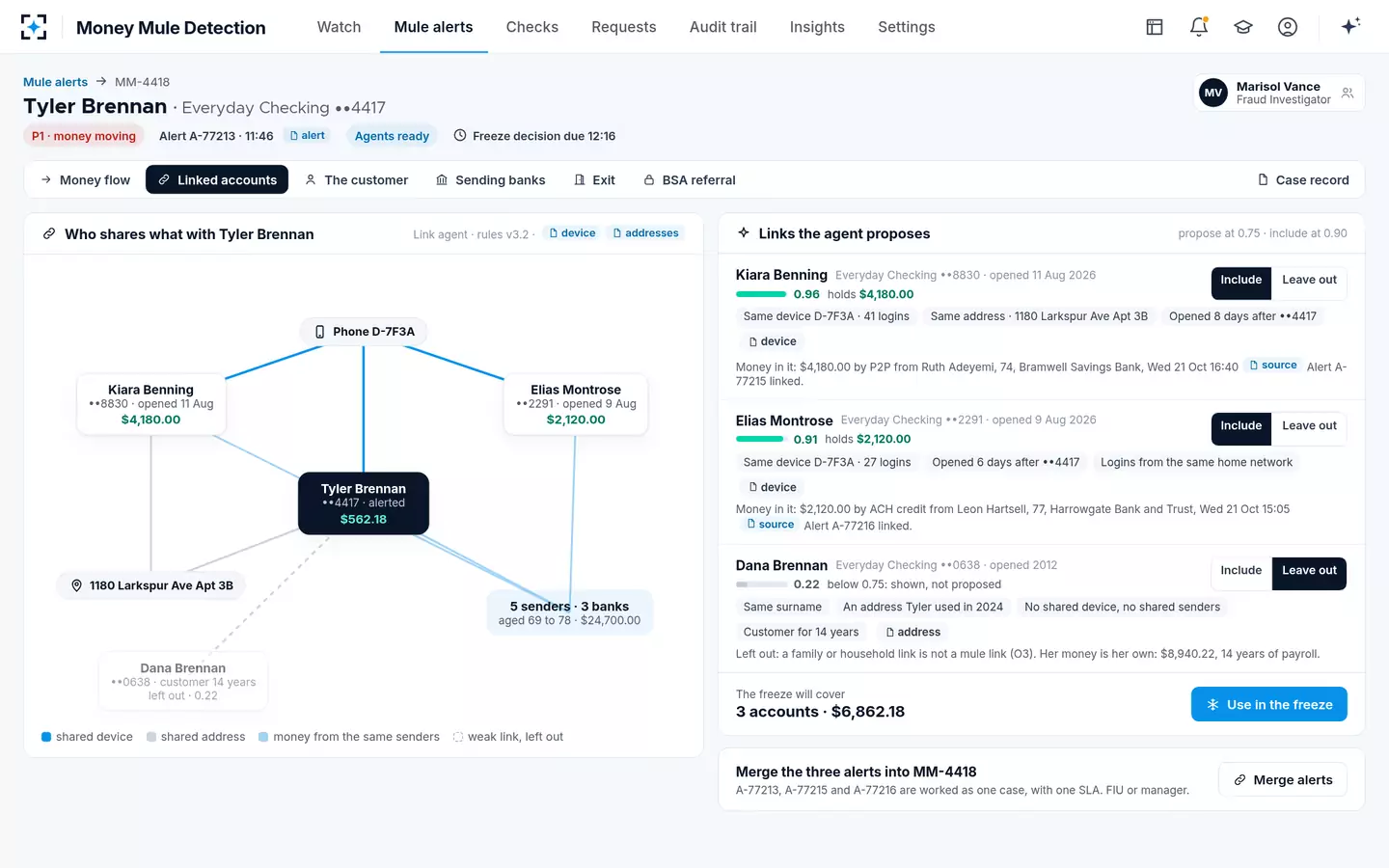
Agents: Proposes links with evidence; leaves the relative out with a reason
Rules: No
Scores: No
Graphs: No
Agents: Weighs unwitting, witting and complicit with signals cited; a person records the type
Rules: The condition that fired
Scores: A number and its top features
Graphs: The shape of the ring
Agents: Every leg, link and signal, opened at its source
Rules: Not a “model”: deterministic rules are excluded
Scores: A model, validated as one
Graphs: A model if it scores; a rule if it only matches
Agents: Agentic AI is outside the guidance; governed by the bank’s own controls
Rules: Evaded once criminals learn the threshold
Scores: Needs history a new account lacks
Graphs: Over-links households and shared housing
Agents: Needs an alert to start from and the bank’s own feeds
How are mule accounts detected, and which method is best?
The best model is a stack, not a choice: a detection layer that raises the alert early and a case layer that turns it into a decision fast. The UK Financial Conduct Authority, which has reviewed mule controls three times since 2023, declines to pick one: "Both types of systems have benefits and shortcomings and we do not propose a prescriptive approach" (FCA, October 2023). It does say what good looks like: "Machine learning models with a combination of tactical rules and behavioural biometrics can contribute to a robust and more proactive fraud detection system if firms fully understand and apply these tools appropriately." The condition at the end is the whole test.
Most banks have not built the stack yet. In the Federal Reserve Financial Services survey of more than 400 institutions, the most common ways of finding mule accounts were manual: review at opening and alerts from other banks.
How US institutions find mule accounts today
58%
use rules-based analysis in AML review of payment types
53%
find them when another institution alerts them
28%
screen received transactions in real time
Rules vs machine learning for mule detection
Rules are explainable and evadable; machine learning adapts and needs governing. A rule such as a credit over $5,000 to an account under 90 days old, followed by outflows of more than 80% within a day fires for one reason anyone can read, which makes it easy to defend and easy for a recruiter to coach around. The FCA found the cost of rules is speed of change as much as accuracy: firms "taking too long to implement changes to their transaction monitoring rules even where they had identified a mule characteristic" (FCA, 2023).
Machine learning learns patterns no one wrote down, but it learns from the past. The FCA noted that models need a customer's history to know what normal looks like, a problem for mule accounts, which are often new. Academic work on fraud models adds concept drift and verification latency: investigators confirm only a small share of transactions in time for the model to learn from them (Dal Pozzolo et al., IEEE TNNLS). Our page on mule account detection using machine learning takes the tasks of a case one by one.
Rules vs machine learning on the questions an examiner asks
Rules: The written condition, word for word.
Machine learning score: The features that weighed most, if the vendor exposes them.
Rules: Anything just under the threshold, and every new pattern.
Machine learning score: Patterns absent from past cases, and new accounts with no history.
Rules: Edit, test, approve; slow if the change queue is long.
Machine learning score: Retrain on new labels; validate as a model before use.
Rules: Excluded: “deterministic rule-based processes”.
Machine learning score: In scope: a statistical method producing quantitative estimates.
What is a mule score, and what does it leave out?
A mule score is a number, usually between 0 and 1, that ranks an account by how closely its behavior matches past mule accounts. It is good at ordering a queue. It leaves out three things the next hour depends on: where the money went, which other accounts belong to the same people, and whether the account holder knew. FinCEN's red flags are a reminder of why a score alone cannot carry a freeze: the advisory says no single indicator proves wrongdoing, and asks institutions to weigh each one against the wider facts, starting with the customer's own history (FinCEN Advisory FIN-2020-A003).
Even good tools are treated that way by the people who use them. Firms told the FCA that they do not take a tool's alert, by itself, as proof that an account is a mule (FCA, January 2025). The score starts the case. Something else has to finish it.
How do graph models find money mules?
Graph models find mules by what accounts share rather than what each does. Accounts become nodes; devices, addresses, phone numbers, senders and payees become edges; and patterns such as several accounts on one device, or many senders converging on one account, stand out. The FCA called a shared device a typical mule sign, often meaning the customer has sold their account details to a herder who now runs the account (FCA, 2023). FinCEN's June 2026 fact sheet lists the same kinds of evidence among what banks may share under 314(b), including accounts that share the same or near-identical identifying details (FinCEN).
Graphs have a characteristic failure: they over-link. Families share addresses; students share flats; one phone may belong to a household. The FCA's own advice is to check whether there is an innocent explanation, such as people living in one household. In the sample case the graph also connects a relative who shares a surname and an address the customer used in 2024. The link is real and means nothing. Money mule networks works through how to link accounts without over-linking.
A graph proposes links; the evidence decides which go in the freeze
Where agents fit: after the alert, before the decision
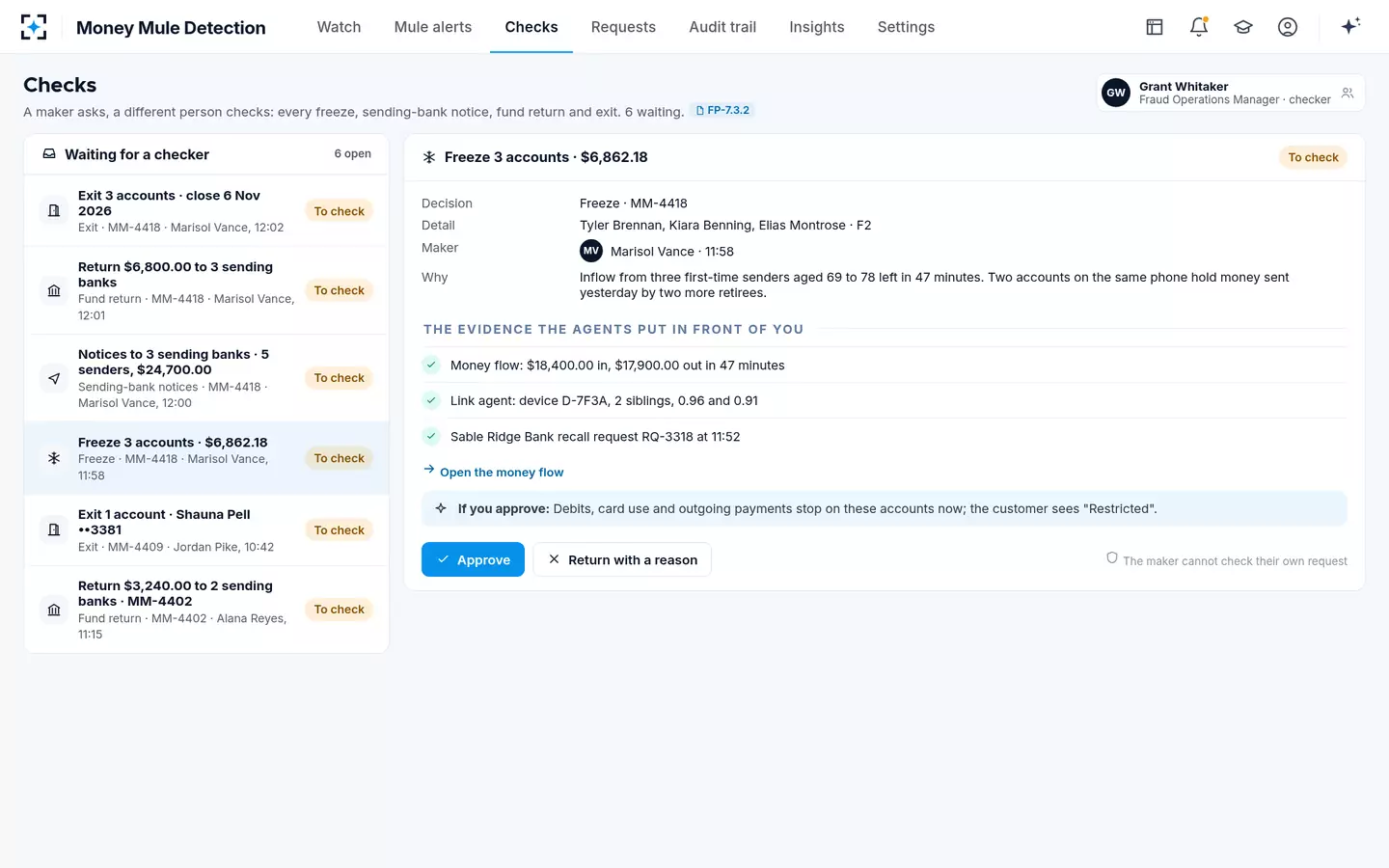
Agents are not a fourth way of scoring. They take the alert any of the other three raises and do the work between it and a decision: trace each payment in and out, propose links with their evidence, weigh the mule type, and draft the freeze request, the notices to sending banks, the return plan, the exit and the referral. In the sample case that work took the agents three minutes after the alert, and a person decided everything that followed.
A layered money mule detection model, from alert to decision
Agent
Trace and linkEvery leg drawn to its source; accounts sharing a phone, address or senders proposed with evidence.
Never: Links on a surname alone; hides a leg a late feed is missing.
Agent
Weigh and draftMule type weighed with signals cited; freeze, notices, return, exit and referral drafted.
Never: Sends, freezes, moves money or files.
A person decides
Investigator decidesRequests the freeze with a reason code, records the type, edits the drafts.
A person decides
Manager checksApproves or returns each request with a reason; cannot check their own.
What data does a mule model need?
Every approach needs money in both directions, device and login data, counterparties, and what the customer said at opening; models also need outcomes. The FCA found gaps in each: firms that "do not capture information during the onboarding phase such as, salary or turnover details", firms watching outbound but not inbound payments, and firms that "could not easily produce customers' proof of identification" when investigating (FCA, 2023; FCA, 2025).
Two sources are underused. The first is other banks: in the Federal Reserve Financial Services survey, 53% of institutions said another institution's alert is how they find mule accounts, yet only 18% shared under 314(b) on a regular basis (FRFS, 2026). The second is the customer's own words: secure messages, contact-center notes and branch conversations, where a deceived customer often asks whether a "job" is real before the money moves.
How do you validate a money mule detection model?
Validate it on your own closed cases with the outcomes held back, and measure what the bank cares about: how early the model would have alerted, how much money would still have been there, how many linked accounts it would have found, and how many genuine customers it would have touched. For a statistical score, the 2026 guidance applies; for rules, test that they fire as written, since the FCA found alerts that "did not trigger when parameters had been met". For agents, which the guidance leaves out of scope, validate each step's output: do the traced legs match the payments system, are proposed links right, do investigators agree with the drafts?
Money Mule Detection builds part of that into its controls: link rules, prompts, models and thresholds are versioned, and a new rule goes live only after a 90-day back-test and approval by someone other than its proposer. On the sample program's insights screen, link precision is 0.94 and 81% of sending-bank notices were sent without edits, both on fictional sample data.
Validating any money mule detection model on your own cases
- Pick closed cases with known outcomes
Confirmed mules, cleared customers and the cases you are unsure of; hold the outcomes back.
- Measure the minute it would have alerted
Against the minute the credit landed and the minute the money left.
- Measure the money it would have reached
Share of inflow still in the account, plus money in accounts it links.
- Count the genuine customers it touches
Every false alert is a restriction on a customer who did nothing wrong.
- Ask your investigators to explain three decisions
If they cannot, from what the model shows, neither can the examiner.
- Re-run after each change
Versioned rules and thresholds, a back-test, and an approver who did not propose it.
The decision a model feeds: a freeze, checked by a second person
Choose a money mule detection model by the sentence your investigator will have to say out loud: we froze this account because… The model that finishes that sentence with evidence is the one to buy.
How do you switch mule detection approaches?
Switch in layers and in parallel. Keep existing rules as a floor while a score or graph runs beside them; compare their alerts on the same weeks; and move the case work to agents on alerts the bank already trusts before changing detection at all. The case layer can change first because it changes no alert: it changes the minutes after one. Because rules are excluded from the model risk guidance and statistical scores are not, plan validation effort before the switch, not after it. Our guide to money mule account detection tools prices each layer.
Questions people ask
Is machine learning better than rules for detecting money mules?
Not on its own. The FCA found machine learning reduces the risk that criminals simply learn a rule's threshold, but also that some firms could not explain their tools and analysts were unsure why alerts fired. Most mature setups combine both, with rules for known patterns and a score for the rest.
What is the best data for a money mule detection model?
Inbound and outbound payments, account age, stated income or turnover at opening, devices and logins, counterparties, and confirmed outcomes. The FCA found firms missing income data at opening, which leaves a model nothing to compare a large first deposit against.
Can a graph model detect a mule network across banks?
Only as far as its data reaches. A graph of one bank's customers sees shared devices and addresses inside that bank; following money to other banks needs their cooperation, through 314(b) sharing in the US or through cross-bank tracing schemes such as the one the FCA reviewed on the UK's Faster Payments System.
Do mule detection models need model risk validation?
A statistical score does: it is a "model" under the April 2026 guidance. Deterministic rules are excluded, and generative and agentic AI are explicitly outside its scope, pending a promised request for information. Banks still govern those under their own controls.
How long does it take to switch to a new mule detection model?
The case layer can change in weeks, because it changes no alert. A new score or graph should run in parallel with existing rules long enough to compare outcomes on the same cases; Money Mule Detection itself requires a 90-day back-test before a new link rule goes live.