The SEC reg flex agenda 2026 is the Commission's spring 2026 Regulatory Flexibility Agenda, printed in the Federal Register on 14 August 2026 with information "accurate on May 12, 2026". For asset managers its Division of Investment Management section listed seven rulemakings at the proposed-rule stage, from Form N-PORT and Form PF to custody, pay-to-play and cross trading, plus one long-term item. By 15 October 2026 all seven had been proposed, and five proposals affecting advisers and funds had comment periods running into December. Reading the agenda well is part of regulatory change management: it is a forecast of what the change team will have to triage, map to funds and comment on. Botminds' Regulatory Change Management for Asset Managers keeps each agenda entry, proposal, comment date and withdrawal in one register, tied to the funds and owners it would touch.
This guide is for the regulatory change analyst who reads the agenda each spring and fall, and the CCO who has to staff for it. Every agenda entry and date below is from the Federal Register; the comparison with what happened is ours.
The 2026 agenda for advisers and funds, in four numbers
7
Investment Management rulemakings at the proposed-rule stage in the spring 2026 agenda
7
of them proposed in the Federal Register by 15 October 2026
5
proposals touching advisers and funds with comment periods open on 28 October 2026
27
SEC documents filed under proposed rules from January to 27 October 2026, against 3 in 2025
What is the SEC regulatory flexibility agenda?
The regulatory flexibility agenda is a list, published twice a year under the Regulatory Flexibility Act, of rules the SEC expects to consider in the next 12 months that may affect small entities, each with a stage and an estimated date. The spring 2026 edition is the one people search as the "SEC spring regulatory agenda" or the "SEC reg flex agenda 2026"; the next edition will update it. The printed version is partial: the SEC now prints in the Federal Register "only those agenda entries for which we have indicated that preparation of an RFA analysis is required", and the complete agenda sits on reginfo.gov.
It is also a statement of one person's priorities. The preamble says the items "reflect only the priorities of the Chairman of the U.S. Securities and Exchange Commission, and do not necessarily reflect the views and priorities of any individual Commissioner" (91 FR 53164). An agenda entry is therefore an intention, not a proposal, and a proposal is not a rule; a change register that treats them as the same will plan work that never arrives.
What the spring 2026 agenda listed for investment advisers and funds
The Division of Investment Management's proposed-rule stage held seven entries. Two had already been proposed when the agenda was compiled. Of the other five, three carried the estimate "10/00/26", meaning October 2026 with no day, and two pointed to the Regulatory Plan printed alongside. The table follows each one by its Regulation Identifier Number, the only key that survives a change of title.
Seven Investment Management agenda entries, and what each became by 28 October 2026
| Agenda entry (RIN) | Agenda estimate | What was published | Comments close |
|---|---|---|---|
| Amendments to Form N-PORT (3235-AN44) | Proposed 23 Feb 2026 | Form N-PORT Reporting: 15 more days to file monthly reports, quarterly publication restored | 24 Apr 2026 |
| Form PF; all filers and large hedge fund advisers (3235-AN64) | Proposed 24 Apr 2026 | Form PF; Reporting Requirements for All Filers: filing threshold from $150 million to $1 billion | 23 Jun 2026 |
| Electronic Delivery of Information (3235-AN57) | October 2026 | Regulation E-Delivery, proposed 21 Jul 2026 | 21 Sep 2026 |
| Pay-to-Play Reform (3235-AN65) | October 2026 | Proposal to rescind the political contribution rule, 10 Sep 2026 | 9 Nov 2026 |
| Amendments to the Custody Rules (3235-AN46) | Regulatory plan entry | Adviser and Regulated Fund Custody Rules; Crypto Custody Rules, 6 Oct 2026 | 7 Dec 2026 |
| Enhancing Retail Exposure to Private Markets (3235-AN59) | Regulatory plan entry | Investment Adviser Performance-Based Compensation Modernization, 6 Oct 2026 | 7 Dec 2026 |
| Amendments to Rule 17a-7 (3235-AN45) | October 2026 | Investment Company Cross Trading, 15 Oct 2026 | 14 Dec 2026 |
Two rows teach more than the rest. The pay-to-play entry was titled "reform"; the proposal that arrived would rescind Rule 206(4)-5 altogether, with the Commission saying other obligations, including the compliance rule and the code of ethics rule, are "likely sufficient to address pay-to-play practices" (91 FR 57698). And the entry called "Enhancing Retail Exposure to Private Markets" reached the Federal Register as a performance-fee proposal that would widen advisers' ability to charge regulated funds performance-based compensation and widen the "qualified client" definition to accredited investors (91 FR 63676). A register keyed by title would have lost both.
How reliable are SEC agenda dates?
For 2026 the stages were reliable and the months were not. Every Investment Management entry at the proposal stage was proposed within the agenda's 12-month window; two of the three with an October estimate came early, e-delivery in July and pay-to-play in September, and the cross-trading proposal arrived in mid-October as estimated. The agenda warns about exactly this.
"The Commission may consider or act on any matter earlier or later than the estimated date provided on the agenda."
SEC, Regulatory Flexibility Agenda, 91 FR 53164
The practical reading is to plan for the stage and staff for the window, not the month. An entry estimated for October can reach a comment deadline in September, as Regulation E-Delivery did. Entries without a date go into the long-term category, where the SEC says it "may nevertheless act on items in that category within the next 12 months". And the opposite happens too: an item can appear in the Federal Register with an identifier that is not among the printed entries at all, which is why the printed agenda is not a complete list of what the change team will see.
Estimated versus actual: three October estimates that arrived on different dates
- Agenda compiled to proposal12 May → 21 Jul
- Comment periodto 21 Sep
- Agenda compiled to proposal12 May → 10 Sep
- Comment periodto 9 Nov
- Agenda compiled to proposal12 May → 15 Oct
- Comment periodto 14 Dec
SEC proposed rules 2026: why the count went from 3 to 27
The Federal Register filed 27 SEC documents as proposed rules between 1 January and 27 October 2026, after 3 in all of 2025 and 9 in 2024 (Federal Register API). In 2025 the agencies were also reviewing rules already adopted, under a Presidential Memorandum of 20 January 2025 that the SEC cites in its own Form PF extension notices; the 2026 count includes the agenda's proposals plus requests for comment, concept releases and a correction, so it overstates new rules but not new reading.
SEC proposed-rule documents rose ninefold in 2026; final rules fell
For a change team the useful split is between documents that need a decision from the firm and documents that need only triage. A proposal touching a fund type the firm runs needs a fund-level view and a decision on whether to comment; a final rule needs the full process; a correction needs to be attached to the item it corrects, not opened as a new one.
SEC withdrawn proposed rules: closing items the agenda no longer carries
On 17 June 2025 the SEC withdrew 14 proposals issued between March 2022 and November 2023, saying it would not finalize any of them (90 FR 25531). The list included the 2023 Safeguarding Advisory Client Assets proposal, the 2022 cybersecurity risk management proposal for advisers and funds, and the predictive data analytics conflicts proposal.
Withdrawal is a change to be managed like any other. A firm that had mapped the safeguarding proposal to its custody procedures needed to close that item with a reason, and then, when the SEC proposed new adviser and fund custody rules on 6 October 2026, open a new one rather than reviving the old analysis: the notice itself says that if the Commission returns to an area, "it will issue a new proposed rule". The register should show both items and the link between them.
Which SEC proposals affect investment advisers in 2026, and when do comments close?
Five proposals that touch advisers or funds were open for comment on 28 October 2026. Each needs an owner, a first view of which funds or entities it would hit, and a decision on whether the firm or its trade group will comment, before the deadline rather than after the final rule.
The comment calendar for advisers and funds, as of 28 October 2026
| Proposal | Published | Comments close | Who in the firm reads it first |
|---|---|---|---|
| Political contributions: rescind Rule 206(4)-5 | 10 Sep 2026 | 9 Nov 2026 | CCO and the pay-to-play pre-clearance owner |
| Interval fund modernization and multiple share classes for closed-end funds | 5 Oct 2026 | 4 Dec 2026 | Fund product, fund legal and fund treasurer |
| Adviser and regulated fund custody rules; crypto custody | 6 Oct 2026 | 7 Dec 2026 | Operations, custody oversight and Form ADV owner |
| Adviser performance-based compensation; qualified client | 6 Oct 2026 | 7 Dec 2026 | Fund board liaison, product and Form ADV owner |
| Investment company cross trading (Rule 17a-7) | 15 Oct 2026 | 14 Dec 2026 | Trading compliance and the fund CCO |
Several of these interact with dates already in the change register. The 2024 Form PF amendments, now due on 1 July 2027, sit beside a 2026 proposal that would raise the Form PF filing threshold, and the guide to the Form PF compliance date extension works through how to plan for both. Every dated item lands on the firm's RIA compliance calendar for 2026–27.
Reading the SEC agenda beside the UK and EU pipelines
A manager with European entities reads three pipelines, and they behave differently. The UK regulators' Regulatory Initiatives Grid, tenth edition, first published on 19 May 2026, "sets out the planned regulatory initiatives for the next 24 months" and lists 135 live initiatives (FCA, Regulatory Initiatives Grid). Its investment management section holds six, two of them marked higher impact: liquidity risk management in funds and a new data collection regime for asset managers and funds, on which the FCA planned to consult in the third quarter of 2026.
ESMA's 2026 work programme, dated 3 October 2025, listed guidelines on suspensions of subscriptions and redemptions under the AIFMD and UCITS Directive among its 2026 outputs (ESMA, 2026 Annual Work Programme). On 2 June 2026 ESMA's chair wrote to the Commission that those guidelines would be delayed until after adoption of the Market integration and supervision package (ESMA, prioritisation of 2026 deliverables). Like the SEC agenda, a work programme is a plan that its author revises mid-year, and the revision is itself a publication to capture.
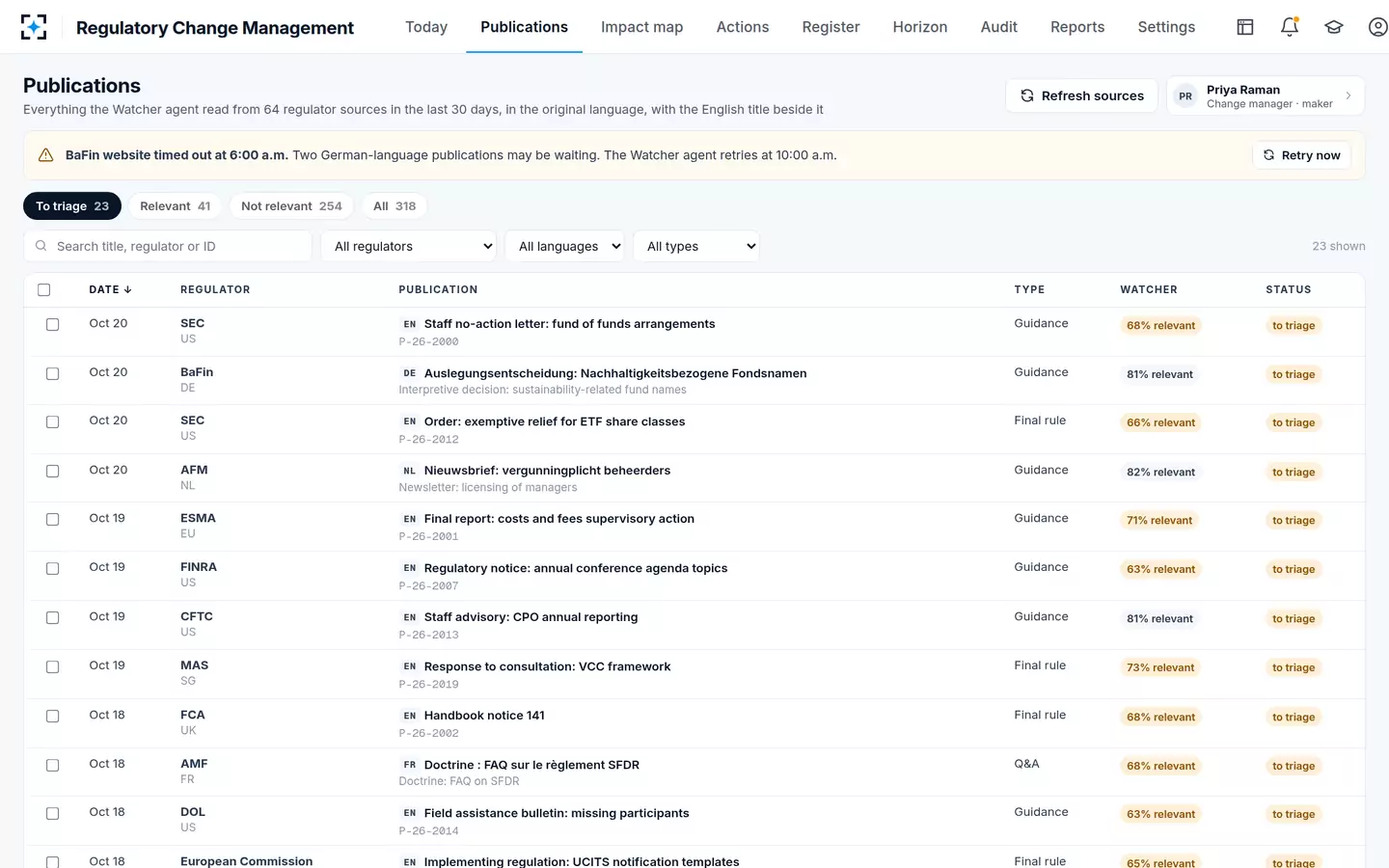
Every publication in one queue, whatever its source or language
What to staff for: the agenda as a workload forecast
An agenda tells a change team roughly how many items will need a fund-level view in the next year and when the comment windows are likely to open. Counting the 2026 Investment Management entries, a US fund complex should have expected five more proposals in roughly five months, with comment windows of about 60 days each and at least two overlapping in December. That is a forecast of analyst and lawyer time, and it is the main reason to read the agenda at all.
Three habits turn the forecast into a plan. Track every entry by its identifier, so a renamed proposal is recognised. Open a lightweight item for each entry that touches a fund type or entity the firm has, with an owner and a provisional list of affected funds. And re-read the agenda against the Federal Register each month: when an entry is proposed, the item moves to the proposal stage with its comment date; when it is withdrawn, it closes with the reason.
Dates on the horizon, including comment deadlines and moved dates
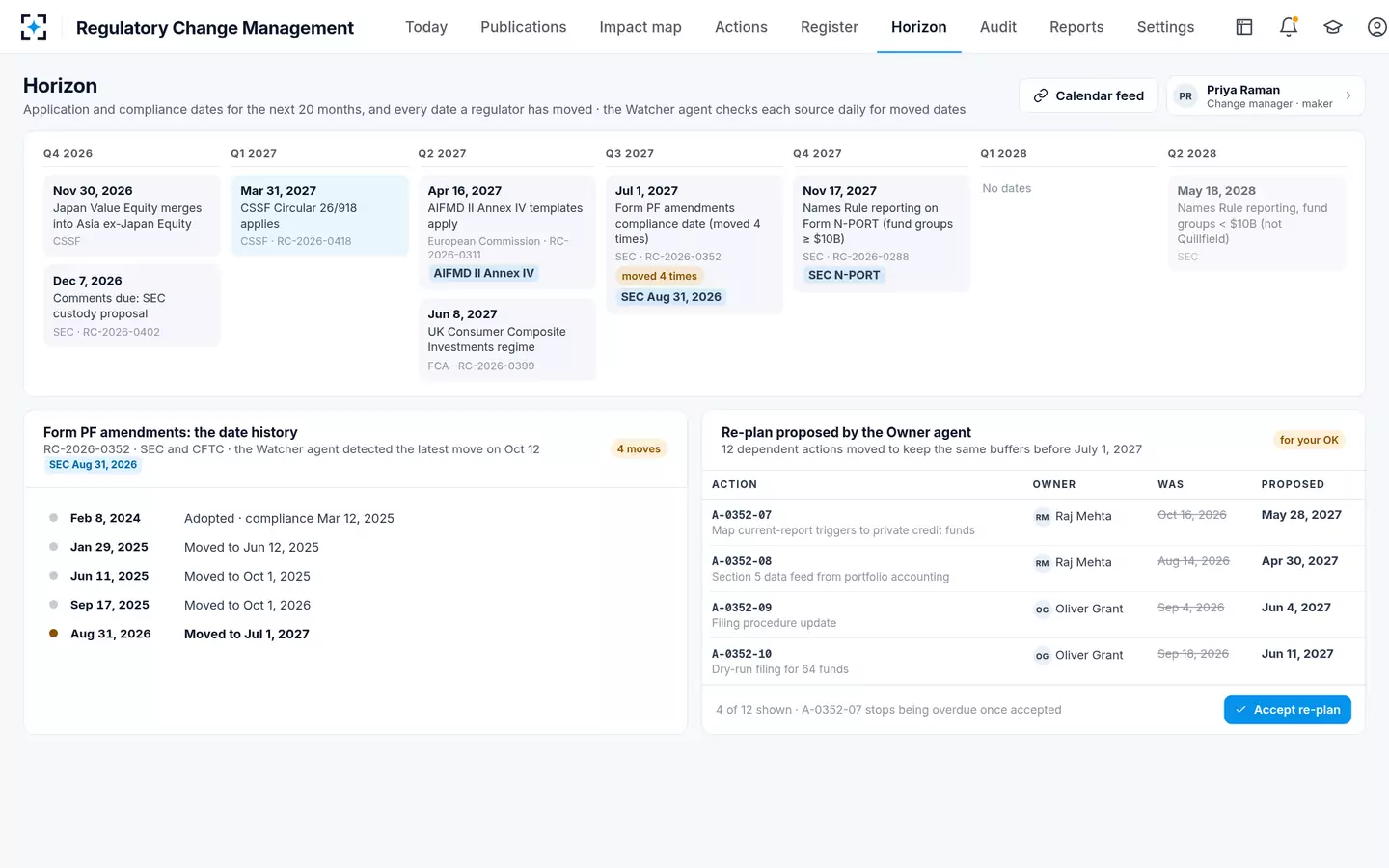
The solution's Watcher agent reads the Federal Register, the SEC's own pages and the other regulators daily and classifies each publication as a proposal, final rule, guidance, consultation or date change; the analyst decides relevance where it is unsure, and every proposal that touches the firm becomes an item with an owner. To see the agenda and the comment calendar on your own fund list, start from Regulatory Change Management for Asset Managers.
Questions people ask
What is the difference between the SEC spring and fall regulatory agendas?
They are the two editions of the same semiannual agenda required by the Regulatory Flexibility Act. Each restates the Chairman's planned rulemakings with stages and estimated dates and records items completed or withdrawn since the last edition. The spring 2026 edition was printed on 14 August 2026 with data as of 12 May 2026.
Where can I find the full SEC rulemaking agenda for 2026?
On reginfo.gov, in the Unified Agenda, under the Securities and Exchange Commission. The Federal Register prints only the entries for which an analysis under the Regulatory Flexibility Act is required, so the printed list is shorter than the full agenda.
Is an item on the agenda a proposed rule?
No. An agenda entry is a statement that the staff is considering recommending a rulemaking; it has no legal effect. A proposal exists only when it is published for comment, and the agenda says the Commission may act earlier or later than the estimate, or not at all.
Which SEC proposals were withdrawn in 2025?
Fourteen proposals published between March 2022 and November 2023, withdrawn on 17 June 2025, including Safeguarding Advisory Client Assets, cybersecurity risk management for advisers and funds, and predictive data analytics conflicts. The SEC said it would issue a new proposal if it returned to any of those areas, as it did for custody in October 2026.
Does the SEC agenda include FINRA rule changes?
No. FINRA rule changes reach the Federal Register as SEC notices and orders on self-regulatory organisation filings, not as agenda entries; 1,466 of the 2,070 SEC notices published from January to 27 October 2026 were titled as such filings. The approval of FINRA's Rule 2210 change on projections, ordered on 15 October 2026, is an example.
How far ahead does the SEC agenda look?
Twelve months for the proposed and final rule stages, under the Regulatory Flexibility Act. Items without an estimated date sit in a long-term category, which the SEC says it may still act on within the year; in the 2026 edition the customer identification programme for advisers carried an estimate of July 2027.