Regulatory horizon scanning software for a fund manager watches every financial regulator that supervises the firm for what is coming and when, and turns each publication into a dated item someone owns. For an asset manager it goes live in a fixed order: first the sources and languages, so nothing is missed; then the map of funds and entities, so every item can be tested for scope; then the owners, so every decision lands on a person; and finally a replay of the last six months of real publications, compared call by call with what the team decided by hand. Skipping the order is the usual reason a horizon scanning project produces alerts nobody acts on. Botminds' Regulatory Change Management for Asset Managers is set up the same way: connect the regulator sources, import the fund master, the policy library and the coded rules, map owners, then replay past publications and compare.
This guide is for the regulatory change manager who will run the go-live and the CCO who will sign it off. Regulator facts are linked where they appear; examples use the solution's fictional sample firm, Quillfield Capital, which reads 64 sources for entities in 9 domiciles.
What a horizon has to hold at a multi-domicile manager
64
regulator and standard-setter sources read daily at the sample firm
135
live initiatives on the UK regulators’ grid of May 2026, over 24 months
2
editions of that grid a year, neither updated after it is published
20
months of application and compliance dates on the sample firm’s horizon screen
What does horizon scanning mean for an asset manager?
Regulatory horizon scanning is watching regulators for what is coming and when: proposals, consultations, work programmes, final rules with future dates, and changes to dates already set. It differs from triage of today's publications in what it produces: not "is this relevant?" but "what will we have to do, by when, and for which funds?". A good horizon holds both kinds of date, the regulator's planned milestones and the firm's own due dates worked back from them.
Regulators publish horizons of their own, and they are the best starting point. The SEC's semiannual agenda lists the Chairman's planned rulemakings with estimated dates (91 FR 53164), ESMA publishes an annual work programme, and the UK regulators publish the Regulatory Initiatives Grid. None of them is a horizon for a particular firm; each needs to be read against the firm's own funds and entities.
FCA regulatory horizon scanning: what the Regulatory Initiatives Grid gives you
The grid is the UK regulators' joint plan for the next two years. Its tenth edition, first published on 19 May 2026, lists 135 live initiatives, a third of them joint, each with a lead authority, expected milestones, an indicative impact on firms marked higher, lower or unknown, and quarter-by-quarter timing (FCA, Regulatory Initiatives Grid). Its investment management section lists six initiatives, two marked higher impact: implementing international guidance on liquidity risk management in funds, and a review of data collection for asset managers and funds on which the FCA planned to consult in the third quarter of 2026 (Grid, May 2026).
What it does not do is change after publication. The FCA says so plainly, which is the single best argument for horizon scanning software that reads the regulators daily rather than the grid twice a year.
"Editions will not be updated after publication to reflect the impacts of these decisions or to add initiatives announced later."
FCA, Regulatory Initiatives Grid, 10th edition
ESMA's programme behaves the same way. Its 2026 work programme, dated October 2025, listed guidelines on fund suspensions under the AIFMD and UCITS Directive among its 2026 outputs (ESMA, 2026 Annual Work Programme); in June 2026 a letter from its chair postponed them until after a pending legislative package was adopted (ESMA, letter of 2 June 2026). A horizon built once from the programme would still show the old date.
Reading a regulator’s horizon on the day it lands: the grid’s investment management section
The day a horizon document is published, each item in it relevant to the firm should become a dated placeholder with a provisional owner. For a UK investment manager the grid's investment management section is the obvious start; the table maps its six initiatives to the people who would read each first.
The six investment management initiatives on the May 2026 grid, and who should read each
| Initiative (lead) | Indicative impact | Milestone as stated | First reader at a UK manager |
|---|---|---|---|
| Solo remuneration rules review (FCA) | Unknown | Consultation paper, Q3 2026 | HR and the remuneration committee secretary |
| Liquidity risk management in funds (FCA) | Higher | Consultation on UCITS and non-UCITS retail schemes in December 2025; further consultation on retail funds in illiquid assets, H2 2026 | Head of risk and fund product |
| Money market fund resilience (FCA) | Unknown | Final draft rules in the summer, final rules at the end of the year | Treasury and liquidity fund managers |
| Review of data collection for asset managers and funds (FCA) | Higher | Consultation on a new reporting regime, including draft rules, Q3 2026 | Regulatory reporting and fund operations |
| Registration of authorised fund assets (FCA) | Unknown | Consultation paper by end of Q2 2026 | Depositary oversight and private markets funds |
| Repeal and replace of AIFMD (FCA and HM Treasury) | Unknown | Draft statutory instrument and FCA consultation with draft rules, around mid-2026 | Fund legal and AIFM compliance |
Several of those milestones had passed by the autumn of 2026, which is the point: the grid told the firm when to look, and only daily reading of the FCA's own publications tells it whether the consultation actually appeared. Each row on the firm's horizon should carry both the planned milestone and the publication that met it, or a note that it has not appeared yet.
The regulatory horizon scanning process, end to end
The process has five stages, and the software's job is to make each one cheap and visible, not to make the decisions. In the solution the agents run the reading and drafting; the people steps are the ones a regulator would expect to see signed.
Horizon scanning, from source to owned date
Agent
Read every sourceEach regulator and standard setter on the list, daily, in the original language; a source that fails is shown with its retry time.
Never: Never drops a source silently.
Agent
Classify and dateProposal, consultation, work programme, final rule, guidance or date change; application and compliance dates extracted, moved dates detected against earlier publications.
A person decides
Decide relevanceAn analyst decides every item below the confidence threshold and samples the rest; each "not relevant" carries a reason.
Agent
Test funds and draft the planEvery fund tested against the fund master; dated actions proposed, worked back from the regulator’s date.
Never: Never decides applicability or extends a date.
A person decides
Approve and ownChange manager proposes scope, Legal approves, owners accept their dates; the CCO approves any extension.
Step one of go-live: how many regulator sources does an asset manager need?
As many as there are regulators of the firm's entities and funds, plus the standard setters and official journals whose output those regulators implement. Build the list from the entity register, not from a vendor's catalogue: each licence names a regulator, and each fund's domicile adds the fund regulator. The sample firm's 64 sources include the SEC, FINRA, the CFTC, the Department of Labor, the FCA, ESMA, the CSSF, the Central Bank of Ireland, BaFin, the AMF, CONSOB, the CNMV, the AFM, MAS, the SFC, the Japanese FSA, the Federal Register and the EU's Official Journal.
Building the source list from the entity register: one row per licence or domicile
| Entity or fund domicile | Regulators and journals to read | Original language | Format to expect |
|---|---|---|---|
| US registered adviser and US funds | SEC, FINRA where an affiliate is a member, CFTC for commodity pools, Department of Labor for plan assets; Federal Register | English | Releases, staff statements, risk alerts, SRO filings; Federal Register API |
| UK investment manager | FCA, Bank of England and PRA where relevant; the joint Regulatory Initiatives Grid | English | Policy statements, consultation papers, Handbook notices, the grid twice a year |
| Luxembourg management company and funds | CSSF; ESMA; EU Official Journal | French and English; record which version the regulator treats as the reference | Circulars, FAQs, press releases |
| Irish UCITS platform | Central Bank of Ireland; ESMA; EU Official Journal | English | Regulations, guidance, Dear CEO letters |
| German, French, Italian, Spanish and Dutch distribution | BaFin, AMF, CONSOB, CNMV, AFM | German, French, Italian, Spanish, Dutch | Circulars, interpretive decisions, Q&A, newsletters |
| Singapore, Hong Kong and Japan entities | MAS, SFC, Japanese FSA | English (MAS); English and Chinese (SFC); Japanese, with English for some texts (FSA) | Notices, circulars, FAQs |
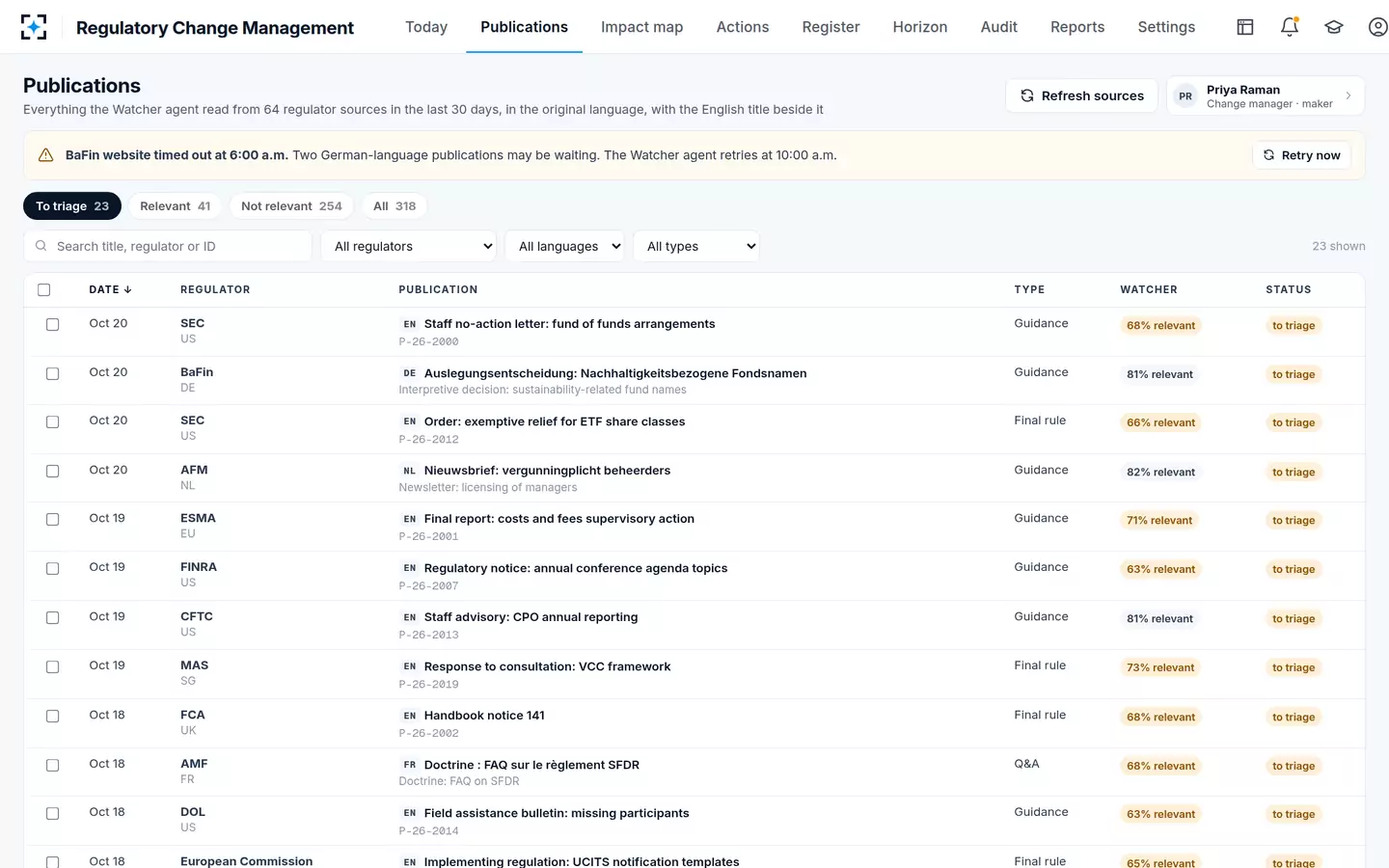
Record for each source what "read" means: the page or feed, the language of the binding text, and how a failure will show. The sample firm's queue shows a BaFin timeout at 6:00 a.m. with the agent retrying at 10:00 a.m.; a horizon that hides that is reporting a quiet morning that may not have been quiet.
Every source in its own language, and the one that failed this morning
Step two: the fund and entity map
Without the fund master a horizon can say a rule is coming but not whom it binds. Import it before tuning anything else: each fund's domicile, manager and its authorisation, wrapper, open- or closed-ended status, money market status, strategy, investor type and lifecycle events such as mergers and liquidations. The entity register adds licences and regulators. Lifecycle matters more than it looks: on the sample firm's illustrative circular, one sub-fund fell out of scope only because it merged before the application date.
Load the policy library and the compliance engine's coded rules at the same stage, read-only. The point is not to change them; it is so every future item can be mapped to the policy section and rule it would touch, which is where the compliance obligations register template starts.
Step three: owners and escalation
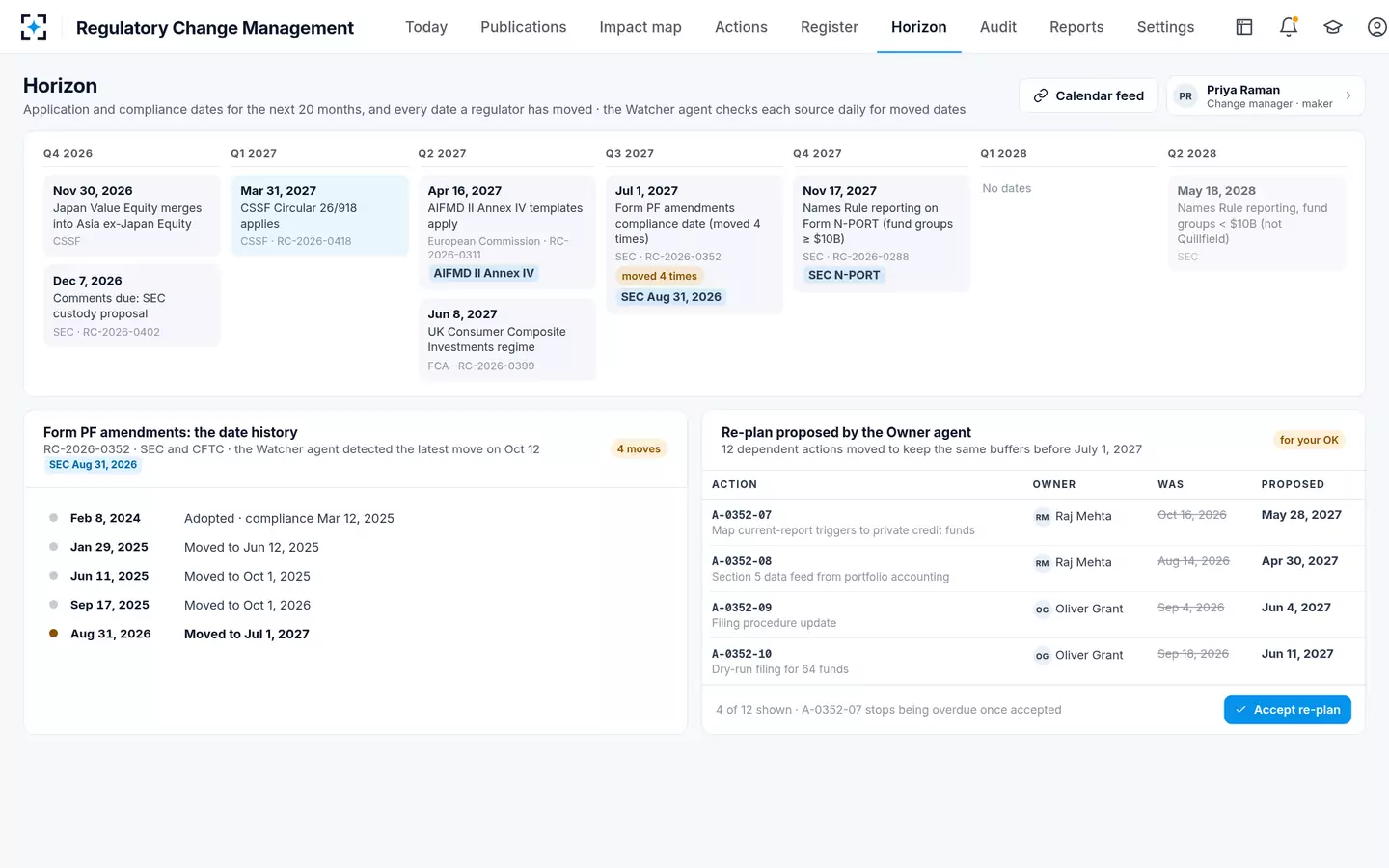
Map every policy and coded rule to a named owner and a delegate from the responsibility map, and set the reminder and escalation rules before the first real item arrives. The sample firm's settings remind owners 14 and 3 days before a due date and escalate to the CCO one day overdue; due dates sit 33 days before the regulator's application date for policies and 16 days before for coded rules. Every one of those is a setting the firm owns, and changing one needs a second approver.
The application and compliance dates for the next 20 months, and the dates that moved
Step four: replay six months of publications and compare
Before anyone relies on the software, run it on the last six months of publications the team has already handled, and compare each call with the team's. The useful counts are items the software found that the team missed, items the team decided differently, and funds scoped differently; every disagreement is resolved against the text by a third person. Six months gives enough items for patterns in the disagreements to show, and is short enough to finish in a go-live window.
An eight-week go-live, in the order that works
- Sources and languageswk 1–2
- Fund, entity, policy and rule mapswk 3–4
- Owners and settingswk 5
- Six-month replay and comparisonwk 6–7
- Sign-off and livewk 8
The replay is also the fairest way to compare products, and the cost model behind the decision is set out in regulatory monitoring software: the full cost. It produces the evidence a CCO needs to sign off: a list of calls, a list of disagreements and how each was resolved.
Regulatory horizon scanning tools: what to check before go-live
Seven checks, each with a pass condition a reviewer can see on screen. If one fails, fix it before go-live rather than after the first missed item.
Seven go-live checks for regulatory horizon scanning software
- Every source on the entity map is read, and failures show
Pass: a list of sources with today’s read time; a deliberately broken source appears as failed.
- The binding text is shown in its own language
Pass: English beside the original, never instead of it.
- Moved dates are detected against earlier publications
Pass: the replay picks up at least one moved date with its full history.
- Every fund in the fund master can be tested
Pass: the replay scopes every fund on a multilingual item, with each exclusion cited.
- Every policy section and coded rule has an owner and a delegate
Pass: no orphan rows in the map.
- Thresholds and buffers are set and approved
Pass: relevance and applicability thresholds, due-date buffers and escalation rules, each approved by a second person.
- The replay disagreements are resolved and signed
Pass: each disagreement has a decision, a reason and a signer.
Regulatory compliance horizon scanning after go-live: the monthly routine
Once live, the routine is short. Each month, check source health and add any regulator a new entity or fund brings in; re-read the regulators' own horizons, the SEC agenda when a new edition appears, each twice-yearly edition of the UK grid, ESMA's work programme and any mid-year reprioritisation, against the items already open; and close items the regulator has withdrawn, with the reason. Each quarter, report what arrived, what was decided and what moved to the CCO. The SEC reg flex agenda 2026 guide shows how one regulator's horizon read against what it then published.
To see the go-live on your own sources and fund master, start from Regulatory Change Management for Asset Managers.
Questions people ask
What is a regulatory horizon scanner?
A person or a tool that watches regulators for upcoming changes and dates. In software it is the capture and classification layer: reading sources, dating each item and flagging moved dates. On its own it produces alerts; joined to a fund map and owners it produces a plan.
What is the FCA Regulatory Initiatives Grid?
A joint publication of the UK's Financial Services Regulatory Initiatives Forum, co-chaired by the FCA and the Bank of England and PRA, setting out planned initiatives for the next 24 months with timings and indicative impact. It is published twice a year and not updated between editions; the May 2026 edition lists 135 live initiatives.
Is a regulatory horizon scanning template in a spreadsheet enough?
For a small, single-domicile adviser it can be, if someone re-reads every source monthly and the dates are re-checked against each regulator's notices. It breaks down with many funds and languages, because the spreadsheet cannot test scope per fund or notice a moved date.
How long does regulatory horizon scanning software take to go live?
It depends mostly on the source list and the state of the fund master. Our suggested plan for a multi-entity manager is about eight weeks, two of them spent replaying six months of past publications and resolving the differences; a single-entity adviser can be faster.
Should horizon scanning include proposals or only final rules?
Proposals, consultations and work programmes belong on the horizon, marked by stage, because comment windows and planning start there. They should be closed when withdrawn or superseded, as ESMA's June 2026 postponement of its fund suspension guidelines shows a planned item can move.