RIA compliance software typically combines a compliance calendar, a policy library with attestations, code-of-ethics reporting and a marketing review queue; some add a feed of regulatory updates. When a rule changes, that stack tells the CCO something happened. It rarely says which funds and entities the change binds and on which paragraph, who owns each resulting change to a policy or a coded compliance rule, what to do when the regulator moves the date, or what evidence will show an examiner it was done. A chat assistant can summarise the release; it cannot do those things on its own. Botminds' Regulatory Change Management for Asset Managers is built as agents that read every regulator in its own language, test every fund, draft the redlines and rule changes and keep the register, with a named person deciding applicability, accepting each change and signing.
This guide is for the chief compliance officer choosing software for the rule-change part of the program, and is honest about fit: a single-strategy adviser with one entity may need nothing more than a good calendar. Examples use the solution's fictional sample firm, Quillfield Capital, with 486 funds in 9 domiciles.
Why rule changes need more than an alert
27
SEC proposed-rule documents in the Federal Register from January to 27 October 2026, after 3 in 2025
4
moves of one compliance date, Form PF, since the rule was adopted in 2024
486
applicability calls on one illustrative circular at the sample firm, one per fund
1
call the second agent disputed, decided by a person with a written reason
What should RIA compliance software do when a rule changes?
It should produce five things, each of which an examiner can check. A decision on relevance, with a reason. A decision on scope, fund by fund and entity by entity, with the paragraph behind each exclusion and a named approver. A list of changes to policies, procedures and coded compliance rules. Owners and dates worked back from the regulator's date, re-planned when that date moves. And evidence that each change was made: the published policy version, the rule test, the attestation.
That list follows from the compliance rule itself. Rule 206(4)-7 asks for written procedures built to keep the firm inside the Advisers Act, and a yearly check that they are adequate and working (17 CFR 275.206(4)-7). When a rule changes, "reasonably designed" changes with it. Software that stops at the alert leaves the rest of the list to email.
Can ChatGPT track regulatory changes?
A general chat assistant can summarise a release you paste into it, translate a circular and answer questions about the text in front of it. On its own it cannot reliably watch a list of regulator sources every day, it does not know your fund master or policy library, its knowledge of rules stops at its training data unless you give it the current text, and a conversation is not a register an examiner can follow. Used that way it is a reading aid, which is useful, not a regulatory change process.
The gap shows most on dates. The Form PF compliance date moved four times between February 2025 and September 2026 (91 FR 56593); an assistant asked from memory may give any of the five dates, and even with the current notice in front of it, it does not know which twelve of your tasks depended on the old one.
Chatbot or agents: the same circular, handled two ways
A chat assistant: Only if someone pastes it in or links it.
Agents with a register: Read from the regulator’s site the evening it is published, in the original language, with source health checked daily.
A chat assistant: A fluent summary; may paraphrase a legal term.
Agents with a register: English set beside every paragraph of the original; obligations, scope clauses, exclusions and dates extracted, each cited.
A chat assistant: A general answer about “funds like yours”.
Agents with a register: Every fund tested against the fund master; each exclusion cited to its paragraph; every call re-tested by a second agent.
A chat assistant: Suggestions in prose.
Agents with a register: A tracked-change redline of the policy section and a drafted parameter change to the coded rule, each insertion cited.
A chat assistant: None; the conversation ends.
Agents with a register: Actions assigned from the responsibility map, worked back from the application date, re-planned when it moves.
A chat assistant: Whoever reads the answer, with no trace.
Agents with a register: Change manager proposes, Legal approves, owners accept and attest, CCO signs; each step kept.
How is AI used in regulatory change management?
In a well-designed process, AI does the reading, the first draft and the bookkeeping, and every step that decides something is a person's. The flow below is the one the solution runs on each publication; the people steps are where the judgement and the signatures stay.
One rule change, step by step: what agents do and what people decide
Agent
Watcher agentReads 64 sources daily in the original language, classifies each publication and detects moved dates.
Never: Never marks an item not relevant without a reason.
Agent
Reader agentSets English beside every paragraph and extracts obligations, scope clauses, exclusions and dates.
Never: Never shows English without the original beside it.
Agent
Applicability and Checker agentsTest every fund against the fund master; a second agent re-tests every call, including every “not applicable”.
Never: Never rule a fund out without citing the paragraph; never resolve a disagreement.
A person decides
Change manager, then LegalDecides disputed and low-confidence funds with a reason, proposes scope; Legal approves or rejects with its own reason.
Agent
Impact and Owner agentsDraft policy redlines and the coded rule change; assign owners and dates; remind and escalate.
Never: Never change a published policy or a live rule; never extend a date.
A person decides
Owners and the CCOOwners accept, edit or reject each change, test the rule and attest with evidence; the CCO approves extensions and signs the quarterly summary.
The agents’ run on one circular, and a question answered from the text
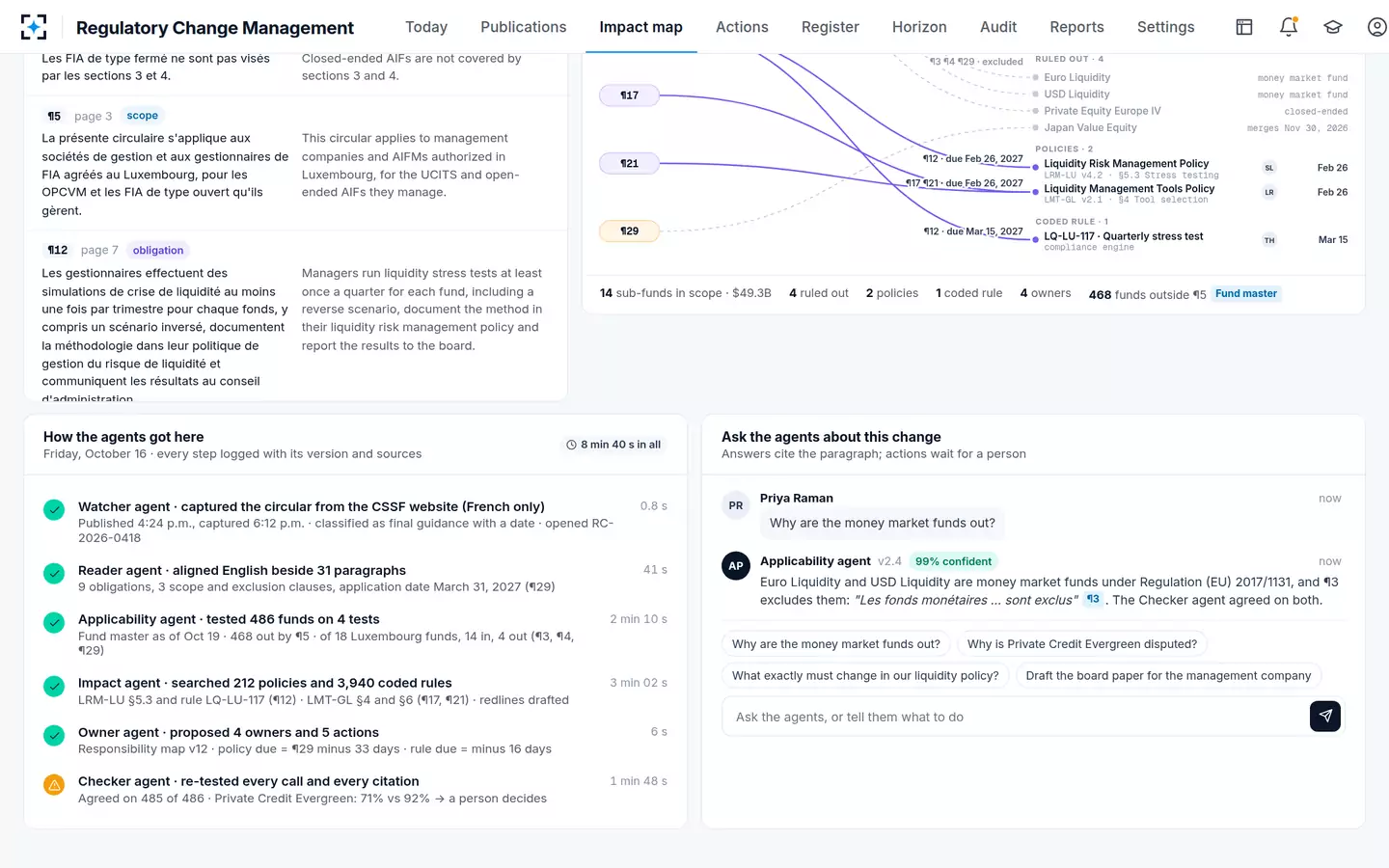
A worked example: the October 2026 cross-trading proposal, two ways
On 15 October 2026 the SEC proposed to amend Rule 17a-7, which permits cross trades between a registered fund and certain affiliates: the proposal would widen the securities eligible for cross trades, update the rule's conditions, and require aggregated reporting of trading activity and cross trades on Forms N-PORT and N-MFP; comments close on 14 December 2026 (91 FR 65622). For a fund complex the useful questions are concrete: which of our registered funds cross trade today, under which procedures, which coded pre-trade rules would change if the eligible securities widen, and who decides whether we comment.
Asked about the proposal, a chat assistant given the release will summarise it well and list the kinds of funds affected. It will not know which of the firm's funds file Form N-MFP and which file Form N-PORT, who owns the firm's cross-trade procedure, or which coded rules in the compliance engine enforce today's eligibility conditions. An agent setup with the fund master, the policy library and the engine's rules can propose exactly that list, cited to the release's paragraphs, and open one item with an owner and the 14 December deadline. The CCO still decides whether the firm comments; the difference is that the decision is made on the firm's own list, not on a summary.
What rule-change handling an adviser needs, by size and footprint
| Adviser profile | Where the work is | What software should cover |
|---|---|---|
| Single entity, a few US separate-account strategies | Reading SEC and FINRA output; keeping the calendar; the annual review | A dependable source list, a calendar with cited dates, a register with reasons |
| US adviser with registered and private funds | Scope by fund type (registered, private, money market); Form PF and Form N-PORT lines; coded pre-trade rules | Fund-level scope from the fund master; links to policies and coded rules; moved-date handling |
| Global manager, funds in several domiciles | Scope across hundreds of funds and several languages; Legal approval; many owners | Original-language reading, every fund tested and re-tested, drafted redlines and rule changes, owners and re-plans, evidence for each step |
Does the SEC allow AI in compliance?
No SEC rule prohibits it, and none approves it; existing obligations apply whatever tools a firm uses. The Division of Examinations' fiscal 2027 priorities note that registrants are using generative "super intelligence (SI)" tools in drafting, client communications and compliance monitoring, and describe the obligations examiners test as technology-neutral (SEC, FY2027 Examination Priorities).
FINRA said the same to broker-dealers in 2024: its rules apply to generative AI "just as they apply when member firms use any other technology or tool", and its notice adds that a firm's policies and procedures "should address technology governance, including model risk management" (FINRA Regulatory Notice 24-09). For European entities, ESMA's May 2024 statement is shorter still: "When using AI, ESMA expects firms to comply with relevant MiFID II requirements" (ESMA, 30 May 2024). The practical consequence is that the CCO must be able to show how the software reached each call, and who approved it.
What are the risks of AI in compliance work on rule changes?
Five failure modes matter, and each has a control that can be tested before go-live. Ask any vendor to show the control working on your own data, not to describe it.
Five risks of AI in regulatory change work, and the control for each
| Risk | What it looks like | Control to test |
|---|---|---|
| A citation that does not say what the answer claims | A fund ruled out on a paragraph that excludes something else | Every citation checked against its source passage by a second agent; a person sees the paragraph beside the call |
| A silent miss of a source | A regulator’s site times out and nobody notices for a week | Source health shown daily, with the failed source and the retry time |
| A wrong “not applicable” | A fund ruled out and never revisited | Every call re-tested, outs included; disagreements and low-confidence calls go to a person |
| A paraphrased legal term | The English summary softens “must” to “should” | English always shown beside the original; the obligation cites the original paragraph |
| Decisions drifting to the software | A redline applied or a date extended without anyone choosing it | Agents cannot change a published policy, a live rule or a date; the proposer cannot approve |
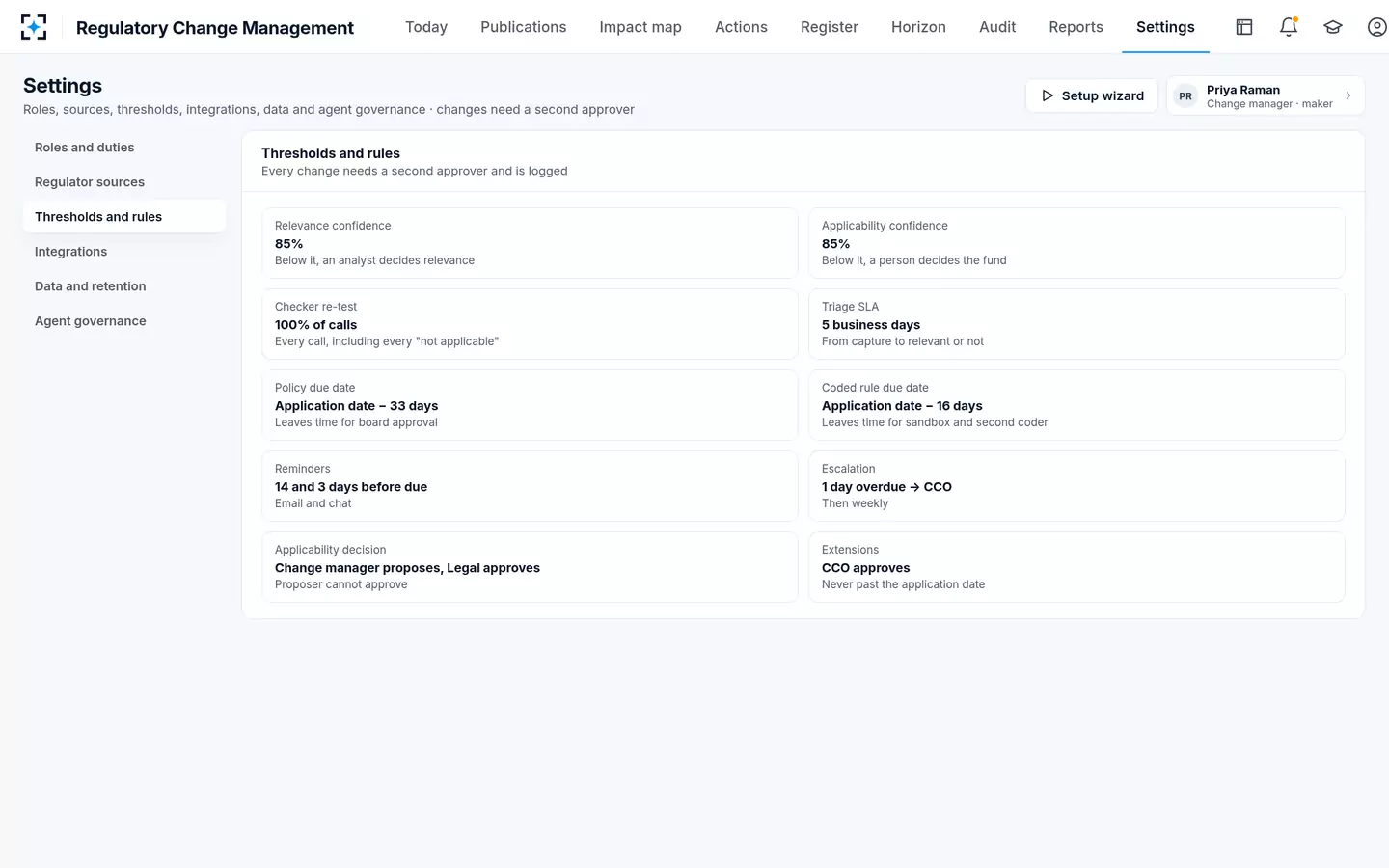
The thresholds that send a call to a person, set by the firm
Best RIA compliance software for rule changes: ten questions to ask a vendor
"Best" depends on the firm. A one-entity adviser with a handful of US strategies needs a reliable calendar and a feed it can trust; a manager with funds in several domiciles needs scope decisions per fund and sources in more than one language. The questions below separate the two, and none of them can be answered with a slide.
Ten questions for any RIA compliance software that claims to handle regulatory change
- Which sources does it read, and how do I know one failed?
Ask for the source list and the last successful read of each, today.
- Does it read the original language?
For a Luxembourg or German entity, a summary is not the binding text.
- Does it decide scope per fund, from my fund master?
Ask to see one fund ruled out, and the paragraph that excludes it.
- Is every call re-checked, including the outs?
A second check only on the ins misses the error that hurts.
- Who approves scope, and can the proposer approve?
The answer should be no.
- Does it reach the coded rule, or stop at the policy?
Ask to see a drafted parameter change and how it is tested.
- What happens when a regulator moves a date?
Ask for the date history on one item and the re-plan it proposed.
- Can it change anything on its own?
Policies, live rules and dates should be changed only by people.
- What evidence does an owner attest with?
A tick, or the published policy and the test result?
- Can I replay last quarter?
Run it on the publications your team handled and compare its calls with theirs, before you sign.
The replay test is also the honest way to judge go-live effort; regulatory horizon scanning software sets out the order to connect sources, the fund map and owners, and how to compare six months of the agents' calls with your team's.
Where Regulatory Change Management for Asset Managers fits, and where it does not
It fits a manager with several entities, domiciles or fund types, where the hard question is which funds a change binds and the work runs through Legal, policy owners and rule coders. It reads 64 regulator and standard-setter sources in the sample configuration, tests every fund against the firm's own fund master, and drafts redlines and coded rule changes for people to accept.
It is more than a single-entity adviser with a few US strategies needs. If every rule change reaches one person who also owns every policy, a calendar, a dependable source list and a disciplined annual review may be enough. It is also not a replacement for the compliance engine, the policy library or the governance, risk and compliance tool: it connects to them, queues changes for their own approval and keeps obligations in step both ways.
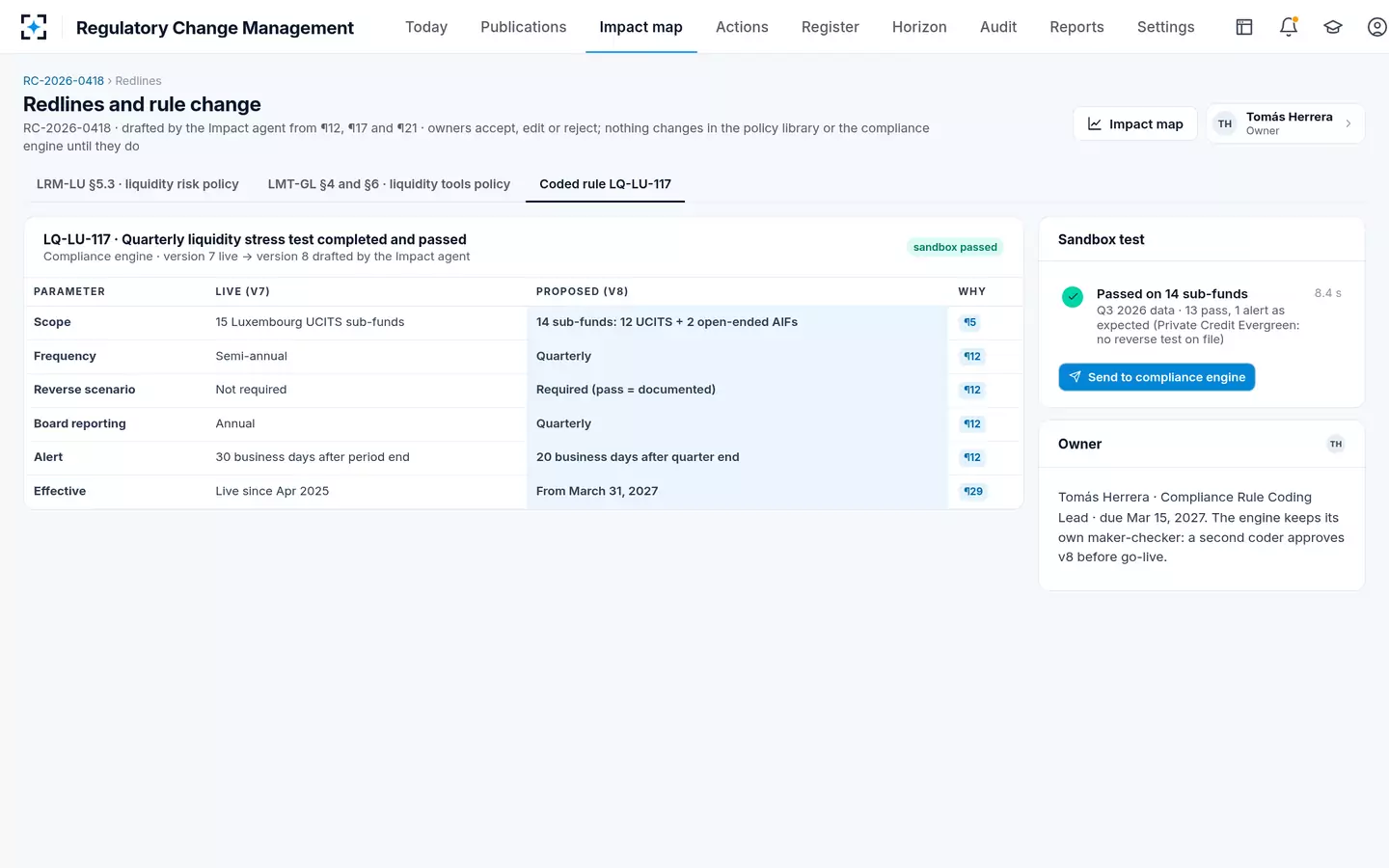
A coded rule change drafted from the circular, tested before anyone approves it
The annual review is where any software's misses show up a year later; the RIA annual compliance review checklist includes a test for exactly that. To run the replay on your own regulators and fund list, start from Regulatory Change Management for Asset Managers.
Questions people ask
What is RIA compliance software?
Software that helps a registered investment adviser run its compliance program under Rule 206(4)-7: a calendar of filings and reviews, a policy library with attestations, code-of-ethics and personal trading reporting, marketing review and, sometimes, regulatory updates. Rule-change handling is one part of it, and the part most products cover least.
What is RIA compliance technology expected to prove to an examiner?
That the program is reasonably designed and actually followed: who decided what, on which text, and what changed as a result. The SEC's fiscal 2027 priorities make clear that using such a tool leaves every obligation with the firm, so the software's output has to be readable by a person, cited and approved.
Are AI tools for compliance a model under model risk rules?
For broker-dealers, FINRA's Regulatory Notice 24-09 says a firm's policies and procedures should address technology governance, including model risk management, when it uses generative AI. For advisers, the SEC's predictive data analytics proposal, which would have addressed some of this, was withdrawn in June 2025; the same controls, validation, monitoring and change approval, are still what an examiner will look for.
Can RIA compliance solutions be outsourced instead?
Yes; some advisers use outsourced compliance consultants for parts of the program. Outsourcing moves the work, not the responsibility: the adviser still designates its own CCO under Rule 206(4)-7, and someone at the firm must decide scope and own the changes.
How long does it take to evaluate rule-change software properly?
Long enough to replay at least one quarter of real publications through it and compare the results with your team's decisions; on most source lists that is a few weeks of elapsed time. A demonstration on the vendor's own examples tells you little about your funds.