Regulatory monitoring software, which vendors often call regulatory intelligence, gives a compliance team a feed or database of regulator publications, usually with tags, summaries and alerts. Its subscription is the visible cost and, at an asset manager, the smaller one: the larger cost is the analyst, lawyer and owner time it takes to read each item, decide whether it is relevant, work out which funds and entities it binds, and get the policy and the coded rule changed. The right comparison between tools, outsourcing and agents is therefore the full cost per decided item, not the price per seat. Botminds' Regulatory Change Management for Asset Managers is built to lower that full cost: its agents read the regulators in their own languages, test every fund and draft the changes, and people make and sign the decisions.
This guide is for the chief operating officer or CCO deciding how to resource the work. No regulator or independent study publishes what managers pay for regulatory intelligence or how many hours each item takes, so the guide shows how to measure both on your own team; volumes from regulators are linked, and examples use the solution's fictional sample firm, Quillfield Capital.
What one quarter of regulatory intelligence looks like at a multi-fund manager
912
publications read from 64 sources in one quarter at the sample firm
118
ruled relevant; the other 794 each needed a reason
41
changes whose fund scope Legal approved
427
actions closed by owners in the quarter
What is regulatory monitoring software?
Software that collects regulator publications, classifies them and delivers them to the people who need them: a regulatory intelligence database you can search, alerts by topic or jurisdiction, and often summaries written by the provider's editors or generated by a model. Platforms add workflow on top: assigning items, recording relevance, linking to policies. The category goes by several names, regulatory monitoring, regulatory tracking and regulatory intelligence among them, and overlaps with regulatory change management software; buyers often use the names for the same thing.
For an asset manager the question is how far down the chain the tool goes. A feed stops at "here is what was published". A database lets an analyst find what was published about a topic. A platform records what the firm decided. None of those, by itself, decides which of several hundred funds a circular binds or drafts the change to a coded compliance rule; that is where most of the cost sits.
How much does regulatory monitoring software cost?
The subscription varies with the number of jurisdictions, languages, users and integrations, and no regulator or independent study publishes what managers pay, so there is no neutral price list to compare against. The more useful number is the full cost per decided item: everything the firm spends on regulatory intelligence in a period, people included, divided by the number of items it decided. A decided item is a publication with a recorded relevance call, or a change with an approved fund scope; count both, because they cost very different amounts.
The full cost of regulatory intelligence, per decided item
Sources
Subscriptions and feeds ÷ items
Feeds, databases, translation services and any outside summaries, for the period.
Procurement
Reading and triage
Analyst hours × loaded rate
Capture, reading in the original language, relevance with a reason, sampling.
Change team
Scope and approval
Manager and Legal hours × rate
Which funds and entities, the reasons for exclusions, approval.
Change manager, Legal
Changes
Owner and coder hours × rate
Policy redlines, board papers, coded rule changes, tests, attestations.
Policy owners, rule coders
Misses
Remediation cost × late items
Work redone when a change is found late: in an annual review, an exam or a breach.
CCO
Two terms are routinely left out. The first is owners' time: the policy owner who rewrites a section and the coder who changes a rule are rarely charged to regulatory intelligence, but without them nothing changes. The second is misses. The SEC staff's September 2026 risk alert found advisers whose annual reviews had not caught marketing procedures never updated for the Marketing Rule, and filing procedures never updated for Form CRS (SEC risk alert, 14 September 2026): years-old changes, found late, and remediated at whatever that cost.
Build or buy regulatory intelligence?
Building the capture layer in-house is cheaper than it looks for US rules and dearer than it looks for everything else. The Federal Register and the eCFR offer free programming interfaces that need no key, and a short script against the Federal Register API lists every SEC document by type and date; the counts on this page were taken that way. National regulators' websites change layout, block automated reads, publish in their own languages and time out: the solution's sample firm sees a BaFin timeout on its morning queue, with a retry scheduled, which is the kind of failure an in-house scraper hides.
Buying a feed solves capture and coverage, at the price of reading someone else's summary. Neither choice touches the expensive middle of the chain, scope and changes, which is why the build-or-buy decision for the feed is smaller than it seems and the decision about the middle is larger.
Three ways to run regulatory intelligence at an asset manager, and where the cost goes
| Cost driver | Feed plus in-house analysts | Outsourced reading and summaries | Agents plus in-house decisions |
|---|---|---|---|
| Capture across regulators and languages | Subscription; gaps in languages the feed does not cover | In the provider’s fee | Agents read each source in the original language; source failures shown daily |
| Relevance with a reason | Analyst time on every item | Provider’s relevance tags; the firm’s reason still needed | Agent scores and reasons; analyst decides below the threshold |
| Which funds and entities | Analyst and Legal, by hand, against the fund master | Only if the provider holds your fund master | Every fund tested and re-tested; people decide disputes, Legal approves |
| Policy and coded rule changes | Owners and coders from the circular | Not covered | Redlines and rule parameter changes drafted, cited, tested in a sandbox |
| Owners, dates, re-plans | Spreadsheet and email | Not covered | Assigned, reminded and re-planned; extensions approved by the CCO |
| Evidence for an examiner | Assembled at review time | Provider’s logs for its part only | Each step kept as it happens, with its version |
Regulatory change management vendors: what drives the price
Five things drive what a provider will quote, and each is worth pinning down before comparing offers: the number of sources and jurisdictions, the languages read in the original, the number of users who decide rather than read, the integrations (fund master, policy library, compliance engine, governance, risk and compliance tool), and how much of the chain the product covers past capture.
The last driver decides the total. A cheaper feed that leaves scope and changes to people can cost more per decided change than a dearer product that does the first draft of both. The only way to know is to price the people time, which the next section shows how to measure.
What is the cost per decided regulatory change? Measure it in four weeks
Four weeks of time records on a representative sample is enough for a first estimate. The checklist below avoids the two common errors: counting only the change team, and counting elapsed days as if they were hours worked.
Measuring your own cost per decided item
- Pick a four-week window and freeze the source list
Count every publication captured in the window, by regulator and language.
- Log hours by step, not by person
Capture, triage, scope, approval, policy change, rule change, owner chasing, attestation.
- Include owners and coders
Ask policy owners and the rule coding team to log time on items that started in the window.
- Separate hours from elapsed days
An item can take twenty working days to close and six hours of work; both matter, for different reasons.
- Count decided items two ways
Relevance calls on all items; approved scope decisions on relevant ones.
- Add the subscription share
Feeds, translation and outside summaries for the window.
- Price last year’s misses
From the annual review and any exam findings: the work redone on changes found late.
- Repeat after any change of tool
Same window length, same steps, so the comparison holds.
Where the working days go, and why that is a cost too
Elapsed time is a cost even when hours are low, because a change that sits waiting for a scope decision is a change whose policy is not yet written. In Botminds' estimate for one relevant publication at a multi-domicile manager, about 20 working days pass by hand from publication to owned and dated actions, and the largest share goes to deciding which funds it applies to and to policy owners assessing impact; with the solution the estimate is 2.8 days, people's decisions included. On the sample firm's third quarter the median from publication to triage was 1.6 business days against a five-day target.
Two ways a cost per decided change falls
Fewer hours per item: Analyst, Legal and owner time in the four-week log.
Fewer late or missed items: Annual review findings, exam findings, breach reports.
Fewer hours per item: Reading in the original, fund tests done once for all funds, redlines drafted.
Fewer late or missed items: Every source read daily, every “not relevant” reasoned, every out-of-scope call re-tested, dates re-planned when they move.
Fewer hours per item: Repeat the time log after the change.
Fewer late or missed items: Replay a past quarter and count what the new process catches that the old one missed.
Approval with the evidence in front of the approver, not an email thread
Four multipliers that drive the people cost
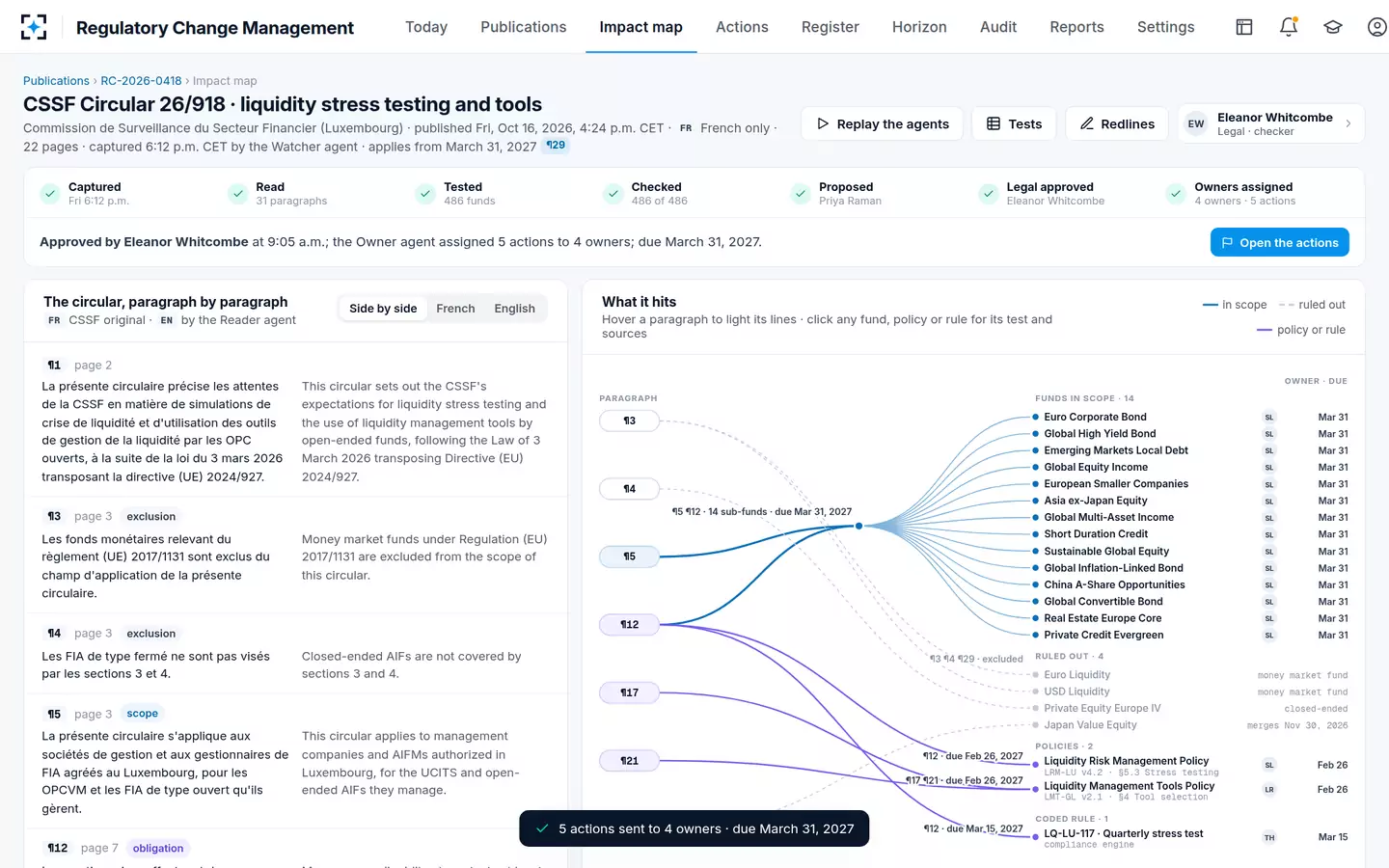
The people cost does not grow with the number of publications so much as with four multipliers, and a business case should state each one for the firm. The first is funds: scope is decided per fund, so even at a minute a fund, a circular that must be tested against 480 funds is a full working day. On the sample firm's illustrative Luxembourg circular there were 486 calls to make, one per fund, even though only 18 funds were in Luxembourg; the other 468 still had to be ruled out on the scope paragraph.
The second is languages. In the sample firm's third quarter, 31% of the 912 publications were not in English. Each of those needs the binding text read, not a summary, and the reading is slower and scarcer. The third is owners: a change that touches two policies and one coded rule involves at least three people outside the change team, each of whom has to read, decide and attest. The fourth is moved dates, which multiply work already done: every dependent task re-planned, and some of it redone. A firm that runs funds in more domiciles, or adds a language, should expect the people cost to rise faster than the publication count.
The multipliers also show where software changes the arithmetic and where it cannot. Testing 486 funds, reading French and German, and re-planning twelve tasks are mechanical once the rules and data are in place; deciding a disputed fund, accepting a redline and approving an extension are not. A cost model that assumes agents remove the second group is wrong, and a vendor that suggests it should be asked who signs.
What a moved date costs
A moved compliance date has a cost even when it is good news, because every dependent task has to be re-planned and the work already done may be wasted. The SEC's own notice extending the Form PF amendments to July 1, 2027 says the delay saves less for advisers that have already spent part of the initial cost (91 FR 56593); the Form PF extension guide follows each move. A process that re-plans every dependent action within days, at the same buffers, limits that cost to the decisions rather than the rework.
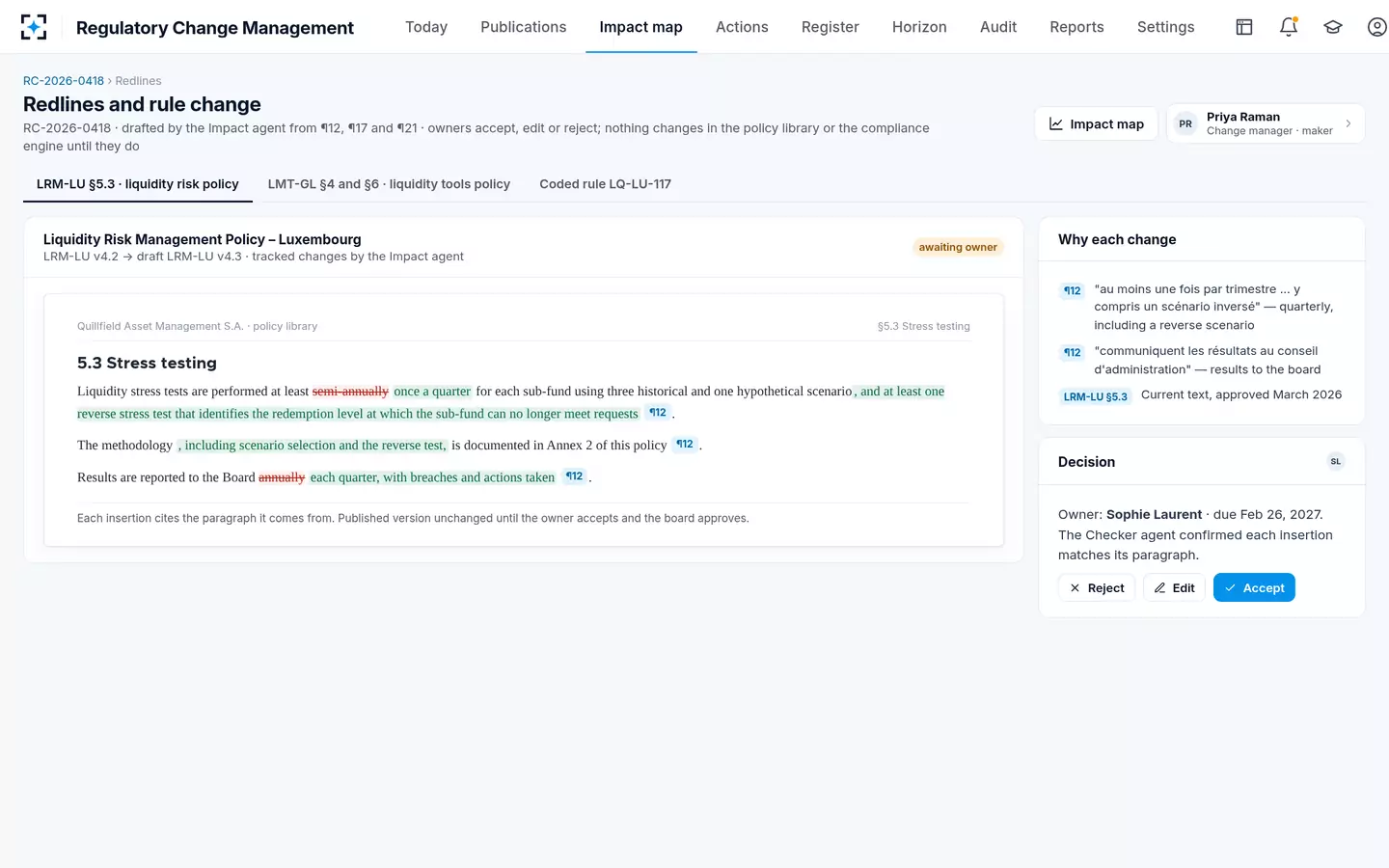
The redline the owner receives, so the policy hours go into reviewing, not drafting
The order in which to connect sources, the fund map and owners, and how to prove the new process on six months of your own history, is in regulatory horizon scanning software: sources first, then owners; the questions to put to any vendor about what its software does on its own are in RIA compliance software for rule changes. To price the full cost on your own regulators and funds, start from Regulatory Change Management for Asset Managers.
Questions people ask
What is the difference between regulatory intelligence and regulatory change management?
Regulatory intelligence is knowing what regulators published and what it means; regulatory change management is acting on it: deciding scope, changing policies and rules, assigning owners and keeping evidence. Software sold under either name may cover one or both, so ask where it stops.
Is a regulatory intelligence database enough for a small adviser?
Often, yes. A single-entity adviser with a few US strategies can decide scope in minutes, and a good database plus a disciplined register may be all it needs. The case for more grows with the number of funds, domiciles and languages.
What do regulatory intelligence tools leave out?
Usually the firm's own data. A tool that does not hold the fund master cannot decide which funds a rule binds, and one that does not connect to the policy library and compliance engine cannot draft the change. Those are the steps where most hours go.
How do I compare regulatory intelligence platforms fairly?
Replay the same past quarter of publications through each, with your own fund list, and compare the decisions and the hours with what your team did. A demonstration on the provider's own examples shows coverage, not fit.
Do regulatory intelligence solutions cover non-English regulators?
Coverage varies by provider. For a Luxembourg, German or French entity, ask whether the obligation is cited to the original paragraph, because the binding text is the one in the regulator's language.
How many publications does an asset manager need to read?
It depends on the source list, and the US alone is large: the SEC published 2,070 notices and 27 proposed-rule documents in the Federal Register from January to 27 October 2026, and the UK regulators' grid lists 135 live initiatives over 24 months (FCA). The sample firm, with entities in 9 domiciles, read 912 publications from 64 sources in one quarter.