The Form PF compliance date extension now in force moves the compliance date for the 2024 Form PF amendments to July 1, 2027. It is the fourth extension: the SEC and the CFTC set March 12, 2025 when they adopted the amendments, then moved it to June 12, 2025, to October 1, 2025, to October 1, 2026, and, in a notice published on September 3, 2026, to July 1, 2027. Until then private fund advisers keep filing the version of Form PF in effect before the 2024 amendments. Meanwhile an April 2026 proposal would raise the filing threshold from $150 million to $1 billion in private fund assets. A date that moves four times is exactly where regulatory change management breaks down, because every dependent task was planned to the old date. Botminds' Regulatory Change Management for Asset Managers detects a moved date, re-plans each dependent action with the same buffer, and waits for a person to accept the re-plan.
This guide is for the chief compliance officer of a private fund adviser and the operations lead who builds the filing. The dates and quotations are from the Federal Register notices, linked where they appear; the planning advice is ours.
The Form PF amendments, by the numbers
4
extensions of the compliance date since adoption on 8 February 2024
841
days between the original compliance date, 12 March 2025, and the current one, 1 July 2027
$1bn
proposed filing threshold, up from $150 million in private fund assets under management
70% → 40%
share of registered private fund advisers that would file, on the SEC’s estimate
What is the Form PF amendments compliance date now?
July 1, 2027. The fourth extension, effective September 3, 2026, gives filers "an additional 9 months" beyond the previous date of October 1, 2026 (91 FR 56593). The amendments themselves, adopted on February 8, 2024 in Release IA-6546, amended the form for every filer and for large hedge fund advisers in particular (89 FR 17984); the SEC's 2026 proposal describes them as having "comprehensively amended Form PF".
The notice gives two reasons, and both matter for planning. The Commissions are considering comments on a 2026 proposal that would amend or remove parts of the 2024 amendments, and want filers to "avoid certain potentially significant costs associated with aspects of the 2024 Form PF Amendments that the Commissions have proposed to amend and/or eliminate". The extension is also "intended to provide Form PF filers with sufficient time to comply with the 2024 Form PF Amendments in the event the Commissions do not adopt the proposed amendments in whole or in part". In other words, July 1, 2027 is a real date if nothing else changes.
Form PF amendments delayed four times: each extension and its reason
Each extension was a separate Federal Register notice with its own reason, and each one invalidated a plan built on the previous date. Read in order, they also show the reasons changing from operational timing to a review of the rule itself.
Four extensions of the 2024 Form PF amendments, with the reason each notice gave
| Notice | Compliance date moved | Reason the notice gave |
|---|---|---|
| Adopting release IA-6546, 8 Feb 2024 (89 FR 17984, 12 Mar 2024) | Set at 12 Mar 2025, one year after publication | Single effective and compliance date |
| IA-6838, 29 Jan 2025 (90 FR 9007, 5 Feb 2025) | 12 Mar 2025 → 12 Jun 2025 | "certain challenges associated with the timing of reporting cycles for Form PF" |
| IA-6883, 11 Jun 2025 (90 FR 25140, 16 Jun 2025) | 12 Jun 2025 → 1 Oct 2025 | "remaining significant challenges associated with coming into compliance" |
| IA-6919, 17 Sep 2025 (90 FR 45131, 19 Sep 2025) | 1 Oct 2025 → 1 Oct 2026 | "more time to complete a substantive review of Form PF" |
| Notice of 3 Sep 2026 (91 FR 56593) | 1 Oct 2026 → 1 Jul 2027 | Comments on the 2026 proposal, and costs filers could avoid if parts are removed |
How long each compliance date lasted before it moved
- Mar 2025 date330 d
- Jun 2025 date131 d
- Oct 2025 date95 d
- Oct 2026 date349 d
- Jul 2027 date, so far55 d
Two of the dates lasted less than five months. A filer that started a build in spring 2025 to meet June saw the date move twice by September. The lesson is not to stop work at each extension; it is to know, at any point, which tasks depend on the date and which do not.
Which version of Form PF do I file now?
The current Form PF, the version in effect before the 2024 amendments, until the compliance date. The September 2026 notice states that "filers have been allowed to file the version of Form PF in effect prior to the 2024 Form PF Amendments (the 'Current Form PF') until the Current Compliance Date" (91 FR 56593), and it moves that date to July 1, 2027. The filing threshold in the rule itself is unchanged: an SEC-registered adviser with at least $150 million in private fund assets at its last fiscal year-end files, under 17 CFR 275.204(b)-1.
The effective date and the compliance date are different things here, and searches for the "Form PF amendments effective date" often mix them up. The first extension notice says the effective date of the 2024 amendments "remains March 12, 2025" (90 FR 9007): the amended form exists in the Code of Federal Regulations, but filers are not required to use it until the compliance date.
What is the proposed Form PF filing threshold?
One billion dollars in private fund assets under management, up from $150 million, in a proposal published on April 24, 2026 with comments due June 23, 2026 (91 FR 22232). The same proposal would raise the reporting threshold for large hedge fund advisers "from $1.5 billion in hedge fund assets under management to $10 billion", and advisers that fall below it "would file annually instead of quarterly".
The SEC's own estimates show the scale. Form PF would continue to capture "approximately 94 percent of the most recent aggregate private fund gross asset value reported, while reducing the percentage of advisers that are required to file by almost half": in the proposal's table, from 70% to 40% of registered private fund advisers. For a change team the question is which of its entities sit between $150 million and $1 billion, because for them the 2024 amendments may never apply. The proposal suggests "a minimum 12-month transition period" from publication if it is adopted.
What the proposal would change for large hedge fund advisers
Most of them would stop being large hedge fund advisers for Form PF purposes. The threshold would rise from $1.5 billion to $10 billion in hedge fund assets, and an adviser below it would file annually rather than quarterly, without section 2 and outside section 5 current event reporting (91 FR 22232). The SEC estimates the change would reduce "the percentage of advisers that are required to file as large hedge fund advisers by almost two-thirds", from 26% to 9% of the advisers in its comparison, while the share of hedge fund gross assets reported under the large hedge fund adviser requirements would fall from 92% to 81%.
Under the proposal, far fewer advisers would report as large hedge fund advisers, for most of the same assets
For a change team this splits the hedge fund build in two. Section 2 and the quarterly cycle are exactly the work that would disappear for an adviser between $1.5 billion and $10 billion; the rest of the 2024 amendments would remain. That adviser has the strongest case for pausing section 2 work with a written reason, and the clearest obligation to restart it promptly if the proposal is not adopted as written.
Form PF amendments 2026: two tracks that can collide
A private fund adviser now tracks two Form PF items at different stages: final amendments with a compliance date, and a proposal that would change them. They must sit in the change register as two linked items, because they have different owners, different evidence and a different "done".
The 2024 Form PF amendments and the 2026 proposal, side by side
2024 amendments (final): Adopted 8 Feb 2024; effective 12 Mar 2025; compliance date 1 Jul 2027 after four extensions.
2026 proposal (not final): Proposed 20 Apr 2026, published 24 Apr 2026; comment period closed 23 Jun 2026; no final rule.
2024 amendments (final): Unchanged threshold: $150 million in private fund assets.
2026 proposal (not final): $1 billion in private fund assets; large hedge fund adviser threshold $10 billion.
2024 amendments (final): Filers use the amended form from 1 Jul 2027 unless the date moves again.
2026 proposal (not final): At least 12 months after any final rule is published, on the proposal’s terms.
2024 amendments (final): Keep the build plan to 1 Jul 2027; separate tasks the proposal would remove from those it would keep.
2026 proposal (not final): Map each entity to the proposed thresholds; decide whether to comment next time; watch the agenda for a final rule.
2024 amendments (final): Build plan, test filings, owner attestations.
2026 proposal (not final): Entity map against both thresholds; the decision on whether to pause each task, with a reason.
The spring 2026 SEC agenda listed the Form PF rulemaking under the same identifier as the April proposal, 3235-AN64 (91 FR 53164). How to read the agenda, and why to track by identifier rather than title, is covered in the guide to the SEC reg flex agenda 2026.
Money already spent: what the SEC says about sunk costs
The SEC's economic analysis admits that the extension helps least the advisers that did the most work. The benefit of delay, it says, "will be reduced to the extent that advisers have already incurred any portion of the initial costs", and in a footnote it adds that "many advisers may have already incurred a large fraction of the initial costs associated with developing the new reporting systems in order to meet previously extended compliance dates" (91 FR 56593).
That sentence is the case for planning to tasks rather than to dates. A build plan that separates the tasks the 2026 proposal would remove, such as sections an adviser under the proposed thresholds would never file, from those it would keep lets a firm pause the first group and finish the second. A plan that is one block of work against one date can only be paused whole or run whole.
Plan to the rule, re-plan from the notice
A moved date should change the register within a day and every dependent task within a week, with the old and new dates both visible. The steps below are the minimum; the point is that nobody works from memory of what the date used to be.
What to do in the week a compliance date moves
- Capture the notice itself
The Federal Register notice, not a summary of it: the release number, the effective date of the extension and the new compliance date.
- Keep the full date history on the item
Each previous date and the notice that changed it, so an examiner or auditor can see why a task was re-planned.
- Re-plan every dependent task with the same buffer
If the build test was due 60 days before the old date, it is due 60 days before the new one, unless an owner decides otherwise.
- Have a person accept the re-plan
The change manager approves the new dates; any task pushed past its new buffer needs the CCO.
- Tell every owner the old and new date
One message per owner, with the tasks that moved and those that did not.
- Separate tasks a pending proposal would remove
Pause those with a reason; keep the rest on plan.
- Check related forms and dates
Form ADV answers, investor reporting and data feeds that were timed to the old date.
Other dates that moved the same way, and one that did not
Form PF is not unique. The SEC moved the Names Rule compliance dates in March 2025, and in February 2026 moved only the related Form N-PORT reporting, to November 17, 2027 for fund groups with net assets of $10 billion or more and May 18, 2028 for smaller groups (91 FR, 23 February 2026). A register that tracked "the Names Rule" as one date would have got the reporting piece wrong.
And some dates do not move. The Regulation S-P amendments kept both compliance dates, December 3, 2025 for larger entities and June 3, 2026 for smaller ones; for an adviser, larger means $1.5 billion or more in assets under management. A change team that assumed every 2024 rule would slip found out on the first of those dates. The full set of adviser dates for the coming year is in the RIA compliance calendar 2026–27.
The Form PF date history, and twelve tasks re-planned for a person’s OK
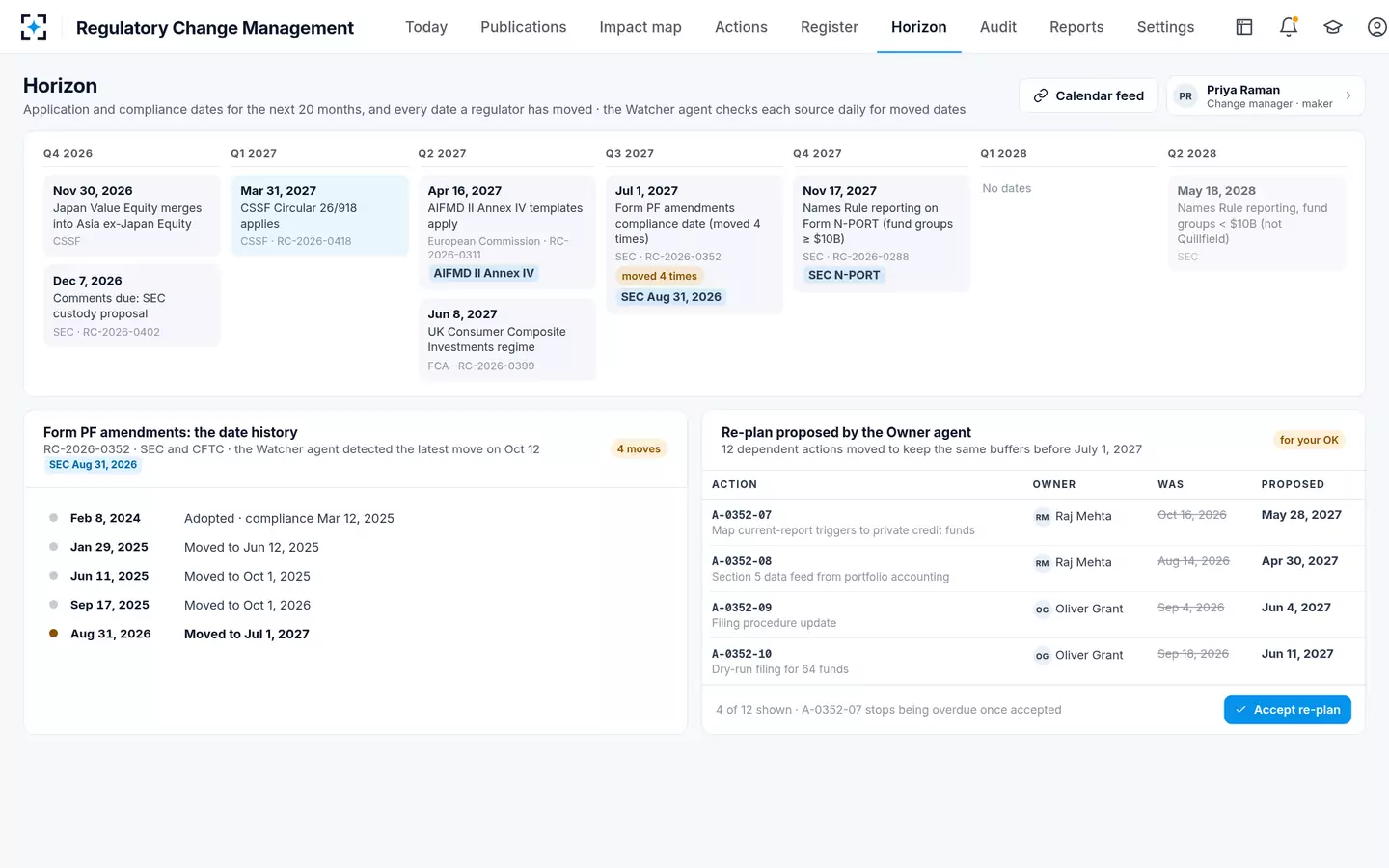
How the solution handles a Form PF compliance date extension
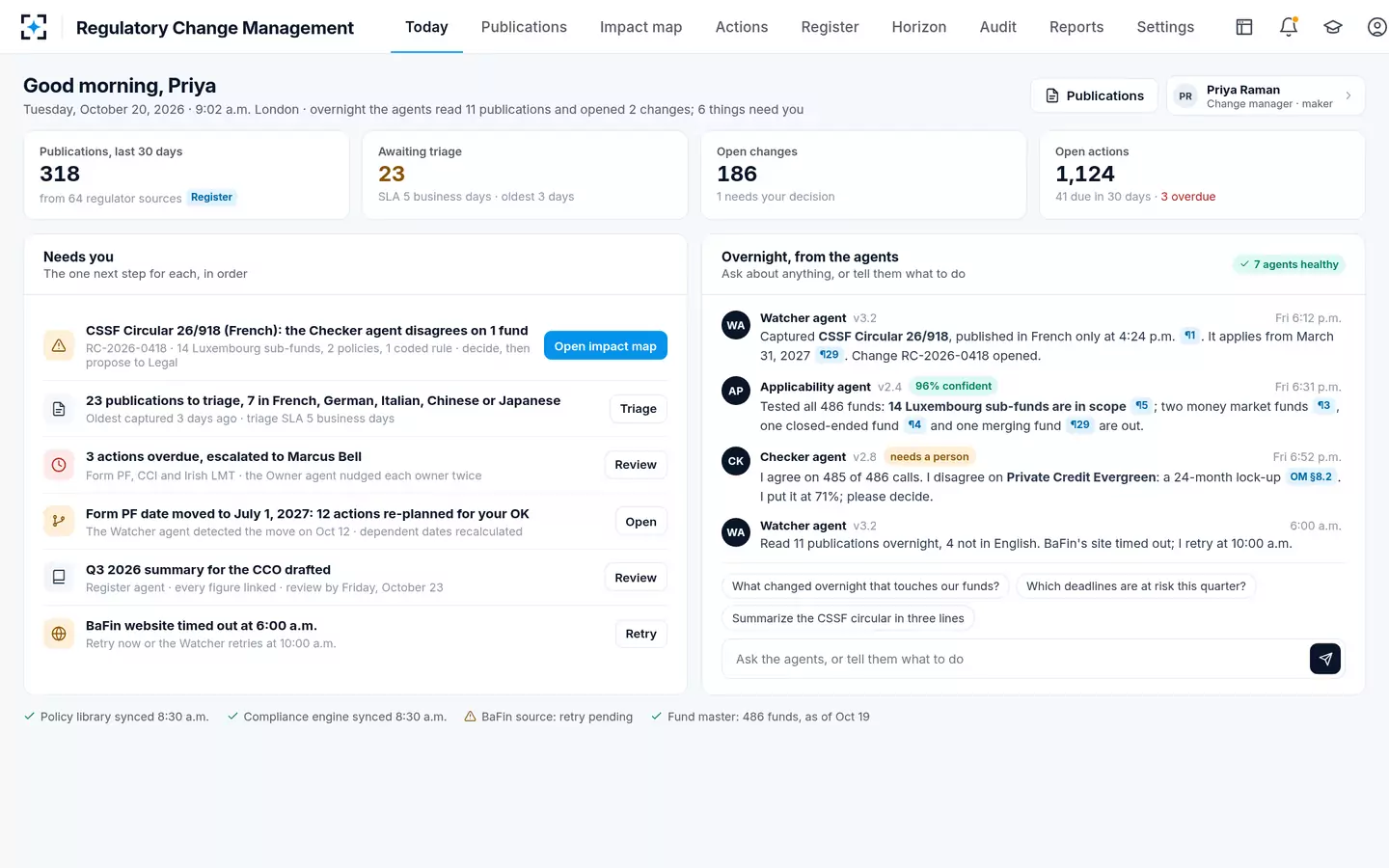
The solution's Watcher agent reads the Federal Register and the SEC's pages daily and classifies an extension notice as a date change on the item it belongs to. The Owner agent then proposes a re-plan of every dependent action at the same buffer, and it never extends a date on its own: the change manager accepts the re-plan and the CCO approves any task pushed past its buffer. On the fictional sample firm, the fourth extension re-planned 12 actions, from mapping private credit funds to a dry-run filing for 64 funds, and the date history stayed on the change.
A moved date arrives on the change manager’s home screen as one task
To see the date history and the re-plan on your own private fund entities, start from Regulatory Change Management for Asset Managers.
Questions people ask
When did the SEC extend the Form PF compliance date to July 1, 2027?
The extension was published in the Federal Register on September 3, 2026 (91 FR 56593) and took effect that day. It moved the date from October 1, 2026, the date set by the September 2025 extension.
Do I have to file the amended Form PF before July 1, 2027?
No. Until the compliance date, filers may file the version of Form PF in effect before the 2024 amendments, which the notice calls the Current Form PF. Due dates for each filing still follow the form's instructions and your fiscal year.
Is the $1 billion Form PF threshold in effect?
No. It is a proposal published on April 24, 2026, whose comment period closed on June 23, 2026. The rule in force still requires an SEC-registered adviser with at least $150 million in private fund assets to file, and the proposal itself suggests at least 12 months after any final rule before new requirements apply.
Could the Form PF compliance date move again?
It could; nothing in the notice prevents a fifth extension, and the SEC tied this one to its consideration of the 2026 proposal. Plan to July 1, 2027, keep the tasks the proposal would remove separate, and re-plan from the next notice if one comes.
Does the extension cover the 2023 Form PF event-reporting amendments?
No. The extensions apply to the amendments adopted on February 8, 2024. The 2023 amendments on current and quarterly event reporting for large hedge fund and private equity fund advisers were a separate release with their own dates, so check them as a separate item.
Who should own the Form PF date in a change register?
The regulatory change manager owns the date and the re-plan; the operations or fund reporting lead owns the filing build; the CCO approves any task pushed past its buffer. Keeping those three apart is what lets an auditor see that a moved date was handled rather than discovered.