Will AI replace fraud analysts? The evidence says no, not as a job, though it will change much of what the job consists of. No government or academic source we could find predicts the end of the occupation; the Bureau of Labor Statistics' own analysis of AI expects it to raise the productivity of analyst occupations in banking and finance while leaving demand for them in place, and the federal projections O*NET publishes for the occupation group that contains fraud examiners show average growth through 2035. What moves to AI is the gathering and first drafting: finding related alerts, pulling evidence from five systems, writing the first version of the memo. What stays is the decision, the record a person signs, and the accountability when an examiner or a court asks why. Botminds' Fraud Case Management is built on that split: agents gather and draft, and named investigators and supervisors decide.
Examples from the product are sample data from a fictional bank, Corvane National Bank, and its invented customers and staff. Labor figures come from the Bureau of Labor Statistics and O*NET, the Labor Department's occupational database, with the limits of each stated where it is used.
What moves to agents, and what stays with each person
Today
Finds the related alerts in several queues, pulls transactions, logs, images and calls into a narrative by hand.
With agents
Opens one binder with the evidence gathered and a cited memo drafted; reads, edits and proposes the close.
Still theirs: The decision, the edits, and the judgment of whether the customer’s story fits the evidence.
Today
Signs closes without seeing which statement came from which record.
With agents
Reads the source behind each line and the quality agent’s challenges, then approves or returns.
Still theirs: Approval of every dollar moved, within a limit, and the second signature.
Today
Finds weak reasoning after a case has closed, in a sample.
With agents
Rules on challenges before approval and reviews a 6% weekly sample of closed cases.
Still theirs: The standard of what a supported sentence is.
Today
Waits for a loss report rebuilt by hand each quarter.
With agents
Sees loss, recovery and control gaps from the closed cases.
Still theirs: Approval of losses above the supervisor’s limit and of every agent change.
Will AI replace fraud analysts? What the labor data say
The Bureau of Labor Statistics addressed the question for business and financial occupations directly in February 2025, in an article explaining how it builds AI into its employment projections. Its conclusion for the group was that AI is expected to improve productivity growth, "thus moderating or reducing (but not eliminating) employment demand" for some occupations. For analyst occupations specifically, it was more definite.
"further software advances driven by AI could raise the productivity of many analysts but are unlikely to eliminate employment demand for them."
Bureau of Labor Statistics, Monthly Labor Review, February 2025
BLS also cautioned about the pace of change. Its projections assume technology moves at the pace of past experience, and it notes that although displacement has happened before, "it tends to take longer than technologists typically expect". That is a statement about method, not a promise, but it is the most careful public view available.
The same article shows where the pressure is real. It projected employment of insurance claims adjusters, examiners and investigators to fall 4.4 percent from 2023 to 2033, because AI can generate damage estimates and summarize documents, and credit analysts to fall 3.9 percent. Those are neighbouring trades, not bank fraud analysts, and the reason in each case is that the core task, an estimate or a score, can be produced by the model. A fraud decision that moves money and must survive review is a different kind of task.
What the projections say about fraud examiners and analysts
O*NET groups bank fraud analysts with fraud examiners and investigators in other industries, under occupation 13-2099.04. BLS does not publish wages or employment for that occupation separately; O*NET shows the figures for its parent group, Financial Specialists, All Other, which also contains other specialists. Read the numbers as the neighbourhood, not the street.
The occupation group that contains fraud examiners and analysts
137,800
employed in 2025, Financial Specialists, All Other
$81,100
median annual wage, 2025 ($38.99 an hour)
3–4%
projected growth 2025 to 2035, which O*NET calls average
9,400
projected job openings over 2025 to 2035
Average growth is not a boom, but it is not the profile of an occupation being automated away. For comparison, the same BLS article put the business and financial operations group as a whole at 6.9 percent growth over 2023 to 2033. The honest reading is that fraud work will keep needing people in roughly today's numbers, doing a changing mix of tasks.
Which tasks move to agents, and which stay?
The tasks that move are search, assembly and first drafts; the tasks that stay are judgment, signature and conversation. O*NET's survey of the occupation ranks its most important tasks as documenting investigative activities, keeping records of fraudulent activity, writing reports of findings, interviewing witnesses and gathering financial documents. Agents can do much of the gathering and the first draft of the writing; they cannot interview a customer who is frightened, decide whether a story is credible, or sign.
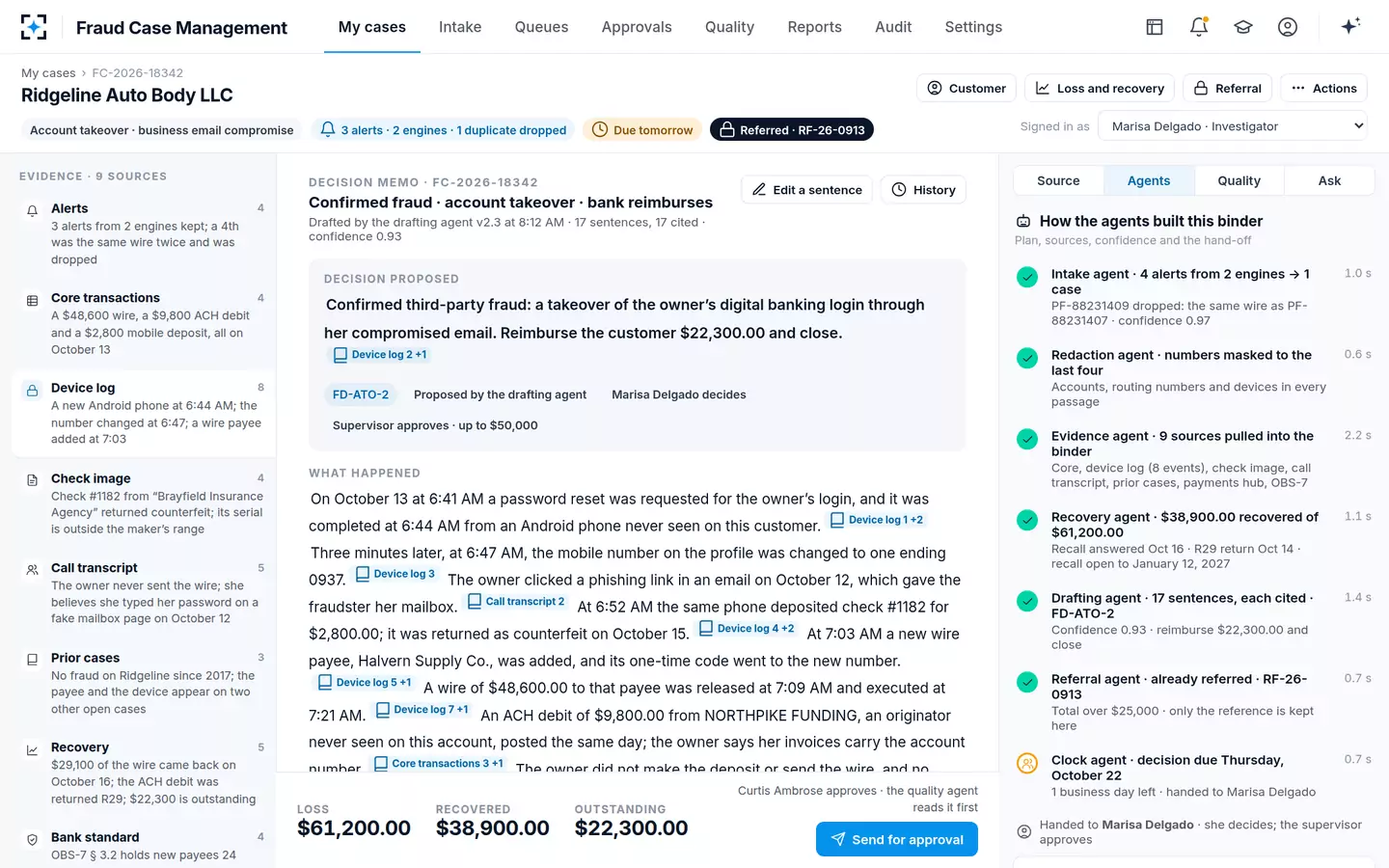
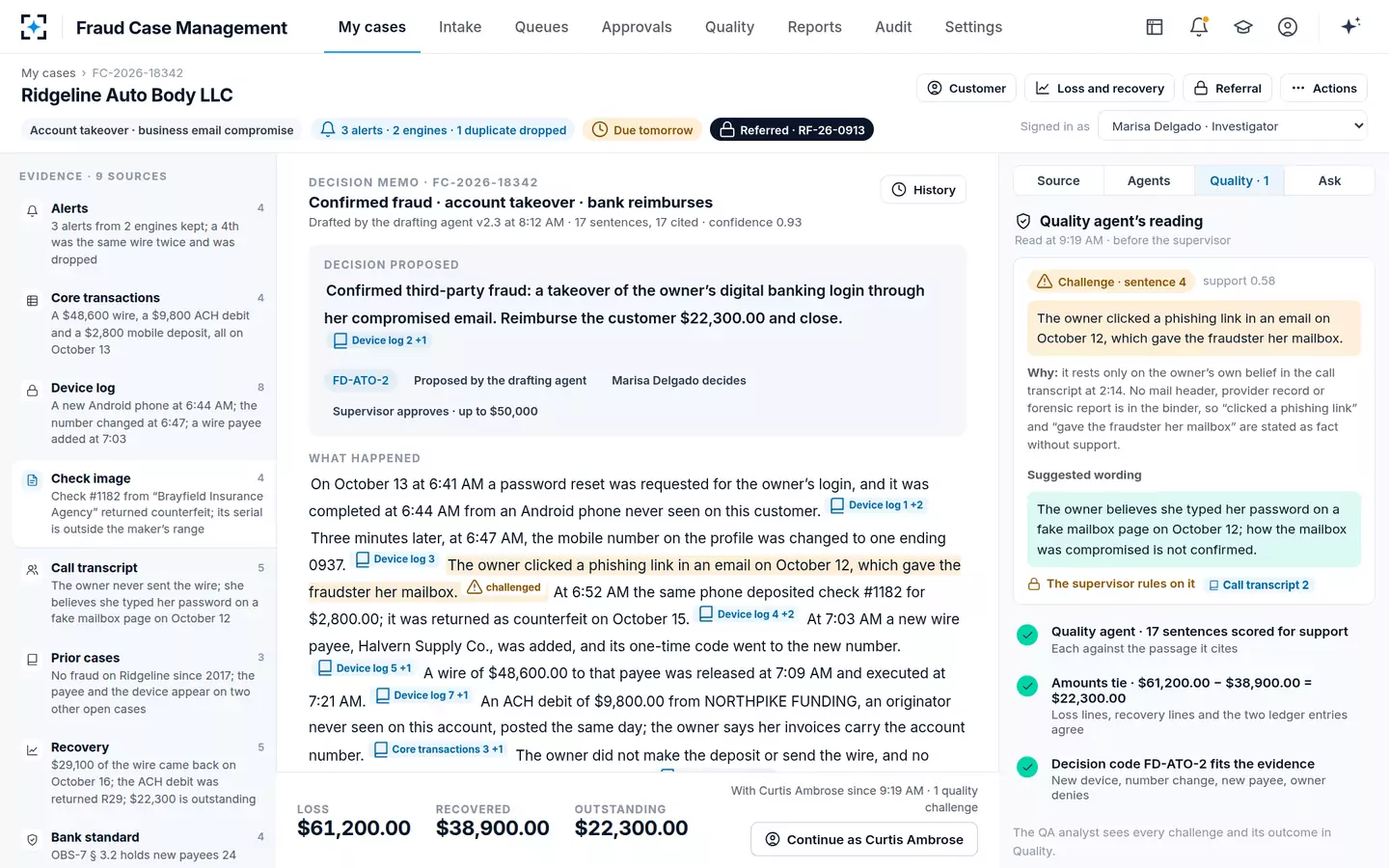
The sample case shows the line in practice. On an account takeover at Ridgeline Auto Body LLC, the agents merged four alerts, pulled nine evidence sources, computed $61,200 lost and $38,900 recovered, and drafted a 17-sentence memo with a citation on every sentence. The investigator read it, and the supervisor approved the close and two general ledger entries. In between, a quality agent challenged one sentence that turned the owner's guess about a phishing email into a fact, and a person ruled on the challenge.
What the agents did on one case, and where they handed it to a person
Why the decision stays with a person
Because a regulator has already ruled on what happens when it does not. In 2022 the CFPB found that Bank of America acted unfairly by denying prepaid-card fraud claims and freezing accounts based solely on an automated fraud filter, and that it failed to investigate reasonably; the CFPB and the OCC fined the bank a combined $225 million (CFPB order). A bank that removes the person from the decision takes on that risk directly.
The product rules make the same choice explicit. In Fraud Case Management, agents never close a case, move money, post to the general ledger, contact a customer or file a SAR. Overriding an agent's proposal needs a reason code, and those reasons go to fraud strategy. The analyst's role shifts from producing the file to judging it, and the judgment is recorded.
What skills will fraud analysts need?
The ones O*NET already ranks highest, used on different material. Its essential skills for the occupation start with active listening and writing, then reading comprehension, speaking and critical thinking; its transferable skills start with judgment and decision making and complex problem solving. The work styles it rates most important are attention to detail and integrity.
The work styles rated most important for fraud examiners and analysts
Three skills rise in weight when agents draft. Reading for support: telling whether a sentence is actually proved by the passage it cites, which is the check the sample bank's quality agent runs and the analyst has to rule on. Questioning the file: asking what is missing rather than what is wrong, since a fluent draft hides gaps better than a rough one. And explaining a decision to a customer, a supervisor or an examiner, which no agent does on the analyst's behalf.
The skill that rises: reading a sentence against its source
How is AI changing fraud investigation jobs already?
Mostly by changing where the hours go, not how many people there are. The product team's own estimate for one multi-alert account-takeover case is about nine hours of investigator and supervisor time by hand and under two with agents; it is an estimate, deliberately modest, not a measured result. On the sample bank, the median from a complete case file to a signed decision in one quarter was 38 minutes.
Where the time goes instead is the question for managers. On a fraud desk the obvious candidates are recovery work while money can still be stopped, the cases that need a phone call, and control gaps: on the sample bank, one gap, a payee hold that did not start when a phone number changed on one page, was tied to 14 cases and $212,400 of gross loss in a month. Finding and closing those is analyst work that agents surface but do not do. How a day looks with that mix is in a day in the life of a fraud analyst.
Which fraud roles feel the change first?
The roles whose main output is a routine disposition feel it first; the roles whose output is a signed decision feel it last. BLS's reasoning about its neighbouring trades points the same way: claims adjusting is projected to shrink because the core product, a damage estimate, can be produced by software, while occupations whose final decisions "will still be made by humans", in the article's phrase about investment analysts, are expected to keep growing.
On a fraud desk the routine disposition is the alert that turns out to be nothing. At the fictional sample bank, 42,180 alerts in one quarter became 6,910 cases, and 86 percent of alerts were closed as not fraud. That is one invented bank's figure and describes how its engines are tuned, but wherever the share is high, alert review is where automation pressure lands first: merging duplicates, pulling the context, closing the obvious with a reason. The investigator's work on the case that remains, deciding who bears a $22,300 loss and defending it, is where it lands last.
That suggests a career direction rather than a threat. Analysts who spend most of their day clearing alerts should expect that share to fall, and the time to move toward case work, recovery and quality review is before it does. Banks that want to keep experienced people should build that path deliberately.
Is fraud analyst a good career?
On the public data, it is a stable professional career with average growth. O*NET places it in Job Zone Four, where most jobs require a bachelor's degree, and 83 percent of respondents said new hires need one. The parent group's 2025 median wage was $81,100. The occupation is also wider than banking: O*NET's sample titles include fraud analysts and financial crimes investigators alongside insurance special-investigations staff and gaming regulators, so the skills travel.
The analysts best placed are those who move toward judgment: reviewing, challenging, deciding and explaining. A fraud analyst who can read a drafted file critically, find the control that failed and defend the decision in writing has a job agents make more valuable, not less. Where the line between drafting and deciding sits, agent by agent, is set out in AI for fraud investigation.
What fraud managers should do now
Plan for the hours, not the headcount. The productivity gain is in gathering and drafting, and it is only real if the hours freed go somewhere useful and the review stays real.
Five moves for a fraud operations manager
- Measure where today’s hours go
By task, on a sample of cases, before any tool arrives; otherwise no one can say what changed.
- Keep a person on every decision that moves money or speaks to a customer
And make the second signature real, with the evidence visible to the checker.
- Train for reading against sources
The new core skill is telling a supported sentence from a fluent one.
- Redeploy freed hours to recovery and control gaps
Recalls and returns are time-critical, and each closed gap prevents losses.
- Record overrides with reasons
They are how you learn where the agents are weak and where your people are strong.
Questions people ask
Will AI take fraud investigator jobs?
The public projections do not show that. BLS expects AI to raise analysts' productivity without eliminating demand for them, and O*NET projects average growth of 3 to 4 percent from 2025 to 2035 for the occupation group containing fraud examiners and investigators.
What will fraud analysts do with AI?
Review and decide rather than fetch and type. On the sample bank the agents gather nine sources and draft a cited memo; the analyst checks each sentence against its source, edits, decides and sends the close to a supervisor.
How many fraud examiners are employed in the United States?
BLS does not publish the occupation on its own. O*NET reports 137,800 people employed in 2025 in the parent group, Financial Specialists, All Other, which includes fraud examiners, investigators and analysts among other specialists.
Is fraud analyst a good job for the future?
The data point to steady demand: average projected growth and about 9,400 openings in the parent group over 2025 to 2035. The safest path is toward the parts of the job agents do not do, such as judging evidence, deciding and explaining decisions.
Can AI do a fraud investigator's job alone?
Not lawfully, in the parts that matter. The CFPB's 2022 order found that a bank acted unfairly when it froze accounts and denied claims based solely on an automated filter. Agents can gather and draft; a person has to decide.