A day in the life of a fraud analyst at a bank starts with a queue of cases, each with a clock, and most of it goes on gathering: pulling transactions from the core, the device and session log from digital banking, a check image, a recorded call, prior cases, then writing what they show. The decision itself, whether it was fraud and who bears the loss, often takes minutes once the evidence is in one place. What outlasts the case is the record; the Labor Department's description of the occupation ranks "Document all investigative activities" as its single most important task. The work is hard because one fraud arrives as several alerts in several queues and every fact lives in a different system. Botminds' Fraud Case Management exists to move that gathering and first drafting to agents, so the analyst's day goes on reading, judging and signing.
The hour-by-hour day below is a sample day at a fictional bank, Corvane National Bank, as it runs in the solution; the bank, its customers, its staff and every figure about them are invented. The occupational data come from O*NET, the Labor Department's occupational database, and the split of hours is the product team's own estimate.
Where the hours on one multi-alert case go, by hand and with agents
By hand · about 9 hours
- Finding the related alerts · 11%
- Pulling the evidence · 34%
- Writing and deciding · 22%
- Loss and entries · 11%
- Supervisor review · 11%
- Referral and letter · 11%
With the agents · about 1.7 hours
- Finding the related alerts · 6%
- Pulling the evidence · 18%
- Writing and deciding · 29%
- Loss and entries · 12%
- Supervisor review · 17%
- Referral and letter · 18%
What does a fraud analyst do all day?
Gathers, documents, decides and explains, in roughly that order of hours. O*NET's profile of fraud examiners, investigators and analysts summarizes the occupation as: "Obtain evidence, take statements, produce reports, and testify to findings regarding resolution of fraud allegations." Its task list, ranked by importance from surveys of people in the job, puts documentation and record-keeping at the top, ahead of interviewing and analysis.
The five most important tasks, as fraud examiners and analysts rate them
Three of the top five are writing things down. That is the honest center of the job, and the part a bank most often under-resources: a case that was decided correctly but recorded badly fails the supervisor, the examiner and, if a SAR follows, law enforcement. The rest of this page shows where in a day that writing happens, and what changes when the first draft is not the analyst's to type.
6:00 to 8:30 a.m.: the queue and its clocks
The day starts before the analyst does. At the sample bank, at 6:02 a.m. the clock agent escalated a $22,740 vendor-impersonation case that had passed its decision clock by one business day; the escalation reached the supervisor's panel at that minute, ahead of the working day. Between 8:10 and 8:12 the agents built the binder for the day's most urgent case, an account takeover at Ridgeline Auto Body LLC, due the next day.
One sample Wednesday, hour by hour
- 6:02Clock agentA vendor-impersonation case for $22,740 is one business day past its decision clock; the clock agent escalates it to the supervisor.
- 8:10Evidence agentPulls nine sources into the binder for the Ridgeline Auto Body takeover: core, device log, check image, call, prior cases, payments hub, the bank’s payee-hold standard.
- 8:11Recovery agentComputes loss $61,200, recovered $38,900, outstanding $22,300 from the recall answer and the ACH return.
- 8:12Drafting agentDrafts a 17-sentence memo, every sentence cited, proposing confirmed fraud and a $22,300 reimbursement.
- MorningInvestigatorOpens the queue: 31 open cases, one past due. Reads the Ridgeline memo sentence by sentence, opens the sources, asks the binder whether the payee hold applied.
- 9:18InvestigatorSends the close for approval with the reimbursement and two general ledger entries.
- 9:20Quality agentChallenges one sentence that states the owner’s guess about a phishing email as fact.
- 9:22–9:24SupervisorAccepts the corrected wording, then approves the close and both entries.
- Rest of dayInvestigatorThe past-due case, then a $14,950 check alteration due Friday, and the customer letter for Ridgeline once its wording check passes.
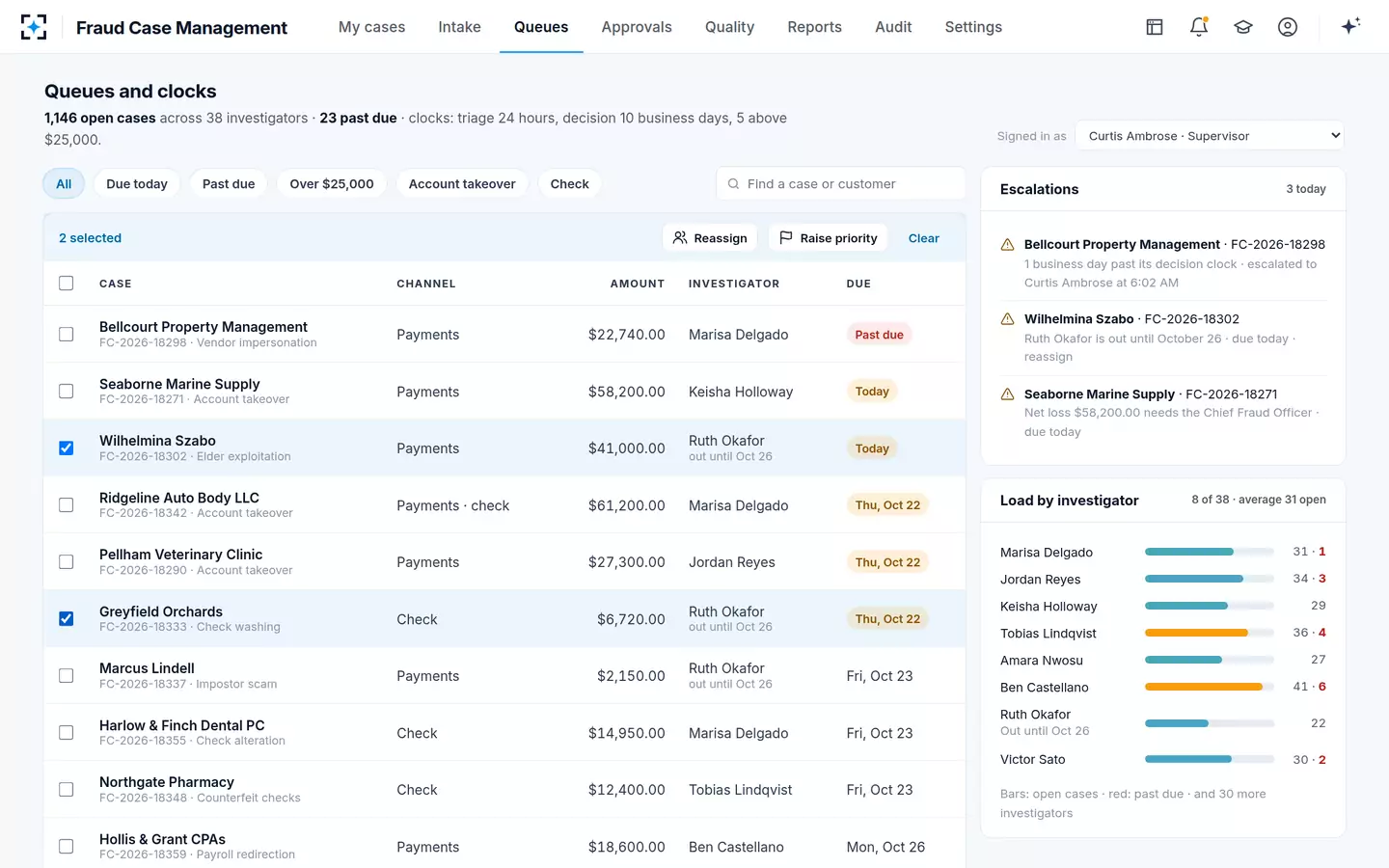
The queue is the analyst's first screen. The sample bank's shows 1,146 open cases across 38 investigators, 23 past due, with clocks of 24 hours for triage and 10 business days for a decision, five above $25,000. This investigator's own load was 31 open cases with one past due, about the team average.
The morning queue: every case, its amount and its clock
From 8:30: one customer, four alerts, one binder
Without the merge, the Ridgeline takeover would have been four separate items: a wire alert, a second alert on the same wire from a velocity rule, an ACH alert, and two days later a returned-deposit alert from the check engine. In many banks those land in different queues, and two analysts can work the same fraud. In the solution they arrived as one case, with the duplicate dropped and kept visible.
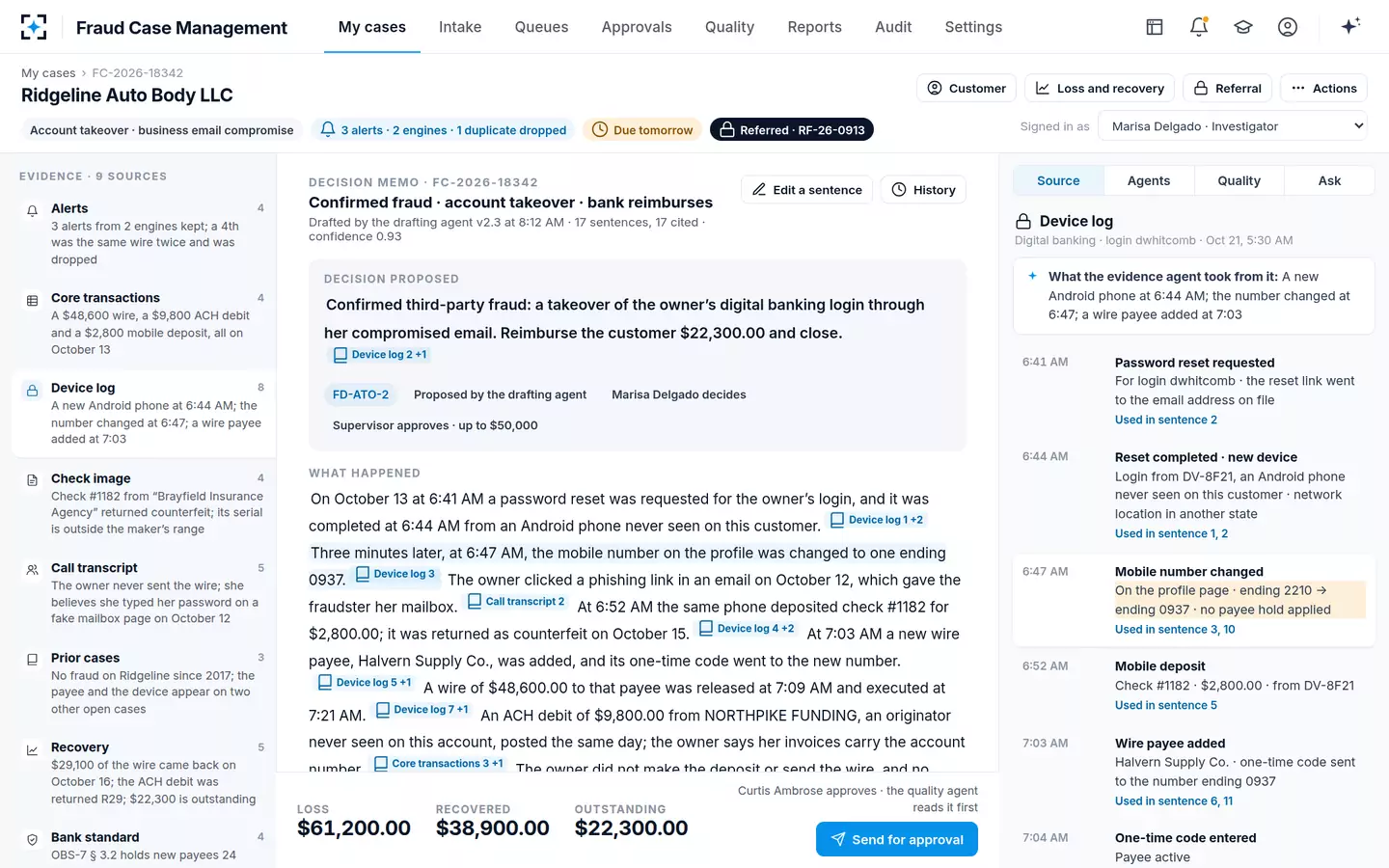
The analyst's work here is reading, not fetching. The binder has nine evidence tabs, each with a one-line takeaway, and a 17-sentence memo where every sentence opens the passage it rests on. The device log tab tells the story in three timestamps: a new Android phone at 6:44 a.m., the number changed at 6:47, a wire payee added at 7:03; the core shows the wire released at 7:09. The analyst's question is whether the memo says what the evidence shows, and only what it shows.
The binder the analyst opens instead of five systems
Before 9:30: the questions, the write-up and the decision
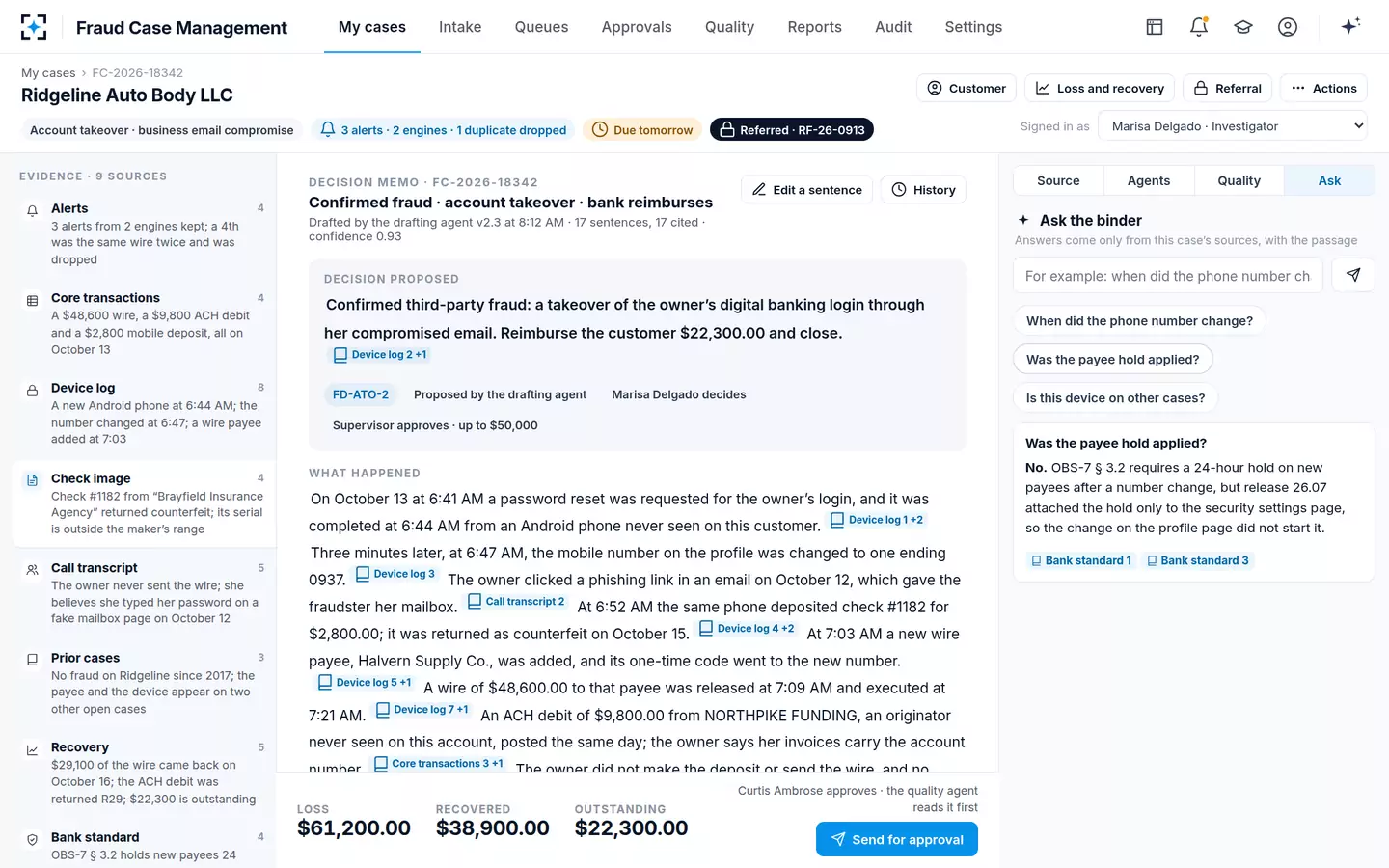
Before signing, the analyst tests the story. On the sample case the question that mattered was why the bank's own control had not stopped the wire: the bank's standard holds new payees for 24 hours after a mobile number change. Asked whether the hold was applied, the binder answered no, citing two passages of the bank's standard: the hold had been attached only to the security settings page, and the number was changed on the profile page. That answer changed who bears the loss, and it became a rule gap for fraud strategy.
Asking the binder the question that decides who pays
The analyst sent the close at 9:18 a.m. with the reimbursement and two general ledger entries. Two minutes later the quality agent challenged one sentence, the owner's guess about a phishing email written as fact, and suggested wording that kept it as her belief. The supervisor accepted it at 9:22 and approved the close at 9:24. The judging, the most skilled part of the job, took the analyst part of one morning; on the sample bank's whole third quarter, the median from a complete binder to a decision was 38 minutes.
The afternoon: everything that is not one case
The rest of the day is the rest of the queue. On the sample investigator's list that Wednesday sat the past-due vendor-impersonation case escalated at dawn, a $14,950 check alteration due Friday, and the Ridgeline customer letter, which goes out only after a wording check confirms nothing in it hints at a referral to the BSA team. Recalls and returns need chasing on the cases still open; on the Ridgeline case the wire recall stays open into January.
The record-keeping does not stop when the case closes. Every action, the analyst's and the agents', lands on one audit trail: who did what, when, why and on what evidence. That trail is what an internal auditor or an examiner will sample months later, and it is why the O*NET task list ranks documentation first.
What is a typical fraud analyst workload?
There is no public figure. No regulator publishes caseloads or time per case for bank fraud teams, and the numbers that circulate online have no traceable source. Workload depends on the bank's fraud mix, the number of detection engines feeding the queue, how many alerts each engine raises, and how much evidence-gathering is manual.
The sample bank gives one illustration, not a benchmark: 38 investigators carrying 1,146 open cases, about 31 each, fed by about 14,000 alerts a month from three engines. O*NET's survey of the occupation gives the shape of the pressure rather than the volume.
What the occupation reports about the work itself
92%
use e-mail every day
Work context
63%
say being exact or accurate is extremely important; 29% very important
26%
face strict deadlines every day; 17% at least weekly
25%
typically work more than 40 hours a week; 71% work 40
What tools do fraud analysts use?
Mostly the bank's own systems, plus general data tools. A bank analyst works in the core banking system, the detection engines' consoles, the digital banking session logs, a check image archive, the contact center's recordings, the payments hub for recalls and returns, and a case management system to hold it all. O*NET's list of software reported for the occupation is general-purpose: spreadsheets, SQL databases, statistical and business-intelligence tools such as SAS and Tableau, Python and R, and legal-research databases.
The tools are not the hard part; switching between them is. Every source in the Ridgeline binder lived in a different system, and the by-hand estimate above gives three of the nine hours to pulling evidence. A case management system earns its place by putting those sources in one binder with a citation to each, which is the test set out in judging fraud case management software.
Is being a fraud analyst stressful?
It carries steady pressure rather than constant crisis. In O*NET's survey, a quarter of people in the occupation face strict deadlines every day, most say accuracy is extremely important, and most describe their decisions as having very important results for their employer. The work styles rated most important are attention to detail and integrity, with stress tolerance further down the list. The stress has specific sources: clocks that do not stop, customers who have lost money, and decisions that move money and may be read by an examiner years later.
Some of that pressure is avoidable. A clock that escalates a day early, a queue that shows who is overloaded, and a second reader who catches a weak sentence before the supervisor does are all ways of taking the surprise out of the deadline. Whether agents change the job itself, rather than the hours, is the subject of will AI replace fraud analysts.
What is the difference between a fraud analyst and a fraud investigator?
Titles vary by bank, and O*NET groups both under one occupation, listing "Fraud Analyst" and "Financial Crimes Investigator" among its sample job titles. In practice the analyst usually sits closer to the alert and the investigator closer to the decision.
Fraud analyst and fraud investigator, as most bank fraud teams divide the work
| Fraud analyst | Fraud investigator | |
|---|---|---|
| Starts from | An alert, often in real time | A case, often several alerts merged |
| Main question | Is this activity likely fraud, and does it need a case? | What happened, who bears the loss, what can be recovered? |
| Typical output | An alert closed, escalated or a customer contacted | A decision memo, general ledger entries, a letter, a referral |
| Who checks it | Sampling and rules | A supervisor, on every case that moves money |
| Clocks | Minutes to hours | Days, set by the bank and, for consumers, Regulation E |
Both roles feed the same file, and both need the same habit: write down what you saw and where you saw it. The steps that file passes through, from alert to close, are in the fraud investigation process in banks.
Questions people ask
How many cases does a fraud investigator handle?
No regulator or research body publishes a figure for banks, so any number you see online should be treated with care. At the fictional sample bank in this guide, 38 investigators carried 1,146 open cases, about 31 each; real loads depend on the alert volume, the fraud mix and how much evidence-gathering is manual.
What skills does a fraud analyst need?
O*NET rates active listening and writing highest among the essential skills for the occupation, followed by reading comprehension, speaking and critical thinking, and lists judgment and decision making and complex problem solving among the transferable skills. Attention to detail and integrity are the work styles rated most important.
Do you need a degree to be a fraud analyst?
Usually. O*NET places the occupation in Job Zone Four, where most jobs require a four-year bachelor's degree, and 83 percent of respondents said a bachelor's degree is required for new hires.
Is fraud analyst an entry-level job?
Alert-review roles are often a first job in fraud operations; investigator roles usually come after. O*NET's Job Zone Four description calls for considerable work-related skill, knowledge or experience, which is closer to the investigator end of the trade.
How much of a fraud analyst's day is writing?
No study measures it for banks. O*NET's survey ranks documenting investigative activities, keeping records and preparing written reports as three of the five most important tasks, and the product team's estimate for one multi-alert case gives two of nine hours to writing and deciding by hand.