Fraud and AML convergence, often shortened to FRAML, is the practice of running fraud investigations and anti-money laundering investigations on shared evidence, so a case worked by the fraud team flows into the BSA team's SAR decision without being rebuilt. It is not a regulatory term, and it does not require merging the two teams. What it requires is one file: the fraud team gathers the evidence and decides the loss; the BSA team uses that same evidence to decide whether to file; and the SAR decision is sealed from everyone who writes to the customer. It is hard because the two teams answer different questions on different clocks, and because SAR confidentiality is strict. Botminds' Fraud Case Management keeps the evidence shared and the referral in a restricted BSA space.
The worked example is a fictional sample bank, Corvane National Bank, and an account takeover at its business customer Ridgeline Auto Body LLC; the bank, the people and every figure about them are invented sample data. The rules quoted are real and linked.
One fraud case file: what both teams use, and what only one team sees
| Part of the file | Fraud team | BSA team | Customer-facing staff |
|---|---|---|---|
| Alerts, evidence, chronology, amounts | Builds it | Uses it | Only what the customer letter needs |
| Classification of the fraud | Decides it | Uses it to choose the SAR category | No |
| Loss decision, reimbursement, general ledger entries | Decides and approves | Reads | The outcome, in the letter |
| Referral to BSA | Drafts and sends; keeps the reference | Receives | Never |
| SAR decision, narrative, filing status, BSA notes | Never | Owns | Never |
What is fraud and AML convergence, or FRAML?
It is an industry name for treating fraud and money laundering as two views of the same activity. Fraud is how criminals take the money; laundering is what they do with it next. The account that receives a business email compromise wire is a fraud problem for the victim's bank and a laundering problem for the receiving bank, and the same transactions appear in both investigations. FinCEN's own advisory on email compromise frames it the same way, noting that institutions may share information about such fraud under the USA PATRIOT Act's section 314(b) safe harbor to identify and report activity they suspect of money laundering or terrorist financing.
Convergence has three practical meanings, and a bank should be clear which it means: shared data and evidence, so neither team rebuilds the other's work; shared or connected case systems, so a referral is a hand-off rather than an email; and, sometimes, a combined team. The first two are where most of the value is. The third is an organizational choice examiners accept either way, as long as the lines stay open.
Fraud SARs are BSA SARs: why the hand-off is now high-volume
Every SAR a bank files about fraud is filed under the Bank Secrecy Act, by the BSA function, on the same form and the same clock as a money-laundering SAR. The fraud team's decision becomes the BSA team's evidence. That hand-off has grown sharply.
The fraud-to-BSA hand-off, by the numbers
489%
rise in SARs on check, ACH and wire fraud, 2014 to 2024
$5,000
fraud SAR threshold where a suspect can be identified
$25,000
fraud SAR threshold regardless of a suspect
30days
to file from initial detection, shared by both teams
The agencies, citing FinCEN data, put the growth at 489 percent: that is how much the number of SARs filed on check, ACH and wire fraud rose between 2014 and 2024. Each of those began as a fraud case that someone referred. When the SAR clock of 30 days runs from the bank's initial detection, a fraud case that takes three weeks to reach the BSA team leaves it one week to decide and write. The convergence question is first a timing question.
What is the difference between fraud and AML work?
Fraud work decides a loss; AML work decides a report. The evidence overlaps, but the questions, clocks and outputs do not, and convergence fails when either team forgets that.
Fraud and AML work on the same activity
Fraud team: Was the customer or the bank defrauded, and who bears the loss?
BSA / AML team: Is the activity suspicious enough that the bank must report it?
Fraud team: Regulation E for consumer claims; the bank’s own decision clocks
BSA / AML team: SAR filing: 30 days from initial detection, 60 with no suspect
Fraud team: A decision, a reimbursement or denial, general ledger entries, a letter
BSA / AML team: A SAR or a decision not to file
Fraud team: Yes, about the outcome
BSA / AML team: Never about the SAR
Fraud team: Net loss, recovery, time to decision
BSA / AML team: SAR timeliness and quality
An analyst moving between the two notices the difference in the last row first. A fraud analyst is judged on dollars; an AML analyst on reports. What an AML investigator's day looks like is set out in what does an AML investigator do; the fraud side is in a day in the life of a fraud analyst.
Should fraud and AML teams be combined?
They can be, but they do not have to be, and the examination manual takes no side. What it requires of a bank that keeps them apart is that they talk.
"When multiple departments are responsible for researching unusual activities (i.e., the BSA department researches BSA-related activity and the Fraud department researches fraud-related activity), the lines of communication between the departments must remain open."
FFIEC BSA/AML Examination Manual, Suspicious Activity Reporting
The manual gives the reason in the next sentence: open lines let banks with bifurcated processes gain efficiencies "by sharing information, reducing redundancies, and ensuring all suspicious activity is identified, evaluated, and reported." That is the case for convergence of evidence, whatever the organization chart says. The case for keeping some separation is confidentiality: the fraud team writes to customers and works with the contact center, and those are exactly the places a SAR must never surface.
The sample bank keeps two teams and one file. The fraud investigator, supervisor and quality analyst work the case; the BSA officer receives referrals in a restricted space. Neither team re-gathers the other's evidence, and neither sees what it should not.
Who files the SAR for fraud?
The BSA function, through the bank's SAR decision maker, an individual or a committee. The fraud investigator's job is to recognize when a case may need a SAR, refer it promptly with the facts, and then step back. For a national bank the fraud thresholds are in the OCC's rule: insider abuse of any amount, $5,000 where a suspect can be identified, $25,000 regardless of a suspect.
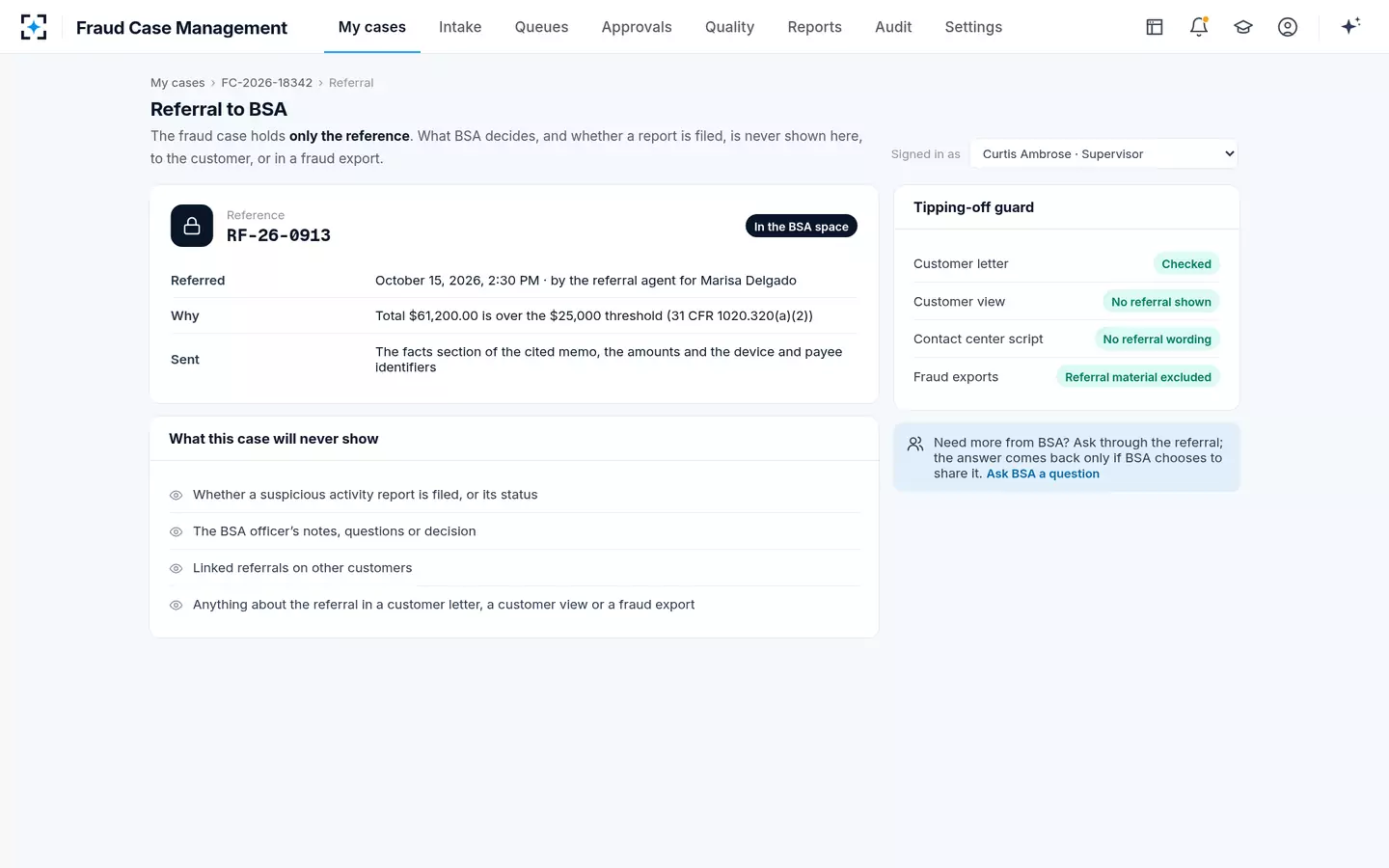
On the sample case, the total of $61,200 was over the $25,000 threshold, so the referral agent drafted a referral and moved it to the restricted BSA space; the fraud case kept only the reference, RF-26-0913. The referral agent never files a SAR and never shows a referral's status to fraud roles. Who decides on the BSA side, and how, is set out in AML investigation steps.
The referral, held in the BSA space; the fraud case keeps a reference
How do fraud and AML teams share cases in practice?
By reference, in one direction at a time. The fraud team's evidence stays where it was gathered, and the referral points to it; the BSA team reads the binder rather than receiving a copy that drifts out of date. When the BSA analyst needs more, the question goes back through the referral, and the answer stays in the fraud file as evidence. On the sample bank, the fraud team can ask BSA a question through the referral, but an answer comes back only if BSA chooses to share it.
Links between customers matter as much as the hand-off. On the sample case, device DV-8F21, the phone that took over Ridgeline's login, had also logged in to a second business customer's profile the day before, and both customers had paid the same supplier. The fraud cases stay separate and linked. For the BSA analyst that link is the start of a pattern, a single device behind activity on several accounts, which is exactly the kind of connection a converged file makes visible and two disconnected systems hide.
Sharing also runs across banks. When the money went to an account at another institution, that institution's BSA team may be seeing the receiving side of the same fraud. The 314(b) safe harbor is the channel FinCEN points to for business email compromise, and it is the BSA team's call, not the fraud team's, because what can be said is bounded by the same confidentiality rule.
Can fraud investigators see SARs?
Not as a matter of course, and the safe design is that they do not need to. The SAR rule is blunt about disclosure.
"No bank, and no director, officer, employee, or agent of any bank, shall disclose a SAR or any information that would reveal the existence of a SAR."
31 CFR 1020.320(e)(1)(i)
The rule allows some sharing. A bank may share a SAR, or information that would reveal one, within its corporate organizational structure for purposes consistent with the Bank Secrecy Act, as determined by regulation or guidance, and it may disclose the underlying facts, transactions and documents in specified cases, provided no one involved in the reported activity is told that it was reported. That is room for a BSA team to ask the fraud team for more evidence. It is not a reason to show SAR status on a fraud case that the customer's letter is written from.
The sample bank's answer is a guard rather than a policy. Before a customer letter goes out, the referral agent checks it, and the customer view, the contact center script and fraud exports, for any wording that would reveal a referral. Whether a SAR was filed, and the BSA officer's notes, never appear on the fraud case at all.
The no-file decision: what each team writes down
Each team documents its own decision, and only its own. The fraud team always records its decision on the loss, because reimbursements, charge-offs and customer letters depend on it. The BSA team's decision not to file is a different matter, and the guidance on it has moved.
The examination manual's SAR section, as published online in December 2025, says banks should document SAR decisions, including the reason for not filing. The interagency FAQs of October 2025, which are later, say "There is no requirement or expectation under the BSA or its implementing regulations for a financial institution to document its decision not to file a SAR." A bank may still choose to, and the FAQs say a short statement will usually do. For a converged process, the practical consequence is that the fraud memo should never be treated as the BSA team's no-file record, and the BSA team's reasoning should never be written into the fraud memo.
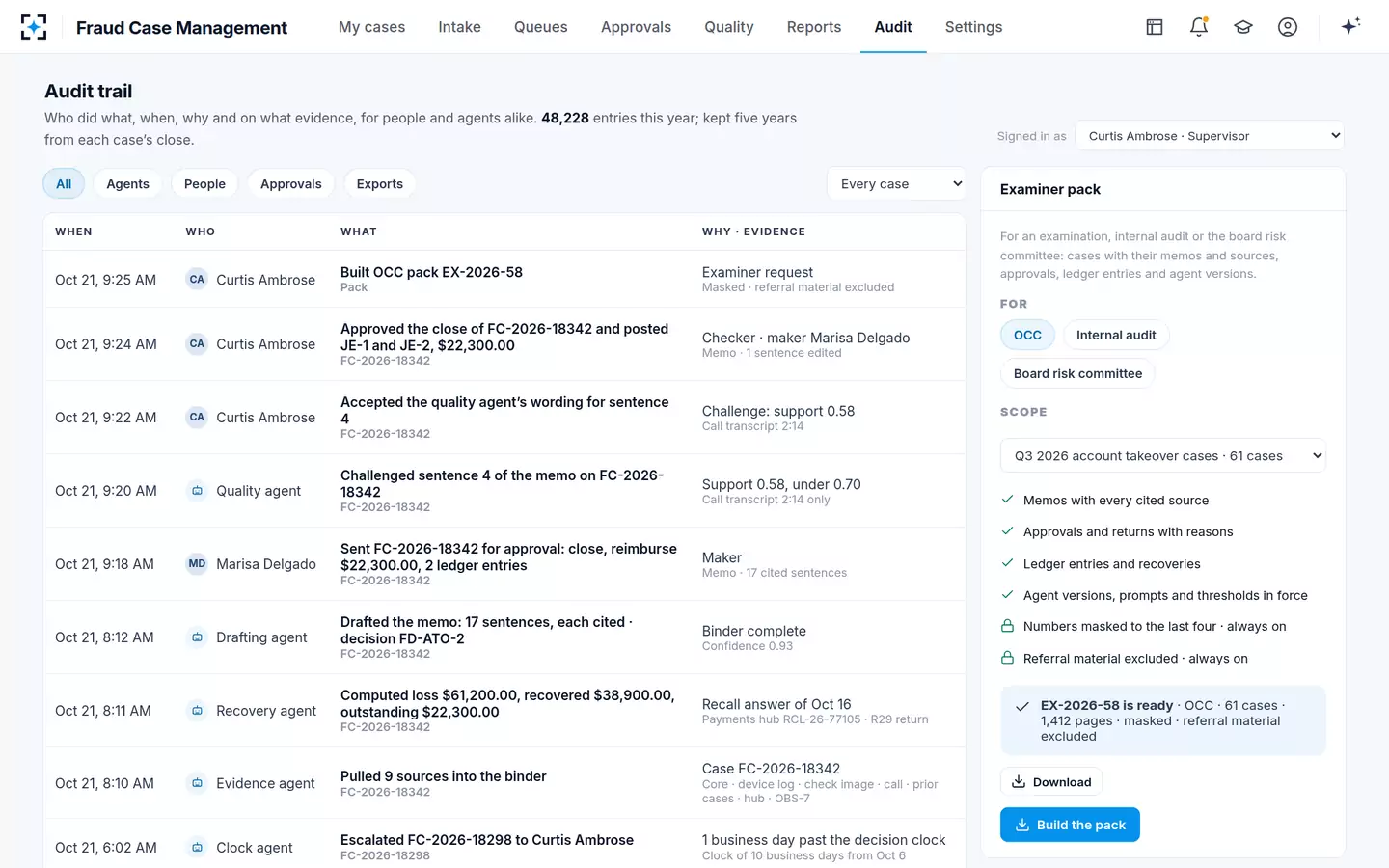
One trail for both teams, with referral material excluded from exports
Where fraud and AML convergence goes wrong
Most failures are leaks or gaps at the hand-off. A customer letter that says the matter "has been reported" tells the customer something the bank may not say. A contact center script that reads from the same notes the BSA officer wrote in can do the same. A referral sent by email loses its evidence and its clock. And a BSA team that rebuilds the evidence from scratch spends days of a 30-day clock on work the fraud team has already done.
Five checks for a fraud-to-BSA hand-off
- One evidence file, referenced by both teams
The BSA team starts from the fraud team’s binder, not a summary of it.
- A referral clock far shorter than 30 days
On the sample bank, 5 business days after fraud is confirmed.
- The SAR decision in a restricted space
The fraud case holds a reference and nothing else.
- A wording check on everything customer-facing
Letters, customer views, contact center scripts and exports.
- Each team documents its own decision
The fraud memo is not the no-file record, and the BSA reasoning is not in the fraud memo.
For the questions to put to the case software on either side, see judging fraud case management software and twelve questions to ask about an AML case management system.
Questions people ask
What is the difference between a fraud analyst and an AML analyst?
A fraud analyst decides whether a customer or the bank was defrauded and what happens to the loss; an AML analyst decides whether activity is suspicious enough to report under the Bank Secrecy Act. Their evidence overlaps, but the fraud analyst writes to the customer and the AML analyst never discusses a SAR with anyone outside the permitted channels.
Do fraud SARs go to the same place as AML SARs?
Yes. Both are filed with FinCEN under 31 CFR 1020.320 by the bank's BSA function, on the same form and within the same 30-day clock from initial detection, or 60 days with no suspect identified.
Can the fraud team tell the customer a SAR was filed?
No. The SAR rule forbids disclosing a SAR or any information that would reveal one. The customer can be told the outcome of the fraud investigation, but nothing about a report.
Should fraud and AML share one case management system?
They should share evidence; the system can be one or two. What matters is that a referral carries the evidence and the clock, and that the SAR decision sits where fraud roles and customer-facing material cannot reach it.
Can banks share fraud information with each other?
Under the section 314(b) safe harbor of the USA PATRIOT Act, financial institutions may share information to identify and report activity they suspect may involve money laundering or terrorist activity; FinCEN's 2019 advisory says this covers business email compromise fraud.