AI for fraud investigation works best on the part of a case that is labor, not judgment: finding the alerts that belong together, pulling transactions, logs, check images and call transcripts into one place, computing what was lost and recovered, and drafting a memo in which every sentence points to its evidence. It should not freeze an account, deny a claim, move money or file a report on its own. That line is not a matter of taste. In 2022 a federal regulator found that a large bank acted unfairly when it froze accounts and denied fraud claims on the strength of an automated filter alone. Fraud investigation is hard because the evidence is spread across five or more systems and every decision moves money. Botminds' Fraud Case Management puts eight agents on the gathering and drafting and leaves every decision with a named investigator and a second approver.
The case used throughout comes from a fictional sample bank, Corvane National Bank, and an account takeover at its business customer Ridgeline Auto Body LLC. The bank, the customer and the people are invented; every figure about them is sample data from the solution, and anything called a target is a design goal.
Eight agents gather and draft; people decide and sign
Agent
Intake agentMerges alerts from every engine into one case per customer when customer, device or payee match inside 72 hours; drops duplicates with the reason shown.
Never: merges below 0.90 confidence on its own, merges two customers, or closes an alert
Agent
Redaction agentMasks account, routing, card and device numbers to the last four in memos, letters and exports.
Never: can be switched off
Agent
Evidence agentPulls each source into the case binder and writes a one-line takeaway on each tab.
Never: changes an account, or guesses when a source is unavailable
Agent
Recovery agentFollows wire recalls, ACH returns and warranty claims; drafts the general ledger entries for the close.
Never: posts to the general ledger or contacts another institution
Agent
Drafting agentWrites the decision memo one cited sentence at a time and proposes a decision code.
Never: writes a sentence it cannot cite, or proposes a decision below 0.80 confidence
Agent
Quality agentScores every sentence against its source, checks that the amounts tie and the decision code fits.
Never: edits the memo or approves anything
A person decides
Investigator decidesReads the memo sentence by sentence, edits, proposes the close, the reimbursement and the general ledger entries.
A person decides
Supervisor approvesApproves the close and the money up to $50,000 net loss, or returns it with a reason code; the Chief Fraud Officer approves above that.
Agent
Referral agentChecks SAR thresholds, drafts the referral into a restricted BSA space, and checks letters for wording that would reveal it.
Never: files a SAR or shows a referral’s status to fraud roles
Agent
Clock agentRuns triage, decision and referral clocks; reminds a business day before; escalates on breach.
Never: extends a deadline
How is AI used in fraud investigations today?
Most banks met AI first in detection, where models score payments and logins and raise alerts. Investigation is a different job. An alert says something looks wrong; an investigation establishes what happened, who bears the loss, what can be recovered and whether the BSA team needs to know. That work is mostly reading and writing, which is exactly what language models are good at, and mostly decisions about money and customers, which is exactly where they should not act alone.
The distinction matters for how a bank buys. A detection model is judged on what it catches and how many good customers it stops. An investigation agent is judged on whether its work can be checked: whether the evidence it gathered is complete, whether each sentence it wrote is supported by the record it cites, and whether a person made every decision that moved money. The rest of this guide is about that second kind of AI.
Can AI make fraud decisions? What the Bank of America order settled
No, not on its own, and the clearest reason is a consent order. In the fall of 2020, Bank of America changed how it investigated error notices from holders of prepaid cards carrying state unemployment benefits, relying on an automated fraud filter. The CFPB found that the bank engaged in unfair acts or practices by denying those notices and freezing accounts based on that filter alone, and that it failed to conduct reasonable investigations as Regulation E requires. The CFPB fined it $100 million and the OCC a further $125 million.
"denying prepaid debit cardholders’ notices of error and freezing their prepaid debit card accounts based solely on the results of the Bank’s flawed fraud filter"
Consumer Financial Protection Bureau, order against Bank of America, N.A., July 14, 2022
The lesson is precise. The finding was not that the bank used automation; it was that the automation decided, and nobody checked. Fraud Case Management is built on the opposite rule. Its agents never close a case, move money, post to the general ledger, contact a customer or another institution, or file a SAR. Every freeze, unfreeze, reimbursement, charge-off, general ledger entry, customer letter and referral needs a maker and a different checker, and nobody approves their own case.
What does an AI fraud agent actually do on one case?
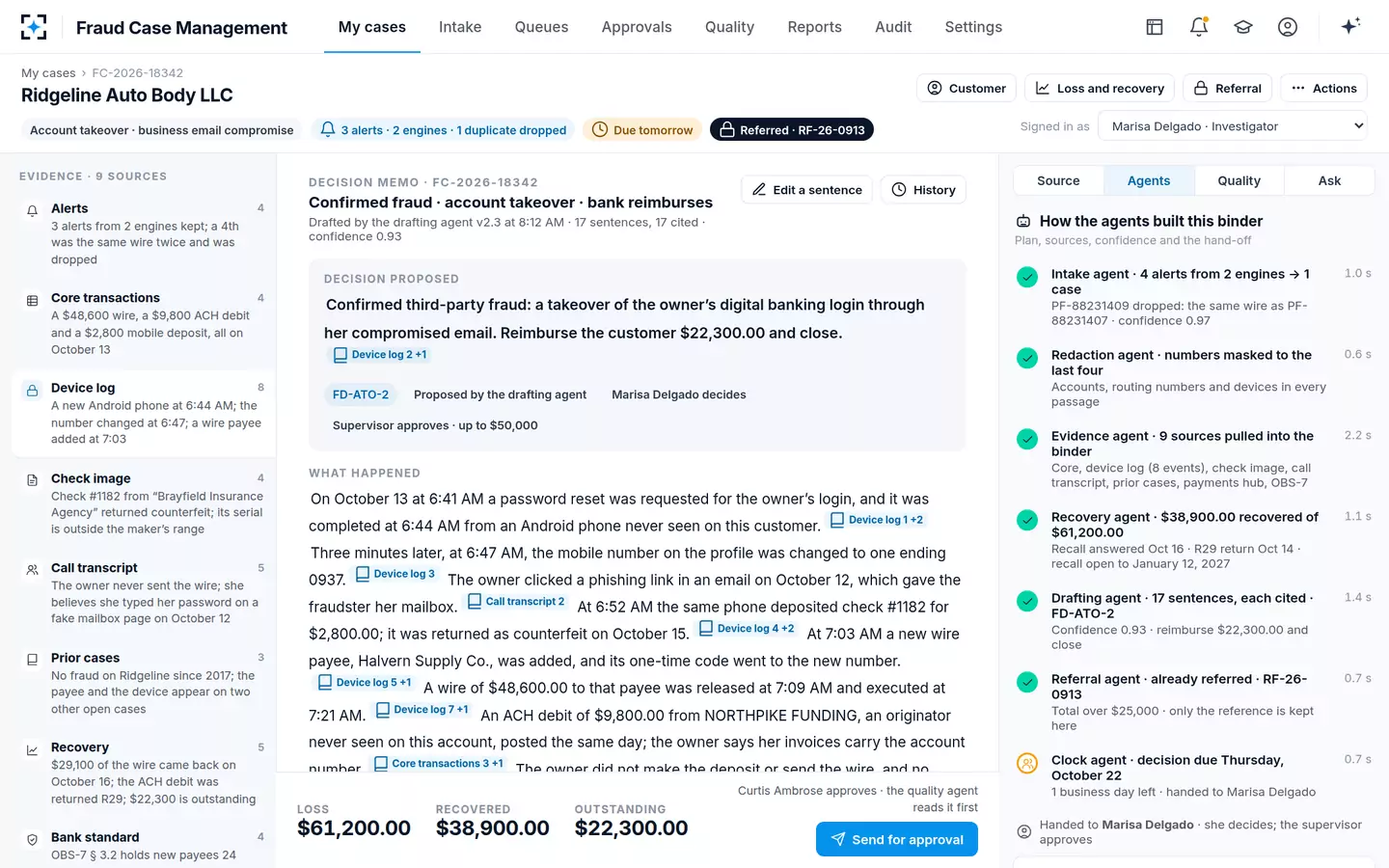
An AI fraud agent is a piece of software with one narrow job, the data it may read, and a short list of things it may never do. On the Ridgeline case they worked in sequence. The intake agent joined four alerts from two engines into case FC-2026-18342 at confidence 0.97 and dropped a duplicate wire alert with its reason. The redaction agent masked every account, routing and device number to the last four. The evidence agent pulled nine sources, including an eight-event device log showing a new Android phone at 6:44 a.m., a changed mobile number at 6:47 and a new wire payee at 7:03.
The recovery agent read the payments hub and computed a $61,200 loss, $38,900 recovered through a wire recall and an ACH return, and $22,300 outstanding. The drafting agent wrote 17 sentences, all cited, under decision code FD-ATO-2 at confidence 0.93. The referral agent saw the total was over the $25,000 threshold and recorded the referral reference. The clock agent set the decision due on Thursday, October 22. Then it all went to the investigator.
On the sample case, the agents' work took seconds; the decision took people
7.7seconds
the seven agents’ combined run time shown on the Agents tab
9sources
pulled into the binder, each with a one-line takeaway
17/17
memo sentences cited to a passage
1
sentence challenged before the supervisor saw it
How the agents built the binder, step by step
Why a cited sentence beats a confident one
Because language models can be fluently wrong. Treasury's 2024 report on AI in financial services described generative models as susceptible to "AI hallucinations," "producing confidently stated but incorrect output". The defense is structural rather than a promise of better models: the agent may only write what it can point to, and something other than the agent checks the pointing.
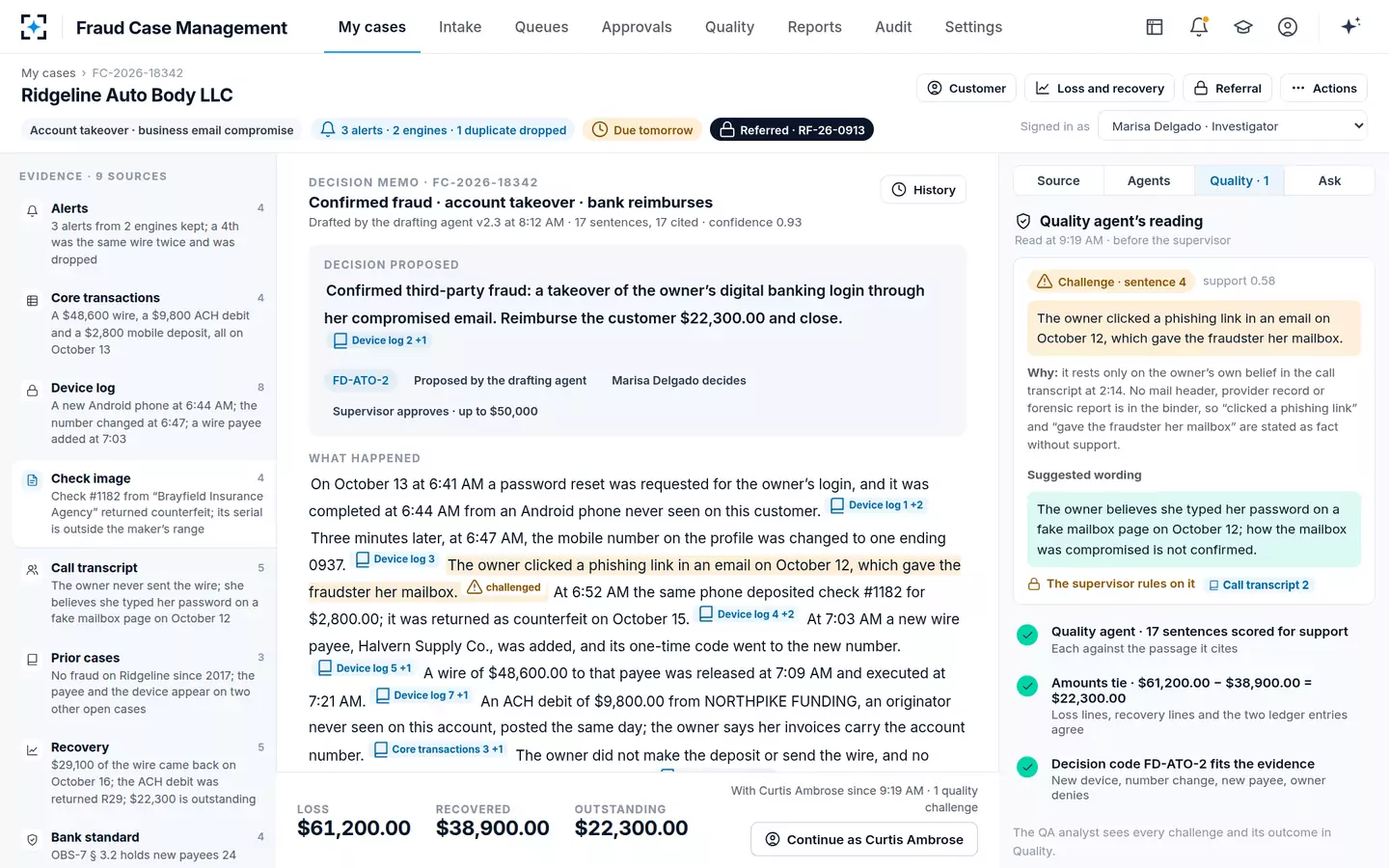
The Ridgeline memo shows both halves. Sentence 4 stated as fact that the owner had clicked a phishing link on October 12 and so handed the fraudster her mailbox. It cited the call transcript, and the citation was real. But the transcript held only the owner's own belief; no mail header, provider record or forensic report was in the binder. The quality agent scored the sentence's support at 0.58, under the 0.70 threshold, and suggested recasting it as the owner's belief, that she had typed her password into a fake mailbox page, with the cause of the compromise marked as unconfirmed. The supervisor accepted the wording, and the edit is marked as his. Both versions, side by side, are in how to write a fraud investigation report.
The quality agent's challenge, before the supervisor reads
Respondents to Treasury's request said something similar about method. One told Treasury that retrieval augmented generation, where the model answers from documents it is given, "provides more transparency as to the basis of the responses and therefore enables the user to better assess the credibility of the output". That is a respondent's view, not a Treasury finding, but it describes the design choice: an answer tied to its passage can be checked; an answer from the model's general knowledge cannot.
Do regulators allow AI in fraud case management?
Nothing in federal banking rules forbids it, and nothing yet gives it a specific rulebook. The interagency model risk guidance revised in April 2026 by the OCC, the Federal Reserve and the FDIC says directly that generative and agentic AI are outside it for now, on the ground that both are new and changing fast (OCC Bulletin 2026-13 and SR 26-2, April 17, 2026).
No model guidance covers the agent yet. Every rule its work touches still does.
The same guidance excludes "deterministic rule-based processes" from its definition of a model, and the agencies said they plan a request for information on banks' use of AI, including agentic AI. As of late October 2026 it had not been issued. In the gap, the obligations that do apply are the ones the AI touches: Regulation E's reasonable-investigation duty for consumer claims, SAR confidentiality, the bank's safety-and-soundness duty, and its own risk management. NIST's AI Risk Management Framework is intended for voluntary use, and many banks use it as the structure for exactly this governance.
For pilots, the closest supervisory signal is BSA-specific. The banking agencies and FinCEN said in 2018 that a pilot program that ultimately proves unsuccessful should not by itself draw supervisory criticism. That statement covers BSA/AML innovation, so it reaches a fraud team's work only where the work feeds suspicious activity reporting; a bank should not read it as cover for consumer-claim decisions.
How do you audit AI in fraud investigations?
The same way you audit people: by reading what each did, when, why and on what evidence. An audit trail that records only the final approval hides the most important part, which is what the agent proposed and what the person changed. On the sample bank, the trail records every agent step and every human step on one timeline: the evidence agent's nine sources at 8:10 a.m., the drafting agent's memo at 8:12, the quality agent's challenge at 9:20, the supervisor's accepted wording at 9:22 and his approval at 9:24.
Three more things belong in the audit. The agent version, prompt and thresholds in force on each case, so a finding can be traced to a configuration. The override reasons: on the sample bank, overriding an agent's proposal needs a reason code, and those codes go to fraud strategy every month. And the change history: every new agent version replays a golden set of 300 closed cases, and the Chief Fraud Officer approves it before it runs on live cases. How to measure the agents' proposals over time is the subject of measuring fraud investigation software.
Where AI for fraud investigation should stop
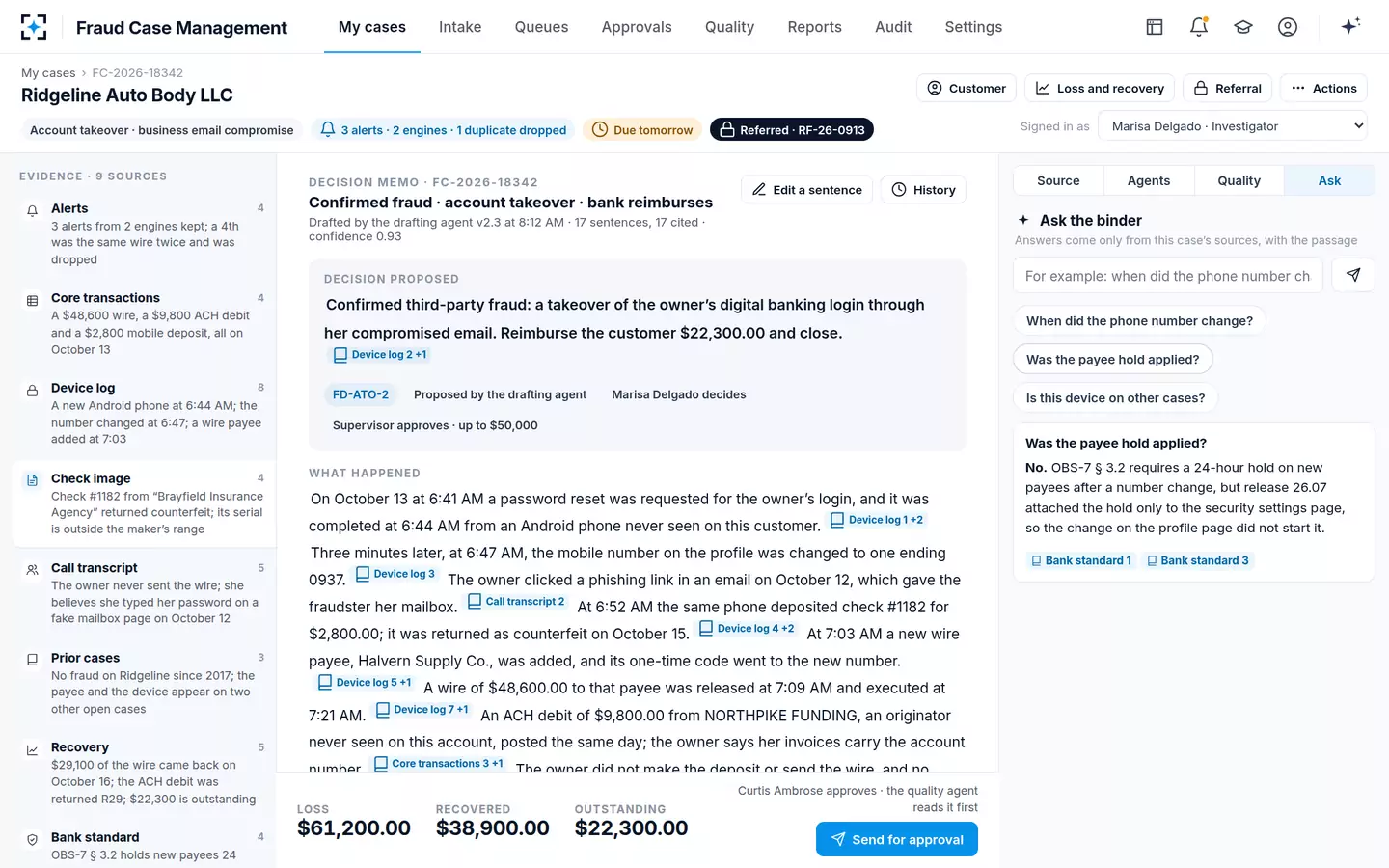
It should stop at every point where the bank speaks or pays. On the sample bank that means seven actions always need two people: freeze, unfreeze, reimbursement, charge-off, general ledger entry, customer letter and referral. It should also stop where it does not know. Asked a question the binder cannot answer, the solution replies "I will not guess" rather than inventing an answer.
Ask the binder: answers only from this case's sources
There are judgments AI should not be asked to make at all: whether a customer's account of events is credible, whether an elderly customer is being coached by someone on the phone, whether to call a customer before or after a freeze. Those depend on things no binder holds. The agents can make the investigator faster at the parts that are search and arithmetic, so there is more time for the parts that are not. Whether that changes the job itself is taken up in will AI replace fraud analysts.
What to ask before you buy AI for fraud investigation
Ask to see the limits, not the capabilities. Any vendor can show an agent drafting a memo; fewer can show what the agent refused to do, the challenge it raised against itself, and the approval record that proves a person decided. Run the questions below on a few of your own closed cases.
Questions that separate drafting from deciding
- What can each agent never do?
Expect a written list per agent, enforced by the software, not a policy statement.
- Can every sentence be opened to its source?
Click three at random. A citation that opens a summary rather than the record is not a citation.
- What checks the agent’s work before a person signs?
And what score triggers a challenge? On the sample bank, support below 0.70.
- What happens when the agent is unsure?
Below 0.80 confidence the drafting agent writes the facts but proposes no decision.
- Which actions need two people?
Freezes, reimbursements, charge-offs, general ledger entries, letters, referrals; and self-approval locked off.
- How are agent changes tested?
A golden set of closed cases replayed before approval, with the result on the record.
- Where do SAR referrals go?
Somewhere the fraud team, the customer letter and fraud exports cannot see.
The agents, their limits and the people around them are shown screen by screen on the Fraud Case Management page. For the questions to put to the case software as a whole, see judging fraud case management software.
Questions people ask
Will AI write the fraud case narrative?
It can draft it, and on the sample case it drafted all 17 sentences with a citation on each. The investigator reads, edits and owns the final text; any sentence a person types is marked as theirs and the agent's wording is kept in the history. A sentence the agent cannot cite is a sentence it does not write.
What is an AI fraud agent?
Software given one narrow job in a case, such as merging alerts, gathering evidence or drafting a memo, with defined data it may read and actions it may never take. Fraud Case Management uses eight of them. None can close a case, move money or file a SAR.
Can AI freeze an account during a fraud investigation?
It should not do so on its own. The CFPB's 2022 order found Bank of America's freezes and claim denials, based solely on an automated filter, unfair. In Fraud Case Management a freeze is proposed by one person and approved by another.
Does model risk guidance cover AI fraud agents?
Not directly. The April 2026 interagency guidance puts generative and agentic AI outside its scope and promises a request for information that had not appeared by late October 2026. Banks still govern the agents under their own risk management, and Regulation E and SAR rules apply to what the agents touch.
How accurate is AI on fraud investigations?
There is no published regulatory or academic benchmark for agents that draft fraud case memos, so accuracy has to be measured on the bank's own closed cases. The useful measures are evidence completeness, sentence support, agreement with the investigator's decision and time to decision.