The US KYC requirements for foreign nationals opening a deposit account are set by the Customer Identification Program rule, and the rule does not require a Social Security number from anyone who is not a US citizen. Before opening, a bank must obtain a name, date of birth, address and identification number; for a "non-U.S. person" the number may be "a taxpayer identification number; passport number and country of issuance; alien identification card number; or number and country of issuance of any other government-issued document evidencing nationality or residence and bearing a photograph or similar safeguard" (31 CFR 1020.220). What the bank's written program adds on top decides whether a newcomer with only a passport opens an account online, in a branch, or not at all. Botminds' Deposit Account Opening runs the identity, screening and funding checks as each piece of data arrives, and sends any application its limits do not clear to a specialist with the one document or detail that is missing.
The rule text below is quoted from the eCFR, the 2003 final rule and FinCEN. The sample applications come from the solution's fictional bank, Corvane National Bank; its applicants and figures are sample data.
Who counts as a foreign national under the CIP rule?
Anyone who is not a US citizen. The rule's split is between a "U.S. person" and a "non-U.S. person," and for an individual a US person is a United States citizen. A permanent resident, a student or a worker on a visa is a non-US person for CIP purposes, whatever their tax residency.
The agencies chose that line deliberately. Commenters on the 2003 rule asked for the tax definition, which treats resident aliens as US persons; Treasury and the agencies kept the citizenship test, finding it "a better standard for purposes of this final rule than the IRS definition," because the tax test would require branch staff to distinguish among tax statuses (68 FR 25090, May 9, 2003). A procedure that asks "do you have an SSN?" instead of "are you a US citizen?" is applying a test the rule does not use.
The identification number the CIP rule requires, by applicant
| Applicant | Identification number the rule accepts | What the bank's program decides |
|---|---|---|
| US citizen with an SSN | A taxpayer identification number | Whether to take the TIN from a third-party source, under FinCEN's 2025 order |
| US citizen who has applied for an SSN | None yet, if the program allows it: the application must be confirmed before opening and the number obtained within a reasonable time | Whether to offer this at all, and what proves the application was filed |
| Non-citizen with an SSN or ITIN | The SSN or ITIN, both taxpayer identification numbers | Which sources it uses to verify an ITIN holder |
| Non-citizen with no SSN or ITIN | Passport number and country; alien identification card number; or another government photo ID number and country | Which of these it accepts, in which channel, and how it verifies each |
Why the rule offers four numbers instead of one
Because no single number exists for non-citizens. The 2003 preamble explains that the rule "provides this flexibility because there is no uniform identification number that non-U.S. persons would be able to provide to a bank," and that "a bank must decide for itself," based on its own risk factors, whether the information a customer presents is reliable. Those factors are named: the types of accounts the bank offers, its methods of opening them, the other identifying information available, and its size, location and customer base.
That leaves real policy decisions with the BSA officer. A bank near a university may see hundreds of student applicants each autumn with a passport and an I-20; a bank in a border region may see consular identification cards; a bank with a digital-only product sees all of them through a phone camera. Each should write down which numbers it accepts, how it verifies them, and why, and apply the same answer in every channel.
Can a bank open an account for a foreign national with only a passport?
Yes, under the rule. The passport's number and country of issuance are the identification number, and the passport itself is the rule's own example of a verification document: "unexpired government-issued identification evidencing nationality or residence and bearing a photograph." A bank still needs a date of birth and an address, and the address is where many passport-only applications stop.
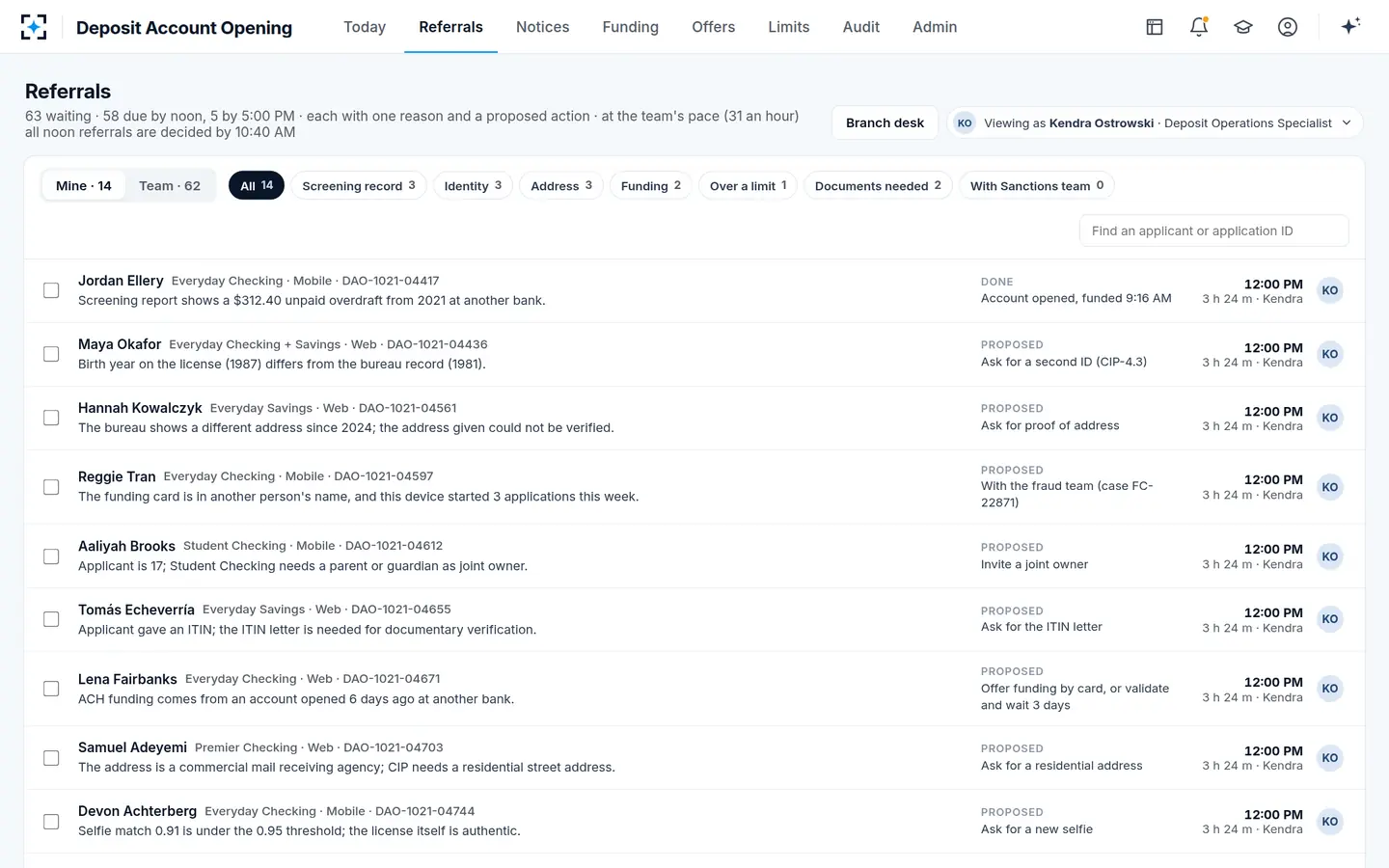
For an individual the rule requires "a residential or business street address." Only someone without one may give an APO or FPO box, or "the residential or business street address of next of kin or of another contact individual." A newcomer staying with relatives can use their address; a commercial mail receiving agency on its own does not meet the rule. In the sample bank's queue, an applicant who gave a commercial mailbox was referred with that reason and a proposal to ask for a residential address, not declined.
Referrals as plain sentences: an ITIN letter, a residential address, a second ID
How should a bank treat an ITIN?
As a valid identification number that is not an identity document. An ITIN is a taxpayer identification number, so it satisfies the rule's first option for a non-US person exactly as an SSN would. The IRS issues it to someone who has "a federal tax purpose" and is "not eligible for an SSN," and says plainly that an ITIN does not "serve as identification outside the federal tax system" (IRS, Individual Taxpayer Identification Number).
The practical consequence is in verification. The number collects the CIP data; it does not verify who presented it. Data sources that confirm an SSN against a credit file often know little about an ITIN holder, so the program needs a documentary route (a passport, or the IRS assignment letter with a photo ID) and should not stop at a failed database match. In the sample bank, an ITIN applicant was referred with the one-line reason "the ITIN letter is needed for documentary verification," and the agents proposed asking for it.
Online, in a branch, or both: where foreign-national policies diverge
The rule names remote opening as a situation that needs extra care: non-documentary procedures must address cases where "the customer opens the account without appearing in person at the bank" and where "the bank is not familiar with the documents presented." Both apply to a foreign national applying through an app with a foreign passport. Neither forbids it.
The same foreign-national applicant, online and in a branch
In a branch: An employee who can handle the passport and a second document.
Online or in the app: A document check reading the image or the passport chip, with a live selfie.
In a branch: Staff unsure which foreign IDs the program accepts.
Online or in the app: A form that requires an SSN field, so the applicant never reaches the CIP rule at all.
In a branch: Often not needed if the document is examined in person.
Online or in the app: Required by the rule; database matches are thin for new arrivals.
In a branch: The list of accepted foreign documents and who checks unfamiliar ones.
Online or in the app: The remote proofing standard, the fallback when a match fails, and the referral reason.
The most common online failure is not a compliance decision at all. A form built with a mandatory SSN field turns away every foreign national without one before any rule is applied, and the bank never sees the application. If the written CIP accepts passport numbers, the form should too, with the applicant routed to whatever verification the program requires. NIST identity assurance levels for account opening covers what a defensible remote standard looks like.
What changed in 2025: the TIN can come from a third party
On June 27, 2025, FinCEN issued an order "permitting banks to collect Tax Identification Number (TIN) information from a third party rather than from the bank's customer," for banks supervised by the OCC, FDIC and NCUA, provided the bank otherwise complies with the CIP rule, including obtaining the TIN "prior to opening an account" (FinCEN, June 27, 2025). Use of the exemption is optional.
For foreign nationals the order changes little. A third-party source cannot supply an SSN that does not exist, so a non-citizen without one still gives a passport, alien ID or other photo ID number. What the order does change is the form: a bank that pre-fills the TIN for citizens and residents with a number on file should make sure the same form still offers the non-US options to everyone else.
Why this policy matters for access
Identification is one of the reasons households give for staying outside the banking system. In the FDIC's 2023 survey, 13.0% of unbanked households cited not having the personal identification required to open an account, and among households that had never been banked the share was 20.4%, against 4.8% for previously banked households (FDIC, 2023 National Survey of Unbanked and Underbanked Households).
Missing ID weighs most on households that have never had an account
13.0%
of unbanked households cite not having the ID required to open an account
20.4%
of never-banked households cite it
4.8%
of previously banked unbanked households cite it
A bank whose written program accepts passports but whose channels do not is carrying the compliance cost of a policy without the customers it was written for. The fair-access and complaint exposure from inconsistent treatment is the subject of the debanking policy guide.
What the CIP file must show for a foreign national
The same four parts as any CIP file, with more detail in the document line. The rule requires the identifying information obtained, a description of any document relied on "noting the type of document, any identification number contained in the document, the place of issuance and, if any, the date of issuance and expiration date," the non-documentary methods and results, and how each substantive discrepancy was resolved. For a passport, place of issuance is the issuing country, which is also part of the identification number.
What a foreign-national CIP file should let a reviewer confirm
- The classification
That the applicant is not a US citizen, and therefore a non-US person under the rule.
- The number and its type
Passport number and country, alien identification card number, other photo ID number and country, or a TIN.
- The street address and its basis
The applicant's own, or a next-of-kin or contact address recorded as such.
- The document relied on
Type, number, issuing country, issue and expiry dates.
- The non-documentary methods
Which sources were checked and what they returned, including a failed match and what replaced it.
- Discrepancies resolved
Transliterated names, date formats, and how each was settled and by whom.
- List checks
OFAC and 314(a) results with the list dates, kept outside the applicant-facing file where required.
Two discrepancy types dominate foreign-national files. Names transliterated from another script appear differently on a passport, a visa and a lease, and dates of birth written day-first on a foreign document are keyed month-first on the application. A procedure that names both, and says what evidence settles each, keeps them from turning into declines.
How Deposit Account Opening handles applicants without an SSN
The checks run in parallel as data arrives, and a foreign national's application follows the same path as anyone else's until a check does not clear. The Identity agent verifies the document, the selfie and the CIP data on two sources; when a passport applicant's data cannot be matched, or an ITIN needs its letter, it proposes the resolution the bank's procedure allows and never resolves a discrepancy on its own.
Deposit Account Opening: a foreign-national application from submission to decision
Agent
CollectTakes name, date of birth, street address and the identification number type the applicant selects, including passport number and country.
Agent
VerifyReads the passport image or chip, matches the selfie, and checks the data on two sources.
Never: resolve a discrepancy on its own
Agent
ScreenRuns OFAC and 314(a) list checks and the deposit account screening report.
Agent
ReferSends anything outside the bank's limits to a specialist with one reason and one proposed request.
A person decides
Specialist decidesApproves, asks for the document, or declines with a reason code.
A person decides
Team lead checksGives the second approval on any offer, decline or released hold.
Limits are the bank's own: the agents open accounts alone only inside them, and a proposed change is replayed on the last 30 days of applications before the BSA officer approves it. Files are kept five years after the account closes or the application is declined, with SSNs and ID numbers masked. The account opening workflow guide shows how the checks run side by side, and the whole solution is on the Deposit Account Opening page.
Questions people ask
Is a green card holder a US person for CIP?
No. For an individual, the CIP rule's US person is a US citizen, so a permanent resident is a non-US person and may give an alien identification card number or passport number. The 2003 final rule rejected the tax definition that would have treated resident aliens as US persons.
Can a bank require an SSN from every applicant anyway?
The rule sets a minimum, and a bank's program can ask for more if it applies the requirement consistently. A bank that does so should know it is turning away non-citizens the rule would let it serve, and should be able to explain the risk reason.
Is a matrícula consular acceptable for CIP?
It can fit the rule's fourth option, a government-issued document evidencing nationality or residence and bearing a photograph. Whether a bank accepts it, and how it verifies an unfamiliar document, is its own written decision.
Can a US citizen open an account while waiting for an SSN?
Only if the bank's CIP provides for it. The bank must confirm the application was filed before opening the account and obtain the number within a reasonable period afterwards.
Does an ITIN verify identity?
No. An ITIN meets the identification number requirement, but the IRS says it does not serve as identification outside the federal tax system. The bank still verifies identity through documents, non-documentary methods or both.
Do foreign-national accounts need extra tax forms?
Often, for interest-bearing accounts, because a nonresident's interest is reported differently from a citizen's. That is a tax reporting requirement separate from CIP and should be collected without blocking the identity step.