A debanking policy for account opening is the bank's written statement of when it will decline a deposit account, on what evidence, who decides, what the applicant is told and what the file keeps. Executive Order 14331, signed August 7, 2025, made such a policy necessary rather than optional: it states that "banking decisions must instead be made on the basis of individualized, objective, and risk-based analyses," and defines politicized or unlawful debanking to include restricting access for "any customer or potential customer" because of political or religious beliefs or politically disfavored lawful business (EO 14331, 90 FR 38925). A bank that cannot show why each applicant was declined now has a supervisory and legal exposure as well as a fair-access one. Botminds' Deposit Account Opening refers every application outside the bank's written limits to a specialist with one reason, the evidence and the policy test applied, so the same facts produce the same decision and every decision carries its reasoning.
The rules are quoted from the Federal Register, the eCFR and the statutes, linked where they appear; the referrals shown are fictional sample applications.
"Banking decisions must instead be made on the basis of individualized, objective, and risk-based analyses."
Executive Order 14331, Guaranteeing Fair Banking for All Americans, section 2
Can a bank still decline to open an account?
Yes. No federal law obliges a bank to open a deposit account for every applicant, and the CIP rule requires the opposite in one case: the program must describe "when the bank should not open an account" after it cannot form a reasonable belief that it knows the customer's identity (31 CFR 1020.220(a)(2)(iii)). Fraud signals, checking-account history outside the bank's policy, sanctions matches and anti-money-laundering risk remain lawful grounds.
What changed is the standard of proof. The order's definition reaches potential customers, so a refusal to open is covered as much as a closure. And it tells the agencies to look backwards: within 120 days each federal banking regulator was to review the institutions it supervises for past or current policies or practices that "require, encourage, or otherwise influence" politicized or unlawful debanking, and take remedial action where the law allows, naming section 5 of the FTC Act, section 1031 of the Consumer Financial Protection Act and the Equal Credit Opportunity Act. A decline file written today may be read under that standard later.
What changed in 2025 and 2026, and what binds whom
The order set a policy and directed the regulators; the regulators' rules bind the regulators. Banks are affected through supervision and through the order's own definitions, which is why a bank's policy should meet the order's standard whichever agency examines it.
From the fair banking order to the reputation-risk rules
- EO 14331 signed Aug 7, published Aug 12Aug
- Regulators remove reputation risk from guidancewithin 180 days
- OCC and FDIC final rule; FinCEN AML/CFT program proposal, Apr 10Apr
- OCC and FDIC rule effective Jun 9Jun
- NCUA rule effective Jul 27Jul
The OCC and FDIC rule "prohibits the agencies from requiring, instructing, or encouraging an institution to close an account, to refrain from providing an account, product, or service," on the basis of political, social, cultural or religious views, protected speech, or "solely on the basis of politically disfavored but lawful business activities perceived to present reputation risk" (91 FR 18279). It covers reputation risk "regardless of how the risk is labeled," so a relabelled concern does not escape it. The practical effect for a bank: an examiner will no longer press it to turn away a lawful customer on reputation grounds, and a bank that does so of its own accord has lost the supervisory cover it might once have claimed.
Which grounds for declining an account hold up?
Grounds tied to a named rule or a written policy line, applied to the applicant's own facts. Each leaves a different trace in the file an examiner, a regulator reviewing complaints, or a court would read.
Grounds for declining a deposit account: what each rests on and what the file shows
| Ground | What it rests on | What the decline file should show |
|---|---|---|
| Identity not verified | CIP rule: procedures for when the bank should not open an account | The data not verified, the sources tried, and any discrepancy and how it was handled |
| Checking or credit history | The bank's written policy applied to a consumer report | The entry relied on, the policy line it failed, any second-chance test, and the FCRA notice |
| Fraud signals | The bank's fraud and funding controls | The signal, its evidence and the person who decided |
| Sanctions or AML risk | OFAC obligations and the AML program | The match or risk factor, reviewed by a person, restricted to those who need it |
| Business-specific risk the program cannot manage | The AML program and risk appetite, applied to this customer | Ownership, expected activity, controls assessed, and why the program could not manage them |
| Political or religious belief, or lawful business disfavored for political reasons | Not a lawful ground under EO 14331 | Never the reason |
The fifth row is where most new exposure sits. A one-line "outside risk appetite" on a money transmitter, a charity working abroad or a cannabis-adjacent business no longer reads as an individualized analysis. The file should show what was assessed and why the bank's controls could or could not manage the specific risks, which is the same work a bank would do to open the account.
Declining a business by type: what a case-by-case assessment looks like
Treasury and the banking agencies have said for two decades that a customer type is not a risk rating. The 2023 de-risking strategy repeats that "banks should assess all customers on a case-by-case basis, and no individual type of customer, including MSBs, should be considered uniformly high risk," and that the government "does not view the charitable sector as a whole as presenting a uniform or unacceptably high risk," while recognising that charities operating in or funding conflict regions "can face potentially higher risks." A policy that declines a category, rather than an applicant, cannot meet the order's standard and does not match the agencies' own guidance.
For money services businesses the minimum work is written down. The 2005 interagency guidance on banking money services businesses lists it: apply the bank's CIP, "confirm FinCEN registration, if required," confirm state or local licensing where applicable, confirm agent status where applicable, and conduct a basic BSA/AML risk assessment. The same guidance says it is essential that banks "neither define nor treat all money services businesses as posing the same level of risk," and that the agencies do "not expect banking organizations to act as the de facto regulators" of the businesses they bank.
A decline file for a business applicant should therefore show four things: the facts gathered (registration, licences, ownership, products, corridors or programmes, expected volumes); the specific risks those facts present; the controls the bank would need, such as enhanced monitoring, transaction limits or periodic review; and why the bank could not apply them, whether for cost, capability or appetite. For a charity working abroad, the facts include the foreign activities, regions and grants it reports on Schedule F to Form 990, which Treasury notes charities with activities outside the United States must file. A file that skips to the fourth item reads as a category decision, whatever the letter says.
Why banks decline more than they need to
Mostly cost, not crime. Treasury's 2023 de-risking strategy, written under the Anti-Money Laundering Act, "identifies profitability as the primary factor in financial institutions' de-risking decisions" (Treasury, 2023 De-risking Strategy). An applicant who is expensive to verify and monitor, and earns little, is easy to decline and hard to defend under an individualized standard.
That gives a bank a practical lever. If a thin-file applicant takes a specialist half an hour to verify, the cheapest answer is no. If the checks run once and the referral arrives already explained, the bank can say yes to more applicants inside the same risk appetite. FinCEN's April 2026 proposal for AML/CFT programs ties itself to the order and to lowering the risk that institutions are pushed into closing accounts (91 FR 18704), which points the same way: spend the program's effort on actual risk, not on categories.
What must a bank tell an applicant it declines?
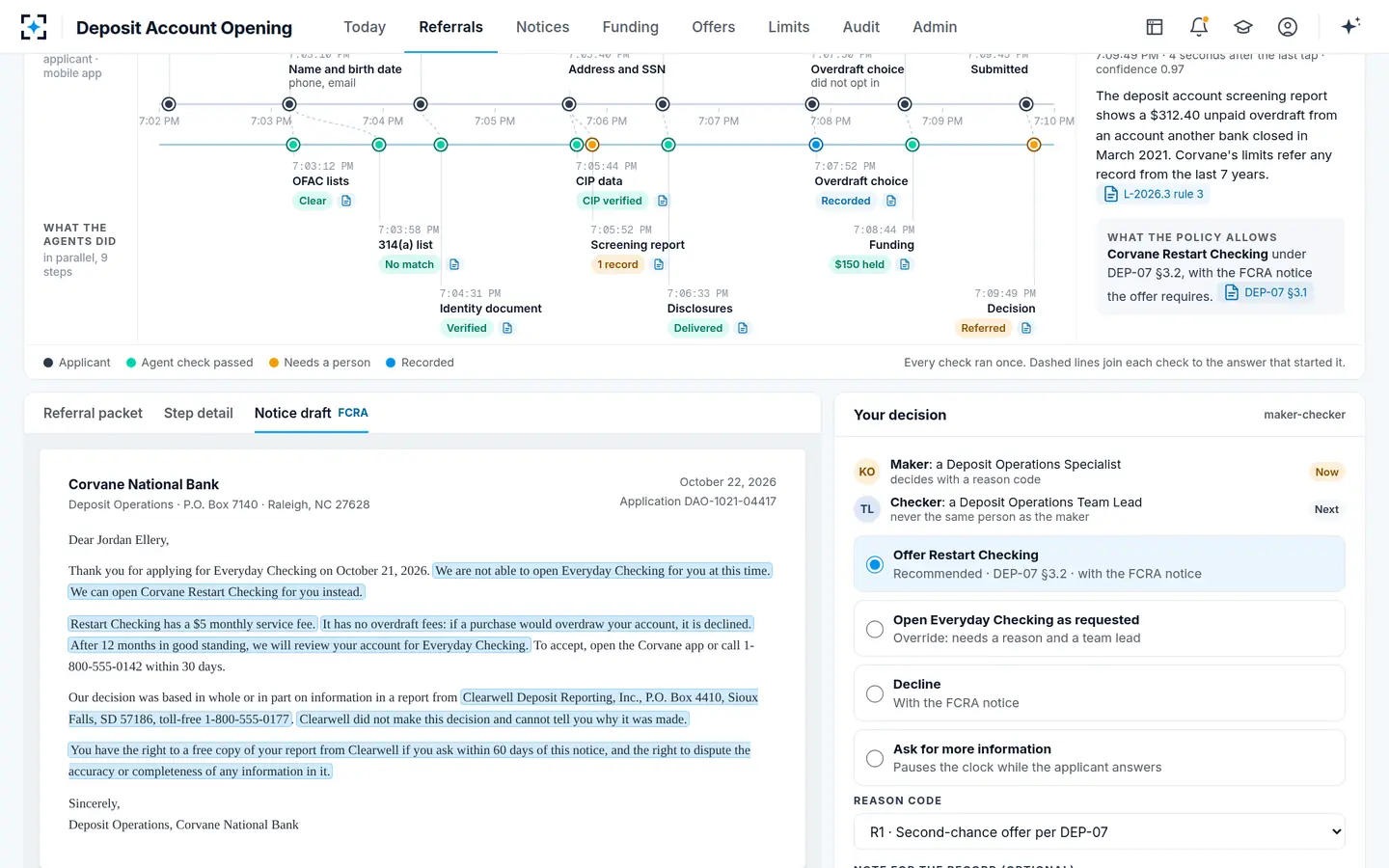
It depends on what the decline relied on. No general rule requires a full statement of reasons for a deposit account. But where a decision rests "in whole or in part on any information contained in a consumer report," the Fair Credit Reporting Act requires notice of the adverse action, the name, address and telephone number of the reporting agency, a statement that the agency did not make the decision, and notice of the right to a free copy and to dispute (15 U.S.C. 1681m(a)). A counteroffer, such as a second-chance account instead of the one applied for, is still an adverse action if the report drove it.
Some reasons must stay out of every letter. A 314(a) match is confidential, and so is anything related to a suspicious activity report. An honest decline letter can be specific about a consumer report and silent about those, and the policy should say so, so that specialists are not left to improvise wording that discloses too much.
Checking-history declines: accuracy, disputes and the bank as a source
The most common consumer decline rests on a checking-account report, and the law treats the agencies that compile them as a class of their own. The FCRA defines a "nationwide specialty consumer reporting agency" to include one that "compiles and maintains files on consumers on a nationwide basis relating to" check writing history (15 U.S.C. 1681a(x)). Such agencies must provide a free annual disclosure on request, and when an applicant disputes an entry the agency must reinvestigate "before the end of the 30-day period beginning on the date on which the agency receives the notice of the dispute," extendable by up to 15 days in some cases (15 U.S.C. 1681i(a)(1)).
Two practical rules follow for the policy. First, a decline should say what happens if the entry is corrected: an applicant whose disputed overdraft is removed should be able to reapply without starting again, and the referral should be reopened rather than re-decided by someone new. Second, the bank is usually also a furnisher to the same agencies, reporting its own closures for unpaid balances or suspected fraud. Its policy for what it reports, and how quickly it corrects an error, decides how fairly other banks will treat its former customers, and it is the same exposure seen from the other side.
The age and size of an entry matter more than its presence. The sample bank's second-chance rule, in the sample referral below, turns on both. A policy that treats a five-year-old $312 overdraft and a recent account closed for fraud as the same "negative history" will decline people it could serve and cannot explain why when asked.
The counteroffer letter and adverse action notice, drafted from approved wording
Consistency: the test that matters most
A decline is individual and objective when the same facts produce the same answer, the answer cites the policy line it rests on, and a second person has checked it. Inconsistency is the usual finding, and it comes from people reading the same consumer report differently on different days.
The same applicant, two ways a decline gets decided
Decided case by case: A specialist reads the screening report and judges it.
Decided against a written policy line: The report entry is tested against the written second-chance and history rules.
Decided case by case: Depends on who reads it, and when.
Decided against a written policy line: The same proposal every time.
Decided case by case: Invisible: the decision is the override.
Decided against a written policy line: Allowed, with a reason code and a second person.
Decided case by case: Whether the outcome looks reasonable.
Decided against a written policy line: Whether the policy was applied, file by file.
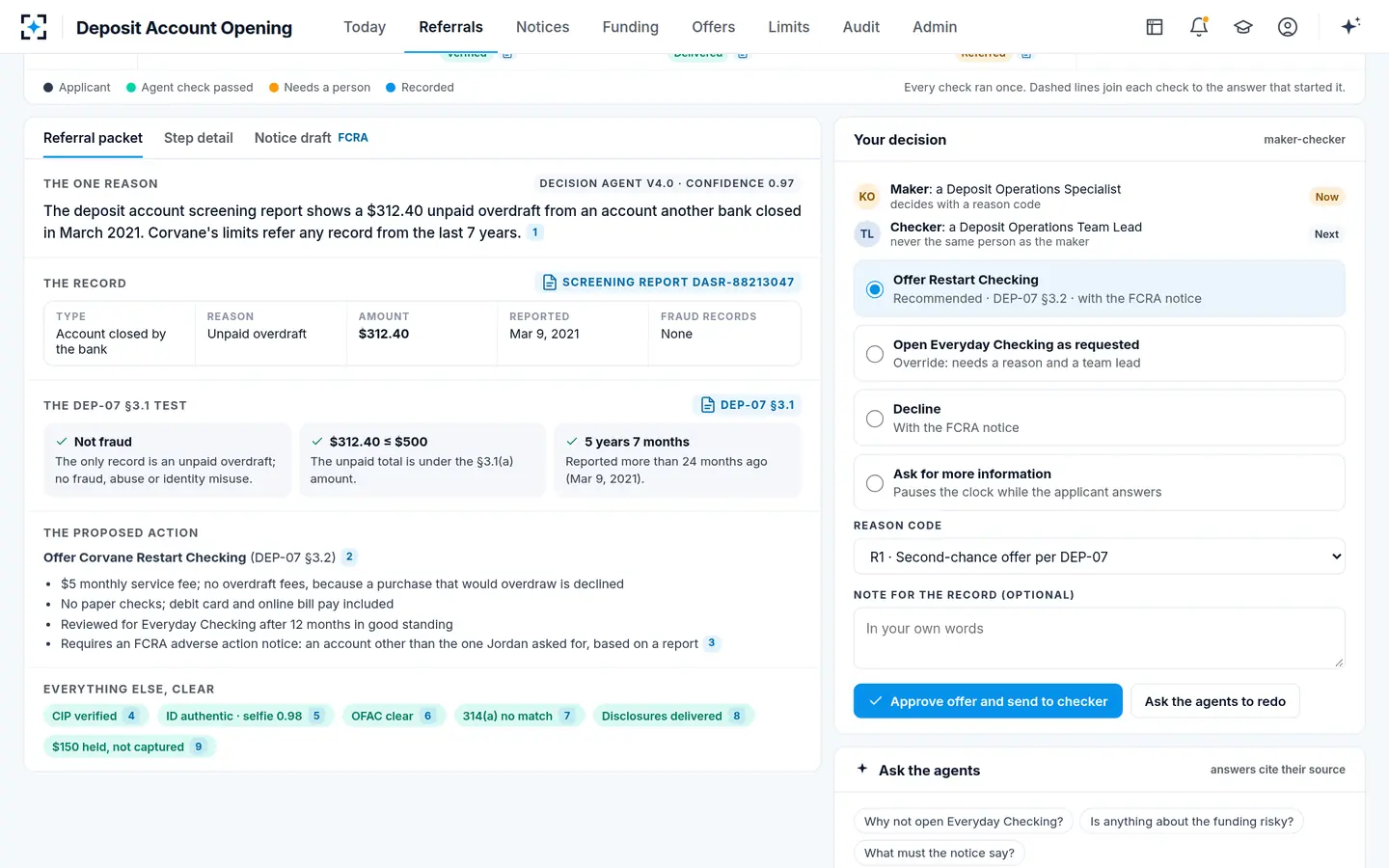
Take a sample referral. A fictional applicant had one entry on his checking account report: an unpaid overdraft of $312.40 from March 2021, with no fraud record. The sample bank's second-chance policy allows a second-chance account for "$500 or less reported more than 24 months ago, or $100 or less at any age; no fraud," so the agents proposed one, with the adverse action notice the counteroffer requires. Every applicant with the same facts gets the same proposal.
A referral that carries its own reasoning: the reason, the evidence, the policy test
What a debanking policy for account opening should contain
Enough that two specialists reading the same file reach the same answer, and a reviewer can tell whether they did. The checklist below is a starting structure.
Nine parts of a debanking policy for account opening
- Permitted grounds
Each ground for declining, tied to its rule or written policy line.
- Prohibited grounds
Political or religious beliefs and politically disfavored lawful business, stated in the order's words.
- Alternatives before a decline
Second-chance products, lower funding limits, a request for one more document.
- Who decides and who checks
A maker and a different checker on every decline and counteroffer.
- Overrides
When a specialist may depart from the proposal, with a reason code.
- Notices
When the FCRA notice is required, approved wording, and what may never be disclosed.
- Business applicants
The customer-specific assessment required before declining on activity type.
- Records
What each decline file keeps and for how long.
- Monitoring
Decline and override rates by reason, channel and branch, reviewed by compliance.
The monitoring item is the one that proves the rest. A bank that reviews decline rates by reason and by branch each quarter will see a branch declining three times the bank's rate on the same reports, or an override rate that has crept up for one product, before a complaint pattern or an examiner does.
An illustrative quarter shows what the review looks for. A bank refers 4,000 applications, 480 of them on checking-account history, and declines 96 of those 480, a 20% rate. One branch referred 60 on the same reason and declined 27. At the bank's rate it would have declined about 12, so the branch is more than double, and with 60 cases the gap is too large to be chance. The review then reads the 27 files against the written rule. If 15 failed the policy line and 12 would have qualified for a second-chance account, the finding is a training gap at one branch, with twelve applicants to contact. Without the review, it is twelve complaints waiting to be filed.
The same arithmetic applies to overrides. A product whose override rate rises from 3% to 9% of referrals over two quarters has a policy line that specialists no longer believe, or a pressure on them to say yes or no that the policy does not describe. Either way, the line needs rewriting or the pressure needs naming, and the file of overrides, each with its reason code, says which.
How Deposit Account Opening keeps declines explainable
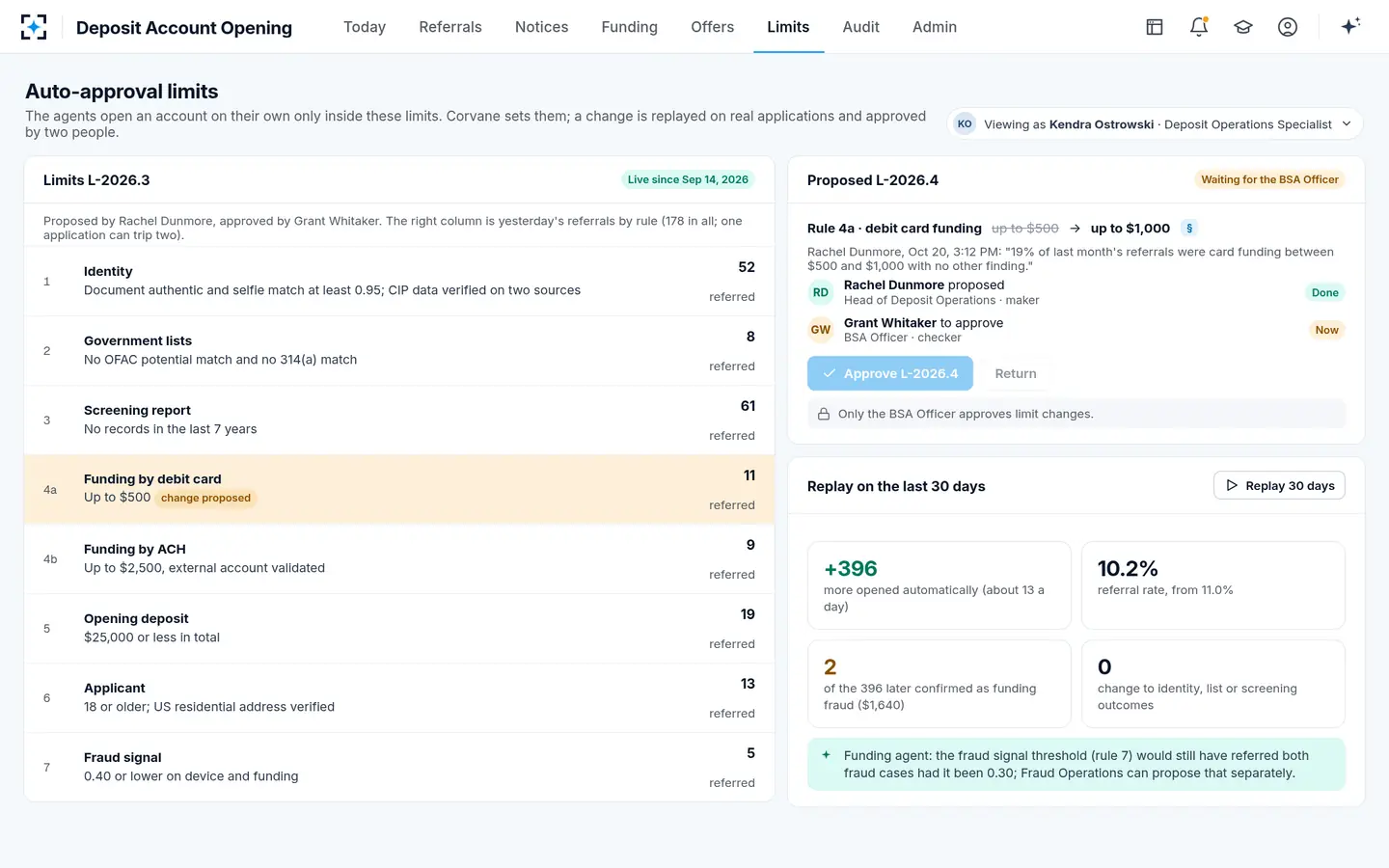
The agents open an application on their own only inside written limits the bank sets, and they never decline. Everything outside the limits reaches a specialist as a referral packet: one reason, the evidence behind it, the policy test applied line by line, and the action the policy allows. The specialist decides with a reason code and a team lead checks; an override needs a reason and a note, and the system blocks the same person from making and checking one item.
The limits the agents work inside, and yesterday's referrals by rule
Restricted items stay restricted: a 314(a) match or anything SAR-related appears only to the BSA officer and never in a specialist's queue text or a customer letter. Each action is kept with who, what, when, why and the evidence, five years after the account closes or the application is declined. For foreign nationals and the identification numbers the CIP rule accepts, see KYC requirements for foreign nationals; for where each agent's authority stops, the automation limits matrix. The whole solution is on the Deposit Account Opening page.
Questions people ask
Does EO 14331 apply to refusals to open an account, or only closures?
Both. Its definition of politicized or unlawful debanking covers restricting access for "any customer or potential customer," so a refusal to open is within it.
Do the 2026 reputation-risk rules bind banks directly?
They bind the agencies: the OCC, FDIC and NCUA may not require or encourage institutions to refuse lawful customers on reputation grounds. Banks feel them through supervision, and through the order's standard of individualized, objective analysis.
Is a second-chance counteroffer an adverse action?
If a consumer report played any part in offering a different account from the one applied for, the FCRA notice applies. The notice names the reporting agency and states the applicant's right to a free copy and to dispute.
Can a bank decline a business because of its industry?
It can decline because of specific risks the business presents that its program cannot manage, assessed for that customer. Activity type alone, or lawful business disfavored for political reasons, does not meet the order's standard.
What should a bank monitor to prove its declines are consistent?
Decline and override rates by reason, channel and branch, with a sample of files re-read against the written policy each quarter. A branch or product far from the bank's own rate on the same inputs is the first sign of inconsistency.
Why do banks decline low-balance applicants most?
Treasury's 2023 de-risking review found profitability the primary factor in de-risking decisions. Lowering the cost of verifying and monitoring thin-file applicants is often the most effective fair-access control a bank has.