Vibe coding
You describe an app, an AI writes the code, and you iterate by feel. Ideal for prototypes and personal tools.
- New code every time
- Security is whatever was generated
- Review means reading the code
- Hosting, access and audit are yours to add
Piper builds whole governed applications from a conversation — for every builder in the enterprise.
Describe the outcome in plain words. Piper, the Botminds builder, writes a brief, shows a numbered plan and builds on your yes — agents, collections, pages, cards, packs, workflows and meshes, on 700+ platform tools. It tests what it made, reads back every change and ships it as a package.
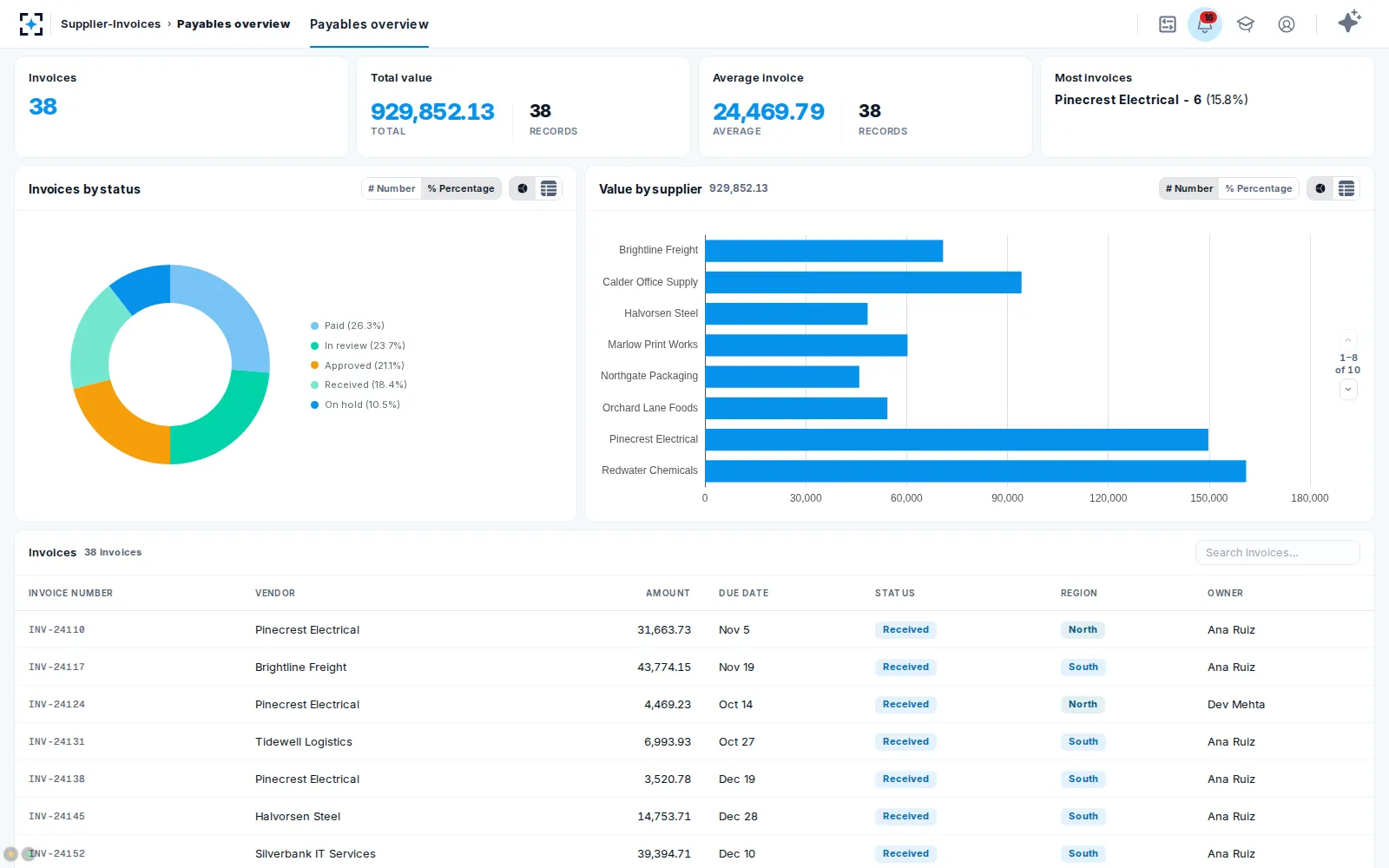
“Build a desk for supplier invoices: read each invoice, flag the ones over budget, and give the payables team a queue and a dashboard.”
TestedPackagedEvery change read back
Enterprise vibe coding is building business software by describing it in plain language, with the enterprise’s controls built into the process: a plan you approve, work done within your role, parts that are already secured, and every change on the audit trail. On Botminds, Piper is the builder and the platform supplies the controls — for thousands of builders at once.
Vibe coding made building fast. Enterprise vibe coding keeps the speed and adds what a company runs on: the result respects who may do what, it is reviewed before it runs, and it can be rolled back.
You describe an app, an AI writes the code, and you iterate by feel. Ideal for prototypes and personal tools.
You describe an outcome, approve Piper’s plan, and it assembles parts the platform already secures. The app inherits roles, audit, versions and packaging.
Every build follows the same path, so a reviewer always knows where it stands. Before your yes, Piper reads and plans. After it, Piper checks each change landed before it moves on.
Deletes get their own confirmationEvery result reported as it isYour role on every call
Piper confirms a brief: it says back what it understood, names every field with its type, states its defaults, and asks the one question whose answer would change the plan most. Small asks stay small — one sentence, one yes, done and read back.
Build an intake desk for supplier invoices. Read each invoice, pull the vendor, number, amount and due date, flag anything over its purchase order, and give the payables team a queue and a dashboard.
Brief: a new project with an Invoices collection (vendor — text, invoice number — text, amount — number, due date — date), an agent that reads each invoice into those fields, a review queue for flagged ones and a dashboard page. One question: where do purchase orders come from — a spreadsheet, or a system we connect?
A spreadsheet for now.
Plan: 1) project and collections; 2) the reading agent; 3) the purchase-order table from your sheet; 4) the over-budget check; 5) queue and dashboard pages in one pack; 6) tests; 7) save to the repository. Shall I build it?

Piper reads each message for what kind of ask it is, checks it against your role, and reaches the platform’s full tool catalogue — the same one your agents use and outside assistants reach through the Botminds MCP server.
Piper assembles the platform’s own parts, and each already carries permissions, audit, versions and tests. The application is safe because its parts are.
Instructions, tools granted by name, models and tests. See the agent harness.
Typed fields, taxonomies, structured tables and knowledge. See AI data modeling.
Screens composed from 149 card types. See composable UI.
Steps, schedules, events and agent networks. See agentic workflows.
Built as data when a new card is needed — templates cleaned, scripts sandboxed.
SharePoint, mail, drives and outside MCP servers, on schedules or on upload.
Users, roles and who may open each page, set by the people allowed to.
Packaged know-how an agent loads, versioned like the rest.

Your approval, your role on every call, a separate confirmation for every delete and the audit trail are how the platform works — the same for every builder, every time.
Measured: 53 of 53. In a 150-conversation test bank run as three users with different roles, every one of the 53 requests beyond the asker’s role was answered with a plain refusal and no change. More in AI agent security and on the security page.
A page or an agent is built in the conversation. A whole solution — many collections, agents, pages and workflows — goes to a dedicated builder that works through it in phases while you watch.
Confirmed in the conversation, assumptions stated.
Requirements and user stories you can read.
A clickable prototype to approve before building.
Data, agents, workflows and pages, phase by phase, each checked.
Saved as a package in a repository of its own.
The builder changes the platform through the same governed tools Piper uses, each phase with the tools it needs.
Approval before shared changes; steer or stop it at any point, and ask Piper where it stands.
An interrupted build resumes from its last finished step, with spend tracked for every build.
Finance, claims, HR and IT can all build at the same time, each in its own project under its own roles. The platform’s stateless services scale out on Kubernetes as builders arrive, and every build ends as a governed package that installs into any environment, in any cloud and region.
What Piper builds is a project you can version, diff, move between environments and roll back — the way your engineers ship code.
Governance end to end. Versions, evaluations and audit: AI governance. Testing agents before they publish: AI agent evaluation.
Three ways to get software without a long project. They differ in who does the work, what the result is made of, and who carries the risk.
| Vibe coding tool | Low-code platform | Enterprise vibe coding on Botminds | |
|---|---|---|---|
| You describe | The app, in words | Nothing — you drag and configure | The outcome, in words |
| It produces | New source code | An app in that tool | A solution of governed platform parts |
| Before anything runs | You run it and see | You test it yourself | A brief and a plan you approve |
| Permissions | Whatever the code does | Configured per app | Your role, checked on every call |
| AI agents and documents | Build them yourself | Add-ons | Built in: agents, extraction, workflows, meshes |
| Audit | Set it up yourself | Platform logs | Every change, recorded as agent work on your behalf |
| Rollback | Version control, if set up | Varies | Snapshots, diff, rollback, packages |
| Scale | Whatever you host it on | Per app | Thousands of builders on one scale-out platform |
And agentic engineering? Agentic engineering is AI agents working through a software project with tests and reviews. Piper applies the same discipline — plan, act, verify — to your business solution on a governed platform. Weighing a coding assistant instead? See Botminds vs Cursor.
More from the platform: the full architecture, and how security works at Botminds.
Enterprise vibe coding is building business software by describing it in plain language, with enterprise controls in the process: an approved plan, work within your role, secured parts and a full audit trail. On Botminds, Piper builds and the platform supplies the controls.
It is as safe as what the AI is allowed to produce and do. Piper builds from governed parts, works within your role, builds on your yes, reads back every change and records it. In a 150-conversation test bank, all 53 requests beyond the asker’s role were refused with no change.
Unreviewed code, an AI acting beyond its user, untraceable changes, destructive mistakes and no way back. Botminds answers each: governed parts and an approved plan, your role on every call, the audit trail, a separate confirmation for deletes, and snapshots with rollback.
Low code means configuring an app by hand in a visual tool; vibe coding means describing it and letting AI build it. On Botminds you describe, Piper configures the platform’s parts, and you can open every page, agent and workflow in the designer.
Vibe coding is prompt-and-see building. Agentic engineering is disciplined: agents plan, act, test and verify. Piper works the second way — brief, plan, approval, build, test, package — on a business solution.
Projects, collections and fields, taxonomies, agents with their tools and tests, workflows, meshes, pages, cards, packs, custom cards, skills and connectors — plus everyday actions like inviting users, re-running documents and saving to a repository.
You need to know the outcome you want. Piper states its defaults, asks the one question that matters and shows a plan in plain words. Developers can open, review and version everything it built.
Yes. Each team builds in its own project under its own roles, on services that scale out on Kubernetes, and every build ships as a package that installs into any environment and region.
Every tool call runs as you, and the platform checks your role on each one. A request above your role gets a plain answer naming who can do it.
Roll a module back to an earlier snapshot, discard unsaved changes, or pull the last saved version from the repository. Deletes get their own confirmation before anything goes.
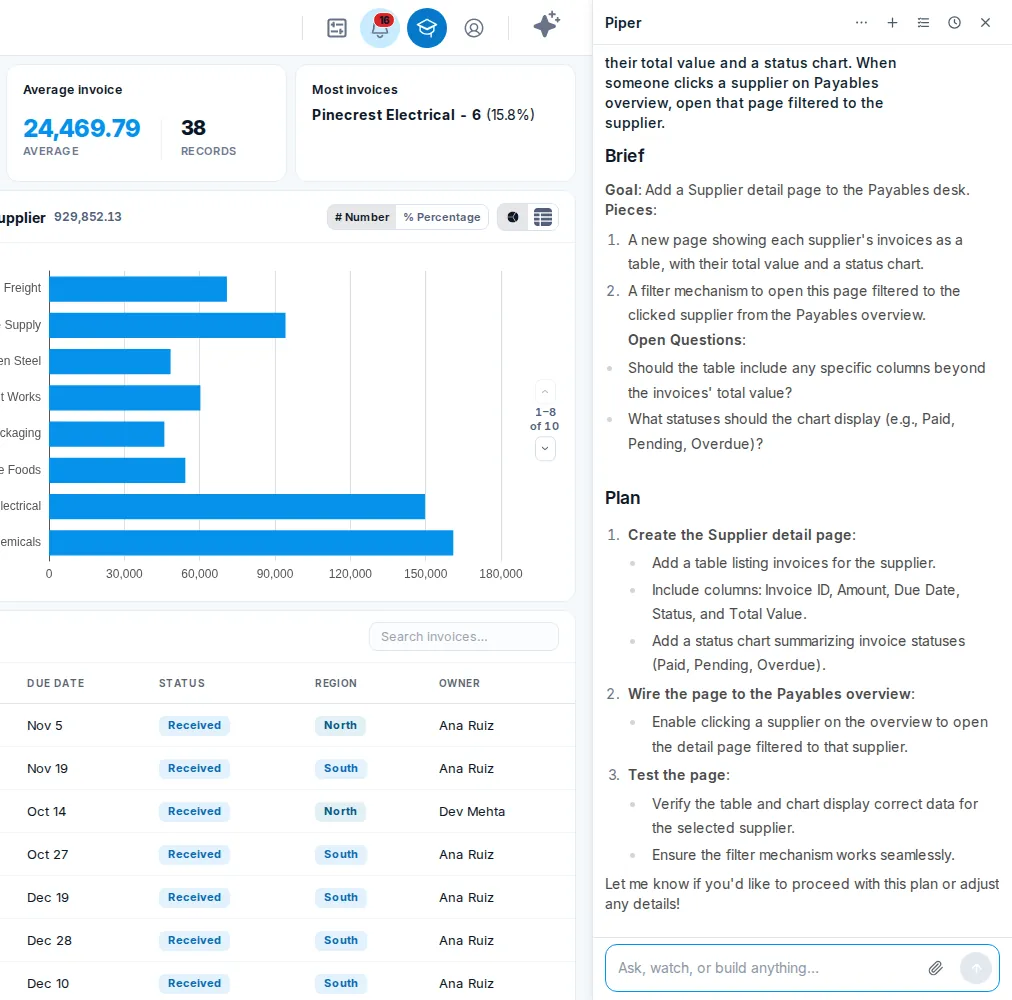
Bring one process your team runs by hand. Watch Piper plan it, ask for your yes, and build it on your own data.