The CFPB's junk fees guidance for banks, the 2022 circular on surprise overdraft fees, the bulletin on returned deposited item fees and the 2024 circular on overdraft opt-in, was withdrawn on May 12, 2025, along with dozens of other documents. The CFPB's 2024 overdraft rule for the largest banks never took effect, and in April 2026 the FDIC rescinded its own guidance on re-presentment fees. None of that undoes the refunds already made, about $250 million on overdraft and NSF fees alone, and none of it changed the law those refunds rested on. For a bank deciding whether to review fees before launch, that is the point: a fee found late still costs a refund on every account it touched, while a fee found on the screen costs a wording change. Botminds' UDAAP Risk Assessment tests each fee and each fee claim on a new or changed journey against the fee schedule and the agreement before customers see it, and a compliance officer decides what changes.
The CFPB's junk fee guidance is gone; the fee refunds are not
≈$250M
agreed in refunds of overdraft and NSF fees after CFPB supervision since 2022
About $184M overdraft, $66M NSF
67
CFPB guidance documents withdrawn on May 12, 2025
Including the junk fee circular and bulletin
Apr 10, 2026
FDIC rescinds its re-presentment fee guidance as "overly broad"
FIL-32-2023
Still posted
FDIC FIL-19-2023 on overdraft fees, and OCC Bulletin 2023-12
Checked October 2026
What was the CFPB junk fees guidance?
It was a set of circulars, bulletins and supervisory reports issued from 2022 that told banks which fees the CFPB considered unfair under the Consumer Financial Protection Act. The CFPB's own definition, in a special edition of its Supervisory Highlights in March 2023, was this: "Junk fees are unnecessary charges that inflate costs while adding little to no value to the consumer. Theses unavoidable or surprise charges are often hidden or disclosed only at a later stage in the consumer's purchasing process or sometimes not at all" (CFPB Supervisory Highlights, Issue 29).
For deposit accounts the guidance named three fees. Overdraft fees on debit card transactions that authorized against a positive balance and settled negative, known as APSN fees, were the subject of Circular 2022-06. Returned deposited item fees charged on every returned check, whatever the circumstances, were the subject of Bulletin 2022-06. Repeat NSF fees on the same item presented again were reported as supervisory findings. Circular 2024-05 later added overdraft opt-in practices. Alongside the guidance sat two rulemakings: a proposal to ban NSF fees on instantly declined transactions, which the proposal itself said "would constitute an abusive practice", and a final rule on overdraft lending at institutions over $10 billion.
Is the CFPB junk fees guidance still in effect?
No. On May 12, 2025 the CFPB withdrew Circular 2022-06, Bulletin 2022-06 and Circular 2024-05, among 67 documents, and said it would not enforce or rely on the withdrawn guidance while it reviewed it, adding that the withdrawal might not be the last word (90 FR 20084; the notice's two key sentences are quoted in CFPB overdraft rule repealed). A search of the Federal Register in October 2026 found no reissue of any of them.
Where each piece of fee guidance stands, October 2026
| Document | What it said | Status today |
|---|---|---|
| CFPB Circular 2022-06 | APSN overdraft fees can be unfair | Withdrawn May 12, 2025 (90 FR 20084) |
| CFPB Bulletin 2022-06 | Blanket returned deposited item fees are likely unfair | Withdrawn May 12, 2025 |
| CFPB Circular 2024-05 | Improper overdraft opt-in practices | Withdrawn May 12, 2025 |
| CFPB proposal on instantly declined NSF fees (89 FR 6031) | Would have treated the fee as abusive | Proposal withdrawn January 14, 2025 (90 FR 3044) |
| CFPB overdraft lending rule (89 FR 106768) | Overdraft pricing rules for institutions over $10 billion | Disapproved by Congress; Public Law 119-10, approved May 9, 2025: "no force or effect" |
| CFPB Supervisory Highlights 29 and 37 | Exam findings on fees, refunds paid | Not withdrawn; marked "Archived content" on the CFPB site |
| FDIC FIL-32-2023 | Multiple re-presentment NSF fees | Rescinded April 10, 2026 as too broad |
| FDIC FIL-19-2023 | APSN overdraft fees raise unfairness risk | Still posted; no rescission found |
| OCC Bulletin 2023-12 | Overdraft risk management: APSN and representment | Not on the OCC's rescinded list |
The FDIC's reason for its own rescission is worth reading closely. It concluded that the re-presentment guidance was too broad, and had left banks unsure when a disclosure about re-presentment might still raise an unfairness concern under Section 5 of the FTC Act (FDIC, April 10, 2026). The FDIC withdrew a document about how to apply the unfairness standard. It did not withdraw the standard, and its APSN letter from April 2023 is still on its site.
Which fees did the CFPB call junk fees, and what did banks refund?
In deposits, the refunds were for surprise overdraft fees and repeat NSF fees. The CFPB's last full report on the subject, published in January 2025, put the total at "nearly $250 million to consumers—approximately $184 million in unfair unanticipated overdraft fees charged on transactions that were authorized when the consumer had sufficient funds, and approximately $66 million in unfair NSF fees charged on the same transaction that already incurred an NSF fee when it was previously declined" (CFPB Supervisory Highlights, Issue 37).
Fee refunds after CFPB supervision since 2022, by fee
The 2023 report adds the detail that matters for a launch review: the APSN refunds went to "over 170,000 consumers", and the CFPB found that customers could not avoid the injury, whatever the account-opening disclosures said (Issue 29). A footnote in the same report goes further: "while involuntary fees are often unfair when they are not authorized by a consumer contract, fees that are disclosed in the contract can also be unfair, depending on the circumstances." A fee that is in the schedule is not, for that reason alone, safe.
Are junk fees still a UDAAP risk for banks?
Yes, for three reasons that survived 2025. The statute is unchanged: Dodd-Frank still prohibits unfair, deceptive and abusive acts and practices, and the FTC Act still prohibits unfair and deceptive ones. The prudential regulators still apply it: the FDIC reported issuing civil money penalty orders of about $150 million in 2025 for violations of the Flood Disaster Protection Act and of Section 5 of the FTC Act, and ordering about $1.2 billion in restitution (FDIC Consumer Compliance Supervisory Highlights, March 2026). And the CFPB's own April 2025 priorities, still on its site, list "Various fraudulent overcharges, fees, etc." among the areas it will pursue, and put getting money back to harmed consumers ahead of penalties (CFPB Supervision and Enforcement Priorities).
Examiners also do not need a circular to notice a fee problem. The OCC's handbook lists "High levels of fee income" and "High volume of charge-backs or refunds" among its red flags: "a pattern of refunding fees associated with a specific product or service could indicate associated disclosures or marketing materials may be misleading or confusing" (OCC Comptroller's Handbook, UDAP and UDAAP). A bank's own refund log can start a review that no guidance document prompted.
What does a fee found after launch cost a bank?
It costs the refunds on every account the fee touched, the work of finding those accounts and paying them, and the fee income from the day it stops. Public orders show what the work involves. The CFPB's 2022 order against Regions Bank, terminated in July 2025 after the refunds, required a written redress plan setting out how the bank would find each affected customer and work out what each was owed (bank overdraft fee refunds walks through it), pay by direct deposit "whenever feasible", search for current addresses before mailing checks, and send each customer a notification (Regions Bank consent order; status).
The cost of a fee problem found after launch
Refunds
customers charged × fee × times charged
Over the whole period from launch to the fix, not just the month it was found.
Finance, from core banking data
Lookback and remediation
identify, calculate, pay, notify
Methodology, per-customer amounts, direct deposit or checks, address searches, notices and their review.
Compliance and operations
Forgone fee income
the fee × expected use, from the fix on
Usually the fee itself, or the claim around it, has to change.
Product
What a pre-launch review costs
reviewer hours + a wording change
Found on the screen, the fix is the headline or the default, before anyone is charged.
Compliance, product
Take a sample journey as it runs through the solution; the companies are fictional. Fernway, a fintech partner of Tessaly Community Bank, submits an Early Pay account whose landing screen says "always free". Its fee schedule charges $4.99 for each instant transfer, and the fee first appears two screens later inside a folded list. At Fernway's own forecast, 30% of 40,000 accounts using instant transfers twice a month, the account would charge an estimated $1,437,120 a year under that headline. That figure is the exposure a refund would be measured against; the pre-launch alternative is a new line that reads "No monthly fee. Instant transfers cost $4.99; standard transfers are free."
UDAAP Risk Assessment: “Always free”, two screens before a $4.99 fee
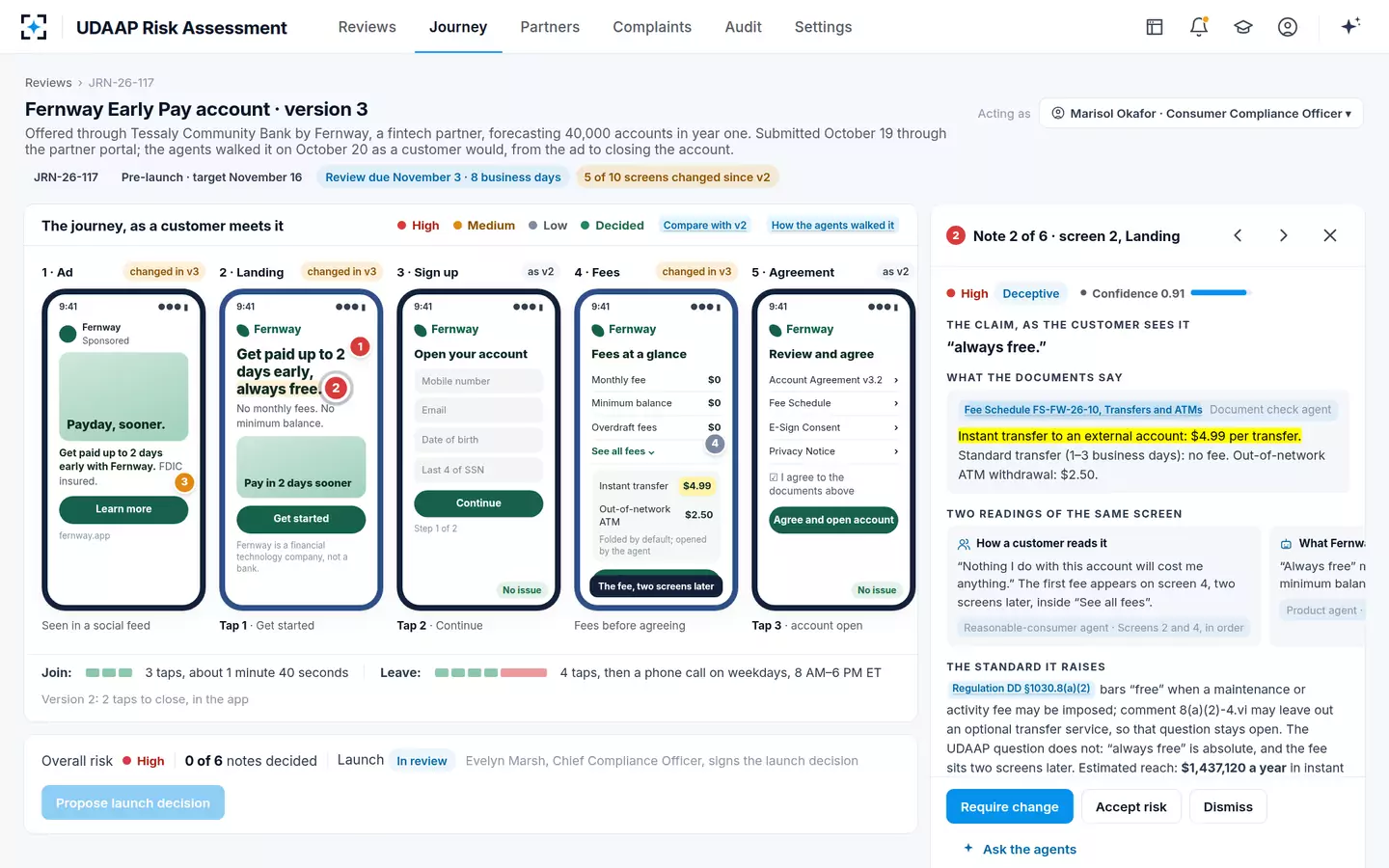
The estimated reach, $1,437,120 a year at the partner's forecast, turns a wording question into a number a chief compliance officer can weigh.
Is it cheaper to review fees before launch?
Almost always, because the two costs grow differently. A pre-launch review costs the same whether the product will have a thousand accounts or a hundred thousand; a refund grows with every account and every month until the fee is found. The comparison below sets the two side by side for one fee claim.
One fee claim, two moments to find it
Found on the screen, before launch: A headline, a default or the order of a fee list.
Found after launch: The headline, plus every account charged under it.
Found on the screen, before launch: The reviewer, the product owner or partner, the signer.
Found after launch: Compliance, operations, finance, legal, often a regulator, and every affected customer.
Found on the screen, before launch: The screen, the fee schedule, the decision.
Found after launch: Transaction data back to launch, a methodology, payment records, notices.
Found on the screen, before launch: Reviewer time, roughly fixed per journey.
Found after launch: Accounts × uses × months until found.
Found on the screen, before launch: A decision with a reason code.
Found after launch: A refund pattern the OCC treats as a red flag.
What is the FTC junk fees rule, and does it apply to banks?
The FTC's Rule on Unfair or Deceptive Fees covers only live-event tickets and short-term lodging. It took effect on May 12, 2025, the same day the CFPB withdrew its guidance, and requires the total price to be shown "clearly, conspicuously and prominently" whenever a price is advertised in those two markets (90 FR 2066). It does not reach bank accounts, and the FTC Act itself excludes banks from the FTC's jurisdiction. Its principle, that a headline price should not hide a mandatory fee, is the same one a bank's examiner applies to a deposit ad under the deception standard.
Where UDAAP Risk Assessment fits in fee review, and where it does not
The solution reads every fee and every claim about fees on each screen of a new or changed journey, tests them against the fee schedule, the account agreement and the program agreement, and matches fee codes against the core banking system. It pins the risk where the customer meets it: an "always free" headline, a fee folded behind a link, a paid option chosen by default. It also runs Regulation DD and E checks on the journey; on the sample journey eight checks ran, four passed, three failed and one was left open for a person. A compliance officer decides each note; the agents never decide one.
It does not run the refund. Once a fee problem is in production, identifying affected accounts, calculating amounts and paying them is remediation work. The solution's part is the decision trail that tells remediation where the problem started and which version introduced it. Why a fee can be unfair even when it is disclosed is set out in the UDAAP 3 part test, and what regulators actually pursued in 2025 is in UDAAP enforcement actions 2025. To see a fee checked on one of your own journeys, start from UDAAP Risk Assessment.
Questions people ask
Can a bank still be cited for surprise overdraft fees?
Yes. The CFPB's circular is withdrawn, but the unfairness standard is in the statute, and the FDIC's April 2023 letter on APSN overdraft fees and the OCC's Bulletin 2023-12 were still on their sites in October 2026. The prudential regulators enforce Section 5 of the FTC Act at the banks they supervise.
Did the CFPB's overdraft rule ever take effect?
No. Congress passed a joint resolution disapproving the December 2024 rule, and Public Law 119-10, approved May 9, 2025, voids the rule. Regulation E's opt-in requirement for ATM and one-time debit card overdraft fees, which predates the rule, still applies.
Are returned deposited item fees still risky?
The CFPB bulletin calling blanket returned-item fees likely unfair was withdrawn in May 2025. The underlying question, whether a customer could reasonably avoid a fee for a check someone else wrote, is still the unfairness test any regulator applies, so a blanket fee deserves the same scrutiny before launch.
Do disclosures protect a bank from a junk fee finding?
Not on their own. The CFPB found APSN injury unavoidable whatever the account-opening disclosures said, and noted that fees disclosed in the contract "can also be unfair, depending on the circumstances." Disclosure helps most when it actually lets the customer avoid the fee.
How is a fee refund calculated?
Usually from transaction data: each customer charged the fee in the covered period, the number of times and the amount, sometimes net of fees already refunded. The Regions order asked for the methodology, the amount per customer, payment by direct deposit where feasible and a notification to each customer.