What does a credit risk analyst do, in the week a vintage turns? In one sentence: they find out why loans failed and route each answer to the team that owns the fix. It is not one job but a relay across five seats — the analyst who confirms causes, the fraud strategy manager who closes rings, the credit policy manager who amends rules, the head of loan servicing who repairs the borrowers the bank itself made late, and the credit risk director who signs the report the committee reads. Early Payment Default Review does not replace any of them; it changes what each spends the week confirming instead of re-reading.
The five people on this page are the solution's fictional characters — Priya Raman, Daniel Okoro, Lena Hoffmann, Marcus Bell and Renee Alvarez, at the invented Lanternfield Bank — and their week is sample data. The wages and task descriptions come from the US Department of Labor's O*NET database for the real occupations, linked where they appear.
What the federal data says the two core seats earn
$83,510
median annual wage for credit analysts — $40.15 an hour, 2025 data
$81,100
median annual wage for fraud examiners, investigators and analysts — $38.99 an hour, 2025 data
5seats
one bad vintage runs through — confirm, fix fraud, fix the rule, repair onboarding, sign
What does a credit risk analyst do, in one bad vintage?
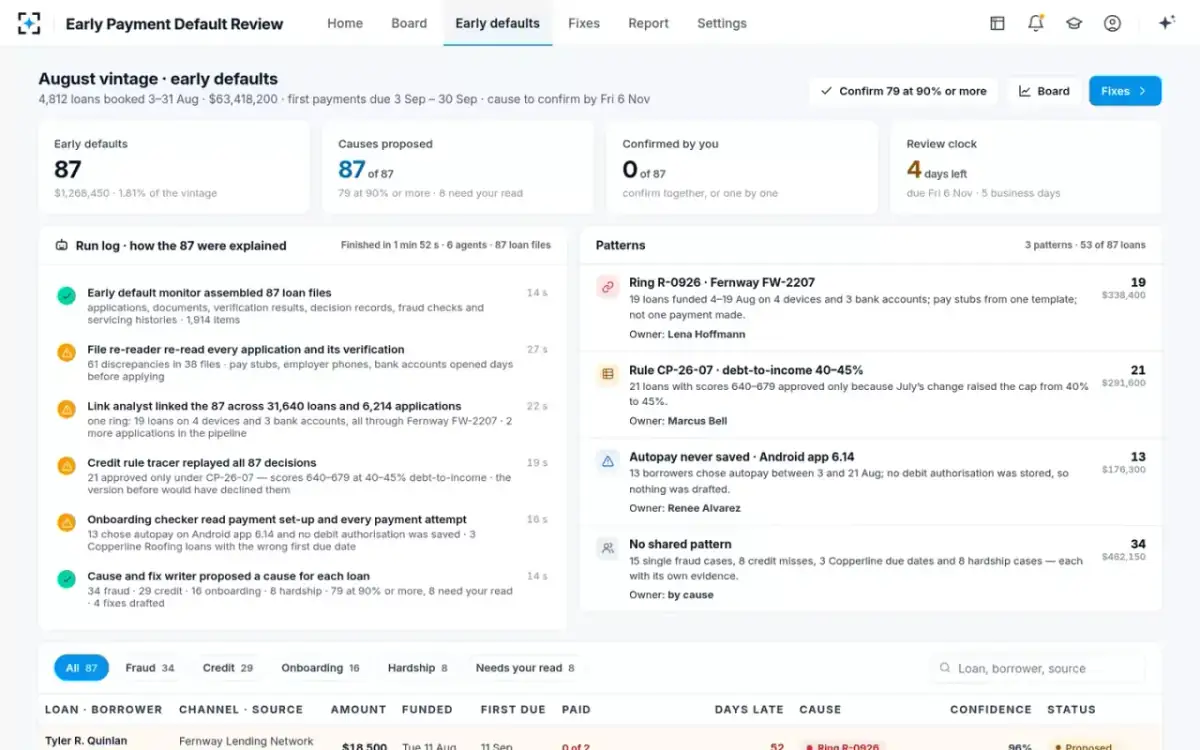
The occupational definition is dry and accurate: credit analysts "analyze credit data and financial statements of individuals or firms to determine the degree of risk involved in extending credit or lending money" (O*NET, Credit Analysts 13-2041.00). The vintage version of that job is anything but dry. August's book of 4,812 loans has produced 87 early defaults — $1,268,450 at 30 days past due, 1.81% against 1.06% for the six vintages before — and causes are due Friday. The analyst's week is to turn 87 unexplained loans into one explained vintage: every file re-read, every cause proposed with its evidence, every fix drafted for its owner, and nothing sent that they have not confirmed themselves. The senior version of the role carries the same load with the authority to confirm in bulk: 79 causes at the configured confidence threshold together, the 8 below it read one by one.
The list an analyst actually works: 87 proposed causes, 8 left to read
The five seats: who confirms, who fixes, who signs
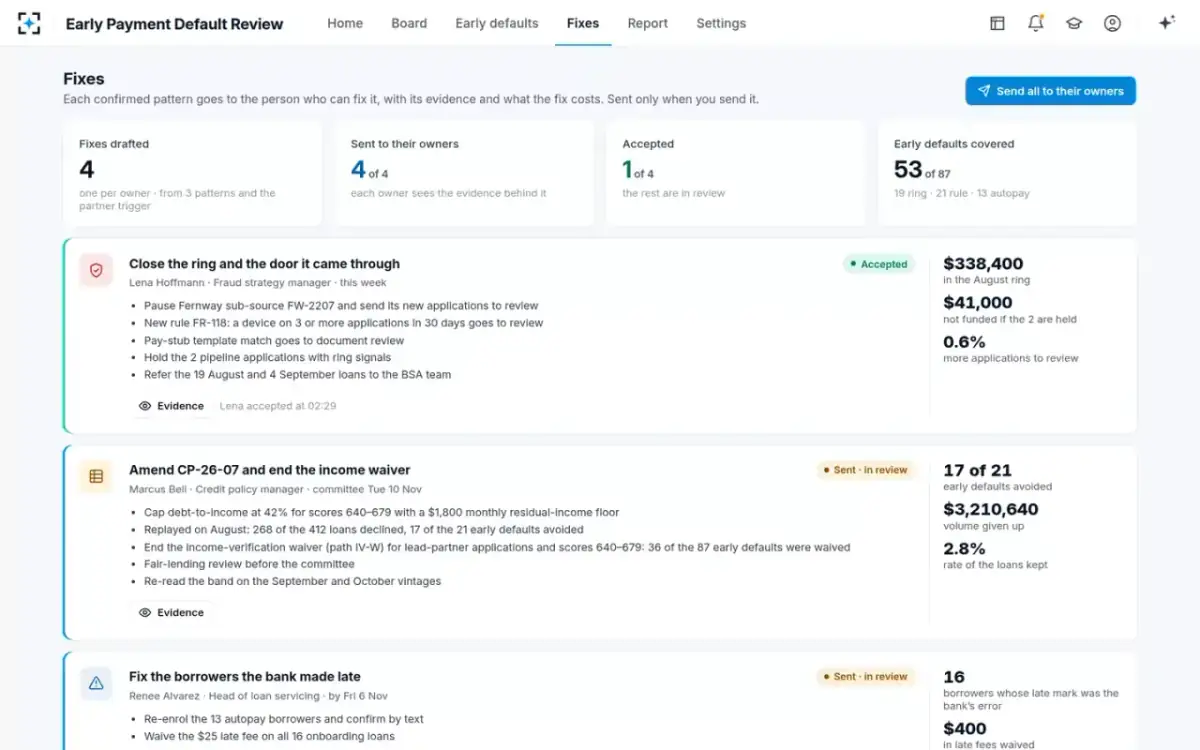
Every early default touches all five seats, and the handoffs are the job. The analyst confirms causes and sends fixes. The fraud strategy manager receives the ring — link map, sub-source, open applications to hold, BSA referral. The credit policy manager receives the rule — which change admitted the credit misses, and a what-if replay under any proposed cap. The head of loan servicing receives the borrowers the bank made late, with fees to waive and bureau marks to correct. The consumer credit risk director receives the month: a report that splits the rise into its causes and names each fix and its owner. Nobody signs what they have not read; nothing leaves until the analyst sends it.
The five seats at Lanternfield Bank, and what each still owns
Today
Re-reads a sample of files by hand, weeks later; the rest of the early defaults stay a number in the vintage chart.
With agents
Starts from 87 proposed causes with their evidence, confirms 79 together and reads the 8 below threshold one by one.
Still theirs: Every confirmation, every send — nothing counts as explained on an agent’s proposal alone.
Today
Learns about a ring in the quarterly review, after it has moved on.
With agents
Gets the ring the week it is found — link map, sub-source, open applications to hold, and the BSA referral.
Still theirs: The hold, the partner decision and the referral call.
Today
Is asked to tighten the score cut-off without knowing which rule let the defaults in.
With agents
Sees the rule, the band, and a replay of the vintage under any cap and residual-income floor before he proposes it.
Still theirs: The proposal and the fair-lending review that precedes it.
Today
Learns that autopay was never set up only once the borrower is already 30 days late.
With agents
Gets the 16 borrowers the bank made late, with fees to waive and late marks to correct with the bureaus.
Still theirs: The corrections and the borrower conversation.
Today
Hears that early defaults went up, not which team fixes it.
With agents
Signs a report that splits the rise into fraud, credit and onboarding, with each fix and its owner.
Still theirs: The signature, and the committee’s question time.
What a credit risk analyst's week looks like when 87 files need an answer
The week has a shape even when it goes well. Monday: the vintage crosses the line and cases open on the servicing feed; the files assemble themselves — application, documents, verification results, decision record, fraud checks, channel, every payment attempt — for each of the 87. Tuesday morning: six agents re-read everything and propose one cause per loan with its evidence and its runner-up; on the sample run that takes a minute and 52 seconds, a sample-run figure to demonstrate the mechanism, not a processing promise. Tuesday afternoon through Thursday: the analyst confirms — 79 together at the configured threshold, the 8 below it one by one, changing any cause the evidence disagrees with. Friday: fixes go to their owners with what each costs, and the report drafts itself from the confirmed record. The whole cycle ran inside the 5-business-day review clock the bank set; the July report, done the same way, took 4 days; the sampled review it replaced took about six weeks to reach a cause — our estimate, not a measured figure.
Where the review days went, sampled by hand against agents-first
| Stage of the review | Sampled review by hand | Agents re-read first |
|---|---|---|
| Pulling each file together | 5.0 days | 0.5 days |
| Re-reading applications and verification | 15.0 days | 1.0 days |
| Linking loans that share devices or accounts | 5.0 days | 0.5 days |
| Tracing which rule let the loan in | 5.0 days | 0.5 days |
| Agreeing causes and fixes with owners | 7.0 days | 2.0 days |
| Writing and signing the report | 5.0 days | 0.5 days |
| Total for one monthly vintage | 42 working days ≈ six weeks (estimated) | 5 working days |
The same review as shares: re-reading shrinks, deciding stays
Sampled review by hand · 42 working days (estimated)
- Assembling files · 12%
- Re-reading · 36%
- Linking · 12%
- Tracing rules · 12%
- Agreeing with owners · 17%
- Writing the report · 12%
Agents re-read first · 5 working days on the sample vintage
- Assembling files · 10%
- Re-reading · 20%
- Linking · 10%
- Tracing rules · 10%
- Agreeing with owners · 40%
- Writing the report · 10%
What a fraud strategy manager actually owns
The fraud seat is the easiest to misunderstand, because the title sounds analytic and the job is operational. The federal task description runs: fraud examiners "obtain evidence, take statements, produce reports, and testify to findings regarding resolution of fraud allegations", and "analyze financial data to detect irregularities in areas such as billing trends, financial relationships, and regulatory compliance procedures" (O*NET, Fraud Examiners, Investigators and Analysts 13-2099.04). On the sample vintage that translates to: accept the ring referral, pause the partner sub-source FW-2207, hold the two open applications, commission the new device rule (three or more applications in 30 days goes to review), and take the referral decision to the BSA team, whose clock started the day the ring was detected. What the seat does not own is the score cut-off — the ring's applications passed the old scores, and tightening them would have caught nothing while the door stayed open.
What a credit policy manager checks before a rule changes
The policy seat answers a different question: not "who did this" but "what did we change". Before CP-26-07 — the July rule that lifted the debt-to-income cap for scores 640–679 from 40% to 45% — the credit rule tracer replays every decision under the version in force at funding and the one before, and names the change that made the difference: 21 of August's early defaults were approved only under the new cap. Before any amendment, the manager replays the whole vintage under the proposed line: a 42% cap with a $1,800 monthly residual-income floor declines 268 of the 412 loans booked above the old cap and avoids 17 of the 21 early defaults, while the 144 kept default at 2.8%. The OCC expects this discipline to be visible to management, not just exercised: "Policy exception volumes and analysis should be a normal part of board and senior management reporting. Policy compliance is a useful risk management tool, and examiners should view adherence to the exceptions process as an important internal control" (Comptroller's Handbook, Retail Lending). Every proposal from this seat passes fair-lending review before the committee sees it.
Fixes with owners: what each one costs, sent only by the analyst
What does a senior credit risk analyst get paid? What federal wage data shows
The federal numbers put the role's midpoint at a $83,510 median annual wage — $40.15 an hour — for credit analysts, and $81,100 for fraud examiners, investigators and analysts, in Bureau of Labor Statistics 2025 wage data as O*NET reports it (O*NET 13-2041.00; O*NET 13-2099.04). A median is the middle of the whole occupation; O*NET also publishes state and local wages for each, which is the comparison a senior analyst or a hiring manager should make. The premium the market pays for is judgment under deadline — the version of the job this page describes, where 87 files need an answer by Friday and the answer has to survive an examiner.
Is credit risk analyst a good career, and what does it take?
It is a good career for a particular temperament: people who like documents more than drama, and who want their work to be checked rather than applauded. A common entry path runs through a bachelor's degree in finance, economics or accounting plus a few years in underwriting or analytics; the recognized certificates — the CFA charter for the markets side, FRM for the risk side, CFE for the fraud side — mark specialisms rather than requirements. The work's direction of travel is visible in this series itself: the analyst who once spent weeks assembling and re-reading files now spends the week confirming what software proposes and owning what it cannot. The skills that appreciate in that world are the ones O*NET's description quietly assumes — reading a file skeptically, writing down why, and standing behind the number.
What changes for these five roles once agents read the files first
The seats stay; the week changes. Where the sampled review spent its effort reading a quarter of the files and extrapolating, the agents-first week starts from all of them proposed and cited, and the people spend their hours on the decisions only people can make: confirming causes, holding applications, amending rules, correcting bureau marks, signing the report. Fannie Mae's quality-control language states the supervision-side logic in one sentence — a statistically valid random sample, "augmented with targeted, discretionary sampling, which aids in the measurement of the overall quality of mortgage loan deliveries" (Servicing Guide, A2-4-01). The discretionary part is the point: when the review population itself is chosen by risk, the human seats spend their attention where it matters, and the agents' job is to make sure that is where the evidence already is.
One vintage across the five seats: who hands off to whom
Agent
Six agentsRe-read all 87 files and propose one cause each, with evidence, runner-up and confidence.
Never: confirm a cause or send a fix
A person decides
Priya Raman · analystConfirms 79 together at the configured threshold, reads the 8 below one by one, sends each fix to its owner.
A person decides
Lena · Marcus · ReneeAccept or decline their fixes: pause the sub-source, amend the rule after fair-lending review, correct the borrowers the bank made late.
A person decides
Daniel Okoro · directorSigns the monthly report: the rate, the causes, each fix and its owner, for the credit risk committee.
The month, signed: what the committee actually reads
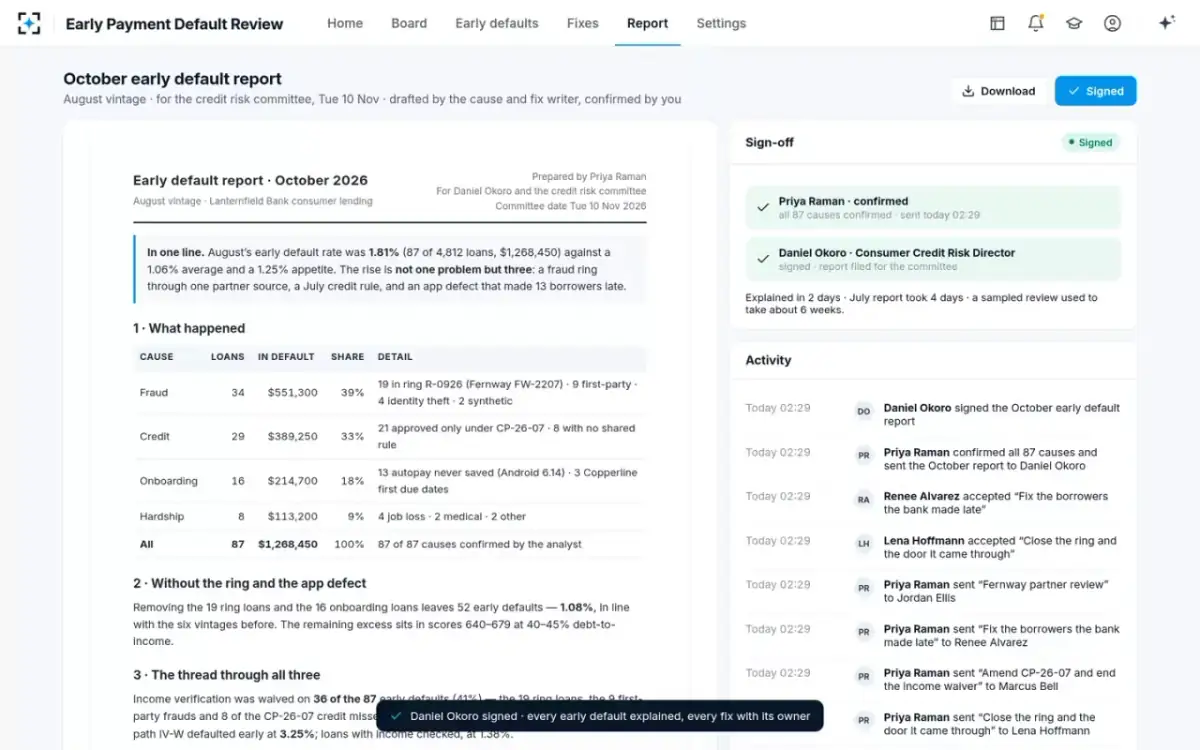
The signature is where the relay ends. In the sample run the October report went to the committee on Tuesday 10 November: the rate, the four causes, the fixes and their owners, and the thread that ran through all three problems — income verification waived on the instant-decision path, 41% of the early defaults. What the other five guides in this series cover is the work behind each seat — the term itself, the ring, and the six agents doing the reading. To see the five seats on a working vintage, start from Early Payment Default Review.
Questions people ask
What does a credit risk analyst do?
They analyze credit data and financial statements to judge the risk of extending credit — and, when a vintage turns, they find out why loans failed and route each cause to the team that owns the fix. In an early-default review that means confirming a proposed cause for every loan and sending each fix to its owner.
What does a senior credit risk analyst do differently?
The same work with confirmation authority: reading the files below the confidence threshold one by one, changing causes the evidence disagrees with, and owning what is sent. On the sample vintage the senior analyst confirms 79 causes together and personally reads the remaining 8.
What is a fraud analyst's job description?
In the federal occupation's words: obtaining evidence, taking statements, producing reports and testifying to findings on fraud allegations, and analyzing financial data for irregularities in billing trends, financial relationships and compliance procedures. In a lending operation, add the operational calls — pausing a sub-source, holding pipeline applications, referring a ring to the BSA team.
What does a credit policy manager check before changing a rule?
Which rule admitted the losses: a replay of each decision under the policy version in force and the one before, the band the change touched, and a what-if replay of the whole vintage under any proposed cap — volume given up, early defaults avoided, rate on the loans kept. Every proposal passes fair-lending review before the committee sees it.
Is credit risk analyst a good job?
For people who like documents, deadlines and accountability, yes: median pay of $83,510 nationally in 2025, a clear seniority ladder, and skills — skeptical file-reading, defensible writing — that appreciate as automation takes the mechanical share of the work.
Does the analyst still matter if agents read the files first?
More, not less: the agents propose, and every proposal waits on a person's confirmation. The analyst's week moves from re-reading a sample of files to deciding all of them — and the audit trail records whose decision each cause was.