The false positive rate in fraud detection is the share of the cases a system flags as fraud that turn out, on investigation, not to be fraud at all — a credit miss, an onboarding slip, a borrower in real hardship, or simply a false alarm. It matters because every false positive costs someone's time to clear, and a high enough rate trains the people reading the flags to stop trusting them. Botminds' Early Payment Default Review puts a confidence percentage next to every cause its agents propose for an early default, and lets a bank bulk-confirm everything at or above a threshold it sets — which raises the exact question this guide answers: what does that confidence number actually promise, and what would it take to know the system's real false positive rate on your own files?
The examples below come from the product's own fictional sample vintage: Lanternfield Bank, August, 87 early defaults out of 4,812 loans booked. The research figures come from GAO, NIST, the Federal Reserve and FinCEN, linked where they appear.
The alert volume a fraud flag competes with
3.8M
Bank Secrecy Act reports filed with FinCEN in 2021, the year FinCEN analysed for identity-related activity
1.6M
identity-related BSA reports in 2021, 42% of all reports filed
$212B
in suspicious activity those identity-related reports covered
What does "false positive rate" mean in fraud detection, exactly?
A false positive, in this setting, is a case the system flags as fraud (or proposes a fraud cause for) where the truth, once established, is something else. The false positive rate is that count divided by every case the system flagged, not by every case it reviewed — a tool can have a low false positive rate and still miss most of the real fraud, because the two numbers answer different questions. A false positive rate tells you how much you can trust a flag; it says nothing about how many real frauds slipped through unflagged. That second number has its own name, the false negative rate, and a defensible evaluation needs both, plus a third: how often a human reviewer, looking at the same file, disagrees with the system's call.
In Early Payment Default Review, the unit being judged is not a flag but a proposed cause: for every early default, the cause and fix writer agent names fraud, a credit miss, an onboarding slip or hardship, with a confidence percentage and a runner-up. A false positive, here, is a loan the system proposed as fraud (or any other cause) that the credit risk analyst — reading the same evidence — assigns differently. The four causes an early default can have sets out what each one looks like in a file; this guide is about how much to trust the system's call between them.
Why a confidence score is not an accuracy score
A confidence score is the system's own estimate of how sure it is, generated the same way the cause itself was. An accuracy score is a measurement of how often that estimate turned out to be right, generated separately, against an outcome nobody told the system in advance. The two are built from different ingredients, and the gap between them is exactly where a bank gets burned: a system that is well calibrated says "90% confident" and is right about nine times in ten; a system that is poorly calibrated can say "90% confident" and be right six times in ten, and nothing in the number itself tells a reader which one it is looking at.
Calibration has to be checked, not assumed, and it has to be checked on a bank's own files, because the mix of fraud types, channels and credit policy a confidence score was tuned on elsewhere may not match what shows up in your vintage. A vendor's claimed accuracy, measured on its own training or demonstration data, answers a different question than "how often is a 90%-confidence cause right on my loans." Those are the two sentences worth distinguishing before a single case gets bulk-confirmed on the strength of a percentage.
Confidence score vs accuracy rate: what each one actually tells you
| A confidence score | A false positive / accuracy rate | |
|---|---|---|
| Who sets it | The system itself, case by case, as part of proposing the cause | Measured afterward, by comparing proposed causes with confirmed outcomes |
| What it answers | "How sure am I about this one case?" | "How often was I right, across many cases like it?" |
| Where it comes from | The model’s own internal estimate | A truth file: closed cases where the real cause is known |
| What it cannot tell you | Whether the system is well calibrated on your files | Nothing, once it exists — but it does not exist until someone measures it |
What regulators and auditors actually say about AI and false positives in fraud and AML alerts
The federal government's own audit of AI in financial services names false positives directly, and names the benefit in the same breath as the caution. "AI may also reduce false positives, which constitute the vast majority of money laundering and terrorist financing alerts, allowing institutions to focus on genuinely suspicious cases, according to the International Monetary Fund," the Government Accountability Office reported in May 2025 (GAO-25-107197). That sentence is the strongest public case for a tool like Early Payment Default Review: the alert volume at most institutions already buries real cases under false ones, and a tool that genuinely cuts the noise is solving a problem regulators recognize.
It is not, on its own, a safety case. The same report is an audit of use and oversight, not a certification of any product's false positive rate, and the banking agencies' own guidance draws the line plainly: "Generative AI and agentic AI models are novel and rapidly evolving. As such, they are not within the scope of this guidance," the Federal Reserve, OCC and FDIC wrote in April 2026's revised Model Risk Management guidance (SR 26-2), the letter that supersedes the model-risk guidance banks have followed since 2011. A tool can be doing real work and still sit in a gap the rules have not caught up with — which is exactly why the measuring has to be done by the bank, not assumed from the regulation.
"Generative AI and agentic AI models are novel and rapidly evolving. As such, they are not within the scope of this guidance."
SR 26-2, Board of Governors of the Federal Reserve System, OCC and FDIC, April 2026
The four numbers to ask for, and how to measure each on your own files
A defensible evaluation of a cause-finding tool rests on four numbers, and none of them can be taken from a vendor's marketing claim — each has to be built from a bank's own closed, confirmed files, where the true cause is already known from a completed investigation. The first two are the standard pair: the false positive rate (of everything flagged as a given cause, how much was not) and the false negative rate (of everything that really was that cause, how much the system missed or misassigned). The third is a human-disagreement rate: of everything the system proposed, how often did the analyst change the cause, whether or not the system turned out to be wrong in the end. The fourth is a confidence-calibration check: within the cases proposed at 90% confidence or more, what share actually held up when confirmed — the number that tells a bank whether its own bulk-confirm threshold means what it sounds like it means.
The four numbers to ask a vendor for, and where each comes from
- False positive rate
Of every case proposed as cause X, what share was not X on confirmation. Measured on a sample of your own closed early defaults, re-scored against the vendor’s current model.
- False negative rate
Of every closed case that really was cause X, what share the system proposed as something else. Needs a truth file the vendor did not help build.
- Human-disagreement rate
Of everything proposed, how often the analyst changes the cause — whether or not the system was ultimately wrong. Pulled straight from the audit trail once the tool is live.
- Calibration at the bulk-confirm threshold
Of the cases proposed at 90% confidence or more, what share held up. If this number is below roughly 90%, the threshold is set too low for your files.
No false-positive or false-negative rate is published for Early Payment Default Review; the product does not claim one, and this guide will not invent one on its behalf. What the product offers instead is the mechanism to build all four numbers once it is live: every proposed cause, every confirmation and every change the analyst makes is on the audit trail, timestamped and attributed, which is exactly the raw material a false positive rate is measured from. A buyer should ask to see that trail from a pilot before relying on the confidence number for anything larger than a handful of files.
What "90% confidence or more" should and should not mean for bulk confirmation
In the product's own settings, "bulk confirm" is a threshold a bank sets — 90% or more, 95% or more, or never, meaning every cause is read one by one regardless of confidence. On the sample August vintage, 79 of the 87 proposed causes sit at 90% confidence or more and can be confirmed together; the remaining 8 are read individually. That design choice does real work: it is the difference between a credit risk analyst reading 87 files and reading 8, which is most of the time a sampled review never reached at all.
79 of 87 ready to confirm together, 8 that need a read
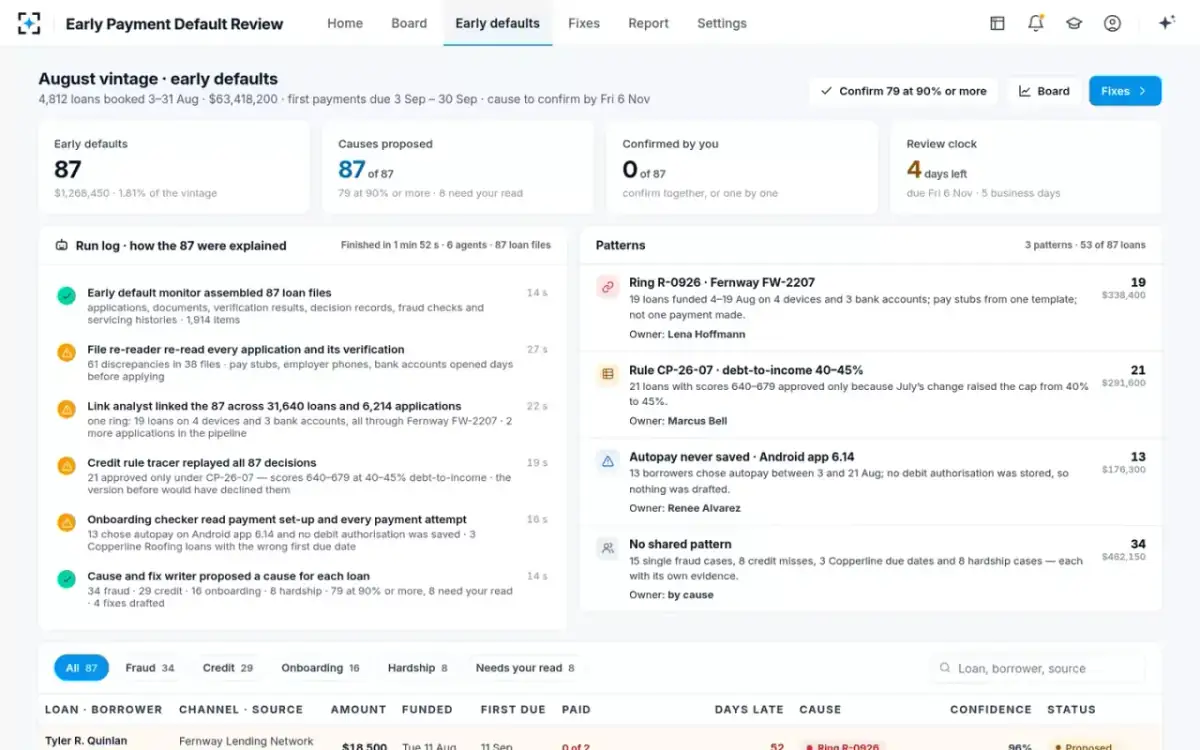
What 90% should never mean is "90% accurate." It is the system's own stated confidence on each case, set as the bar above which a bank has decided it is comfortable confirming without an individual read — a policy choice, not a measured result. A bank that treats the two as the same thing is making a bulk decision on an unverified assumption. The honest sequence is: pilot the tool on closed files, measure calibration at 90% specifically, and only then decide whether 90% is the right bar for your own risk appetite, or whether 95% — or never — fits better until more history accumulates.
What each confidence tier should trigger, until it is measured on your own files
| Confidence | What it should trigger |
|---|---|
| 95% or more | Eligible for bulk confirm once calibration is checked at this tier |
| 90–94% | Eligible only after a measured false positive rate at this tier |
| 70–89% | Read individually; the runner-up cause is usually close |
| Below 70% | Treat as unexplained until a person reads the file |
How agentic AI fits — and does not yet fit — current model risk guidance
SR 26-2 is explicit that it supersedes SR 11-7, the model risk guidance banks have operated under since 2011, and that the revised guidance "highlights sound principles for effective model risk management while recognizing that model risk management practices appropriately vary among banking organizations based on their specific risk profiles and model usage" (SR 26-2). It then carves generative and agentic AI out of its own scope. The practical reading is not that agentic AI escapes oversight — it is that the agencies have not yet told a bank exactly how to apply decades of model-risk discipline to a system like this, which leaves the bank's own risk function to decide what "sound principles" mean here, using the same instincts that built model risk management in the first place: independent validation, ongoing monitoring, and a documented limit on what the system may decide on its own.
That is also where NIST's framework is useful, because it is written generally enough to apply regardless of whether a regulator has issued AI-specific rules yet. "Human roles and responsibilities in decision making and overseeing AI systems need to be clearly defined and differentiated. Human-AI configurations can span from fully autonomous to fully manual," the NIST AI Risk Management Framework states (NIST AI 100-1). Early Payment Default Review's own design answers that question explicitly: the cause and fix writer agent "never confirms a cause," and every fix drafted for a fraud, credit, servicing or partner fix "never sends without the analyst." The configuration is fixed at agent proposes, person confirms — not a sliding scale a bank has to define for itself, which is one less open question for a model-risk reviewer evaluating it under guidance still being written.
What a seeded-error test looks like for a cause-finding tool
Before a false positive rate exists, a bank needs a way to generate the truth file it measures against, and the most direct way is a seeded-error test: take a set of closed early defaults whose real cause is already confirmed by past investigation, run them through the tool as if they were new, and compare. The test is only honest if the files span the four causes in roughly realistic proportions — on the sample vintage, fraud is the largest branch at 34 of 87, credit 29, onboarding 16 and hardship 8 — because a test file set weighted toward the easy cases will always look better than production.
A seeded-error test should also deliberately include the hard cases: a loan with genuine hardship that happens to share a device with an unrelated fraud ring by coincidence, a credit miss that also shows a waived income check, a bank-caused onboarding error on a borrower who was separately a credit risk. Those overlapping-signal cases are where a confidence score is most likely to be miscalibrated, because they are exactly the cases a model is least likely to have seen cleanly labeled in whatever it learned from. If a vendor cannot produce a seeded-error test result, or resists running one on your own closed files, that itself is close to an answer.
What happens when the system is wrong — who catches it, and how fast?
In the product's own design, the backstop for a wrong proposed cause is the same place every cause passes through regardless of confidence: the credit risk analyst. Every cause, confirmed in bulk or read one by one, is attributed to the analyst who confirmed it, and every change from the proposed cause to a different one is on the audit trail with who made it and when. That trail is also the raw material for catching a systematic miscalibration early — if a particular pattern of proposed-fraud causes keeps getting changed to credit misses by the analyst, that disagreement rate is visible well before a false positive rate would formally confirm it.
What the design does not do is catch a wrong cause before it is confirmed, for anything above the bulk-confirm threshold — that is the tradeoff a bank is explicitly accepting when it sets the threshold at 90% rather than never. The fair question for a buyer is not whether the system is ever wrong (every system is), but how fast a wrong call surfaces and what it costs when it does: a wrongly bulk-confirmed credit-miss cause that should have been fraud delays a BSA referral; a wrongly bulk-confirmed fraud cause on a hardship case delays the fee waiver and bureau correction a real borrower was owed. Both are recoverable if caught within the review clock; both get more expensive the longer they sit unconfirmed as something they are not.
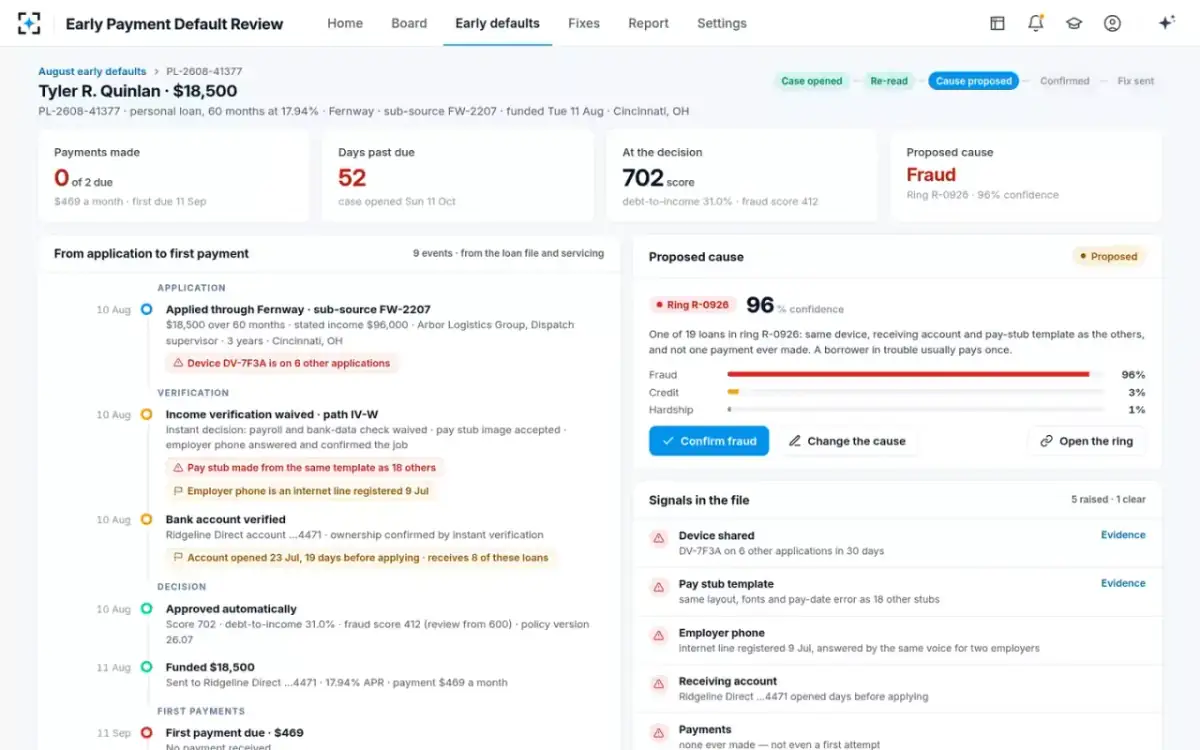
Measuring a cause-finding tool properly, before trusting its bulk-confirm threshold at scale, is also most of the work behind a fair comparison across approaches: fraud detection software for banks, compared on one vintage runs a sampled review, a rules engine and an agentic re-read side by side on the same 87 files. And the cost of getting the cause wrong, or getting it right six weeks late, is the subject of what fraud actually costs a bank. To see the confidence bars and the confirm flow on one loan, start from Early Payment Default Review.
One loan's confidence bars: 96% fraud, 3% credit, 1% hardship
Questions people ask
What is a good false positive rate for AI fraud detection?
There is no industry-standard figure, and a vendor who quotes one without naming the file set it was measured on should be asked for that file set. What matters more than a single target number is whether the rate is measured on your own closed files, broken out by cause and by confidence tier, and refreshed as volume and fraud patterns change.
Is a 90% confidence score the same as 90% accuracy?
No. A confidence score is the system's own estimate on one case; an accuracy or false positive rate is a measurement, made afterward, of how often that estimate held up against a known outcome. The two can match closely in a well-calibrated system and diverge badly in a poorly calibrated one, and nothing in the confidence number itself tells you which you have until it is measured.
Does AI actually reduce false positives in fraud and AML alerts?
The Government Accountability Office reports that AI can, citing the International Monetary Fund's observation that false positives make up the vast majority of money-laundering and terrorist-financing alerts at many institutions. That is a finding about the category of technology, not a guarantee for any specific tool on any specific bank's files, which is why the four numbers in this guide still have to be measured locally.
How do you measure a false positive rate for a fraud cause-finding tool?
Build a truth file of closed, confirmed early defaults where the real cause is already known, run them through the tool, and compare its proposed cause with the confirmed one, broken out by confidence tier. The share proposed as a given cause that was not that cause, on confirmation, is the false positive rate for that cause.
Does agentic AI fall under current bank model risk management rules?
Not explicitly. SR 26-2, the Federal Reserve, OCC and FDIC's April 2026 revised Model Risk Management guidance, states that generative and agentic AI models "are novel and rapidly evolving" and are not within its scope, while adding that a bank's own risk management and governance practices should still determine appropriate controls. That is not a free pass; it means the bank's model risk function has to decide what oversight looks like without a rule telling it the exact answer yet.
Who confirms a proposed cause if the confidence score is wrong?
In Early Payment Default Review, the credit risk analyst confirms or changes every cause, whether it was proposed above or below the bulk-confirm threshold; the agents themselves never confirm a cause. Every confirmation and every change is recorded with who made it and when, which is the record a bank uses to catch a miscalibrated pattern early.