How much does fraud cost banks? Most answers stop at the charge-off rate, the number that already sits in every credit risk report. It is real, and it is also the smallest of four layers. An early default that goes unexplained keeps a fraud ring funding new loans, lets a credit rule approve the next vintage's version of the same risk, and leaves the bank's own mistakes — a fee that should have been waived, a late mark that was never the borrower's fault — sitting uncorrected because nobody connected them to a cause. Botminds' Early Payment Default Review re-reads every early default, not a sample, specifically so those three hidden layers get found while they are still cheap to fix.
The figures below come from the product's own fictional sample vintage — Lanternfield Bank, August, 87 early defaults out of 4,812 loans booked, $1,268,450 at risk — next to published rates from the Federal Reserve, FinCEN and academic research, linked where they appear.
The baseline everyone already tracks
1.21%
annualized charge-off rate, other consumer loans (not credit cards), 2026:Q2
3.82%
annualized charge-off rate, credit card loans, 2026:Q2
1.81%
the sample vintage’s early default rate — 87 of 4,812 loans, against 1.06% for the six vintages before
What fraud actually costs a bank: the layers nobody adds up
A charge-off is a single loan's loss, booked once and reported in a rate everyone already watches. The three layers underneath it are not single losses; they are costs that compound every month a cause stays unexplained. A fraud ring that funded 19 loans in August does not stop at 19 if nobody closes the door it came through — it keeps presenting new applications through the same channel. A credit rule that let in 412 loans above its old debt-to-income cap, 21 of which defaulted early, keeps letting in the next vintage's 412 until someone amends it. And a bank's own onboarding error, autopay the app never saved, keeps generating late marks on borrowers who did nothing wrong, each one a small, avoidable cost in fees, bureau corrections and goodwill.
None of those three layers shows up in a vintage default-rate chart. They show up only once someone re-reads the files and asks why, which is the point of trusting the cause a system proposes in the first place — a cost that is miscounted as a credit problem gets a credit fix, while the ring and the bank's own mistakes keep running.
The baseline: charge-off and delinquency rates on consumer loans today
In the second quarter of 2026, the annualized charge-off rate across commercial banks was 3.82% for credit card loans, 1.21% for other consumer loans and 2.66% for consumer loans as a whole, seasonally adjusted, the Federal Reserve's own release reports (charge-off and delinquency data). Those figures describe losses that have already been written off — the end of a process, not the early-default signal this solution is built around, which is why a vintage running at 1.81% early defaults against a 1.06% baseline is worth investigating well before it shows up as a charge-off. By the time a loan charges off, the cost of the ring it came through, or the rule that let it in, has already been paid several more times over.
The cost of an open ring: not one loan, but every loan like it
Identity fraud is not a marginal share of financial crime. In 2021, identity-related suspicious activity reports made up 42% of a total 3.8 million Bank Secrecy Act reports filed, "reporting $212 billion in suspicious activity, filed during the Review Period," FinCEN's own trend analysis found (FinCEN, Identity-Related Suspicious Activity). A single ring sits inside that total, and its real cost is not the loans it has already funded but the ones it is about to.
One ring, three cost lines
| What | Where it stands | What it costs if the door stays open |
|---|---|---|
| 19 loans, 4–19 Aug | Already funded, $338,400, not one payment made | The visible loss — already on the books |
| 4 loans, Sep | Same devices, accounts and template, found after August | $71,200 more, funded while the door was still open |
| 2 applications | Still in the pipeline, same signals, held for review | $41,000 that a 30-day detection window can still stop |
Academic research backs the scale of the underlying problem: misrepresented mortgage loans default far more often than similar honest ones, and misrepresentation is not rare. "About one out of every ten loans has one of these misrepresentations," a National Bureau of Economic Research working paper on asset quality misrepresentation in the non-agency mortgage market found, and "ex post delinquencies of such loans are more than 60% higher when compared with otherwise similar loans" (NBER Working Paper 18843, Piskorski, Seru and Witkin). The paper studies mortgages, not personal loans, but the mechanism is the same one a ring like R-0926 exploits: a misrepresentation that passes the point of approval keeps defaulting at a materially higher rate for as long as it funds.
The suspicious activity report clock adds a time cost on top of the dollar one. Under the Bank Secrecy Act's implementing regulation, "a bank is required to file a SAR no later than 30 calendar days after the date of initial detection by the bank of facts that may constitute a basis for filing a SAR" (31 CFR 1020.320). A ring found on day 2 of November and confirmed on day 25 has spent most of that clock before the BSA team even sees it — which is the argument for re-reading every file the day it turns late, not weeks after, when a sampled review would have reached it.
The cost of a credit policy that keeps letting the same risk back in
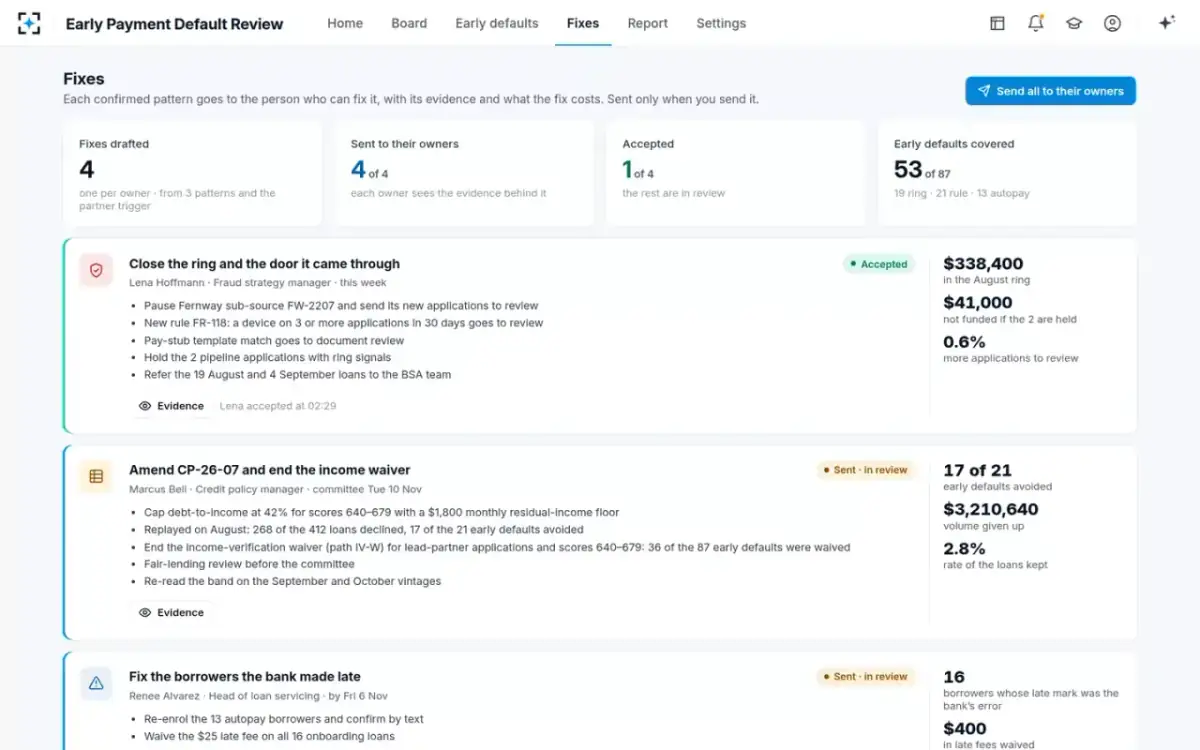
A credit rule change that looked reasonable in isolation can quietly widen a bank's exposure every vintage after it. On the sample vintage, rule CP-26-07 raised the debt-to-income cap for scores 640–679 from 40% to 45% in July. August booked 412 loans in that newly opened band; 21 of them defaulted early, a 5.10% rate against 1.62% for loans below the old 40% cap. Left unamended, the rule does not cost 21 loans once — it costs roughly that rate on every vintage that follows, until someone traces the cause back to the rule and brings a replacement to the credit risk committee.
What a what-if replay prices is the trade a bank is actually making. Tightened to a 42% cap with a $1,800 monthly residual-income floor, the same August vintage would have declined 268 of the 412 loans — $3,210,640 of volume — and avoided 17 of the 21 early defaults, with the 144 loans kept defaulting at an estimated 2.8%. Going back to the original 40% cap avoids all 21 but gives up all 412 loans of volume. Neither number is free; the cost of leaving the rule as it is, is the gap between what gets declined now and what keeps defaulting at 5.10% every vintage until it is amended.
The cost the bank causes itself: fees waived, late marks corrected
The fourth layer is the one that costs the bank its own money and a borrower's trust, with no fraud and no credit miss behind it at all. On the sample vintage, 13 borrowers chose autopay at application and the app never saved the authorization, so the payment that was supposed to happen automatically never did. Sixteen onboarding-caused loans in total needed a fix: re-enroll the borrower, waive the late fee, and correct the late mark with the credit bureaus — $400 in fees waived across those loans, plus whatever it costs in goodwill when a borrower's credit file shows a missed payment the bank itself caused.
Four fixes, each with its cost, sent only when the analyst sends them
What it costs to find the cause, by hand vs re-reading every file
Finding these three hidden layers has its own cost, and it is the one a bank controls most directly. A sampled review by hand — pulling files together, re-reading applications, linking loans across devices and accounts, tracing which rule let a loan in, agreeing causes and fixes with the owners who have to act on them, writing the report — is estimated, by us, at about six weeks for one monthly vintage's sampled review of roughly 25 files. Re-reading every file rather than a sample compresses most of that into about 1 minute 52 seconds for six agents to read 87 files, demonstrated on the sample vintage, with the remaining days spent where judgment still belongs: agreeing causes and fixes with the people who own them.
Where a vintage's review days go, estimated
Sampled review (today) · about 6 weeks, estimated
- Pulling each file together · 5d · 12%
- Re-reading applications and verification · 15d · 36%
- Linking loans across devices and accounts · 5d · 12%
- Tracing which rule let the loan in · 5d · 12%
- Agreeing causes and fixes with owners · 7d · 17%
- Writing and signing the report · 5d · 11%
Re-reading every file (with agents) · about 5 days
- Pulling each file together · 0.5d · 10%
- Re-reading applications and verification · 1d · 20%
- Linking loans across devices and accounts · 0.5d · 10%
- Tracing which rule let the loan in · 0.5d · 10%
- Agreeing causes and fixes with owners · 2d · 40%
- Writing and signing the report · 0.5d · 10%
The shift that matters is not just less time; it is where the time goes. In a sampled review, most of the six weeks is spent assembling and re-reading files by hand, work a person does not need to do twice. Re-reading every file compresses that mechanical work to under a day and lets the days that remain go almost entirely to the part that still needs a person: agreeing each cause and fix with the fraud, credit, servicing and partner owners who have to act on it.
What one vintage's 87 early defaults cost, by cause
How to build a simple return estimate from your own numbers
A defensible estimate does not need a vendor's figures; it needs four of a bank's own. Start with how many early defaults go through a sampled review today, and how many weeks that review typically takes before a cause is agreed. Add the dollar volume of the loans that stay unexplained between the sample and the full vintage — the ones a 25-of-87 sample never reaches. Add an estimate of how long a ring or a loose credit rule typically runs before it is caught by the current process, multiplied by what it funds in that window. And subtract the fees, bureau corrections and goodwill cost of the bank's own onboarding errors that go uncorrected for the same stretch of time.
None of those four numbers needs to be precise to be useful. A credit risk team that can say "our sampled review typically takes five weeks, and a ring that size usually keeps funding for three of them before anyone notices" has already priced the delay, even without a vendor's demonstration figures attached. The estimate is most useful not as a single number to defend in a committee meeting, but as a way to see which of the four layers is actually driving the cost at a given bank — a bank with a clean credit policy and heavy fraud exposure needs a different fix than one where onboarding errors dominate, and the two look identical on a vintage default-rate chart until someone breaks the total apart.
Building your own cost-of-fraud estimate
- How many early defaults are sampled today, and how many are not
The unsampled loans are not explained — they are unknown, which is a different thing from investigated and cleared.
- How long a sampled review takes, from 30 days late to an agreed cause
Every week a ring or a loose rule runs unexplained is a week it keeps funding more of the same.
- What a ring like R-0926 would cost if it ran one more vintage
Multiply its monthly funding rate by the months your current process typically takes to catch one.
- What a credit policy change avoids, replayed on last vintage’s files
Ask any tool to show loans declined and early defaults avoided together — one number alone hides the trade.
- What the bank’s own onboarding errors cost in fees and bureau corrections
Small per loan, and the only layer where the fix costs the bank money directly rather than avoiding a future loss.
Why a sampled review understates the true cost
A sample built to catch 25 of 87 files was never designed to find a ring, a rule or a pattern of self-caused errors — it was designed to catch what a vintage-level default rate already shows, one file at a time, at a scale small enough for a person to get through in six weeks. The 62 files it never reaches are not evidence that nothing is there; they are simply unmeasured. A ring that happens to fall outside the sample stays open for another vintage. A credit rule that happens not to show up in the sampled files keeps admitting the same risk, invisibly, until the vintage default rate rises enough on its own to force a look.
That is the honest case for re-reading every file rather than a sample: not that a sample is done badly, but that a sample was never the right instrument for finding a ring, a rule or a pattern — those need every file read, because the pattern is exactly the thing a smaller slice is least likely to contain enough of to see. A ring of 19 loans inside a vintage of 4,812 is 0.4% of the book; a 25-file sample drawn at random has a real chance of missing most of it entirely, and a sample that happens to catch two or three of its loans has no way to tell they belong to the same ring without comparing every file's devices and accounts against every other file's — which is link analysis across the whole vintage, not a sampling exercise at all.
The same logic applies in the other direction: a sample that comes back clean is not evidence the vintage is clean, only that the 25 files drawn happened not to surface a pattern. A credit risk committee that reads "sample clear" as "vintage explained" is treating an absence of evidence as evidence of absence, on a process that was never built to find the three costliest layers in the first place. How a sampled review, a rules engine and an agentic re-read compare on the same 87 files sets out what each approach actually catches, and where each stays blind. To see the board, the ring and the rule trace on one vintage, start from Early Payment Default Review.
Questions people ask
How much does fraud cost banks, in total?
There is no single published industry figure for early payment default fraud specifically; the Federal Reserve tracks charge-off rates (3.82% for credit cards and 1.21% for other consumer loans, 2026:Q2) and FinCEN tracks identity-related suspicious activity ($212 billion across 42% of BSA reports filed in 2021), but neither maps directly onto one bank's early-default cost. The honest answer is to build the four-layer estimate in this guide from your own numbers.
What is the personal loan charge-off rate today?
The Federal Reserve's most recent release puts the seasonally adjusted, annualized charge-off rate at commercial banks for other consumer loans at 1.21% and for credit card loans at 3.82%, both for the second quarter of 2026. Personal loans are not published as their own line; they sit inside the broader other-consumer category.
Why does an open fraud ring cost more than its charge-off?
Because a ring that is not closed keeps funding new loans through the same channel. On the sample vintage, 19 August loans were already funded through Ring R-0926 when it was found; four more September loans and two pipeline applications carried the same signals, adding $112,200 more at risk before the ring was closed.
What does a credit policy rework cost, compared with just tightening the score cut-off?
Tightening broadly gives up volume across the whole book to fix a problem that may only live in one band. On the sample vintage, a targeted 42% debt-to-income cap with a residual-income floor declined 268 of 412 loans in the affected band and avoided 17 of 21 early defaults; reverting the whole cap to 40% would have avoided all 21 but given up all 412 loans, most of which performed fine.
What does it cost a bank to find the cause of an early default?
By our estimate, a sampled review by hand takes about six weeks per monthly vintage for roughly 25 files; there is no published industry figure. Re-reading every file compresses the mechanical part — pulling and re-reading files, linking loans, tracing rules — to under a day, in a demonstrated 1 minute 52 seconds for six agents on 87 files, leaving the remaining days for agreeing causes and fixes with owners.
Does fixing the bank's own onboarding errors really matter financially?
Individually, each fee waived is small — $400 across 16 loans in the sample vintage. What it buys is a borrower's credit file corrected before the error compounds, and it is the one layer where delay has no offsetting benefit: there is no scenario in which leaving a bank-caused late mark uncorrected helps the bank.