A payoff statement request asks a lender for the exact sum that will retire a loan in full on a stated date, and the answer — the payoff statement, or payoff letter — is a priced, dated promise with a short shelf life. On a commercial loan it typically carries the principal balance, interest accrued to a good-through date, any permitted fees, the total, the daily interest that accrues after that date, where the money is to be sent, and what the lender will release when it arrives. Three of those lines decay or can be tampered with: the good-through date, the per diem and the remittance account. Botminds' Drawdown & Payoff Request Processing reads each payoff letter as it lands, checks its arithmetic and its conditions against the credit agreement, compares the account on it with every payment ever made to that payee, and holds the release until a person has cleared whatever does not match.
Almost everything that ranks for this search is a consumer-mortgage explainer or a blank template. This page is about the commercial letter and what the paying side does with it. The worked example runs on fictional sample data — a fictional lender, Corvane Equipment Finance, paying off a fictional borrower's facility at the fictional Ashgrove Bank; every name, account and reference in it is invented. The rules and conventions are from the Code of Federal Regulations, the Uniform Commercial Code, the Federal Reserve and the market's own conventions committee, linked where they appear.
How one sample payoff total is built, and what each further day adds
Principal balance
$2,831,904.17
The outstanding principal at the good-through date, after the last scheduled payment has been applied.
The payee's loan system
Accrued interest
+ $12,486.25
Interest from the last paid-to date through 13 October, at the note rate on an Actual/360 basis.
The payee's loan system
Payoff processing fee
+ $1,920.00
Chargeable only if the note or security agreement provides for it. Ask which clause if it does not say.
The note
Each day after 13 October
+ $786.64
$2,831,904.17 × 10.00% ÷ 360. A wire that misses the cut-off on Friday costs three days, not one.
The clock
What is a payoff statement, and what makes a commercial one different?
A payoff statement is the lender's own figure for retiring the debt: not the balance on a statement, not the principal outstanding, but the total that, received on a named date, discharges the obligation and triggers whatever releases the lender has promised. The gap between a balance and a payoff is accrued interest, fees the agreement allows, and sometimes a prepayment or yield-maintenance amount that only appears when the loan is actually being repaid.
The commercial letter differs from the consumer one in three ways that matter at a funding desk. First, there is usually no deadline: a consumer payoff on a loan secured by a dwelling has a federal timetable, and a commercial payoff has whatever the agreement says, which is frequently nothing at all. Second, the arithmetic is more exposed — day-count conventions, fee clauses, prepayment formulas and the treatment of outstanding letters of credit all show up on the face of the letter, and all can be wrong. Third, the amounts are large enough to be worth stealing, and the letter travels by email.
That third point reshapes the whole process. A consumer payoff goes wrong when it is late. A commercial payoff goes wrong when it is convincing — right borrower, right loan, right total, and a remittance account nobody has ever paid before.
How long is a payoff statement good for?
Until its good-through date, and not a minute longer. The good-through date is the only date on the letter that matters to the paying side: it is the day on which the stated total is exactly right. Pay it earlier and you overpay by the interest that has not yet accrued, which most lenders refund without complaint. Pay it later and you underpay by the per diem for every day in between, which is a short payoff, and a short payoff does not discharge the loan.
Commercial payoff letters commonly run anywhere from a few days to a month. The length is a trade between two risks the issuing lender carries: a long window means the figure is wrong for longer if something changes, and a short window means the borrower's bank has to arrange a large wire inside a few days. Some letters also carry a separate expiry — a date after which the letter is void and must be re-issued, even for a payment inside the good-through window. Read both dates; they are not always the same.
Three events can invalidate a letter before its own date. A scheduled payment posting after the letter was computed changes the principal. A fee or advance the lender makes in the meantime — a forced-placed insurance premium, a protective advance — is added. And a draw on a facility that was supposed to be frozen moves the balance. Any of these produces a short payoff from a letter that was honest when written, which is why a large payoff is usually re-confirmed on the morning of the wire.
Per diem: the number that moves while you read the letter
Per diem interest is the daily cost of not having paid yet, and on a commercial loan it is usually computed on an Actual/360 basis: the annual rate divided by 360, applied to the actual number of days. The Alternative Reference Rates Committee recommends Actual/360 for Term SOFR loans as the US money-market standard, while allowing that an agreement may choose another fraction (ARRC conventions for syndicated and bilateral business loans; our guide to Term SOFR day count conventions quotes and works through it).
Divide by 360 and you get a number slightly larger than the one a borrower expects, because a year has 365 days. On the sample letter, $2,831,904.17 at 10.00% is $786.64 a day on Actual/360 and $775.86 on Actual/365 — a difference of $10.78 a day, about $3,900 a year on this one loan. Neither is wrong; what is wrong is applying one convention to a note written on the other. If the letter does not say which it used, divide the stated per diem into the principal and see which denominator comes back.
The per diem is also the price of a missed cut-off, and that is where it becomes an operational number rather than an arithmetic one. One day costs $786.64 on this loan. A wire that misses a Friday afternoon cut-off costs three days, because the next value date is Monday. That is the whole reason a funding desk sets its own release cut-off earlier than the payment system's: a letter paid at 2:16 p.m. on its good-through date costs nothing extra, and the same letter paid at 9:00 a.m. the next morning costs a day.
The seven-business-day rule, and where it does not reach
The rule people find when they search for how long a lender has to provide a payoff statement is Regulation Z. It is real, it is strict, and it does not apply to a commercial loan. Its words are specific: in connection with a consumer credit transaction secured by a consumer's dwelling, a creditor, assignee or servicer must provide an accurate statement of the total outstanding balance needed to pay the obligation in full as of a specified date, and "the statement shall be sent within a reasonable time, but in no case more than seven business days, after receiving a written request from the consumer or any person acting on behalf of the consumer" (12 CFR 1026.36(c)(3)).
Every limb of that sentence narrows it. Consumer credit. Secured by a consumer's dwelling. A written request. Seven business days, not seven days. A commercial loan to an operating company meets none of the first three conditions, so a commercial payoff request has no federal clock behind it at all — only whatever the loan documents provide, and most credit agreements say nothing about how fast the lender being repaid must answer.
A consumer dwelling-secured payoff and a commercial payoff are not the same instrument
Consumer, secured by a dwelling: The creditor, assignee or servicer, within a reasonable time and in no case more than seven business days of a written request
Commercial loan: Whoever the agreement names, in whatever time the agreement allows — often unstated
Consumer, secured by a dwelling: The consumer, or any person acting on behalf of the consumer
Commercial loan: The borrower, or a third party the borrower authorises in writing; lenders usually require the authorisation first
Consumer, secured by a dwelling: An accurate statement of the total outstanding balance to pay the obligation in full as of a specified date
Commercial loan: Whatever the letter says it is. The paying side checks the arithmetic itself
Consumer, secured by a dwelling: Not set by the seven-day rule; state law and the loan documents govern
Commercial loan: A matter for the note and the security agreement — read the clause before paying a processing fee
Consumer, secured by a dwelling: State recording law and the security instrument; the seven-day rule does not reach it
Commercial loan: The security documents, and Article 9 for the filings — including a twenty-day deadline once a demand is made
Two things follow for anybody requesting a commercial payoff. Ask early — five business days is a courteous minimum on a loan of any size, and more if the payee has to compute a prepayment amount. And ask in writing through a channel the payee will recognise, naming the obligor, the loan or note numbers, the intended payoff date and who is authorised to receive the letter, because a vague request produces a vague letter.
What a complete commercial payoff letter carries
Nine things, and a letter missing any of them will be chased. The table below is the sample letter read line by line, with what the paying side does with each line. The last three rows are the ones that cost money when they are wrong.
One payoff letter, line by line, and what the paying side does with each line
Issued by
Corvane Equipment Finance, payoff desk
Does the letter come from the payee's own payoff channel, or from an ordinary mailbox? The sample re-issue, CVF-PO-77810, came through the payee's portal.
Obligor and loan
Marlow Freight Lines, Inc. · equipment notes 7731 and 7735
Matched to the borrower and to the facility the money is being drawn under, not just to a name.
Principal balance
$2,831,904.17
The figure every other number on the letter is computed from.
Accrued interest to 13 October
$12,486.25
Accrued to the good-through date, not to the date of the letter.
Payoff processing fee
$1,920.00
Permitted only if the note or security agreement allows it. Add it up: the three lines must make the total.
Total, good through 13 October
$2,846,310.42
$2,831,904.17 + $12,486.25 + $1,920.00. If it does not add up, nothing else on the letter is worth checking yet.
Per diem after that date
$786.64
Principal × 10.00% ÷ 360. One missed cut-off costs this much; a weekend costs three times it.
Remittance instructions
Beneficiary · bank · routing · account
The only line on the letter that cannot be checked against arithmetic. It is checked against the payee directory and every past payment, or it is not checked at all.
What happens on payment
Lien releases and UCC-3 terminations
Name the filings to be terminated, by office and file number, and who will file them.
Two additions are worth asking for even when the payee's template omits them. The first is the UCC filings to be terminated, listed by filing office and file number, so the borrower's counsel can check that the terminations filed afterwards are the right ones. The second is a named contact with a telephone number — not because you will dial it, but because its absence is itself informative. A payoff letter that offers no way to reach a human is a letter that does not expect to be questioned.
Paying it: the value date, the cut-off and the wire
A payoff is paid on a value date, and the value date is the day the receiving bank is credited, not the day somebody presses a button. For a same-day wire that distinction collapses into the payment system's clock. The Fedwire Funds Service "stops processing online messages at the cutoff times shown below and closes at 7:00 p.m. ET", with customer transfers — the category a payoff falls into — cut off at 6:45 p.m. ET (Federal Reserve Financial Services, operating hours). Those times are not ancient: in a December 2019 notice the Board approved moving the third-party cutoff from 6:00 p.m. to 6:45 p.m. ET and the service's closing from 6:30 p.m. to 7:00 p.m. ET, and the Reserve Banks put the change into effect on 19 March 2021 (Board of Governors, Docket OP-1692).
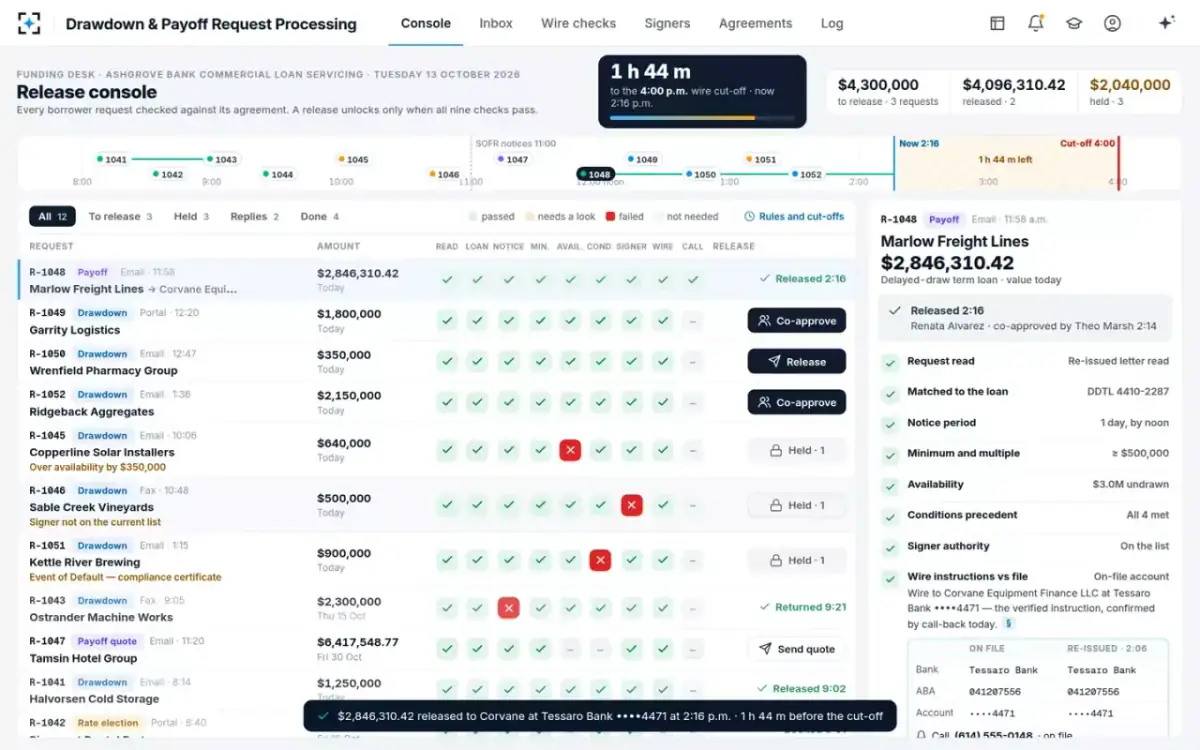
No funding desk works to 6:45 p.m., and it should not. The sample desk's own release cut-off is 4:00 p.m. ET, with a warning 60 minutes before it, and the gap is deliberate: it is the room a call-back needs. A payoff that turns out to need a phone call at 5:30 p.m. has nowhere to go; the same payoff at 1:49 p.m. has nearly three hours. On the sample day the payoff was released at 2:16 p.m., one hour and 44 minutes before the desk's cut-off and inside the letter's good-through date, so no further day of per diem was added.
One payoff against two clocks: the desk's own cut-off, and the payment system's
- Read, locked, called back, re-issued, released2 h 18 m
- Margin before the desk's cut-off1 h 44 m
- Everything above, to the desk's 4:00 p.m. cut-off4 h 02 m
- The 2 h 45 m the desk deliberately keeps back2 h 45 m
The account on the letter is the line most worth doubting
Every other line on a payoff letter can be tested against something: the total against its own three components, the per diem against the principal and the rate, the good-through date against the calendar. The remittance account can only be tested against what the paying bank already knows about that payee — which is why a desk that checks arithmetic carefully and accepts the account as written has checked everything except the part somebody would want to change.
FinCEN's standing advisory lists the pattern among the red flags of email compromise fraud: emailed instructions that send a payment to a beneficiary the bank already knows, but to account details different from the ones used before (FinCEN Advisory FIN-2016-A003; the advisory's wording, and the rest of its list, are in our guide to wire fraud red flags). Known beneficiary. New account. That is the whole attack, and it survives every arithmetic check a careful person can run.
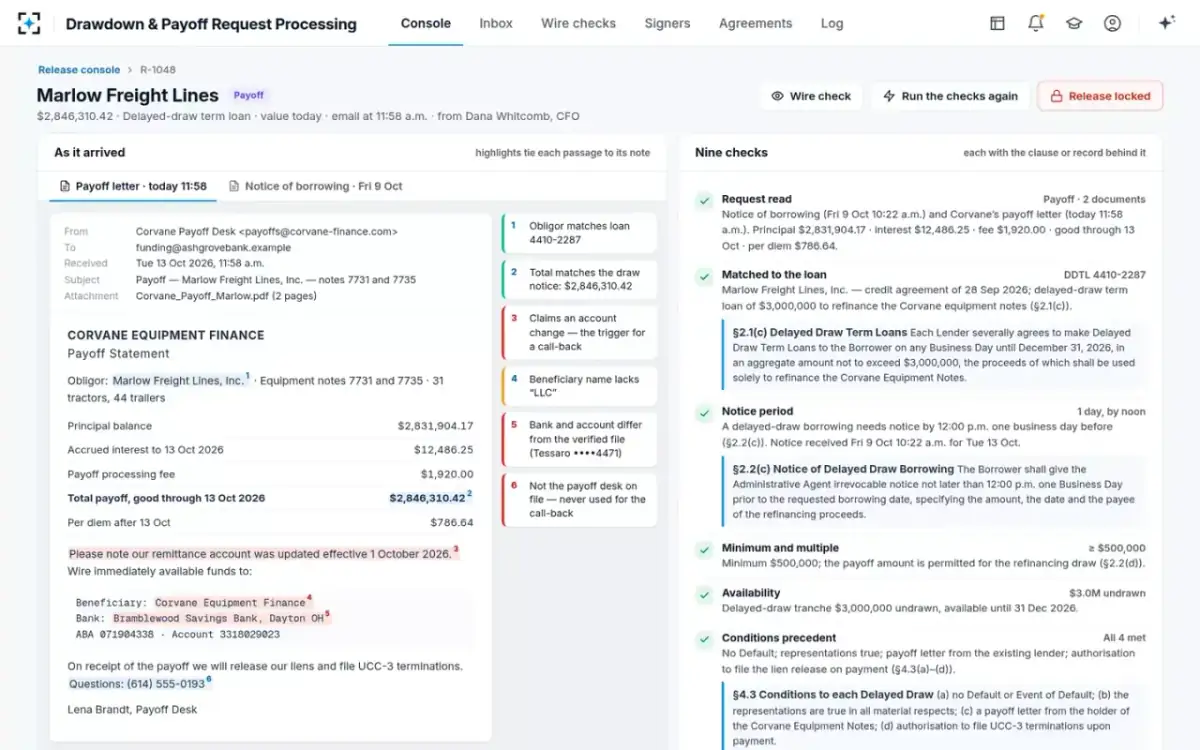
The sample day is an example of the shape. The letter was right in every respect a calculator could reach — correct obligor, correct notes, correct principal, correct interest, correct total — and asked for a bank the payee had never used. It arrived from a domain one character away from the payee's real one, registered seven days earlier, and offered a telephone number that was not the one on file. The release stayed locked until somebody called the number the bank already held. What that call-back has to cover for it to be worth anything later is a procedure worth settling before you need it, and where the loss actually lands when a payoff goes to the wrong account explains why the control belongs on the sending side.
The payoff letter read as it lands, with every value tied to the passage it came from
After the money: terminations, releases and the twenty-day demand
Paying a payoff is not the end of it. The borrower needs the public record cleaned up, and that is governed by Article 9 rather than by the letter. Once the secured party has received an authenticated demand from the debtor, the Code gives it 20 days to have the secured party of record either send the debtor a termination statement or file one in the filing office (UCC § 9-513(c); what a termination does to a financing statement is set out in our guide to UCC lien searches).
Two practical points sit in that sentence. The clock starts on the demand, not on the payment, so a borrower that pays and waits politely has started no clock at all — send the authenticated demand the same day the wire goes. And the obligation may be satisfied either by sending the termination to the debtor or by filing it, so a borrower should check the filing office rather than the post.
On a draw used to repay another lender, the cleanest arrangement puts this in the conditions precedent to the draw itself. In the sample agreement, §4.3 required both the payoff letter and the payee's authorisation to file the UCC-3 terminations before the money moved, which means the borrower's own lender holds the authority to clear the record and does not have to ask for it afterwards. That is worth negotiating at closing; the rest of the conditions a draw has to satisfy are usually settled at the same time.
When a payoff is short, stale or wrong
A short payoff is the common one, and it is rarely dramatic: the wire lands a day or two after the good-through date and falls short by the per diem. The payee applies what arrives as a payment, the loan stays open for a few hundred dollars, and nothing is released until the balance is cleared. The cost is not the money; it is the week somebody spends discovering that a lien is still on file.
A stale payoff is a letter whose good-through date has passed entirely, usually because a closing moved. Ask for a re-issue rather than adding per diem yourself: the payee may have posted a payment or advanced a fee in the interval, and your arithmetic will be confidently wrong.
A wrong payoff is the one worth building a habit around. If the three components do not make the total, if the per diem does not match the principal and the rate on any ordinary day-count, or if a fee appears that no clause supports, stop and query it before the wire is priced. Each of those is cheap to resolve by telephone on the day the letter arrives, and expensive to resolve after $2.8 million has moved.
Eight checks on a payoff letter, before anyone prices the wire
- Add the components and compare them with the total
Principal plus accrued interest plus permitted fees. If the three lines do not make the stated total, nothing further on the letter is reliable.
- Derive the per diem from the principal and the rate
Principal × rate ÷ 360, or ÷ 365. If neither denominator reproduces the stated figure, ask which convention the note uses.
- Check the good-through date against the day you can actually pay
Count in business days and allow for your own release cut-off, not the payment system's closing time.
- Read the fee against the note
A payoff or processing fee is chargeable only where the loan documents provide for one. Ask which clause.
- Check the obligor and the loan numbers
Against the borrower and the facility, not against a company name that looks familiar. Groups have similarly named entities.
- Compare the remittance instructions field by field with the file
Beneficiary name, bank, routing and account, against the verified payee directory and every past payment to that payee.
- Ask how the letter reached you
A letter through the payee's own payoff channel is a different thing from a PDF attached to an ordinary email. The sample desk treats the second as a call-back trigger.
- Settle who files the terminations, and when
Name the filings by office and number in the letter, and send the authenticated demand the day the wire goes — the twenty-day clock starts on the demand.
The payoff released inside its good-through date, 1 h 44 m before the cut-off
Questions people ask
How do you request a payoff statement on a commercial loan?
In writing, through the payee's payoff channel where it has one, naming the obligor, the loan or note numbers, the date you intend to pay, and the person authorised to receive the letter. If you are not the borrower — a title company, a refinancing lender, a buyer's counsel — expect to provide the borrower's written authorisation first; the payee has no duty to discuss another company's debt with you. Allow at least five business days, and longer where a prepayment or yield-maintenance amount has to be computed.
What is the difference between a payoff statement and a payoff quote?
A quote is an estimate for planning; a statement is a figure the lender stands behind for a stated date. In practice the words are used loosely, so the test is the letter itself: if it names a good-through date, a per diem and what will be released on payment, it is a statement whatever it is headed. If it is a number in the body of an email with no date attached, treat it as a quote and ask for the letter before you move money.
What happens if the payoff is short?
The loan is not paid off. The payee applies what arrives as a payment, the remaining balance keeps accruing interest, and no lien release or termination is issued until it is cleared. The usual cause is harmless — a wire that landed a day after the good-through date, leaving one per diem outstanding — but the consequence is not, because the public record still shows a secured party. Ask the payee to confirm the exact residual the same day, and clear it before anybody files anything.
When is the lien released after a loan payoff?
For filings under Article 9, the deadline is driven by the debtor's demand rather than by the payment: once a secured party receives an authenticated demand, it has 20 days to send the debtor a termination statement or file one. Mortgages and titled collateral follow their own state rules and timetables. The practical move is to send the authenticated demand on the day the wire goes out, and to check the filing office afterwards rather than waiting for paper.
Who can request a payoff statement on a commercial loan?
The borrower, and anybody the borrower authorises in writing. Commercial payees generally require the written authorisation on file before they will send a letter to a third party, and that is a protection for everybody: an unsolicited payoff request from a stranger, naming a real obligor and a real loan, is one of the ways an attacker learns what a payoff is worth before trying to redirect it.
How long does a lender have to provide a payoff statement?
On a consumer credit transaction secured by a consumer's dwelling, no more than seven business days after a written request, under Regulation Z. On a commercial loan there is no federal deadline at all — the obligation, if any, is whatever the loan documents create, and most credit agreements are silent. If timing matters to your closing, negotiate a payoff-letter turnaround into the agreement rather than relying on goodwill.