A notice of borrowing is the borrower's signed, dated request to draw money under a credit agreement it has already signed: it names the facility, the amount, the date the money is wanted, the rate option and interest period, where the money should go, and it is signed by somebody the lender has already agreed may ask. It is not a form the lender fills in. It is a set of representations the agreement tests one by one, and a lender that funds against a notice which fails one of those tests has lent against terms nobody agreed. Botminds' Drawdown & Payoff Request Processing reads every notice of borrowing as it arrives by email, fax or the borrower portal, runs the nine checks the agreement implies, cites the clause behind each one, and puts the request on a release console whose release button stays locked until all nine pass.
The useful way to learn what a notice of borrowing must contain is to write it backwards, from what the funding desk will do with it. Everything below is organised that way. The worked examples use a fictional sample bank and fictional borrowers — Ashgrove Bank's funding desk, Marlow Freight Lines, Ostrander, Copperline and Sable Creek Vineyards; every person, company, account and clause reference in them is sample data. The rules, periods and conventions are from regulators, the market's own conventions committee and the Federal Reserve, linked where they appear.
The notice is how most of a committed loan book is actually reached
$6.9tn
in commitments across the 6,857 borrowers in the 2025 Shared National Credit portfolio
$3,362.4bn
of that drawn — so roughly half the book is undrawn, and is called on with notices like this one
3days
of notice recommended for a Term SOFR borrowing, in US Government Securities Business Days
What is a notice of borrowing?
A notice of borrowing — also called a borrowing notice, a drawdown request, a funding notice or a request for advance — is the document by which a borrower exercises a right it already has. The commitment was agreed at closing. The notice is how the borrower calls on it, and the agreement sets out exactly how and when it may be called.
Three things follow from that, and they explain most of what a funding desk does with one. First, the notice is a condition, not a courtesy: the lender's obligation to fund arises only when a conforming notice has been given within the period the agreement states. Second, the notice usually carries representations with it — that no Default exists, that the representations in the agreement remain true, that the proceeds will be used for a permitted purpose — so sending it repeats those promises on the borrowing date. Third, because the notice travels by email or fax, it is the point at which an attacker can reach the bank's money with nothing more than a convincing document.
A note on vocabulary, because the search results mix two different things. In a credit agreement, a drawdown request and a notice of borrowing mean the same thing: the borrower asking for its own committed money. In the Federal Reserve's funds-transfer vocabulary, a "customer drawdown request" is a different instrument altogether — message type pain.013, by which one party asks another to send funds to it, listed among the Fedwire Funds Service message types that must clear the 6:45 p.m. ET customer-transfer cut-off. If a colleague in payments looks puzzled when you say drawdown request, that is why.
The nine checks a borrowing notice has to survive
Nothing in a credit agreement is headed "the nine checks". The list below is what the agreement's own clauses add up to on a funding desk, and it is the sequence Drawdown & Payoff Request Processing runs on every request. Write the notice so that each one passes on the first read, and the money moves the same day.
The nine checks, in the order a funding desk runs them
- Read it, and cite every value
Classify the request — drawdown, payoff, paydown, rate election or payoff quote — and pull out each field with the line it came from. A missing field is asked for, never guessed.
- Match it to the loan
The right borrower, the right facility, the right agreement as amended. A group with a revolver and two term loans can have three notice clauses with three different deadlines.
- Notice period
Business days and the hour of day, counted back from the borrowing date. This is the check most same-day requests fail.
- Minimum and multiple
Most agreements set a floor for each borrowing and require a round multiple above it, with a separate rule for drawing the remaining balance of a tranche.
- Availability
The lesser of the unused commitment and, on an asset-based facility, the borrowing base in the latest certificate — less outstanding loans and letters of credit.
- Conditions precedent
No Default, representations still true, deliverables current, plus anything the specific draw requires, such as a payoff letter or a lien release.
- Signer authority
The signer against the current incumbency certificate, and the signature against the specimen on file. Certificates are replaced more often than desks expect.
- Wire instructions against the file
Beneficiary, bank, routing and account compared field by field with the verified payee directory and every payment already made to that payee.
- Call-back where one is required
Any change of bank, routing, account or beneficiary name locks the release until a person has called the number already on file and logged what was said.
The order matters more than it looks. The cheap checks come first because they are the ones a borrower can fix inside the same afternoon: a notice that is a day early can be re-dated, a notice $40,000 under the minimum can be re-sized. The expensive check comes last, because a wire check that fails is not a drafting problem. It is a phone call, and it has to happen before the cut-off.
How much notice does the agreement actually require?
Whatever its own clause says — and the clause is usually two numbers, a count of business days and an hour of the day, which differ by rate option. Base Rate borrowings are commonly same-day on notice by late morning, because the rate is known. A Term SOFR borrowing needs longer, because the rate for the interest period has to be set before the loan is made.
The market's recommendation is explicit. The Alternative Reference Rates Committee, convened at the Federal Reserve Bank of New York, writes that for both SOFR Averages and Term SOFR, "the recommended convention is for the borrower to provide notice of a borrowing request three US Government Securities Business Days prior to the borrowing date, similar to the LIBOR convention today" (ARRC conventions for syndicated and bilateral business loans). Three business days, not three days: a Thursday draw needs the notice in by the preceding Monday, and a public holiday in the government securities calendar pushes it back further.
Two practical points follow. The deadline has an hour as well as a day, and a notice that arrives at 3:00 p.m. on the third business day is late even though the date is right. And the hour is the lender's hour, in the lender's time zone, which is not always the borrower's. A notice from a West Coast treasury team sent at 8:30 a.m. local is 11:30 a.m. in New York — half an hour past an 11:00 a.m. deadline.
Two rate options, two deadlines: how one sample desk's defaults are set
Term SOFR borrowing: 11:00 a.m., three business days before the borrowing date
Base Rate borrowing: 12:00 p.m. on the borrowing date itself
Term SOFR borrowing: The rate for the interest period has to be set and the funding arranged before the loan is made
Base Rate borrowing: The rate floats off a published reference the lender already knows
Term SOFR borrowing: The draw moves to the next date the notice allows — often two or three days later
Base Rate borrowing: Usually the next business day
Term SOFR borrowing: Take a Base Rate loan on the date wanted and convert to Term SOFR when the notice period is satisfied
Base Rate borrowing: None needed
Term SOFR borrowing: The agreement's own clause, always — the default is only what applies when no clause is found
Base Rate borrowing: The agreement's own clause, always
The workaround in the last row is worth knowing because it turns a refusal into a plan. On the sample desk, a fictional borrower called Ostrander asked for a Term SOFR loan on Thursday 15 October, having given notice that morning. Three business days from that notice reaches Friday 16 October at the earliest, so the request failed. The note that went back offered two routes: a Base Rate loan on the 15th converting to Term SOFR on the 19th, or Term SOFR on the 16th. Nothing was booked, nothing was waived, and the borrower had its money on the day it needed it.
Minimum amounts, multiples and the undrawn tranche
Agreements set a floor on each borrowing and usually a multiple above the floor, because a lender does not want to fund and administer a drawdown of $12,431.17. A typical middle-market revolver might require borrowings of at least $500,000 and in multiples of $100,000. The numbers vary with the size of the facility; the structure rarely does.
Three details catch people writing their first notice. The floor and the multiple are separate: $550,000 can clear a $500,000 minimum and still fail a $100,000 multiple. Agreements almost always carve out the remainder of a tranche, so a borrower with $340,000 left on a delayed-draw commitment may take all $340,000 even though it is neither a round multiple nor above the floor — read that proviso before you re-size a request down. And a delayed-draw term loan is not a revolver: the tranche can usually be drawn in a limited number of advances within a commitment period, and what is not taken by the end of that period is lost, not carried.
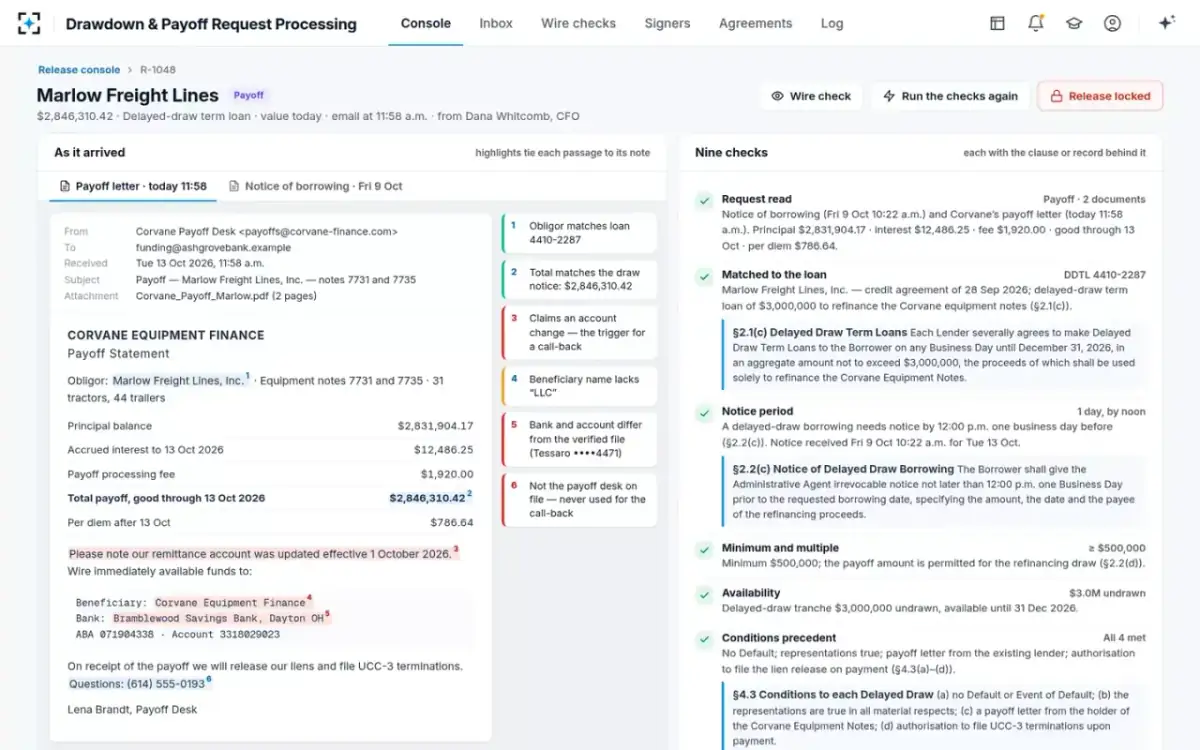
The sample bank's Marlow Freight Lines notice sits inside all of this cleanly: $2,846,310.42 against a $500,000 minimum and a $3,000,000 delayed-draw tranche, all of it undrawn. The amount is not a round multiple, which is exactly right — it is the full payoff figure demanded by the lender being repaid, and the agreement's proviso for a payoff draw admits it. An unusual number on a notice is not a red flag by itself; an unusual number nobody can trace to a document is.
Availability: the commitment, the balance and the borrowing base
Availability is the smallest of the limits that apply at the moment the loan would be made. On a plain revolver that is the commitment less outstanding loans and less the face amount of outstanding letters of credit. On an asset-based or borrowing-base facility there is a second cap: the eligible collateral in the most recent borrowing base certificate, after its advance rates, caps and ineligibility tests, and the lender lends the lesser of the two.
The certificate is where availability goes wrong, because it ages. A borrowing base dated 30 September does not know about October's invoicing, and no amount of argument on 13 October changes what the certificate says. In the sample data a fictional borrower, Copperline, asked for $640,000 against a 30 September base of $8,200,000 with $7,910,000 outstanding — $290,000 available. The return note offered the $290,000 that day, or the full $640,000 against an updated certificate showing the new receivables. That is a different conversation from "declined", and it is the one the relationship manager wants to have.
One notice of borrowing, field by field: what it says, and what the lender tests it against
On the noticeBorrower and facility
What the borrower wroteMarlow Freight Lines · delayed-draw term loan 4410-2287
What the lender testsThe signed agreement and its amendments: which facility, and is it still available to draw?
Read fromCredit agreement
On the noticeDate of the notice
What the borrower wroteFriday 9 October, received 10:22 a.m.
What the lender testsBusiness days and the hour of the deadline, counted against the borrowing date
Read from§2.2(c) of the agreement
On the noticeBorrowing date
What the borrower wroteTuesday 13 October
What the lender testsOne business day on notice given by noon — met
Read from§2.2(c)
On the noticeAmount
What the borrower wrote$2,846,310.42
What the lender testsAbove the $500,000 minimum, a permitted multiple, inside the $3,000,000 tranche
Read from§2.1 and the loan system
On the noticeRate option and interest period
What the borrower wroteBase Rate
What the lender testsA Base Rate election is same-day by noon; Term SOFR needs three business days
Read from§2.2(a) and §2.2(c)
On the noticeUse of proceeds
What the borrower wrotePayoff of the Corvane Equipment Finance facility
What the lender testsA permitted use, and the condition that the payoff letter be delivered
Read from§4.3
On the noticeSignature
What the borrower wroteDana Whitcomb, Chief Financial Officer
What the lender testsOn the current incumbency certificate, specimen matched
Read fromIncumbency file
On the noticeWire instructions
What the borrower wroteCorvane Equipment Finance LLC · Tessaro Bank, Columbus · ••••4471
What the lender testsField by field against the verified payee directory and every past payment
Read fromPayee directory
Conditions precedent, read as a list and not as a paragraph
Conditions precedent to each borrowing are typically drafted as one long sentence with four or five limbs, which is why they are so often read as a single idea and ticked once. Pulled apart, they are a list, and each limb rests on a different record: no Default or Event of Default has occurred and is continuing; the representations and warranties are true in all material respects as of the borrowing date; the notice itself has been delivered in time; and whatever the specific draw requires.
That last limb is the one worth reading closely, because it varies by draw. A payoff draw commonly requires the other lender's payoff letter and its authorisation to file UCC-3 terminations before the money moves — both were conditions under §4.3 of the sample agreement for the Marlow draw. An acquisition draw may require the signed purchase agreement and a certificate of solvency. A construction draw may require a lien waiver and an inspection.
The deliverable test is subtler than it looks. "Financial statements current" means current against the agreement's delivery dates and its cure periods, not against the calendar, so a borrower 20 days past a 45-day quarterly deadline may still be inside a grace period and perfectly entitled to draw. A desk that reads the clause as "statements in by the 45th day" declines a draw it has no right to decline — and the borrower's lawyers will say so.
The request, read against the agreement clause by clause
Who signs a notice of borrowing, and how the lender proves it
Whoever the borrower's current incumbency certificate says may sign. That certificate — a secretary's or manager's certificate naming the officers authorised to act, with their specimen signatures — is the lender's proof, and it is a living document. People are promoted, resign and are removed, and a new certificate replaces the old one entirely rather than amending it.
This is where an entirely honest request can fail. In the sample data, Sable Creek Vineyards faxed a $500,000 advance request signed by Gareth Lowe, who had signed its requests for years. The incumbency certificate of 14 August 2026 had removed him; the current signers were Imogen Hart, the chief financial officer, and Paul Sabatino, a managing member. The request was held, the note went to Imogen Hart, and the relationship manager was prompted to call. Nothing was wrong with the borrower, the draw or the facility — the bank's proof of who may ask had been replaced, and the person asking had not been told.
Two habits make this painless. Borrowers should send a fresh incumbency certificate with any change of officers, rather than waiting for the annual refresh. And lenders should check the certificate's date against the request's date on every draw, not only on the first one, because the failure mode is a signer who was authorised for three years and is not authorised today.
Where wire instructions belong on the notice — and why they are the riskiest line
Wire instructions belong on the notice when the proceeds are going anywhere other than the borrower's own operating account at the lender — to a seller, a title company or, as on the Marlow draw, another lender being repaid. They are the most dangerous line on the page because they are the only one an outsider benefits from changing, and because unlike a date or an amount they cannot be checked against the agreement. They can only be checked against what the bank already knows.
That is why a funding desk keeps a verified payee directory and compares every outgoing instruction with it field by field: beneficiary name, bank, routing number, account number, and the payments already made to that payee from any loan. Regulators treat the comparison as part of ordinary fraud prevention, and they pair it with separation of duties: among the preventive controls the OCC lists are "dual controls (e.g., over monetary instruments, accounting, customer transactions, and reporting)" (OCC Bulletin 2019-37). The FDIC's examiners ask the same question of the whole process in a single line — "is the process for loan disbursement, booking, and reconcilement adequate?" (FDIC Loan Operations Review module).
In practice the rule that does the work is narrow and absolute: any change of bank, routing, account or beneficiary name locks the release until someone has called the payee back on the number the bank already holds. Not the number in the request. What that call must cover, and what the record has to show afterwards, is a procedure worth writing down before you need it. When the instructions arrive inside a payoff letter rather than on the borrower's own notice, the same comparison applies to everything a commercial payoff letter is supposed to carry.
One request through Drawdown & Payoff Request Processing, from the inbox to the release
Agent
Request readerReads the email, fax or portal form, classifies it, and pulls out borrower, facility, amount, date, rate option, interest period, signer, payee and every wire field.
Never: Never fills a missing field — it asks the sender
Agent
Terms checkerFinds the clause that governs this facility and tests notice, minimum and multiple, interest period and use of proceeds against it.
Never: Never waives a term; the agreement's own clause beats a default
Agent
Availability and conditions checkerReads balances from the loan system and the latest borrowing base certificate, computes availability, and works through the conditions precedent with their cure periods.
Never: Never overrides a default flag; uses the latest certificate only
Agent
Signer verifierChecks the signer against the current incumbency certificate and the signature against the specimen on file.
Never: Never accepts a signer who is not on the current certificate
Agent
Wire instruction guardCompares beneficiary, bank, routing and account with the verified payee directory and past payments, checks the sender's domain and how the document was produced, and locks the release until a call-back is logged.
Never: Never uses a phone number from the request, and never unlocks a release itself
Agent
Release preparerBuilds the wire or book-transfer instruction when every check passes, drafts the return note with the clause and the alternative when one fails, and warns 60 minutes before the cut-off.
Never: Never releases money, and never sends a note without a person
A person decides
Funding specialistReads the red squares, makes the call-backs, and releases. A second named approver co-signs above $1,000,000.
What happens when the notice is late, short or unsigned
Nothing dramatic, if the desk is organised: the request is held, and the borrower is told what will work. A held request is not a declined one. The difference, from the borrower's side, is whether the answer names the clause and offers a date or an amount that complies — the next borrowing date the notice period allows, the amount availability supports, the signer the certificate names.
What should never happen is a silent hold. A request that sits unanswered until the borrower calls has cost the relationship manager a conversation and the borrower a day, and it is a familiar complaint about a funding desk. On the sample desk every failed check becomes a drafted note naming the clause and the alternative, and a person reads and sends each one; an Event of Default is routed to the relationship manager rather than back to the borrower, because that is a credit conversation, not a processing one.
One category deserves its own rule. A request that fails because the wire instructions do not match the file is not a drafting problem and must not be answered with a note asking the borrower to confirm the new account by email — the email is exactly what an attacker controls. It is answered with a phone call to a number the bank already held.
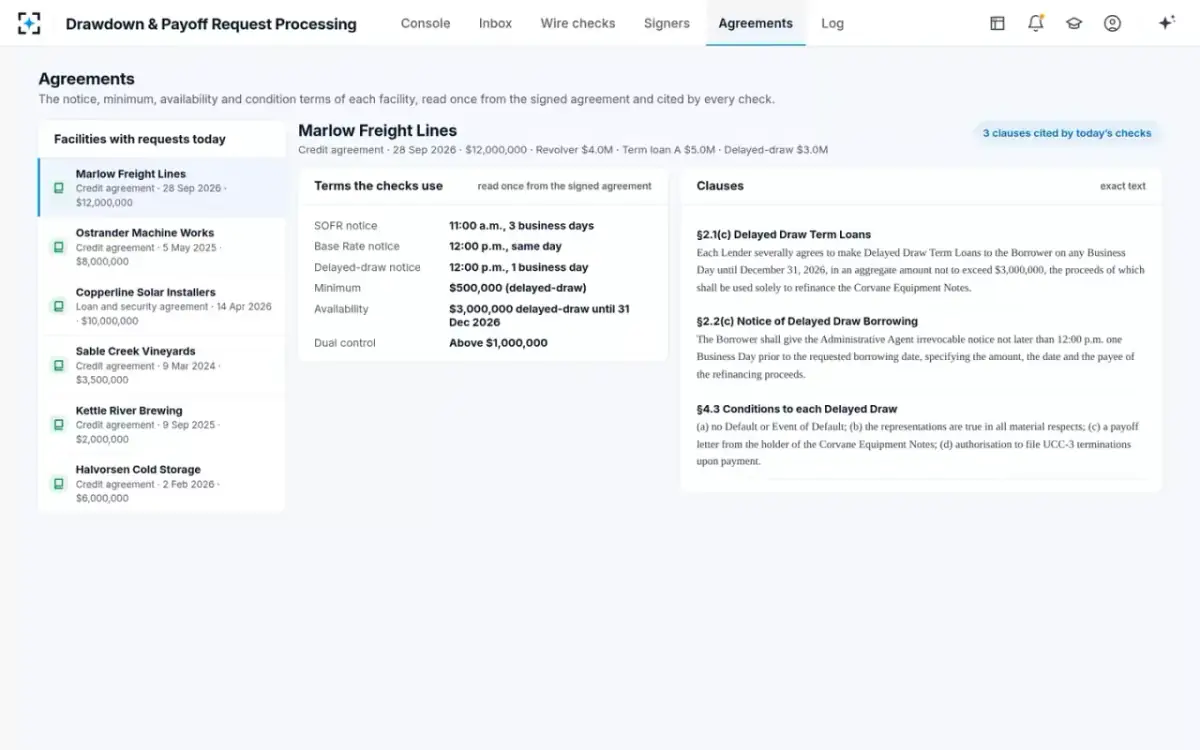
Each facility's notice, minimum and availability terms, read once from the signed agreement
A checklist for the borrower writing one
Most notices that fail do so for one of six reasons, and all six are visible before the notice is sent. The list below is what a treasury analyst can run against a draft in five minutes.
Six things to settle before a notice of borrowing goes out
- Count the notice period in business days, in the lender's time zone
And check the hour, not only the date. Term SOFR conventionally needs three US Government Securities Business Days; your agreement may say more.
- Check the amount against the floor, the multiple and the tranche
And read the proviso for drawing a remaining balance before you round a number down.
- Compute availability from the certificate the lender holds
Not from this month's receivables. If an updated certificate would change the answer, send it with the notice.
- Work through the conditions precedent as separate limbs
No Default, representations true, deliverables current within their cure periods, plus whatever this particular draw requires.
- Check the signer against the certificate you last sent
If an officer has changed, send a fresh incumbency certificate with the notice, not after the draw is held.
- Send wire instructions once, through a channel the lender can verify
A change of account on a draw request will stop the money until somebody calls you back on the number already on file. Expect the call; do not treat it as distrust.
Questions people ask
What is the difference between a notice of borrowing and a drawdown request?
In a credit agreement there is none: both mean the borrower's signed request to draw on a committed facility, and agreements use notice of borrowing, borrowing notice, drawdown request, funding notice and request for advance interchangeably. Use whichever term your own agreement defines. Confusingly, "customer drawdown request" is also the name of a Fedwire message type (pain.013), by which one bank customer asks another to send it funds — a different instrument entirely.
How many business days of notice are needed for a SOFR loan?
Your agreement decides, but the market convention is three. The Alternative Reference Rates Committee recommends that for both Term SOFR and SOFR Averages the borrower give notice three US Government Securities Business Days before the borrowing date, which is the convention LIBOR used. Base Rate borrowings are usually same-day on notice by late morning. Both deadlines have an hour attached as well as a day.
Can a notice of borrowing be revoked?
Usually not without cost, and often not at all once it is given. Agreements commonly make a borrowing notice irrevocable, and where revocation is allowed the borrower indemnifies the lender for breakage — the loss the lender takes on funding it had already arranged for that interest period. The practical rule is to treat a Term SOFR notice as final the moment it is sent, and to settle the amount before sending rather than after.
What is a minimum borrowing amount and a multiple?
The minimum is the floor for a single borrowing; the multiple is the increment it must be a round number of above that floor. A clause requiring borrowings "of at least $500,000 and in integral multiples of $100,000" rejects $450,000 and also $550,000. Almost every such clause carves out the remaining balance of a commitment or tranche, so a borrower drawing the last $340,000 of a delayed-draw tranche may take all of it.
Who signs a notice of borrowing?
An officer named on the borrower's current incumbency certificate, which the lender holds and checks the signature against. It is not enough that the signer is a real officer of the company, or that they signed last quarter's draw: a certificate replaces its predecessor outright, so an officer removed by a new certificate cannot authorise a borrowing until a further certificate restores them.
What happens if a borrowing notice is late?
The lender is not obliged to fund on the date asked, and a well-run desk will tell you the first date it can fund instead. Late notices are usually solved rather than refused: on a Term SOFR request that missed its three-day period, taking a Base Rate loan on the date wanted and converting it when the period is satisfied gets the borrower its money on time at a different rate for a few days. What the lender should not do is waive the period quietly, because the clause is also protecting the other lenders in the syndicate.