In commercial loan operations, the loan funding specialist — on many desks the title is loan operations specialist, or funding and payments specialist — is the person who turns an approved credit into money leaving the bank. The work, described as the desk would describe it, is this: take every borrower request to draw money, pay a loan off, pay it down, quote a payoff or change an interest rate; match each one to the right facility; test it against the credit agreement, the loan system, the borrowing base certificate, the incumbency file and the payee file; and either release the money before the wire cut-off or send back a note saying what will work instead. It is hard because all five of those sources disagree with each other sooner or later, the requests arrive all day rather than in a batch, and the last one lands when there is not enough afternoon left. Botminds' Drawdown & Payoff Request Processing is built around that seat: six agents read and check every request as it arrives, and a person still releases the money.
The desk in the examples below is a fictional sample bank used throughout the solution, Ashgrove Bank, on one Tuesday afternoon. The employment figures come from the U.S. Department of Labor; the cut-off comes from the Federal Reserve Banks.
The numbers behind a commercial funding desk
169,100
people employed in 2025 in the official occupation that comes closest to this desk
6:45p.m. ET
the Fedwire customer-transfer cut-off that every funding desk sets its own clock inside
What does a loan funding specialist do all day?
A loan funding specialist takes instructions from borrowers and turns them into money movements or refusals, inside the terms the bank already signed. On a commercial desk that means six or seven kinds of request. A notice of borrowing asks for an advance under a revolver or a delayed-draw term loan. A payoff request asks what it costs to retire the loan today, or sends the money to do it. A paydown returns part of the principal. A rate election continues or converts a SOFR interest period. A payoff quote goes out to another lender's attorney. And a steady trickle of things that look like requests and are not — statements, certificates, auto-replies — has to be filed rather than worked.
Each one is checked, not merely processed. The federal banking agencies' own examination material puts the checking in plain words. The FDIC's Loan Operations Review module asks the examiner to check that commitments carry an amount, a period and the conditions a draw must satisfy, and, on disbursement, whether "documentation is complete and appropriate waivers are obtained before loans are funded" and "funds are disbursed according to the loan terms". That is the job: somebody has to be the person who knows the conditions were satisfied, and can show it afterwards.
The checks themselves are not deep. Is the notice in on time, measured in business days and in hours? Is the amount above the minimum and on the right multiple? Is there availability, once the latest borrowing base certificate is applied? Are the conditions precedent met? Is the person who signed still an authorised signer? Do the wire instructions match the ones the bank verified? Nine questions of that kind, each cheap on its own and each requiring a different document, repeated twelve to thirty times a day against a clock. Depth is not what makes the work hard. Switching is.
A Tuesday afternoon, request by request
Here is the shape of a real afternoon, drawn from the sample desk. Three requests, three outcomes, and almost none of the time spent on anything a typical description would call a duty.
Three requests, and the minutes of desk work inside them
- Read and checked4 m
- Call-back5 m
- Re-checked3 m
- Approved and released3 m
- Read and checked3 m
- Held on the signer2 m
- Note and call prompted3 m
- Read and checked3 m
- Notice short2 m
- Note drafted2 m
The arithmetic of that afternoon is the argument of the job. Of the 138 minutes the payoff took from arrival to release, about fifteen were work: four reading it and running the checks, five on a telephone call, six re-reading the corrected letter and getting the second approval. The other two hours were waiting. The specialist's real output on that request was one decision — do not send $2.85 million to the account in the letter — and the day was arranged so that the decision was reached at 1:49 p.m. rather than at 3:50.
Where one request's minutes go
By hand — about 50 minutes a request
- Reading it and matching it to the loan · 20%
- Notice, minimum and interest period · 20%
- Availability, borrowing base, conditions · 20%
- Signer against the incumbency certificate · 10%
- Wire instructions against the file · 20%
- Release instruction or return note · 10%
With the checking done first — about 4 minutes a request
- Reading it and matching it to the loan · 13%
- Notice, minimum and interest period · 25%
- Availability, borrowing base, conditions · 25%
- Signer against the incumbency certificate · 12%
- Wire instructions against the file · 13%
- Release instruction or return note · 12%
The four seats around one release
No bank releases commercial money on one signature, and no description of this desk is honest if it covers only one seat. Four people touch a large release, and the examination material says why: the FDIC module asks the examiner to look at the separation of "preparing loan documents", "posting subsidiary loan records to the core loan application" and "disbursing loan proceeds", and the OCC lists dual control over monetary instruments among the preventive controls a bank should run. A desk that cannot say which of those three each seat holds has a control weakness, whatever its people are like.
The four seats, and what each of them actually owns
Today
Reads each request against the agreement, the loan system, the signer file and the wire file by hand, with the last ones arriving close to the cut-off.
With agents
Starts from a console where every check is already done and cited, and spends the afternoon on the red squares and the telephone calls.
Still theirs: The release itself, and the judgement about whether to make it
Today
Is asked to approve large wires with the evidence somewhere in an email thread.
With agents
Sees the same nine checks and the logged call-back on the approval screen before saying yes.
Still theirs: The second approval above $1,000,000
Today
Hears that a draw was held when the borrower telephones to ask why.
With agents
Gets the referral or a copy of the return note first, with the clause and the next date or amount that works.
Still theirs: The conversation with the borrower
Today
Learns about a late release or a near miss after it has happened.
With agents
Sees turnaround against the cut-off, every call-back and every caught instruction change for the quarter.
Still theirs: The rules, and approval of every change to them
Notice what the supervisor's seat is not. It is not a reviewer of the specialist's arithmetic; the arithmetic has been done and cited. It is a second pair of eyes on the destination and on the evidence that a changed account was called back. That is a narrow job, done well in two minutes, and done badly in two minutes as well — which is why what the approval screen shows matters more than who sits in the chair.
The release console, which is where the work is actually done
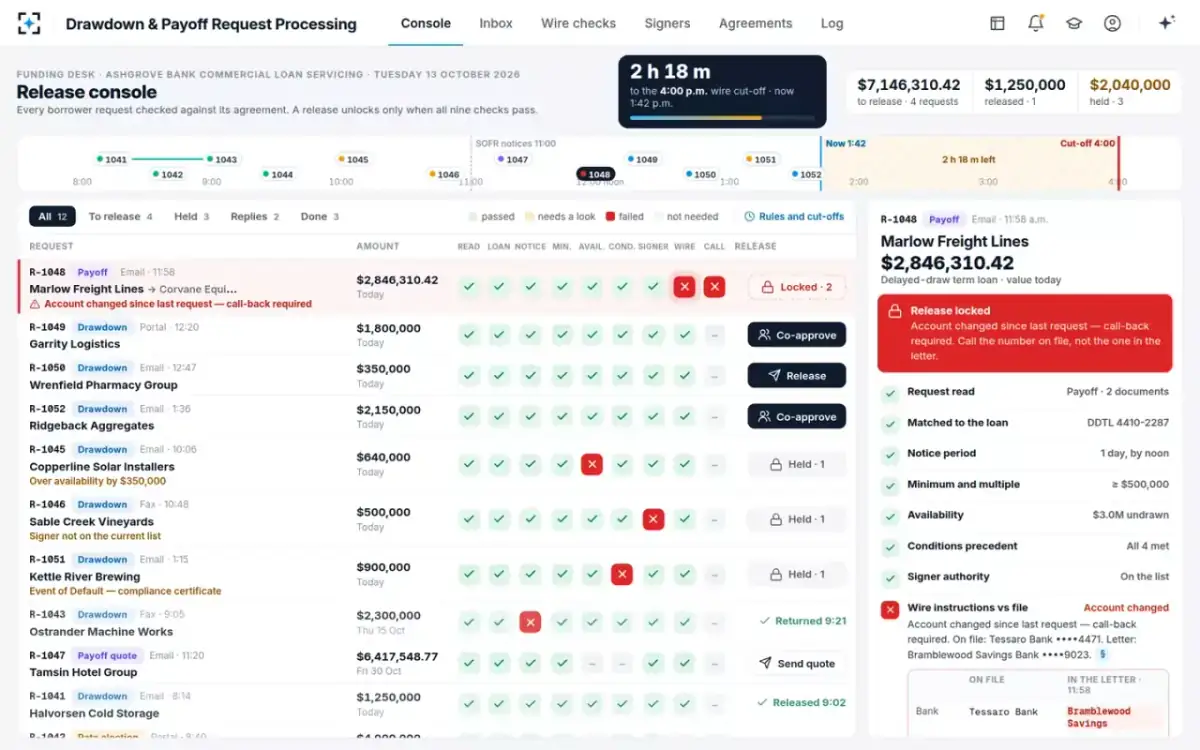
What the occupational data and the credit book say about the desk
There is no federal occupation called "commercial loan operations specialist". The nearest official match is 43-4131, Loan Interviewers and Clerks, and it is a wide net: it counts mortgage processors and consumer loan clerks alongside commercial funding desks, with employment of 169,100 in 2025 (O*NET OnLine, 43-4131.00).
A desk that handles syndicated credit carries more than that family suggests, because the agreements are longer and the amounts are larger. The scale behind those agreements is public: the federal agencies' 2025 Shared National Credit review counted 11,952 credit facilities in the shared portfolio alone, each with its own notice clauses and its own conditions precedent.
The trend line is the part worth arguing with. O*NET projects the occupation to decline by 1% or more over 2025–2035, and it is the clearest statistical statement of what is happening to this work: fewer clerks typing, and a continuing need for someone who can decide.
Loan operations or loan servicing? The line, and why it moves
In most banks, loan operations is what happens to the loan as an instrument and servicing is what happens to the loan as a relationship, but the line moves from bank to bank and the two words are often used for the same desk. The useful distinction is the moment of irreversibility. Operations is the work where an error moves money: booking the loan, funding the draw, applying the payment, releasing the payoff wire. Servicing is the work where an error is embarrassing and recoverable: a statement, an escrow analysis, a rate letter, a maturity notice.
That distinction explains why the two jobs feel so different to do. A servicing error is found next month and corrected. A funding error is found when a borrower calls to ask where the money went, and by then the money has settled in someone else's account. The job description should say which side of that line the seat is on, because it decides everything else: the approval limits, the dual-control rules, the training, and the kind of person who will be happy in the chair.
It also decides what "busy" means. A servicing queue can be worked down. A funding queue cannot, because a request that arrives at 3:40 p.m. with a same-day value date has to be resolved at 3:40 p.m. or not at all. Everything a funding desk does is a priority decision in disguise.
The skills that separate a good desk from a slow one
Ask a specialist what the hard part is and they will not say the agreements. They will say the order of operations: which check to run first, so that a request that is going to fail fails in the first two minutes rather than the last ten. A notice that is a day late cannot be rescued by availability analysis. A signer who was removed from the incumbency certificate in August cannot be rescued by anything. Running the cheap, fatal checks first is the habit that does most for a desk's afternoon, and it is almost never in a posting.
The second skill is holding. A request that fails is a conversation with a borrower, often through a relationship manager who would rather the answer were yes, and the specialist is the one person whose job is to say not yet. The O*NET profile is unusually blunt about the temperament that goes with it, listing cautiousness — "a tendency to be careful, deliberate, and risk-avoidant when making work-related decisions" — alongside integrity, attention to detail and dependability as the work styles of the occupation.
The third is evidence. Every hold and every release has to be explicable later to someone who was not there: the relationship manager this afternoon, the supervisor tomorrow, the examiner next year. A specialist who writes down the clause, the certificate date and the telephone number they dialled makes all three of those conversations short. One who does not will spend an hour reconstructing a decision that took four minutes to make. That is also why a call-back is only worth making if it is logged.
The duties on paper, against the duties that fill the afternoon
The official task list: Checking loan applications and closing documents for accuracy — the first task on the list.
The commercial funding desk: Reading a payoff letter against the credit agreement, then against the loan system's balance, then against the borrowing base certificate — three documents that were written by three different parties on three different dates.
The official task list: "Prepare and type loan applications, closing documents, legal documents, letters, forms, government notices, and checks, using computers."
The commercial funding desk: Almost none. The letters arrive as PDFs and faxes; what gets written is the return note that says which clause the request failed and what date or amount would work.
The official task list: "Answer questions and advise customers regarding loans and transactions."
The commercial funding desk: On the sample desk, about one call-back a day, made to a number already in the bank's own payee file and never to the number in the request.
The official task list: "Record applications for loan and credit, loan information, and disbursements of funds, using computers."
The commercial funding desk: Writing down why a release was held, with the clause, the certificate date and the time, so the decision survives being questioned.
The official task list: —
The commercial funding desk: The clock. Every one of the above has to finish before a cut-off that the desk sets earlier than the Fedwire one, to leave room for the call-back.
Where the day breaks: the request that arrives at three o'clock
Every funding desk has the same failure mode, and it is not a difficult request. It is an ordinary request that arrives with fifty minutes of afternoon left. The checks take four minutes if nothing is wrong; the problem is that something is often wrong — on the sample day, three requests in twelve were held — and the remedy for most of those things is another person — a borrower's CFO who is in a meeting, a payee's payment desk that closes at five, a supervisor who is on another call.
This is why banks set their own cut-off before the network's. The Fedwire Funds Service closes at 7:00 p.m. ET and stops taking customer transfers at 6:45 p.m. ET (the payoff guide sets out when those hours last moved); the sample desk's own cut-off is 4:00 p.m. ET, and the gap is the room a call-back needs. A desk with no gap has no procedure, only an intention.
The second thing a desk does about three o'clock is warn itself. On the sample console a request that is still open sixty minutes before the cut-off turns amber, which converts a vague anxiety into a list of three rows. Most of the value is in the sorting: at 3:00 p.m. the useful question is not "how am I doing" but "which of these four can still be finished, and who do I have to telephone first".
Is loan operations work being automated away?
The reading and the comparing are being automated, and they are most of the minutes. The deciding is not, and it is most of the work. That is a real change to the seat and not an abolition of it, and a head of operations should look at it squarely.
In the solution, six agents do the mechanical half. One reads every email, fax and portal form and pulls out borrower, loan, amount, value date, rate option, interest period, signer and every wire instruction field, citing the line it took each value from. One finds the governing clause and tests the notice deadline, the minimum and the interest period. One computes availability from the loan system and the latest borrowing base certificate and checks the conditions precedent. One checks the signer against the current incumbency certificate. One compares the wire instructions with the verified payee file and locks the release if anything has changed. One builds the payment instruction or drafts the return note. None of them releases money, waives a term, dials a number out of a request or edits the payee file — the limits are the specification, and they are why the specialist's seat survives the change.
What the hours become is the honest question for the desk. On the sample desk they become three things: the exceptions, which are now the whole queue rather than a layer under it; the telephone calls, which are the only part of the control that cannot be done by comparison; and the rules, because a desk that is no longer typing has time to notice that one agreement's notice clause has been mis-set since the amendment in March.
What the desk sends back when a check fails
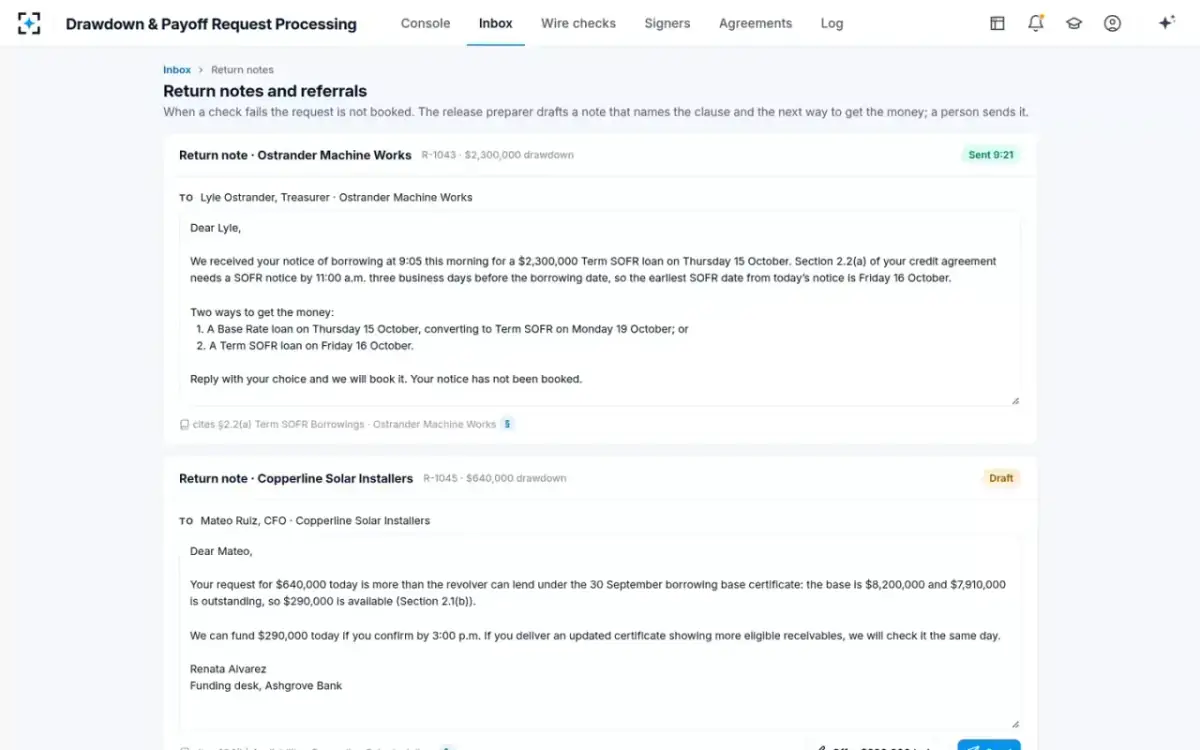
The note is drafted with the clause and the alternative already in it; what the specialist adds is the part only a person can judge — whether this borrower should be telephoned before the note goes.
Who should set the order of the checks?
The most valuable seat on the desk is the one that sets the order of the checks, and too few banks name it. On a desk where the mechanical work is done first by software, that person is worth more than two clerks, because their judgement is now applied to every request rather than to the ones they personally had time to open.
Questions people ask
What does a loan funding specialist do at a bank?
On a commercial desk, a loan funding specialist is the person who turns an approved credit into money leaving the bank: they take the borrower's notice of borrowing or payoff instruction, check it against the agreement and the bank's records, build the payment instruction and release it before the cut-off. The title is often used interchangeably with loan operations specialist; where both exist, "funding" usually means the disbursement half of the work and excludes payment application and payoff accounting.
Who releases a wire at a bank?
A named person, never a system, and above a limit two named people. On the sample desk the funding specialist releases and the operations supervisor co-approves everything above $1,000,000, both seeing the same nine checks and the same logged call-back. The OCC lists dual control over monetary instruments and customer transactions among the preventive controls banks should maintain, which is the reason the second signature exists.
What does an operations supervisor approve?
The destination and the evidence, not the arithmetic. The supervisor confirms that the beneficiary, bank and account are the ones the bank has verified, that any change to them was called back on a number already held, and that the amount is within the authority they hold. It is a two-minute job that depends entirely on the approval screen putting the evidence in front of them rather than in an email thread.
Which part of loan operations is shrinking?
The clerical part. The official occupation nearest to it is projected to decline slightly to 2035, as reading and keying move to software. The judgement part — holding a release, reading a clause, deciding whether a changed account is genuine — is not, because it carries the bank's money.
What should a bank write down about its funding desk?
Four things most descriptions leave out: which requests the seat handles and their daily volume; the cut-off it works to and how far it sits before the network's; the approval limit above which a second person signs; and who the seat may not be, in control terms, such as the person who maintains the payee file. Those four lines tell an examiner, and the people on the desk, more about the day than a list of twenty duties.
Does a loan funding specialist need to read credit agreements?
Yes, in a narrow and deep way. The seat does not read the whole agreement; it reads the same six or seven clauses in hundreds of different agreements — notice, minimum and multiple, availability, conditions precedent, authorised signers, and the dual-control or payment mechanics. The skill is knowing that a specific agreement's own clause beats whatever the bank's default is, and checking rather than assuming. What a notice of borrowing has to survive works through the most common of those clauses.