The consent-based SSN verification service — eCBSV, run by the Social Security Administration — answers one question for a lender: does the name, date of birth and Social Security number this applicant submitted match the agency's own records? It is the most direct check a lender can run against a synthetic identity, and the first question any head of fraud asks about it is what a check costs. The answer is that there is no per-check price. There are twelve annual subscription tiers, and the cost of a check is the tier fee divided by how many checks you actually run inside it. Botminds' Synthetic Identity Fraud Detection treats when that check runs as a setting precisely because the answer is arithmetic rather than policy.
That pricing shape has a consequence most procurement conversations miss. Moving from checking only the applications you hold to checking every application can raise your annual fee by a factor of twenty-four and lower your unit cost by more than half at the same time. Both statements are true, and which one matters depends on whether you are defending a budget line or a cost per account.
Every fee below comes from the Social Security Administration's own notice of 7 April 2025. The divisions are ours and are shown so you can repeat them. The volumes in the worked example are the solution's sample data on a fictional issuer.
The service, in the numbers the agency published
21
participating permitted entities the fee schedule was built on, for fiscal year 2025
68M
transactions a year the agency projects across all of them
$5,100
the lowest annual tier, covering up to 10,000 checks
365days
the agreement period each enrolled entity pays for
What does eCBSV cost, and how is it priced?
It costs an annual subscription fee, chosen from a twelve-tier schedule by the number of transactions you expect to use. There is no published rate per verification and no volume discount negotiated in the usual sense: the fee is set by the band your expected volume falls in. An enrolled entity "will be required to remit the above tier-based subscription fee for the 365-day agreement period," and the schedule applies to agreement periods starting on or after 7 April 2025.
The statutory reason for the shape is worth knowing, because it tells you the number will move. Section 215 of the legislation that created the service requires the Commissioner to "periodically adjust" the price paid by users, which the agency reads as setting fees so that collections fully offset the cost of administering the system, and it says it will review the schedule at least once a year. The April 2025 schedule was a decrease, built on a projection of 21 participating entities and 68 million transactions a year. If either number changes materially, the schedule is supposed to follow it.
What a check actually returns, and what it does not
A match or a no-match. The service "allows SSA to verify and disclose to a PE, based on the number holder's consent, whether a number holder's submitted SSN, name, and date of birth matches the information in SSA's records," and the request "must be in connection with a credit transaction or a circumstance described in section 604 of the Fair Credit Reporting Act."
Three things follow from that sentence and each one shapes the cost case. It is binary, so it cannot rank or score anything. It requires the number holder's consent, which has to be captured in the application flow before any of this is possible. And it is limited to credit transactions and the other permissible purposes of the consumer reporting statute, so it is not a general identity tool you can point at anything.
The Federal Reserve set out the boundaries plainly when the service launched, listing what it will not be able to do: allow non-financial institutions to use it, provide round-the-clock validation, "allow financial services to validate existing account data," or "eliminate the risk of all false positives for a financial institution" (Federal Reserve, July 2020). The third of those is the one that surprises people: the service validates new account applications, and the Social Security Administration's position, as recorded in the same paper, is that checking existing accounts is not possible because the privacy statute prohibits disclosure without the consumer's prior consent.
The twelve tiers, and the cost per check at the top of each
Here is the published schedule with two divisions added: what one check costs if you fill the tier exactly, and what it costs if you only just crossed into it. Both are simple division, and the gap between them is the whole decision.
The twelve tiers, and what a single check costs at each end of the band
| Tier | Transactions a year | Annual fee | Per check, tier full | Per check, first in band |
|---|---|---|---|---|
| 1 | Up to 10,000 | $5,100 | 51c | $5,100.00 |
| 2 | 10,001 – 75,000 | $37,125 | 49.5c | $3.71 |
| 3 | 75,001 – 200,000 | $98,000 | 49c | $1.31 |
| 4 | 200,001 – 500,000 | $240,000 | 48c | $1.20 |
| 5 | 500,001 – 1,000,000 | $470,000 | 47c | 94c |
| 6 | 1,000,001 – 2,500,000 | $907,500 | 36.3c | 90.7c |
| 7 | 2,500,001 – 5,000,000 | $1,765,500 | 35.3c | 70.6c |
| 8 | 5,000,001 – 10,000,000 | $3,206,250 | 32.1c | 64.1c |
| 9 | 10,000,001 – 15,000,000 | $3,562,500 | 23.8c | 35.6c |
| 10 | 15,000,001 – 20,000,000 | $4,453,125 | 22.3c | 29.7c |
| 11 | 20,000,001 – 25,000,000 | $5,165,625 | 20.7c | 25.8c |
| 12 | 25,000,001 – 200,000,000 | $5,878,125 | 2.9c | 23.5c |
Read down the fourth column and the schedule rewards scale steadily: 51 cents at the top of the smallest tier, 47 at the top of tier 5, 23.8 at the top of tier 9, and under three cents in the enormous twelfth band that runs to 200 million. Read the fifth column and the same schedule punishes a half-filled tier without mercy.
Cost per check if you fill the tier exactly, tier 1 to tier 12
The cliff at every band boundary
Because the fee is a subscription rather than a meter, every boundary is a step. One transaction past the top of tier 4 moves you from a $240,000 fee to a $470,000 one, so in unit terms the first check in tier 5 costs 94 cents against the 48 cents you were paying at the top of the tier below. The same shape repeats at every boundary. Tier 9's first check costs 35.6 cents where tier 8's last one cost 32.1.
There are two practical consequences. The first is that a volume forecast is a pricing decision: under-forecast and you cross a boundary mid-year, over-forecast and you pay for checks you never run. The second, and the more useful one, is that any additional volume inside your current band is free. If you are running 21,500 checks a year inside a tier that runs to 75,000, you have 53,500 more checks already paid for — a fraud control that costs nothing extra to switch on.
Every application, or only the ones you hold?
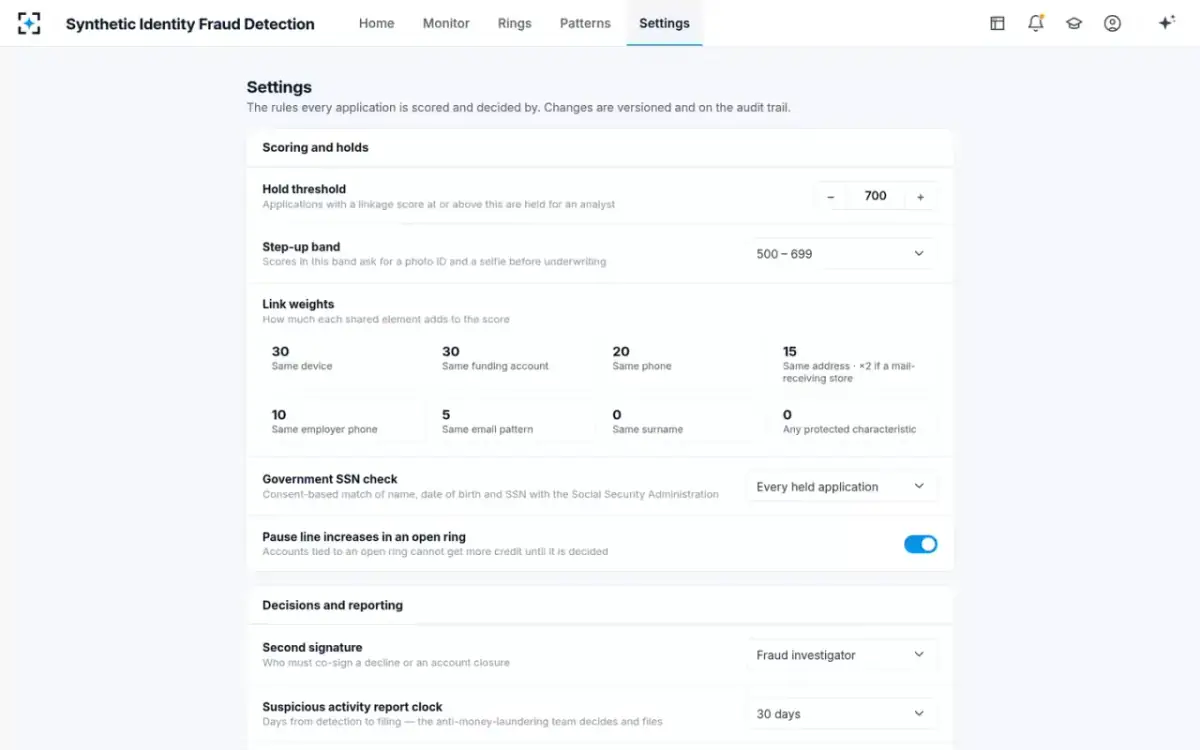
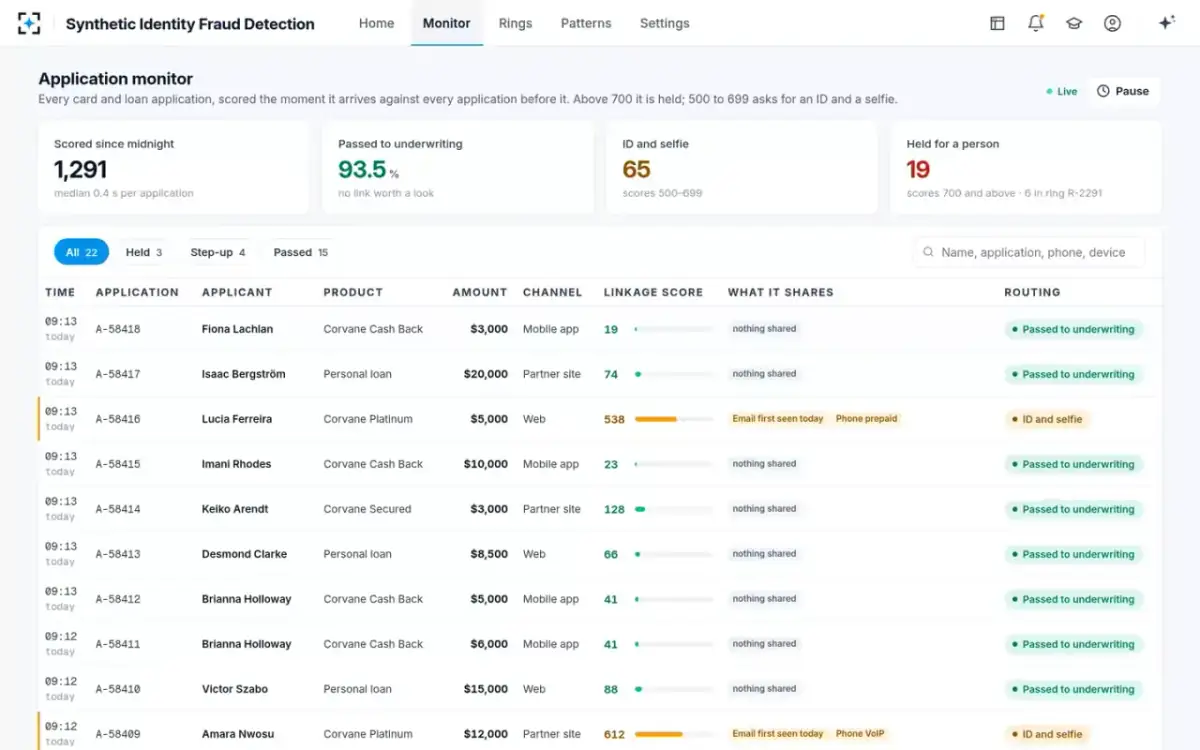
This is the setting the arithmetic exists to answer, and in the solution it has three positions: every held application, which is the default; every application; or held and step-up. The case for the narrow setting is cost. The case for the broad one is that a no-match on an application you were never going to hold is exactly the finding a link-based control cannot produce on its own, because a first-of-its-kind synthetic identity has nothing to link to yet.
It is worth being precise about what the check adds. The Federal Reserve's description of a synthetic identity's early life is that it "first appears via a credit bureau" and "is likely to have anomalies in its identity elements, such as a 40-year-old applicant with a brief six-month credit file" — but also warns that leaning on that single characteristic produces false positives against legitimate thin-file customers (Federal Reserve, October 2019). A government no-match is a far harder signal than a thin file, and it is available at the door rather than after a link forms.
Where the setting lives, and what else moves with it
One issuer's arithmetic, worked both ways
Take the solution's sample issuer: 3,400 card and loan applications a day, which is 1,241,000 a year. On its sample week, 23,860 applications were scored and 412 were held for a person — about 1.7 per cent.
Holds only. 1.7 per cent of 1,241,000 is roughly 21,500 checks a year. That sits inside tier 2, which runs to 75,000 transactions for $37,125. The unit cost is about $1.73 a check, and the annual line is $37,125. More than two thirds of the tier is unused, so the next 53,500 checks are already bought.
Every application. 1,241,000 checks lands in tier 6, which runs to 2.5 million for $907,500. The unit cost falls to about 73 cents — 58 per cent cheaper per check — and the annual line rises by $870,375.
Both of those are defensible, and the choice between them is not a fraud argument but a loss-avoidance one. The solution's sample ring is a useful unit of comparison: nine of ten identities in it return no match, and the actions recommended keep $102,500 of new credit, limit increases and open lines from the ring. On that sample case, the annual difference between the two settings is the equivalent of about eight and a half comparable rings — which is the question to put to your own last twenty-four months of charge-offs rather than to a vendor.
The four terms of the decision, and who owns each
The tier fee
checks a year → the band it lands in → that band’s annual fee
Not a per-check rate. Forecast the volume, then read the schedule; crossing a boundary mid-year is the risk to size.
Head of fraud, with finance
Credit kept at application
rings caught before booking × credit at stake per ring
Measured on your own closed files, not estimated. The sample ring is $102,500 of new credit, increases and open lines.
Fraud strategy
Analyst time released
rings a year × hours saved per ring × loaded hourly cost
The solution’s estimate is about 24 hours by hand against about 3.5 with the agents, for a ring of roughly ten identities.
Fraud operations
Genuine applicants held
additional holds × conversion value of a held applicant
The term everyone forgets. A broader check means more no-match investigations, and some of them will be legitimate people.
Identity operations
What a match does not tell you
A match says the combination exists in the agency's records as submitted. It does not say the person in front of you is the number holder, and the federal identity guidelines are explicit that it never could: "Knowledge of an SSN is not sufficient to act as evidence of identity, nor is it considered an acceptable method of verifying possession of the Social Security card when used as evidence" (NIST SP 800-63A-4).
That is not a criticism of the service, which was built for a narrower job. It is the reason the check belongs in a sequence rather than on its own. A matched number with a credit file first seen last year, a voice-over-internet telephone line and a mail-receiving address is still a synthetic identity; a no-match on a genuine applicant is often nothing more than a mistyped date of birth. Treating either result as a decision is how a control produces its worst outcomes.
Three outcomes, of which a no-match is only one input
What the fee does not cover
Enrolment is not instantaneous and it is not only a payment. A permitted entity is defined as "a financial institution or service provider, subsidiary, affiliate, agent, subcontractor, or assignee of a financial institution," and such entities "must possess an Employer Identification Number and a Data Universal Number System (DUN) and Bradstreet number." The entity must also certify, among other things, that it is a permitted entity, that it complies with section 215 and with the financial privacy requirements, and that it "will retain sufficient records to demonstrate its compliance with its certification and section 215 for a period of not less than 2 years."
Three further costs sit outside the fee entirely. Consent has to be captured electronically in your application flow and retained. The service is not available around the clock, so an overnight application queue needs a design that does not stall waiting for it. And every no-match produces work: somebody has to look at it, and the route back for a wrongly held applicant is a requirement in its own right, not a courtesy.
Five things to settle before you enrol, and one after
- Confirm you are a permitted entity, and which legal entity enrols
The definition covers financial institutions and their service providers, subsidiaries, affiliates, agents, subcontractors and assignees — but the enrolling entity needs its own EIN and DUNS number.
- Forecast the volume against the band boundaries, not the midpoints
The fee is a subscription. Being one transaction over a boundary costs a full tier step, and an unfilled tier is money spent on checks you never ran.
- Decide where consent is captured, and prove it is retained
The verification is consent-based by statute, and the certification requires records sufficient to demonstrate compliance for at least two years.
- Design for the service not being available overnight
The service is not a round-the-clock facility. An application arriving at 02:00 needs a defined path that does not leave the applicant waiting.
- Staff the no-match queue before you widen the check
A broader check produces more results to work. Federal identity guidance requires a redress route for applicants who fail a fraud check, and recommends a trained human reviewer in unattended processes.
- Re-read the schedule each year
The Commissioner is required to adjust the price periodically so collections offset the cost of running the system. The April 2025 schedule was a decrease, and the agency says it will cut fees again once it breaks even, which it expects in fiscal 2027.
Why this number will move
The fee schedule is not a price list in the commercial sense; it is a cost-recovery mechanism with a statutory instruction attached. The April 2025 revision was built on 21 participating entities and a projection of 68 million transactions a year, and the Commissioner is required to adjust periodically so that collections fully offset the cost of administering the system. More participants spreading the same fixed cost should push tiers down; fewer should push them up.
For a buying decision that means two things. Quote the date of the schedule whenever you quote a figure, as this page does. And treat the unit cost you calculate as a planning number for one agreement period rather than a contract rate, because the agreement period is 365 days and the schedule underneath it is explicitly adjustable.
If you want to see what the check is worth alongside everything else a ring investigation turns up, the sequence of checks and what each one needs puts it in order; to test the whole control against files whose ending you already know, the back-test design is the next page. To run the arithmetic on your own volumes, start from Synthetic Identity Fraud Detection.
Questions people ask
How are eCBSV fees structured?
As twelve annual subscription tiers set by transaction volume, not as a per-check rate. The smallest covers up to 10,000 transactions for $5,100; the largest covers up to 200 million for $5,878,125. Each enrolled entity remits the tier fee for a 365-day agreement period, and the effective cost of a single check is the fee divided by the checks you actually run inside the tier.
Who can use eCBSV?
Permitted entities only — defined as a financial institution or a service provider, subsidiary, affiliate, agent, subcontractor or assignee of one. The entity must hold an Employer Identification Number and a Dun and Bradstreet DUNS number, and must certify to its status, its compliance with section 215 and the applicable financial privacy requirements, and to retaining records demonstrating that compliance for at least two years.
Can you check existing accounts with eCBSV?
No. The service validates information for new account applications. The Social Security Administration's position, as recorded by the Federal Reserve, is that extending it to existing account data is not possible because the privacy statute prohibits a federal agency from disclosing information without the consumer's prior consent. Portfolios therefore need a different approach from applications.
What does an SSN no-match mean?
That the name, date of birth and number submitted do not match the agency's records as a combination. It does not identify which element is wrong, and it is not in itself proof of fraud: a mistyped date of birth, a recent legal name change or an unupdated record all produce the same answer. It is a strong signal that belongs with the others rather than a decision on its own.
Does a match prove the applicant is real?
No. It proves the combination exists in the agency's records. Federal identity guidance is explicit that knowledge of a Social Security number is not sufficient to act as evidence of identity, and a synthetic identity is often built on a number that is genuine and belongs to someone else. A match narrows the question; it does not close it.
Should the check run on every application?
That depends on arithmetic you can do yourself. Count the applications you would check under each setting, read the tier each count lands in, divide, and set the result against what a caught ring is worth on your own closed files. For an issuer taking 3,400 applications a day, checking only holds sits in a $37,125 tier and checking everything sits in a $907,500 one — with the per-check cost falling by more than half on the way.