AI fraud detection in banking is not one capability, and the reason the phrase is hard to buy against is that vendors use it for at least four different jobs: scoring a card transaction after the account exists, scoring an identity at the door, comparing one application with every application before it, and writing up what was found. Only the last three touch application fraud, and only one of them — the comparison across applications — is the thing a synthetic identity ring is actually caught by. Botminds' Synthetic Identity Fraud Detection is built for that third job: six specialist agents link every new card and loan application to the ones before it, run the identity and credit checks on each name in the cluster, and hand a fraud analyst a finished file. No agent declines anything.
The useful way to test any claim in this area is not to argue about the word. It is to take the list of tasks the work is already known to consist of, and sort it. The US Department of Labor maintains exactly that list for this occupation — 23 tasks for Fraud Examiners, Investigators and Analysts (13-2099.04) — and it was written without a single vendor in the room.
Sorted against what an agent can genuinely finish, twelve of the 23 are assembly: reading files, pulling documents, comparing records, drafting. Three are a judgement a person has to make with that assembly in front of them. Eight are things nobody automates — an interview, a court appearance, a subpoena, a negotiation. The figures and screens on this page are the solution's sample data, on a fictional issuer and fictional applicants.
What the federal task list looks like once it is sorted
23
tasks the Department of Labor lists for a fraud examiner, investigator or analyst
12
that are assembly — reading, pulling, comparing, drafting — and can be finished before a person opens the file
8
nobody automates: an interview, a court appearance, surveillance, a subpoena, an arrest, a negotiation
3
that are a judgement a person makes, with the assembly in front of them
What “AI fraud detection” means when you unpack it
Four distinct products share the phrase. Transaction scoring watches payments on an account that already exists and is the oldest and best-understood of them. Identity scoring judges one application on its own attributes — number, file depth, device, phone line type. Link analysis compares an application with every other application the institution has taken. Drafting turns whatever was found into a case file, a recommendation and a notice.
For synthetic identities the order of usefulness is almost the reverse of the order of maturity. A transaction model never sees the fraud, because a cultivated synthetic identity behaves impeccably: "once synthetics enter a lender’s portfolio, detection becomes increasingly difficult because they initially look and behave like normal customers" (Federal Reserve, October 2019). An identity model sees a clean applicant, because the number is real and the file is real. What breaks a ring is the comparison across applications — and the Federal Reserve’s reason for expecting a machine to do that comparison is the honest one rather than the exciting one. A credit union service organisation it spoke to "cited the value of integrating technology into fraud detection and analysis processes, as there is more data available than humans can possibly analyze manually" (Federal Reserve, July 2020).
So the honest unpacking of the phrase, for this problem, is: the part that matters is a comparison across your own book, and the part that saves hours is the drafting. Everything else is table stakes. If you want the underlying crime first, start with what a synthetic identity is and how it is built.
The 23 tasks, as the federal record lists them
O*NET is the US Department of Labor's occupational description programme. Its entry for this occupation is a plain list of what people in the job do, maintained for employment and training purposes rather than for a market. That makes it the right yardstick: it predates the product category and owes it nothing.
Read the list once and a pattern is already visible. Roughly half the verbs are document, create and maintain, prepare, gather, analyze, review. The other half are interview, lead, coordinate, testify, train, advise, negotiate, serve, arrest. The first set describes handling material. The second describes being a person in a room with other people. That is the fault line the whole buying question runs along.
All 23 tasks, each in the column we would put it in
An agent prepares it 12
1Document all investigative activities
Every check, its result and its source are written as they happen.
2Create and maintain logs, records, or databases of information about fraudulent activity
Confirmed rings, their elements and the decisions become the book the next application is scored against.
3Prepare written reports of investigation findings
Drafted — narrative, numbered exhibits, the notices. A person signs and sends.
5Gather financial documents related to investigations
Credit files, number-check responses, carrier lookups, images — pulled for every name at once.
6Analyze financial data to detect irregularities
Tradelines, inquiry velocity, limit-increase requests, payments that free credit before they clear.
7Review reports of suspected fraud to determine need for further investigation
The queue arrives sorted, with the reason for each entry. The analyst confirms or clears it.
8Recommend actions in fraud cases
A recommendation per application and per account, each carrying the fact it rests on.
11Prepare evidence for presentation in court
Exhibits that open at their source, in the order the narrative uses them.
12Design, implement, or maintain fraud detection tools or procedures
Candidate rules are proposed and tested against the last 90 days — a person approves them.
14Conduct in-depth investigations of suspicious financial activity
The depth is the assembly: every identity, every link, every source, in one pass.
16Maintain knowledge of current events and trends
A weekly reading of what changed in your own book — what linked, what was caught late.
17Evaluate business operations to identify risk areas for fraud
Which product, channel and limit band the rings actually came through, counted.
A person decides it 3
9Lead, or participate in, fraud investigation teams
Directing other people’s work. The material in front of them can be assembled; the direction cannot.
18Advise businesses or agencies on ways to improve fraud detection
Advice is a position taken in front of people who can refuse it.
19Research or evaluate new technologies for use in fraud detection systems
The comparison can be assembled; choosing what the bank will depend on is a person’s call.
Nobody automates it 8
4Interview witnesses or suspects and take statements
A conversation with a person who may be lying. Nothing here is assembly.
10Coordinate investigative efforts with law enforcement officers and attorneys
A relationship with named people outside the bank, under their rules.
13Testify in court regarding investigation findings
A human being under oath, answering questions nobody wrote down in advance.
15Train others in fraud detection and prevention techniques
Teaching a colleague judgement they do not have yet.
20Conduct field surveillance to gather case-related information
Someone has to be standing outside the mail-receiving store.
21Obtain and serve subpoenas
A legal instrument signed and served by a person with the authority to do it.
22Arrest individuals to be charged with fraud
Not a bank’s task at all, and never a machine’s.
23Negotiate with responsible parties to arrange for recovery of losses due to fraud
A negotiation, with a counterparty who has their own interests.
The twelve an agent prepares
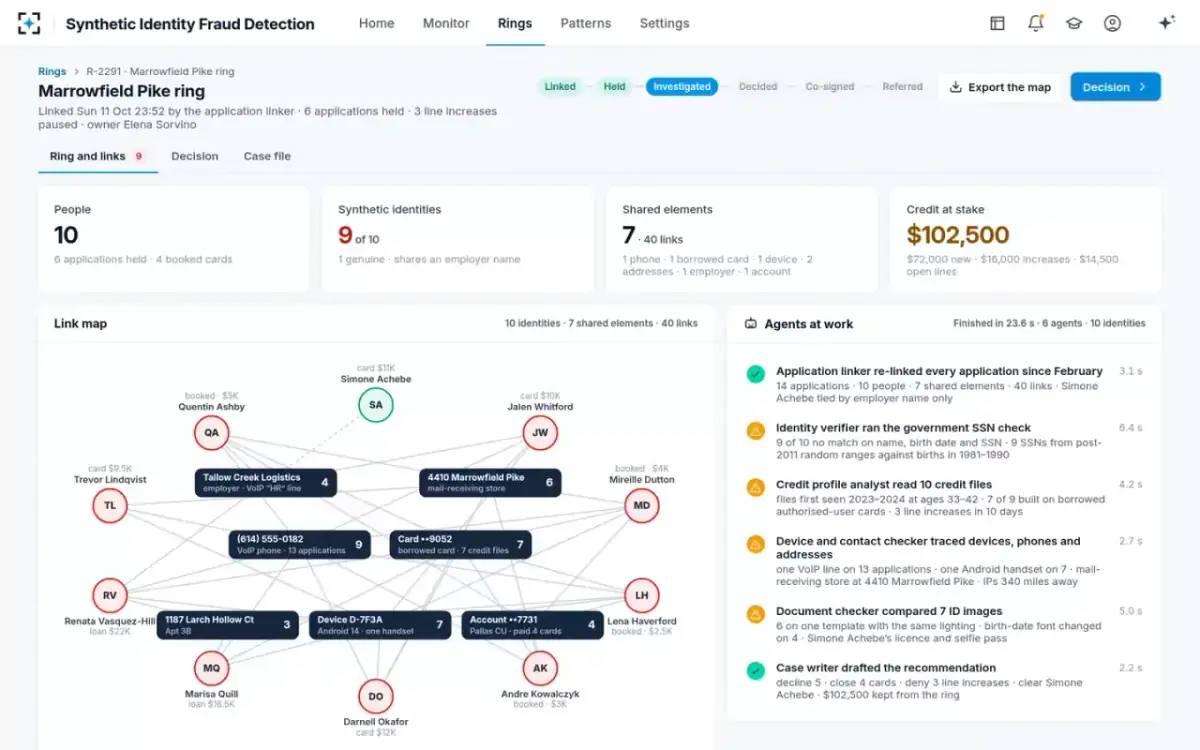
In the solution these twelve are divided among six agents, each with one job and a stated limit. The application linker does tasks 6, 7 and 14's comparison half: it scores every new application against every earlier one on device, phone, address, email pattern, employer phone, internet address and funding account, and groups what it finds. The identity verifier and the credit profile analyst do task 5 — the consent-based government number check, the issuance-range logic, the credit file's first-seen age and depth, the tradelines. The device and contact checker reads the handset, the internet location, the phone line type and the address type. The document checker compares identification images for shared templates and altered fields. The case writer does tasks 1, 2, 3, 8 and 11: the run log, the confirmed-ring history, the narrative, the recommendation and the numbered exhibits.
What that is worth is a matter of elapsed time, not cleverness. On the solution's sample ring — fourteen applications from ten people — the six agents finish every check on all ten identities in 23.6 seconds, and a new application is scored against the whole book in a median of 0.4 seconds. The same assembly by hand is the part of a ring investigation that eats the week: six hours to notice the applications are linked at all, five to pull number checks and credit files for ten names, four to trace devices, phones and addresses, three to compare identification images, five to write the file and the notices.
Where a ring investigation’s hours go, before and after
By hand — about 24 hours
- Spotting the links (6h) · 25%
- Number checks and credit files (5h) · 21%
- Devices, phones, addresses (4h) · 17%
- ID images (3h) · 12%
- Writing the file and notices (5h) · 21%
- Decision and second signature (1h) · 4%
With the agents — about 3.5 hours
- Spotting the links (0h) · 0%
- Checks and files (0.5h) · 14%
- Devices (0.5h) · 14%
- ID images (0.5h) · 14%
- Reading the drafted file (1h) · 29%
- Decision and second signature (1h) · 29%
Read the two bars beside each other and the shape of the change is clear. The hour spent deciding is identical in both. What collapses is the twenty-three hours of fetching and typing that stand between an analyst and the point at which deciding is even possible.
The twelve, finished, in twenty-three seconds
The eleven that stay with a person
Eight of the eleven are not close calls. You cannot automate an interview with a suspect, a court appearance under oath, field surveillance, serving a subpoena, an arrest, training a colleague, coordinating with a prosecutor, or negotiating a recovery. They are listed here because a buying conversation that pretends otherwise is a buying conversation you will regret, and because they are a real part of the job's calendar.
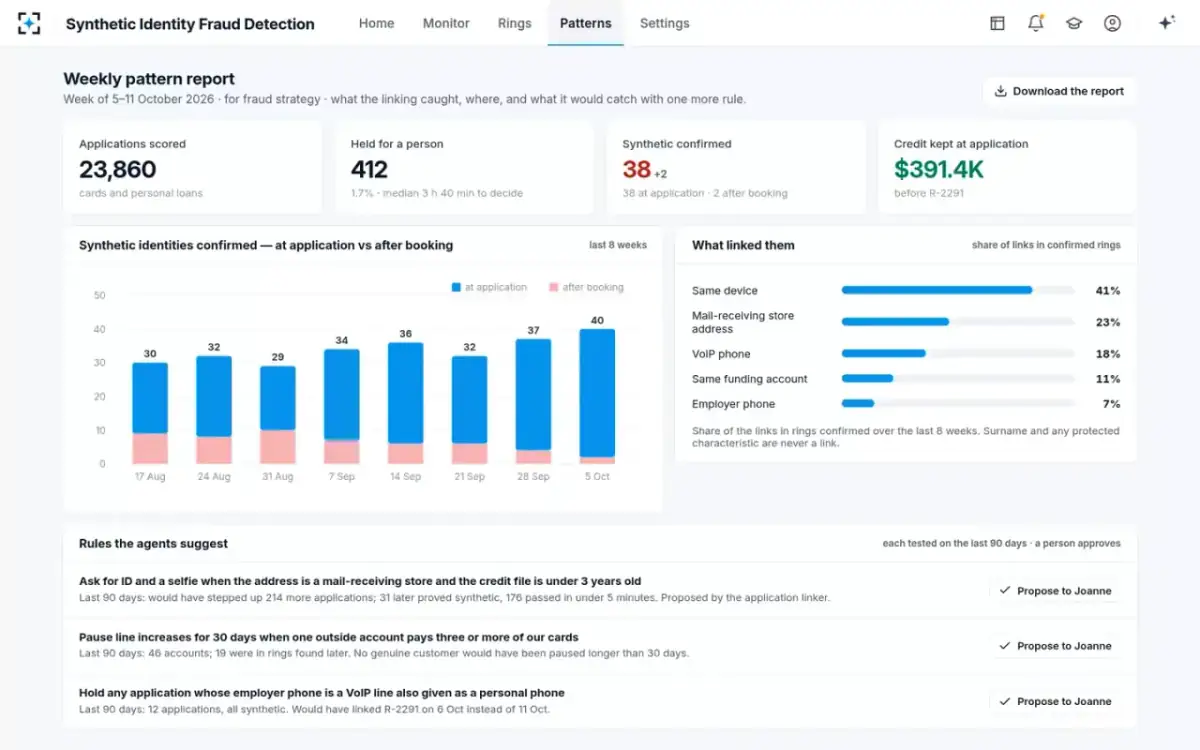
The three that are genuine judgements matter more, because they are the ones a vendor is most likely to claim. Leading an investigation team is directing people. Advising the business on how to improve detection is a position taken in front of colleagues who can refuse it. Evaluating a new technology is deciding what the institution will depend on. In each case the material can be assembled — and in the solution it is: a weekly pattern report counts synthetics caught at application against those caught after booking, names what linked them, and proposes candidate rules that have already been tested against the last 90 days. The proposal is prepared work. The approval is not.
There is a fourth kind of task that is worth naming separately, because it does not appear on the federal list at all: deciding to refuse a person credit. That is a regulated act with its own notice requirements, and in the solution it is reserved to people twice over — an analyst recommends, a second person co-signs, and only then does a notice leave. Who signs what, and what each signature commits to, is a question with its own answer.
Prepared work for the one task a model may not finish
How is an agent different from a rules engine?
A rules engine applies conditions you wrote down. An agent is given a job, a set of sources and a hard limit, and assembles an answer from whatever the sources actually say. The practical differences show up in four places, and all four are worth asking a vendor about.
A rules engine and an agent, on the four things that differ
A rules engine: Invisible. It fires on the conditions it was given and nothing else, so a new typology is a change request.
An agent with one job: Visible as a link, because the comparison is across every element rather than a list of named ones — but still needs a person to name it.
A rules engine: Easy and complete: the rule that fired is the explanation.
An agent with one job: Only as good as what it carries. Worth nothing unless each link names the element and the applications it was found on, and each check opens at its source.
A rules engine: A release. The rule is code, so a new rule is a deployment and a test cycle.
An agent with one job: A setting with a date and a signature — thresholds, weights, which checks run — provided every change is versioned and attributable.
A rules engine: Whatever you granted it. A rules engine will decline an application if you tell it to.
An agent with one job: In this solution, none: the linker may hold and may never decline, and no agent sends a notice or files a report.
The honest summary is that neither technique finds a synthetic identity on one application, because there is nothing wrong with one application. And the caution that belongs beside both of them is the Federal Reserve’s: "while AI provides many benefits, industry experts note that false positives in customer identity information can be difficult for consumers to rectify" — its own example being a mismatch caused by nothing worse than a consumer writing Bob where their records say Robert.
What NIST requires when a model touches an identity check
If a model is anywhere near your identity decisions, the federal digital identity guidelines set out what has to be disclosed — and they are written as obligations on whoever supplies the technology, which makes them a ready-made list of questions for a vendor. Section 3.8 of the current guidelines is short and unambiguous.
"All uses of AI/ML SHALL be documented and communicated to organizations that rely on these systems. … All organizations that use AI/ML SHALL provide information to any entities that use their technology on the methods and techniques used for training their models, a description of the data sets used in training, information on the frequency of model updates, and the results of all testing completed on their algorithms."
NIST Special Publication 800-63-4, Digital Identity Guidelines, July 2025, §3.8
Two further requirements sit in the same section: organisations using these systems "SHOULD implement the NIST AI Risk Management Framework … to evaluate the risks that may be introduced," and "SHALL perform and document privacy risk assessments for personal information and data processed by such systems." The companion volume on identity proofing adds the one that keeps a control honest after it goes live: providers "SHALL monitor the performance of their fraud checks and fraud mitigation technologies to ensure continued effectiveness in mitigating fraud risks," and must give applicants a documented way to resolve problems a fraud check causes them (NIST SP 800-63A-4, §3.2.3).
The guidelines are binding on federal agencies and the providers that serve them; for a bank they are not law, but they are the most specific public statement of what good looks like, and an examiner who has read them will expect answers in their shape.
Nine questions the federal guidelines hand you, as a buyer
- Where exactly is a model used, and where is it not?
The disclosure obligation is "all uses". A vendor who cannot draw that line has not done the exercise.
- What methods and techniques trained it?
Named in §3.8 as information the supplier must provide to anyone relying on the system.
- What was it trained on?
A description of the data sets — not an adjective. Ask whether it includes your product and your population.
- How often is the model updated?
Required by §3.8, and the number that tells you whether last year’s evaluation still describes what you are running.
- What testing has been completed, and what did it show?
The results of all testing on the algorithms, in the vendor’s own words, before you run your own.
- How is live performance monitored?
SP 800-63A-4 makes continued monitoring of fraud checks an obligation, not an option. Ask what is measured and who reads it.
- What is the route back for someone wrongly held?
Redress procedures are required, and a trained human reviewer is recommended for anyone who fails an automated fraud check unattended.
- Has a privacy risk assessment been done and written down?
A SHALL in §3.8 for any system processing personal information.
- What can the system do without a person?
Not from the guidelines — from the loss. Ask for the list, in writing, and read it as the list of errors nobody will catch.
Will AI replace fraud analysts?
Not on this evidence. Eleven of the 23 tasks in the federal description are untouched, and three of them — leading a team, advising the business, choosing what to depend on — get harder rather than easier when the volume of prepared material goes up. What changes is the composition of the day. An analyst who spends six hours noticing that fourteen applications are linked is doing clerical work that happens to require expertise; an analyst who opens a finished cluster and decides is doing the job the title describes.
There is a second-order effect worth naming, because it is the one that shows up in a workforce plan rather than in a demonstration. If a ring takes 24 hours to work by hand, a team can only investigate the rings it already suspects. If it takes three and a half, the team can investigate the ones it does not — which means the count of cases goes up even as the hours per case go down. The number of people needed is set by how much fraud you intend to look for, not by how fast each case runs.
The occupational list also contains its own warning against over-claiming. Task 16 is to "maintain knowledge of current events and trends"; task 19 is to "research or evaluate new technologies for use in fraud detection systems." Keeping up with the attack and judging the defences were always part of the job. A tool that makes both easier is not a replacement for the person doing them.
What to ask a vendor about its model
Beyond the nine disclosure questions above, three more are specific to link-based detection and are the ones that separate a product from a demonstration.
What is linkable, and what is deliberately not? In this solution the weights are visible and editable — device 30, funding account 30, phone 20, address 15 and doubled when it is a mail-receiving store, employer phone 10, email pattern 5 — and surname and any protected characteristic carry a weight of zero, by design rather than by convention. A vendor that cannot show you the list cannot tell you what its model is allowed to infer.
What happens between pass and hold? A control with only two outcomes will hold people it should have asked a question. The step-up band here sits between 500 and 699 and asks for a photo identification and a selfie instead of stopping the applicant, which is the difference between a fraud control and a conversion problem.
Can it be tested on files you already own? The only claim worth buying is one you can replay against your own closed applications and confirmed fraud cases, where you already know the ending. How to design that test, and the four numbers it should produce, is the next thing to read. To see the twelve prepared tasks finished on your own applications, start from Synthetic Identity Fraud Detection.
Questions people ask
What does AI actually do in fraud detection?
In application fraud, two useful things: it compares a new application with every application taken before it, and it drafts the case that comparison produces. Sorted against the Department of Labor's 23-task description of the occupation, twelve tasks are that kind of assembly. Scoring a single application on its own attributes — the thing most often demonstrated — is the weakest of the three against synthetic identities, because each identity in a ring looks clean on its own.
Which fraud tasks can be automated, and which cannot?
Assembly can: documenting activity, maintaining the history of confirmed rings, gathering financial documents, analysing data for irregularities, triaging the suspected-fraud queue, drafting findings and recommendations, preparing exhibits, proposing and testing rules. Eight tasks on the federal list cannot be automated by anyone — interviewing a suspect, coordinating with law enforcement, testifying, training colleagues, surveillance, serving a subpoena, an arrest, and negotiating a recovery.
Does a model decide to decline an application?
It should not, and in this solution it cannot: the application linker may place a hold and is forbidden from declining, and every decline needs an analyst's recommendation and a second person's signature before a notice goes out. The regulatory reason is that an applicant must be told the specific principal reason for an adverse action, and a linkage score is neither specific to that applicant nor an acceptable reason on its own.
What does NIST require when AI is used in identity checks?
Section 3.8 of SP 800-63-4 requires that all uses of such systems be documented and disclosed to anyone relying on them, and that suppliers provide the training methods, a description of the training data, the frequency of model updates and the results of all testing. It also expects the NIST AI Risk Management Framework to be applied and a written privacy risk assessment. SP 800-63A-4 adds continuous monitoring of fraud-check performance and a redress route for applicants.
How do you stop a fraud model drifting?
By measuring it against outcomes on a schedule rather than watching its score distribution. NIST makes monitoring of fraud checks an explicit obligation. In practice that means a regular count of what was caught at application against what was only found after booking, which element did the catching, and how many genuine applicants were held — plus a rule that any threshold or weight change is dated and attributable, so a past decision can be read against the settings in force when it was made.
Is a rules engine enough for synthetic identity fraud?
Only for the patterns you have already written down, which is the problem: a cultivated synthetic identity is specifically designed to satisfy every single-application rule. The Federal Reserve's own guidance points away from single characteristics and towards aggregating data and linking records across accounts, and warns that leaning on one characteristic — credit-history length, for instance — produces false positives against legitimate thin-file customers.