To evaluate regulatory exam management software, first decide which jobs it must do, then run it on an exam you have already finished. Your last exam's request letter, the answers your team sent, and the examiner's follow-ups and findings form a ready-made test set, and they describe your bank's products, systems and owners better than any vendor demonstration. Replaying the letter shows how the requests are split, which are matched to earlier answers, whether the right document versions are found, which gaps are flagged before sending, and how each draft compares with what your team sent and the examiner accepted. Botminds offers this for Regulatory Exam Management on a bank's own last exam before anything goes live; this guide sets out how to run such a replay with any tool, and how to read the results.
What one letter turned up against a bank's kept answers (fictional sample)
What features should regulatory exam management software have?
Software in this category ranges from a shared request tracker to agents that draft answers, so start by listing the jobs of an exam and asking which ones the product does, and which it leaves to people. The table below runs through the work of one letter in order. A tracker covers the first rows; the rows after it are where the hours of an exam go, and where products differ.
The jobs of an exam letter: what to ask of regulatory exam management software
| Job | Why it matters in an exam | How to test it on your last exam |
|---|---|---|
| Read the letter into requests and clauses | Clauses joined by "with" or "including" are where answers fall short | Count the clauses it finds against an experienced reviewer's count |
| Assign owners and due dates | In our estimate for a 46-request letter, chasing owners is the largest single block of time | Requests routed to the right owner first time, from the owner map as it stood |
| Keep and match past answers | A request list repeats across exams and audits, years apart | Matches at your own threshold, with a library frozen at the letter's date |
| Find the right version of the evidence | Drafts, superseded policies and unsigned responses lead to follow-ups | Exhibits that equal what you sent, or a better version you should have sent |
| Check every clause before sending | A missed clause becomes a follow-up, and a signal about the program | Follow-ups from the last exam the check would have caught |
| Draft the cover note | The note is what the examiner reads first | Drafts your coordinator would send with light edits, every figure cited |
| Approval, signature and sending | The bank answers for what it sends | Named approver, meaning of the signature, a person uploads |
| Track findings to closure | The next exam starts with the last one's findings | Last report's findings carried forward, closed only with validation |
Exam management software vs a spreadsheet tracker
A spreadsheet is free, and for a short letter with owners who have answered it before, it can be enough. Its limits show up in three places: nothing carries the last exam's answers and follow-ups forward, nothing checks a version or a clause, and the record of who approved what lives in email. Software earns its place where those three cost the most: long gaps between exams, staff turnover, and long letters with many owners.
The same letter answered with a spreadsheet tracker and with exam management software
Spreadsheet tracker: Requests typed or pasted in by the coordinator; owners emailed.
Exam management software with agents: Letter read into requests and clauses; owners and due dates set from the owner map.
Spreadsheet tracker: Whatever someone remembers or finds in a share.
Exam management software with agents: Kept answers matched at a threshold, with the examiner's follow-ups shown.
Spreadsheet tracker: Attached by owners, version unchecked.
Exam management software with agents: Gathered read-only, latest issued or signed version, owners asked only for gaps.
Spreadsheet tracker: Read by eye, if there is time.
Exam management software with agents: Every clause mapped to an exhibit and page; draft cover note cites each figure.
Spreadsheet tracker: A closed file nobody opens until the next letter.
Exam management software with agents: Each answer kept with its versions for the next exam; findings tracked to validation.
Why your last exam is the right test set
Exam answers are local. A request for "the most recent consumer compliance risk assessment and the methodology used to prepare it" is answered from your files, in your committee's language, by your owners. A demonstration on a vendor's sample bank shows the mechanism; it cannot show whether the tool will find your Q2 QC report in your share, or know that your committee signs management responses a week after the report. Your last exam can.
It also comes with an answer key that no one has to invent. You know what was asked, what you sent, which requests the examiner came back on, and which findings followed. The FDIC keeps the same file in its workpapers (CCEM II-4), so your examiner can compare this exam's answers with last exam's. You can make that comparison first.
The responsibility does not move with the tool. A Federal Reserve examiner put it plainly: "Although a financial institution may hire a reliable vendor, the institution remains responsible for ensuring that the output from vendor-provided systems and services meets regulatory requirements" (Consumer Compliance Outlook, 2019). A replay is the bank's own evidence that it checked.
Building the test set: the letter, the answers, the follow-ups
The test set has four parts. Gather them before you talk to a vendor, because each part tests a different step.
The test set: what to collect from your last exam
- The request letters, exactly as received
The first-day letter (at the FDIC, the CIDR) and the transaction testing request, with dates. Tests the reading and clause splitting.
- What you sent, request by request
Cover notes and exhibits, with the versions used. Tests evidence finding and drafting.
- Every examiner follow-up
What was asked again, and how long it took to answer. Tests the completeness check.
- The owner of each request at the time
Tests assignment from an owner map.
- Answers from before that exam
Earlier exams and audits, to load as the library. Tests matching without letting the tool see the answers it is being tested on.
- The report and its findings
Tests whether findings tracking would have carried them forward to the next letter.
The fifth item is the one most often missed. If the library the tool matches against already contains the answers to the letter being replayed, every request will match and the test proves nothing. Load only what existed before the letter arrived: the exam before last, internal audits, HMDA reviews, external reviews. The bank's library at the time of the letter is what the tool would really have had.
Running the replay: the same steps the live exam takes
A replay of a closed exam, step by step
A person decides
Freeze the libraryLoad only answers and documents that existed before the letter's date.
Agent
Read the letterSplit into numbered requests and clauses; assign owners from the owner map as it stood.
Agent
Match, gather, check, draftEach request matched, evidence found, clauses checked and a cover note drafted.
Never: Send anything. In a replay nothing leaves the bank.
A person decides
Score against what you sentRequest by request: same documents? same versions? same clauses covered?
A person decides
Adjudicate each differenceWas the tool wrong, or was the original answer?
In Regulatory Exam Management the replay runs the same seven agents as a live exam: the letter reader, answer matcher, evidence gatherer, completeness checker, response drafter, due-date watch and findings tracker. The difference is that the outputs are compared with history instead of being sent for approval. Every step is in the run log, so a reviewer can see why a request was matched or flagged.
Scoring the replay: six measures that mean something
Score request by request, and keep the scores separate. A single "accuracy" figure hides the thing you need to know, which is where the tool is strong and where your people will still have to work.
Six measures for a replay, and what each tells you
| Measure | How to count it | What a weak score means |
|---|---|---|
| Clause splitting | Clauses the tool found ÷ clauses an experienced reviewer finds in the same wording | Gaps will reach the examiner; the completeness check cannot check what it never saw |
| Owner assignment | Requests sent to the right owner first time | The owner map is out of date, or the areas are drawn differently from the letter |
| Match rate at your threshold | Requests matched to an earlier answer at the reuse threshold you would set | Little reuse; check whether the wording changed or the library is thin |
| Right document, right version | Exhibits that match what you sent, or a better version you should have sent | Search is finding the wrong files; check where your documents live |
| Follow-ups caught | Examiner follow-ups that the completeness check would have flagged before sending | The check reads wording only; follow-ups for things the letter never asked will need the library |
| Draft acceptance | Cover notes your coordinator would send with light edits | Drafting style or figures need work before go-live |
A replay is only as honest as its library. If the tool can see the answers it is being tested on, every request will match.
Reading the disagreements: sometimes the old answer was wrong
Where the tool's answer differs from what the bank sent, do not assume the tool is wrong. The original answer may have sent a draft policy, missed a quarter, or left out a clause that the examiner then asked for. In the sample bank, the 2023 answer to the QC request sent "committee minutes extracts" as management's responses; the replayed answer would send the signed responses. That difference counts against the old answer, not the tool.
Classify each difference into one of four kinds: the tool was wrong; the original was wrong; both are acceptable; or the question cannot be settled from the files. Only the first counts against the tool. The second is a finding about your own process, and it is worth having before the next examiner reads the same file. The Federal Reserve's 2026 principles describe self-identified deficiencies that a bank "promptly starts remediating" as presumptively observations rather than MRAs (Federal Reserve, 2026); a replay is one way to self-identify.
Last exam beside this letter in Regulatory Exam Management's answer library
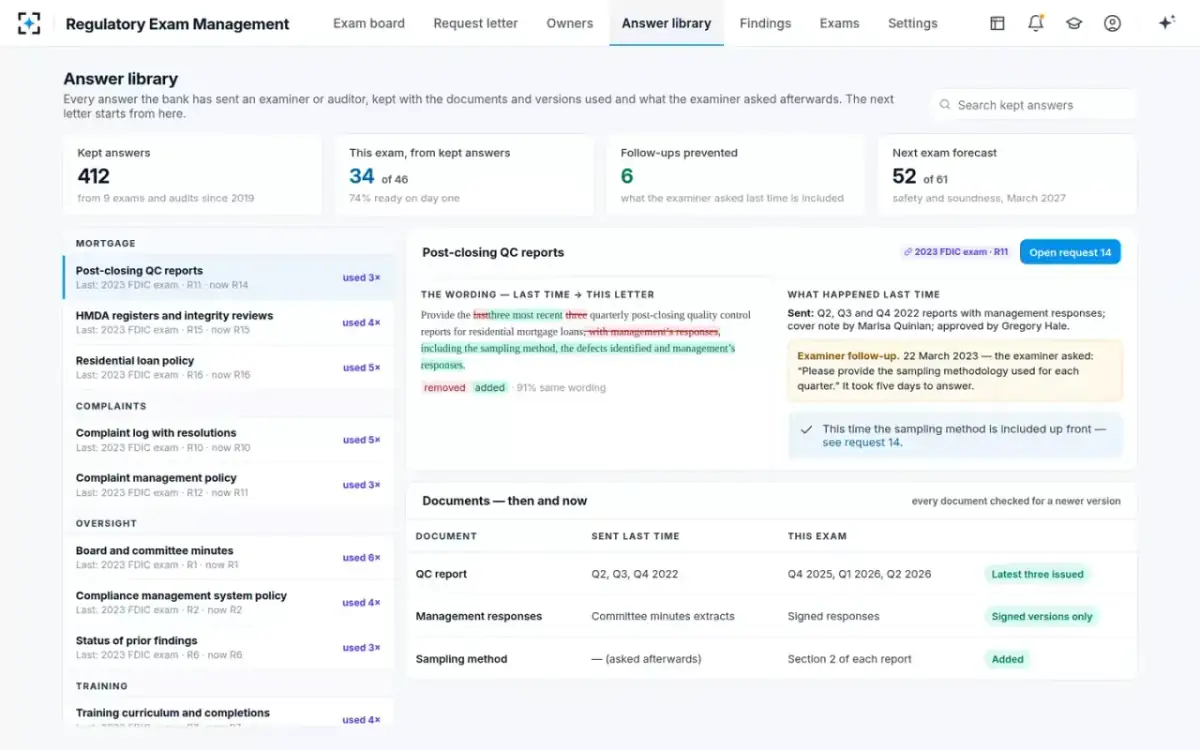
Documents then and now: the 2023 answer sent minutes extracts; the replayed answer sends the signed responses.
What a replay cannot tell you
A replay measures the tool on a letter whose answers you know. It does not measure how owners respond to nudges, how long the approver takes, or what a new examiner will ask that the last one did not. Treat its counts as the tool's ceiling on your files, then confirm the rest in a live exam or an audit request list with your coordinator reviewing every item.
There is no regulator standard for validating software of this kind. The agencies' April 2026 model risk guidance states that "Generative AI and agentic AI models are novel and rapidly evolving. As such, they are not within the scope of this guidance", and it excludes "deterministic rule-based processes" (interagency guidance, 2026). In the absence of a standard, the principles that regulators apply to their own AI use are a fair benchmark: humans make the decisions, and the tool is not "a sole source of input" (GAO, 2025). A replay, a run log for every request and a named person signing every answer meet that benchmark.
The settings a replay should be run with in Regulatory Exam Management
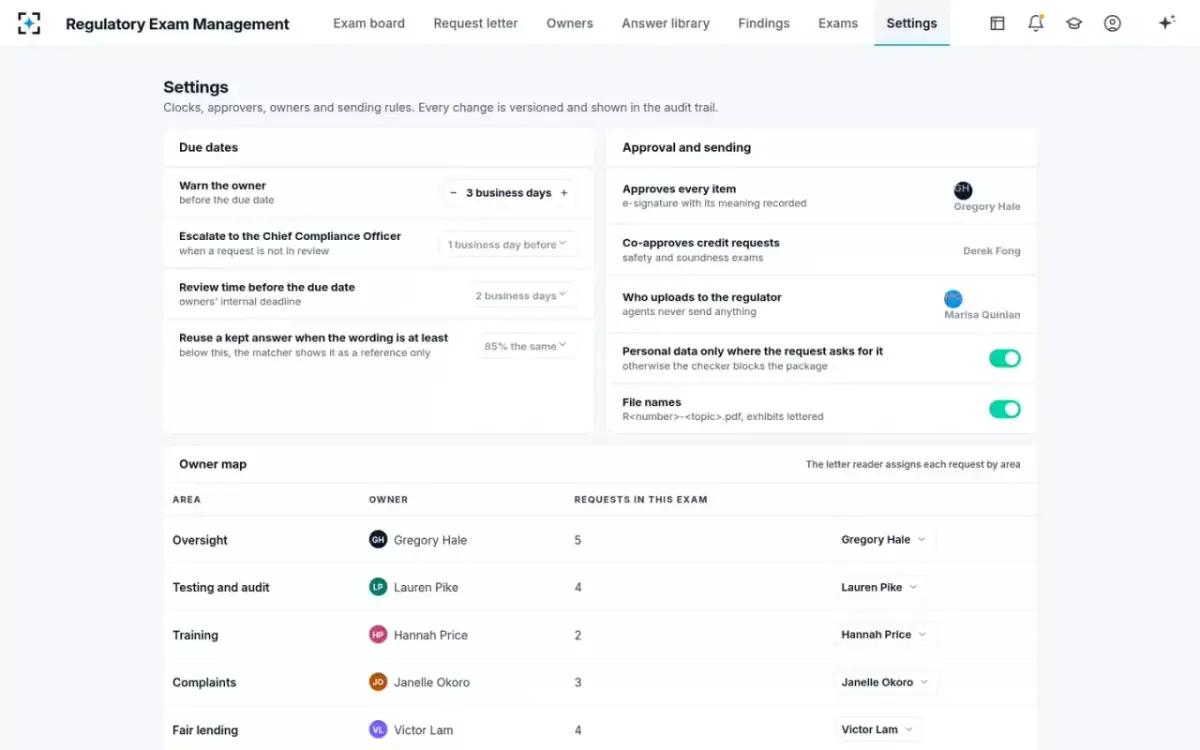
Once a replay has shown where the tool is strong, the work of going live is mostly the bank's: an owner map, a library of past answers and rules for closing findings. Ready before the letter sets out that plan, and AI for exam responses, traced follows one request through every step the replay scores.
Questions people ask
How long does a replay take?
The run itself is short; the agents in the sample bank read a 46-request letter in eleven minutes and answer a request in minutes. Collecting the test set and scoring each request against what was sent takes the evaluator's time, roughly proportional to the number of requests.
Should internal audit run the replay?
It is a good fit. Internal audit is independent of the compliance team that answered the last exam, and its validation is increasingly what examiners rely on to close findings.
What is the best regulatory exam management software for a community bank?
The one that passes a replay on your own last exam with your coordinator scoring it. A community bank should weigh the rows a small team cannot staff (matching to past answers, version checks, clause checks and drafting) above dashboards, and should insist that a named person signs and sends every answer.
Can we pilot on a live exam instead of a replay?
A live exam has no answer key and a regulator on the other end, so a miss costs a follow-up. Replay first, then run the tool live on a lower-stakes request list, such as an internal audit or an external compliance review, with every item reviewed before it goes.
What reuse threshold should we set?
The sample bank reuses a kept answer at 85% the same wording or more, with 80% and 90% as alternatives. Run the replay at the threshold you intend to use, and look at the requests just below it to see what you would be leaving on the table.