To automate regulatory exam preparation, automate the memory first: an exam readiness program has one job, which is that when the next request letter arrives, most of it should already be answerable. That needs four things in place beforehand: the last exam's letters, answers and follow-ups loaded as a library; an owner for every request area; a rehearsal on a request list; and rules for closing findings with evidence. Botminds' Regulatory Exam Management goes live on those four, in that order, and the plan below is timed against the bank's exam calendar rather than a fixed number of weeks. The FDIC gives at least 90 days' notice of a consumer compliance exam and at least 30 days to answer its first request list (CCEM II-4). The work below belongs before either.
Ready before the letter: the four things to have in place
- The last exam, loaded as a library
Every request with the examiner's wording, the answer sent, the versions used and every follow-up. Earlier audits and exams too.
- An owner map by request area
Oversight, testing and audit, training, complaints, fair lending, mortgage, servicing, deposits, marketing, privacy, CRA: one named owner each.
- A rehearsal on a real request list
Replay last exam's letter, then run an audit or a safety and soundness request list live with full review.
- Rules for findings
Who logs a finding, who owns each action, who validates, who closes, and what evidence closes it.
- Clocks and approvers as settings
Warning and escalation days, review time, reuse threshold, the approver, the co-approver and the person who uploads.
- Open findings brought up to date
Each with its fix, its retests and its validation, so the next letter's corrective-action request is already answered.
What is an exam readiness program?
It is the work a bank does between exams so that the request letter is a retrieval task, not a research project. The FDIC's own manual describes the stakes from both sides. Examiners start planning with the bank's previous reports, workpapers and "Prior corrective actions (such as restitution) and responses to ROEs" (CCEM II-4). During the exam they ask whether "management responded appropriately to deficiencies noted and suggestions made at previous examinations and audits" (CCEM II-5). A ready bank can show the same history from its own files.
Readiness also makes room for the one thing that counts in the bank's favour at the exam: self-identification. Violations "self-identified by a bank and fully corrected before the start of the examination (including remedial action, if appropriate) generally are not cited", once examiners "confirm that the bank identified the root cause" (CCEM II-6). That requires the evidence to be filed when the work is done, not reconstructed when the letter arrives.
Which parts of regulatory exam preparation can be automated?
The retrieval and the routine checks, before and during the letter; not the judgement, the signature or the conversation with the examiner. Between exams, software can keep every answer sent with its versions, watch for newer versions of the documents those answers used, remind owners of open findings and forecast how much of each upcoming request list is already answered. When a letter arrives, agents can read it, route it, match it to past answers, gather evidence, check clauses and draft cover notes.
Automating exam preparation: what software can carry, and what stays with people
| Stage | Can be automated | Stays with people |
|---|---|---|
| Between exams | Keeping each answer with its versions and follow-ups; reminders on open findings; a forecast of each upcoming list | Deciding what a finding needs; validating fixes; keeping the owner map true |
| The day the letter arrives | Splitting requests into clauses; owners and due dates from the owner map; matching to kept answers | Agreeing the time and scope with the examiner-in-charge at the interview |
| Gathering | Finding the latest issued, approved or signed version, read-only; re-running exports; asking owners only for gaps | Owners confirming their own evidence is right |
| Before sending | Mapping every clause to an exhibit and page; drafting the cover note with each figure cited | The coordinator's review; the approver's signature; a person uploading |
| After the exam | Logging findings with actions, owners and dates; drafting the board update | Commitments to the examiner; closing a finding after validation |
Step one: load the last exam as the library
The library is the base of everything. In Regulatory Exam Management every answer the bank sends is kept with the documents and versions used and anything the examiner asked afterwards. Going live starts by doing the same for the past: the last consumer compliance exam's letters and answers, then earlier exams, internal audits, HMDA reviews and external reviews, as far back as the files allow. The fictional sample bank used in this series loaded 412 answers from nine exams and audits since 2019.
Three things matter more than volume. Keep the examiner's exact wording for each request, because matching works on wording. Keep the follow-ups beside the answers they corrected, because they show which clauses to answer up front. And keep the version of each document sent, so the next answer can show what changed. A library of final PDFs without wording or follow-ups will match poorly and teach nothing.
Step two: an owner for every request area
The owner map is the shortest document in the program and the one that saves the most time. When the letter arrives, the letter reader assigns each request to an owner by area, so the first week of the exam is not spent asking who has what. The FDIC asks for this clarity in its own terms: "When more than one individual is responsible for compliance matters, responsibility and accountability must be clearly defined" (CCEM II-3).
Map by request area, not by person: oversight, testing and audit, training, complaints, fair lending, each lending and deposit line, marketing, privacy, CRA. In the sample bank, 46 requests went to 14 owners on the day the letter arrived, from the chief compliance officer for oversight to the mortgage QC manager for one QC request. Update the map whenever someone changes roles; the moment the letter arrives is the worst time to discover the training lead left in the spring.
Who does what during go-live
Today
Rebuilds the tracker and the owner list at each exam.
With agents
Collects last exam's letters and answers, owns the owner map and runs the replay.
Still theirs: Reviewing every draft before it reaches the approver.
Today
Approves packages under time pressure.
With agents
Sets the clocks, the reuse threshold and who signs and uploads; signs the first live answers.
Still theirs: Approval of everything sent, and closing findings.
Today
Find out what is wanted when the letter arrives.
With agents
Confirm where their documents live and which version is current.
Still theirs: Confirming their own evidence.
Today
Asked late whether findings were fixed.
With agents
Agrees what evidence closes a finding and validates the open ones.
Still theirs: Independent validation before closure.
Step three: run a mock regulatory exam on a real request list
Rehearse twice. First, replay the last exam's letter against a library frozen at the date it arrived, and compare each answer with what the bank sent and what the examiner accepted. Replaying your last exam sets out how to score it. Second, run the next real request list live, with the coordinator reviewing every item and the approver signing as normal. A bank's calendar usually has one soon: an internal audit, a HMDA review, an external review or a safety and soundness exam, which comes every 12 or 18 months.
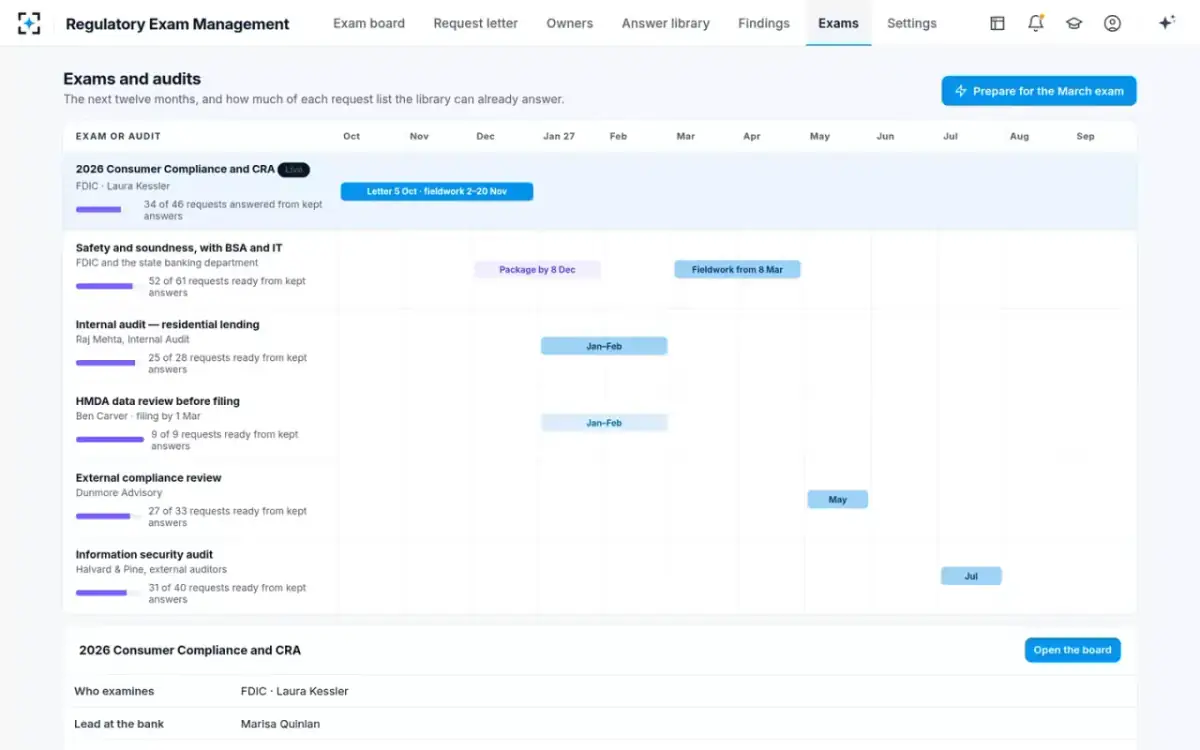
The sample bank's calendar shows why the rehearsal is cheap. In the twelve months after its consumer compliance exam, the library could already answer 52 of 61 requests for a safety and soundness exam with BSA and IT review, 25 of 28 for an internal audit of residential lending and all 9 for a HMDA data review. Each of those lists is a live rehearsal that also does real work.
The exam calendar in Regulatory Exam Management: each request list, and how much is ready
Step four: rules for closing findings
Findings are where readiness is won or lost, because the next letter will ask for "the status of corrective action taken on each finding" of the last exam, with evidence. Set the rules before go-live: who logs a finding (from examiners, internal audit or the bank's own testing), who owns each action, how often owners are reminded, who validates and who closes. In the sample bank, the findings tracker reminds owners at 14 and 3 days, drafts the board update, and allows only the Chief Compliance Officer to close a finding, after internal audit has validated it.
That last rule tracks where supervision is heading. The Federal Reserve's 2026 principles tell examiners not to re-validate remediation unless the firm's internal audit function "is ineffective or unsatisfactory, the firm does not have an internal audit function, or the firm's internal audit function has not validated the remediation" (Federal Reserve, 2026). Long plans need checkpoints: at the Fed, consumer compliance action plans running past twelve months "should include interim progress targets" (SR 13-13). From November 2, 2026, OCC and FDIC findings will also come in three kinds, set out in the OCC and FDIC MRA final rule; set up the tracker to tell them apart.
What to bring to go-live, and what each input does
| Input | Format | What it makes possible |
|---|---|---|
| Last exam's request letters | As received: PDF or document | Matching on the examiner's wording; the replay |
| Answers sent, with exhibits | Cover notes and the files, by request number | Reuse with a version check; the answer key for the replay |
| Examiner follow-ups | Emails or portal messages, with dates | Clauses answered up front next time |
| Earlier exams and audits | Same as above, as far back as practical | A deeper library for every request list, not only the compliance exam |
| Owner map | Request area → named owner | Assignment on the day the letter arrives |
| Where documents live | Policy library, board portal, QC and testing shares, complaint, training, loan and deposit systems | Read-only gathering of the latest approved, signed or issued version |
| Open findings | Each with actions, owners, dates and evidence so far | The corrective-action request answered from one page |
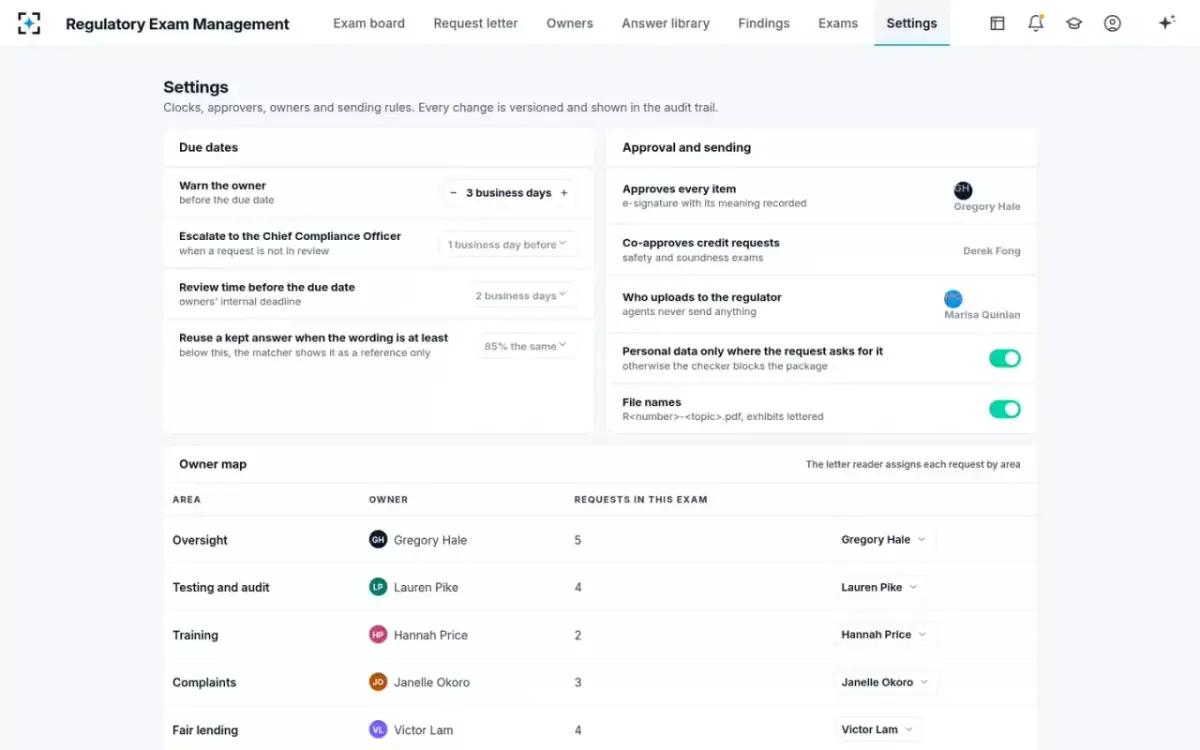
| Rules | Clocks, reuse threshold, approver, co-approver, uploader | Settings, versioned in the audit trail |
The rules as settings in Regulatory Exam Management, every change versioned
How long does it take to implement exam management software?
In the illustration below, about eight weeks before the first live list; in practice the duration depends on the files, not the software. The longest step is usually collecting the last exam's letters, answers and follow-ups from wherever they ended up, and that step is the same whatever tool is chosen. The order below is the one that pays off soonest; the durations are an illustration.
An example go-live sequence, timed against the exam calendar (illustrative)
- Collect letters and answers2 wks
- Load the library2 wks
- Owners, rules1 wk
- Replay last exam2 wks
- First live liston arrival
Time the go-live against the calendar, not a fixed date. A bank that has a safety and soundness exam package due in two months has a ready-made first live list; one that has just finished its consumer compliance exam has the best possible library, while the people and files are still at hand. The worst time to start is after the information package arrives, when the same people are answering the interview questions.
Who signs off that the bank is ready?
The Chief Compliance Officer, on evidence. Before the first consumer compliance letter is answered with the solution, the CCO should have seen the replay scores and their misses, the first live request list answered under full review, the owner map and the rules, and the open findings with their evidence. A bank that has those in hand is ready, whatever tool it uses. One that does not will spend the first fortnight of its next exam finding out what it sent last time.
For the sequence the letter will set off, see the FDIC compliance exam, step by step; for the cost of the hours this plan saves, what one request letter costs.
Questions people ask
When should exam readiness work start?
Right after the last exam's response letter, while the people and files are at hand. Under the FDIC's current schedule a small, well-rated bank may wait up to 78 months for the next full exam; the mid-point risk analysis around half-way is a natural checkpoint.
What if we cannot find last exam's answers?
Start with what exists: internal and external audit request lists, HMDA reviews and the last report's findings. The first live exam then builds the library, and every answer sent from then on is kept with its versions.
Can regulatory exam preparation be fully automated?
No, and it should not be. The interview, the judgement on what each answer says about the compliance program, the signature and the upload belong to named people. What can be automated is everything that is retrieval, routing and checking, which is where most of the hours go.
How do we keep the evidence library current between exams?
Keep every answer the bank sends to any examiner or auditor, not only the consumer compliance exam's, with the versions used and any follow-up. Check each document for a newer version whenever an answer is reused, and update the owner map when someone changes role, not when the next letter arrives.
Does it work for safety and soundness exams too?
Yes. The same library and owner map serve any request list; credit requests in a safety and soundness exam can require the Chief Credit Officer's co-approval as well as the CCO's.