The cost of a bank regulatory exam is mostly people's time, and most of that time goes on answering request letters: building a tracker, chasing owners, finding what was sent last time, checking each answer and writing cover notes. No regulator or research body publishes a per-exam figure, so the honest answer is a method: requests × hours × wages, plus what follow-ups and findings add. This page builds that cost for one 46-request consumer compliance letter at a fictional sample bank, shows where the hours go by hand and with Botminds' Regulatory Exam Management, and gives a return formula to fill with your own numbers. The hours are our estimates and the product's design target, labelled as such; the wages and industry figures are published.
Where a 46-request letter's nine business days go, by hand and with the agents (our estimate)
By hand · 9 days
- Tracker and owners · 11%
- Chasing owners · 33%
- Finding last answer and current version · 17%
- Checking against the request · 11%
- Cover notes · 17%
- CCO review, approval, upload · 11%
With the agents · 4 days (target)
- Tracker and owners · 6%
- Chasing owners · 37%
- Finding last answer and current version · 6%
- Checking against the request · 13%
- Cover notes · 13%
- CCO review, approval, upload · 25%
How much does a regulatory exam cost a bank?
There is no published figure per exam, and figures quoted without a method should be treated with care. What is published is the share of cost that compliance takes. Across ten years of the CSBS Annual Survey of Community Banks, "the smallest banks reported spending roughly 11% to 15.5% of their payroll on compliance tasks, compared with 6% to 10% at the largest institutions" (CSBS, November 2025). That is all compliance work, not the exam alone, but it shows where the money is: in salaries.
What does a compliance officer's hour cost? The rate to use
Use a published wage and your own benefits load. The Bureau of Labor Statistics put the mean annual wage of compliance officers in credit intermediation at $94,090 in May 2025, against $88,400 across all industries (BLS OEWS). At 2,080 working hours that is about $45 an hour before benefits and overhead. The exam's cost is that rate, times the hours of everyone who touches a request, times the number of requests, plus the cost of whatever comes back.
Regulators price compliance time the same way when they estimate the burden of their own rules. When the CFPB costed its 2015 HMDA rule, it wrote that "The wage rate is $33 per hour, which is the national average wage for compliance officers based on the most recent National Compensation Survey" (80 FR 66128). The method has not changed; the national mean has since risen to about $42.50 an hour. Two refinements matter at a bank. The owners who supply documents are rarely compliance staff, so price their hours at their own rates. And the approver's hour is the Chief Compliance Officer's or the CEO's, which is worth pricing separately because it is the hour the bank can least spare.
The published inputs
$94,090
mean annual wage, compliance officers in credit intermediation, May 2025
~$45/hr
the same wage over 2,080 hours, before benefits (our arithmetic)
11–15.5%
of payroll spent on compliance at the smallest community banks
145days
average length of a Federal Reserve consumer compliance exam, 2017–2019
Building the cost of one letter, hour by hour
Take the fictional sample bank, Calder Ridge Bank, as it answers its 2026 FDIC consumer compliance and CRA letter: 46 requests across 11 areas, owned by 14 people. Our estimate of the coordinator's and approver's time by hand is nine business days, about 72 hours, or roughly an hour and a half per request. At $45 an hour that is about $3,250 in direct wage for those two people, before benefits. It leaves out the 14 owners' time, which is real but scattered: each owner stops other work to search for documents, often more than once.
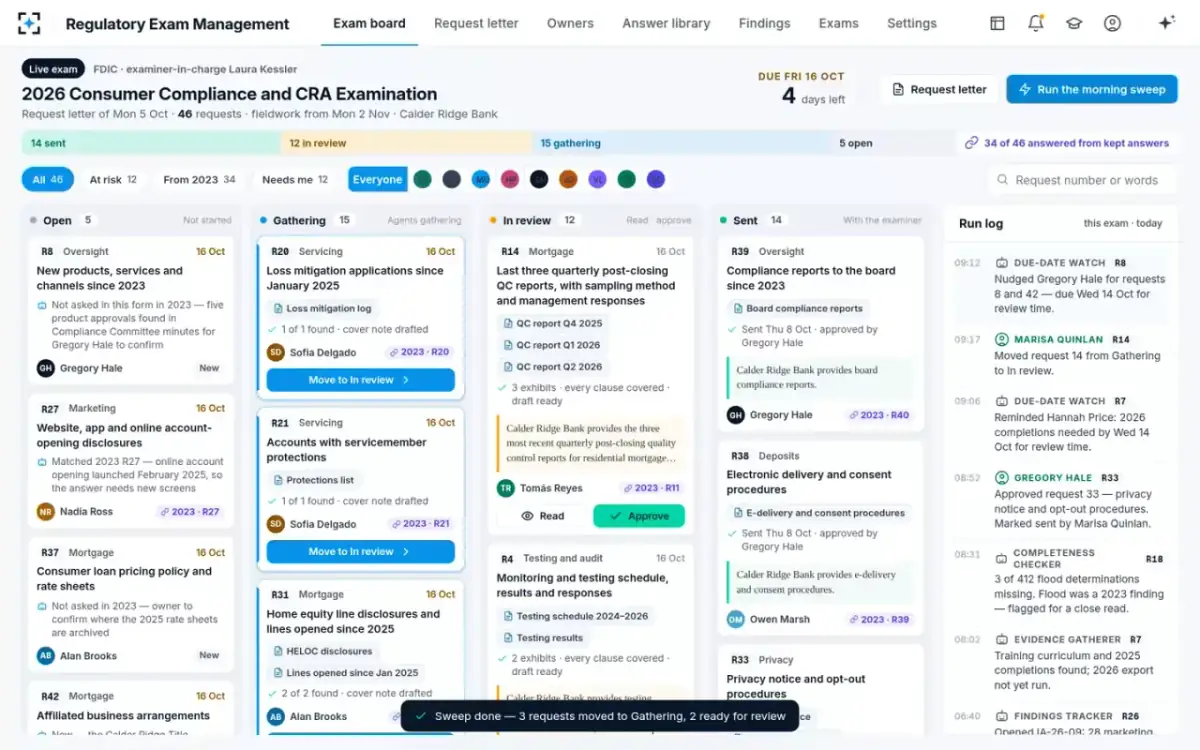
The chasing is the largest single block, three days of nine, and it is also the block that shrinks least. Owners still have to confirm their evidence and supply what the agents cannot find. What shrinks most is the finding: a day and a half spent reconstructing last exam's answer and locating the current version of each document becomes a quarter of a day when 34 of the 46 requests already carry a link to the 2023 answer and every document has been checked for a newer version. Cover notes go from a day and a half to half a day because the coordinator edits drafts instead of writing from scratch.
Where the five saved days come from (our estimate)
What does an examiner follow-up cost?
The direct hours are modest at a small bank. The costs that grow are the ones an incomplete answer sets off. In the sample bank's 2023 exam, a QC request answered without the sampling method came back eight days later and took five days to answer. A follow-up costs those days, interrupts the next request, and tells the examiner the monitoring evidence was not organised. Multiply by every clause a team misses across 46 requests and the follow-up cost can rival the original effort. In the sample, six of this letter's requests carry last exam's follow-up into the first answer.
Price a follow-up as the original request again, plus the disruption. At the rate above, five days of a coordinator chasing one sampling method is about $1,800 of wage before the owner's time, for a document the bank already held. A bank can count its own: every follow-up in the last exam, the days each took, and who worked on it. That count is also the most useful list it can make before the next letter, because each follow-up names a clause to answer up front.
Findings and exam length: the costs software does not decide
Findings cost more again. A Level 3 violation at the FDIC "typically result[s] in a request or a requirement that the institution provide restitution in excess of $10,000 (in aggregate)" (CCEM II-6), and in 2025 FDIC-supervised banks also paid "voluntary restitution payments totaling $4.7 million to 47,902 consumers" (FDIC, March 2026). Exam length is a cost of its own. The Federal Reserve's Inspector General found that consumer compliance exams with an unfair or deceptive practices consultation averaged 370 days, against 145 for all consumer compliance exams (Federal Reserve OIG, 2021). Software does not decide findings. What it can change is whether the evidence that a problem was self-identified and fixed is in hand when the examiner asks.
The coordinator's morning in Regulatory Exam Management: the sweep instead of the chase
Count every request list in a year, not one exam
A consumer compliance exam may come once in five or six years at a well-rated small FDIC bank, but request lists do not. Safety and soundness exams come every 12 or 18 months, internal audit works through the compliance areas on its own cycle, HMDA reporters review their data before filing, and many banks commission an external compliance review. Each arrives as a list of requests for documents the bank already holds, and much of it repeats. The cost of exams is therefore an annual cost, and so is the saving.
Request lists in the sample bank's next twelve months, and how much the kept answers already cover
What is the ROI of exam management software? A formula to fill in
The return on exam management software is a sum of a few terms, and each one can be estimated from your last exam. The formula below names the inputs and who in the bank can price each; it gives no single answer, because the answer depends on your request counts, your library and your rates.
The return on one exam cycle, written as a sum
Coordinator and approver hours
requests × hours saved per request × loaded rate
From your last letter: count requests; time a sample of them by hand.
Compliance
Owner hours
owners × searches avoided × hours per search × rate
Owners asked only for what could not be found.
Area heads
Follow-ups avoided
follow-ups last exam × days each × daily cost
Count last exam's follow-ups; the library carries them forward.
Compliance
Software and setup
subscription + time to load the library and owner map
Mostly a one-time effort before the first letter.
Finance, IT
Filled in for the sample letter, the first term is small: five estimated days saved, at eight hours a day and $45 an hour, is about $1,800 of coordinator and approver wage for one letter. That is the honest scale of the direct saving at a small bank, and it is why the other terms decide the case. One avoided five-day follow-up is worth as much again; a library that already answers 52 of 61 requests on the next safety and soundness exam repeats the saving within months; and the hours freed belong to the person the bank most needs on monitoring and findings.
Two adjustments make the formula realistic. First, sum it over every request list in the year, from the table of upcoming lists above, not over the consumer compliance exam alone. Second, discount the first exam: the library is thinner, and the owner map is new. A bank that answers five or six request lists a year and keeps every answer will see the terms grow with each list; one that answers a single exam every six years should expect most of the return from follow-ups avoided and from the memory kept.
How to price your own last exam
Pricing your own last exam: what to collect
- Count the requests
Both letters: the first-day request and the transaction testing request.
- Count the owners
Everyone who supplied a document. Each is a chase.
- Time five requests by hand
From reading to sent, for an easy, a middling and a hard one. Multiply out.
- Count the follow-ups
With the days each took to answer.
- List the other request lists in a year
Safety and soundness exams, internal and external audits, HMDA reviews.
- Use a published wage
BLS OEWS for your area and role, plus your benefits load.
Small banks carry the heaviest share of this cost per person, as when the compliance officer is the exam team shows. Before relying on any hours saved, measure them on your own closed exam with a replay of your last request letter.
Questions people ask
How many hours does it take to answer an exam request letter?
No published benchmark exists. Our estimate for a 46-request consumer compliance letter is about nine business days of the coordinator's and approver's time by hand, plus the owners' time; time a sample of your own requests to replace it.
Is the approver's time reduced?
Not in our design. The Chief Compliance Officer still reviews and signs every item. The approver sees each request with its exhibits and completeness check, which makes review faster per item, but the estimate keeps the full day.
Do banks pay for their regulatory exams?
Some pay fees, all pay in time. National banks and federal savings associations pay the OCC a semiannual assessment, due by March 31 and September 30, and the OCC can charge fees for special examinations and investigations (12 CFR part 8). State-chartered banks' fees are set by their state. For most banks the larger cost is the staff time this page counts.
Who should be counted in the cost of an exam?
The coordinator and the approver, every owner who supplied a document, the IT or operations staff who ran exports for the transaction testing request, management's time in the entrance and exit meetings, and the board's time on the report. Most estimates count only the first two.
Does the return include avoided penalties?
No. Findings depend on what the bank did, not on how it answered the letter. A complete, well-evidenced answer can show self-identified and corrected issues, which the FDIC generally does not cite, but that is a benefit to describe, not to price.