Customer risk assessment software scores each customer's money laundering risk under the bank's method, keeps the rating current as facts change, and routes changes to the people who approve them. A good one shows its work: for any customer it can say which facts produced the rating, where each fact came from, which version of the method weighed it, who signed, and what would move it back. Most tools can produce a score; fewer can explain one, hold a downgrade while an alert is open, or test a method change on the whole book before it goes live, and those are the things that decide an exam. Botminds' Customer Risk Rating is one option: Customer Risk Rating puts eight agents in front of the work of re-scoring, explaining, checking and drafting, and a BSA analyst and a different checker sign every change. This guide is written to be useful whichever tool a bank chooses.
Where examples help, they come from a fictional sample institution, Norrell Federal Credit Union, as it runs through the solution. Estimates are labelled as ours.
Customer risk assessment software, question by question: a strong answer and a weak one
A weak answer: A tier, a total and a list of attributes that carried points.
A strong answer: A sentence naming each fact, its source, its rule and its points, with the reverse condition.
A weak answer: "Weights are configurable."
A strong answer: Type is capped, every proposed High is recomputed without it, and the whole book is tested nightly.
A weak answer: The analyst is expected to check.
A strong answer: Held automatically, with the alert shown; only a named senior role can override.
A weak answer: Scores run on the last data received, silently.
A strong answer: The late feed is shown, affected customers are re-checked, no rating uses a stale result.
A weak answer: One approver, or none for automated moves.
A strong answer: A maker and a different checker who sees the same evidence and cannot sign their own work.
A weak answer: An administrator edits weights; they apply tonight.
A strong answer: Drafted, back-tested on every customer, validated and approved before it scores anyone.
A weak answer: A spreadsheet extract of before-and-after tiers.
A strong answer: Every change with its reason, sources, method version, maker and checker, redacted and signed.
What is customer risk assessment software?
It is software that applies a bank's customer risk rating method to every customer and manages the decisions that follow. The legal need comes from the CDD rule, which requires procedures for understanding each customer relationship well enough to develop a customer risk profile, and for ongoing monitoring that maintains and updates customer information on a risk basis (31 CFR 1020.210(a)(2)(v)). People search for it as customer risk assessment software, customer risk rating software, AML risk rating systems or KYC risk scoring; the products overlap.
Products come in three shapes. A module inside a transaction monitoring or know-your-customer suite scores with the suite's own data model. A stand-alone scoring engine applies configurable rules or a statistical model to data the bank feeds it. A newer kind, which includes Customer Risk Rating, uses agents to read the bank's existing systems, apply the bank's rules, write the explanation and route the decision. An AML risk rating tool built inside one agent describes the scoring step in detail.
What should customer risk rating software do?
Six things, each traceable to a rule or an examiner expectation: score every customer, keep the score current, explain it, stop changes that should not go through, route each change to the right signatures, and prove all of it later. Missing any one turns the software into a faster way to produce ratings nobody can defend.
Coverage is first because it fails quietly. FinCEN found TD Bank had 1.6 million customers that had never been scored, and the consequences are in the TD Bank risk-score gap. Software should reconcile the customers it scored against the core banking system every night and show the difference. Currency is second: a rating should move when a fact moves, not wait for the calendar. Explanation, holds, signatures and proof follow from the FFIEC's expectations on who may change a risk profile and how individual decisions are tested.
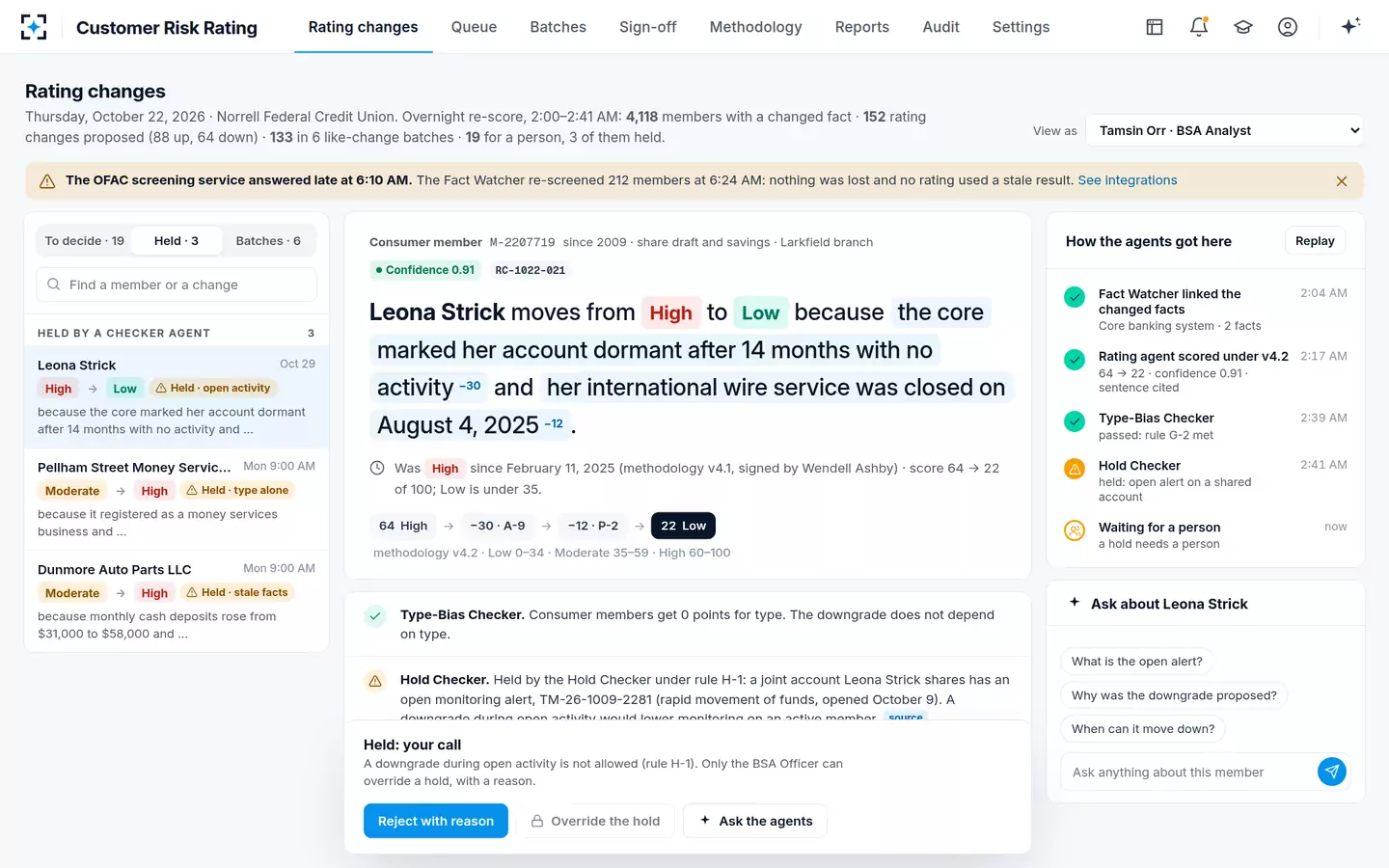
A downgrade the software should stop: lower rating, open alert on a shared account
How do you evaluate a customer risk rating tool? Ten questions
Ask each question in the demonstration, on the bank's own data if possible, and mark it pass only if the product shows the answer rather than describing it. The pass marks below are deliberately concrete.
Ten questions for a customer risk assessment software demonstration, each with a pass mark
- 1. Show why one customer sits in its tier
Pass: every factor named with its points, its evidence and where the evidence came from, in one click.
- 2. Show the customers you did not score last night
Pass: a count reconciled to the core, with reasons. "None" without a reconciliation is a fail.
- 3. Change one fact and show what happens
Pass: the customer is re-scored on the change, not at the next review date.
- 4. Propose a High that rests only on customer type
Pass: it is held or visibly flagged, with the score recomputed without type.
- 5. Propose a downgrade while an alert is open
Pass: held automatically, with the alert shown, and an override limited to a named role.
- 6. Have the same person prepare and approve a change
Pass: the system refuses. Segregation should be enforced, not policy.
- 7. Change a weight
Pass: the change is back-tested on the whole book with a tier migration table before it can score anyone.
- 8. Break a data feed
Pass: the failure is shown, affected ratings are held or re-checked, nothing silently uses stale data.
- 9. Export every change in a quarter for an examiner
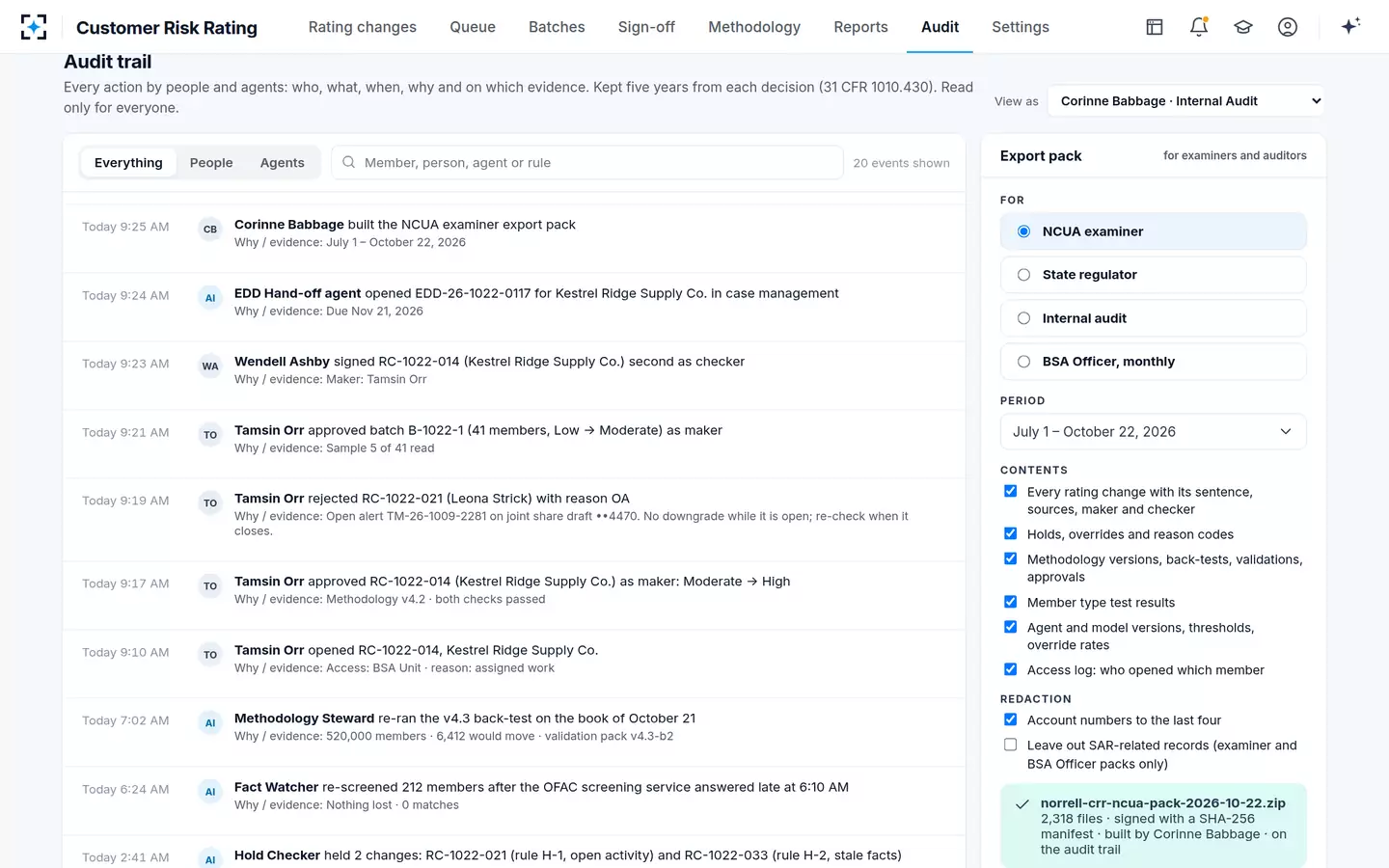
Pass: reasons, sources, method versions, both signers, redaction, and a way to show the file was not altered.
- 10. Show what a branch employee sees
Pass: no rating, alert or report is visible to customer-facing staff, so nothing can tip off a customer.
Question 4 deserves a moment with any vendor. The 2022 joint statement says no type of customer carries one uniform level of risk (2022 joint statement), yet many scorecards let type weights grow until a category is effectively pre-rated. A product that cannot show which of its High ratings would survive without the type points cannot show that it respects that statement. The arithmetic behind type caps is in the customer risk rating methodology guide.
Can customer risk scores be explained to an examiner?
They can if the software keeps the reasons when it makes the decision, and usually cannot if it does not. Explaining afterwards means re-deriving the score from data that may have changed since. The practical test is question 9: export a quarter of changes and read five at random. Each should stand on its own, with the facts, the sources, the rule version and the two signatures, so that an examiner testing individual decisions can follow each one without asking the analyst.
The examiner pack: every change with its reason, sources and signers
Does customer risk rating software need validation?
Yes in substance, though the basis depends on how it computes. Under the federal banking agencies' April 2026 model risk guidance, deterministic rule-based software falls outside the definition of a model, statistical or machine learning scoring falls inside, and generative and agentic AI are outside its scope. Whatever the label, a bank must be able to show that its ratings tell customers apart, and the honest way to show that is validation.
Bought software raises one extra problem the guidance names: "because certain components may be proprietary, banking organizations may not receive from the vendor the underlying code, data, or methodology that they would have if a model were developed internally. Nevertheless, the principles of model risk management remain applicable" (Supervisory Guidance on Model Risk Management, April 2026). Ask a vendor for the scoring logic in a form the bank's validator can test, and for outcome data, such as tier migration on the bank's own book. The full treatment is in is a customer risk rating model a model.
For AI-assisted products, the Wolfsberg Group's principle of proportionate use is a sensible bar: weigh how serious the financial crime risk is against how often the AI can be wrong, and validate how it is used and configured on a regular cycle (Wolfsberg Principles, 2022). In a rating product, that means knowing what the AI does, scoring, explaining or both, and testing that part directly.
What does customer risk rating software cost?
Published prices are rare and depend on the number of customers scored, the systems connected and the deployment, so the useful comparison is total cost: license, integration, set-up of the method, validation, and the analyst time the product leaves behind. The last item is usually the largest and the least examined.
What drives the cost of customer risk rating software, and what to ask
| Cost driver | What to ask the vendor | Why it matters |
|---|---|---|
| Customers scored | Is pricing by customer, by account or by scoring run? | Re-scoring on change multiplies runs; a per-run price punishes currency. |
| Systems connected | Which of our systems can it read in place, and which need extracts? | Every extract is a feed to build, monitor and reconcile. |
| Write-back | Can it write the signed rating to the core and to monitoring? | A rating that must be re-keyed does not change monitoring until someone does. |
| Method set-up | Who encodes our rules, and how are versions controlled? | A method that only the vendor can change is a dependency. |
| Validation | What will our validator receive: logic, data, back-test tools? | Without these, validation becomes a separate project. |
| People time | How long does one rating change take a maker and a checker? | The largest recurring cost, and the one a demonstration rarely measures. |
People time can be estimated. Our estimate for one individual rating change done by hand is about 160 minutes of an analyst's time, mostly pulling data from several systems and writing the reason, against about 20 minutes of reading and deciding with agents doing the retrieval and drafting. At the sample credit union, about 410 changes a month need an analyst one by one, which on that estimate is roughly 1,090 analyst hours a month by hand and about 140 with the agents; batched changes are on top.
People time on rating changes, at a sample credit union's scale
410
rating changes a month that need an analyst one by one, of about 3,400
~1,090
analyst hours a month at about 160 minutes each, by hand
~140
hours a month at about 20 minutes each, with the agents
$38.81
median hourly wage for compliance officers, 2025, before benefits
What the demonstration should show on your own customers
A demonstration on the vendor's sample data shows the interface; one on a sample of the bank's own customers shows the product. Bring the current method, the reason codes, the high-risk lists and a few hundred customers' facts, including some the BSA team knows well: a customer recently moved to High, one whose downgrade was refused, one with an open alert on a joint account. Then watch what the software proposes for each, and whether the explanations match what the team knows.
Technology fit is a choice, not a mandate. FinCEN's April 2026 proposal, not yet final, accepts that new technology will not suit every institution, smaller ones especially, and for that reason names and requires none (91 FR 18704). A small bank with a stable book and a well-run spreadsheet method may rationally stay with it; the questions above still apply to the spreadsheet.
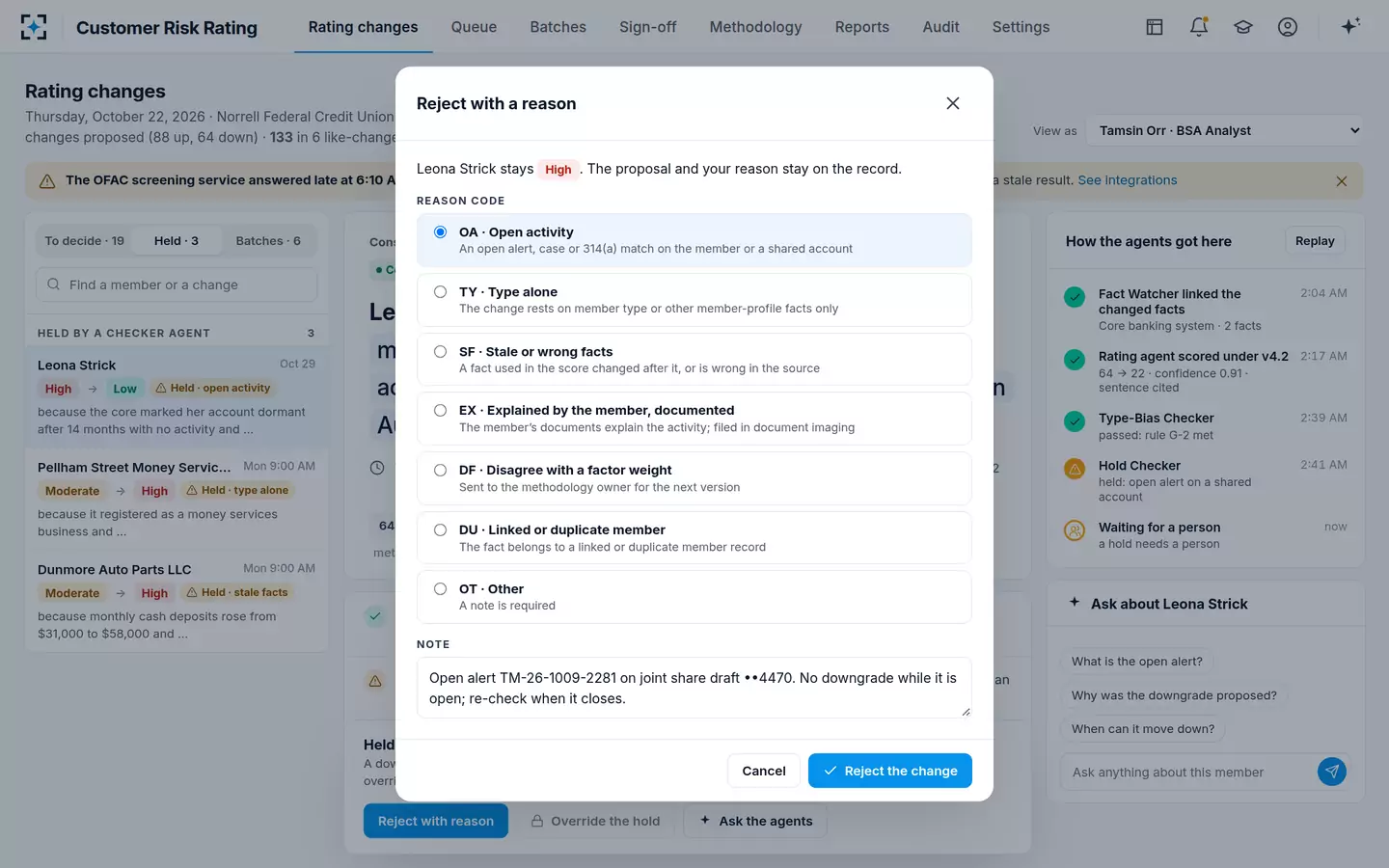
Rejecting a change with a coded reason the software keeps
Where Customer Risk Rating fits, and where another tool fits better
Customer Risk Rating fits a bank or credit union that has a rating method it trusts, runs its own core, monitoring, account-opening, screening and case systems, and wants every rating change explained in a cited sentence, held when it should be, and signed by two people. It reads those systems in place and writes the signed rating back; it does not replace them.
Another tool fits better in three cases. A bank buying a new transaction monitoring and know-your-customer suite may prefer that suite's own rating module, accepting its data model. A bank with no written method needs to write one before any software can apply it. And a bank that wants a statistical or machine learning score estimated from its own outcomes needs a modeling platform and a validation program to match; the agents in Customer Risk Rating apply the bank's rules rather than estimate new ones. To see the ten questions answered on a sample of your own members, start from Customer Risk Rating.
Questions people ask
What is the best customer risk assessment tool?
The one that passes the bank's own questions on the bank's own data. There is no independent ranking from regulators or standards bodies; the useful comparison is how each product explains a rating, holds the changes that should not go through, enforces two signatures and exports the evidence.
Is customer risk assessment software the same as KYC software?
They overlap. Know-your-customer software collects and verifies identity and ownership information and manages refresh cycles; customer risk assessment software turns that information and the account's activity into a risk tier and manages rating changes. Many suites include both, and a stand-alone rating tool reads from the KYC system.
Can a spreadsheet be customer risk rating software?
For a small book, a well-controlled spreadsheet can apply a method, and the 2026 model risk guidance excludes simple spreadsheet arithmetic from its definition of a model. The weaknesses are coverage, currency and control: spreadsheets rarely reconcile to the core, re-score on change or stop the same person preparing and approving a change.
How long does it take to implement customer risk rating software?
It depends mostly on the method and the data, not the software: writing the method as explicit rules, mapping each factor to the system that holds it, and re-rating the existing book to resolve the differences. Banks that already have a written method and clean account-opening data move fastest.
Should customer risk assessment software use AI?
It can, for retrieval, explanation and checks, provided people still decide. FinCEN's 2026 proposal neither requires nor favors any particular technology, and the Wolfsberg principles ask that AI's margin for error be weighed against the severity of the financial crime risk it touches.