An AML risk rating tool scores each customer's money laundering risk from facts about who the customer is, what it uses, where it deals and how its account behaves, and sets the tier that decides how closely the bank monitors it. The hard part is not the arithmetic. It is that the rule behind the rating asks for a customer risk profile, and a profile is something a person must be able to read, challenge and sign. A score that nobody can explain leaves the analyst re-deriving it by hand. Botminds' Customer Risk Rating puts the scoring inside one agent, the Rating agent, which scores from stated facts under the bank's approved method and writes every change as a sentence whose clauses each cite a source and a weight.
The example follows one business customer of a fictional sample institution, Norrell Federal Credit Union, through the solution on the night of October 21, 2026. Rules and research are linked where they appear.
One AML risk score, opened factor by factor
Rating before the change
Points38
The reasonModerate since March 3, 2025, under the previous method version, signed by a senior analyst.
SourceRating history
Rule A-3 · cash intensity
Points+14
The reasonCash deposits averaged $71,000 a month from July to September against $25,000 expected: more than 2.5 times expected and over $50,000.
SourceCore banking cash deposit summary
Rules G-4 and P-2 · counterparty geography
Points+15
The reasonSeven wires since August 12, $186,400 in all, to two counterparties in jurisdictions on the institution's high-risk list.
SourceWire log and high-risk list v2026-09
Score after the change
Points67
The reasonHigh, because the High tier starts at 60 under the approved method.
SourceMethod version 4.2
Type check
Points6 of 67
The reasonMember type contributes 6 points; without it the score is 61, still High. Activity and geography drive the change.
SourceRule G-2
Hold check
Pointsclear
The reasonNo open alert, case, 314(a) match or pending enhanced due diligence. A large-cash alert was closed on September 30.
SourceMonitoring and case systems
What is an AML risk rating tool?
An AML risk rating tool is software that turns a customer's due diligence information and account activity into a risk tier, usually low, moderate and high, under a method the bank approves. Its output drives two things: the thresholds and scenarios transaction monitoring applies to the customer, and whether enhanced due diligence starts. Some banks call the same thing an AML risk rating system or a customer risk scoring model; the function is the same.
The tool exists because the rule asks for it in substance if not in form. Banks must have procedures for understanding each customer relationship well enough to develop a customer risk profile, and for ongoing monitoring that maintains and updates customer information on a risk basis (31 CFR 1020.210(a)(2)(v)). A book of tens of thousands of customers cannot be profiled and kept current by hand, so the profile becomes a scored rating, refreshed by software.
Three families of tool are sold. A configurable scorecard adds points for each attribute against a table. A statistical or machine learning model estimates risk from historical outcomes. An agent, like the one in this guide, applies the bank's own scorecard rules and writes the explanation a person reviews. The difference matters for validation, covered in whether a customer risk rating model counts as a model.
How does an AML risk rating tool score a customer? One score, opened up
It adds points for each risk factor the method defines, compares the total with tier cut-offs, and records which factors moved the total. In the sample, Kestrel Ridge Supply moved from 38 to 67 of 100 because two rules fired: rule A-3 added 14 points for cash running at more than two and a half times the customer's expected level, and the counterparty geography rules added 15 for wires to two jurisdictions on the institution's high-risk list.
The rule behind the first clause is itself plain arithmetic. Rule A-3 compares the three-month average of cash deposits with the expected cash on the customer's profile: 1.5 times expected adds 4 points, 2 times adds 8, and 2.5 times and over $50,000 adds 14. Kestrel Ridge's cash ran at $64,800, $71,300 and $76,900 in July, August and September against $25,000 expected, after three months near $22,000. The tool did not decide that the cash was suspicious; it measured how far the customer had moved from what the bank was told to expect.
Each because-clause opens its source and its weight
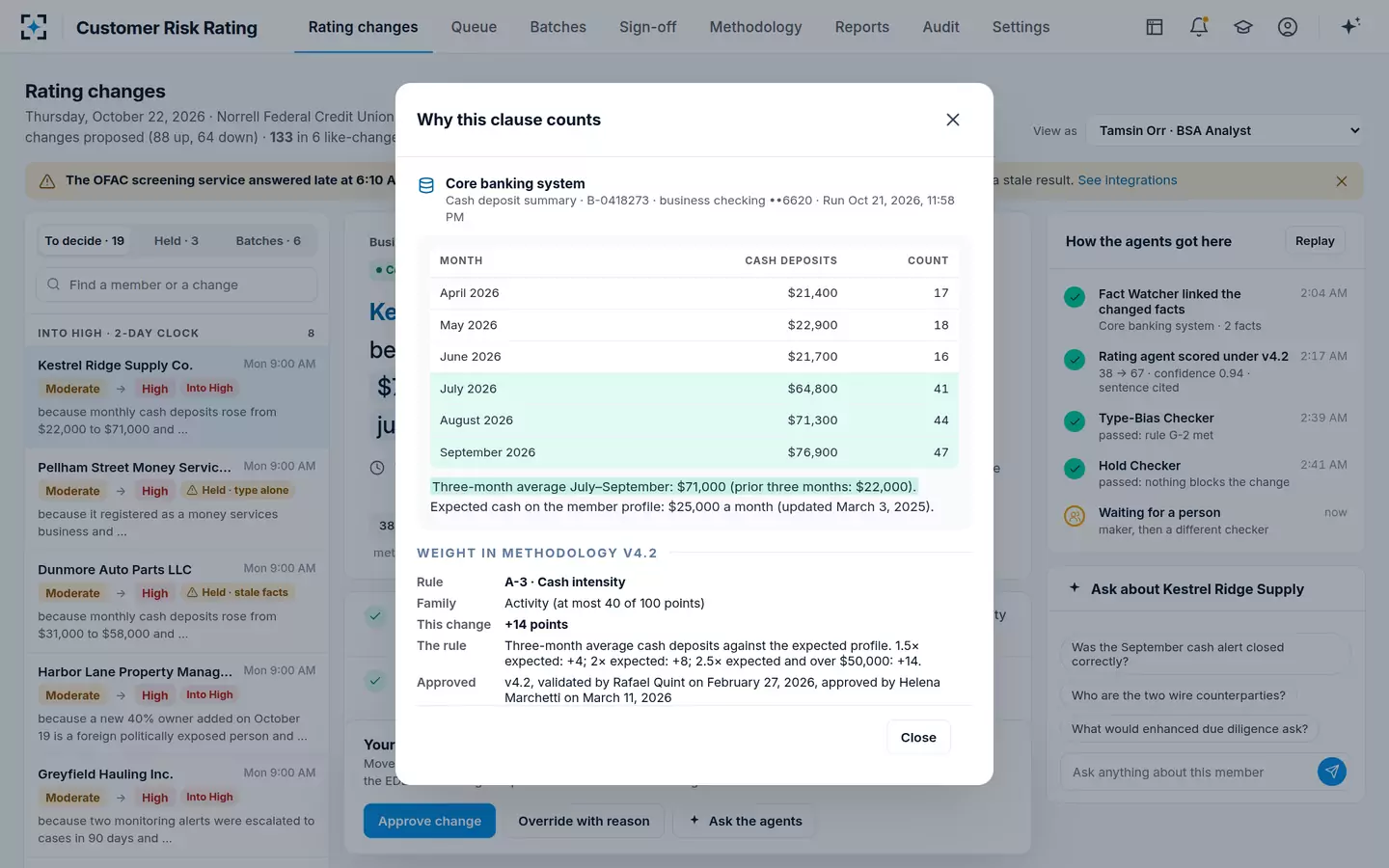
The arithmetic is the easy half. The half that takes an analyst forty-five minutes by hand is pulling the cash, wire, account and profile data from the systems that hold it and checking that nothing newer has changed the picture. The customer risk rating methodology guide works through how such weights are chosen; this page is about what the tool does with them.
A number is not a profile: what the rule asks the tool to produce
The rule asks for an understanding of the customer, and a number is only a summary of one. The FFIEC manual describes the profile as the bank's "understanding of the money laundering and terrorist financing risks of its customers," and says the program "should be sufficiently detailed to distinguish between significant variations" in those risks (FFIEC, Customer Due Diligence overview). Two customers at 67 can present entirely different risks; the score cannot tell them apart, and the reasons can.
A score from a scorecard tool, and a score that explains itself
Scorecard output: A tier and a total, sometimes a list of attributes that carried points.
Explained score: One sentence: the customer moves from one tier to another because of named facts, each with its points.
Scorecard output: Re-derived by the analyst from the core, the monitoring system and the account-opening file.
Explained score: Each clause opens the passage in the system that holds it, and the rule version that weighed it.
Scorecard output: Not stated; the next review starts from scratch.
Explained score: A reverse sentence: the conditions under which the rating returns to its previous tier.
Scorecard output: Invisible unless someone runs a separate report.
Explained score: Tested on every proposed High: the score is recomputed without the type points.
Scorecard output: Checked by memory, if at all, before a downgrade.
Explained score: Cross-checked before the change reaches a person; a downgrade during open activity is held.
Scorecard output: A summary of the first person's conclusion.
Explained score: The same sentence, sources and checks the first signer read.
The Wolfsberg Group, the association of global banks that writes standards for financial crime compliance, puts the expectation for any automated method in one line: design "should be driven by a clear definition of the intended outcomes and ensure that results can be adequately explained or proven given the data inputs" (Wolfsberg Principles for Using AI and Machine Learning in Financial Crime Compliance, 2022). A rating whose reasons are written down, and whose inputs are one click away, meets that standard whatever technique computed it.
Inside the Rating agent: facts in, sentence out
The Rating agent does one job: it scores the customer's five risk families under the approved method version and writes the result as a sentence. It does not gather data and it does not apply ratings. Another agent, the Fact Watcher, reads the core banking, monitoring, account-opening, screening and case systems each night and links each changed fact to a customer; two checkers test the proposal afterwards; people sign.
What the Rating agent reads, writes and never does
| In Customer Risk Rating | |
|---|---|
| Reads | The customer's changed facts as linked by the Fact Watcher, the rest of the customer's file, and the approved method version with its rules, weights and tier cut-offs. |
| Scores | Five families: customer profile, products and services, geography, channel and activity. Each rule that fires is kept with its points. |
| Writes | The change as one sentence; each because-clause cites its source and points; the reverse sentence; a confidence figure. |
| Flags | Any change below 0.85 confidence for close reading, so an uncertain proposal is never read at speed. |
| Never | Applies a rating, uses a method version that has not been validated and approved, or contacts the customer. |
Separating the jobs is the design choice that makes the agent reviewable. An agent that both gathered data and scored it could quietly drop an inconvenient account; one that both scored and applied would put arithmetic straight into the core banking system. Here each step leaves something a person can check: the linked facts, the sentence and the checks.
The rating change as one sentence, with both checks under it
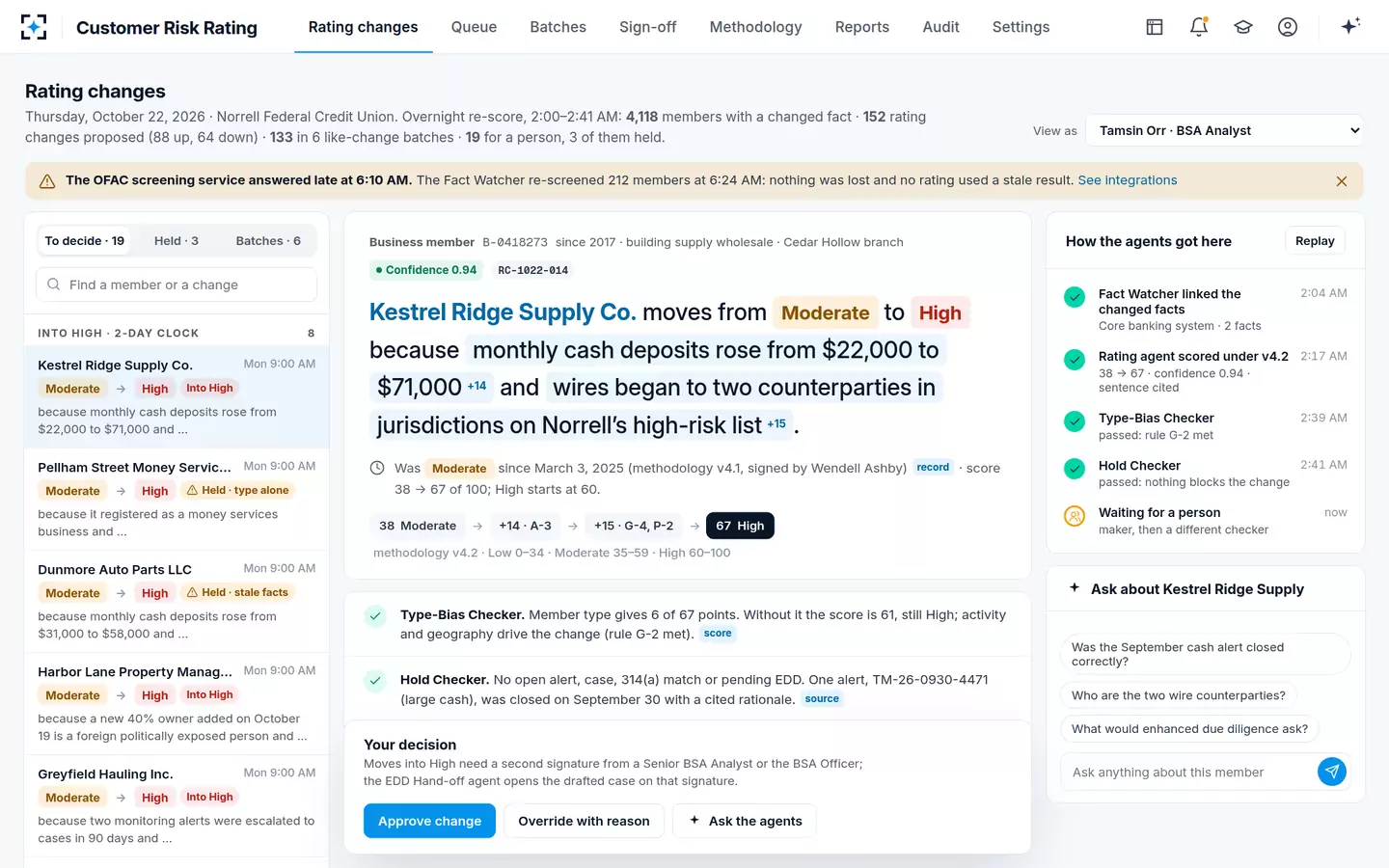
The reverse sentence: what would move a rating back
Every change the agent proposes carries a second sentence: the conditions under which the rating would return to its previous tier. For Kestrel Ridge it reads that the customer returns to Moderate only if cash deposits stay under $40,000 a month for three months and no wire goes to a listed jurisdiction for 90 days.
The reverse sentence does three jobs. It tells the analyst whether the change is driven by one month or a trend. It gives the enhanced due diligence investigator a concrete target, since an explanation for the cash that does not bring it under $40,000 will not move the rating. And it makes the next downgrade testable: when the customer is proposed for Moderate in the spring, the reviewer can check the conditions rather than re-read the whole file.
Can AI rate customer AML risk? What the agent may not do
AI can compute and explain a rating; it should not be the one who decides it. The rule puts the duty on the bank, and the Wolfsberg principles add that institutions answer for their use of AI, including every decision that relies on its analysis. The working answer is an agent that proposes and people who sign, with the agent's limits written down and enforced.
The risk of skipping the signature is real. In Treasury's December 2024 report on AI in financial services, one respondent said imprecise AI models used to detect suspicious activity had led to more accounts being closed in error, with no way for customers to appeal or get frozen funds back promptly (Treasury, Artificial Intelligence in Financial Services). That is one respondent's claim, not a Treasury finding, but it names the failure a rating tool must be built against: a consequential decision about a customer with no person who can say why.
AI also works for the other side. Treasury's 2026 national money laundering risk assessment reports FinCEN analysis showing criminals opening accounts with fake identities that appear to have been made with generative AI (2026 NMLRA). A rating tool that re-reads activity every night catches the account that looked ordinary at opening and stopped being ordinary in its third month.
One night of agent-proposed changes at a sample credit union
4,118
members with a changed fact, linked between 2:00 and 2:41 AM
152
rating changes proposed: 88 up, 64 down
19
came to an analyst one by one; the rest went into six like-change batches
0.85
confidence below which a change is flagged for close reading
What data does a risk rating tool use?
A rating tool uses the customer due diligence file and the account's behavior, and most of both already exists in systems the bank runs. The FFIEC manual's list of what to gather for higher-risk customers doubles as a list of what a rating tool should be able to read.
Data an AML risk rating tool should be able to read, and where it usually lives
- Customer type, owners and occupation or line of business
Account opening and the beneficial ownership file. Type should carry limited weight on its own.
- Expected activity: cash, wires, volumes, trade area
Account opening profile. The baseline every activity rule compares against.
- Actual cash, wire, ACH and P2P activity
Core banking and payment systems, summarized by month.
- Products and services used, and when each was added
Core banking. A new international wire service is a fact in its own right.
- Geography: where the customer is, and where its money goes
Core and wire logs, compared with the bank's versioned high-risk lists.
- Screening results for the customer and counterparties
The sanctions screening service, with its timestamps.
- Alerts, cases, SARs, 314(a) matches and pending enhanced due diligence
Monitoring and case management. Read for holds; never shown outside the BSA unit.
- Negative media and law enforcement inquiries
Where the bank runs them. Usually a reason for a person to look, not an automatic score.
Reading in place matters more than it sounds. A tool that needs its own copy of every system's data starts every night a little out of date and needs a second team to keep the copies aligned. A customer risk rating system that re-scores with the data you already hold sets out the integration side.
Is an AML risk rating tool a model?
It depends on how it computes. Under the model risk guidance the federal banking agencies issued on April 17, 2026, a "model" is a complex quantitative method applying statistical, economic or financial theories, and deterministic rule-based processes are excluded; generative and agentic AI are outside the guidance's scope altogether. A points-based scorecard applied by an agent is, on that reading, a rule-based process with an AI-written explanation on top. Validation still matters, but its basis is the bank's own risk management, not the model guidance.
Where an AML risk rating tool fits, and where it does not
A rating tool is the right purchase when the bank's problem is that ratings are stale, unexplained or slow to sign. It is the wrong purchase when the problem is upstream: if expected activity was never collected at opening, no tool can compare actual activity with it, and the first project is the account-opening profile. It is also no substitute for transaction monitoring; a rating sets how closely monitoring watches, it does not watch.
Customer Risk Rating fits a BSA unit that already has a method it trusts, wants every change explained and signed by two people, and wants the method versioned and back-tested before it scores anyone. A bank that has no method yet should write one first; the agent applies the bank's rules, it does not invent them. To see one night of changes on a sample of your own customers, start from Customer Risk Rating.
The analyst asks the agents a question, then approves as maker
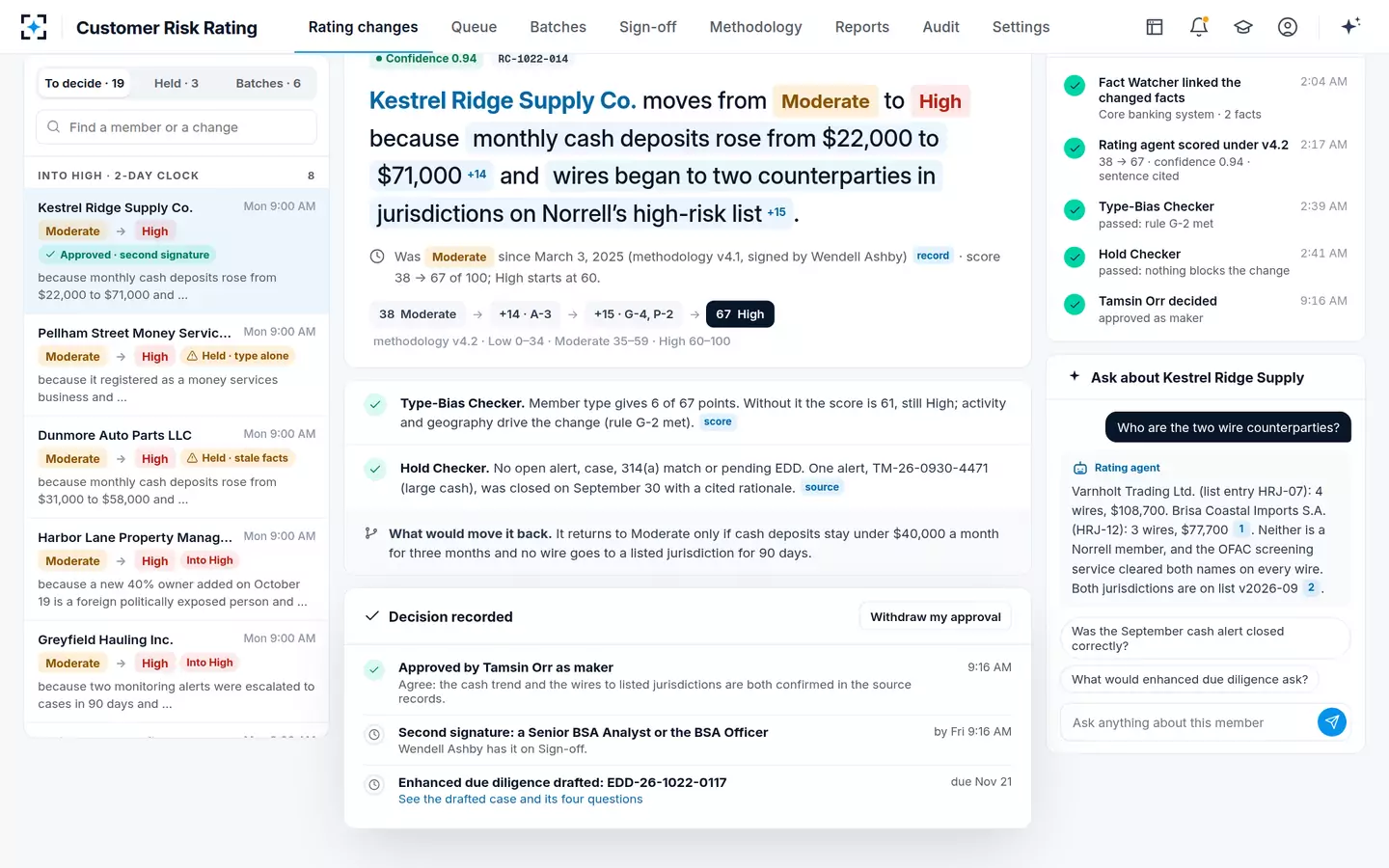
Questions people ask
How are customer risk scores calculated?
Usually by adding points for each risk factor the bank's method defines, such as customer type, products used, geography and how activity compares with the expected profile, then comparing the total with tier cut-offs. In the sample method, Low runs from 0 to 34, Moderate from 35 to 59 and High from 60 up, and a cash rule adds 4, 8 or 14 points depending on how far cash exceeds the expected level.
What is an AML risk rating system?
The same thing as a rating tool, seen as part of the bank's systems: the method, the software that applies it, the data feeds it reads and the workflow by which people approve changes. Examiners look at the whole system, because a correct score that nobody signs, or a signed score built on stale data, fails either way.
How do you explain a customer risk score to an examiner?
Show which factors produced it, the evidence for each, the method version that weighed them and who approved the result. The FFIEC manual says examiners test individual risk decisions to judge the process, so a score explained in a sentence with cited sources answers the question before it is asked.
Can a risk rating tool work without machine learning?
Yes. Many rating methods are points-based scorecards with no statistical estimation at all, and the 2026 model risk guidance excludes deterministic rule-based processes from its definition of a model. Machine learning can help find factors and weights, but the bank still has to explain each customer's result.
Should the tool rate a customer High because of its business type?
Not on type alone. The 2022 interagency joint statement says no customer type presents a single level of uniform risk. A good tool caps the points type can contribute and tests each proposed High without them; in the sample method, type carries at most 10 of 100 points.