For KYC at account opening, an expired ID is not prohibited by the federal Customer Identification Program rule, but it is not the rule's model document either. The rule gives an "unexpired government-issued identification" with a photograph as its example of what a bank may rely on, and it requires every bank's non-documentary procedures to cover an applicant who is "unable to present an unexpired government-issued identification document" (31 CFR 1020.220). So the question a bank must answer is not whether an expired ID is legal; it is what its own written procedure does when one arrives, who approves the result, and what the file shows an examiner afterwards. Botminds' CIP Verification gives the account opening and BSA teams agents that read each exception against the institution's own procedure steps, propose the route the procedure allows, and leave every resolution to a person who did not propose it.
The rule text below is quoted from the eCFR and the 2003 final rule; examples come from the solution's fictional sample credit union, whose members and figures are sample data.
Can a bank accept an expired ID for CIP?
Yes, if its CIP procedure says how, and the bank still reaches a reasonable belief that it knows the customer's true identity. The rule sets the outcome, not the document: "The procedures must enable the bank to form a reasonable belief that it knows the true identity of each customer." For documents it requires only that the CIP "set forth the documents that the bank will use," followed by an illustrative list.
The 2003 final rule made the point explicitly. The examples "were intended only to illustrate the documents a bank might use," and a bank "may use other documents, provided that they allow the bank to establish that it has a reasonable belief that it knows the true identity of its customer." The same preamble required each bank "to conduct its own risk-based analysis of the types of documents it believes will enable it to know the true identity of its customers" (68 FR 25090, May 9, 2003).
What a bank may not do is rely on an expired document as if it were the rule's example, without a written step that allows it and without the other evidence that step requires. An expired license still carries a photo, a name, a date of birth and a number that can be checked against other sources. It is weaker evidence, not worthless evidence, and the procedure has to say how much weight it carries.
What the CIP rule says about an expired ID, clause by clause
The rule never uses the word "expired." It uses "unexpired" twice, and its recordkeeping section asks for an expiration date. Read together, the four clauses below are the whole federal answer.
Four clauses of the CIP rule that decide what happens to an expired ID
| Clause | What it says | What it means for the procedure |
|---|---|---|
| (a)(2)(ii)(A)(1) | Documents "may include … unexpired government-issued identification evidencing nationality or residence and bearing a photograph or similar safeguard, such as a driver's license or passport." | An example, not an exhaustive list. An expired license is outside the example, so the procedure must say whether and how it is used. |
| (a)(2)(ii)(B)(2) | Non-documentary procedures "must address situations where an individual is unable to present an unexpired government-issued identification document." | Every CIP must have a written route for this applicant. Having none is a gap in the program. |
| (a)(2)(ii)(B)(1) | Methods "may include contacting a customer; independently verifying … through the comparison of information provided by the customer with information obtained from a consumer reporting agency, public database, or other source." | The usual corroboration for an expired ID: a database match, a call to a number the bank sourced, or a second document. |
| (a)(3)(i)(B) | The record must describe any document relied on, including "the date of issuance and expiration date." | An expired document the bank relied on is visible in the file to every reviewer and examiner who opens it. |
The 2003 proposal described who the second clause was written for: situations "where an individual, such as an elderly person, legitimately is unable to present an unexpired government-issued identification document." The rule anticipated that some honest applicants would not have a current photo ID, and required banks to plan for them rather than turn them away by default.
Three policy positions a bank can write for an expired ID
Banks land in one of three places, and each is defensible if it is written, applied consistently and evidenced in the file. The choice is a risk decision for the BSA officer, approved under the bank's CIP governance, not a decision for each branch or each analyst.
Expired ID at account opening: three positions, and what each costs
| Position | How it works | What the file must show | Trade-off |
|---|---|---|---|
| 1. Not relied on; ask for a current ID | The expired document is noted but not used; the applicant uploads or brings one current government photo ID. | The current document, with its issue and expiry dates; the expired one recorded as not relied on. | Cleanest file; slowest for the applicant, and a route the rule still expects for those who cannot get one. |
| 2. Relied on with corroboration | The expired ID is accepted as the documentary method if a non-documentary check also matches, often within a stated period after expiry. | The document with its expiry date, the step that permits it, and the non-documentary method and result. | Keeps good applicants moving; the step needs a clear limit and a second method, or examiners will question it. |
| 3. Supporting evidence only | Identity is verified non-documentarily; the expired ID helps resolve discrepancies but is not the method relied on. | The non-documentary methods and results; any discrepancy resolved with the expired ID described. | Works online and for thin files; depends on data sources that may not cover every applicant. |
Whichever position a bank takes, the procedure should name the exceptions to it. An applicant whose license has been renewed but has only the expired card and a state renewal receipt is different from one whose license expired years ago. An older applicant with a passport that lapsed and no driver's license is the case the 2003 preamble had in mind. A step that treats all three the same will either reject people it should accept, or accept files it cannot defend.
What NIST says about expired identity evidence
Federal identity standards reach the same conclusion from the technical side: an expired document can still prove identity, and the organisation relying on it decides whether that is acceptable. NIST's digital identity guidance treats validity as a policy question for the verifier.
"Evidence can remain a useful means to prove identity, even if it is expired or was issued outside of a determined time frame."
NIST SP 800-63A-4, Digital Identity Guidelines: Identity Proofing and Enrollment, section 2.4.2
The same section says identity services "define their policy for addressing expired evidence," and the organisations relying on them "determine whether this is acceptable." For a bank that buys document verification from a vendor, that is a useful frame. The vendor's default may reject every expired document; the bank's CIP procedure, not the vendor's setting, decides what happens next, and the two must agree. A procedure that allows expired licenses with corroboration is not being followed if the online channel's document check stops every expired card before a person sees it.
How should the expired-ID step be written into the CIP procedure?
As a numbered step with its own scope, methods, message and approver, so that a branch representative, an online reviewer and an examiner read the same answer. The checklist below is what a complete step covers.
What a complete expired-ID step in a CIP procedure states
- Scope
Which documents and how far past expiry: a license expired last month, a passport expired five years ago, a renewal receipt in hand.
- Channels
Whether the step applies in branches, by phone and online, and how each channel reaches it, including what the online document check does.
- Position
Not relied on, relied on with corroboration, or supporting evidence only, with the reason.
- Corroborating methods
Which non-documentary methods count and how many must match: credit bureau header, public database, a call or code to a number the bank sourced, a second document.
- Applicant message
An approved, plain request for what is needed, without suggesting the applicant is suspected of anything.
- Approver
Who may approve the resolution, separate from who proposed it.
- Account terms while pending
Whether the account may be used, and with what limits, while verification completes, as the lack-of-verification clause requires.
- When to stop
When the bank does not open, when it closes after failed attempts, and when the matter goes to the BSA officer for a SAR decision.
- What is recorded
The document with its expiry date, the methods and results, and how any discrepancy was resolved.
The "when to stop" item is not optional. The rule requires procedures describing "when the bank should not open an account," the terms under which an account may be used while verification is attempted, "when the bank should close an account, after attempts to verify a customer's identity have failed," and when a SAR should be filed. An expired-ID step that ends with "ask for a current ID" and no outcome if the applicant never sends one leaves accounts open on unverified identities.
A request for a current ID, drafted from the procedure and approved before it is sent
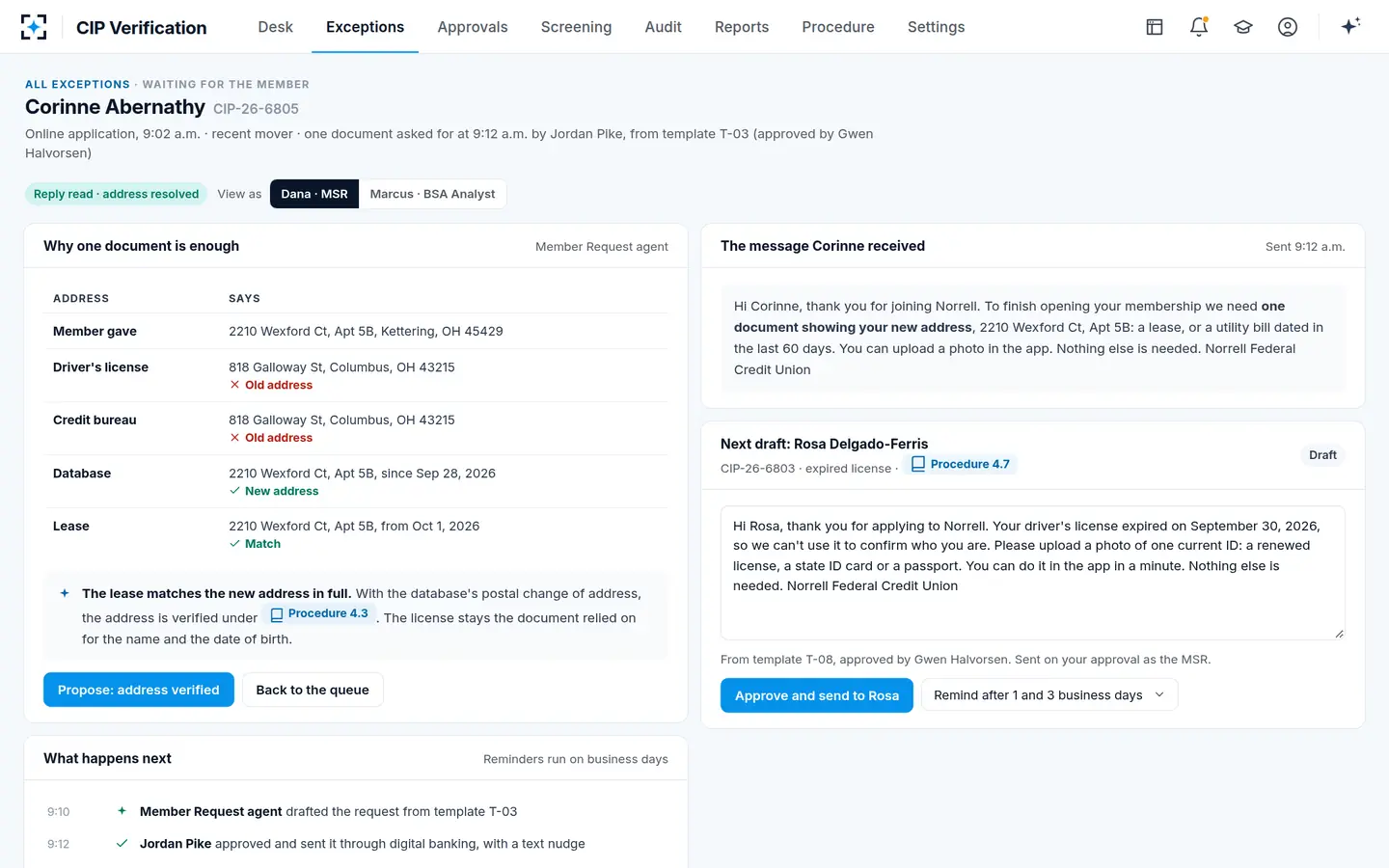
Branch and online: where an expired-ID policy breaks
Most inconsistency comes from channels, not people. In a branch, a representative can look at a second document and follow the procedure step; online, an automated document check usually decides first, and its settings may not match the written policy.
The same expired-ID step, applied at a branch and online
At a branch: A representative, who can ask for a second ID or a bill.
Online or in the app: An automated document check, then a person only if it refers the file.
At a branch: The representative follows the written step.
Online or in the app: A check configured for current documents stops; the applicant is asked for another ID or dropped.
At a branch: Second document, database match, a call to a number the bank finds itself.
Online or in the app: Database match, one-time code, upload of another document, video or branch visit.
At a branch: Representatives improvising a route the procedure does not name.
Online or in the app: Vendor settings stricter or looser than the written step, with no one reconciling the two.
The test is simple: take the written expired-ID step and run three files through each channel. If the branch opens an account the app would have rejected, or the app opens one the branch would have escalated, the bank has two policies and has written down one. Examiners notice, because the record shows the channel and the method for every file.
What the CIP file must show when the ID was expired
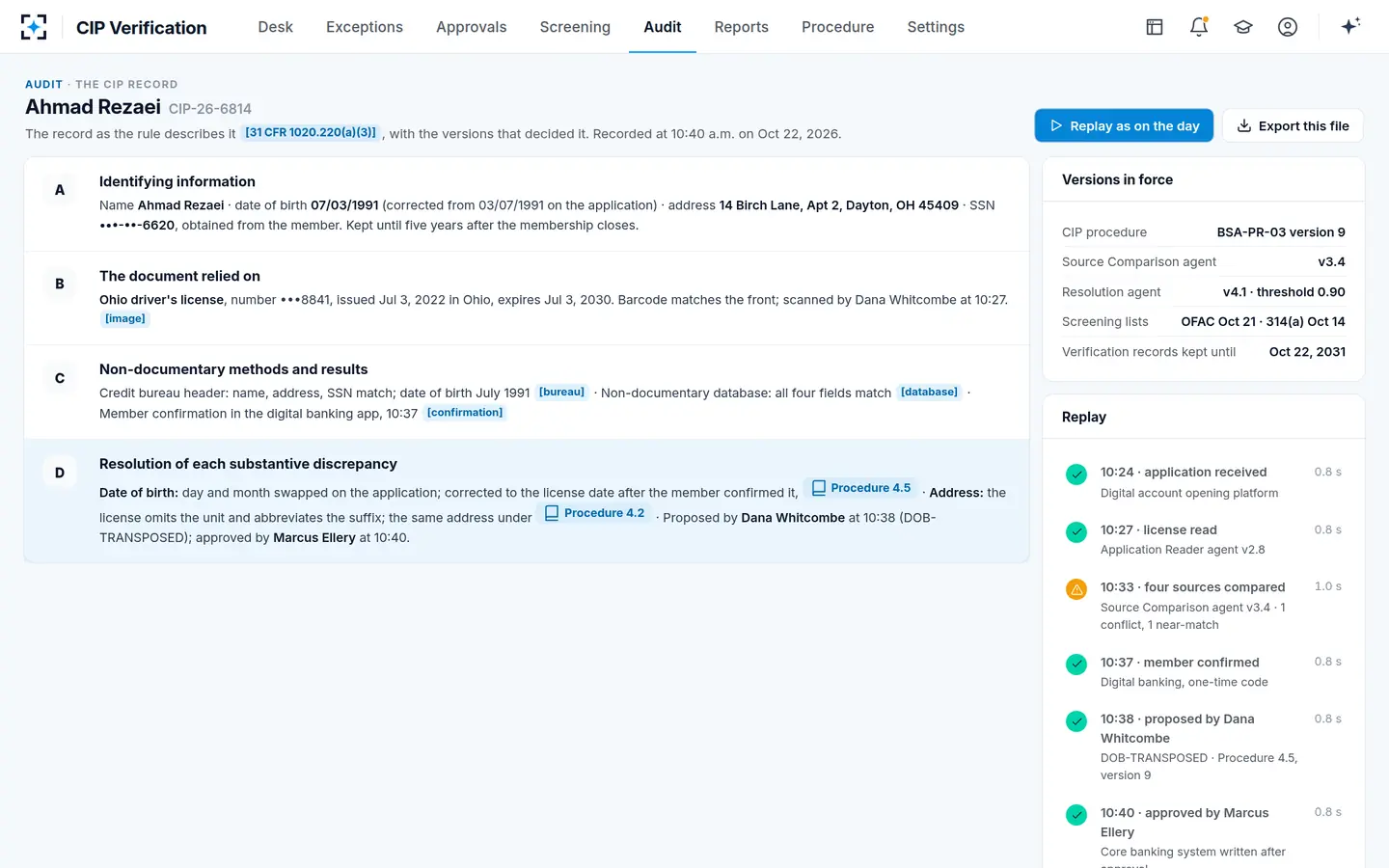
Four things, from the rule's recordkeeping clause: all identifying information obtained; a description of any document relied on, with its type, number, place of issuance and "the date of issuance and expiration date"; the methods and results of any non-documentary verification; and how each substantive discrepancy was resolved. The documents and methods are kept five years after the record is made; the identifying information, five years after the account closes.
An expired ID therefore shows up in two places an examiner reads: the expiry date on the document described, and the method that compensated for it. A file that relies on a license expired two years earlier, with no non-documentary method recorded, tells the examiner that the procedure either allows reliance on stale documents alone or was not followed. What examiners sample in CIP testing shows how likely such a file is to be picked.
The CIP file in four parts, as the rule lists them
Why the expired-ID policy is also an access decision
Because missing identification keeps people out of the banking system, and the households it affects most are the ones a bank's outreach is often trying to reach. In the FDIC's 2023 survey, 13.0% of unbanked households cited not having the identification required to open an account as a reason; among households that had never had an account, the share was 20.4%, against 4.8% for those that had been banked before (FDIC, 2023 National Survey of Unbanked and Underbanked Households).
Missing ID keeps some households out of banking altogether
13.0%
of unbanked households cite not having the ID required to open an account
20.4%
of never-banked households cite it
4.8%
of previously banked unbanked households cite it
An expired ID is a narrower problem than no ID, but it falls on the same groups: older customers who no longer drive, people between addresses, people waiting on a renewal. A bank that takes position 1 should make sure the current-ID request comes with a route for applicants who cannot get one quickly, as the rule's non-documentary clause expects. A bank that takes position 2 or 3 should measure whether the corroborating sources cover those same applicants, because a database check fails most often on thin files.
Existing customers, and IDs that expire after the account is open
The CIP rule applies at account opening, to a "customer" as the rule defines it, and the definition excludes "a person that has an existing account with the bank, provided that the bank has a reasonable belief that it knows the true identity of the person" (31 CFR 1020.100). An existing customer who opens a second account with an expired license may not need to be re-verified at all, if the bank's procedure says the first verification stands.
An ID that expires after opening does not reopen CIP. Whether the bank asks for a current document later is a question for its customer due diligence program and its refresh triggers, not for the CIP rule. Banks that set an expiry-driven refresh should say so in the CDD procedure, not leave it as an informal practice that applies to some files and not others.
How CIP Verification handles an expired ID
In CIP Verification, an expired ID becomes one exception in a queue, labelled with the rule's own situation and the step of the institution's procedure that applies. The agents read the document, compare its fields with the application, the credit bureau header and the non-documentary database, mark the document as expired rather than treating its data as wrong, and propose only what the cited step allows. When no step fits, or confidence is below 0.90, they hand the file to a person.
An expired license as one row in the CIP exception queue
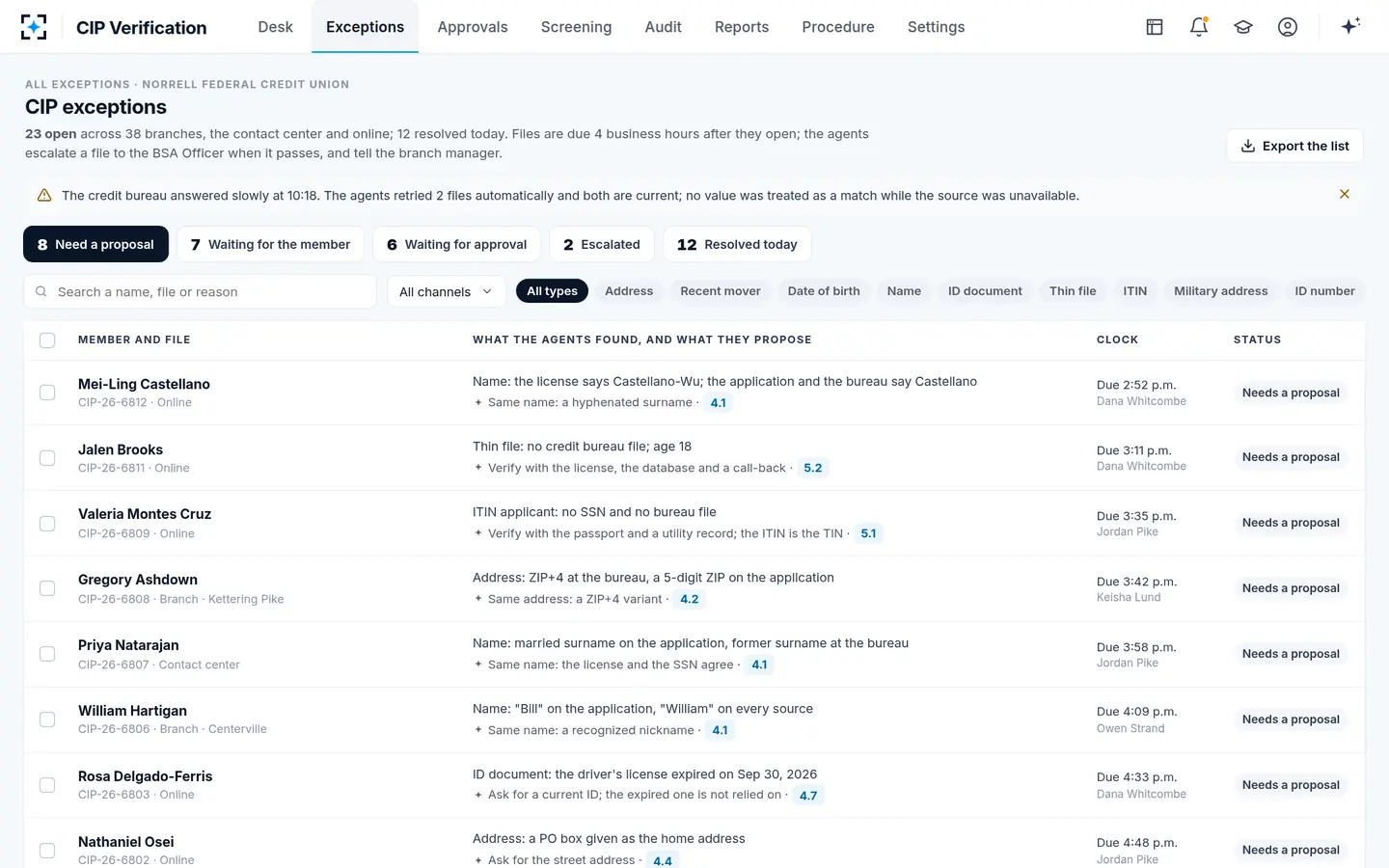
A member service representative proposes the resolution and a BSA analyst who did not propose it approves; the core banking system is written only after approval. A bank that takes position 2 instead of position 1 writes that as its step, and the agents propose it the same way, with the corroborating method recorded beside the expiry date. The route an expired ID takes is one of several the rule names; the CIP exceptions guide covers the others, and identity verification for banks covers the non-documentary methods in depth. The whole solution is on the CIP Verification page.
Questions people ask
Does the CIP rule require an unexpired ID?
No. It gives an unexpired government-issued photo ID as an example of a document a bank may rely on, and requires non-documentary procedures for applicants who cannot present one. The bank's written CIP decides which documents it uses.
Can a bank accept an expired passport for KYC?
Only if its procedure allows it, usually with a second method. The CIP record must describe the document relied on, including its expiration date, so a reviewer will see the expiry and look for the step and the corroboration that supported it.
Should a bank set a grace period for expired IDs?
The rule neither requires nor sets one. A bank that takes the corroboration route often states a period after expiry within which a document may be relied on with a second method; the period is a risk decision the BSA officer should document and apply in every channel.
Does an expired ID have to be reported as suspicious?
No. An expired ID is a verification exception, not a red flag in itself. The CIP must say when the bank should file a SAR after it cannot verify identity; that decision belongs to the BSA function, and nothing about it should appear in messages to the applicant.
How long must the bank keep the description of an expired ID it relied on?
Five years after the record is made, under 31 CFR 1020.220(a)(3)(ii). The identifying information itself is kept five years after the account closes.
Does a customer's ID expiring after account opening require new CIP?
No. CIP applies at opening. Whether to collect a current document later is a customer due diligence decision, set by the bank's refresh triggers rather than by the CIP rule.