Agentic AI in third-party risk management is the use of AI agents that complete multi-step oversight tasks rather than answer one question: an agent takes a partner's files, re-runs the checks, reconciles the numbers, investigates a difference, drafts a finding and tracks the fix, handing each decision to a named person. For a sponsor bank overseeing fintech partners, the hard part is not speed but honesty about gaps: when a partner's evidence is missing or ambiguous, a useful agent asks the partner a specific question, through a person, rather than filling the gap with a plausible guess. US regulators allow banks to use such tools, and generative and agentic AI sit outside the April 2026 model risk guidance, so the controls are the bank's to design. Botminds' BaaS Compliance is built on that design: seven agents re-perform partner files, tie partner records to FBO accounts, explain breaks, review SAR referrals and draft findings, and each has written limits on what it may never do.
Examples come from a fictional sample bank, Tessaly Community Bank, and its 11 fintech partner programs; every person, partner and figure in them is sample data. The regulatory statements are quoted from the agencies and linked where they appear.
When evidence is missing, the agent asks: one break, from question to decision
Agent
ReconcilerTies the partner's end-customer file to the FBO account at close: $22,790.75 unexplained since October 14. The partner's reply calls it timing.
Never: nets a difference away, or accepts timing without a matching payment.
Agent
Break explainerSearches settlement files, the payments hub and the general ledger; finds 23 card funding reversals that sum to the cent. Proposes the cause with its evidence, confidence 0.86.
Never: closes a difference; it proposes a cause only when the amounts tie exactly.
A person decides
Partner oversight analystAsks the partner to confirm the 23 reversals by name, instead of asking it to explain "the difference" again.
Agent
Referral reviewerChecks the outgoing message for anything that would reveal a SAR or a referral to investigators before it is sent.
Never: tells a partner whether a SAR was filed.
A person decides
Analyst and BSA OfficerAccept the cause once the partner confirms; the fix closes only after three daily tie-outs in a row at $0.00.
What is agentic AI in third-party risk management?
Agentic AI in third-party risk management is software that takes a goal, such as "test this partner's fourth-quarter onboarding," plans the steps, uses tools and data to carry them out, and returns evidence and a draft for a person to decide on. The difference from earlier automation is scope. A questionnaire portal collects a partner's answers; a scoring model rates them; an agent re-does the partner's work with the bank's own sources and says where the answers were wrong.
In the language of the 2023 Interagency Guidance on Third-Party Relationships, agents mostly serve the ongoing monitoring stage, which, where risk warrants, may include testing the third party's own controls directly (88 FR 37920). They can also support due diligence before a partner is signed, by testing sample files, and termination, by keeping the end-customer records a bank would need to move accounts. They should not own the decisions the guidance assigns to management and the board.
How is AI used in third-party risk management today?
AI is already used in financial crime compliance, and banks mostly buy it from third parties, which is why third-party risk management governs it. Treasury's December 2024 report on AI in financial services, built from responses to a request for information, found AI in wide use for AML/CFT and sanctions work, from analysing large data sets and spotting anomalies to flagging suspicious activity and verifying identities, with generative AI already helping investigation platforms gather and summarise case data and draft and file reports (Treasury, December 2024).
The same report notes that because firms rely on externally developed AI, respondents "emphasized the need for financial firms to rely on their third-party risk management (TPRM) processes and conduct robust due diligence," and "generally agreed" the 2023 interagency guidance "addressed many risks of third-party AI models and systems." So agentic AI enters TPRM twice: as a tool for overseeing partners, and as a vendor to be overseen. The neighbouring guide on AI agents for fintech partner oversight covers the second for lending programs.
Is AI allowed in vendor due diligence?
Yes. No US banking rule prohibits AI in due diligence or monitoring, and the agencies have said they will not penalise careful experiments. The 2018 joint statement by the Federal Reserve, FDIC, FinCEN, NCUA and OCC says a pilot that fails is not, by itself, grounds for supervisory criticism, and that AI finding activity the old process missed does not by itself prove the old process deficient (Joint Statement on Innovative Efforts, December 2018). The same statement says banks that choose not to innovate will not be criticised, and that management must still consider "third-party risk management" when adopting new approaches.
Responsibility does not move with the tool. The 2023 guidance allows banks to "engage external resources" for monitoring, and says use of external parties "does not abrogate the responsibility of the banking organization" (88 FR 37920). FinCEN's April 2026 proposal to rewrite the AML program rule would go further, counting machine learning and generative AI among innovative approaches and saying responsible experiments with them would not, on that ground alone, add to an institution's enforcement risk (91 FR 18704). That proposal is not final.
Is agentic AI covered by model risk guidance?
No. The revised model risk management guidance the OCC, the Federal Reserve and the FDIC issued on April 17, 2026 leaves generative and agentic AI out of its scope, calling both too new and fast-changing, and says the agencies plan a request for information on model risk and on banks' use of AI, generative and agentic AI included (OCC Bulletin 2026-13). As of late October 2026 we found no such request published.
The gap leaves a bank to set its own controls, and three public frameworks give it a vocabulary. The NIST AI Risk Management Framework, "intended for voluntary use," with a generative AI profile issued in July 2024 (NIST). Treasury's February 2026 Financial Services AI Risk Management Framework, which tailors the NIST framework to financial services (Treasury, February 19, 2026). And the Wolfsberg Group's five principles for AI in financial crime compliance, whose fourth says institutions "are responsible for their use of AI/ML, including for decisions that rely on AI/ML analysis, regardless of whether the AI/ML systems are developed in-house or sourced externally" (Wolfsberg Group, 2022).
Why the useful agent asks instead of guessing
The useful agent asks because the guidance treats a gap in evidence as something to document and address, not to paper over. The 2023 guidance says that when a bank "may not be able to obtain the desired due diligence information," it should "identify and document any limitations," understand the risks, and consider alternatives such as "additional controls on or monitoring of the third party" (88 FR 37920). An agent that infers a missing identity result, or labels an unexplained difference as timing because that is the usual answer, converts a documented gap into an undocumented one.
In practice "asking" has three forms. When a re-performed check comes back below a confidence threshold, the agent hands the file to an analyst rather than deciding; in the sample bank that threshold is 0.92. When evidence is missing from the partner's file, the agent says which item and why it matters, and the analyst requests it. When the agent has found a likely cause, as with the 23 card reversals in the flow above, it turns a vague question into a specific one the partner can confirm or refute. In each case a person sends the message, and nothing reaches a partner until a named person approves it.
What does a sponsor bank need from a fintech?
A sponsor bank needs the partner's raw operating data, not its summaries: per-customer balances and transactions, onboarding evidence, alerts and referrals, settlement files and notice of changes. The agencies' 2024 request for information lists the kinds of information banks receive, "key performance indicators, product-level data, service levels, end-user information, key risk indicators, consumer complaints, fraud monitoring metrics, or KYC/CIP information," and asks what challenges banks face in "timely access to customer information" (89 FR 61577).
What agents need from a fintech partner, and what each lets the bank prove
| From the partner | How often | What the agents do with it | What the bank can then prove |
|---|---|---|---|
| End-customer balance and transaction file | Daily, by a set time | Rebuild every balance and tie the total to the FBO account | It can name every end customer and what each is owed |
| Onboarding files with raw identity responses | Daily, or on request for the sample | Re-run identity, OFAC and due diligence checks with the bank's sources | Its CIP was followed, file by file, or where it was not |
| Card processor and payment settlement files | Daily | Match reversals, returns and fees to explain any difference | Why a break exists, to the cent |
| SAR referrals with detection dates | As made, within the agreed window | Check completeness and timeliness; open them for the bank's investigators | Referrals arrive on time and complete |
| Change notices and release notes | Before each release | Flag changes to onboarding, monitoring or data flows for review | Control changes were reviewed before they reached customers |
| Remediation evidence | When the partner says an item is fixed | Re-test the files the fix should have corrected | The fix works, not just that it was promised |
Can AI review fintech partners? What agents do, and what stays with people
AI can review fintech partners' work in the sense that matters most, re-performing it at a coverage no team could match by hand, but it should not decide what the bank does about the result. The Wolfsberg principles and the 2023 guidance both keep accountability with the institution and its people. The practical line is between testing and drafting on one side, and approving, restricting, closing and communicating on the other.
BaaS Compliance: what the agents do, and what people decide
The agents: Pick each quarter's files by risk: high-risk applicants, new accounts and a draw across the book, weighted by tier.
Named people: The BSA Officer approves every plan; a top-up is a new plan.
The agents: Re-run identity, OFAC and due diligence checks with the bank's sources; test the whole population when failures share a cause.
Named people: The analyst agrees or disagrees with each failure, with a reason code the BSA Officer sees; under 0.92 confidence the analyst decides.
The agents: Tie each partner to its FBO account daily, rebuild every balance, propose the cause of any break.
Named people: A person accepts a cause only after the partner confirms; no one can accept timing without a matching payment.
The agents: Check completeness and timeliness; check every partner message for anything that reveals a SAR.
Named people: The bank's investigators and BSA Officer decide and file.
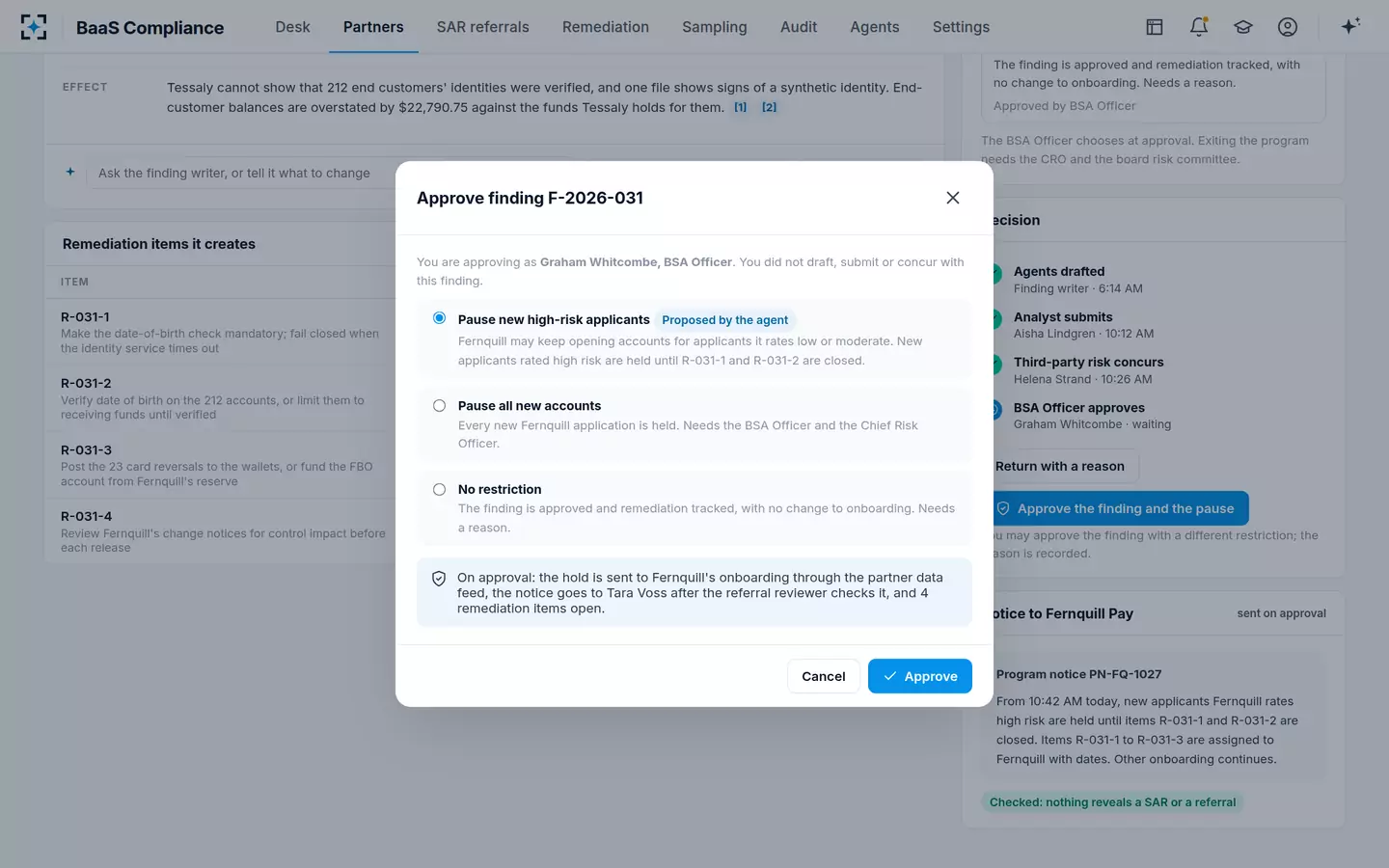
The agents: Draft condition, criteria, cause and effect with citations; propose the narrowest restriction.
Named people: Analyst submits, third-party risk manager concurs, BSA Officer approves; a full pause also needs the Chief Risk Officer.
The agents: Remind owners, check uploaded evidence, re-test after a fix, escalate overdue items.
Named people: A person closes each item; no agent extends a date.
The BSA Officer approves from a ladder the agents proposed but cannot choose
How do you monitor fintech partners with agents? One morning, timed
You monitor fintech partners with agents by letting them do the overnight and early-morning work, re-performance, tie-outs, break investigation and drafting, so that people start the day with decisions rather than data requests. In the sample bank's morning, the agents' part took twelve minutes and the people's part took twenty-nine; the hours between were the queue.
One partner finding, from first test to approved restriction
- Agents, 12 min: population test, tie-out, break, draft
- Waiting for the analyst's dayabout 4 hours
- People: submit, concur, approve29 min
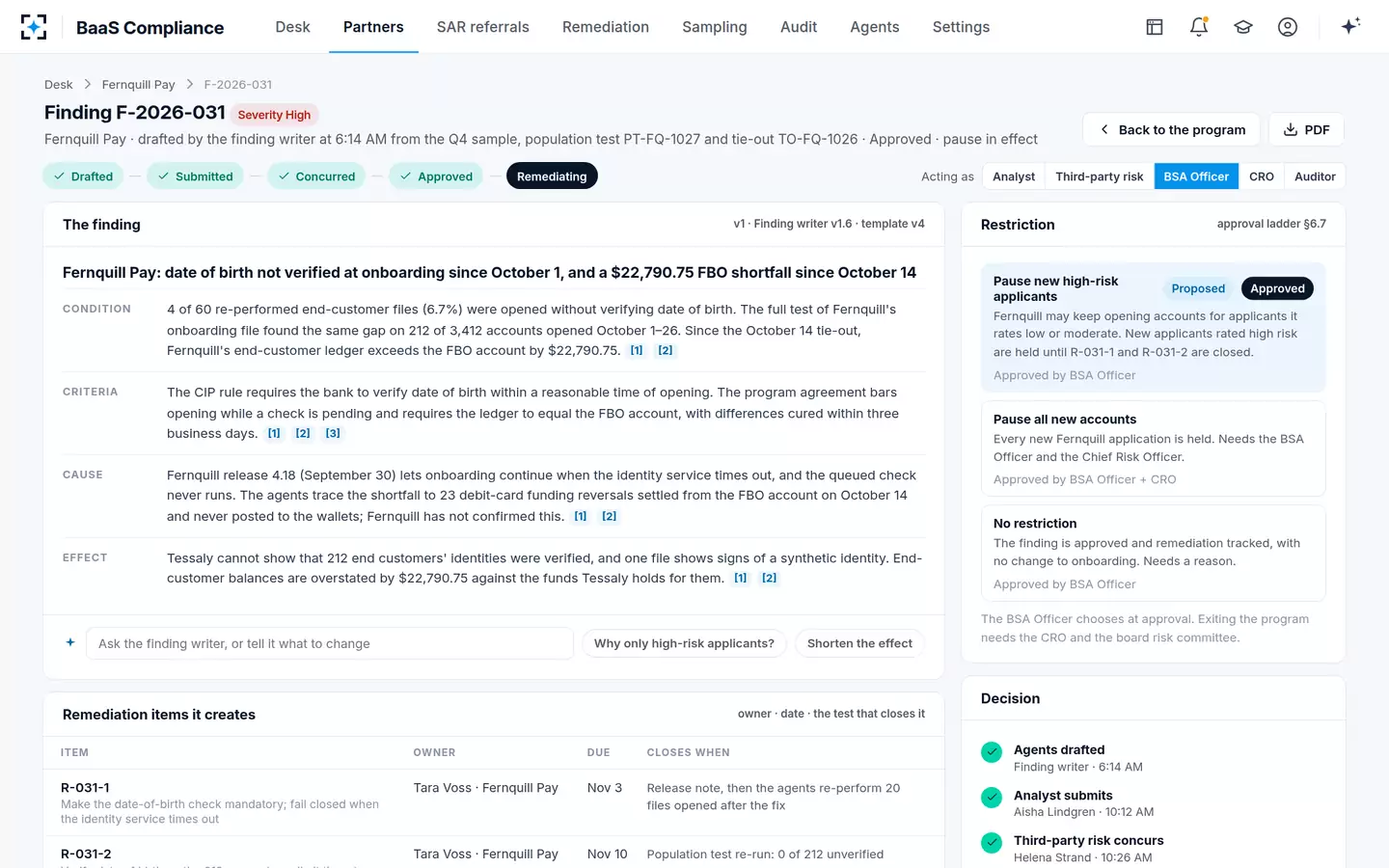
The order of work matters as much as the speed. Because the population test ran before the finding was drafted, the finding described 212 affected accounts rather than four failed files, and proposed a restriction scaled to that. Because the break was explained before the analyst arrived, her first message to the partner was a request to confirm 23 named reversals.
Where agents must stop: the SAR wall and restrictions
Agents must stop short of anything that would reveal a SAR, and of any action that changes a partner's business. The SAR rule bars the bank, its staff and its agents from disclosing a SAR or anything that would reveal one (31 CFR 1020.320(e)). An agent that drafts partner messages is exactly where an accidental disclosure could start, which is why, in the solution, a separate agent checks every outgoing message and the partner-facing status is locked to "Referral received" or "Review complete." The Wolfsberg principles make the same point about AI transparency: it should not "breach reporting confidentiality requirements."
Approved, and the partner told only what it may know
What to ask an agentic AI vendor for third-party risk management
Ask an agentic AI vendor to show, on your own partner files, what its agents test, what they never do, and how you would prove both to an examiner. Marketing claims about accuracy are less useful than the answers below, and a vendor that cannot answer them on your data is selling a demo. How to pilot fintech compliance software on one partner's last quarter turns these questions into a test plan.
Questions for any agentic AI vendor in sponsor-bank oversight
- What does each agent never do?
Written limits per agent: no approvals, no partner messages, no closing differences or remediation, no SAR decisions.
- Whose sources does it test with?
The bank's identity service and OFAC list history as of the opening date, not the partner's own results.
- What happens below its confidence threshold?
A named threshold, and a person decides every case under it.
- What does it do when evidence is missing?
It says what is missing and why, and a person asks the partner; it does not infer the answer.
- Can every sentence it drafts be traced?
Each test result, total and finding sentence cites the rule, agreement section or partner record behind it.
- How are versions controlled?
Pinned versions, testing on last quarter's files before go-live, approval by the BSA officer, and every override logged with a reason.
- How is the SAR wall enforced?
A locked partner-facing status and a check on every outgoing message, with held drafts listed.
- What will the examiner see?
A trail of who, what, when, why and which evidence, for people, agents and partners, exportable as a pack.
Where BaaS Compliance does not fit matters too. It is not a transaction monitoring system and does not replace the bank's own alerts on its FBO accounts; it is not an identity vendor; and it does not decide or file SARs, which stay in the bank's case management. It is the layer that tests the partner's work and keeps the evidence. The BaaS compliance overview places it in the full program.
Questions people ask
What is the difference between agentic AI and a TPRM chatbot?
A chatbot answers questions about information it is given; an agent carries out a task with tools, such as re-running identity checks or reconciling settlement files, and returns evidence. In sponsor-bank oversight the chatbot can summarise a partner's attestation; the agent can show whether it was true.
Do examiners accept AI-drafted findings?
Examiners judge the bank's process and evidence, not who typed the draft. A finding a named person reviewed, submitted and approved, with every sentence cited to a rule or record, is the bank's finding. The 2018 joint statement says adopting new approaches does not, of itself, raise what regulators expect of a bank.
Does the AI need to be validated like a model?
Generative and agentic AI are outside the April 2026 model risk guidance, so no specific validation regime applies; the agencies plan a request for information. Sound practice is still to test each version on known files before use, monitor its performance, and record overrides, as the Wolfsberg principles and NIST's framework describe.
Can an AI agent talk to a fintech partner directly?
It can draft, but in a defensible design a person sends. In BaaS Compliance no agent messages a partner; every message is approved by a named person and checked for anything that reveals a SAR before it goes.
Is agentic AI third-party risk management only for large banks?
No. The 2023 guidance expects oversight scaled to risk, not to size, and community banks run many BaaS programs; the FDIC estimated 600 to 1,100 insured institutions hold the kind of custodial accounts these programs use. A smaller team gains more from agents that do the mechanical work, which is the case BaaS Compliance is built for.