Under Regulation B an incomplete credit application has exactly two lawful endings, and the choice is the lender's. Within 30 days of receiving an application that is incomplete "regarding matters that an applicant can complete", the creditor must either notify the applicant of action taken — approval, counteroffer or adverse action — or send a written notice of incompleteness that meets section 1002.9(c)(2). What it may not do is let the file sit. And where the application was missing information but the lender had enough to decide anyway, a third option disappears: "incomplete application" can no longer be the reason on the letter. Botminds' Adverse Action Notice Automation keeps every waiting file on its own clock, shows what was asked of the applicant and when, and will not let a notice pass its date in silence.
The examples on this page come from the working prototype running on sample lending data: a fictional lender, fictional applicants and fictional products. The rules and quotations come from the regulation and the regulator, linked where they appear.
Three numbers that govern a file nobody has decided
30days
from receiving an incomplete application to either a notice of action taken or a notice of incompleteness
25months
the file must be kept where no notice was ever owed — counted from the application, not from a decision
8
files waiting on the applicant in the prototype’s queue, each with a date and days left
What Regulation B lets you do with an incomplete application
Section 1002.9(c)(1) is written as a fork. "Within 30 days after receiving an application that is incomplete regarding matters that an applicant can complete, the creditor shall notify the applicant either: (i) Of action taken, in accordance with paragraph (a) of this section; or (ii) Of the incompleteness, in accordance with paragraph (c)(2) of this section" (12 CFR 1002.9(c)).
Two things in that sentence are easy to read past. The first is the qualifier: the fork applies to matters an applicant can complete. Information the lender has to obtain for itself — a valuation, a flood determination, a verification it ordered and has not chased — is not the applicant's incompleteness, and a notice telling the applicant to supply it is not a notice of incompleteness. The second is the starting event. The 30 days run from receipt of the incomplete application, not from the day somebody noticed it was incomplete, and not from the day the request for more information went out.
The incompleteness branch is the only place in the notification rules where a lender can stop a clock that is already running. Everywhere else the clock runs to a notice. That makes it valuable, and it is also why examiners look at it closely: a branch that ends an obligation is worth testing.
Two notices, two purposes, and only one of them ends the matter
Notice of incompleteness — section 1002.9(c)(2): The information still needed, a date by which to supply it, and that failure to supply it ends consideration of the application.
Notice of action taken — section 1002.9(a): The action taken, the creditor, the ECOA paragraph, the supervising agency, and the specific principal reasons or the right to ask for them.
Notice of incompleteness — section 1002.9(c)(2): Suspends the lender’s duty to notify, provided the notice met all three requirements.
Notice of action taken — section 1002.9(a): Discharges it.
Notice of incompleteness — section 1002.9(c)(2): The lender “shall have no further obligation under this section”. No second letter is owed.
Notice of action taken — section 1002.9(a): Nothing further; the notice has already gone.
Notice of incompleteness — section 1002.9(c)(2): The lender must take action on the application and notify under paragraph (a) — the 30-day duty revives.
Notice of action taken — section 1002.9(a): Not applicable.
Notice of incompleteness — section 1002.9(c)(2): None are required, because no credit decision has been made.
Notice of action taken — section 1002.9(a): Specific and principal, drawn from what was actually considered or scored.
Notice of incompleteness — section 1002.9(c)(2): Form C-6, five lines long.
Notice of action taken — section 1002.9(a): Forms C-1 to C-5, with a checklist of 24 reasons and the FCRA block.
What a notice of incompleteness must say
Three things, and the regulation is exhaustive about them. "If additional information is needed from an applicant, the creditor shall send a written notice to the applicant specifying the information needed, designating a reasonable period of time for the applicant to provide the information, and informing the applicant that failure to provide the information requested will result in no further consideration being given to the application."
Miss any one and the notice is not a section 1002.9(c)(2) notice, which means the 30-day duty was never suspended and a late adverse action notice is waiting at the end of it. The commonest miss is the third element: a polite request for documents that never tells the applicant what silence costs. The second commonest is the date — "as soon as possible" is not a designated period.
Form C-6 in Appendix C shows how little this takes. Stripped of the letterhead it is three sentences: thanks for the application; "the following information is needed to make a decision on your application"; "we need to receive this information by ___ (date). If we do not receive it by that date, we will regrettably be unable to give further consideration to your credit request." Nothing else. A lender whose incompleteness letter runs to a page has usually added content that creates obligations rather than discharging them.
Six tests on an incompleteness letter before it is sent
- Is it in writing?
The regulation permits an oral request for information, but if the application stays incomplete a written notice must still follow inside the 30 days.
- Does it specify the information needed?
Named items, not a category. “Further documentation” does not tell the applicant what to send.
- Does it designate a period, as a date?
A reasonable period the lender chooses and can evidence. An open-ended request designates nothing.
- Does it say what happens if the applicant does not reply?
That no further consideration will be given to the application — the element most often left out.
- Is every item something the applicant can supply?
Matters the lender must obtain itself are not the applicant’s incompleteness, however long they take.
- Did it go inside 30 days of receiving the application?
Counted from receipt, not from the day the gap was spotted or the file was picked up.
When incomplete application may not be the reason for denial
This is the trap the branch is famous for, and the Official Interpretations draw the line in two consecutive comments. Where the file is incomplete and the lender "lacks sufficient data for a credit decision", it "may deny the application giving as the reason for denial that the application is incomplete" — the phrase is the first item on form C-1's checklist for exactly this case. Where the file is incomplete but the lender has enough to decide, the position reverses: "the creditor may evaluate the application, make its credit decision, and notify the applicant accordingly. If credit is denied, the applicant must be given the specific reasons for the credit denial (or notice of the right to receive the reasons); in this instance missing information or 'incomplete application' cannot be given as the reason for the denial" (comments 9(a)(1)-3 and -4).
The test is therefore not whether the file was complete. It is whether the lender decided. If a scoring model ran, a policy rule failed and an underwriter declined, the decision was made on what was in front of them, and the reasons on the letter have to describe that — however many documents were still outstanding when it happened. "Credit application incomplete" on a file that was scored and declined is a misstated reason, and a misstated reason is the finding examiners write up, not a technicality.
When an application is missing information but provides sufficient data for a credit decision, the creditor may evaluate the application, make its credit decision, and notify the applicant accordingly … in this instance missing information or "incomplete application" cannot be given as the reason for the denial.
Official Interpretations, comment 9(a)(1)-4
There is a quieter version of the same error that no checklist catches. A lender that routinely declines thin or stalled files for incompleteness, while its decision engine has in fact scored every one of them, will pass a content review — the letters are complete, the clocks are met — and fail a reason-accuracy review, because the reason does not describe what decided. Tracing each reason back to the factor or rule that produced it is the only test that separates the two.
Designating a reasonable period, and what happens after it
Regulation B does not say how long a reasonable period is, and the Bureau has never fixed a number. What it does fix is the consequence at each end. If the applicant does not respond within the designated time, "the creditor shall have no further obligation under this section". If the applicant does respond within it, "the creditor shall take action on the application and notify the applicant in accordance with paragraph (a)" — a fresh 30 days from the completed application, and a full notice at the end of them.
Information that arrives late is a third case, and it is the one most systems handle worst. The Official Interpretations are permissive: "If information requested by a creditor is submitted by an applicant after the expiration of the time period designated by the creditor, the creditor may require the applicant to make a new application." May — not must. A lender that chooses to pick the old file back up has reopened it, and the clock it reopened is the original one unless it treats the submission as a new application and says so. The practical rule is to decide the policy in advance, apply it the same way every time, and make the date on which the designated period expired visible on the file.
One incomplete file, and the three places its clock can stop
- Application received, incompletedays 0–12
- Notice of incompleteness sent14 days designated
- Duty endsday 26
- Application received, incompletedays 0–12
- Waitingreplies day 18
- Application complete — 30 days rundue day 48
- Application received, incompletedays 0–30
- Notice owedday 30
Withdrawn applications, and the approval nobody came back for
Two different rules get called "withdrawal", and only one of them is the applicant's doing. The first is an express withdrawal: "When an applicant expressly withdraws a credit application, the creditor is not required to comply with the notification requirements under § 1002.9. (The creditor must comply, however, with the record retention requirements of the regulation.)" Express is the operative word. A file that went quiet is not a withdrawn file, and a note on the system reading "applicant withdrew" without anything from the applicant is the weakest evidence in a loan file.
The second is narrower and surprises people. Section 1002.9(e) lets a lender treat an application as withdrawn where it approved it: "When an applicant submits an application and the parties contemplate that the applicant will inquire about its status, if the creditor approves the application and the applicant has not inquired within 30 days after applying, the creditor may treat the application as withdrawn and need not comply with paragraph (a)(1) of this section." It applies only to approvals, only where the parties contemplated that the applicant would check back, and only after 30 days. It is not a general rule for files nobody chased.
Both cases move the retention clock rather than removing it. Where no notice was owed, the 25 months run from the date of the application instead of the date of a notice, and the lender must keep "all written or recorded information in its possession concerning the applicant, including any notation of action taken" (12 CFR 1002.12(b)(3)). In other words, the files with no letter at the end of them are the files with the least evidence and the same retention duty — which is why the lookup for a complaint two years later is hardest on exactly these.
Prequalification and preapproval: when an inquiry becomes an application
Whether anything is owed at all turns on whether a request was an application, and Regulation B answers that by looking at the lender rather than the consumer. The Official Interpretations put it plainly: a creditor that, in giving information, "also evaluates information about the consumer, decides to decline the request, and communicates this to the consumer" has treated the request as an application and must comply with section 1002.9.
The comments then give worked examples on each side. Not an application: quoting a rate once the make, sale price and deposit are known; explaining loan-to-value policy to a consumer who has volunteered her income and deposit, without telling her whether she qualifies; describing general lending policy and offering to send a form. An application: a request to "preapprove" reviewed under a programme that, after a comprehensive analysis of creditworthiness, issues a written commitment valid for a period — and, on the same facts, a determination that the consumer "does not qualify for a preapproval" (comments 2(f)-3 to -5).
One further point catches lenders who run a preapproval programme well. Comment 9(c)(1)-1 removes the incompleteness option from it: "The requirement to provide a notice of incompleteness does not apply to preapprovals that constitute applications under § 1002.2(f)." A preapproval that is an application and cannot be decided therefore ends in a notice of action taken, not in a request for more documents that stops the clock.
Nine endings to an application, and what each one owes
| What happened | Notice owed? | The rule, and what to keep |
|---|---|---|
| Incomplete, and the lender cannot decide | Either a notice of incompleteness or a denial for incompleteness | 1002.9(c)(1) and comment 9(a)(1)-3; keep the notice and the date it went. |
| Incomplete, but the lender decided anyway | Adverse action notice with specific reasons | Comment 9(a)(1)-4; “incomplete application” may not be the reason. |
| Notice of incompleteness sent, applicant silent | None | 1002.9(c)(2); keep the notice, the designated date and the absence of a reply. |
| Notice of incompleteness sent, applicant replies in time | Action taken, within 30 days of completion | 1002.9(c)(2); the duty revives in full. |
| Information arrives after the designated date | None, unless the lender reopens the file | Comment 9(c)(2)-1; a new application may be required. |
| Applicant expressly withdraws | None | Comment 9-2; 25 months from the date of application. |
| Approved, applicant never inquired within 30 days | None, if the parties contemplated an inquiry | 1002.9(e); applies to approvals only. |
| Prequalification where the lender evaluated and declined | Adverse action notice | Comments 2(f)-3 and 9-5; it was an application. |
| Preapproval that is an application and cannot be decided | Action taken — the incompleteness route is closed | Comment 9(c)(1)-1. |
When is an adverse action notice not required?
Short answer: when no adverse action was taken, when the applicant expressly withdrew, when a conforming notice of incompleteness went unanswered, when an approved application was treated as withdrawn under section 1002.9(e), when another creditor on a multi-creditor application approved it, and when the law itself prohibits the lender from extending the credit requested. The CFPB's own examination narrative reduces the list for the timing rule to two: a counteroffer, where the duty is 90 days rather than 30 unless the applicant accepts or uses the credit; and an incomplete application where a conforming notice of incompleteness was sent (CFPB, ECOA examination procedures, July 2026).
It is worth being clear about what is not on that list. Delay is not on it. A file that has been in manual review for six weeks owes its notice on the same day it always did, which is the problem the 30-day clock and when it starts takes on. Nor is a decision the lender has not yet communicated: the regulation attaches the duty to the action, not to the letter leaving the building. And the counteroffer branch, which ends an obligation at 30 days only by starting a different one at 90, is handled in the guide on counteroffers.
How the queue should show a file that is waiting on the applicant
Every rule above fails in the same way in practice: the file leaves the queue. A system that sorts by decision date has nowhere to put an application that has not been decided, so files waiting on an applicant end up in a spreadsheet, in somebody's follow-up folder, or nowhere at all — and the 30 days of section 1002.9(c)(1) run anyway.
In the working prototype the queue is sorted by days left on the clock rather than by what stage a file has reached, so a waiting file sits in the same list as a decided one. The sample data shows one on a $15,000 personal loan: the action reads Incomplete, the clock started on the day proof of income was asked for, the notice date is nine days out, and the reason column records what was requested rather than a credit reason. It can be filtered on its own, and it is counted in the same total as everything else due.
Adverse Action Notice Automation: a waiting file, on the same clock as a decided one
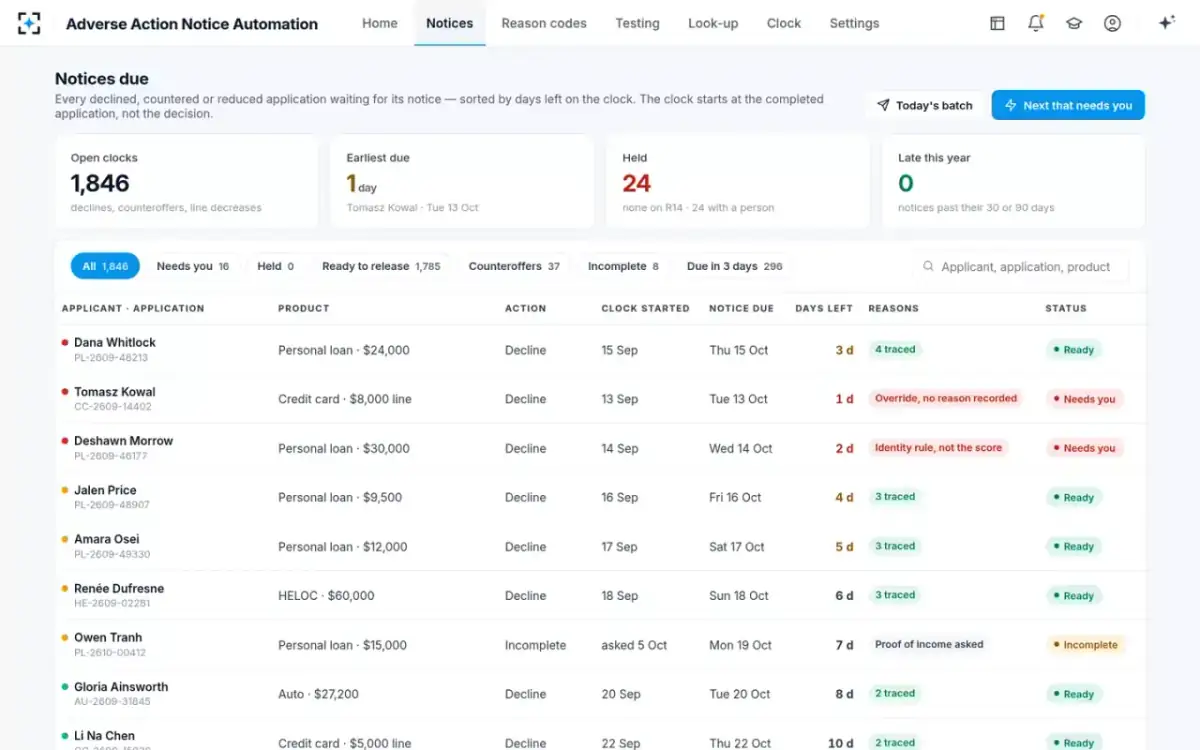
The second half of the job is proving later what was asked and when. Where no letter was ever sent, the only evidence that the incompleteness branch was taken properly is the notice itself, the date designated on it and the absence of a reply — material the retention rule requires for 25 months from the application. The prototype's look-up assembles that for one application at a time, which is the form a complaint or an examiner's request actually arrives in.
Adverse Action Notice Automation: one application, assembled for the question asked about it
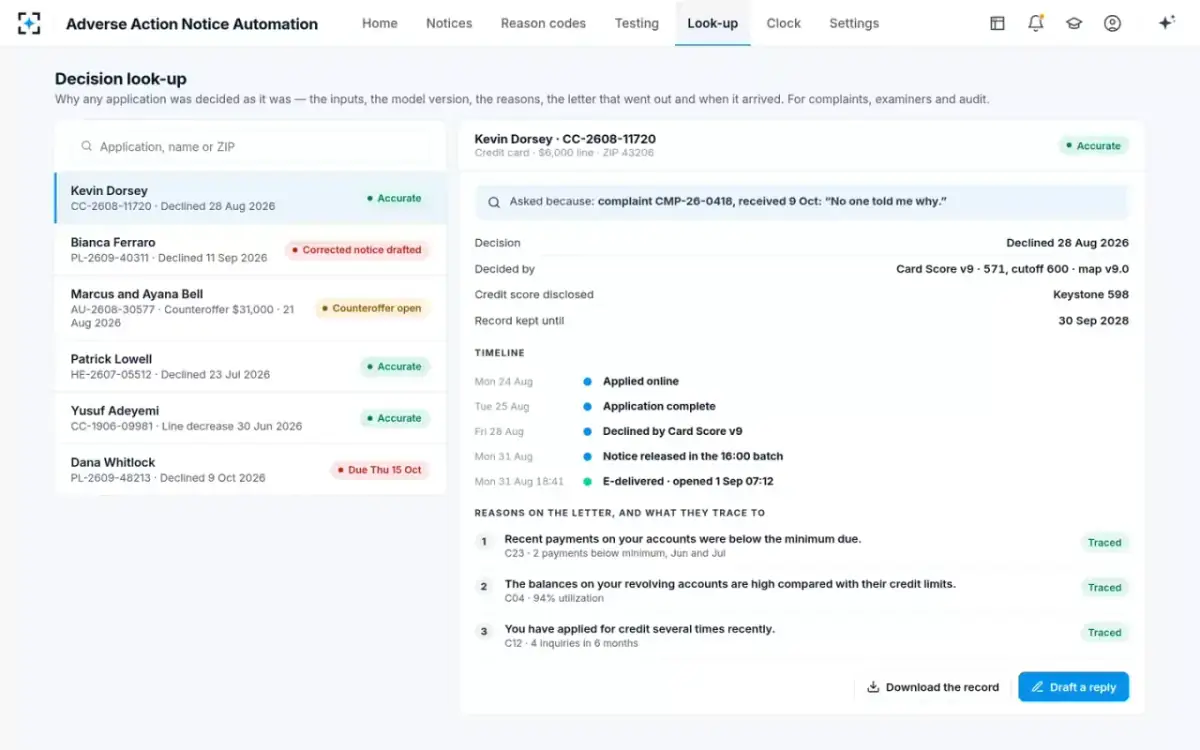
Neither screen changes a credit decision, and neither decides whether a file is complete — that judgement stays with the processor and the underwriter. What they remove is the category of file that nobody is counting. To see the clocks, the waiting files and the letters in one place, start from Adverse Action Notice Automation.
Questions people ask
What do you do with an incomplete credit application under Regulation B?
Within 30 days of receiving it, do one of two things: notify the applicant of action taken on the application, or send a written notice of incompleteness that specifies the information needed, designates a reasonable period for supplying it, and states that failure to supply it will end consideration of the application. The choice is the lender's. Doing neither leaves an unmet 30-day duty, whatever happens to the file afterwards.
Can you say incomplete application as the reason for denial?
Only where the application was incomplete on matters the applicant could supply and the lender genuinely lacked sufficient data to decide. Where the lender had enough to decide and did decide, the Official Interpretations are explicit that missing information or "incomplete application" cannot be given as the reason; the letter must carry the specific principal reasons for the decision actually made. The test is whether a decision happened, not whether the file was tidy.
What is a reasonable period of time to supply missing information?
Regulation B does not say, and no number is safe by itself. The lender designates the period, so what matters is that it is genuinely workable for the information requested, that it is expressed as a date on the notice, and that the same policy is applied to comparable applicants. A period short enough that most applicants cannot meet it invites a different line of enquiry altogether.
What happens if the applicant sends the information late?
The lender's obligation under section 1002.9 ended when the designated period expired without a reply, and comment 9(c)(2)-1 permits it to require a new application. It may instead choose to reopen the file, in which case it should be clear with itself about which clock it is running: a reopened old application carries the original timeline unless the submission is treated, and recorded, as a new application.
Is an adverse action notice required for a withdrawn application?
Not where the applicant expressly withdrew — but the record retention rules still apply, and for a file with no notice at the end of it the 25 months run from the date of the application rather than from a notification. Section 1002.9(e) adds a separate and much narrower case: an application the lender approved, where the parties contemplated that the applicant would inquire about its status and no inquiry came within 30 days, may be treated as withdrawn.
Is an adverse action notice required for a prequalification?
It depends entirely on what the lender did. Quoting terms, explaining policy or offering to send a form is an inquiry and owes nothing. Evaluating information about the consumer, deciding not to approve the request and communicating that decision makes it an application, and the full notice obligation follows. For a preapproval that is an application, the incompleteness route is closed: comment 9(c)(1)-1 removes the notice of incompleteness from preapprovals, so the ending must be a notice of action taken.