The counteroffer adverse action requirements turn on a conditional. Regulation B's definition of adverse action excludes a refusal of the amount or terms requested where the creditor "makes a counteroffer (to grant credit in a different amount or on other terms) and the applicant uses or expressly accepts the credit offered". Both halves have to happen. Make the counteroffer and the applicant never replies, and the exclusion lapses: section 1002.9(a)(1)(iv) requires notice within 90 days of the counteroffer, and what has to be disclosed then is adverse action on the terms originally sought. Adverse Action Notice Automation keeps every open counteroffer on its own 90-day clock alongside the 30-day ones, so the obligation a quiet applicant creates is visible before it matures.
The screens and counts here are from the working prototype running on a fictional lender's sample data. The rules come from Regulation B, its Official Interpretations and Appendix C.
What a counteroffer changes, and what it does not
90days
from the counteroffer to the notice, if the applicant does not accept or use the credit
0days
a counteroffer must be held open — the regulation sets no minimum
1notice
needed, where the counteroffer and the adverse action notice are combined on form C-4
Is a counteroffer adverse action?
Not while it is alive, and yes once it dies. The definition in section 1002.2(c)(1)(i) treats "a refusal to grant credit in substantially the amount or on substantially the terms requested in an application" as adverse action "unless the creditor makes a counteroffer (to grant credit in a different amount or on other terms) and the applicant uses or expressly accepts the credit offered" (12 CFR 1002.2(c)).
That is an unusual drafting choice, and it repays attention. The exclusion is not triggered by making the counteroffer. It is triggered by the applicant taking it. Until the applicant uses or expressly accepts the credit, the original refusal is sitting there unexcluded, and the only thing holding the notice off is the 90-day window in section 1002.9(a)(1)(iv). A lender that counts a counteroffer as a closed file on the day it is sent has recorded the opposite of what the regulation says.
It follows that three outcomes exist, not two. The applicant accepts or draws the credit, and no adverse action notice is owed at all. The applicant declines explicitly, which is a refusal of the counteroffer and leaves the original decline to be notified. Or the applicant says nothing, which is the common case and the one that produces a duty 90 days later.
Three endings to one counteroffer, and the duty each creates
Agent
The decisionThe amount or terms requested are refused; a counteroffer on different terms is prepared.
A person decides
The counteroffer goes outWith or without a combined adverse action notice on the terms originally sought.
Agent
Accepted or usedThe exclusion applies: no adverse action notice is owed on the original request.
Never: Acceptance must be express, or shown by use of the credit
Agent
Expressly declinedThe counteroffer is dead; the original refusal must be notified in the ordinary way.
Agent
No answer at allAt 90 days from the counteroffer, notice of adverse action on the terms originally sought is due.
Never: Silence never closes the file by itself
A person decides
Compliance analyst releasesApproves the notice, or confirms the evidence of acceptance that closes the clock.
The 90-day clock, and the event that starts it
Section 1002.9(a)(1)(iv) gives the creditor "90 days after notifying the applicant of a counteroffer if the applicant does not expressly accept or use the credit offered". The start event is the notification of the counteroffer, not the original application and not the credit decision, which makes it the only one of the four Regulation B clocks that begins with something the lender sends rather than something it receives.
The CFPB's examination procedures carry it as a separate test: whether, "within 90 days after notifying the applicant of a counteroffer, if the applicant does not expressly accept or use the credit offered, the creditor notified applicants of the adverse action taken in writing (unless the counteroffer was accompanied by the notice of adverse action on the credit terms originally sought)" (CFPB, ECOA examination procedures, July 2026). The parenthesis is the escape hatch, and the next section is about using it.
Because the start event is a send, the clock is easy to instrument and easy to lose. It lives in correspondence systems rather than in the decision record; it belongs to a file that operations has already marked as handled; and nothing happens on day 89 to attract anyone's attention. In the prototype the open counteroffers are carried on the same report as the 30-day clocks, for exactly that reason.
The combined notice: what form C-4 buys you
A lender can collapse the whole problem into a single letter. Comment 9(a)(1)-6 provides that "a creditor that gives the applicant a combined counteroffer and adverse action notice that complies with § 1002.9(a)(2) need not send a second adverse action notice if the applicant does not accept the counteroffer. A sample of a combined notice is contained in form C-4 of appendix C to the regulation."
Form C-4 is headed "Sample Notice of Action Taken, Statement of Reasons and Counteroffer", and its body does both jobs in four lines: "We are unable to offer you credit on the terms that you requested for the following reason(s)", then "We can, however, offer you credit on the following terms", then an acceptance instruction, then the FCRA block (Appendix C to Regulation B).
Two ways to run a counteroffer, and what each costs
Counteroffer now, notice later: One now, and a second if the applicant goes quiet.
Combined notice on form C-4: One, which serves both purposes whatever the applicant does.
Counteroffer now, notice later: A 90-day clock per open counteroffer, closed only by evidence of acceptance or use.
Combined notice on form C-4: None. The notice has already been given on the terms originally sought.
Counteroffer now, notice later: Produced twice: once when you decide, once when you draft the later notice.
Combined notice on form C-4: Produced once, at the moment of decision, with the counteroffer beside them.
Counteroffer now, notice later: A clean offer now; a decline letter months later, after the applicant has moved on.
Combined notice on form C-4: An offer and a refusal in one letter, which some lenders think dampens take-up.
Counteroffer now, notice later: Nobody owns the 90-day clock, and the second letter is never sent.
Combined notice on form C-4: The reasons describe the counteroffer rather than the refusal of the original request.
The trade-off is commercial, not legal. Lenders who keep take-up rates high on counteroffers generally dislike pairing the offer with a refusal in one envelope; lenders who have been examined on their counteroffer population generally prefer never to owe a second letter. Whichever is chosen, the choice should be a setting per product rather than a habit per team, because the compliance obligation differs between the two and the queue has to know which one applies.
Section 1002.9(a)(1)(iv) does not require a creditor to hold a counteroffer open for 90 days or any other particular length of time.
Comment 9(a)(1)-5 to Regulation B
Does a counteroffer have to stay open for 90 days?
No, and the confusion is natural: the same paragraph that sets the 90-day deadline is widely read as setting a 90-day validity. Comment 9(a)(1)-5 exists to correct it. A lender may give the applicant ten days to accept a counteroffer, or seven, as form C-4's "please notify us within [amount of time]" contemplates. The 90 days is the outer limit on the creditor's own notice obligation, and it keeps running after the offer has expired.
That gap is where the clock quietly accumulates. An offer that expires on day ten leaves 80 more days before the notice is due, during which the file looks closed in every system the lender runs. A programme that derives its counteroffer clocks from the offer expiry rather than from the regulation will report nothing to do and still be late.
Terms versus type of credit: when a refusal is not adverse action
A neighbouring comment draws the line that decides whether there is anything to counteroffer at all. Comment 2(c)(2)(v)-1: "When an applicant applies for credit and the creditor does not offer the credit terms requested by the applicant (for example, the interest rate, length of maturity, collateral, or amount of downpayment), a denial of the application for that reason is adverse action (unless the creditor makes a counteroffer that is accepted by the applicant) and the applicant is entitled to notification under § 1002.9."
So refusing the applicant's requested rate or term is adverse action. Not offering that kind of credit at all is excluded by section 1002.2(c)(2)(v) — a lender that does not write 40-year mortgages is not declining anyone by not writing them. The distinction is between a product the lender does not sell and a price the lender will not give this applicant, and it is the second that generates both a counteroffer and, eventually, a notice.
Five common counteroffers, and what each one owes
| What was asked | What was offered instead | Adverse action on the original request? | What the clock looks like |
|---|---|---|---|
| $24,000 personal loan, 60 months | $15,000 over 48 months | Yes, unless the applicant accepts or draws it | 90 days from the counteroffer, or none if a combined notice went with it. |
| Credit card, $10,000 limit | Card approved at a $2,500 limit | Yes — the amount requested was refused | 90 days, and the card being issued is use only if the applicant activates and transacts. |
| Auto loan at the rate quoted | Same amount, 2.4 points higher | Yes — substantially the terms requested were refused | 90 days; take-up is usually fast here, so most clocks close early. |
| Home equity line, $120,000 | $80,000, with a co-signer required | Yes, on both counts | 90 days, and a co-signer requirement is itself a term change worth stating in the reasons. |
| A 40-year term the lender does not write | The lender’s longest term | No — the refusal is of a type of credit not offered | No clock, but the file is still kept. |
Acceptance, use, and the evidence that closes a clock
Only two things end the obligation: express acceptance, or use of the credit offered. Both are facts about the applicant's conduct, which means both have to be captured as evidence rather than inferred from a status change. A loan that funds is use. A card that is activated and transacted on is use. A signed acceptance of amended terms is express acceptance. An internal note that the branch "spoke to the customer and they were happy" is neither.
This is also where the record-keeping rule reappears. The material behind an application has to be kept for 25 months for consumer credit after notification of action taken, and for applications where no section 1002.9 notification was required the creditor must still retain "all written or recorded information in its possession concerning the applicant, including any notation of action taken" (12 CFR 1002.12(b)(3)). An accepted counteroffer is exactly that case: no notice was owed, and the evidence of why no notice was owed is the thing worth keeping.
Seven checks on a counteroffer population
- Is every counteroffer recorded as an event, with its date?
The 90-day clock starts on notification of the counteroffer, so the send date is the controlling fact.
- Does the file say which route was taken?
Combined notice on form C-4, or counteroffer alone with a clock to follow. The two owe different things.
- Is acceptance evidenced, not assumed?
Express acceptance or use of the credit. A status change in the origination system is not either of them.
- Do expired offers keep their clocks?
An offer may expire in ten days; the notice obligation still runs to day 90.
- Do the reasons describe the original refusal?
The later notice is adverse action on the terms originally sought, not on the alternative offered.
- Are counteroffers on existing accounts caught too?
A reduced line on an open account is an unfavourable change in terms, on its own 30-day clock.
- Does anything report the open population weekly?
Counteroffer clocks are invisible by construction: the file looks handled from the day the offer goes out.
Where Adverse Action Notice Automation keeps the counteroffer clocks
In the prototype, counteroffers are not a separate workflow. The agent that reads each decision records the action taken — decline, counteroffer, line decrease — and the clock keeper opens the matching clock: 30 days for a decline or an account change, 90 days for a counteroffer, both dated from the event the regulation names. The daily report shows open counteroffers against their 90-day clocks beside the 1,846 open 30-day clocks, and escalation fires at five days left on either.
When a counteroffer clock matures without acceptance, the notice drafted is a notice of adverse action on the terms originally sought, with the reasons traced to the factors that produced the original refusal rather than to anything about the alternative offer. That distinction is not cosmetic — it is the difference between a compliant letter and a letter that explains the wrong decision — and it depends on the trace being kept from the first decision, which is the subject of tracing a reason back to the factor that decided.
Adverse Action Notice Automation: the decision, the action taken and the clock it opens
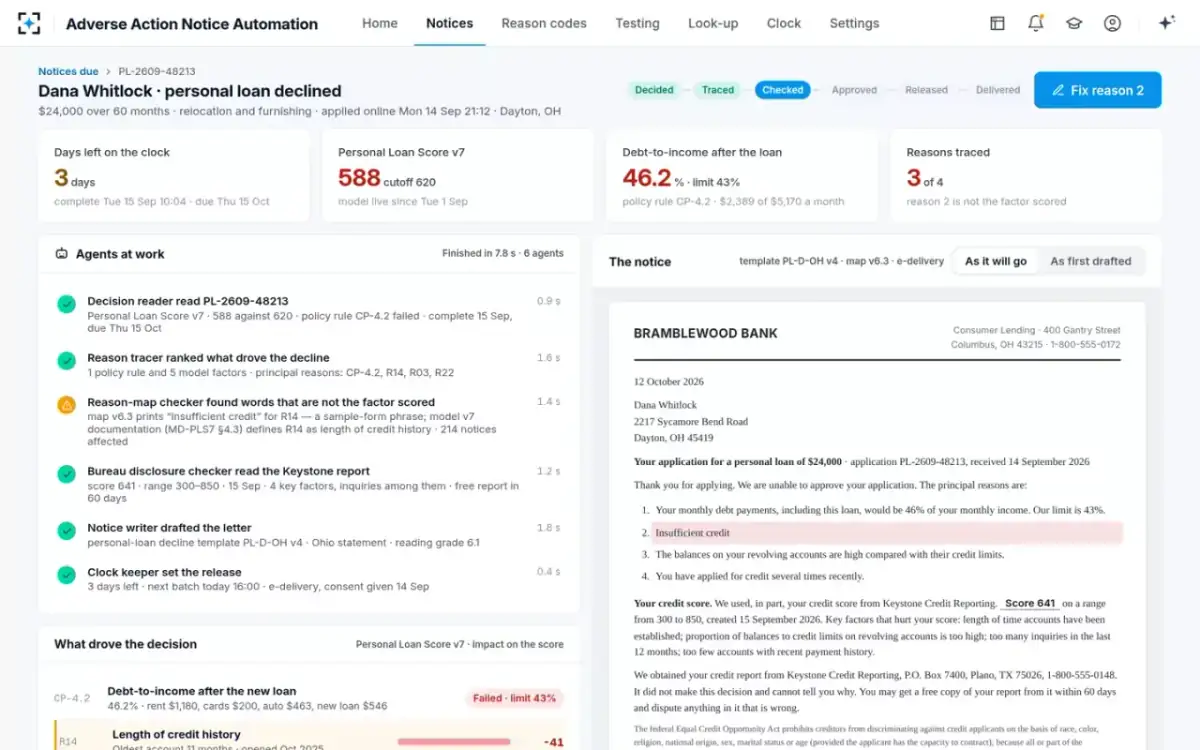
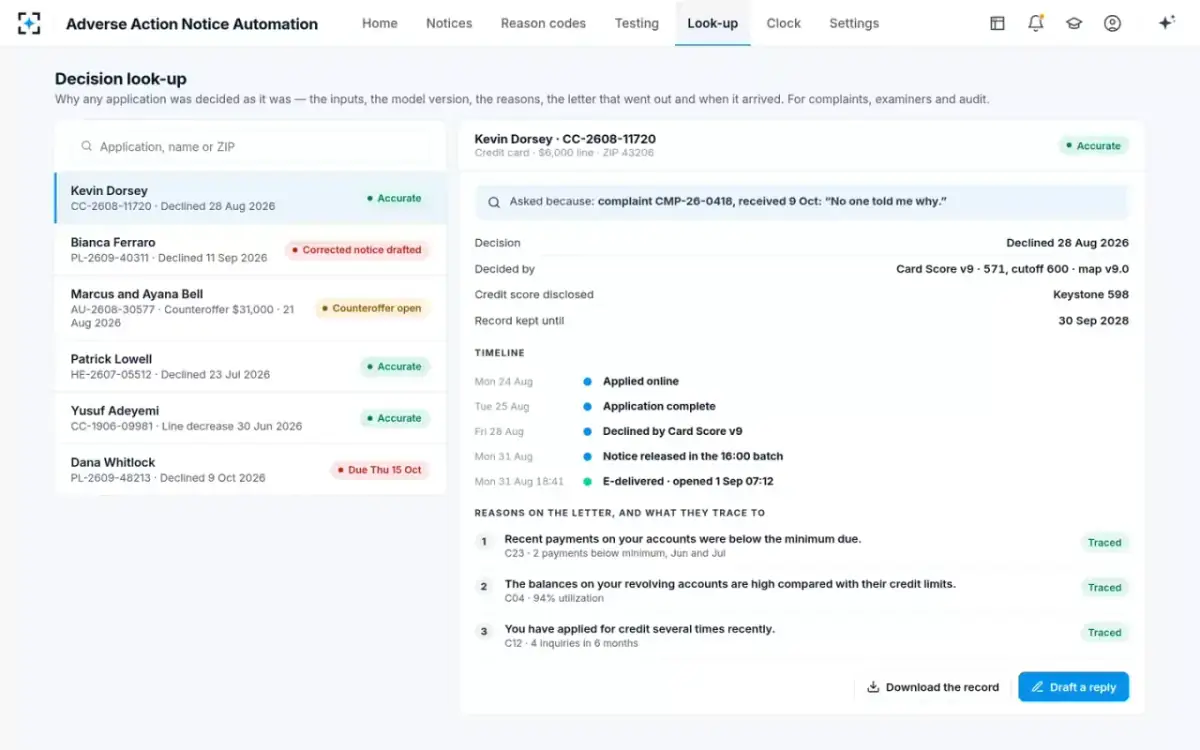
The look-up view answers the question that arrives months later, when an applicant complains or an examiner samples: what was asked for, what was offered, what the applicant did, what was sent and when. The clocks and how they are dated covers the 30-day side of the same report, and what the eventual notice must contain is unchanged by the counteroffer route.
Adverse Action Notice Automation: one application, reconstructed
Questions people ask
Is a counteroffer adverse action under Regulation B?
It becomes one if the applicant does not take it. The definition excludes a refusal of the amount or terms requested only where the creditor counteroffers and the applicant uses or expressly accepts the credit offered. Until that happens the original refusal is unexcluded, and the creditor owes a notice within 90 days of the counteroffer unless it already sent a combined one.
How long do you have to send a notice after a counteroffer?
Ninety days from notifying the applicant of the counteroffer. The notice due is adverse action on the terms originally sought. A creditor that paired the counteroffer with a conforming adverse action notice at the time — form C-4 is the regulation's own sample of this — does not need to send a second letter at all.
Does a counteroffer have to stay open for 90 days?
No. The Official Interpretations say the regulation "does not require a creditor to hold a counteroffer open for 90 days or any other particular length of time". A lender may set its own acceptance window, and form C-4 leaves a blank for it. The 90 days limits the creditor's notice obligation, not the applicant's time to decide.
What counts as the applicant accepting a counteroffer?
Express acceptance, or use of the credit offered. Drawing the loan, activating and transacting on the card, or signing the amended terms all qualify. A note that someone spoke to the applicant does not, and neither does a status change in the origination system. Because acceptance is what removes the notice obligation, the evidence of it is worth keeping with the file.
Is offering a lower credit limit than requested a counteroffer?
Yes. Refusing the amount applied for and offering a different amount is the textbook case, whether the product is a card, a line of credit or an instalment loan. If the applicant takes the smaller limit, no adverse action notice is owed; if the card is issued but never activated or used, the 90-day clock runs and a notice falls due on the amount originally requested.
What if the lender simply does not offer the product the applicant asked for?
That is not adverse action. Regulation B excludes a refusal to extend credit because the creditor does not offer the type of credit or credit plan requested. The distinction is between a product the lender does not sell and a price or amount the lender will not give this applicant: refusing the requested rate, term, collateral or down payment is adverse action, and may be answered with a counteroffer.