There is an official adverse action notice template, and there are ten of them. Appendix C to Regulation B prints sample notification forms C-1 to C-10, and proper use of the right one satisfies the rule it was drawn for. What no template can satisfy is the fifth ECOA content element — the specific principal reasons — because that is not a field but a claim about a decision, and Appendix C says as much in its own text. A template library is therefore only as good as the discipline that keeps each product's reason list true to the model and policy that decided. Botminds' Adverse Action Notice Automation writes each letter from the approved template for its product, action and state, and checks the reasons it fills in against the factors the decision actually used.
The examples on this page come from the working prototype running on sample lending data: a fictional lender, fictional applicants and fictional products. The regulation and its appendices are linked where they appear.
What the appendices actually contain
10forms
sample notification forms in Appendix C, of which five carry the FCRA disclosure
24reasons
on form C-1’s Part I checklist, including “Other, specify” — a starting point, not a reason list
$10bn
the asset threshold in Appendix A that moves a bank’s supervising agency onto the letter
Is there an official adverse action notice template?
Yes, and it is worth being precise about what the official status buys. Appendix C paragraph 5 sets it out: "A creditor may design its own notification forms or use all or a portion of the forms contained in this Appendix. Proper use of Forms C-1 through C-4 will satisfy the requirement of § 1002.9(a)(2)(i). Proper use of Forms C-5 and C-6 constitutes full compliance with §§ 1002.9(a)(2)(ii) and 1002.9(c)(2), respectively" (Appendix C to Regulation B).
So the forms are optional, a lender may take part of one, and proper use of the right one satisfies a named requirement. The weight sits entirely on "proper use". The structural parts of a notice — the statement of the action, the creditor's name and address, the ECOA paragraph, the supervising federal agency — are satisfied by construction once the form is filled in correctly. The reasons are not, and that is the distinction the rest of this guide turns on.
What Appendix C to Regulation B actually gives you
Three things, in descending order of usefulness. First, a correct skeleton: the ECOA notice wording, the placement of the FCRA block, and a layout that a court or an examiner has seen before. Second, a worked division between the FCRA's two disclosures — form C-1 carries both the section 615(a) and 615(b) disclosures, forms C-2 to C-5 only the section 615(a) one, which is the division the FCRA side of the letter sets out in full. Third, some genuinely optional language: paragraph 2 permits wording directing the consumer to the entity that provided the credit score, and notes that "creditors may use or not use this additional language without losing the safe harbor, since the language is optional".
What it does not give you is a reason list. Paragraph 3 is explicit, and reads less like a safe harbour than a warning: "The sample forms are illustrative and may not be appropriate for all creditors. They were designed to include some of the factors that creditors most commonly consider."
If a creditor chooses to use the checklist of reasons provided in one of the sample forms in this appendix and if reasons commonly used by the creditor are not provided on the form, the creditor should modify the checklist by substituting or adding other reasons.
Appendix C to Regulation B, paragraph 3
The appendix then gives its own examples of what to add: "if 'inadequate down payment' or 'no deposit relationship with us' are common reasons for taking adverse action on an application, the creditor ought to add or substitute such reasons for those presently contained on the sample forms." Neither of those phrases appears on form C-1, and both are ordinary grounds for a decline. The appendix is telling lenders, in its own voice, that its checklist is incomplete for them.
Which sample form fits which case: C-1 to C-10
Appendix C paragraph 1 assigns each form a job, and the assignment matters because two of the forms are not adverse action notices at all. Forms C-1 to C-4 notify an applicant that adverse action has been taken under sections 1002.9(a)(1) and (2)(i). Form C-5 is the right-to-request alternative under section 1002.9(a)(2)(ii). Form C-6 is the notice of incompleteness under section 1002.9(c)(2). Forms C-7 and C-8 are for business credit under section 1002.9(a)(3). Form C-9 is the appraisal-copy notice under section 1002.14, and form C-10 requests applicant characteristic information for non-mortgage credit under section 1002.5(b)(1).
The ten sample forms, and the rule each one satisfies
| Form | What it is for | Proper use satisfies |
|---|---|---|
| C-1 | Notice of action taken and statement of reasons, with the FCRA sections 615(a) and 615(b) disclosures | 12 CFR 1002.9(a)(2)(i) |
| C-2 | Notice of action taken and statement of reasons, section 615(a) disclosure only | 12 CFR 1002.9(a)(2)(i) |
| C-3 | The same, written for a decision made by a credit scoring system | 12 CFR 1002.9(a)(2)(i) |
| C-4 | Notice of action taken, statement of reasons and counteroffer, combined | 12 CFR 1002.9(a)(2)(i), and comment 9(a)(1)-6 |
| C-5 | Disclosure of the right to request specific reasons, with the person or office to ask | 12 CFR 1002.9(a)(2)(ii) |
| C-6 | Notice of an incomplete application and request for additional information | 12 CFR 1002.9(c)(2) |
| C-7 | Notice of action taken and statement of reasons, business credit | 12 CFR 1002.9(a)(2)(i) for business credit |
| C-8 | The right to request reasons, given at the time of application — business credit only | 12 CFR 1002.9(a)(2)(ii) for business credit |
| C-9 | Disclosure of the right to receive a copy of appraisals and written valuations | 12 CFR 1002.14 |
| C-10 | Disclosure about voluntary data notation, for non-mortgage applicant characteristic information | 12 CFR 1002.5(b)(1) |
Two choices on that table shape a whole programme. Taking form C-5 instead of C-1 defers the work of producing reasons rather than removing it, and splits it across two deadlines. Taking form C-4 for counteroffers closes the 90-day branch at the moment the counteroffer goes out rather than three months later, which is why the guide on counteroffers treats it as the default rather than the clever option.
Form C-3 deserves separate attention, because it is the one written for a decision a model made and it is the one most libraries do not have. Rather than a tick-box checklist it carries a short narrative — the application "was processed by a [credit scoring] system that assigns a numerical value to the various items of information we consider in evaluating an application" — and then lists the reasons under a comparative heading: "The reasons you did not score well compared with other applicants were". That framing is not decoration. It matches how the Official Interpretations expect scoring reasons to be selected, by comparing the applicant's score on each factor against other applicants' scores, and a lender whose decisions come from a model is better served by C-3's shape than by C-1's list.
What the forms do not buy you: the checklist is not your reason list
Form C-1's Part I is headed "Principal Reason(s) for Credit Denial, Termination, or Other Action Taken Concerning Credit" and instructs that it "must be completed in all instances". Under it sit 24 tick-boxes: credit application incomplete, insufficient number of credit references provided, unacceptable type of credit references provided, unable to verify credit references, temporary or irregular employment, and so on through collection action or judgment, garnishment or attachment, foreclosure or repossession, bankruptcy, number of recent inquiries, value or type of collateral, and finally "Other, specify".
Read as a list of the decisions a mid-century consumer lender made, it is excellent. Read as the output vocabulary of a modern scorecard, it is a category error. A model that scores the age of an applicant's oldest tradeline, the utilisation of revolving limits and the number of recent inquiries produces factors that map onto that checklist with varying honesty: inquiries are there, utilisation is not, and length of credit history is not. The nearest tick-box is not the reason, and nothing about ticking it is proper use.
What a sample form settles, and what it leaves entirely to you
Settled by the form, once filled in correctly: A stated description of the action, in words the applicant will understand.
Left to the lender, every time: Nothing — unless the action is one the form does not contemplate.
Settled by the form, once filled in correctly: Wording substantially similar to section 1002.9(b)(1), on the form.
Left to the lender, every time: Any addition you make, such as a state statute reference, and keeping it current.
Settled by the form, once filled in correctly: A slot on the form.
Left to the lender, every time: Which of the nine Appendix A entries applies to this charter and asset size, and whether it has changed.
Settled by the form, once filled in correctly: The structure, and which form carries which disclosure.
Left to the lender, every time: The score, range, date, supplier and key factors for this applicant, from this decision.
Settled by the form, once filled in correctly: A heading, an instruction to complete it in all instances, and 24 illustrative tick-boxes.
Left to the lender, every time: All of it: which factors decided, which were principal, and the words that describe them accurately.
Settled by the form, once filled in correctly: Nothing. The appendix is silent.
Left to the lender, every time: Clear and conspicuous form, retainability, and E-SIGN consent before any electronic delivery.
When your real reason is not on the checklist
Appendix C answers this directly and gives two routes. "The creditor should either add such other factors to the form or check 'other' and include the appropriate explanation." Adding the factor is the better route for anything recurring, because a named tick-box can be tested, counted and traced; "other, specify" is a free-text field, and free text is where reason accuracy goes to die.
There is one real constraint on how far the explanation goes. The appendix is clear that the creditor "need not, however, describe how or why a factor adversely affected the application" — the notice may name the factor without arguing the case. In practice that means a reason on a letter should be a specific, accurate statement of what was considered, carrying the applicant's own value where that makes it concrete, and nothing more. "Length of credit history: oldest account 11 months" names the factor and grounds it. A paragraph explaining why short histories predict default is not required, and invites an argument the letter cannot win.
One template per product, action, state — and charter
The reason a template library multiplies is that four independent things vary. The product changes the reason vocabulary, because the model and the policy rules are per product. The action changes the form: a decline, a counteroffer, a credit line decrease and an incompleteness notice are four different documents. The state adds required statements, and a lender operating across state lines carries several. And the charter decides the agency block.
That last one is the quiet failure. Appendix A lists nine entries, and the first is asset-based: banks, savings associations and credit unions with total assets of over $10 billion, and their affiliates, list the Bureau — with affiliates that are not themselves depositories also listing the Federal Trade Commission. Below that threshold the letter names the OCC, the Federal Reserve, the FDIC or the NCUA according to charter. A bank that grows across $10 billion, or converts its charter, changes the correct contents of every one of its templates, and nothing on any letter will look wrong until somebody checks.
Nine tests on a template before it ships, and after anything changes
- Is the agency block right for this charter and asset size today?
Appendix A has nine entries and an asset threshold. A charter conversion or a crossing of $10 billion invalidates every template at once.
- Is the ECOA paragraph substantially similar, with no prohibited basis dropped?
Additions are expressly permitted — a state statute, or the point that age may be considered in certain scoring systems. Omissions are not.
- Does the reason checklist contain the reasons this product actually uses?
If a common ground for decline is missing, Appendix C says to substitute or add it rather than tick the nearest item.
- Have the two insufficient formulations been removed everywhere?
Internal standards or policies, and failure to achieve a qualifying score — named in section 1002.9(b)(2) and sometimes still lurking in a fallback template.
- Does the FCRA block suppress cleanly when no score was used?
An empty score, a blank range and no key factors is a defective disclosure, not a blank space.
- Do the state statements match the states this product is sold in?
Tested per product, not per template family; a product added to a state inherits nothing automatically.
- Is the letter retainable, and is consent on file if it goes electronically?
Section 1002.4(d): clear and conspicuous, in a form the applicant may retain, electronic only subject to E-SIGN consent.
- Can the template be rendered for a real decision, not just previewed?
Fill it with a live decision’s reasons and values. Most template defects appear only when the data arrives.
- Is this version recorded, with who approved it and when?
A template is a control. An unversioned control cannot be shown to have been in force on the day a letter went out.
Plain words, and the one thing you may not explain
No federal rule sets a reading level for an adverse action notice. What section 1002.4(d)(1) requires is that written disclosures be provided "in a clear and conspicuous manner and … in a form the applicant may retain" (12 CFR 1002.4(d)). A reading grade is a lender's own proxy for "clear", and a sensible one: it is measurable, it can be checked on every letter rather than argued about in review, and it catches the specific failure that matters here, which is a reason worded in the model's vocabulary rather than the applicant's.
The limit on plainness is the one the appendix draws. Naming the factor is required; explaining its effect is not. A reason should be concrete enough that the applicant can check it against their own file — a value, a count, a date — and should stop there. Rewriting "R14" as a paragraph about credit-history modelling is not plainer; it is longer, and it asserts things the letter does not have to defend.
Electronic delivery, E-SIGN, retainability and other languages
Section 1002.4(d)(2) permits the written disclosures to be given electronically, "subject to compliance with the consumer consent and other applicable provisions of the Electronic Signatures in Global and National Commerce Act". That consent is part of the disclosure rather than a delivery preference: a notice e-mailed without it on file is not an electronic disclosure but a missing one, and the fact that the applicant read it does not cure that. A template library therefore needs to know, per applicant, whether an electronic channel is available at all — which is why consent belongs in the batch's checks rather than in the mailroom's.
Two further points are often missed. Retainability is a property of what the applicant receives, not of what the lender keeps: a notice that exists only as a screen the applicant cannot save does not satisfy the rule, however well archived it is on the lender's side. And section 1002.4(e) permits disclosures in languages other than English "provided they are available in English upon request" — which makes a translated template a legitimate part of a library, with the same version control as the rest of it, rather than an informal courtesy copy.
Version control: who may change a template, and what has to be recorded
A template is a compliance control that writes thousands of statements on a lender's behalf, and it should be governed like one. Three things need to be true. A template version has an identity, so a letter can be tied to the version that produced it. A change to a reason's wording is approved by someone who knows what the model scored and someone who knows what the regulation requires — the two competences are rarely in one person. And the before-and-after is retrievable for as long as the letters it produced have to be kept, which for consumer credit is at least 25 months from the notification.
In the working prototype those are settings rather than conventions. The reasons on a letter are capped at a number the lender chooses, a reading grade is set and checked on every reason, a switch requires the reason-code map to match the model version that decided, and a change to the map needs both the model owner and the compliance officer before any letter uses it. The notice writer itself is constrained in the plainest possible terms: only approved templates, each reason at the set reading grade or lower, and it never sends a letter.
Adverse Action Notice Automation: the template rules, as settings a lender owns
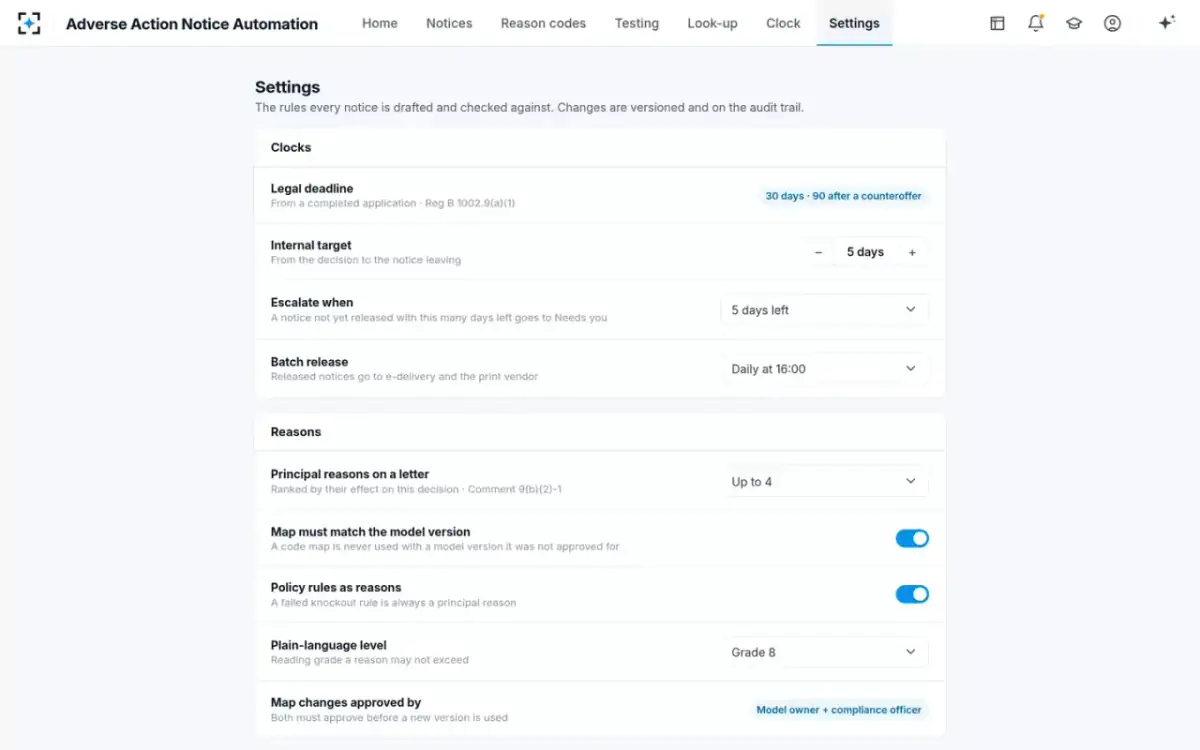
The test of a template library is what happens when the letter and the decision disagree. On the sample decline, a phrase that came from a sample-form checklist — "insufficient credit" — is replaced by the factor the model actually scored, with the applicant's own value in it, and the content checks that were failing on specificity clear. The template did not change. The reason did, because the reason was never the template's to supply.
Adverse Action Notice Automation: the template held, the reason rewritten from the factor
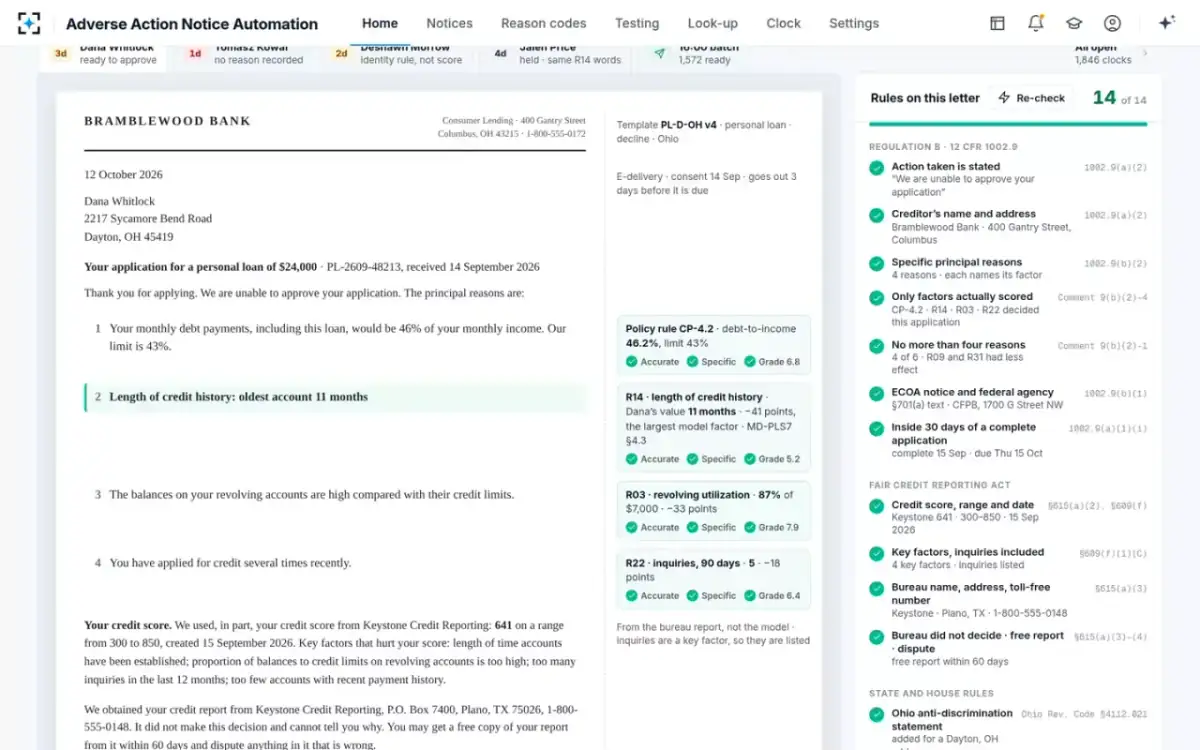
Buying advice, stated plainly: a product that ships adverse action templates is selling you the easy half. Ask instead how it fills the reason field, what it does when the words and the model documentation disagree, and who has to approve a change. To see the templates, the checks and the reasons together, start from Adverse Action Notice Automation.
Questions people ask
Can you use the CFPB sample form as is?
For the structure, yes — proper use of forms C-1 to C-4 satisfies section 1002.9(a)(2)(i), and the forms are expressly optional and severable. For the reasons, no: Appendix C states that the forms are illustrative, that a creditor whose common reasons are missing from the checklist should substitute or add them, and that ticking the closest identifiable factor does not satisfy the notice requirement. Using the form as is, with its checklist unchanged, is the most common way a lawful-looking letter becomes a finding.
Which sample form do I need?
C-1 to C-4 for a notice of action taken with reasons, C-1 where you need both FCRA disclosures; C-5 if you are disclosing the right to request reasons instead of printing them; C-6 for a notice of incompleteness; C-7 and C-8 for business credit. C-9 and C-10 are in the same appendix but are not adverse action notices — they cover appraisal copies and the voluntary data notation. For counteroffers, C-4 is the combined form that closes the 90-day branch at the moment the counteroffer goes out.
What do you do when your reason is not on the checklist?
Add it to the form, or tick "other" and include the appropriate explanation — Appendix C offers both, and adding a named factor is much the better option for anything that recurs, because a named reason can be counted, tested and traced while free text cannot. What is not an option is ticking the nearest listed item: the appendix states that a creditor will not satisfy the notice requirement by checking the closest identifiable factor.
What reading level should a denial letter be?
No federal rule sets one. Section 1002.4(d)(1) requires written disclosures to be clear and conspicuous and in a retainable form, and a reading grade is a lender's own measurable proxy for that. Grade 8 or lower is a common house standard for consumer correspondence. The useful discipline is not the number but checking it on every reason as it is written, since the reasons are the part of the letter generated per decision and therefore the part no template review ever sees.
Do you need a different template for each state?
You need a template for each combination that actually differs, and state is one of four axes — product, action, state and charter. States add required statements; products change the reason vocabulary because the model and the policy rules are per product; actions change the document; and the charter and asset size decide which of Appendix A's nine agency entries goes on the letter. Treating the library as one document with variable text, rather than as a matrix, is how a product added to a new state ends up with the wrong statement.
Can an adverse action notice be delivered electronically?
Yes, subject to the consumer consent and other applicable provisions of the E-SIGN Act, under section 1002.4(d)(2). Consent is a precondition of the disclosure rather than a mailing preference, so the right place to check it is before the batch goes out, per applicant. The notice must also be in a form the applicant may retain — a property of what they receive, not of the lender's archive.