A sanctions screening false positive is a hit on a customer, applicant or payment that turns out, after review, not to be the person or entity on the sanctions list. OFAC says plainly that "many" potential matches are false positives, but it publishes no rate, and the percentages often quoted for sanctions screening trace back to no government or academic measurement. What a bank can measure is what clearing one costs: the minutes an analyst spends on it, times the loaded cost of a minute, plus the review that checks it. On our estimate that is about three minutes and a little over three dollars of loaded labour per hit by hand, small for one hit and large across a year. Botminds' Sanctions Alert Review lowers the cost of each false hit, by taking the look-ups and the drafting, rather than lowering the number of hits by raising thresholds and risking a miss.
The worked figures use a fictional sample, Norrell Federal Credit Union, and wage data from the Bureau of Labor Statistics. Every estimate is labelled, with its arithmetic, so a bank can replace it with its own.
What is known about sanctions screening false positives, and what is not
“Many”
OFAC's word for how many potential matches are false positives; it gives no number
$1.07
loaded labour cost of one compliance officer minute in banking, by our arithmetic from BLS data
~3min
per hit by hand, our estimate; under one minute with the agents is the design target
$24.6K
average settlement per apparent violation in OFAC's 2026 Bank of America case
What is a false positive in sanctions screening?
A false positive in sanctions screening is a hit raised because a name looks like a listed name, on a customer who is not the listed person. The screening did its job: the name was close enough to deserve a look. The review then found an identifier, a date of birth, a nationality, a registration number, that rules the match out. A false positive is not an error to be eliminated; it is the price of catching the variants of real names, and the question is how much it costs to pay.
OFAC's own example is a vessel. FAQ 5 says many potential matches turn out to be false positives, and illustrates it with a person or company whose name or alias resembles a ship on one of OFAC's lists (OFAC FAQ 5; why the IMO number settles most of those is in vessel sanctions screening). The SDN List carried 1,568 vessels among its 19,471 entries on October 26, 2026, by our count from OFAC's Sanctions List Service file, many with names that are also ordinary words, places or surnames.
What percentage of sanctions alerts are false positives?
No official figure exists for sanctions screening. OFAC says "many" and stops there. The high percentages that circulate in industry material are not measurements from a regulator or a peer-reviewed study of sanctions alerts, and this page does not repeat them. The nearest official statement is about a different kind of alert: the U.S. Government Accountability Office, citing the International Monetary Fund, wrote in 2025 that false positives "constitute the vast majority of money laundering and terrorist financing alerts" (GAO-25-107197). That is transaction monitoring, not name screening.
The honest answer for any one bank is its own number, and it is easy to get. Every closed hit has an outcome. The share closed as false positives over a quarter, by channel, is the bank's rate, and it moves with the threshold, the lists screened, the customer base and the quality of the identifiers collected at onboarding. The FFIEC examination manual treats the rate as a signal: "A high volume of false hits may indicate a need to review the bank's interdiction program" (FFIEC BSA/AML manual, OFAC section).
In the sample credit union's October, 10,214 hits through the 22nd produced 41 escalations to the OFAC Officer and 2 true matches. That is fictional data, but the shape is familiar to any screening team: true matches are rare enough that a whole working day can pass without one.
What drives false positives in sanctions screening
False positives are driven by five things: names that are common or short, list entries with little to tell people apart, customer files missing the identifiers that would rule a match out, a threshold set to catch spelling variants, and the size of the list itself. Each is a lever, and each has a risk if pulled too hard.
Common and short names match many entries; OFAC marks some of its aliases as "weak" for exactly that reason. Entries that list only a name and a country give the reviewer little to disqualify a match with, so the review takes longer. Customer files are the lever banks control: a missing date of birth or nationality turns a ten-second disqualification into a request for documents. The threshold is the lever regulators watch most closely, because raising it removes false hits and true variants together, as what a sanctions screening threshold can and cannot say shows. And every list update re-screens the whole customer base against the changed entries, so a busy designation day produces a block of hits overnight.
The list itself is the fifth driver, and it only grows in busy years. A third of the SDN List now comes from one program: 6,346 of 19,471 entries carried the RUSSIA-EO14024 tag on October 26, 2026, by our count from OFAC's file. Every one of those entries is a name the bank's customers, counterparties and payment parties are compared against, and every transliteration variant a filter is tuned to catch is a potential false hit on someone else.
The five programs with the most SDN entries; one carries a third of the list
How long does one sanctions alert take to clear?
On our estimate for the sample credit union, an analyst clearing a hit by hand spends about three minutes on it, and most of that is finding information rather than judging it. The estimate splits the three minutes into five tasks: opening the member and the wire or application, finding the list entry and its version, comparing the identifiers, checking earlier closures, and typing the reason. Only the comparison is judgement.
Where the minutes on one false positive go, by hand and with Sanctions Alert Review
By hand: about 3.0 minutes a hit
- Opening the member and the wire or application · 26.7%
- Finding the list entry and version · 16.6%
- Comparing identifiers · 26.7%
- Checking earlier closures · 10%
- Typing the reason · 20%
With the agents: about 0.8 minutes a hit, the design target
- Opening · 12.5%
- Finding the entry · 12.5%
- Comparing identifiers · 37.5%
- Earlier closures · 12.5%
- Reason · 25%
The second row is not just shorter; its shape changes. With the look-ups done before the analyst opens the hit, comparison becomes the largest share of the time, which is the share a bank wants its people to spend. A held payment, a 3-of-5 match or an entry with two dates of birth takes far longer than three minutes, and should.
How much does a false positive cost?
A false positive costs its review minutes times the loaded cost of a minute, plus a share of the quality review that checks it. On public data, the labour alone is about $1.07 a minute and a little over $3 for a three-minute hit. The arithmetic is simple enough to redo with a bank's own wage, minutes and QA rate.
The cost of one false positive, term by term
Analyst review
3.0 min × $1.07
Our estimate of minutes by hand; loaded cost per minute from BLS and FinCEN's benefit factor
Sanctions analyst
QA re-review
10% × 3.0 min × $1.07
A 10% blind sample re-reviewed at the same pace, as in the sample settings
QA reviewer
Held customer time
minutes held × customers
A held wire or application waits for the review; not priced here
Customer
Systems and lists
licence ÷ hits
Screening, list data and case management, spread across hits; varies by contract
Technology
Three dollars and fifty cents looks trivial, which is why false positives are underpriced in budgets. At the sample credit union's October pace, 10,214 hits in 22 days, three minutes each is about 511 hours of analyst time, roughly $32,800 of loaded labour in three weeks before QA. The cost is real but it is mostly hours, and the hours are the constraint: they are the reason backlogs form on busy days.
How many analysts does an alert volume need?
Divide the review minutes a month's hits need by the productive minutes one analyst has in a month. The table works it for 10,000 hits a month at different minutes per hit, assuming 21 working days and 6.5 productive hours a day; both assumptions are ours and should be replaced with a bank's own.
Cost and staffing for 10,000 false positives a month, by minutes per hit
| Minutes per hit | Labour per hit | Labour a month | Analyst hours | Analysts needed |
|---|---|---|---|---|
| 0.8 (design target with agents) | $0.86 | $8,565 | 133 | 1.0 |
| 1 | $1.07 | $10,706 | 167 | 1.2 |
| 2 | $2.14 | $21,412 | 333 | 2.4 |
| 3 (our estimate by hand) | $3.21 | $32,117 | 500 | 3.7 |
| 5 | $5.35 | $53,529 | 833 | 6.1 |
Two things follow. First, the minutes per hit move staffing more than any plausible change in hit volume: going from three minutes to one has the same effect as cutting the hits by two thirds. Second, staffing to the average is staffing for a backlog. A designation round that triples a day's re-screen hits needs spare capacity on that day, and the cases in the analyst's day, hour by hour show what happens when it is not there.
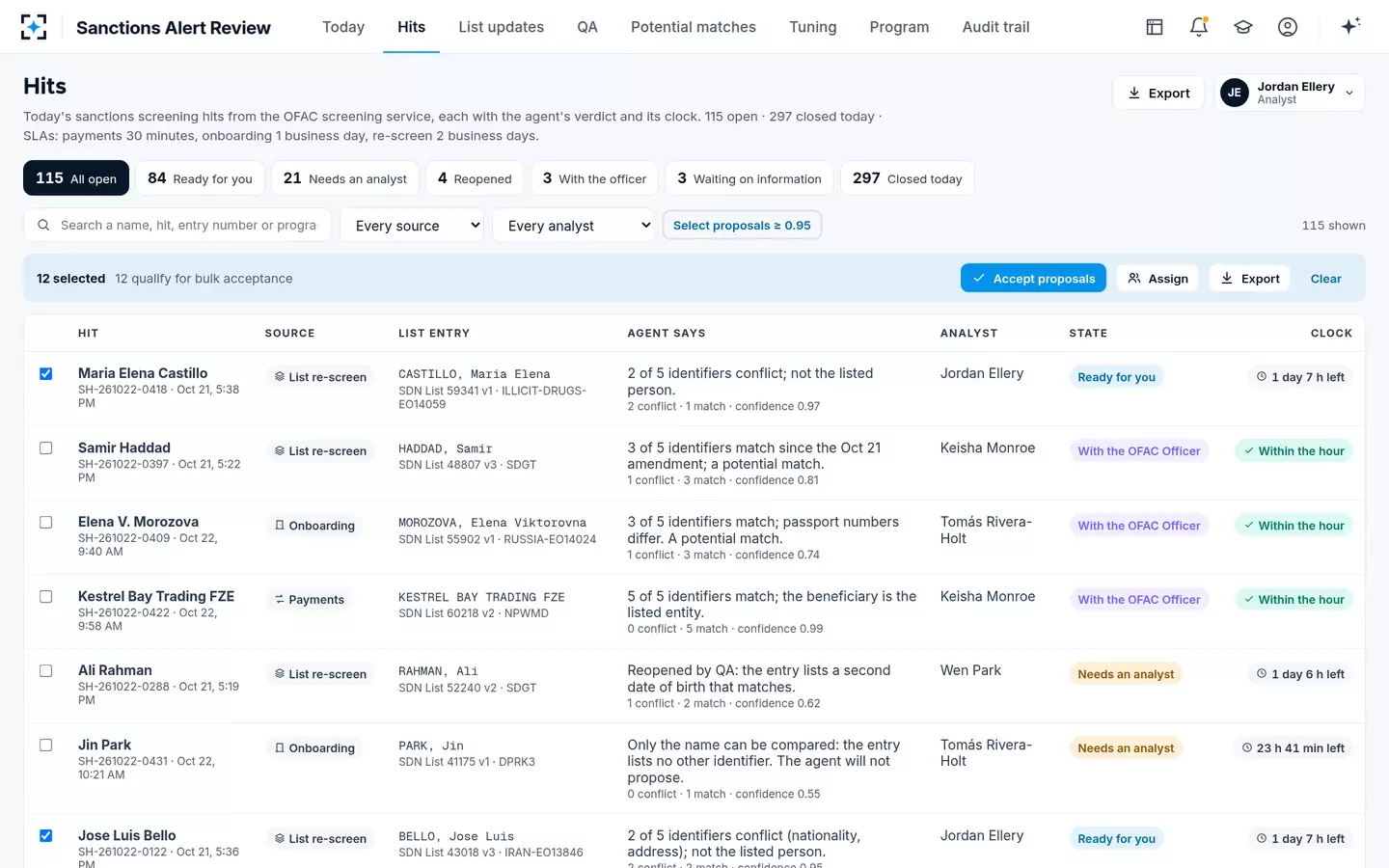
Cheaper false positives in Sanctions Alert Review: proposals ready to accept, each with its evidence
The cost that matters more: one missed match
The cost of a false positive is measured in dollars per hit; the cost of a missed true match is measured in enforcement. OFAC's 2025 civil penalties totaled $265,746,819 across 14 actions, though one case, GVA Capital at $215,988,868, accounts for most of it, and the year before totaled $48,790,404 across 12 (OFAC, 2025 enforcement information). Totals swing with single cases, so the counts are the steadier guide.
A closer comparison is per violation. OFAC's 2026 settlement with Bank of America was $11,662,930 for 475 apparent violations, about $24,550 each, with no reduction for remediation or cooperation (OFAC, Bank of America, 2026). Some of those payments went through because analysts cleared real hits as false positives in error. Against $3.53 of labour per false positive, the economics are lopsided: a program can afford many thousands of careful false-positive reviews for the cost of one careless closure.
OFAC civil penalties by year: a few cases drive the totals
Can false positives be reduced without risk?
Yes, if the reduction comes from cheaper reviews and better data rather than from a blunter filter. There are three ways to lower the false-positive bill. Make each review faster by doing the look-ups before a person opens the hit. Make the hit easier to disqualify by collecting date of birth, nationality and identification at onboarding. And narrow the filter only where seeded tests prove the change misses nothing that matters.
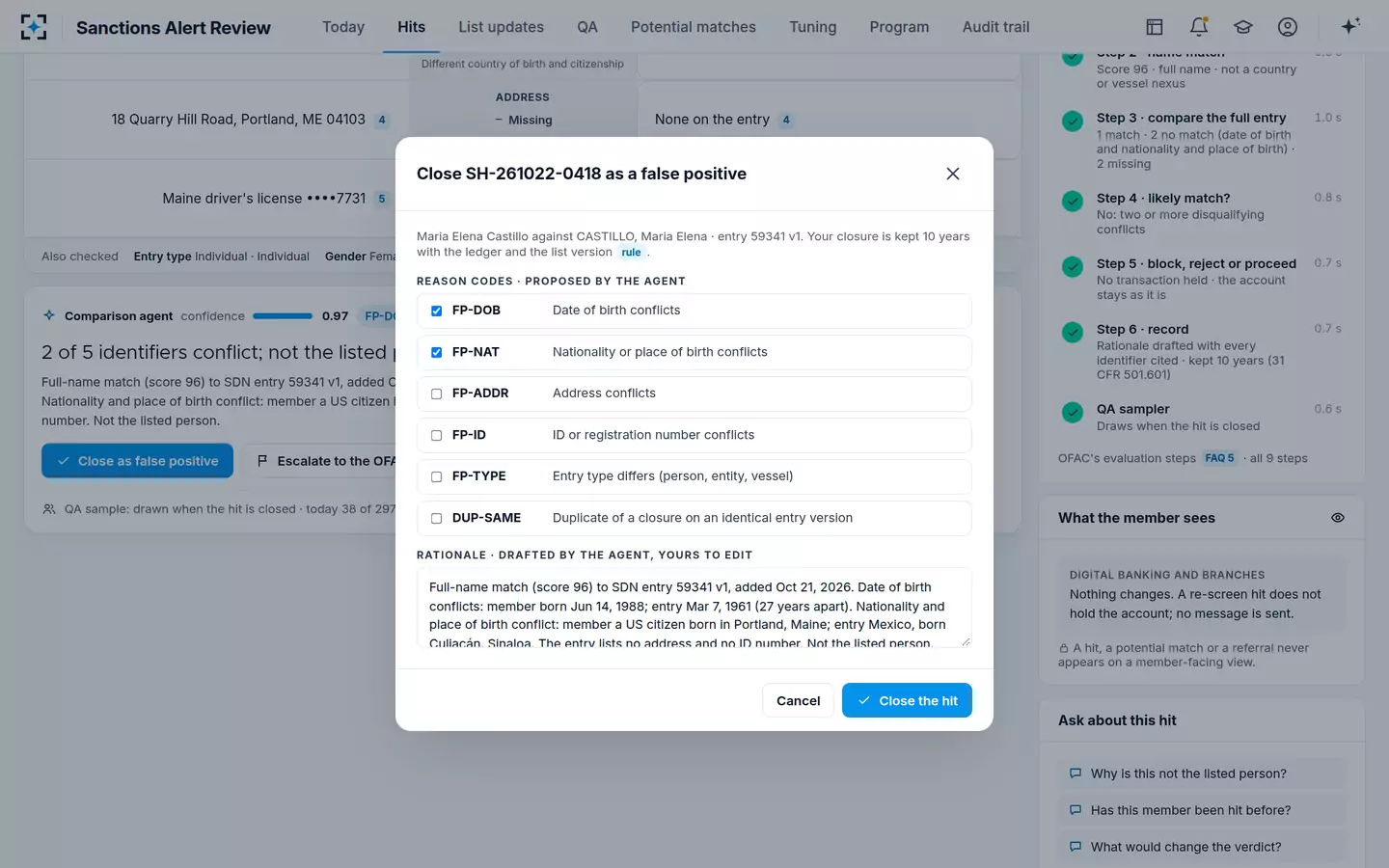
The third is where risk lives, so it needs evidence and a second approver. In the sample, the solution's tuning agent found that single-token names drove a large share of false hits, proposed raising their threshold from 85 to 88, and tested it before anyone approved: about 70 fewer hits a day, while every one of 180 list-derived variants still hit. Two officers approve such a change before an administrator applies it, and the agent never changes a setting itself. How to build those seeded tests is covered in sanctions screening testing built from fined failures. To price a bank's own false positives with the agents in place, start from Sanctions Alert Review.
Reason codes feed the tuning: a false positive closed in Sanctions Alert Review
Questions people ask
Is there an industry benchmark for sanctions false positive rates?
Not from a regulator or a peer-reviewed study of sanctions screening. OFAC says many potential matches are false positives without giving a figure. The best benchmark is a bank's own rate by channel over time, which the FFIEC manual treats as a signal when it runs high.
How do I calculate the cost of a false positive?
Multiply the minutes per hit by the loaded cost per minute, then add the share re-reviewed in QA. With the BLS mean wage for compliance officers in banking, $94,090 in May 2025, and a 1.42 benefit factor, a minute costs about $1.07, so a three-minute hit costs about $3.21 before QA.
Do false positives hurt customers?
They delay them. A held wire or application waits for the review, which is why payment hits carry short service levels, 30 minutes in the sample credit union's settings. The customer is told only that a payment could not be sent or an application is under routine review, never about the screening.
Does a high false positive rate worry examiners?
It can. The FFIEC manual says a high volume of false hits may indicate a need to review the interdiction program. Examiners also look for the opposite: a filter tuned so tightly that it misses variants, as OFAC found at Deutsche Bank Trust Company Americas, whose filter alerted only on exact matches.
Should we outsource false positive review?
A bank can, but it keeps the liability. OFAC's 2026 Bank of America release is explicit that relying on a third-party provider does not move the responsibility. Whoever reviews, the bank should own the procedure, the QA sample and the record.