WorkflowResidential Mortgage & Home Equity Origination
The complete guide · October 2026
Residential appraisal review, explained.
Before a lender makes a home loan, an appraiser writes a report on what the home is worth and what state it is in. Residential appraisal review is the lender's check of that report: are the comparable sales the right ones, do the adjustments hold up, do the photos match the ratings, and does the report agree with the purchase contract.
This guide is for anyone who reviews, manages or pays for that check: collateral underwriters and appraisal reviewers, underwriting managers, chief appraisers and appraisal desks, management-company coordinators, quality control and compliance teams, and the leaders deciding whether to automate the work. No background needed.
Imagine you are an underwriter at a mortgage lender. At 7:52 on a Monday, the appraisal arrives for Erik and Sarah Lindqvist's $612,000 purchase: 42 pages, a value of $615,000, and the house rated C3, "no adverse conditions observed."
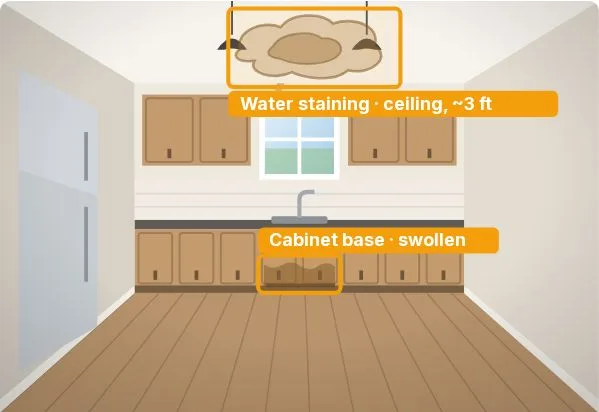
But photo 9, on page 24, shows a water stain on the kitchen ceiling about three feet across, and a swollen cabinet under the sink.
The report · page 6
Condition
C3
Quality
Q3
Adverse conditions
None
Value
$615,000
Photo 9 · page 24
C3 as ratedreads closer to C4minor deferred maintenance, possibly a leak.
You may not change the rating or ask for a value. You may ask the appraiser to comment on the cause and the rating, through the appraisal management company. And the condition rating is yours to warrant to the agency, whatever its risk score says.
Residential appraisal review finds that photo before the loan closes.
What residential appraisal review is, and what the rules ask of it
The report, the comparables, the ratings, the risk scores and the rules around them, explained without selling anything. If you are new to appraisal review, start here.
01 · In plain words
Residential appraisal review in five minutes
When someone buys or refinances a home with a mortgage, the lender wants to know the home is worth enough to secure the loan. So it orders an appraisal. A licensed or certified appraiser inspects the home, finds recent sales of similar homes nearby, adjusts their prices for the differences, rates the home's condition and quality, and writes a report with an opinion of value: photos, a floor sketch, and a grid of comparable sales.
The lender cannot simply accept that report. Fannie Mae's Selling Guide says the lender must analyze the contract, the listing, the comparable sales and the ownership, and validate that the appraiser has given "an accurate and reliable opinion of value that reflects the market value, condition, and marketability" of the property.1 FHA requires its lenders to review every appraisal for completeness, accuracy and a credible analysis too.2
Residential appraisal review is that check. Some teams call it the underwriter appraisal review, mortgage appraisal review or collateral review. The reviewer reads the report, tests the comparables and the arithmetic, compares the photos with the ratings and the contract with the report, and decides: accept it, ask the appraiser questions, or escalate. The reviewer never changes the value, and never asks the appraiser for one.3,4
The life of one appraisal, in five steps
A home goes under contractThe Lindqvists agree to pay $612,000, with a $12,000 seller credit in an addendum.
The appraiser inspects and reports32 photos, a sketch, five comparables, condition C3, a value of $615,000.
The report reaches the lenderThrough the appraisal management company, scored by the agency's risk tool.
Someone reviews itComparables, adjustments, photos against the ratings, contract against the report. This is where the kitchen photo is caught, or missed.
The loan closes, then is checkedQuality control samples funded loans. A collateral defect found then can mean a demand to buy the loan back.
Step 4 is the subject of this guide. Skip it, and step 5 finds the problems for you. The people, lender and property in this example are fictional.
Four things that surprise people
A low risk score does not end the review
A Collateral Underwriter score of 2.5 or below relieves the lender of some value warranties. The lender still warrants the property description, the condition and quality ratings, and the accuracy of the data.5 Fannie Mae's own quality newsletter advises reviewing every appraisal, even those below 2.5.6
There is no 15% net, 25% gross rule
Many checklists still flag adjustments over 15% net or 25% gross. Fannie Mae "does not have specific limitations or guidelines associated with net or gross adjustments." It asks that adjustments reflect the market.7
The underwriter cannot change the value
"A reviewer cannot change the value conclusion in the original appraisal." A second opinion of value takes a USPAP review by an appraiser licensed in the property's state.3,8
The report itself is changing
For reports submitted to Fannie Mae and Freddie Mac on or after November 2, 2026, the redesigned URAR replaces the old forms. A one-time exception keeps legacy reports in some queues into 2027.9,10
Four words you will see on this page
Comparable sale
A recent sale of a similar home nearby, used to estimate the value. "Comps" for short.
Adjustment
A dollar change to a comparable's price for a difference from the subject home, such as size or condition.
Condition rating
C1 (new) to C6 (substantial damage): the state of the home. Quality runs Q1 to Q6.
Revision request
The lender's written questions asking the appraiser to consider, explain, support or correct.
What is a residential appraisal review? Two jobs share the name
In shortA lender's review decides whether the report supports the loan and meets policy; it never changes the value. A USPAP appraisal review is an appraiser's opinion of another appraiser's work, and only that kind of review can give a second opinion of value.
Question
The lender's appraisal review
A USPAP Standard 3 appraisal review
Purpose
Decide whether the report supports the credit decision and meets policy and agency rules
Give an opinion on the quality of another appraiser's work; may include a second opinion of value
Who does it
An underwriter, collateral underwriter or reviewer, independent of loan production3
An appraiser licensed or certified in the property's state, with local data and competence8
Can it change the value?
No. It asks the appraiser to consider, explain, support or correct4
It never alters the original report, but it may produce a second opinion of value3
Rulebook
Agency selling guides, the lender's own policy, the 2010 Interagency Appraisal and Evaluation Guidelines
USPAP, from the Appraisal Standards Board, plus agency rules
Since 2019 the banking agencies' appraisal rules have required regulated institutions to have appraisals for federally related transactions reviewed "for compliance with" USPAP.11 That is a duty on the institution; it does not make every reviewer an appraiser.
Desk review, field review and desktop appraisal
USPAP review
Desk review
Done from the report and data, with no inspection. Because it can change the opinion of value, Fannie Mae requires the reviewer to be licensed or certified in the property's state.8
USPAP review
Field review
Adds an inspection, usually exterior, of the home and often the comparables. If underwriting relied on a desk or field review, the original appraisal must still have gone through the agencies' portal.12
Not a review
Desktop appraisal
An appraisal done without inspecting the home, for eligible one-unit purchases at 90% loan-to-value or less. It is scored like any appraisal.13 People often confuse it with a desk review.
Before closing, and after
Prefunding review. "As part of the credit approval process and prior to a final credit decision, an institution should review appraisals and evaluations."3 This is the review that can still change the loan. Fannie Mae's prefunding quality control adds a full-file appraisal review, including reconciliation of the risk tool's flags, by people not involved in that loan.14
Post-closing quality control. After funding, the lender samples loans and re-checks eligibility, loan-to-value, the comparables, unacceptable practices and the reconciliation, and reconciles the risk tool's flags.14 Findings here come too late to change the loan, but they still decide whether the lender keeps its warranty or faces a repurchase.
Automated or sampled prefunding review is allowed, with conditions. "With prior approval from its primary Federal regulator," an institution may use automated tools or sampling for prefunding review of lower-risk residential mortgages, with sound screening parameters, periodic review of every appraiser's work, and criteria for when to review more deeply.3 A tool that assists a reviewer who still reviews every report is a different use, but its parameters are worth documenting anyway.
What the reviewer must check
The contract, the listing, the comparables and the ownership. The lender "must analyze the current contract for sale", and validate that the value reflects "the market value, condition, and marketability" of the home.1
Fair and factual language. No "prohibited language relating to discriminatory practices and appraisal bias"; the property and the area described "in factual, unbiased, and specific terms".15
Independence and the appraiser's work over time. Comply with the Appraiser Independence Requirements and keep "continually evaluating the appraiser's work through the quality control process".15
FHA loans. The lender must make sure the appraisal "is complete, accurate, and provides a credible analysis", and must underwrite every appraisal even with an automated Accept.2
03 · The report and UAD 3.6
The redesigned URAR and UAD 3.6: what changes, and when
Status as of October 2026
In shortFor reports submitted to Fannie Mae and Freddie Mac on or after November 2, 2026, one dynamic Uniform Residential Appraisal Report replaces the old forms. Lenders approved for a one-time exception may keep sending legacy reports into 2027, and FHA has set no mandatory date, so many review teams will see both formats in one queue for months.
UAD 3.6 "eliminates the use of static appraisal forms and replaces them with a single dynamic Uniform Residential Appraisal Report (URAR)", used for every property type and valuation method.9 The report changes shape with the property. Freddie Mac lists what else changes: specification labels and allowed values; revised quality and condition definitions, with separate interior and exterior condition ratings and a condition status for certain features; new rules for measured square footage; and new update and completion reports.9
The forms reviewers know by number retire for agency submissions, among them the URAR (Fannie Mae 1004, Freddie Mac 70), the condo report (1073 / 465), the small residential income report (1025 / 72), the exterior-only report (2055) and the update and completion report (1004D / 442).9
The dates
When
What happens
September 8, 2025 to January 25, 2026
Limited production: approved sellers only may submit UAD 3.6 reports9
UAD 3.6 mandatory for reports with a portal submission date on or after this day (the submission date counts, not the inspection date)9,10
November 2, 2026 to February 28, 2027
Sellers approved for the exception may submit both formats, scored as usual10
March 1 to May 19, 2027
Legacy reports get a Loan Collateral Advisor score of "99" and no appraised-value relief; Collateral Underwriter returns 999, as reported10,16,17
May 20 to June 27, 2027
New reports must be UAD 3.6; legacy only for resubmissions10
June 28, 2027
Every submission UAD 3.6; legacy support retired10
FHA
Optional UAD 3.6 since October 1, 2026; no mandatory date set. A case keeps the format of its first appraisal18
The November 2 date has not moved since the agencies published the timeline in October 2024. What changed, on September 30, 2026, is the one-time exception: a seller must send each agency a signed request with an implementation plan, and the agencies call it an accommodation that will not be extended.10,16 VA and USDA dates were not confirmed for this guide.
What reviewers have to re-learn
Find things by content, not by page
The report changes shape with the property, so a checklist step keyed to "Form 1004, page 2" stops working.
Read condition in parts
Interior and exterior ratings, plus the status of certain features, replace one condition line. Read the new definitions in the UAD 3.6 Policy Supplement.9,12
Treat every field as a claim
More structured data means more to test against the narrative, the photos and the sketch, not less.
Square footage by the standard
Fannie Mae already requires ANSI Z765-2021 for above- and below-grade area, and sketch or 3D-scan output "must conform to the ANSI standard".19
Watch the 2027 scores. From March 1 to May 19, 2027, a legacy report delivered under the exception scores "99" with Freddie Mac (999 with Fannie Mae, as reported) and gets no value relief.10,17 Any rule that routes low-scoring reports to a lighter review has to treat 99, 999 or a missing score as unscored, never as low risk.
04 · Comparables and adjustments
Comparable sales and adjustment guidelines, without the myths
In shortThe appraiser must report at least three closed sales, normally from the last 12 months, and adjust each one for its differences from the home being valued. Fannie Mae sets no distance limit and no net or gross adjustment limit. It asks that adjustments reflect the market, and that the value sits inside the range of the adjusted sales.
Choosing comparables
"A minimum of three closed comparables must be reported." Listings and pending sales may support them.20
Sales that closed "within the last 12 months should be used"; older ones need an explanation.20
Distance in miles with a direction, such as "1.75 miles NW". There is no numeric distance limit.20
A competing neighborhood is allowed, but the appraiser must not "expand the neighborhood boundaries just to encompass the comparables selected", and must name it and say why.20
Rural comparables may be "a considerable distance away" if explained.20
Adjusting them
"Fannie Mae does not have specific limitations or guidelines associated with net or gross adjustments."7
"The number and/or amount of the dollar adjustments must not be the sole determinant in the acceptability of a comparable."7
No "arbitrary limits on the size of the adjustment": a $20 per square foot rule of thumb is wrong where the market says $100.7
Bracketing: the indicated value "must be within the range of the adjusted sales price" of the comparables.7
"Positive adjustments for sales or financing concessions are not acceptable."7
Where the 15% / 25% habit comes from. Net adjustments over 15% and gross over 25% of a comparable's price are an old rule of thumb that lives on in checklists and software defaults. Fannie Mae states no such limit, and HUD's handbook states no percentage limit either.7,2 A lender may keep them as its own review flags, as long as everyone knows they are flags and not agency limits.
Check a comparable's adjustments
The comparable after adjustment
$0adjusted price
$0net adjustment
0%net, as a share of the sale price
0%gross, as a share of the sale price
Net = upward − downward. Gross = upward + downward. The starting numbers are a fictional comparable: a $598,000 sale with a $6,000 seller concession taken off and $18,480 added for size, a finished basement and a deck. A flag is a reason to read the support, never a reason on its own to reject a comparable.7
Concessions in the contract
The lender "must provide the appraiser with a copy of the complete, ratified contract", and the appraiser reports whether it was analyzed and the total of any financial assistance paid for the borrower.21 Seller and other interested-party contributions are capped by loan-to-value; anything above the cap counts as a sales concession and comes off the price.22
Occupancy
Loan-to-value
Maximum interested-party contribution
Principal residence or second home
Over 90%
3%
Principal residence or second home
75.01% to 90%
6%
Principal residence or second home
75% or less
9%
Investment property
Any
2%
Fannie Mae Selling Guide B3-4.1-02.22 A credit within the limit can still be a reporting question if the appraisal's contract section shows none.
05 · Condition and quality ratings
Appraisal condition ratings, C1 to C6, and what the photos must show
In shortCondition (C1 to C6) says what state the home is in; quality (Q1 to Q6) says how well it was built. Both are the lender's to warrant whatever the risk score. Only C6 makes a home ineligible until it is repaired, and the difference between C3 and C4 often lives in the photos.
Rating
Fannie Mae's definition, shortened
Eligible?
C1
Very recently built, not previously occupied
As is
C2
No deferred maintenance, little or no physical depreciation, no repairs needed; almost new or recently renovated
As is
C3
"Well-maintained and feature limited physical depreciation due to normal wear and tear"
As is
C4
"Some minor deferred maintenance and physical deterioration"; "only minimal repairs" needed
As is
C5
"Obvious deferred maintenance" and "in need of some significant repairs"; still usable
As is, unless safety, soundness or structural integrity is affected
C6
Substantial damage or deferred maintenance affecting safety, soundness or structural integrity
Not eligible until repaired to at least C5; appraised "subject to" the repairs
Fannie Mae Selling Guide B4-1.3-06.23 Many lenders add their own rules, such as routing C5 homes for repairs; that is lender policy, not the agency's eligibility line. Under UAD 3.6 the C and Q scales stay, with revised definitions and separate interior and exterior condition ratings.9
Three rules reviewers lean on
Holistic
One rating for the whole home
It is "inappropriate to select either a lower or higher overall rating on the basis of one or two minor inferior or superior areas", but "if any portion of the dwelling is rated a C6, the whole dwelling must be rated a C6."23
Reported
Adverse conditions, always
Conditions apparent at inspection must be reported "even if the conditions are typical for competing properties". Minor plumbing leaks are on the list that "must be reported", and dampness needs a comment on value and marketability.23
Absolute
Each home on its own merits
Ratings describe the home, not how it compares with the neighbors. Quality runs from Q1, architect-designed, to Q6, basic, and describes design, materials and workmanship.23
The photos the report must carry
Front, back and street scene of the home; the front of each comparable24
Inside, at a minimum: the kitchen, all bathrooms, the main living areas and below-grade areas24
"Examples of physical deterioration, if present", and "examples of recent updates"24
C3 or C4? A ceiling stain over a sink, a swollen cabinet, failed caulk around a tub: each is minor on its own, and each is the kind of thing the photos show and the text may not mention. Whether the house is C3 or C4 is the appraiser's call. Noticing the gap, and asking about it, is the reviewer's.
06 · Collateral risk scores
Collateral Underwriter risk score and Loan Collateral Advisor: what a score of 2.5 does, and does not, cover
Status as of October 2026
In shortFannie Mae's Collateral Underwriter and Freddie Mac's Loan Collateral Advisor score every appraisal delivered to them. At 2.5 or below, the lender is relieved of some warranties about the value. It still answers for the description of the home, its condition and quality ratings, the data and the eligibility, whatever the score.
Relieved at 2.5 or below (eligible one-unit homes)
Underwriting the appraisal for adequate collateral
"Ensuring the appraisal accurately reflects the market value"
The appraiser's reasoning and method
The analysis of the comparable sales: description, selection, adjustments and reconciliation
Still the lender's, whatever the score
"The description of the property, adherence to fair lending, local, state, and federal laws"
"The accuracy and completeness of all data on the appraisal that pertains to the property", which "includes the property's condition and quality ratings"
Eligibility, and the life-of-loan warranties
Fannie Mae Selling Guide A2-2-06, dated June 3, 2026. Manufactured homes are not eligible for this relief.5 Freddie Mac's Loan Collateral Advisor scores from 1 to 5 and offers value-only relief at 2.5 or less, subject to its own eligibility checks.25
Review every appraisal anyway. Fannie Mae's December 2025 quality newsletter recommends: "Review all appraisals, even those with a Collateral Underwriter (CU) score below 2.5."6 Flags and messages from the tool must be reconciled in prefunding and post-closing quality control whatever the score.14
Scores that mean "no score". From March 1 to May 19, 2027, legacy reports under the UAD 3.6 exception score 99 or 999 and get no value relief (section 3).10,17 A score is also used for value acceptance: a prior appraisal with an overvaluation flag, or with no score, rules it out.26
Fewer appraisals, harder files
About a quarter of the new conventional mortgages Fannie Mae and Freddie Mac buy now carry an appraisal waiver.27 In October 2024 the agencies' regulator announced a rise in the maximum loan-to-value for standard waivers on purchases from 80% to 90%, and for inspection-based waivers to 97%.28 Fannie Mae calls its waiver "value acceptance", and excludes, among others, two- to four-unit homes, manufactured homes, construction loans, renovation loans and homes priced at $1,000,000 or more.26
So the appraisals that remain lean toward the files a waiver cannot take: higher loan-to-value purchases, larger loans, multi-unit and manufactured homes, condition questions and thin data. That is our reading of the rules, not a published statistic, but it is why fewer appraisals do not mean less review.
07 · Appraiser independence
Appraiser independence requirements: what a reviewer may ask, and may never ask
In shortNo one involved in a mortgage may push an appraiser toward a value, up or down. A reviewer may ask the appraiser to consider more sales, to explain, to support or to correct errors. A reviewer may never name a number, a range or a target.
Dodd-Frank added valuation independence to the Truth in Lending Act, and Regulation Z, 12 CFR 1026.42, puts it into practice.4 It reaches reviewers by name: "valuation management functions" include "reviewing or verifying the work of a person that prepares valuations".4 Fannie Mae and Freddie Mac add their own Appraiser Independence Requirements, and make the lender responsible for meeting them.15
Situation
Allowed
Not allowed
More information
Ask the appraiser to "consider additional, appropriate property information, including information about comparable properties"4
Seeking "to influence a person that prepares a valuation to report a minimum or maximum value"4
Support
Ask for "further detail, substantiation, or explanation"4
"A predetermined minimum, maximum, or range of values", and pushing a value down counts the same as pushing it up29
Errors
Ask the appraiser to "correct errors in the valuation"4
Implying future work depends on the value; excluding an appraiser for missing "a predetermined threshold"4
Another opinion
Obtain "multiple valuations … to select the most reliable valuation"4
Choosing the appraisal with the highest value rather than the most reliable one8
Payment
Withhold pay for "breach of contract or substandard performance"4
Withholding timely payment over the value, or "conditioning the compensation … on consummation"4
The same question, written two ways
Allowed. "Comparables 2 and 4 are both rated C2 against the subject's C3, but carry condition adjustments of −$5,000 and −$20,000 (pages 9 and 11). Please explain the difference or revise the adjustments so the same difference is treated consistently."
Not allowed. "Please update the contract analysis. The value should be at least $612,000 to support the loan." It names a value and a target, whatever the intent.
Duties around the rule
Independence of reviewers
Insulated from production
Reviewers should be "independent of the transaction", with no interest in it, and "independent of and insulated from any influence by loan production staff".3 In practice, questions go from the reviewer to the appraisal management company to the appraiser, and the loan officer sees the status only.
Referral
Report material failures
A covered person who reasonably believes an appraiser broke USPAP or ethics rules in a way "likely to significantly affect the value" must refer it to the state.4 Fannie Mae asks lenders to forward uncorrected material deficiencies to the licensing board.8
It cuts both ways
Review can break the rule too
In 2026 a state appraiser board suspended a management company and its chief review appraiser for using the review process to press a lower value on an appraisal.30 The rule binds the people who check appraisals, not only the people who sell loans.
08 · Reconsideration of value
Reconsideration of value (ROV): whose rule is which
Status as of October 2026
In shortAn ROV asks the appraiser to reassess the report because of a possible deficiency or new information, often at the borrower's request. Three sets of rules have touched it since 2024. For loans sold to Fannie Mae and Freddie Mac their requirements bind; the 2024 interagency guidance is supervisory; and FHA's 2024 borrower ROV policy was rescinded in 2025.
Source
Status, October 2026
What it asks
Interagency Guidance on Reconsiderations of Value (OCC, Federal Reserve, FDIC, NCUA, CFPB; July 2024)
Active, not withdrawn. "Supervisory guidance that does not have the force and effect of law"31,32
A way to raise valuation concerns "before a final credit decision", without "unreasonable barriers"; risk-based routing, with discrimination allegations to compliance, legal and appraisal review staff; standard notices, information needed, timelines for each milestone and status updates; trained staff and third parties33
Fannie Mae and Freddie Mac ROV requirements (from October 31, 2024; amended September 3, 2025)
A disclosure of the ROV process when the appraisal is delivered; the lender's own review first; "only one borrower-initiated ROV" per appraisal, with no more than five extra comparables; standard communication to the appraiser; records of the outcome; no borrower ROV after closing8
FHA (HUD)
The 2024 borrower-initiated ROV policy was rescinded on March 19, 202535,36
The earlier handbook language: the underwriter may ask for reconsideration when the appraiser did not consider relevant information. Borrowers can still ask their lender2
An ROV may also be how a borrower appeals a value that "reflects prohibited discriminatory practices".8 Do not write that "federal rules require a borrower ROV process" without saying whose rules: the agency requirement binds agency loans, and the interagency guidance does not have the force of law.
What a sound ROV process looks like
Review the appraisal first. The lender must "complete its appraisal review before initiating the ROV process".8
Say what is deficient, with the page. The request to the appraiser names the borrower and property, the deficient areas and the turn time.8
Route by risk. Allegations of discrimination go to compliance and legal as well as appraisal review.33
Keep to a timeline, and tell the borrower where the request stands.33
Keep the record. The outcome, the revised report and its commentary stay with the file.8
09 · Bias and fair lending
Appraisal bias and fair lending: what still binds
Status as of October 2026
In shortThe federal PAVE task force on appraisal bias was effectively disbanded in July 2025, but the laws and rules behind fair appraisals still apply. A reviewer's part is practical: catch prohibited language and unsupported reasoning, with the page, and route concerns to the people who judge them.
What still binds
The Fair Housing Act and the Equal Credit Opportunity Act; HUD said existing fair housing laws "remain fully in effect"37
Fannie Mae's list of unacceptable practices and prohibited terms, and the lender's duty to catch them38,15
The ROV as a channel to appeal a value that reflects discrimination8
USPAP's Nondiscrimination Section, added to the Ethics Rule in the 2024 edition39
The quality-control rule for automated valuation models, in force since October 1, 2025, with a nondiscrimination factor40
What changed in 2025
HUD and OMB effectively disbanded PAVE on July 10, 202537,41
A bill to write parts of PAVE into law was introduced in July 2025; we found no record of it becoming law as of October 202642
Words a reviewer should catch
Fannie Mae's unacceptable practices include relying on protected characteristics, "reference to crime rate or related data", and subjective terms such as "pride of ownership", "poor neighborhood", "good neighborhood", "crime", "desirable" or "undesirable neighborhood or location". The same list names "misrepresentation of the physical characteristics", "failure to comment on negative factors", comparables that are not the most similar, and adjustments that "do not reflect market reaction".38
Why it is watched. Freddie Mac's 2021 research on 12 million purchase appraisals from 2015 to 2020 found 12.5% of homes in Black-majority tracts and 15.4% in Latino-majority tracts appraised below the contract price, against 7.4% in White-majority tracts.43 In 2025 a federal court let a Fair Housing Act appraisal case against a lender and its management company go forward; the parties sought settlement talks in 2026.44
Where people stay in charge. Flagging a prohibited phrase with its page, or a comparable choice that looks unsupported, is checking. Judging whether a value was influenced by a protected characteristic belongs to compliance, fair lending and, where needed, a licensed review appraiser.
10 · How teams review today
Four ways lenders review appraisals today
In shortMost lenders mix these: underwriters review in-house, a chief or review appraiser takes the hard files, outside firms add capacity and USPAP reviews, and software scores or checks the report. The real question is how much of each report gets read, and how early.
1 · In-house
Underwriter review
A collateral underwriter or loan underwriter reads the report, the risk findings and the contract, writes any questions, and decides.
Strength
Knows the loan, the policy and the local market
Strain
Time per report, backlogs, and depth that varies by reviewer and by day
2 · Specialist
Review appraiser
A chief appraiser or staff review appraiser sets policy, takes escalations, and performs or orders USPAP desk and field reviews.
Strength
The only route to a second opinion of value
Strain
Scarce and costly; kept for the hardest files
3 · Outside
Outsourced review or QC
A management company or review firm checks reports before delivery, or a QC vendor re-reviews a sample after closing. Fees are not public.
Strength
Capacity and independence
Watch for
The lender stays "fully accountable", and must re-review at least 10% of a vendor's post-closing sample itself14
4 · Automated
Review software
The agencies' risk tools score every report. Several vendors sell automated review on top, some reading photos as well as data, and several announced UAD 3.6 support in 2026.45,46,47
Strength
Reads every report, every time
Watch for
Evidence for each finding, who may send what to the appraiser, and whose rules it applies
A manual review and an assisted one, side by side
Question
Typical manual review
Review assisted by software (what to look for)
What is read?
The pages the reviewer has time for, guided by the risk score
Every page, field, photo and the sketch, on arrival
The grid?
Spot-checked; re-added by hand when something looks off
Every adjustment recomputed, and rates compared across comparables
The photos?
Scrolled through, if time allows
Each photo read against the condition and quality ratings and the sketch
Whose rules?
The checklist and the reviewer's habits
Your written policy as settings, with every version kept
Questions to the appraiser?
Written from scratch, report by report
Drafted with the page and guideline, screened for independence, edited and sent by a person
What is left behind?
A decision and an email
Each finding with its page, each question, the decision and the person who signed
Whichever way you review, a named person decides and signs, the questions go through the management company, and the appraiser alone sets the value.
Who is involved, and what each cares about
UW
Collateral underwriter or appraisal reviewer
Reviews each report and writes the revision requests. Cares about finding the pages that matter, asking only what is allowed, and turning reports around the same day.
UM
Underwriting manager or head of collateral
Usually the buyer. Owns turnaround, the revision rate, repurchase findings and escalations. Cares about backlog, consistency across reviewers and defects found later.
CA
Chief appraiser or review appraiser
Sets review policy and performs or orders USPAP desk and field reviews. Cares about policy applied the same way, and second opinions only where needed.
AM
Appraisal desk and management-company coordinator
Orders appraisals, relays questions, keeps appraisers independent. Cares about one clean list per report, due dates, and never a number in a question.
AP
Appraiser
Develops the value and answers questions. Cares about the specific page and rule, independence, fair pay and time.
QC
Prefunding and post-closing quality control
Samples files and reconciles the risk tools' flags. Cares about evidence that questions were asked before closing.
CO
Compliance and fair lending
Owns independence, the ROV process, prohibited language and complaints. Cares about records an examiner can follow.
CM
Secondary marketing and capital markets
Delivers loans to the agencies. Cares about portal status, relief eligibility and UAD 3.6 readiness through 2027.
Part B · See it working
Botminds Residential Appraisal Review, one appraisal at a time
Part A described the work without naming a product. This part shows how Botminds does it, at a fictional lender, Tamarack Home Lending in Columbus, Ohio. Every name, number, photo and document in the screens is sample data.
11 · One appraisal, start to finish
Follow 1418 Wrenfield Court from arrival to a signed revision request
In shortThis is the example from the top of the page, inside the product. Agents read the report, the photos and the contract, recompute the grid and draft the questions. Renata Okafor, the senior collateral underwriter, edits, decides and signs. The appraisal arrives at 7:52 and the questions leave at 9:12 the same morning.
1
Every photo is read against the ratings
The 42-page report arrives from the management company at 7:52. By 7:54 all 32 photos of the home and 7 of the comparables are read: 26 support the C3 rating, 2 contradict it, 1 backs a living-area question, and 3 are not about condition.
The two that contradict it lead the page, framed in amber: the kitchen sink wall, and the primary bath, which sits right above it on the sketch. One leak could explain both. The rating is never changed; the screen asks.
The appraisal's photos. Today's appraisals by what their photos show, and this report's photos laid out beside the ratings the value relies on.
2
Six agents review the report in under two minutes
Renata presses Start review. Six agents read the report, the agency risk findings, the contract and the comparables' records: seven documents in 1 minute 36 seconds.
They return four findings and one observation, each tied to its page: two comparables carry different condition adjustments for the same difference, one comparable sits across a school district line with no comment, a $12,000 seller credit is missing from the report, and the living area is 74 square feet larger than the sketch.
Review. Each agent's step and its time on the left; each finding with its pages and the question it became on the right.
3
The grid is made consistent, for the reviewer only
Give comparable 2 the same −$20,000 condition adjustment as comparable 4, and give comparable 3 the location adjustment its paired sales suggest, and the closed sales indicate $592,820 to $613,180. The $615,000 value sits above all five comparables.
This view is labelled as the reviewer's test, not the appraiser's figures. The agents state no value of their own, and nothing from this view goes to the appraiser.
Comparable sales. The map with the district line, and whether the value sits inside the comparables, as reported or with consistent adjustments.
4
Five questions go out, signed
From the kitchen photo, Renata asks the appraiser about the water damage: question 5, naming no rating and no value. Every question carries its page and guideline and passes the independence screen.
At 9:12 she signs Revision required, 5 questions. The request goes through Northfield Valuation Services to the appraiser, due Wednesday at 5 p.m. The loan officer sees the status, not the questions.
Questions and sign-off. Five questions sent through the management company, the signature with its time, and the independence screen on every question.
12 · Every screen
The rest of the work: the queue, photos, comparables, contract, panel and rules
In shortOne appraisal is the story. These screens show the whole desk: every report ranked as it arrives, each flagged photo, each page a finding cites, the contract, the questions that cannot be sent, the appraiser panel and the lender's own rules.
Appraisals. Every report read the moment it arrives, the redesigned report and the legacy forms in one queue, ranked by risk score and how long it has waited.
A flagged photo. What the agent sees, each with a confidence; what the report says on page 6; C3 as rated beside C4, what the photo shows. Clearing the flag needs a reason.
Every finding opens its page. Page 9 of the report, with the adjustments behind the condition finding highlighted.
Photos and condition. The three flagged photos, and the sketch: 2,412 square feet against 2,486 reported. The bonus nook measures 6 feet 2 inches at the low wall.
Comparable 2. Each adjustment, with the reported condition figure kept beside the consistent one, and why it is flagged.
Agency risk findings. The risk score's four messages, each tied to its page, and never treated as the review itself.
Contract and history. The purchase agreement against the report, line by line: the $12,000 seller credit in addendum 2 is not reported. Other valuations are shown for context, never as a substitute.
The independence screen. An edit that names a value or a target is blocked until it is rewritten.
Reconsideration of value. The buyers sent three sales. The request is drafted for the appraiser with the sales, and without a value.
Appraiser panel. Reports, revision rate, average risk score, turnaround and readiness for the redesigned report, by appraiser, for the periodic review of each appraiser's work.
Settings. The lender's own rules, versioned: routing by risk score, and adjustment flags labelled as review flags, not agency limits. Every report is reviewed against them.
Select any screen to open it full size. The lender, management companies, appraisers, borrowers and properties are fictional; figures in the screens are sample data.
13 · Agents, and who signs
Six agents do the reading and the arithmetic. People make the decisions.
In shortEach agent has one job and one thing it never does. None of them states a value, changes a rating or contacts the appraiser. The collateral underwriter signs every review, and hard cases go to a manager or a licensed review appraiser.
The six agents
Appraisal report reader
Reads the redesigned URAR with its UAD 3.6 dataset, and the legacy 1004, 1073 and 1025 forms: every field, photo and the sketch, with page references.
Never edits the appraiser's report.
Comparable sales analyst
Checks comparable selection, dates, distance and neighborhood; recomputes every adjustment; compares the rate for each feature across comparables; tests bracketing.
Never states an opinion of value.
Condition and eligibility checker
Reads every photo against the condition and quality ratings, measures the sketch, and checks eligibility: property type, flood zone, zoning and use.
Never overrides the appraiser's rating; it asks.
Contract and history checker
Compares the purchase agreement and addenda with the report, and reads the sale and listing history and prior valuations.
Never contacts the borrower or the real estate agent.
Collateral risk reader
Reads the agency risk score and its messages, and ties each message to its page.
Never treats the score as the review.
Revision request drafter
Drafts the questions for the appraiser with page and guideline, screens each one for independence, and drafts the collateral risk note.
Never asks for a value, and never sends without the reviewer.
People decide; everything is cited
Decides and signsCollateral underwriterEdits or removes questions, then signs: revision required, accept as is with a reason, or escalate.
EscalationUnderwriting managerTakes risk scores above 4.0, and value questions that survive a revision, to a desk or field review by a licensed appraiser.
RelaysManagement-company coordinatorSends the signed questions to the appraiser and returns the revised report. The loan officer sees the status only.
The signature records the name, the decision, its meaning ("I reviewed this appraisal and its findings") and the time. Agent findings and human decisions are kept apart on the audit trail. Borrower data stays inside your deployment, under your access rules.
The people in the screens
Fictional, from the working demo
RO
Renata Okafor · senior collateral underwriter, Tamarack Home Lending
Fourteen appraisals in her queue this Monday, six arrived overnight. Reviews, edits and signs.
"I read forty pages to find the three that matter, then I write the same questions every week."
OP
Owen Pritchard · underwriting manager
Owns turnaround, the revision rate and repurchase findings; takes escalations.
"When QC finds an unsupported adjustment after closing, it is my name on the finding."
Relays revision requests to 140 panel appraisers and keeps them independent.
"Send me one clean list. Not five emails, and never a number."
DW
Dana Whitlock · certified residential appraiser
Inspected 1418 Wrenfield Court on October 2.
"Tell me what page, and what you need supported."
BA
Ben Achebe · post-closing QC reviewer
Re-reviews a 10% sample after funding.
"If the questions were asked before closing, I don't have to ask them after."
14 · What goes in and out
Appraisals in, a reviewed file out, with a person and a page in between
In shortIt reads the report and the documents around it, writes nothing back to the appraiser's report, and leaves behind findings with pages, questions screened for independence, a signed decision and an appraiser scorecard.
The report
The redesigned URAR and its UAD 3.6 dataset
Legacy forms: 1004, 1073, 1025 and updates
Photos, sketch and addenda
Around it
The purchase agreement and addenda
Agency risk score and messages
Comparable records, paired sales and listing history
County records and prior valuations
Your collateral policy
Agents read, compare, draftEvery page, photo and adjustment, under your policy and the agency guides
A person signs each review
Audit trail on every step
Outputs
Findings, each with its page and guideline
A consistent-adjustment view, labelled as the reviewer's test
Drafted questions, screened for independence
A collateral risk note on the file
The signed decision
An appraiser scorecard
What changes for the team
The pages that matter first, not forty pages
Questions to edit, not to write
Reports reviewed the day they arrive
Systems to plan for
Loan origination systemLoan data, conditions, the decision
MLS and public recordsComparables, paired sales, county data
Quality control systemPrefunding and post-closing samples
Identity and accessRoles, separation of duties
Email or ticketingEscalations and notices
For each, check whether it has an API, a file feed, or only screens, and who owns it. If your management company's platform is changing for UAD 3.6, plan the review around that change.
15 · With what you already run
AI appraisal review that works alongside your systems, your management companies and your appraisers
In shortKeep your origination system, your management companies, the agencies' risk tools, your chief appraiser and your QC vendor. The new piece is a full read of every report, photos included, with every finding cited and every question screened before a person signs.
Your loan origination system
It stays the system of record. The review reads loan data from it; the decision and its conditions go back through your normal process.
Your appraisal management companies
They still engage the appraiser and keep independence. They receive one clean, signed list of questions instead of emails.
Collateral Underwriter and Loan Collateral Advisor
Their scores and messages are read and tied to pages. They inform the review; they do not replace it.
Your chief appraiser and review vendors
USPAP desk and field reviews stay with licensed appraisers, who receive the escalation with its evidence attached.
Your quality control program
Prefunding and post-closing QC get a record of what was asked before closing, and why.
Your review checklist
It becomes settings: your routing, flags and tolerances, versioned, so the same policy applies to every reviewer.
Three principles
1
Read the whole report, photos included
Every page, every adjustment and every photo, against the ratings and the sketch, on the day it arrives.
2
Ask; never value
Questions carry a page and a guideline, and pass an independence screen. Nothing states a value, and nothing goes to the appraiser directly.
3
Agents find; people sign
Agents read, recompute and draft. A named underwriter decides and signs, and every step is on the audit trail.
Built on Botminds
One platform for agents, data and screens
Builder: describe the work, get a spec, build it, test it.
Runtime: agents, data, integrations, screens and models, in one place.
SecureIsolatedGovernedTestedScalableHighly available
Enterprise-ready
Roles and separation of duties; a named signer on every review
An audit export your QC team and examiners can read
Integrations with origination, appraisal management, document and identity systems
Your policy as versioned settings
Human approval and citations everywhere
Part C · Are you ready to automate?
Should you automate residential appraisal review? A buyer's view
You review appraisals, or manage the people who do, or pay for the defects found later. This part is written for you: what defects and delays cost today, what automating the review could return, whether your team is ready, and what to ask any vendor of appraisal review software, including us.
16 · What defects cost you
What a missed collateral defect costs, before you buy anything
In shortStart from your own costs. No regulator or study publishes the time or cost of an appraisal review, so the numbers that matter are yours. Once you trust them, you can judge any solution against them, ours included.
0.252%
the modelled lifetime chance that a new Freddie Mac loan is repurchased; 0.168% for Fannie Mae. Small per loan, large across a book.27
Milliman Mortgage Repurchase Index, 2026 Q1 · model estimates
>½
of Freddie Mac repurchases come from income-driven defects and collateral-related issues, in its defect data through the first quarter of 2026.27
Milliman, citing Freddie Mac's defect data
2.5
the risk score above which the value risk stays with you. At or below it, you still warrant the condition and quality ratings and the data.5
Fannie Mae Selling Guide A2-2-06
Industry quality-control data put the critical defect rate across all loans at 1.71% in the first quarter of 2026, up from 1.38% the quarter before, led by legal and compliance findings.48 Fannie Mae lists condition and quality reported inaccurately, and ineligible properties, among its common collateral defects.6
What nobody publishes. There is no public figure for minutes per review, the cost of an in-house review, reviews per reviewer per day, revision-request rates, turn time through the management company, or how often reconsiderations are asked. Vendor figures for these come without a dataset. Desk and field review fees appear on old lender fee sheets, but there is no current market benchmark. Measure your own.
Find your own numbers
Cost
Where it hides
How to find your number in a week
Reviewer time
Reading, re-adding grids, writing questions
Time five reviews, clean and difficult; multiply by your monthly volume
Revision cycles
Questions, waiting, re-review of the revised report
Last quarter's revision requests, and the days each one added
Escalations
Desk and field reviews, second appraisals
How many you ordered, and what you paid
Defects found later
QC findings, investor and agency repurchase requests
Collateral findings in your last four QC reports, and any demands
Delays to closing
Loans waiting on a collateral decision
Median hours from report arrival to decision, from your LOS
Reconsiderations
Borrower ROVs, complaints and their records
Count and outcome from your ROV log
Costs no calculator counts
Closings that slipA report that waits a day for review is a loan that waits a day, and a rate lock that runs down.
The warranty you keepCondition, quality and the data stay yours to warrant for the life of the loan, whatever the score.5
Independence slipsOne badly worded question can breach the rule, and review is inside it.4
Appraiser goodwillVague or repeated questions slow the answers and strain the panel you rely on.
Your best peopleExperienced reviewers spend their time finding pages instead of judging the hard files.
17 · Your return
What automating appraisal review could return for you
In shortPut in your own numbers. The calculator starts from your volume and the published repurchase probability and asks you for the rest. Every default marked illustrative is an assumption, not a benchmark or a promise: replace it with yours.
The value levers
Review time
The pages that matter, first
Reviewers start from findings with the page open, instead of reading every page to find them.
appraisals × minutes saved ÷ 60 × hourly cost
Revision requests
Questions to edit, not to write
Questions arrive drafted with the page and guideline, and already screened for independence.
Fewer loans waiting on a collateral decision, and revision requests sent sooner.
hours from arrival to decision, before and after
Consistency
One policy for every reviewer
The same flags and tolerances on every report, and settings with a version history.
findings by reviewer, before and after
QC and exams
Evidence ready to hand
What was asked, why, from which page, and who signed, for QC, investors and examiners.
hours spent assembling collateral evidence
The calculator
Only the repurchase probability is a published figure: Milliman's 2026 Q1 model estimate, 0.168% for Fannie Mae and 0.252% for Freddie Mac.27 Every input marked illustrative is an assumption. Replace each one with your own number.
Your volumeReview timeRevision requestsRepurchase exposure
Illustrative yearly value
Review time today, valued$0
Review time saved$0
Question drafting saved$0
Expected repurchase loss avoided$0
Total$0
Reviewer hours freed a year0
Formulas, per year: Review time today = appraisals × minutes today ÷ 60 × hourly cost Review time saved = appraisals × (minutes today − with automation) ÷ 60 × hourly cost Drafting saved = appraisals × share with questions × (minutes today − editing) ÷ 60 × hourly cost Repurchase loss avoided = appraisals × loan × probability × collateral share × loss share × share caught
Freddie Mac's defect data puts income and collateral together at more than half of repurchases; the split between them is not published, so the collateral share is yours to set.27 Not counted: faster closings, fewer escalations, QC and exam time, and the value of the warranty you keep. Weigh the result against the cost of the solution and your rollout.
Start here18 · Readiness check
Are you ready to automate appraisal review? Nine questions, five minutes
In shortPick the answer closest to your team today. Eight questions score 0 to 2; the last is for reflection. The meter adds up your score as you go, and each question says why it matters and what a strong answer sounds like.
1
Volume
About how many appraisals does your team review in a month?
Why it mattersVolume turns minutes per report into reviewer headcount, and a busy month is when depth slips.
A strong answer"About 500 a month, more in spring, across three reviewers."
2
How you review today
How deeply is each report read before the credit decision?
Why it mattersA low risk score does not relieve you of the condition ratings or the data.5 Where only high scores get a full read, that gap is where automation pays off most.
A strong answer"Every report gets a full read, but depth varies by reviewer and by how busy we are."
3
Your baseline
Do you know your minutes per review, revision rate and time from arrival to decision?
Why it mattersNo public benchmark exists for any of them, so your own baseline is the only way to prove an improvement.
A strong answer"About 40 minutes a review, 12% revised, decision the next morning on average."
4
Findings
Have QC, investors or the agencies found collateral defects in your loans in the last two years?
Why it mattersFindings after closing are the costliest kind, and repeat findings bring deadlines and budgets.
A strong answer"Two condition findings in post-closing QC last year, one repurchase request."
5
Files and systems
Do reports, contracts and risk findings reach you electronically, in one place?
Why it mattersSoftware needs to reach the report with its dataset, the contract and the risk findings. Email attachments work, but take longer to set up.
A strong answer"Reports come through our appraisal management platform with the dataset, and our LOS has an API."
6
Decision owner
Is there a named owner of appraisal review with a budget to change how it is done?
Why it mattersReview crosses underwriting, the appraisal desk, QC, compliance and IT. Without one owner it stalls.
A strong answer"Our head of collateral sponsors it, and the review-vendor budget can move."
7
Timing
Is there a date that matters: the UAD 3.6 cutover, the end of the exception in 2027, a QC finding to close, a system change?
Why it mattersA real date turns interest into a plan. Legacy reports under the exception lose value relief from March 1, 2027.10
A strong answer"We have to be reviewing redesigned reports confidently before our exception ends."
8
Governance
Do you have a way to approve AI for credit work: model-risk or vendor review, human sign-off and an audit trail?
Why it mattersFannie Mae and Freddie Mac now expect sellers to govern their use of AI, including vendors'.49,50 A clear approval path shortens the road to production.
A strong answer"Our model-risk and vendor teams have a framework, and every review needs a named signer."
9
Vision · for reflection
If post-closing QC pulled ten of last month's appraisals tomorrow, what would have to be true for you to be sure every question was asked before closing?
Why it mattersYour answer lists the gaps. Each gap is a candidate job for software: reading, recomputing, comparing or drafting.
A strong answerA short, specific list, for example: "every photo checked against the rating, every grid re-added, every contract compared, and every question on file."
What your score means
0–6
Explore
Build the baseline first: time a handful of reviews, count last quarter's revision requests and collateral findings, and name an owner. Start narrow, for example with photos against the condition rating on every report.
7–11
Ready to pilot
Run a measured pilot on a sample of your own recent appraisals, closed and open. Compare what the software finds with what your reviewers found, and have your people sign every review.
12–16
Ready to implement
Plan the full desk: integrations, your policy as settings, routing and escalation, the management-company handoff, the audit export and service levels, with both report formats through 2027.
19 · Questions for any vendor
Eighteen questions to ask before you buy appraisal review software or a review service
In shortAsk every vendor the same questions, us included. The answers show how the review is really done: what it reads, what evidence you keep, what can reach the appraiser, and whose rules apply.
Ask
A good answer
A warning sign
What it reads
Does it read the photos against the condition and quality ratings, or only the data fields?
Every photo, with what it saw and a confidence on each observation, compared with the rating and the report's own words
A condition score with no photo and no reason
Does it measure the sketch and compare it with the reported living area?
Yes, with the difference in square feet and percent, and the page
It trusts the reported figure
Does it read the redesigned URAR and the legacy forms in one queue, through 2027?
Both formats, the UAD 3.6 dataset and the PDF, until the agencies retire the old one
"UAD 3.6 only" while your exception or FHA files still send legacy reports
How does it treat a missing score, or the 99 and 999 scores of 2027?
As unscored: never routed to a lighter review
Anything below a threshold goes to the fast lane
Evidence
Does every finding cite the page, photo, addendum or data source, one click away?
Each finding opens its page, with the guideline it rests on
A flag or a score with no page
How do reviewers clear a finding?
With a reason, kept on the audit trail with their name
Findings can be dismissed silently
What does the signature record?
Name, decision, what the signature means, and the time
A status change with no signer
Independence
What stops a question from naming a value, a range, a target or a rating?
A screen on every question that runs again on every edit and blocks the send
"Our templates are compliant"
Can any recalculated grid or value view reach the appraiser?
Never; it is labelled as the reviewer's test
A "suggested value" field
Can anything reach the appraiser without a named underwriter, or around the management company?
No: a person signs, and it goes through the management company
Auto-sent revision requests
Rules
Whose rules does it apply?
Yours, as versioned settings; its defaults labelled as lender flags, not agency limits
"15% net, 25% gross" presented as an agency rule
How does it support reconsideration of value?
Lender review first, one borrower ROV, up to five comparables, outcome records
ROVs handled by email, outside the file
Does it flag Fannie Mae's prohibited phrases with their page?
Yes, and routes possible discrimination to compliance
It judges bias on its own
Your data and AI
Which AI models do you use, where do they run, and does our data train them?
Named models, a region you choose, no training on your data, in writing, and answers you can give the agencies
"Proprietary AI", no more detail
Fit and proof
Can we test it on our own closed appraisals before we sign, and after go-live?
Yes, with known errors seeded into some of them
Demo data only
What will you measure?
Catch rate by type of flaw, false findings on clean reports, and page accuracy
One accuracy number
Does it keep appraiser-level performance for our periodic review?
Revision rate, turnaround and recurring issues, by appraiser
Nothing beyond the single report
How does it route escalations to a desk or field review?
To a named manager or review appraiser, with the evidence attached
"Email the file"
We found no published independent test of any vendor's accuracy, as of October 2026. A seeded-error test on your own files is the fairest comparison.
20 · How to start
How to start: five steps to a decision you can defend
In shortMeasure first, then test on your own appraisals, then decide with numbers. None of these steps commits you to a vendor.
Time five reviews, two clean and three difficult. Note the minutes, the pages read and how long the questions took to write. That is your baseline.
Pull last quarter's numbers: revision requests, escalations, ROVs, and collateral findings from QC.
Gather 30 to 50 recent appraisals with their contracts and risk findings, both report formats, with an approval path to share them.
Run a pilot with known errors seeded into some of them. Compare what was found with what your reviewers found, and have your people sign every review.
Decide with three numbers: errors caught by type, false findings on clean reports, and minutes from arrival to a signed decision.
The full working-session questions: 24 questions in eight groups
Bring underwriting, the appraisal desk, the chief appraiser, QC, compliance, secondary marketing and IT into one room. Each question says why it matters, what a strong answer looks like, and the warning sign.
A
Scope and volume
A1
How many appraisals do we review a month, by channel (retail, wholesale, correspondent) and loan type (agency, FHA, VA, jumbo)?
Why it mattersEach channel and loan type has its own rules and its own report formats through 2027.
Strong answer · warning sign
Counts by channel and type for the last year.
One number, nobody sure of the mix.
A2
Who reviews: collateral underwriters, loan underwriters, or a central desk? Who takes escalations?
Why it mattersThe signer and the escalation path have to be designed in from the start.
Strong answer · warning sign
Named roles and a written escalation rule.
"Whoever picks it up."
A3
Do we review correspondent and purchased loans' appraisals ourselves, or rely on the seller?
Why it mattersYou still warrant the loans you deliver.5
Strong answer · warning sign
A defined review depth for purchased files.
Relying on the score alone.
B
Current process
B1
Take the last difficult report: how many pages were read, how long did it take, and how long did the questions take to write?
Why it mattersOne timed report shows the work better than any process map, and no public figure exists to borrow.
Strong answer · warning sign
Minutes, timed on a handful of reports.
"It depends," with no measurement.
B2
What does our checklist say about photos, the sketch, the contract and the risk messages? Is it the same for every reviewer?
Why it mattersA written policy is what becomes settings, and what makes reviews consistent.
Strong answer · warning sign
A current checklist, used by everyone.
Each reviewer's own habits.
B3
Which of our flags are agency rules, and which are our own, such as 15% net and 25% gross?
Why it mattersFannie Mae has no net or gross limit; treating a flag as a rule rejects good comparables.7
Strong answer · warning sign
Each flag labelled with its source.
"That's the guideline."
C
Defects and findings
C1
What collateral defects did QC, investors or the agencies find in the last two years, and at what stage could we have caught them?
Why it mattersShows where a fuller read would have paid off.
Strong answer · warning sign
A list by type: condition, living area, comparables, contract.
Nobody tracks them by type.
C2
Which appraisers' reports come back with questions most often, and about what?
Why it mattersLenders must keep evaluating each appraiser's work.15
Strong answer · warning sign
A scorecard by appraiser.
Anecdotes.
C3
How do we reconcile the risk tools' flags today, and where is that recorded?
Why it mattersQC must reconcile flags and messages whatever the score.14
Strong answer · warning sign
Each message answered on the file.
"We look at the score."
D
UAD 3.6 cutover
D1
Did we apply for the one-time exception? Until when will legacy reports reach us, including FHA?
Why it mattersBoth formats in one queue, and legacy reports lose value relief from March 1, 2027.10,18
Strong answer · warning sign
A date for each channel.
"After November it's all the new form."
D2
Have our reviewers been trained on the new condition definitions and the interior and exterior ratings?
Why it mattersThe definitions changed with UAD 3.6.9
Strong answer · warning sign
Training done, checklist updated.
Checklist still says "Form 1004, page 2".
D3
How will our routing treat the 99 and 999 scores in 2027?
Why it mattersA fast lane that reads them as low risk would skip the riskiest reports.
Strong answer · warning sign
Treated as unscored, in writing.
Nobody has looked.
E
Independence and reconsideration
E1
Who can see and send revision requests, and does anything stop a question that names a value?
Why it mattersReview is inside the independence rule.4
Strong answer · warning sign
A screen on every question; sends only through the management company.
Loan officers can email appraisers.
E2
How does our ROV process meet the agency requirements and the interagency guidance?
Why it mattersReview first, one borrower ROV, timelines, routing and records.8,33
Strong answer · warning sign
A written process with a log.
Handled case by case.
E3
How do we catch prohibited language, and who decides on a possible bias concern?
Why it mattersThe lender must catch it; people must judge it.38,15
Strong answer · warning sign
A list, a page reference, and routing to compliance.
"Our appraisers know better."
F
Systems and data
F1
Where do the report, the dataset, the contract and the risk findings arrive, and can software reach them?
Why it mattersSets the integration work and the timeline.
Strong answer · warning sign
One platform with an API.
PDFs in email.
F2
Where does the decision go, and who sees the questions?
Why it mattersThe loan officer should see the status, not the questions.
Strong answer · warning sign
Roles mapped.
Everyone sees everything.
F3
What comparable, listing and public-record data do we license?
Why it mattersChecking comparables and paired sales needs data you are allowed to use.
Strong answer · warning sign
Known sources and terms.
Unknown.
G
Governance and decision
G1
Which approvals does AI in credit need here: model risk, vendor risk, information security?
Why it mattersThe agencies expect sellers to govern AI, vendors' included.49,50
Strong answer · warning sign
A known path and owners.
First time anyone has asked.
G2
Who sponsors the change, and what budget can move?
Why it mattersA pilot without a sponsor ends as a demo.
Strong answer · warning sign
A named executive and a budget line.
No sponsor.
G3
What would a pilot have to show for us to call it a success?
Why it mattersA measured pilot settles the decision.
Strong answer · warning sign
Catch rate by flaw type, false findings, minutes to decision.
"Let's see what it does."
H
Vision
H1
What if every appraisal were read in full the day it arrived, photos included?
Why it mattersTests the appetite for a same-day standard.
Strong answer · warning sign
"Our reviewers would judge, not hunt."
"The score is enough."
H2
What if every question we sent were cited, screened and consistent across reviewers?
Why it mattersLinks review quality to appraiser relationships and to exams.
Strong answer · warning sign
The management companies would welcome it.
Nobody owns the wording.
H3
Which steps would we never let software do without a person?
Why it mattersTells you where the signatures belong.
Strong answer · warning sign
The decision, every question sent, escalations, and anything about value.
"All of it": then start with reading and checking.
It is the lender's check, before the credit decision, that an appraisal supports the value and that the home is eligible: the contract, the listing, the comparable sales, the ownership, the condition and the value. Fannie Mae requires it in Selling Guide B4-1.3-01, and the 2010 Interagency Appraisal and Evaluation Guidelines expect it. The reviewer never changes the appraiser's value.
What does an underwriter look for in an appraisal?
Whether the comparables are the most similar recent sales, whether the adjustments are consistent and supported, whether the value sits inside the adjusted comparables, whether the photos match the condition and quality ratings, whether the living area matches the sketch, whether the report agrees with the purchase contract including concessions, what the agency risk tool flagged, and whether the language is factual and free of prohibited terms.
When is UAD 3.6 mandatory?
For reports submitted to the agencies' portal on or after November 2, 2026, according to Freddie Mac Bulletin 2025-7. Sellers approved for a one-time exception may submit legacy UAD 2.6 reports until May 19, 2027, losing value relief from March 1, 2027 (Freddie Mac Bulletin 2026-J). As of October 2026, FHA accepts UAD 3.6 as an option and has set no mandatory date.
What is the new URAR?
The redesigned Uniform Residential Appraisal Report is one dynamic report that replaces the separate agency forms, among them the 1004, 1073, 1025, 2055 and 1004D. It carries more structured data, separate interior and exterior condition ratings, and new rules for reporting measured square footage.
Does a Collateral Underwriter score of 2.5 or below mean no review is needed?
No. A score of 2.5 or below relieves the lender of value and comparable warranties on eligible one-unit homes. The lender still warrants the property description, the condition and quality ratings, the accuracy of the data, eligibility and fair lending (Fannie Mae Selling Guide A2-2-06). Fannie Mae's December 2025 quality newsletter advises reviewing every appraisal, even below 2.5.
Can an underwriter change the appraised value?
No. The 2010 interagency guidelines say "a reviewer cannot change the value conclusion in the original appraisal". The lender can ask the appraiser to reconsider, order a desk or field review by an appraiser licensed in the property's state, or order a new appraisal, choosing the most reliable report, not the highest value (Fannie Mae B4-1.3-12).
What can a lender ask an appraiser?
To consider additional information, including other comparable sales; to give more detail, support or explanation; and to correct errors. Never a minimum, a maximum or a range of values, and never a target, under Regulation Z, 12 CFR 1026.42. Questions usually go through the appraisal management company.
What is a reconsideration of value (ROV)?
A request to the appraiser to reassess the report because of a possible deficiency or new information. The 2024 interagency guidance describes it but does not have the force of law. For loans sold to Fannie Mae and Freddie Mac, the lender must review the appraisal first, allow one borrower-initiated ROV per appraisal with up to five extra comparables, disclose the process when the appraisal is delivered, and keep the outcome. FHA's 2024 borrower ROV policy was rescinded in March 2025.
Are there net and gross adjustment limits?
Not from Fannie Mae, which "does not have specific limitations or guidelines associated with net or gross adjustments" (B4-1.3-09). The 15% net and 25% gross figures are an old rule of thumb; a lender may keep them as its own review flags.
What is the difference between C3 and C4 condition in an appraisal?
C3 is well maintained, with limited wear and tear. C4 has some minor deferred maintenance and needs only minimal repairs. Both are eligible as is; only C6 is ineligible until repaired (Fannie Mae B4-1.3-06). The difference often shows in the photos: stains, leaks, worn finishes.
What is the difference between a desk review and a field review?
Both are USPAP appraisal reviews by an appraiser licensed or certified in the property's state; a field review adds an inspection. A desktop appraisal is different again: it is an appraisal done without an inspection, not a review.
Can AI review appraisals?
AI can do the reading and the comparison: every page, photo and adjustment. It cannot form a value, perform a USPAP review or sign. Automated prefunding review of lower-risk loans needs prior approval from the lender's primary federal regulator under the 2010 guidelines, and Fannie Mae and Freddie Mac require sellers to govern their use of AI, including vendors'.
What should appraisal review software for mortgage lenders do?
Read every report, photos included, in both report formats; tie every finding to its page and guideline; draft questions that never name a value, screened before a person sends them through the management company; apply the lender's own policy as versioned settings; and keep a signed audit trail. Test it on your own closed appraisals before you buy.
Who is responsible if an outside reviewer misses something?
The lender. Fannie Mae holds it "fully accountable" for outsourced quality control, and requires it to re-review at least 10% of a vendor's post-closing sample each month (D1-1-02).
22 · One-page summary
Residential appraisal review: one-page summary
Print this page
The readiness questions
About how many appraisals do we review a month?
How deeply is each report read before the decision?
Do we know minutes per review, revision rate and time to decision?
Have QC, investors or the agencies found collateral defects in two years?
Do reports, contracts and risk findings arrive in one place?
Is there a named owner with a budget?
Is there a date that matters: UAD 3.6, the 2027 exception, a finding, a system change?
Do we have a way to approve AI, with sign-off and an audit trail?
If QC pulled ten appraisals tomorrow, what would have to be true for every question to have been asked before closing?
Score 0–2 on questions 1–8: 0–6 explore · 7–11 pilot · 12–16 implement.
Key dates as of October 2026: UAD 3.6 mandatory for agency submissions from November 2, 2026 · legacy reports under the exception lose value relief March 1, 2027 · legacy support retired June 28, 2027 · FHA optional, no date set.
12 terms
URAR
The Uniform Residential Appraisal Report; redesigned as one dynamic report.
UAD 3.6
The new appraisal dataset behind the redesigned report.
UCDP
The portal where appraisals are submitted to Fannie Mae and Freddie Mac.
CU · LCA
Fannie Mae's and Freddie Mac's appraisal risk tools; 2.5 or below can relieve value warranties.
Comparable sale
A recent sale of a similar nearby home used to estimate value.
Net · gross
Adjustments with signs, and without, as a share of the sale price.
Bracketing
The value falling inside the range of adjusted comparables.
C1–C6 · Q1–Q6
Condition, from new to substantial damage; quality, from custom to basic.
GLA
Gross living area: finished above-grade area, measured to ANSI Z765-2021.
AMC
Appraisal management company: engages appraisers and relays questions.
AIR · §1026.42
The independence rules: ask for support, never for a value.
ROV
Reconsideration of value: a request to reassess, often from the borrower.
23 · Sources
Sources
Accessed October 2026. Regulatory status statements are as of October 2026. Where a primary document could not be fetched, the trade or law-firm source that reported it is listed.
Fannie Mae Selling Guide D1-1-02, D1-2-01 and D1-3-03: quality control staffing and outsourcing, prefunding and post-closing review. D1-1-02; D1-2-01; D1-3-03
Morgan Lewis, CFPB Guidance Tracker, updated April 2, 2026. morganlewis.com
Interagency Guidance on Reconsiderations of Value of Residential Real Estate Valuations, July 2024 (OCC Bulletin 2024-18; FR Doc. 2024-16200). occ.gov; federalregister.gov
Weiner Brodsky Kider, "GSEs revise appraisal reconsideration of value requirements," September 2025; Fannie Mae ROV page. thewbkfirm.com; singlefamily.fanniemae.com
National Mortgage News, settlement talks in a Fair Housing Act appraisal case, August 10, 2026; DOJ case page. nationalmortgagenews.com; justice.gov
National Mortgage News, "AI disruption, UAD 3.6 rules bring upgrades to appraisal tech," May 14, 2026. nationalmortgagenews.com
Send2Press, "Friday Harbor expands AI appraisal review to support UAD 3.6 ahead of GSE mandate," October 27, 2026. financialcontent.com
HousingWire, "Clear Capital's AURA to automate appraisal review," 2023. housingwire.com
HousingWire, "Mortgage critical defect rate rises to 1.71% in Q1 2026" (ACES Mortgage QC Industry Trends), August 18, 2026. housingwire.com
Fannie Mae, Information Security and Business Resiliency Supplement (October 21, 2026), which superseded Lender Letter LL-2026-04 on AI and machine learning governance. fanniemae.com
HousingWire, "GSE AI governance rules," April 15, 2026 (Freddie Mac Bulletin 2025-16 and Fannie Mae LL-2026-04). housingwire.com
Next step
See it on your own appraisals.
Explore Botminds Residential Appraisal Review, or talk to us about a measured pilot on a sample of your own recent appraisals.
We use essential cookies to make this site work, and cookieless, anonymised analytics to understand how it's used. "Accept all" also turns on Google Analytics, which sets cookies. Privacy policy