A direct lending fund lends to private companies and then holds each loan for years. Monitoring is everything the fund does after the money goes out: reading the borrower's numbers every quarter, testing its promises, rating the loan, valuing it, and deciding what to say when the borrower asks for easier terms. A loan in trouble rarely misses a payment first. It asks for a waiver, then a reset, then permission to pay its interest by adding it to the debt.
This guide is for anyone who watches, values or answers for a private credit book: portfolio managers, credit analysts, valuation teams, chief investment officers and investment committees, fund finance and investor reporting, the boards of business development companies (BDCs) and their valuation designees, and the people deciding whether software should help. No background needed.
Imagine you are a portfolio manager at a direct lending fund that holds 58 loans to mid-sized private companies. It is Monday, October 12, 2026; the quarter has closed and the watchlist committee meets Thursday. One borrower, Brookhollow Provisions, a maker of private-label snacks owned by a private equity sponsor, has just asked for its fourth amendment: one more year to repay, all its interest added to the loan for two quarters, and no leverage test until the summer of 2027. Your fund's share of the loan is $97.45 million. It is still rated 3, "performing".
Each earlier request looked reasonable on its day: a waiver in June 2025, a covenant reset and looser add-backs in September, interest partly paid in kind from March 2026. The borrower's second-quarter compliance certificate, delivered 12 days late, says it passes. Recompute the same ratio the way the loan was written at closing, with the original 20% cap on add-backs (the one-off costs a borrower may count back into its earnings), and the answer changes.
Compliance certificate · Q2 2026
EBITDA
$18.15M + $6.35M add-backs
Net debt
$160.97M
Leverage
6.57×
Test today
6.75× after the reset · passes
Same quarter · definition at closing
EBITDA
$18.15M + $3.63M (20% cap)
Net debt
$160.97M
Leverage
7.39×
Test at closing
5.75× · failing six quarters
2.7% headroom as reported−28.5% on the original testthe request would make seven concessions in sixteen months.
Laid side by side, the four concessions and the new request draw the same shape as the one loan in the fund already on non-accrual. Read one at a time, none of them did.
Good monitoring reads every concession against the whole history, so a borrower leaning on the fund is seen a quarter or more before the loan goes on non-accrual.
Private credit portfolio monitoring from first principles, and why 2026 put it under a brighter light
The reporting, the covenants, payment-in-kind interest, amendments, ratings, fair value, non-accrual, the default data and the 2025–2026 rules, explained without selling anything. If you are new to direct lending, start here.
01 · In plain words
How trouble at a private borrower arrives as a run of waiver and PIK requests, and what the lender watches
A private credit fund raises money from pensions, insurers, endowments and, more and more, from individual savers, and lends it straight to companies that do not borrow in the public bond market. Most of those companies are owned by private equity firms, called sponsors, and most of the loans are floating-rate, senior and held until they are repaid. Lending of this kind is called direct lending. A business development company (BDC) is one common way to hold it: a fund registered with the SEC that reports its loans every quarter.1,2
A fund holding a loan for five or six years cannot sell it the moment it worries. So it watches. Each month or quarter the borrower sends financial statements and a compliance certificate, a signed page that works out the ratios the loan agreement promises, such as debt no more than 5.75 times earnings.
The bank that administers the loan sends interest notices. The sponsor holds lender calls. The fund's analysts check the numbers, the portfolio manager rates the loan, a valuation team marks it at fair value, and a committee decides which loans go on the watchlist and which stop counting their interest as income.
The surprising part is how trouble shows up. A struggling borrower in a private loan has one lender, or a handful, who know it well. It does not default in public. It calls and asks: waive this quarter's test, reset the test higher, let us count more one-off costs as earnings, let us pay part of our interest by adding it to the loan, give us another year.
Fitch, which tracked about 1,200 private borrowers in 2025, counts many of those requests as defaults. In the year to August 2026, interest deferrals and payment in kind made up 47% of its default events and distressed maturity extensions 41%; hard payment defaults were a small share.3,4
Each request arrives as one document, to a deal team that judges it on that day's facts. The danger is in the sequence. Four reasonable answers in nine months can add up to a loan that would have failed its original promises for a year and a half. Monitoring, done well, keeps the whole history of a loan in view, tests each covenant the way it was written at closing as well as the way it reads today, and tells the committee which loans are leaning on the fund before the mark or the rating does.
The life of one direct loan, in five steps
The deal closesThe fund agrees a $135 million unitranche loan (one loan in place of separate senior and junior layers), priced at a spread over SOFR, the benchmark overnight rate, with a leverage covenant of 5.75 times and add-backs capped at 20% of earnings.
The borrower reportsFinancial statements and a compliance certificate each quarter, usually due 45 days after quarter end; interest notices from the bank that administers the loan.
The fund watches, rates and valuesEvery certificate re-tested, every amendment read against the history, a rating and a fair value mark each quarter. This guide is about this step.
The borrower asks for changesWaivers, covenant resets, looser add-backs, interest paid in kind, maturity extensions. Each one goes to the deal team, then to the fund's approvers.
Repaid, refinanced, or worked outMost loans are repaid. Some go on non-accrual and into a restructuring, where what the fund noticed early decides how much it recovers.
Step 3 is the subject of this guide. Step 1, judging the deal before it closes, has its own guide. The figures in the steps are from the fictional example at the top of the page.
Two right default rates, and interest that pays no cash
The record default rate and the low one are both right
Fitch's private credit default rate reached 6.3% for the twelve months to August 2026. Proskauer's index read 2.41% for the third quarter. Fitch counts interest deferrals, new payment-in-kind terms and stressed extensions as defaults; Proskauer counts payment, covenant and bankruptcy defaults and loans amended in anticipation of one.4,5,6
A loan can pay all its interest and pay no cash
Interest paid in kind is added to the loan instead of paid. The fund still books it as income. The Financial Stability Oversight Council warned that it "can mask credit problems, as delinquencies would not increase".2
Passing the covenant can mean failing it
After a reset, the borrower is tested against the new, looser number. Recompute the ratio on the definition the loan was written with and the same quarter can be a clear breach.
Marks move slowly by design
Private loans have no daily price. They are valued each quarter from models and judgment. The Boston Fed found BDCs' fair value to cost "relatively stable near 1.0" while BDC shares fell about 20% against the broad market.7,8
Concession, PIK, non-accrual and fair value
Concession
A change in the borrower's favor because it is struggling: a waiver, a looser test, interest deferred or paid in kind, more time.
PIK
Payment in kind: interest added to the loan balance instead of paid in cash, so next quarter's interest is charged on a bigger loan.
Non-accrual
The status a lender gives a loan when it stops recording the interest as income because it doubts it will be paid.
Fair value
The price a market participant would pay for the loan today. For private loans it is estimated each quarter, usually with outside help.
The monitoring package: what a direct lender receives after closing, and when
In shortA direct loan comes with a reporting package written into the credit agreement: statements, a compliance certificate, budgets, interest notices and lender calls, on a fixed calendar. A BDC adds its own deadlines: the fund's quarterly report is due 40 or 45 days after quarter end, so the borrower's numbers, the rating and the fair value all have to land in a few weeks.9
Private borrowers do not publish accounts. What the lender knows is what the credit agreement makes the borrower send. That is one reason a lender with a seat at the table can monitor more closely than a bond investor: the Federal Reserve's economists point to "periodic monitoring of borrowers through loan covenants" and the ease of renegotiating with a small group of lenders as reasons private credit defaults stayed low, while noting the argument is "inconclusive".1
The SEC staff, in September 2026, went further on the fund's side: a lack of timely information "does not relieve management of its responsibility to estimate fair value", and management should consider whether each loan's reporting terms deliver information at "an appropriate cadence".10
What arrives, and what each item proves
Document
Typical timing
What it tells the lender
Monthly management accounts
2 to 4 weeks after month end, where the agreement asks
Early trading: sales, margin, cash. Unaudited, but the first place a slide shows.
Quarterly financial statements
Often 45 days after quarter end
Income statement, balance sheet and cash flow, the basis for the covenant tests.
Compliance certificate
With the quarterly statements
The borrower's own calculation of each financial covenant, signed by an officer, with its EBITDA add-backs listed.
Annual audited statements
90 to 120 days after year end
The auditor's opinion; restatements of the year's quarters.
Budget and projections
Before or soon after the fiscal year starts
What management expects, the yardstick for next year's variance.
Interest notices and elections
Each interest period
Cash interest due, any part paid in kind, the new principal after it is added.
Amendment, waiver and consent requests
Whenever the borrower asks
What the borrower needs now, and in what order it has needed things before.
Lender calls and sponsor updates
Quarterly, or as events happen
Whether the owner will put in more money: the clearest sign of its confidence.
Timings vary by agreement. The 45-day and 90-to-120-day windows are common practice, and your own agreements set the real dates.
One quarter on the calendar
A BDC can owe its quarterly report before its borrowers' certificates are due
Sep 30Quarter ends
Borrowers close their books; interest for the period is paid in cash or added to the loan.
OctoberRatings and marks
Analysts re-test covenants from monthly accounts and early certificates; the valuation team and any outside firm prepare marks.
Early NovCommittee
Watchlist, rating changes and non-accrual decided; the board or valuation designee approves fair values.
Nov 9 or 14BDC 10-Q due
40 days after quarter end for large accelerated and accelerated filers, 45 days for others.
~Nov 14Certificates due
Commonly 45 days after quarter end, so some arrive after the fund has filed. Late ones are themselves a signal.
Our reading of the sources9 · For a calendar-quarter fund. Many funds rate and value before every borrower's certificate is in, using monthly accounts and estimates.
Show the numbers
When
What
Sep 30
Quarter ends
October
Ratings and marks
Early Nov
Committee
Nov 9 or 14
BDC 10-Q due
~Nov 14
Certificates due
The squeeze is real. A fund that files at 40 days may have to value a loan before its borrower's certificate is due. That is why the monthly accounts, the administrator's interest notices and the lender calls carry so much weight: they arrive in time.
03 · Covenants after a reset
Maintenance covenants, covenant-lite loans and the original-definition test
In shortA maintenance covenant is tested every quarter; an incurrence covenant only when the borrower does something, such as borrowing more. Large leveraged loans have mostly dropped maintenance tests: about 90% of large-cap leveraged loans had none through the third quarter of 2025, by an S&P Global figure reported in the trade press.11 When a lender resets a covenant or widens the add-backs, the borrower passes the new test; recomputing it on the definition at closing shows how far the business has moved.
Two kinds of promise
Tested every quarter
Maintenance covenant
The borrower must stay within a ratio at every test date: total net leverage no more than 5.75 times, fixed charge coverage at least 1.10 times, minimum liquidity of $8 million. Miss it and the lender can declare a default. It is an early warning wired into the contract.
Tested on an action
Incurrence covenant
The ratio only matters when the borrower wants to do something: borrow more, pay a dividend, buy a company. A borrower whose earnings collapse breaks nothing until it acts. A loan with only incurrence tests is called covenant-lite.
Nine in ten large leveraged loans now carry no maintenance covenant
90 in 100
large-cap leveraged loans carried no maintenance covenant through the third quarter of 2025 (S&P Global Leveraged Commentary & Data, Covenant Trends, as reported by ABF Journal).
large-cap leveraged loans carried no maintenance covenant through the third quarter of 2025 (S&P Global Leveraged Commentary & Data, Covenant Trends, as reported by ABF Journal).
90 of 100
Direct lenders have long been said to use covenants more than banks do, an argument the Federal Reserve's 2024 note on private credit called "inconclusive"; the same note observed industry commentary that recent large private deals were "devoid of financial maintenance covenants", as funds competed with banks for big borrowers.1 For a monitoring team the practical point is simple: on a covenant-lite loan, the quarterly certificate tests nothing, so the warning has to come from the numbers themselves, from the interest notices and from the requests.
EBITDA, add-backs, and why the definition matters more than the number
Most leverage covenants divide net debt by EBITDA, earnings before interest, taxes, depreciation and amortization. The credit agreement defines EBITDA, and the definition lets the borrower add back items it says will not recur: restructuring costs, the expected savings from an acquisition, plant closure costs. Agreements usually cap those add-backs, for example at 20% of EBITDA before add-backs. Raise the cap to 35% and allow "run-rate synergies", and the same business reports lower leverage without earning a dollar more.
Reported leverage stayed under the reset test while the original definition kept climbing
Brookhollow Provisions, total net leverage by quarter (times EBITDA)
On the definition at closingAs reported
4×5×6×7×8×7.39×6.57×
Q4 24Q1 25Q2 25Q3 25Q4 25Q1 26Q2 26
Fictional example from this guide · The test was 5.75× until the September 2025 reset to 6.75×. Figures from the fictional example; the first two quarters are the same on both definitions.
Show the numbers
On the definition at closing
As reported
Q4 24
4.9×
4.9×
Q1 25
6.12×
6.12×
Q2 25
6.38×
6.31×
Q3 25
6.71×
6.44×
Q4 25
6.95×
6.52×
Q1 26
7.18×
6.61×
Q2 26
7.39×
6.57×
Nothing in the reported column is false. The borrower used the definition the lender agreed to in September 2025. The original-definition column answers a different question: how far has this business moved from the one the fund underwrote? Six quarters above 5.75 times is the answer the committee needs, and the certificate will never print it.
Auto-resets and equity cures. Some agreements step a covenant down or up on a schedule, or let the sponsor "cure" a breach by injecting equity that counts as earnings. A cure the sponsor declines tells the lender more than one that is paid: it is the owner deciding not to put in more money.
04 · Payment in kind
PIK interest: designed at closing, switched on by a toggle, or added by amendment
In shortPayment-in-kind interest is added to the loan instead of paid. It is common and growing: the Boston Fed found the share of BDC loans with PIK rose from about 6% in 2022 to about 10% by early 2026.7 The useful question is why a loan pays in kind. Lincoln International found that 55.4% of loans paying PIK in mid-2026 had none at closing, and says that share of all loans "may also be viewed as" a shadow default rate.12
How PIK works, with numbers
Say the fund holds $96.0 million of a loan priced at SOFR plus 6.25%, and the borrower may pay 3% of that in kind. Each quarter, 3% ÷ 4 × $96.0 million = $720,000 is added to the loan instead of paid. Next quarter the in-kind part is charged on $96.72 million: $725,400. The fund books both amounts as interest income. It receives the cash part only.
For tax purposes, interest that is not unconditionally payable in cash generally makes the loan an original issue discount instrument, so the holder is taxed on income it has not received.
That is why the Federal Reserve's May 2026 Financial Stability Report singled it out: "In private credit markets, loan defaults remained at relatively low levels, but the elevated usage of payment-in-kind (PIK) provisions indicates some borrowers may face repayment difficulties."13 And it is why a BDC's own filings warn shareholders that "PIK interest has the effect of generating investment income at a compounding rate", income on which the adviser's fees can be paid before any cash arrives.14
Three kinds of PIK, three meanings
A structure
Designed at closing
The loan was written to pay part of its interest in kind from day one, often to a fast-growing company that needs its cash for expansion, at a higher price. Track it as part of the deal the fund priced.
An option
A toggle the borrower can pull
The agreement lets the borrower choose cash or in kind for a number of periods. Using it is the borrower's call, and the first election is a signal worth noting.
A concession
Added by amendment
The loan paid cash until the borrower asked to stop. Lincoln calls this "bad PIK": investments "with no PIK interest at close but with PIK interest today". It is the kind that predicts trouble.12
More than half the loans paying in kind did not start that way
55 in 100
loans paying PIK interest in the second quarter of 2026 had no PIK at closing (Lincoln Private Market Index, about 1,800 private companies). Those loans were 6.2% of all loans, up from 5.9% in the first quarter.
loans paying PIK interest in the second quarter of 2026 had no PIK at closing (Lincoln Private Market Index, about 1,800 private companies). Those loans were 6.2% of all loans, up from 5.9% in the first quarter.
55.4 of 100
PIK spread across BDC loans, fastest in construction
Share of BDC loans with PIK, 2022 and early 2026 (approximate)
2022Early 2026
All BDC loans6%10%
Construction borrowers5%20%
Source7 · The paper gives "about 6 percent" to "about 10 percent" overall and "less than 5 percent" to "nearly 20 percent" in construction; values are shown at those round figures. 168 BDCs, nearly 890,000 company-quarter loan observations.
Show the numbers
2022
Early 2026
All BDC loans
6%
10%
Construction borrowers
5%
20%
Two measures matter inside one fund. The first is PIK as a share of interest income, split into designed and added: Lincoln's index puts PIK at 11.3% of interest income across the loans it values.12 The second is the list of toggles ending soon. A borrower that has paid in kind for four quarters must start paying cash again, or ask for more time. That date belongs on the calendar next to the maturity.
A single PIK number hides the story. A fund with three growth loans that pay in kind by design and a fund with six borrowers who asked to stop paying cash can report the same PIK share. Only the second has a problem, and only a split by origin shows it.
05 · Amendments as warnings
Waivers, resets and amend-and-extend: reading a run of concessions as one signal
In shortAmend-and-extend means pushing out a loan's maturity and rewriting other terms in the same document. Each concession is often sensible alone. Read in sequence, they show a borrower that has been short of cash for a long time. Default indexes now count some of them: Proskauer includes loans "amended in anticipation of a default", and Fitch's 2026 defaults were mostly deferrals and PIK.6,15
Direct lenders are built to renegotiate. That is part of what borrowers pay for: one lender, or a small club, who can say yes in a week. A lender that refuses an extension and forces a sale may crystallize a loss that patience would have avoided. The risk runs the other way too. When the problem is solvency and the answer keeps being time, the market calls it "extend and pretend": the loan never defaults and never gets better, and the eventual loss is larger because the debt grew in the meantime.
What each concession does to the lender's position
Each kind of concession weakens a different protection
How much each change moves the lender's position, by what it touches
NoneSomeLarge
Early warningCash receivedTime to repayDebt growsCovenant waiver (one quarter)LargeNoneNoneNoneCovenant reset or holidayLargeNoneNoneNoneWider EBITDA add-backsLargeNoneNoneNoneInterest paid in kindSomeLargeNoneLargeInterest deferredSomeLargeNoneSomeMaturity extensionNoneNoneLargeSomeAmortization holidayNoneSomeSomeNone
Our reading of the sources16 · Our classification. FASB's modification categories for amortized-cost lenders (principal forgiveness, rate reductions, payment delays, term extensions) cover the last four rows; the first three loosen the tests that would have raised the alarm.
Show the numbers
Early warning
Cash received
Time to repay
Debt grows
Covenant waiver (one quarter)
Large
None
None
None
Covenant reset or holiday
Large
None
None
None
Wider EBITDA add-backs
Large
None
None
None
Interest paid in kind
Some
Large
None
Large
Interest deferred
Some
Large
None
Some
Maturity extension
None
None
Large
Some
Amortization holiday
None
Some
Some
None
The categories accounting already names
Banks and other lenders that carry loans at amortized cost must disclose modifications to borrowers experiencing financial difficulty in the form of "principal forgiveness, an interest rate reduction, an other-than-insignificant payment delay, or a term extension". FASB's ASU 2022-02, issued in March 2022, replaced troubled debt restructuring accounting with that disclosure.16
A BDC or private fund carries its loans at fair value as an investment company, so that rule does not total its concessions for it. The SEC staff's 2026 statement fills part of the gap: investors may miss that private credit assets "may undergo modifications, restructurings, extensions, or periods of non-accrual" if they only see high-level portfolio statistics.10
Reading the whole run of requests as one pattern
Count concessions in a window. Three or more in twelve months is a reasonable starting definition of "bunching"; tune it on your own history.
Separate concessions from consents. A consent to an acquisition the lender wanted, or a margin increase, changes the loan and leaves its protections as tight as before.
Put asked-for changes on the same line, marked as asked. The request in front of you is part of the pattern before it is agreed.
Add the signals around them: revolver usage, late certificates, a declined equity cure, a falling mark.
Compare the shape with loans that went bad. A fund's own non-accrual history is its best teacher.
Fitch's data show how far this has gone across the market. In the twelve months to January 2026, interest deferrals and the introduction of PIK in place of cash interest "drove 60% of defaults"; by April it was "more than half", and 47% of events in the year to August.17,15,4
06 · Ratings and the watchlist
Internal risk ratings and the watchlist: what the grades mean in a credit fund
In shortEach fund writes its own rating scale; no regulator sets one for private funds. BDC filings show typical scales of one to five, where a new loan starts at the "as expected" grade and lower grades describe performance against the plan at origination. The rating, the watchlist and non-accrual are committee decisions, and they lag when each concession is approved on its own.
A bank grades loans on the examiners' scale of pass, special mention, substandard, doubtful and loss. A private credit fund answers to its investors and, if it is a BDC, to its board and the SEC, and writes its own scale. One BDC's annual report gives a typical version.14
Rating
What it says, in the fund's own words
What usually follows
1
"Borrower is operating above expectations, and the trends and risk factors are generally favorable."
Normal monitoring.
2
"Operating generally as expected … This is the initial risk rating assigned to all new borrowers."
Normal monitoring.
3
"Operating below expectations and level of risk to our cost basis has increased … may be out of compliance with debt covenants. Payments are generally current."
Closer monitoring; often the watchlist.
4
"Operating materially below expectations and the loan's risk has increased materially since origination."
Watchlist; workout planning; valuation review.
5
"Operating substantially below expectations and the loan's risk has increased substantially since origination."
TCG BDC, Inc., Form 10-K for 2021. Scales and numbering differ between funds: in some, 3 still means performing. Read yours before comparing.
Why the rating and the history can disagree
A rating review usually asks whether the loan is performing on the terms in force. A reset changes the terms in force, so the loan passes. The concessions that kept it passing are in other files. That is how a loan can sit at an unchanged rating while its history says otherwise, and the gap is what a monitoring score is for: it points the committee at the loans to look at, and the rating stays the committee's call.
The loans that need a committee's time are the ones rated fine with a stressed history
Concern in the current rating →
Check the rating
Already in workout
Normal monitoring
Bring to committee
On non-accrualRated 3, 4 concessionsRated 4, one-off lossMost loans
Stress in the loan's history →
Illustrative · replace with your own numbers · History stress: concessions, the original-covenant test and PIK added by amendment. Positions are illustrative.
Show the numbers
Item
Stress in the loan's history (0–1)
Concern in the current rating (0–1)
On non-accrual
0.76
0.70
Rated 3, 4 concessions
0.80
0.14
Rated 4, one-off loss
0.16
0.56
Most loans
0.10
0.07
The watchlist is the committee's list of loans it reviews every meeting. Entry rules are the fund's own: a rating at 4 or worse, a covenant breach, a missed payment, a new PIK election, a score above a line. The exit rule matters as much. A loan that leaves the watchlist after a reset, because it now passes, has left for the wrong reason.
07 · Fair value
Valuing private loans each quarter: ASC 820, Level 3 and SEC Rule 2a-5
In shortBDCs and registered funds carry every loan at fair value, the price a market participant would pay. Private loans have no quoted price, so they are Level 3: valued with models and unobservable inputs, usually quarterly, often with an outside valuation firm.10,8 Rule 2a-5 sets who decides and how the process is tested.18 In September 2026 the SEC staff reminded funds that fair value means what a buyer would pay, and that PIK, non-accrual and modifications need clear disclosure.10
Rule 2a-5: the board, the valuation designee and the outside firm
A fair value mark passes through four hands before it reaches the fund's report
1Deal team reports
Performance, covenant tests, amendments, sponsor news for each loan.
Portfolio manager and analystsEach quarter
2Valuation team models
Usually a yield approach: the loan's cash flows discounted at a market yield for similar risk; calibrated to the price at closing.
Valuation team2 to 4 weeks
3Outside firm reviews
A third-party valuation firm values or reviews a set of loans each quarter.
Independent valuation firmSame window
4Valuation designee decides
The adviser, as the board's valuation designee, determines fair value under the board's oversight.
Valuation designeeBefore the report
5Board oversees
Quarterly and annual reports from the designee; material matters within five business days.
Performance, covenant tests, amendments, sponsor news for each loan.
Portfolio manager and analysts
Each quarter
Valuation team models
Usually a yield approach: the loan's cash flows discounted at a market yield for similar risk; calibrated to the price at closing.
Valuation team
2 to 4 weeks
Outside firm reviews
A third-party valuation firm values or reviews a set of loans each quarter.
Independent valuation firm
Same window
Valuation designee decides
The adviser, as the board's valuation designee, determines fair value under the board's oversight.
Valuation designee
Before the report
Board oversees
Quarterly and annual reports from the designee; material matters within five business days.
Board of directors
Quarterly
Rule 2a-5, adopted in December 2020 and effective March 8, 2021, lets a fund's board determine fair value in good faith or designate an adviser to do it under its oversight.
The rule requires the fund to assess valuation risks periodically, to select and apply methodologies consistently, to test them for "appropriateness and accuracy", and to oversee any pricing service. The designee reports to the board every quarter and every year, and material matters "in no event later than five business days" after it becomes aware of them.18,19 One BDC's annual report describes the usual practice: investments valued "on at least a quarterly basis", with a third-party valuation firm to "aid" the board.14
What the SEC staff said in September 2026
Level 3 and calibration
Private credit loans "are typically categorized as Level 3". Where valuations rely on unobservable inputs, ASC 820 requires calibrating the technique so that, at initial recognition, the model gives the transaction price; the staff suggests recalibrating against market data over time.10
What to disclose
"Clear disclosure about PIK interest, including when and how it is recognized"; "clear non-accrual and non-performing investment disclosures"; and that assets "may undergo modifications, restructurings, extensions, or periods of non-accrual".10
The staff tied the statement to growth: private credit in registered fund portfolios rose from $170 billion in December 2020 to $270 billion in December 2025, "nearly 60%".10 It names BDCs and closed-end, interval and tender offer funds, says its reminders are relevant to every registrant with private credit exposure, and reflects staff views without legal force.
Why marks lag the concessions
A mark that falls half a point a quarter looks calm until it is compared with peers
Brookhollow Provisions, fund's quarterly mark (% of par)
85909510093
Q4 24Q1 25Q2 25Q3 25Q4 25Q1 26Q2 26Q3 26
Fictional example from this guide · From the fictional example. Comparable loans with PIK added by amendment and leverage above 7× sit at a median of 86.5 in the example's peer set.
Show the numbers
Fund's mark (Q3 26 is a draft)
Q4 24
99
Q1 25
98
Q2 25
97.5
Q3 25
96.5
Q4 25
96
Q1 26
95
Q2 26
94
Q3 26
93
Quarterly model marks change slowly by construction: the cash flows are the loan's own, and the discount rate moves with spreads and the rating. The Boston Fed found the fair-value-to-cost ratio across BDCs "relatively stable near 1.0" from 2022 through 2025, and that a one-standard-deviation fall in a BDC's ratio came with about 50 basis points lower abnormal equity returns the next quarter.7
The IMF warned in 2024 of "stale and potentially subjective valuations" in private credit.20 A valuation team can only move a mark on evidence. A concession history, the original-covenant test and a peer comparison are exactly that evidence.
08 · Non-accrual and defaults
Non-accrual and default rates in private credit: six measures and what each counts
In shortNo single default rate exists for private credit. Fitch's rate, which counts deferrals and new PIK terms, set records through 2026, reaching 6.3% in August; Proskauer's, which counts payment, covenant and bankruptcy defaults, fell to 2.41% in the third quarter. BDC non-accruals ran from 1.9% to 2.75% of investments at cost in mid-2026 depending on whose sample you read.4,5,21,22 Know what your own number counts before you compare it.
Six measures of private credit distress in mid-2026 range from 1.9% to 6.3%
Latest reading of each measure, as published
Fitch private credit default rate, 12 months to Aug 2026 (counts deferrals and new PIK)6.3%
Lincoln: loans with PIK not there at closing, Q2 20266.2%
KBRA: median non-accruals at cost, rated non-perpetual BDCs, Q2 20262.75%
Octus: BDC debt non-accruals at cost, Q2 2026 (3.74% adjusted)
1.9%
Fitch, Proskauer and the other default measures, side by side
Measure
What counts
Population
Fitch Private Credit Default Rate
Default events including interest deferrals, PIK in place of cash interest, distressed restructurings and stressed maturity extensions; first-time and repeat
About 1,200 US private debt borrowers (2025 count); a subset with Fitch's private ratings ran 9.2% to 9.4% in January 202617,3
Proskauer Private Credit Default Index
Payment, financial covenant or bankruptcy defaults expected to last more than 30 days, and loans "amended in anticipation of a default"
746 senior secured and unitranche loans, $205.7 billion of original principal5,6
Lincoln covenant default rate and bad PIK
Covenant defaults, size-weighted; separately, investments with PIK today and none at closing
Fitch's private credit default rate set new highs through 2026
Trailing twelve months, readings published between September 2025 and September 2026
5.2%Aug 2025
5.6%Dec 2025
5.8%Jan 2026
6%Apr 2026
6.1%Jul 2026
6.3%Aug 2026
Source3,17,15,4 · Months without a reading we could verify are left out; the series began in August 2024.
Show the numbers
Twelve months to
Default rate
Aug 2025
5.2%
Dec 2025
5.6%
Jan 2026
5.8%
Apr 2026
6%
Jul 2026
6.1%
Aug 2026
6.3%
Non-accrual: the line between income and hope
A loan goes on non-accrual when the lender stops recording its interest as income because collection is in doubt. For banks the call report rules set triggers, such as 90 days past due. A BDC writes its own policy, and the SEC staff's 2026 statement asks what triggers the status, when accrual stops and how uncollected interest is handled.10
The measure also depends on the base. Octus found BDC debt non-accruals of 1.9% at cost in the second quarter of 2026, down 5% on the quarter but 58% higher than a year earlier; counting every tranche of any borrower that at least one BDC had put on non-accrual raised it to 3.74%.22 KBRA's median for its rated non-perpetual BDCs rose to 2.75% from 1.81%, a deterioration it describes as concentrated "among a relatively limited number of borrowers and managers".21
PIK delays non-accrual. A loan whose interest is paid in kind is current. It cannot be 90 days late on cash it was allowed not to pay. That is the mechanism the FSOC described when it said PIK "can mask credit problems".2 It is also why the earliest signs of a loan heading for non-accrual usually sit in its amendments, long before its payment record changes.
09 · The 2025–2026 attention
What the SEC, the Fed, the IMF and the BIS said about private credit in 2025 and 2026
In shortNo new rule binds a private credit fund's monitoring, but the official sector spent 2025 and 2026 writing about it: valuation (SEC staff, IMF), PIK and masked distress (Fed, FSOC), links to banks (OFR, Fed), and retail access (an executive order, a Labor Department proposal, BIS research). Each wants the same thing a good monitoring process produces: evidence, on time.
US and international authorities turned to private credit thirteen times in fifteen months
Jul 9, 2025BIS Bulletin 106
Retail investors in private credit: wider participation through BDCs and ETFs; NAV discounts as a price signal.
Aug 7, 2025Executive Order 14330
Directs the Labor Secretary to revisit 401(k) guidance on alternative assets within 180 days.
Dec 5, 2025OCC and FDIC
Withdraw the 2013 leveraged lending guidance for the banks they supervise.
Dec 11, 2025FSOC 2025 Annual Report
PIK "can mask credit problems"; banks' commitments to private credit funds about $445 billion.
Mar 12, 2026OFR Brief 26-02
Bank counterparty exposures are "the main channel for risk transmission".
Mar 16, 2026BIS Quarterly Review
Software loans about 19% of direct loans; BDC discounts to NAV deepen.
Mar 31, 2026Labor Department proposal
A 401(k) safe harbor: quarterly, independent ASC 820 valuation accepted; comments closed June 1.
May 2026Fed Financial Stability Report
"Elevated usage" of PIK "indicates some borrowers may face repayment difficulties".
Aug 5, 2026Boston Fed CPP 26-6
BDC loans with PIK about 6% to 10%; fair value to cost near 1.0.
Sep 14, 2026BIS Quarterly Review
Private credit almost $2.5 trillion; the spread between riskier and safer loans narrowed; open-ended funds may raise liquidity mismatches.
Sep 28, 2026SEC staff statement
Fair value and disclosure for private assets, private credit in particular.
Oct 13, 2026IMF GFSR
"Rising leverage and contingent liquidity risks in private credit could amplify stress."
Oct 23, 2026SEC exam priorities, fiscal 2027
Registered funds holding illiquid investments, including private credit, and their valuation and redemptions.
The Division of Examinations' priorities for fiscal 2026 listed investment products with "alternative investments (e.g., private credit and private funds with investment lock-up for extended periods)" and named valuation among the core areas of advisers' compliance programs.32
Its fiscal 2027 priorities, published October 23, 2026, keep both: registered funds holding "less liquid or illiquid investments, including private credit, and the associated issues regarding valuation, redemptions, and disclosures", BDCs among funds with leverage vulnerabilities, and valuation among the compliance program areas it reviews.31 The September 28, 2026 staff statement from the Chief Accountant and the Director of Investment Management is the most direct text a monitoring team will read this year (section 7).10 The SEC has no rule specific to AI for advisers: it withdrew its 2023 predictive data analytics proposal on June 12, 2025.33
The Fed, the FSOC and the OFR: PIK and the banks
The Fed's May 2026 report found private credit defaults "at relatively low levels" alongside elevated PIK use.13 The FSOC's annual report, approved on December 11, 2025, estimated North American private credit fund assets at $1.1 trillion, put banks' loan commitments to private credit funds at about $445 billion, and noted "a recent increase in semiliquid fund structures" offering periodic redemptions.2
The Treasury's Office of Financial Research judged that vulnerabilities "appear contained" and that bank counterparty exposures merit "close monitoring given the industry's rapid growth".26 On the bank side, the OCC and FDIC withdrew the 2013 leveraged lending guidance on December 5, 2025, and the Fed, OCC and FDIC replaced SR 11-7 with new model risk guidance on April 17, 2026; neither binds a private fund directly, but both apply to banks that lend to funds and their borrowers.25,34
The IMF and the BIS: valuation, liquidity, software
The IMF's April 2024 Global Financial Stability Report devoted a chapter to "The Rise and Risks of Private Credit", flagging stale valuations, data gaps and the redemption pressure retail funds may face.20 Its October 2026 report states: "Rising leverage and contingent liquidity risks in private credit could amplify stress."30
The BIS put private credit funds' assets at over $2,500 billion in March 2025, reported in March 2026 that loans to software firms reached about 19% of direct loans while BDC discounts to net asset value deepened, and in September 2026 that outstanding loans reached almost $2.5 trillion in 2025 while the spread between riskier and safer loans narrowed (the interquartile range fell from 3.25 to 1.75 percentage points), warning that a shift toward open-ended funds could raise liquidity mismatches.35,27,29
Retail access: why a fund's quarterly evidence now has a wider audience
Executive Order 14330 of August 7, 2025 told the Labor Secretary to reexamine 401(k) guidance on alternative assets within 180 days.24 The Department proposed a process-based safe harbor on March 31, 2026. One of its valuation examples treats as prudent a written representation that hard-to-price holdings are valued "no less frequently than quarterly through a conflict-free, independent process" using ASC 820 techniques; another lets fiduciaries rely on valuations that Investment Company Act funds make under Rule 2a-5. Comments closed June 1, 2026. The Federal Register shows no final rule as of October 31, 2026, and the 2026 regulatory agenda lists it at the proposed rule stage.28
Meanwhile retail-facing BDCs met heavier redemptions: in the first quarter of 2026, sponsors of non-traded BDCs met $6.9 billion of redemption requests against $4.9 billion of new money, and several paid only up to their 5% quarterly caps.36 Fitch called keeping those caps "a prudent approach".37
Non-traded BDCs paid out more in redemptions than they raised in early 2026
Non-traded BDCs, first quarter of 2026
Redemption requests met$6.9B
New money raised$4.9B
Source36 · Robert A. Stanger & Co. data, as reported by AltsWire, May 14, 2026: outflows exceeded inflows for the first time, as fundraising fell 59% from a year earlier.
Show the numbers
Flow
Amount
Redemption requests met
$6.9B
New money raised
$4.9B
10 · The market
A $1.4 trillion US market lending to smaller, more leveraged companies
In shortPrivate credit roughly doubled in five years and is now about the size of the leveraged loan market. BDCs alone grew from just over $100 billion of assets in 2020 to $475 billion in early 2025.38 Its borrowers are smaller and carry more debt: a median of 5.0 times EBITDA against 3.2 for leveraged loan borrowers, with earnings covering cash interest 2.2 times.8 More loans per fund and more borrowers near their limits make the quarterly review heavier every year.
North American private credit funds and BDCs both roughly doubled or more in five years
Assets under management, year-end
20192024
Private credit funds, North America$565B$1.1T
Business development companies$123B$438B
Source2 · FSOC 2025 Annual Report, from Preqin and other data. The Fed's August 2026 note puts US private credit at about $1.4 trillion at the end of 2025, roughly equal to leveraged loans.
Show the numbers
2019
2024
Private credit funds, North America
$565B
$1.1T
Business development companies
$123B
$438B
Private credit borrowers carry more debt and cover their interest fewer times
Medians and averages, private credit (PC) against leveraged loan (LL) borrowers
Leveraged loansPrivate credit
Debt to EBITDA (median)3.2×5×
EBITDA to cash interest (average)3.7×2.2×
Source8 · Banegas and others, FEDS Notes, August 11, 2026. 85% of private credit borrowers have estimated ratings in the single-B range and 15% CCC or below; median revenue $223 million.
Show the numbers
Leveraged loans
Private credit
Debt to EBITDA (median)
3.2×
5×
EBITDA to cash interest (average)
3.7×
2.2×
~20%
of the median BDC's loans by count are to internet and software companies, the largest sector.7
Boston Fed, CPP 26-6, August 2026
$270B
of private credit in registered fund portfolios in December 2025, up from $170 billion in December 2020.10
SEC staff statement, September 2026
4–5 pts
median BDC spread over SOFR, about twice high-yield term loans, and about 1 point narrower than two years earlier.7
Boston Fed, CPP 26-6
The Fed's economists described direct lending at $800 billion in mid-2023, about half of a $1.7 trillion private credit market.1 By the end of 2025 they put private credit at about $1.4 trillion, roughly the size of the leveraged loan market, and the two together at about 45% of lending to private nonfinancial companies.8
Leveraged loans are valued "based on market pricing (daily)"; private credit "based on internal or third-party models (quarterly)".8 That difference is the reason this guide exists: in a market with no daily price, the quarterly review is the price discovery.
11 · What software changes
Which parts of the quarterly review software and AI can take over, and which decisions stay with people
In shortMost of the hours in a portfolio review go to finding and reading documents: amendments, notices, certificates, call notes. Software that reads them, places each change on a dated history and recomputes covenants both ways can take most of that. Ratings, marks, non-accrual and the answer to a borrower stay with people, and every output should cite the page it came from.
Reading and recomputing suit software; ratings and marks stay with people
How well each part of the review suits automation, and who should own the result
LowMediumHigh
VolumeRule-basedNeeds judgmentOwner afterCollect and file documentsHighHighLowLowClassify each amendment changeHighMediumMediumMediumTie interest notices to PIKHighHighLowLowRecompute covenants both waysMediumHighLowMediumScore and rank the bookMediumMediumMediumMediumDraft the committee noteMediumLowMediumMediumRating, mark, non-accrualLowLowHighHighAnswer the borrowerLowLowHighHigh
Our reading of the sources10 · Our classification. "Owner after" shows how much a named person must own the output: high means a person decides; low means a person spot-checks.
Show the numbers
Volume
Rule-based
Needs judgment
Owner after
Collect and file documents
High
High
Low
Low
Classify each amendment change
High
Medium
Medium
Medium
Tie interest notices to PIK
High
High
Low
Low
Recompute covenants both ways
Medium
High
Low
Medium
Score and rank the book
Medium
Medium
Medium
Medium
Draft the committee note
Medium
Low
Medium
Medium
Rating, mark, non-accrual
Low
Low
High
High
Answer the borrower
Low
Low
High
High
What regulators expect of the people using it
Funds and advisers
No SEC rule is specific to AI for advisers, and the 2023 predictive data analytics proposal was withdrawn in June 2025.33 The Division of Examinations reviewed firms' use of "AI technologies" in fiscal 2026, and its fiscal 2027 priorities keep checking whether automated advice tools' representations are "fair and accurate".32,31 Rule 2a-5's requirements to test methodologies and oversee service providers apply to any tool that feeds a mark.18
Banks that lend to funds
The April 17, 2026 model risk guidance (SR 26-2, OCC Bulletin 2026-13, FDIC FIL-15-2026) replaced SR 11-7 for banks.34 A bank providing a fund's leverage facility will ask how the fund rates and values the loans in its borrowing base.
A stress score ranks loans; it decides nothing
A stress score ranks and explains; it decides nothing. Its lead time over non-accrual must be back-tested on your own book before anyone relies on it.
Treat market signals as things to watch. The Boston Fed treats rising PIK, compressing spreads and concentration as signs to monitor, and reminds readers that BDCs are only part of private credit.7
A classification without its source is an opinion. Every concession counted should cite the section of the document that makes it one.
The valuation designee and the board own the mark under Rule 2a-5. Software sends evidence; it never changes a mark.18
12 · How teams do it today
Five people, four filing systems: how a portfolio team assembles one quarter's review by hand
In shortAnalysts spread certificates, portfolio managers sign amendments, the valuation team works with an outside firm, and a committee chaired by the chief investment officer decides. The documents sit in different places: amendments with legal, interest notices with fund operations, certificates with the analysts. Assembling one loan's history by hand takes most of the review.
Portfolio manager, credit analyst, valuation team, CIO and fund operations
PM
Portfolio manager
Owns a book of loans; signs off each amendment the fund agrees to; proposes watchlist moves and rating changes.
Cares about: seeing the pattern before answering the request.
CA
Credit analyst
Spreads certificates and statements, recomputes covenants, chases late reporting, writes the quarterly update.
Cares about: whether the add-backs moved so the leverage didn't.
VT
Valuation team
Prepares marks with an outside valuation firm and reports to the valuation designee.
Cares about: evidence strong enough to move a mark.
CIO
Chief investment officer and committee
Decide ratings, the watchlist and non-accrual; approve counter-terms on large requests.
Cares about: the pattern behind the latest request.
FO
Fund operations and reporting
Tie interest notices and PIK to the books; prepare the quarterly report's schedules.
Cares about: PIK and non-accrual figures that reconcile.
One loan's quarterly review through five hands and four filing systems
One loan's quarterly review passes through five hands and four filing systems
1Documents gathered
Certificate and statements, the administrator's interest notices, amendments from legal, call notes.
Analyst and fund operations1 to 2 weeks after they arrive
2Re-spread and re-tested
Covenants recomputed as reported; rarely on the original definition.
Model mark, outside firm's review, designee approval.
Valuation team
2 to 4 weeks
Decided
Ratings, watchlist, non-accrual; the stress note.
CIO and committee
One meeting
Gathering and rereading documents for a quarterly loan review
Gathering and re-reading documents takes most of a hand-built quarterly review
Working days for one fund's quarterly portfolio review, by hand
Pulling amendments, waivers, consentsTying interest notices and PIKRe-spreading and re-testingMarks, liquidity, sponsor newsWriting the note and proposals
By hand, about 13 days3 days2 days3 days2 days3 days
Illustrative · replace with your own numbers · An estimate consistent with one lender's published two to three weeks.39 No public study measures review time; time your own.
Show the numbers
Pulling amendments, waivers, consents
Tying interest notices and PIK
Re-spreading and re-testing
Marks, liquidity, sponsor news
Writing the note and proposals
By hand, about 13 days
3 days
2 days
3 days
2 days
3 days
The published benchmarks are thin and come from vendors. One lender's customer story, published by a software vendor, says portfolio review preparation went "from 2-3 weeks to 2-3 days", and its reporting cycle from "45-60 days post-quarter to about 30".39 The same vendor writes that "many lenders still rely on spreadsheets and manual processes for covenant tracking".39 Both are the vendor's own figures, so time your own review before you rely on them.
Borrower workbooks, administrators and valuation firms, or monitoring software
In house
Workbooks and committee packs
A spreadsheet per borrower, a tracker of amendments kept by one person, a slide pack per committee. Cheap and flexible; the history lives in people's heads and inboxes.
Outsourced
Administrators and valuation firms
Fund administrators tie interest and PIK; outside valuation firms model marks. They hold pieces of the picture. The fund still owns the judgment.
Software
Portfolio monitoring platforms
Tools that collect borrower financials, spread them and test covenants, often with dashboards. They differ most on whether amendments are read and classified, whether covenants are re-tested on the original definition, and whether PIK is split by origin.
Part B · See it working
Botminds Private Credit Portfolio Monitoring on a fictional fund's 58 loans and one amendment request
Part A described the work without naming a product. This part shows how Botminds does it for a fictional direct lending fund, Corvane Senior Lending Fund II: 58 loans, $1.62 billion of par. Every company, sponsor, person, figure and document in the screens is sample data.
13 · One request, start to finish
Brookhollow asks for a fourth amendment: from Monday's timeline to Thursday's committee in seven screens
In shortThis is the example from the top of the page, inside the product. Six agents read the fund's amendments, notices and certificates overnight and place every concession on one timeline. Elena Marsh, the portfolio manager, sees Brookhollow ranked first, runs a stress review of its 41 documents, answers Amendment No. 4 with counter-terms and signs three watchlist proposals. Miriam Halvorsen, the chief investment officer, approves the rating change.
1
Every concession in the fund, one lane per borrower
Monday, October 12, 2026. Elena opens the concession timeline: one lane per borrower over eight quarters, each waiver (W), reset (R), looser add-back (A), switch to interest in kind (P) and extension (E) a marker at the date its document was signed. Where three or more fall within twelve months the lane is outlined with the count.
Brookhollow Provisions shows "4 in 9 months", and a dashed outline where its open request sits: "7 in 16 months if agreed". Directly above it is Ostrander Dental Partners, the one loan on non-accrual, with the same shape. The overnight run at 6:00 am rescored all 58 loans.
The concession timeline. Seventeen borrowers with concessions, sorted by stress score; Brookhollow's four concessions in nine months, with three more asked.
2
The fund ranked by accumulated stress
The stress ranking scores every loan from its history. Five loans sit above the watch line of 60, $302.3 million of par; seven fail their original covenant on the definition at closing; one, $41.6 million, is on non-accrual.
Brookhollow ranks first among the accruing loans at 81, up 7 this quarter, with 29% of this quarter's interest paid in kind under an amendment, 2.7% headroom on the reset test and −28.5% on the original. Its rating: 3, monitor. Its status: amendment asked.
Stress ranking. Each loan's score, change and trend beside its concessions, PIK added, headroom on both tests, liquidity, mark, rating and status.
3
Forty-one documents read in about a minute, lane by lane
Elena opens Brookhollow and runs a stress review. The agents read the credit agreement, four amendments, a waiver letter, eight interest notices, seven compliance certificates, seven quarterly marks, lender call notes and the new request. The lanes fill as each finishes: concessions, interest cash against in kind, leverage reported against the original definition, the mark, liquidity and signals.
The interest and PIK tracker ties $720,000 and $725,400 of capitalized interest to Amendment No. 3, added by amendment. The mark and signal watcher finds the revolver 92% drawn in December, a certificate 12 days late and an equity cure the sponsor declined.
The stress review. Eight quarters and the open request on one page; the run log shows what each agent read and found.
4
The certificate, recomputed on the definition at closing
The covenant recomputer opens the second-quarter certificate, delivered August 26, 2026 against an August 14 due date. As reported, $18.15 million of EBITDA plus $6.35 million of add-backs gives $24.50 million and leverage of 6.57 times against the reset test of 6.75.
On the original definition, add-backs are capped at 20%, $3.63 million, so EBITDA is $21.78 million and leverage 7.39 times against 5.75. The screen labels the right-hand column as the recomputer's own figures.
The certificate, both ways. 6.57× against 6.75× as reported; 7.39× against 5.75× with the add-back cap at closing.
5
The request, read against the history
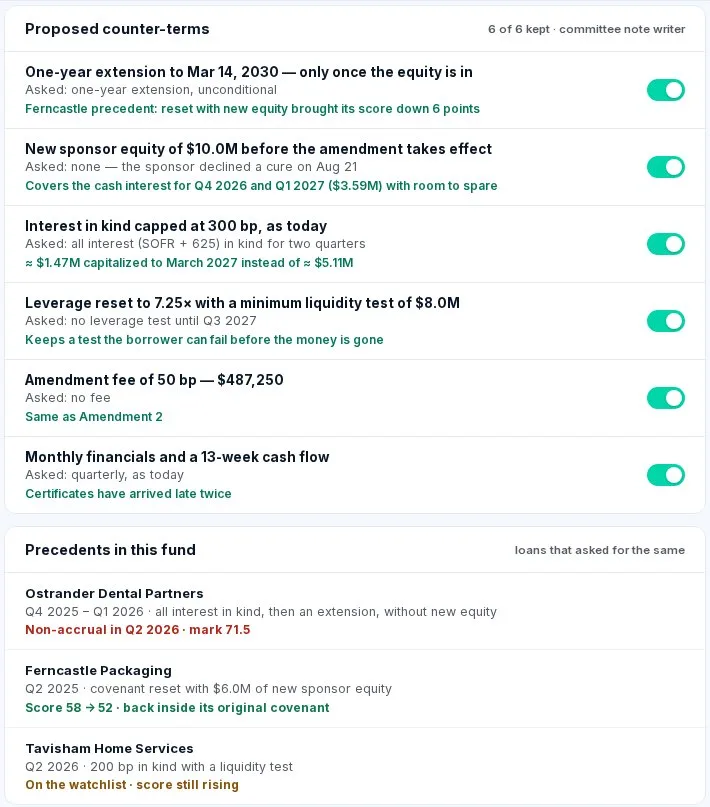
Amendment No. 4 came on Friday, October 2 from the borrower's CFO and the sponsor, Tamsin Ridge Partners, reply due Friday, October 16: maturity from March 14, 2029 to March 14, 2030; all interest in kind (SOFR plus 6.25%) for the fourth quarter of 2026 and the first of 2027, about $5.11 million added to the loan; and no leverage test until the third quarter of 2027.
The screen lays the three asks after the four agreed concessions: seven in sixteen months, and a score of 88 if agreed. Corvane holds 64% of the loan, so its answer is the required lenders' answer.
Amendment No. 4. What is asked, where it falls in the history, the counter-terms and the pro forma.
6
Counter-terms from the fund's own precedents
The committee note writer drafts six counter-terms against what was asked: the extension only once $10.0 million of new sponsor equity is in; interest in kind capped at 300 basis points, as today, about $1.47 million to March 2027 instead of about $5.11 million; a reset to 7.25 times with an $8.0 million minimum liquidity test instead of a holiday; a 50 basis point fee of $487,250; monthly financials and a 13-week cash flow.
The pro forma puts Corvane's par at $98.92 million in March 2027 instead of $102.56 million, and the score at 76 instead of 88. The precedents: Ostrander took all interest in kind and an extension without new equity and went on non-accrual; Ferncastle Packaging reset with $6.0 million of new equity and its score fell from 58 to 52. Elena keeps all six.
Counter-terms and precedents. Each term against the ask, with the reason, and three loans in the fund that asked for something similar.
7
Signed for Thursday's committee
Three watchlist proposals go to the committee: Brookhollow to the watchlist with its rating moved from 3 to 4; Harrowgate Logistics to the watchlist, any extension only with amortization; Pinecrest Modular Builders to the watchlist with monthly reporting. Each reason carries its source.
Elena signs with the meaning "Proposed as portfolio manager". Miriam Halvorsen, who chairs the watchlist and valuation committee, approves the rating change and the watchlist. The stress note goes to the committee with every figure cited.
Signing the proposals. What is being proposed, who receives it, and what the signature means.
Why the score is 81
Four concessions in nine months are the largest part of Brookhollow's score
Stress score drivers, points out of 100
Concessions: 4 in nine months24 pts
Leverage on the original covenant: 7.39× against 5.75×16 pts
Interest in kind added by amendment: 29% of the quarter's interest14 pts
Liquidity: $10.2M, about four months of fixed charges10 pts
Sponsor support: equity cure declined August 217 pts
Mark against peers: 93.0 against 86.56 pts
Reporting: certificate 12 days late4 pts
Fictional example from this guide · Weights are fund settings (30, 20, 17, 12, 9, 7, 5). The drivers add to 81; each links to its document in the product.
Show the numbers
Driver
Points
Concessions: 4 in nine months
24 pts
Leverage on the original covenant: 7.39× against 5.75×
16 pts
Interest in kind added by amendment: 29% of the quarter's interest
14 pts
Liquidity: $10.2M, about four months of fixed charges
10 pts
Sponsor support: equity cure declined August 21
7 pts
Mark against peers: 93.0 against 86.5
6 pts
Reporting: certificate 12 days late
4 pts
From 58 loans to one rating change
The quarter narrows 58 loans to three proposals and one rating change
Loans in the fund58
Loans with concessions in eight quarters17
Loans failing the original covenant7
Loans above the watch line5
Watchlist proposals signed3
Rating changes approved1
Fictional example from this guide
Show the numbers
Stage
Loans
Loans in the fund
58
Loans with concessions in eight quarters
17
Loans failing the original covenant
7
Loans above the watch line
5
Watchlist proposals signed
3
Rating changes approved
1
The solution data labels its outcomes: a median warning of three quarters before non-accrual, with 6 of 7 loans flagged a quarter or more early, is an estimate from a back-test on the fictional fund's own history; one timeline per loan for every amendment, waiver and interest period is a design target. Both are to be measured on your own book.
14 · Every screen
Replayed lanes, amendments classified by section, PIK by origin and the watchlist across the fund's 58 loans
In shortOne request is the story. These screens show the rest: a lane replayed marker by marker, the same shape on a loan that went bad, each amendment classified with its section, the concession grid, the score explained, the dated events, interest in kind split by origin, the watchlist, the cited stress note and the settings that make the rules the fund's own.
Replay a lane. The history plays back marker by marker with a running count: a waiver, then a reset and looser add-backs, three concessions in three months.
The same shape before. Ostrander Dental Partners drew four concessions in nine months, then went on non-accrual in June 2026.
Each change classified. The amendment reader highlights the section that changes the test and records why it counts as a concession.
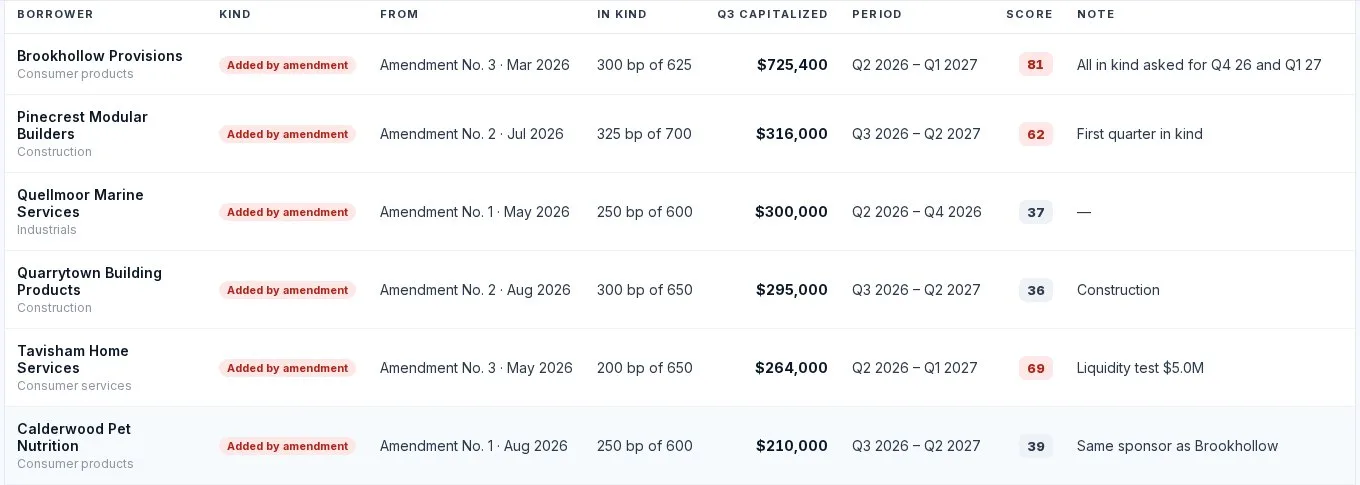
PIK by loan. The six loans paying in kind because of an amendment, $2,110,400 capitalized in the third quarter, each tied to its amendment and interest period.
Concession grid. Every loan by quarter, one letter per concession, with the open requests in their own column and the score at the end.
Why the score is what it is. Seven drivers with their points and sources, beside the terms at closing and today: SOFR plus 5.75% all cash became SOFR plus 6.25% with 3% payable in kind.
Every event, dated. Ten events from the February 2025 consent to the October 2026 request, each opening its document.
Interest in kind. 8.6% of the quarter's interest income, 5.1 points of it added by amendment, against 0.8% two years earlier; toggles ending by the first quarter of 2027.
Watchlist proposals. Three proposals with their cited reasons, the two loans already on the list, and the signatures still needed.
Quarterly stress note. Five sections for the committee, ten sources: eight documents from Brookhollow's loan file and two published studies.
Signed and approved. Two signatures with their meaning and time; the activity record keeps agent steps and people's decisions apart.
The fund's scoring rules. Watch line 60, escalation line 75, eight-quarter look-back, the weights, and what counts as a concession.
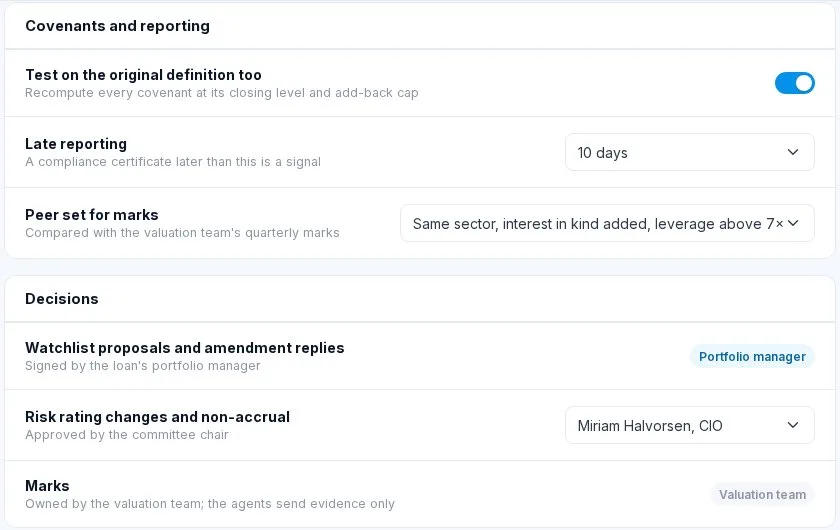
Who decides. The original-definition test switched on, a 10-day late-reporting signal, the peer set, and the approvers: portfolio manager, committee chair, valuation team.
Select a screen to open it larger. The fund, borrowers, sponsors, people and figures are fictional. Three borrower names were changed from the product's sample data because they resembled real companies.
Where the quarter's interest income came from
About one dollar in twelve of the fund's interest income was added to loans instead of paid
Corvane Senior Lending Fund II, third-quarter 2026 interest income
$41.3Minterest income
Paid in cash$37.7M
In kind, added by amendment$2.1M
In kind, designed at closing$1.4M
Fictional example from this guide · $3,560,400 in kind is 8.6% of $41.3M. Ostrander's $702,000 accrued in kind is not recognized as income because the loan is on non-accrual.
Show the numbers
Part
Amount
Paid in cash
$37.7M
In kind, added by amendment
$2.1M
In kind, designed at closing
$1.4M
15 · Agents, and who signs
The six agents' jobs and limits, and who signs a watchlist move, a rating change and a mark
In shortEach agent has one job and limits it does not cross. None of them changes a rating, a mark or a loan's accrual status, books income, or sends anything to a borrower. The portfolio manager signs proposals and amendment replies; the CIO, as committee chair, approves rating changes, the watchlist and non-accrual; marks stay with the valuation team.
Amendment reader, PIK tracker, covenant recomputer and the other monitors
Amendment reader
Reads the credit agreement and every amendment, waiver, consent and forbearance letter, and classifies each change: waiver, covenant reset, add-back change, interest in kind added, maturity extension, covenant holiday, margin change or consent.
Never counts a change it cannot cite to a section; consents and lender-favorable changes are kept off the concession count; asked changes stay dashed until agreed.
Interest and PIK tracker
Ties every interest period to the administrative agent's notice: cash, in kind, toggle elections, principal after. Separates PIK designed at closing from PIK added by amendment and flags toggles ending in the next two quarters.
Never books or reverses income. Designed PIK is tracked and left out of the score.
Covenant recomputer
Reads compliance certificates and statements and tests each covenant as reported and again at its closing level and add-back cap, reporting headroom on both and the quarters failing the original test.
Never resets a covenant or accepts an add-back above the cap it is testing.
Mark and signal watcher
Compares the fund's marks with a peer set and watches revolver use, late reporting, sponsor support and news.
Never changes a mark. It sends the valuation team the evidence.
Stress scorer
Scores every loan 0 to 100 from seven drivers over the look-back, explains each driver with its source and ranks the fund against the watch line.
Never puts a loan on the watchlist or on non-accrual.
Committee note writer
Drafts watchlist proposals, counter-terms to amendment requests from the fund's precedents, and the quarterly stress note, every figure cited.
Never sends anything without the portfolio manager's signature.
The portfolio manager signs; the CIO approves ratings and non-accrual
Proposes and signsPortfolio managerKeeps or drops each counter-term, signs the reply to the borrower and the watchlist proposals, with the meaning of the signature recorded.
ApprovesChief investment officerChairs the watchlist and valuation committee; approves rating changes, the watchlist and non-accrual.
Owns the markValuation teamPrepares marks with the outside valuation firm for the valuation designee; receives the evidence and decides.
Every timeline marker, score driver and figure in the stress note opens the document and section it came from. Agent runs, uploads and signatures are on the activity record with who and when, and every change to weights and lines is versioned.
Elena and Miriam on Corvane Senior Lending Fund II's 58 loans
Fictional, from the sample data
EM
Elena Marsh · portfolio manager, Corvane Senior Lending Fund II
Owns 58 loans, $1.62 billion of par; signs off every amendment the fund agrees to.
"Every amendment looked reasonable on the day. It's the fourth one that tells you."
MH
Miriam Halvorsen · chief investment officer
Chairs the watchlist and valuation committee; decides ratings, the watchlist and non-accrual each quarter.
"Bring me the pattern behind the latest request."
TL
Theo Lindqvist · credit analyst
Spreads compliance certificates for 19 borrowers and chases late reporting.
"The add-backs moved, so the leverage didn't."
IC
Ines Carvalho · valuation team lead
Prepares the quarterly marks with the outside valuation firm.
"Give me the evidence and I'll move the mark."
DA
Daniel Anyanwu · head of portfolio management
Answers to investors and the board for non-accruals and PIK income.
"I want to see stress before the mark does."
16 · What goes in and out
From amendments, interest notices and certificates to one cited history per loan
In shortThe solution reads the documents a fund already receives and leaves behind one dated history per loan, every covenant tested two ways, PIK split by origin, a ranked book with each score explained, and drafted proposals, counter-terms and a stress note that people sign. The fund's systems of record stay where they are.
From the loan files
Credit agreements, amendments, waivers, consents and requests
Administrative agent's interest notices and PIK elections
Compliance certificates, quarterly and annual statements
Valuation marks and outside valuation memos
Lender call notes, sponsor updates and news
From the fund
The watch and escalation lines and score weights
What counts as a concession, and the look-back
The peer set for marks and the late-reporting threshold
Who signs, who approves, who owns the mark
Agents read, place, recompute and draftEvery document for every loan, every night, under the fund's own rules
People sign and decide
Every event linked to its document
Outputs
A concession timeline per loan and for the whole fund
Each covenant tested as reported and on the original definition
Interest in kind by loan, designed and added, ready for the quarterly report's schedules
A stress ranking with every score explained
Watchlist proposals, counter-terms with a pro forma, and the quarterly stress note
What changes for the team
A request answered with the loan's whole history
The valuation team gets evidence with sources
The committee gets the pattern, cited
Agent bank portals and portfolio accounting behind each loan's history
Agent bank portalsInterest notices and PIK elections
Portfolio accountingPar, income, PIK capitalized
Valuation workflowMarks and outside firm memos
Borrower reporting portalStatements and certificates in
CRM or deal systemSponsors, call notes, requests
Identity and accessRoles, approvers, separation of duties
EmailRequests and replies
For each, check whether it has an API, a file feed or only screens, and who owns it.
Agent bank notices stay the record of cash and PIK
Your credit agreements
Read as they are, including every amendment; the definitions at closing are kept for the original-covenant test.
Your administrator and agent banks
Their interest notices stay the record of cash and PIK; each period is tied to its notice.
Your valuation process
Unchanged. The valuation designee and outside firm keep the mark; they receive evidence with its sources.
Your rating scale and watchlist rules
Kept as your committee wrote them; the score sits beside the rating and never replaces it.
Your quarterly reporting
Interest in kind by loan exports for the schedules; non-accrual figures stay your accountants' call.
Your committee
Receives a note in its usual sections, every figure cited, at the scale of the whole book.
Covenants tested as written at closing, concessions tied to documents
1
Every event carries its document
Amendment and section, notice and period, certificate and line, one click away.
2
Tested as written at closing too
Every covenant recomputed at its original level and add-back cap, so a reset cannot hide a breach.
3
Agents draft; people decide
Ratings, marks, non-accrual and replies to borrowers are signed by named people.
Part C · Are you ready to automate?
What late warnings cost a direct lending book, and how to test whether monitoring software earns its place
You run a direct lending book, or value it, or answer to investors and a board for it. This part is written for you: what late warnings and hand-built reviews cost, what reading every document could return, whether your team is ready, and what to ask any vendor of monitoring software, including us.
17 · What late warnings cost
The price of seeing a stressed loan a quarter late, and how to count it on your own book
In shortThe biggest cost is the one no study measures: the counter-terms you could have asked for while the borrower still needed your yes. The visible costs are analyst and portfolio manager time each quarter, and the questions an examiner, an auditor or an investor asks when a loan moves straight from "performing" to non-accrual. Start from your own numbers; a few published figures frame them.
6.3%
Fitch's US private credit default rate for the twelve months to August 2026, a record for the series; deferrals and payment in kind were 47% of the year's events.4
Fitch Ratings, as reported by Global Finance, September 16, 2026
2.75%
median non-accruals at cost among KBRA's rated non-perpetual BDCs in the second quarter of 2026, up from 1.81%.21
KBRA BDC Compendium, September 3, 2026
$71/hr
a financial analyst's median pay of $49.40 an hour, loaded for benefits at the 70% wage share of employer costs. Our arithmetic.40,41
O*NET 2025 wages · BLS ECEC June 2026
One lender says software cut its quarterly review preparation from weeks to days
Working days to prepare a quarterly portfolio review, midpoints of the published ranges
BeforeAfter
Portfolio review preparation12.5 days2.5 days
Source39 · A vendor-published customer story: "from 2-3 weeks to 2-3 days", one lender. Not an independent measurement; time your own review.
Show the numbers
Before
After
Portfolio review preparation
12.5 days
2.5 days
What nobody publishes. There is no public figure for hours per loan per quarter, the share of amendments that are concessions, the lead time of any signal before non-accrual across the market, or how much a lender recovers by acting a quarter earlier. The Boston Fed presents rising PIK as a signal that calls for continued monitoring.7 Measure your own, starting with the back-test in section 21.
Tracing your own non-accruals back to their first concession
Cost
Where it hides
How to find your number in a week
Review time
Pulling amendments, tying notices, re-spreading certificates, writing the pack
Ask each person on last quarter's review to log hours by step for five loans
Late warnings
Loans that went to non-accrual from a "performing" rating
For each non-accrual since 2022, list the quarter of its first concession and of the rating change
Concessions given away
Amendments agreed without equity, fees or tighter reporting
Pull the last 20 amendments and mark what was asked against what was taken
Hidden breaches
Loans passing a reset test, failing the original
Recompute the original covenant for every loan with a reset in the last two years
PIK quality
One PIK number in the investor report
Split last quarter's PIK income into designed at closing and added by amendment
Valuation challenge
Marks the auditor or valuation firm questioned
Count marks changed after challenge in the last four quarters, and why
Counter-terms you did not ask for, and a surprise non-accrual
The counter-terms you did not ask forNew equity, a liquidity test or a fee are easiest to get before the borrower has other options.
The disclosure that surprises investorsA loan that jumps from performing to non-accrual invites questions about the fund's process.
The redemption queueRetail-facing funds met heavier redemptions in 2026; confidence in marks is what keeps it short.36
The fee on income never collectedPIK income can raise fees before any cash arrives, and investors notice when it is later written off.14
The next examiner's questionValuation, PIK and non-accrual disclosures are where the SEC staff said it is looking.10,31
18 · Your return
Your return from reading every amendment: time you can measure, recoveries you can only estimate
In shortTwo kinds of value: hours each quarter, which you can measure in a pilot, and better outcomes on the few loans that go bad, which you can only estimate. The calculator keeps them apart. Only the hourly cost comes from published figures; every input marked illustrative is an assumption to replace with your own.
Built loan histories, earlier action and breaches a reset hid
Review time
Each loan's history, already built
Amendments, notices and certificates already read and placed on each loan's timeline before the review starts.
loans × reviews a year × hours saved per loan × hourly cost
Earlier action
Answer from strength
A loan flagged a quarter or more before non-accrual, while counter-terms can still be negotiated.
par reaching non-accrual a year × recovery points gained
Covenants
Breaches a reset hid
Every covenant re-tested on the definition at closing, every quarter, for every loan.
loans failing the original test that the current test passes
PIK
Income quality you can show
PIK split by origin and tied to each notice, ready for the investor report and the valuation team.
hours to prepare PIK and non-accrual schedules, before and after
Valuation
Evidence for the mark
The mark against peers, the original-covenant test and the concession history, sourced, for the designee and outside firm.
marks challenged and changed after the quarter, before and after
Committee
A note with every figure cited
The stress note and proposals drafted from the timelines; the committee reads the pattern.
hours to write the committee pack × people × hourly cost
Review hours saved per loan, per quarterly review
Only the hourly cost is built from published figures: the O*NET 2025 median for financial and investment analysts, $49.40, divided by the 70% wage share of employer costs.40,41 Every input marked illustrative is an assumption.
Your bookHours per loan per reviewEarlier actionYour cost
Illustrative yearly value
Review time today, valued$0
Review time released, valued$0
Earlier action, estimated$0
Both, after your yearly cost$0
Team hours released a year0
Earlier-action value needed to break even$0
Formulas, per year: Review time today = loans × reviews × hours today × hourly cost Time released = loans × reviews × (hours today − hours with automation) × hourly cost Earlier action = par reaching non-accrual × recovery points ÷ 100 After your cost = time released + earlier action − yearly cost Break-even = the earlier-action value needed once time released is counted (zero means time alone covers the cost)
Hours are for everyone who touches a loan in a review: analyst, portfolio manager, operations and valuation. The earlier-action line is an estimate no study supports or refutes; set it to zero to see the case on time alone, and back-test it on your own non-accruals before you rely on it.
On a $40 million year of non-accruals, each point of recovery is worth $400,000
Value of acting a quarter earlier, by recovery points gained, on $40 million of par reaching non-accrual
Half a point$200K
One point$400K
Two points$800K
Three points$1.2M
Illustrative · replace with your own numbers · Arithmetic only. Replace $40 million with your own average yearly par moving to non-accrual.
Show the numbers
Recovery gained
Yearly value
Half a point
$200K
One point
$400K
Two points
$800K
Three points
$1.2M
At the defaults, the time released, $74,124 a year, covers half the illustrative $150,000 cost; the case rests on earlier action on a few loans. A fund with 150 loans and monthly reviews clears the cost on time alone. A fund with 20 loans reviewed quarterly releases about $25,560 a year, so its case rests almost entirely on earlier action.
Start here19 · Readiness check
How ready is your portfolio team? Score your book, your files and your rules
In shortPick the answer closest to your team today. Eight questions score 0 to 2; the last is for reflection. The meter adds up your score as you go, and each question says why it matters and what a strong answer sounds like.
1
Book size
How many loans do you monitor, across all funds and vehicles?
Why it mattersHours per loan per review times loans times reviews is the time case. A small book gains less.
A strong answer"About 150 loans across three vehicles, reviewed quarterly, monthly for the watchlist."
2
Amendment activity
How many amendments, waivers and consents did your book see in the last year?
Why it mattersThe concession history is where early warning lives. Most of Fitch's default events in the year to August 2026 were deferrals, PIK and extensions agreed with lenders.4
A strong answer"About 40, a third of them on loans now on the watchlist."
3
Your files
Are the credit agreements, every amendment, interest notices and certificates for each loan in one place software can reach?
Why it mattersA history is only as complete as its documents; missing amendments are the first gap a pilot finds.
A strong answer"One folder per loan in our document system, and the agent bank notices arrive by email to one inbox."
4
Your history
Can you list your non-accruals and restructurings since 2022, with the dates of their concessions?
Why it mattersA back-test on your own bad loans is the only honest measure of how early any score warns.
A strong answer"Seven loans, and we have every amendment for each."
5
Written rules
Are your rating scale, watchlist entry and exit rules and non-accrual policy written down?
Why it mattersThey become settings. Rules that live in people's heads have to be written first.
A strong answer"A five-grade scale with definitions, watchlist rules in the credit policy, and a non-accrual policy the auditors have read."
6
Pressure
Have investors, auditors, a valuation firm, a lender to the fund or the SEC asked about PIK, modifications or marks in the last year?
Why it mattersQuestions bring deadlines and budgets; the SEC staff's September 2026 statement makes them likelier.10
A strong answer"Our auditor asked how we decide non-accrual on PIK loans, and two investors asked for PIK by origin."
7
Owner and budget
Is there a named owner of portfolio monitoring with a budget to change it?
Why it mattersMonitoring crosses deal teams, operations, valuation, legal and the committee. Without one owner it stalls.
A strong answer"Our head of portfolio management sponsors it, with the CIO's support."
8
Governance
Do you have a way to approve AI tools: vendor due diligence, data rules for borrower files, human sign-off and an audit trail?
Why it mattersBorrower information is confidential under your agreements; Rule 2a-5 asks you to oversee service providers that feed a mark.18
A strong answer"Compliance has a review path for AI vendors, and every rating change and mark has a named approver."
9
Vision · for reflection
If your committee asked tomorrow for every concession on every loan since closing, with the original covenant tested each quarter, how long would it take, and who would do it?
Why it mattersYour answer shows where the history lives today and what it would take to keep it current.
A strong answerA specific plan, for example: "two analysts, three weeks, and we would still miss the side letters."
Portfolio team readiness: gather loan files, back-test, then implement
0–6
Explore
Gather the files first: every amendment and notice for ten loans, including your last few non-accruals. Write down your rating scale and watchlist rules. Start narrow, for example with the original-covenant test on every reset loan.
7–11
Ready to pilot
Back-test on closed history: rebuild the timelines of your non-accruals and a matched set of loans that recovered, and see how early each would have been flagged. Then run one live quarter in parallel with people signing everything.
12–16
Ready to implement
Plan the whole book: your rules and approvers as settings, links to documents, agent notices and portfolio accounting, the committee pack, and the evidence your auditors and valuation firm will ask for.
20 · Questions for any vendor
Testing a monitoring vendor on amendments, covenants after a reset and PIK by origin
In shortAsk every vendor the same questions, us included. The answers show whether the tool reads amendments or only collects financials, how it tests covenants after a reset, how it treats PIK, what evidence you keep, whose rules apply, and how you would measure it on your own loans.
Ask
A good answer
A warning sign
What it reads
Does it read amendments, waivers and consents, or only financial statements?
Every amendment, classified change by change, with the section cited.
"We track covenant compliance from the certificates."
How does it tell a concession from a consent?
A written classification you can change; consents and lender-favorable changes listed apart.
Every amendment counted the same.
Does it read agent interest notices and PIK elections?
Every period tied to its notice, cash and in kind, principal after.
PIK keyed in by hand once a quarter.
Covenants and PIK
After a reset, does it test the original covenant too?
Both, every quarter, with headroom on each and the quarters failing the original.
Only the covenant in force.
Does it apply the add-back cap from the definition at closing?
Yes, line by line from the certificate.
Takes the borrower's EBITDA as given.
Does it separate PIK designed at closing from PIK added by amendment?
Yes, by loan and for the fund, with the source of each.
One PIK percentage.
Scores, ratings and marks
How is the score built, and can we see each driver's source?
Named drivers, weights you set, each driver linked to its document.
A number from a model you cannot inspect.
Can it change a rating, a mark or accrual status?
No. It proposes; named people decide.
"It updates ratings automatically."
How early would it have flagged our own non-accruals?
A back-test on your closed loans, with misses shown.
A lead time quoted from someone else's book.
Evidence
Does every figure in the committee note cite its document?
Document and section, one click away.
A summary without sources.
What is on the audit trail?
Agent runs, uploads, signatures with their meaning, setting changes with versions.
Logins only.
Your rules and data
Whose rating scale, watchlist rules and approvers does it use?
Yours, as settings, versioned.
A fixed scale you must adopt.
Where is borrower information processed, and is it used to train anything?
A clear written answer that fits your confidentiality terms.
Vague answers about "improving the service".
How does it connect to our documents, agent notices and portfolio accounting?
Named connectors or file feeds, and who maintains them.
"Upload a spreadsheet."
Proof
Will you rebuild ten of our loans' histories before we sign?
Yes, including loans that went bad, scored against our own files.
Only a demo on sample data.
What did it miss in your last test, and why?
A candid list of misses by type.
"Nothing."
We found no published independent test of any portfolio monitoring vendor's accuracy as of October 2026. A back-test on your own closed loans is the fairest comparison, and the same test measures your current process.
21 · How to start
A first pilot: rebuild the histories of loans that went bad, then shadow one live quarter
In shortYour closed history is the test set. Rebuild the timelines of your non-accruals and of loans that recovered, see when a score would have flagged each, then run one live quarter in parallel with people signing everything. Decide on four numbers. None of these steps commits you to a vendor.
Choose 20 loans: every non-accrual or restructuring since 2022 and a matched set that recovered after concessions.
Gather their files: agreements, every amendment and waiver, interest notices, certificates and marks. List what is missing; that is a finding.
Back-test: rebuild each timeline blind and record the quarter each loan would have crossed your watch line.
Run one live quarter in parallel on the whole book, with your analysts, portfolio managers and committee deciding as usual.
Decide with four numbers: lead time on the bad loans, false alarms on the good ones, hours per loan per review, and concessions found that your tracker missed.
A fourteen-week pilot ends with a decision on four numbers
Your teamVendor
Choose 20 loans; pull their files
Write rating, watchlist and concession rules
Load rules and files
Back-test the 20 timelines blind
Score lead time and false alarms
Live quarter in parallel
Decide
Week 0481214
Illustrative · replace with your own numbers
Show the numbers
Activity
From
To
Choose 20 loans; pull their files
0
3
Write rating, watchlist and concession rules
1
4
Load rules and files
2
5
Back-test the 20 timelines blind
4
7
Score lead time and false alarms
7
8
Live quarter in parallel
8
13
Decide
13
14
Lead time to non-accrual, the number a monitoring pilot must show
Measure
How
Why
Lead time
Quarters between crossing the watch line and non-accrual, for each bad loan
The point of monitoring; the only honest lead time is on your own book
False alarms
Loans flagged that recovered without a workout
A score that flags everything gets ignored
Concessions found
Concessions on the rebuilt timelines that your tracker lacked
Shows how complete your history is today
Hidden breaches
Loans failing the original covenant while passing the reset
Feeds ratings and valuation evidence
Hours per loan
Logged by each person, by step, in the parallel quarter
The measurable part of the return
Source accuracy
Sample 50 events and check each against its document and section
Evidence is only evidence if it is right
The full working-session questions: 18 questions in six groups
Bring portfolio management, credit analysis, valuation, fund operations, legal, compliance and IT into one room. Each question says why it matters, what a strong answer looks like, and the warning sign.
A
Which vehicles and loans to monitor, and where you are agent
A1
Which vehicles and loans are in scope, and which stay on the current process?
Why it mattersCo-investments and small positions may not justify the work.
Strong answer · warning sign
A clear list by vehicle.
"Everything, day one."
A2
Where are we agent, and where do we hold a minority?
Why it mattersAs agent you hold the documents; as a minority you depend on the agent's notices.
Strong answer · warning sign
Known per loan.
Nobody has the list.
A3
How often do we review: quarterly for all, monthly for the watchlist?
Why it mattersSets the hours and the calendar.
Strong answer · warning sign
Written cadence by status.
"When someone asks."
B
Every amendment, side letter and agent notice per loan
B1
Do we hold every amendment, side letter and waiver for each loan?
Why it mattersA missing amendment is a missing concession.
Strong answer · warning sign
One complete folder per loan.
Some only in a lawyer's inbox.
B2
How do agent interest notices reach us?
Why it mattersThey are the record of cash and PIK.
Strong answer · warning sign
One inbox or portal feed.
Forwarded to whoever is around.
B3
Do we keep each loan's definitions at closing, including add-back caps?
Why it mattersThe original-covenant test needs them.
Strong answer · warning sign
In the closing set.
Overwritten by the latest conformed copy.
C
What counts as a concession, and the watchlist entry rules
C1
What counts as a concession in our book, and over what window?
Why it mattersIt becomes the score's largest driver.
Strong answer · warning sign
A written list and a look-back.
"We know it when we see it."
C2
What are our watchlist entry and exit rules?
Why it mattersA loan leaving after a reset leaves for the wrong reason.
Strong answer · warning sign
Written, both ways.
Entry only.
C3
When do PIK loans go on non-accrual under our policy?
Why it mattersThe SEC staff asks what triggers the status.10
Strong answer · warning sign
A policy the auditor has read.
Case by case, undocumented.
D
What the valuation designee needs to move a mark
D1
What evidence does our valuation designee need to move a mark?
Why it mattersDefines what the monitoring output must contain.
Strong answer · warning sign
A written list.
"The deal team's view."
D2
How do we test our valuation methodologies under Rule 2a-5?
Why it mattersThe rule requires it; back-testing marks against exits uses the same history.18
Strong answer · warning sign
A testing calendar.
Annual sign-off only.
D3
Which peer set do we compare marks with?
Why it mattersA mark looks calm until it is compared.
Strong answer · warning sign
A defined set, refreshed.
None.
E
Who signs ratings and marks, and what borrowers' files allow you to share
E1
Who signs proposals, who approves ratings and non-accrual, who owns marks?
Why it mattersThey become approvers in the tool.
Strong answer · warning sign
Named roles in policy.
"The committee."
E2
What do our credit agreements allow us to share with a software vendor?
Why it mattersBorrower information is confidential.
Strong answer · warning sign
Legal has read the clauses.
Nobody has checked.
E3
Who sponsors the change, and what budget can move?
Why it mattersA pilot without a sponsor ends as a demo.
Strong answer · warning sign
A named executive.
No sponsor.
F
Negotiating each amendment from the loan's whole record
F1
What if every request were answered with the loan's whole history and a pro forma?
Why it mattersTests the appetite to negotiate from the record.
Strong answer · warning sign
"We would ask for equity more often."
"Deal teams know their loans."
F2
What if investors received PIK by origin every quarter?
Why it mattersLinks monitoring to reporting.
Strong answer · warning sign
A slide we would be glad to show.
A number we would rather not.
F3
Which decisions would we never let software make?
Why it mattersTells you where the signatures belong.
Strong answer · warning sign
Ratings, marks, non-accrual, replies to borrowers.
"All of it": then start with reading and recomputing.
In shortThe questions portfolio managers, valuation teams and buyers search for most, each answered on its own.
What is private credit portfolio monitoring?
Private credit portfolio monitoring is everything a direct lender does with a loan between closing and repayment: collecting the borrower's statements and compliance certificates, re-testing covenants, tracking interest paid in cash or in kind, reading amendment requests, rating the loan, supporting its fair value mark and deciding the watchlist and non-accrual. Done well, it keeps each loan's whole history in view so a struggling borrower is seen before the loan stops accruing.
What is PIK interest in private credit?
Payment-in-kind (PIK) interest is interest added to the loan balance instead of paid in cash, so the next period's interest is charged on a larger loan. Some loans are designed with PIK at closing; others add it by amendment when the borrower is short of cash. The Boston Fed found the share of BDC loans with PIK rose from about 6% in 2022 to about 10% by early 2026.
What is "bad PIK"?
Bad PIK is Lincoln International's term for investments with no PIK interest at closing that pay PIK today, which usually means the borrower asked to stop paying cash. Lincoln found it in 55.4% of loans paying PIK in the second quarter of 2026, or 6.2% of all loans it values, and says that share may also be viewed as a shadow default rate.
What is the private credit default rate in 2026?
The answer depends on what is counted. Fitch's US Private Credit Default Rate, which counts interest deferrals and new PIK terms, reached a record 6.3% for the twelve months to August 2026. Proskauer's index, which counts payment, financial covenant and bankruptcy defaults and loans amended in anticipation of default, was 2.41% in the third quarter of 2026.
What is the difference between a maintenance covenant and an incurrence covenant?
A maintenance covenant must be met at every test date, usually each quarter, such as total net leverage at or below 5.75 times. An incurrence covenant is tested only when the borrower takes an action such as borrowing more or paying a dividend. Loans with only incurrence tests are called covenant-lite. About 90% of large-cap leveraged loans had no maintenance covenant through the third quarter of 2025, by an S&P Global figure reported in the trade press.
Why test a covenant on its original definition after a reset?
After a reset or a wider add-back cap, the borrower is tested against looser terms and can pass while the business has moved far from what was underwritten. Recomputing the ratio with the closing level and add-back cap shows that gap. In this guide's example, leverage is 6.57 times against a reset test of 6.75, and 7.39 times against the original 5.75.
What is amend and extend in private credit?
Amend and extend is an amendment that pushes out a loan's maturity and changes other terms at the same time, often with PIK, looser covenants, a fee or new sponsor equity. It can save value when the problem is timing, and it defers a larger loss when the problem is solvency. Reading each request against the loan's earlier concessions shows which it is.
How are private credit loans valued?
BDCs and registered funds carry loans at fair value under ASC 820. Because private loans have no quoted price, they are Level 3, valued each quarter with models, usually a yield approach calibrated to the price at closing, often with an outside valuation firm. Under SEC Rule 2a-5 the board, or the adviser as its valuation designee, determines fair value in good faith and tests the methodologies.
What did the SEC say about private credit valuation in 2026?
On September 28, 2026 the SEC's Chief Accountant and the Director of Investment Management issued a staff statement on fair value and disclosure for private assets, focused on private credit. It notes that private credit loans are typically Level 3, stresses calibration and market-participant assumptions, says clear PIK and non-accrual disclosure may be material to investors, and asks funds to explain modifications and restructurings. It creates no new rule.
What is non-accrual, and how high are BDC non-accruals?
A loan is on non-accrual when the lender stops recording its interest as income because collection is in doubt. In the second quarter of 2026, KBRA's median for rated non-perpetual BDCs was 2.75% of investments at cost, and Octus measured 1.9% across 173 BDCs, or 3.74% when every tranche of a borrower on non-accrual at any BDC is counted.
How do private credit funds rate their loans?
Each fund writes its own scale, often five grades. In one BDC's filing, 2 is the rating every new loan starts with, 3 means operating below expectations and possibly out of covenant compliance, and 5 means substantially below expectations. Ratings, the watchlist and non-accrual are usually decided by a committee chaired by the chief investment officer.
Can AI monitor a private credit portfolio?
AI can read amendments, interest notices and certificates, place each change on a dated history, recompute covenants and draft a committee note, provided every output cites its document and section. It should not change ratings, marks or accrual status; people and the valuation designee decide. Measure it on your own closed loans before relying on its warnings.
What should private credit portfolio monitoring software do?
Portfolio monitoring software should read every amendment and classify the changes, tie interest notices to cash and PIK, test covenants as reported and on the original definition, separate PIK designed at closing from PIK added by amendment, rank the book with each score explained, and cite every figure to its source. Ask any vendor to rebuild the histories of loans you already know went bad.
23 · One-page summary
The quarterly monitoring routine for a direct loan book, the 2026 rule dates and fourteen terms, on one sheet
Print this page
In shortThe whole guide on one screen: the method, the 2025–2026 status, the readiness bands and the terms.
The method
Keep one dated history per loan: every amendment, waiver, consent, request and interest period, with its document.
Classify each change; count concessions in a window and mark asked changes as asked.
Test every covenant as reported and on the definition at closing; record the quarters failing the original.
Split PIK into designed at closing and added by amendment; track toggles ending.
Rank the book with explained drivers; compare marks with peers; send evidence to valuation.
Answer requests from the history, with a pro forma and counter-terms; people sign, the committee decides.
Readiness: score 0–2 on eight questions: 0–6 explore · 7–11 pilot · 12–16 implement.
As of October 2026: SEC staff statement on private asset fair value, September 28, 2026 · Rule 2a-5 in effect since March 8, 2021 · SEC fiscal 2027 exam priorities, October 23, 2026, name private credit valuation · DOL 401(k) proposal of March 31, 2026 not final · Fitch default rate 6.3% (August 2026); Proskauer 2.41% (Q3 2026) · OCC and FDIC leveraged lending guidance withdrawn December 5, 2025 · SR 26-2 replaced SR 11-April 7 17, 2026.
14 terms
Direct lending
Loans made straight to private companies by non-bank funds, usually held to maturity.
BDC
Business development company: an SEC-registered vehicle that lends to private companies and reports quarterly.
Sponsor
The private equity firm that owns the borrower.
Unitranche
One loan combining senior and junior debt, at one blended price.
Compliance certificate
The borrower's signed calculation of its covenants each test period.
Maintenance covenant
A ratio the borrower must meet at every test date.
Covenant-lite
A loan with no maintenance covenants, only incurrence tests.
Add-backs
One-off costs and expected savings the borrower may add to EBITDA, usually capped.
PIK
Payment in kind: interest added to the loan balance instead of paid in cash.
Bad PIK
PIK on a loan that had none at closing.
Amend and extend
An amendment that pushes out maturity and rewrites other terms.
Non-accrual
A loan whose interest is no longer recorded as income.
Level 3
Fair value from unobservable inputs: models and judgment.
Valuation designee
The adviser a fund's board appoints under Rule 2a-5 to determine fair value.
24 · Sources
Sources
Accessed October 2026. Regulatory status statements are as of October 2026.
F. Cai and S. Haque, "Private Credit: Characteristics and Risks", FEDS Notes, Board of Governors of the Federal Reserve System, February 23, 2024. federalreserve.gov
Financial Stability Oversight Council, 2025 Annual Report (approved December 11, 2025), "Private Credit Markets" and "Increasing Access to Private Assets", pp. 33–34. home.treasury.gov
Fitch Ratings, US Private Credit Default Rate for August 2025, as reported by Bloomberg Government, "Private Credit Default Rate Stays at 5.2% in August: Fitch", September 26, 2025. news.bgov.com
Fitch Ratings, US Private Credit Default Rate for the twelve months to August 2026, as reported by A. Noto, "Fed Rate Hike Squeezes an Already Stressed Private Credit Sector", Global Finance, September 16, 2026 (6.3%, up from 6.1% in July; PIK and interest deferrals 47% of trailing-year events; distressed maturity extensions 41%). fitchratings.com refuses automated reads. gfmag.com
Proskauer, "Proskauer's Private Credit Default Index Reveals Rate of 2.41% for Q3 2026", October 27, 2026 (746 senior secured and unitranche loans, $205.7 billion; with the Q1 and Q2 2026 releases). proskauer.com
Proskauer, Q3 2023 Private Credit Default Index release, methodology: the Index "includes loans that have a payment, financial covenant or bankruptcy default" and loans "amended in anticipation of a default". proskauer.com
J. L. Fillat, L. S. Shen and J. C. Wang, "Early Warning Signals in Private Credit? What BDC Portfolios Reveal about Emerging Risks", Federal Reserve Bank of Boston, Current Policy Perspectives 26-6, August 5, 2026. bostonfed.org
A. Banegas, S. Castelo, A. Degerli, C. Dobridge and W. Kennedy, "Private Credit and Leveraged Loan Markets: Similarities, Differences, and Substitution", FEDS Notes, August 11, 2026. federalreserve.gov
SEC, Form 10-Q, General Instruction A: due 40 days after quarter end for large accelerated and accelerated filers, 45 days for all others. sec.gov
SEC, K. Hohl (Chief Accountant) and B. Daly (Director, Division of Investment Management), "Statement on Fair Value Measurement and Disclosure Considerations for Private Assets", September 28, 2026 (staff views; no legal force). sec.gov
L. Rafter, "The covenant divide: why financial protections are holding firm in the lower middle market", ABF Journal (undated; reports S&P Global Leveraged Commentary & Data, Covenant Trends Report, Q3 2025: "roughly ninety percent of large-cap leveraged loans carried no maintenance covenants" through the third quarter of 2025). abfjournal.com
Lincoln International, "The Lincoln Private Market Index: Earnings Growth Drove a Q2 Rebound, While Private Markets Became More Selective", August 2026 (about 1,800 private companies). lincolninternational.com
Board of Governors of the Federal Reserve System, Financial Stability Report, May 2026, section 2, "Borrowing by Businesses and Households". federalreserve.gov
TCG BDC, Inc., Annual Report on Form 10-K for fiscal 2021: internal risk ratings 1 to 5, valuation process, and the PIK risk factor. sec.gov
Fitch Ratings, US Private Credit Default Rate for the twelve months to April 2026, as reported by N. Ahmed, "US Private Credit Defaults Hit New Record of 6% in April: Fitch", Bloomberg Law, May 18, 2026. news.bloomberglaw.com
FASB, Accounting Standards Update 2022-02, "Financial Instruments—Credit Losses (Topic 326): Troubled Debt Restructurings and Vintage Disclosures", March 2022. As amended, ASC 310-10-50-40 excludes receivables measured at fair value with changes in fair value reported in earnings from the modification disclosures. storage.fasb.org
Fitch Ratings, US Private Credit Default Rate for January 2026 and February events, as reported by Funds Society, "U.S. Private Credit Default Rate Continues to Climb", March 2, 2026. fundssociety.com
17 CFR 270.2a-5, "Fair value determination and readily available market quotations" (86 FR 807, January 6, 2021). law.cornell.edu
SEC, "Good Faith Determinations of Fair Value", Release IC-34128, adopted December 3, 2020, effective March 8, 2021. sec.gov
International Monetary Fund, Global Financial Stability Report, April 2024, Chapter 2, "The Rise and Risks of Private Credit". imf.org
KBRA, "Private Credit: Business Development Company (BDC) Ratings Compendium: Second-Quarter 2026", September 3, 2026 (35 rated BDCs). kbra.com
Octus, "Data Drop: Q2'26 BDC debt nonaccruals decline five percent", September 8, 2026 (173 BDCs). octus.com
I. Aldasoro, S. Doerr and K. Todorov, "Retail investors in private credit", BIS Bulletin No 106, July 9, 2025. bis.org
Executive Order 14330, "Democratizing Access to Alternative Assets for 401(k) Investors", August 7, 2025. whitehouse.gov
OCC and FDIC, News Release 2025-119, rescission of the 2013 Interagency Guidance on Leveraged Lending, December 5, 2025. occ.gov
T. Berg and J. H. Lee, "Measuring Counterparty Exposures in Private Credit", Office of Financial Research Brief 26-02, March 12, 2026. financialresearch.gov
Bank for International Settlements, "Private credit's software lending meets AI disruption", BIS Quarterly Review, March 16, 2026. bis.org
US Department of Labor, Employee Benefits Security Administration, "Fiduciary Duties in Selecting Designated Investment Alternatives", proposed rule, 91 FR 16088, March 31, 2026 (FR Doc. 2026-06178, RIN 1210-AC38; comments due June 1, 2026; no final rule in the Federal Register at October 31, 2026). govinfo.gov
P. Abbassi, I. Aldasoro and S. Doerr, "Financing the digital economy: the role of private credit", BIS Quarterly Review, September 14, 2026. bis.org
International Monetary Fund, Global Financial Stability Report, October 2026. imf.org
SEC Division of Examinations, Fiscal Year 2027 Examination Priorities, announced October 23, 2026 (SEC press release 2026-109). sec.gov
SEC Division of Examinations, Fiscal Year 2026 Examination Priorities (staff statement). sec.gov
Proskauer, "SEC Withdraws Fourteen Rule Proposals", June 2025 (the 2023 predictive data analytics proposal withdrawn June 12, 2025). proskauer.com
Federal Reserve SR 26-2, OCC Bulletin 2026-13 and FDIC FIL-15-2026, "Revised Guidance on Model Risk Management", April 17, 2026 (supersedes SR 11-7). federalreserve.gov
F. Avalos, S. Doerr and G. Pinter, "The global drivers of private credit", BIS Quarterly Review, March 11, 2025. bis.org
M. Nicholson, "Nontraded BDC Outflows Exceed Inflows for First Time as Q1 Fundraising Drops 59% Year Over Year", AltsWire, May 14, 2026 (Robert A. Stanger & Co. data). altswire.com
Fitch Ratings on non-traded BDC tenders, as reported by Alternative Credit Investor, "Fitch says non-traded BDCs can withstand redemptions surge", June 1, 2026. alternativecreditinvestor.com
J. Iyoob, "The PIK picture: tracking non-cash income in BDC portfolios", Penn Mutual Asset Management, June 18, 2026. pennmutualam.com
Lumonic, "Best portfolio monitoring software for private credit", vendor page dated October 29, 2026; customer outcomes from the vendor's published customer stories. lumonic.com
O*NET OnLine (US Department of Labor), Financial and Investment Analysts, 13-2051.00: median wage $49.40 an hour, $102,740 a year (2025). onetonline.org
BLS, Employer Costs for Employee Compensation, June 2026, released September 9, 2026: wages and salaries 70.0% of private-industry employer costs (release text archived by FRASER, Federal Reserve Bank of St. Louis). fraser.stlouisfed.org
Next step
See it on your own loan files.
Explore the solution, or bring the amendments, interest notices and certificates for a few of your loans, and we will rebuild their histories with you, every event linked to its document.
We use essential cookies to make this site work, and cookieless, anonymised analytics to understand how it's used. "Accept all" also turns on Google Analytics, which sets cookies. Privacy policy