Section 609(e) of the Fair Credit Reporting Act, 15 U.S.C. 1681g(e), requires a business that dealt with someone using a victim's identity to give the victim "a copy of application and business transaction records in the control of the business entity, whether maintained by the business entity or by another person on behalf of the business entity, evidencing any transaction alleged to be a result of identity theft," within 30 days of a written request and without charge, once the victim's identity and claim are verified (15 U.S.C. 1681g(e)). For a bank, a 609(e) request about a deposit account opened in a stolen identity is a records obligation owed to someone who is not its customer, arriving at the same time as a Red Flags response, a possible suspicious activity report and, often, a consumer reporting dispute. The difficulty is keeping those four threads apart: the victim gets records and a closed account, never a hint of a SAR. Botminds' New Account Fraud Detection rebuilds each new account's opening file and activity with every item cited to its source, keeps referrals in a queue only the BSA team can open, and strips any sentence that would reveal one from every notice before a person approves it.
Statutory text is quoted from the U.S. Code and the eCFR; the accounts and screens shown are fictional sample data at a fictional bank and its fintech partners.
Why fraudulent new-account victims arrive with documents in hand
$3,430
mean direct loss when personal information was used to open a new account, against $670 for a misused bank account
29%
of new-account victims knew how their information was obtained, more than for other identity theft
7%
of all identity-theft victims reported the incident to police in 2021
67%
contacted a credit card company or bank
What does FCRA 609(e) require of a bank?
Records, not conclusions, to the victim or to law enforcement the victim names. The duty applies to any business entity that "provided credit to, provided for consideration products, goods, or services to, accepted payment from, or otherwise entered into a commercial transaction for consideration with" the person who allegedly used the victim's identity, which includes a bank that opened a deposit account for the impostor. The records go to the victim, to any federal, state or local law enforcement agency the victim specifies, or to an agency investigating the theft that the victim authorizes.
Two phrases decide scope. "Application and business transaction records" means the opening file and the account's activity: the identity data, documents, device and contact details the impostor gave, and the transactions alleged to result from the theft. And "whether maintained by the business entity or by another person on behalf of the business entity" reaches records a fintech partner or processor holds for the bank. A bank-fintech program that can only produce the bank's core system records, and not the partner's application record, has not answered the request.
Verification: what the bank may require before it releases records
The bank chooses the proof from a list in the statute. Unless it already has "a high degree of confidence that it knows the identity of the victim," the victim must provide, at the bank's election, proof of identity and proof of the claim.
What a bank may require before answering a 609(e) request
| What the statute allows | The bank's options | Practical note |
|---|---|---|
| Proof of identity | A government-issued ID; identifying information of the same type the impostor gave; or the information the bank asks of new applicants | Matching the impostor's data type lets the bank compare the victim with the opening file directly |
| Proof of the claim | A police report, and a standardized identity theft affidavit or an affidavit of fact the bank accepts | Publish which affidavit you accept; an unpublished preference becomes a delay |
| Form of request | In writing, mailed to an address the bank specifies, if any | A specified address that only one team monitors is the first control on the 30 days |
| Detail to find the account | If asked: the date of the application or transaction and an account or transaction number, if known or readily obtainable | Ask for it; do not refuse a request that lacks it |
| Charge | None | "Without charge," with no exception |
Privacy rules are not a ground to refuse. The statute says that no provision of the Gramm-Leach-Bliley Act's financial privacy subtitle "prohibiting the disclosure of financial information by a business entity to third parties shall be used to deny disclosure of information to the victim" (15 U.S.C. 1681g(e)(9)(A)). Banks often treat the impostor's application as confidential information about the account holder of record; the statute removes that as a reason to keep it from the victim.
The 30 days run from receipt of the request, "subject to verification." A procedure should say who acknowledges a request on arrival, what proof is missing, and when the clock is treated as paused for verification and restarted, so that a request does not sit unanswered because the file was incomplete and nobody asked for the rest.
When may a bank decline a 609(e) request?
Only in good faith, on four grounds the statute lists: the subsection does not require the disclosure; after reviewing the proof, the bank "does not have a high degree of confidence in knowing the true identity of the individual requesting the information"; the request rests on a misrepresentation of fact; or the information is "Internet navigational data or similar information about a person's visit to a website or online service" (15 U.S.C. 1681g(e)(5)).
The identity ground matters because the requester may be the impostor. A request that arrives from the email address on the fraudulent account, or asks for the records to go to a new address, should be verified against the proof the statute allows before anything is sent. The statute protects the bank on both sides: it creates no new recordkeeping duty, it gives an affirmative defense where a reasonably diligent search finds the records do not exist or are not reasonably available, and "no business entity may be held civilly liable" for a disclosure made in good faith under the subsection.
Who enforces 609(e), and what a bank must be able to show
Regulators, not private lawsuits for damages. The subsection says that, "except as provided in section 1681s," the FCRA's civil liability sections for willful and negligent noncompliance, 1681n and 1681o, "do not apply to any violation of this subsection" (15 U.S.C. 1681g(e)(6)). Enforcement therefore runs through the government enforcers section 1681s names, and in practice through examination of the bank's identity theft and Red Flags program.
That shifts what matters from a single response to the pattern. An examiner sampling 609(e) requests will ask whether each was logged on receipt, whether verification was requested promptly and on the bank's published standard, whether the records went out within 30 days of a verified request, and whether every decline names one of the four statutory grounds. The statute's own defense points the same way: in a civil action to enforce the subsection, a bank must establish "by a preponderance of the evidence" that it made "a reasonably diligent search of its available business records" and that the records "do not exist or are not reasonably available" (15 U.S.C. 1681g(e)(10)). A defense that has to be proved needs a search log: which systems and partners were searched, by whom, on what date, with what result.
The definition of victim is broad on purpose. It covers a consumer whose identifying or financial information "has been used or transferred (or has been alleged to have been used or transferred)" without authority, with intent to commit identity theft or a similar crime (15 U.S.C. 1681g(e)(11)). A bank does not need to have concluded that the account was fraudulent before the duty applies; the allegation, verified as the statute allows, is enough.
What the bank must never tell the victim
Whether it filed, or will file, a suspicious activity report. "A SAR, and any information that would reveal the existence of a SAR, are confidential," and no bank or employee "shall disclose a SAR or any information that would reveal the existence of a SAR" (31 CFR 1020.320(e)). The 609(e) statute does not override that: nothing in it "permits a business entity to disclose information ... that the business entity is otherwise prohibited from disclosing under any other applicable provision of Federal or State law."
The records themselves are disclosable; the bank's suspicions about them are not. A letter that says "we have reported this matter" or a records package that includes an investigator's referral note crosses the line. The safest structure keeps the referral in a separate, restricted queue and builds the 609(e) package only from the opening file and the transactions.
Referrals sit where only the BSA team can see them
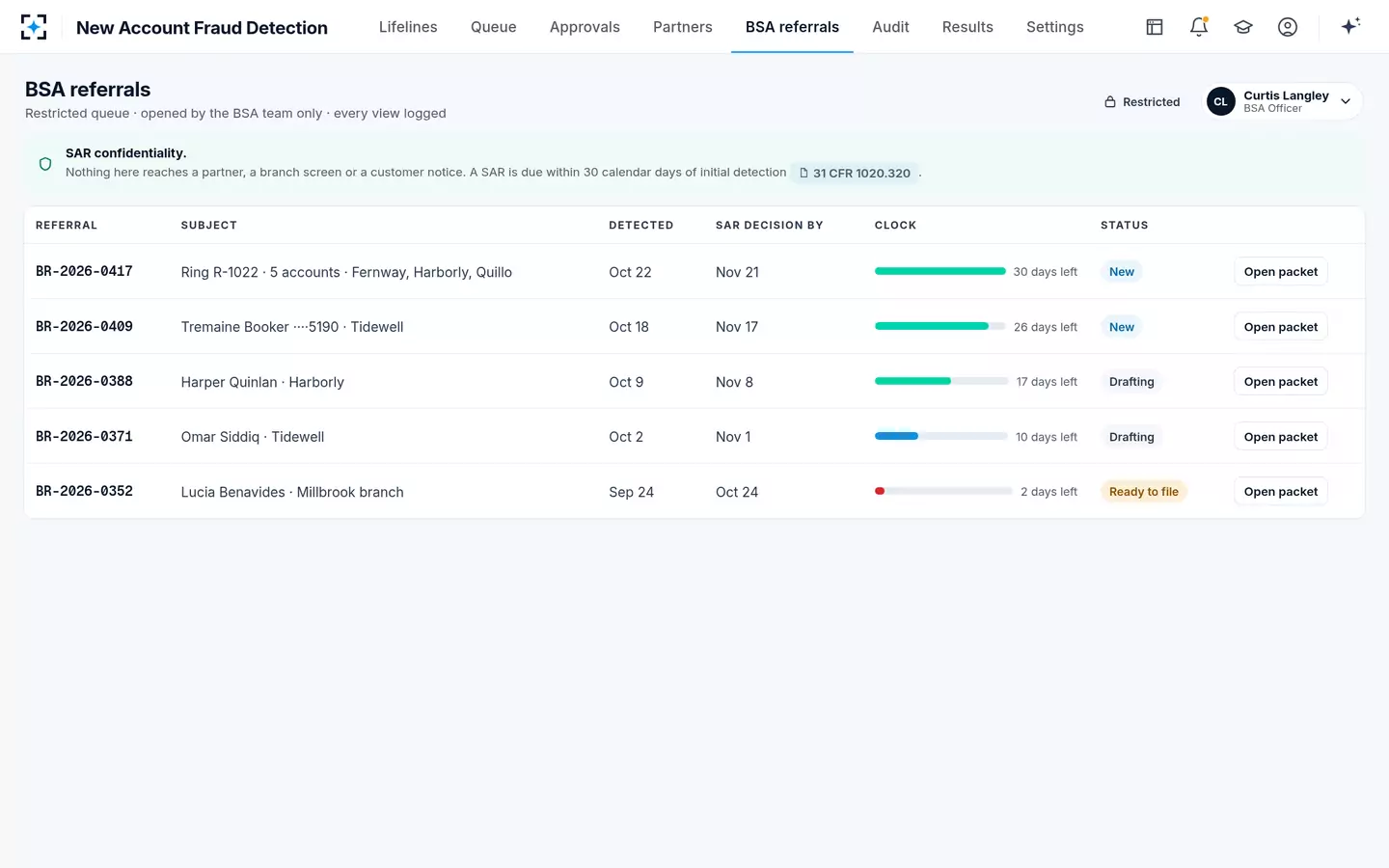
The rest of the bank's response: Red Flags, reporting and collection
A victim's notice is a Red Flag in its own right. The interagency guidelines list as an example that the institution "is notified by a customer, a victim of identity theft, a law enforcement authority, or any other person that it has opened a fraudulent account for a person engaged in identity theft" (Appendix J to 12 CFR part 41). Appropriate responses include closing an existing covered account, "not attempting to collect on a covered account or not selling a covered account to a debt collector," and notifying law enforcement.
The impostor's account and the victim: two parties, two different responses
The account (opened by the impostor): The bank's customer on paper.
The victim whose identity was used: Not a customer of that account, but owed records and protection.
The account (opened by the impostor): Restricts and closes; considers a SAR within the legal deadline.
The victim whose identity was used: Verifies the claim, stops collection in the victim's name, sends records on request.
The account (opened by the impostor): A restriction or closure notice, without any mention of a report.
The victim whose identity was used: Confirmation of closure and the records, also without any mention of a report.
The account (opened by the impostor): Any negative history belongs to the fraud.
The victim whose identity was used: Information resulting from the theft is blocked and not re-furnished.
Reporting is where victims are harmed after the account closes. A consumer reporting agency must block information resulting from identity theft "not later than 4 business days" after receiving the consumer's proof of identity, an identity theft report, the identification of the information and a statement that it is not theirs, and must notify the furnisher (15 U.S.C. 1681c-2). A bank that furnishes to a checking-account reporting company must have "reasonable procedures to respond to any notification" of a block "to prevent that person from refurnishing such blocked information," and once a consumer sends it an identity theft report at its specified address, it "may not furnish such information" unless it later learns the information is correct (15 U.S.C. 1681s-2(a)(6)).
The furnisher's side has its own clock. Regulation V defines an identity theft report as one that "alleges identity theft with as much specificity as the consumer can provide" and is "a copy of an official, valid report filed by the consumer with a Federal, state, or local law enforcement agency, including the United States Postal Inspection Service," where filing a false report carries criminal penalties (12 CFR 1022.3(i)). A furnisher may ask for more information to judge the report's validity, but only "not later than fifteen days after the date of receipt" of the report, with any further requests and a final decision on accepting it within another fifteen days. A bank that wants to test a victim's report has to start within those windows, so the fraud team and whoever handles furnishing disputes need to see the same intake date.
How should a bank run 609(e) requests as a process?
As one case with three outputs, owned by fraud operations, with the BSA decision running separately. The flow below is how the sample bank divides the work.
New Account Fraud Detection: one fraudulent-account case from the victim's notice to the closing letter
A person decides
IntakeLogs the victim's written request on arrival, with the date that starts the 30 days, and asks for any missing proof.
Agent
Rebuild the fileAssembles the opening file from the bank and the partner, the activity and any linked accounts, each item cited to its source.
Never: decide, contact anyone or file
A person decides
Fraud analyst and checkerRestrict or close, stop collection, record reasons; a second person approves.
A person decides
BSA teamDecides separately whether a SAR is due, within 30 calendar days of initial detection.
Never: appears in any letter or records package
Agent
Draft the package and letterBuilds the 609(e) package from the opening file and transactions and drafts the letter from approved wording.
Never: include a referral or report
A person decides
Approve and sendA person approves the letter and records, sends them to the victim or named agency, and requests correction of any furnished data.
Eight controls for a 609(e) procedure
- One specified address and one owner
Requests reach a monitored inbox or mail stop; the date of receipt is recorded the same day.
- A written verification standard
Which ID and which affidavit the bank accepts, published to branches and the contact center.
- A partner records clause
Program agreements require the fintech partner to supply its application records inside the bank's 30 days.
- A standard package
Application data, documents, device and IP, contact details, and the transactions alleged to result from the theft.
- A SAR-free build
The package is built from source records, never from case notes or the referral queue.
- A decline log
Each good-faith decline records which of the four statutory grounds applied and why.
- Reporting correction
Blocks and identity theft reports routed to whoever furnishes, so blocked data is not re-furnished.
- A deadline report
Requests by days open, with any past 25 days escalated.
One request, worked through the 30 days
An illustrative request shows where the days go and where they are lost. The dates are a procedure's, not the statute's, except the 30-day limit.
- Day 0: a written request arrives at the specified mail stop with a copy of the victim's driver's license and a police report, but no affidavit. Intake logs it the same day.
- Day 1: the bank asks for the affidavit it accepts and for the approximate date the account was opened. The procedure records the clock as pending verification.
- Day 6: the affidavit arrives. The victim's ID and date of birth match the identity data in the opening file, while the phone, email and device on the application are not hers. Verification is complete, and the procedure counts the 30 days from here as well as from day 0, keeping both on the case.
- Day 7: the request for application records goes to the fintech partner under the program agreement, with a 10-day return date.
- Day 15: the partner's file arrives: the application, ID images, device and IP, and the email and phone given. The bank's core supplies the transactions and the check images.
- Day 18 to 22: the package is built from those source records only, the letter drafted from approved wording, and a second person checks that nothing in either comes from the restricted referral queue.
- Day 23: the package goes to the victim and, at the victim's request, to the detective named in the police report.
The two places this breaks in practice are day 1 and day 7. A bank that does not ask for missing proof at once lets the request sit with no clock it can defend. And a partner agreement with no return date for application records turns the bank's 30 days into the partner's schedule. Both are fixed in procedure and contract before the first request arrives, not during it.
Why the opening file decides how fast a bank can answer
Because the 609(e) package is the opening file. A bank that can rebuild what the impostor gave (name, date of birth, address, phone, email, ID images, device and IP, and the CIP evidence relied on) answers in days. A bank whose opening file is split between the core, the partner's onboarding system and the identity verification vendor answers in weeks, and risks producing a package that misses the very records the victim needs to show the account was not theirs.
The partner's opening file beside 19 days of activity, with mismatches cited
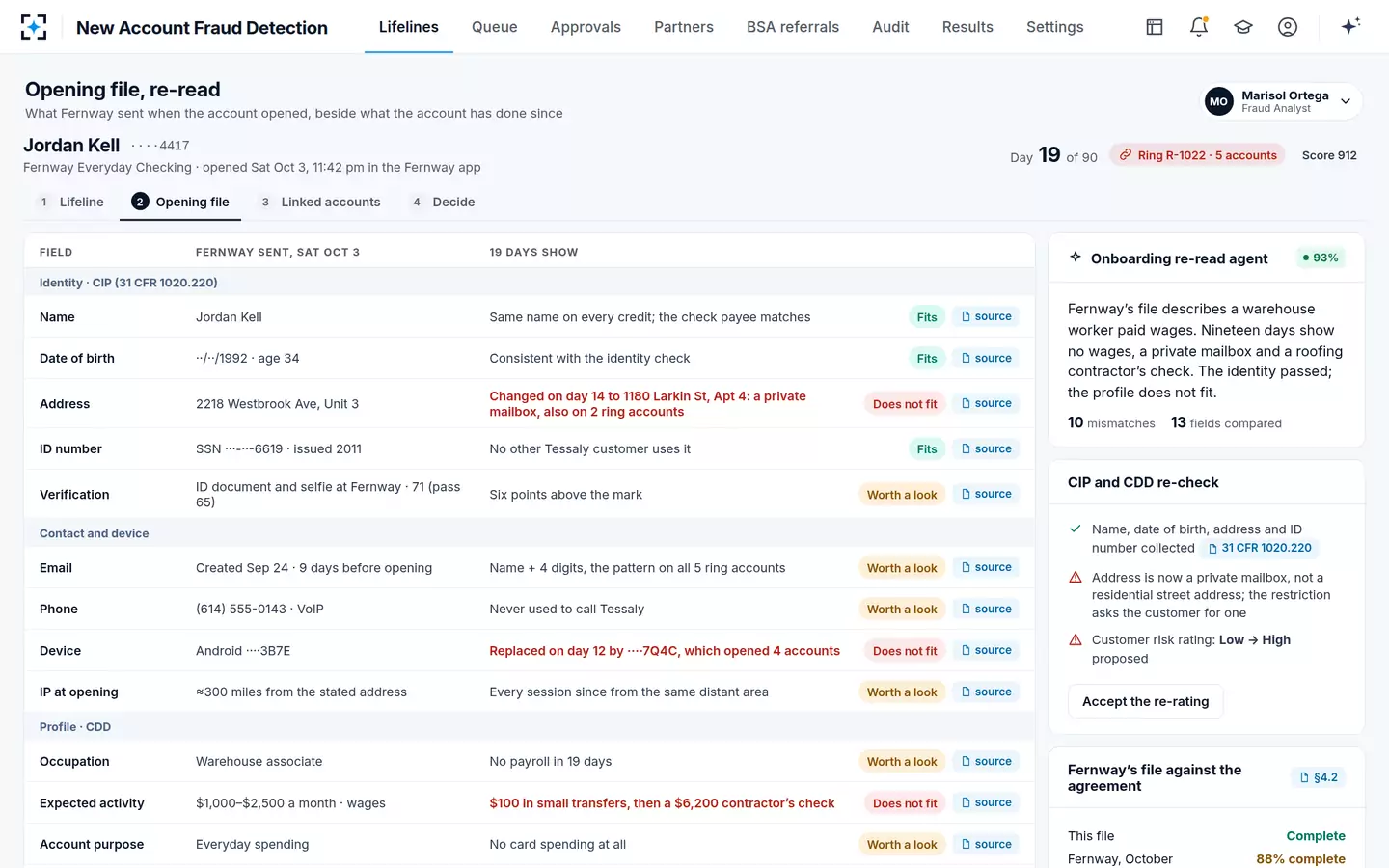
Stolen-identity accounts are rarely alone. In the sample data, five accounts at three fintech partners were tied by one device, one mailbox and one check book, so a victim's request about one account can be the first notice of others opened in other names. New account fraud red flags, day by day covers how those links show before a victim calls, and the identity theft prevention program template covers where the response sits in the written program.
How New Account Fraud Detection supports the response
The agents rebuild each new account from the core, digital banking device data, the check image archive and the partner's opening file, and every value opens the record it came from. They propose; people decide: every restriction, closure, partner notice and customer notice needs a maker and a different checker, and the agents never restrict, close, notify, file or change a customer record.
Two controls map directly to 609(e). The notice agent removes any wording that would reveal a referral and shows the approver what the recipient will see. And the audit trail, kept five years from account closure, records who opened which source record and when, so a bank can show what it produced for a request and that nothing from the restricted queue left with it. The whole solution is on the New Account Fraud Detection page.
Questions people ask
Does FCRA 609(e) apply to deposit accounts?
Yes. It applies to any business entity that provided products or services to, accepted payment from, or otherwise transacted with the person who used the victim's identity, which includes a bank that opened a deposit account for that person.
How long does a bank have to respond to a 609(e) request?
Thirty days from receipt of the request, subject to verification of the victim's identity and claim. The records must be provided without charge.
Can the bank send 609(e) records to the police?
Yes, to any federal, state or local law enforcement agency the victim specifies, or to an agency investigating the theft that the victim authorizes to receive them.
Does the bank have to identify the person who opened the account?
No. The statute requires application and transaction records, not a finding about who the impostor was. The application often shows enough, such as the phone, email and device used, for law enforcement to act.
Are records held by a fintech partner covered?
Yes, if they are in the bank's control, "whether maintained by the business entity or by another person on behalf of the business entity." Program agreements should require partners to supply them in time.
Can a bank mention a SAR in its response to the victim?
No. A SAR and anything that would reveal one are confidential under 31 CFR 1020.320(e), and section 609(e) expressly does not permit disclosures that other federal law prohibits.