A KYC remediation analyst works through existing customer files that fall short of a bank's current CIP, CDD or EDD standard: testing each file, finding the missing identification, beneficial owners, purpose or risk rating, searching the bank's own systems for it, asking the customer for the rest, and preparing the file for a second person to check. The work is hard because it arrives all at once, after a merger, an audit or a consent order, and because it is usually done by temporary staff who do not know the customers or the bank's systems. Botminds' KYC Remediation is built for that desk: agents test and search every file and draft the requests, and the analyst's time goes to the judgments that the bank, not a contractor, has to own.
The examples come from a fictional sample institution as it runs through the solution: Norrell Federal Credit Union, bringing 38,400 member files acquired from Basin Valley Credit Union up to its own standard by June 30, 2027. Research figures come from regulators and public statistics, linked where they appear.
A job without its own statistic, done at a scale regulators now write down
436,400
compliance officers in the US in 2025, the nearest federal occupation; no series names KYC analysts
$80,730
median annual pay for compliance officers, all industries, 2025
800
consultants a bank said it needed for one lookback, in a 2026 FinCEN order
What does a KYC remediation analyst do?
A KYC remediation analyst brings one existing file at a time up to the bank's current standard, and prepares it so that someone else can approve it. The work differs from onboarding because the customer already exists: the account is open, the money is moving, and the bank is the party that let the file fall behind. That changes the order of the work. Onboarding asks first; remediation should search first, because much of what is missing usually sits somewhere else in the bank.
On a typical file the analyst does six things. They test it against the programme's standard and log every gap. They search the bank's systems for evidence that would close a gap: a signed beneficial ownership certification in a loan file, a renewed driver's licence imaged at a branch, a stated purpose in a credit memo. They write to the customer for what cannot be found. They chase the reply and take the customer's calls. They read what comes back against the standard. And they update the core record and the programme tracker once a checker approves.
Every one of those steps leaves a mark an examiner can test. The CIP rule requires the file to describe how each substantive discrepancy was resolved, and the FFIEC's CDD procedures tell examiners to sample customer information and judge whether it supports the risk profile. The analyst is producing evidence, not just closing tickets, and the KYC remediation process, mapped stage by stage, shows where each piece of that evidence is made.
Who works a remediation file, and what each seat keeps
Today
Opens each file as if nothing were known, searches four systems by hand and writes to the customer once per gap.
With agents
Starts from the agents’ search, checks each cited closure and prepares the cases that need a person.
Still theirs: The maker’s signature on every file and batch.
Today
Re-reads replies against several systems to find what the analyst changed.
With agents
Sees each proposed value beside its source and approves, returns or edits with a reason code.
Still theirs: The checker’s signature on smaller batches and customer notices.
Today
Signs for the programme with progress in spreadsheets and no way to test thousands of closures.
With agents
Samples batches with the sources side by side and approves on a stated confidence.
Still theirs: Beneficial owner batches, limits on services, scope and the board report.
Today
Finds out a letter wave went out when the phones light up.
With agents
Sets weekly message caps against the calls the team is staffed for.
Still theirs: The pace of outreach.
Today
Is asked to fill gaps in files from memory.
With agents
Is asked only when a customer relationship needs a call, never for the evidence itself.
Still theirs: The relationship.
Why remediation desks are staffed with contractors
Remediation desks are staffed with contractors because the work is a peak, not a flow. A bank that reviews a few hundred files a month in steady state may suddenly owe tens of thousands, with a deadline set by a regulator or a merger agreement, and it cannot hire and train permanent staff for a two-year spike. So it rents a desk, usually from a consultancy or a staffing firm, sized to the file count.
How big those desks get is now on the public record. In its October 2026 order against Bank of America, FinCEN described a bank that, to work a one-time lookback of potentially missed suspicious activity, needed "800 consultants required to complete the one-time lookback", on top of an "incremental 750" personnel for the higher monthly volumes that followed (FinCEN Consent Order No. 2026-03). That was a transaction lookback, not a KYC file review, but remediation programmes ordered after KYC failures are staffed the same way and for the same reason.
Public statistics do not count these people separately. The Bureau of Labor Statistics has no occupation for KYC or remediation analysts; the work is classified inside compliance officers (13-1041), which numbered 436,400 in 2025 and are projected to reach 453,100 by 2035, with about 32,700 openings a year (BLS). Nothing in that series separates permanent staff from contractors, or banking from other industries.
The bank still owns every decision a contractor touches
Outsourcing the desk does not outsource the obligation. A bank's BSA programme, the file it keeps on each customer and the judgment that a file now meets the standard all remain the bank's, whoever typed the update. The FFIEC's examination manual frames the test around the bank's process: a bank should not be faulted for an individual customer decision where it has an effective decision-making process and has followed its own procedures (FFIEC BSA/AML Examination Manual, CDD). That protection rests on the process, so the process has to say who decides what.
The risk of a desk that does not know the customers is concrete. In its 2021 action against CommunityBank of Texas, FinCEN found that when CDD questionnaires came back incomplete, AML staff were told to fill the gaps by asking account officers, not the customers (FinCEN, CommunityBank of Texas, 2021; KYB automation that asks once reads the case). A remediation analyst under deadline pressure, with no relationship of their own, will reach for whoever is nearest. The design has to say where evidence may come from: a document, a system of record or the customer, and never someone's recollection.
Contractors also carry the bank's confidentiality duties. The SAR confidentiality rule binds every "director, officer, employee, or agent of any bank" and forbids disclosing a SAR or any information that would reveal one (31 CFR 1020.320(e)). A remediation analyst writing to a customer whose account is under review is one careless sentence from that line, which is why restricted files belong with the BSA function, not on a contractor's queue.
Where a remediation analyst's hours go on one business file
Most of an analyst's time on a file goes to finding things and asking for them, not to judging them. The solution's own estimate for one business file with no verified owners, worked by hand, puts testing the file and logging gaps at about 10 minutes, searching loan files, ID images and the state's annual report at 25, writing to the customer at 15, chasing the reply and taking calls at 20, a second person's check at 15 and updating the systems at 10.
Where a remediation analyst’s 80 minutes go on one business file, by hand and with agents
By hand · 80 minutes of the analyst’s time
- Testing and logging gaps · 13%
- Searching the bank’s systems · 31%
- Writing to the customer · 19%
- Chasing and calls · 25%
- Updating systems · 12%
With agents · 16 minutes of the analyst’s time
- Checking the agents’ tests · 6%
- Checking cited sources · 13%
- Approving the drafted request · 13%
- Calls a person must take · 62%
- Confirming the update · 6%
Two things stand out. Searching is the largest single block by hand, and it is the block a contractor does worst, because they do not know which loan file or imaging folder holds the customer's certification. And once the searching is done by agents, the remaining minutes are mostly the conversations a person has to have. That is the right shape for the job: the analyst's hours should go where judgment and courtesy matter, not into opening folders.
On the sample programme, six analysts and two quality reviewers review about 1,100 files a week, against a plan line of roughly 975 files a week to finish 38,400 files by June 30, 2027. Those are the fictional programme's figures; a real desk's rate depends on its cohorts, and the KYC remediation project with agents works the staffing arithmetic task by task.
A quality reviewer checks an analyst’s file, with every value beside its source
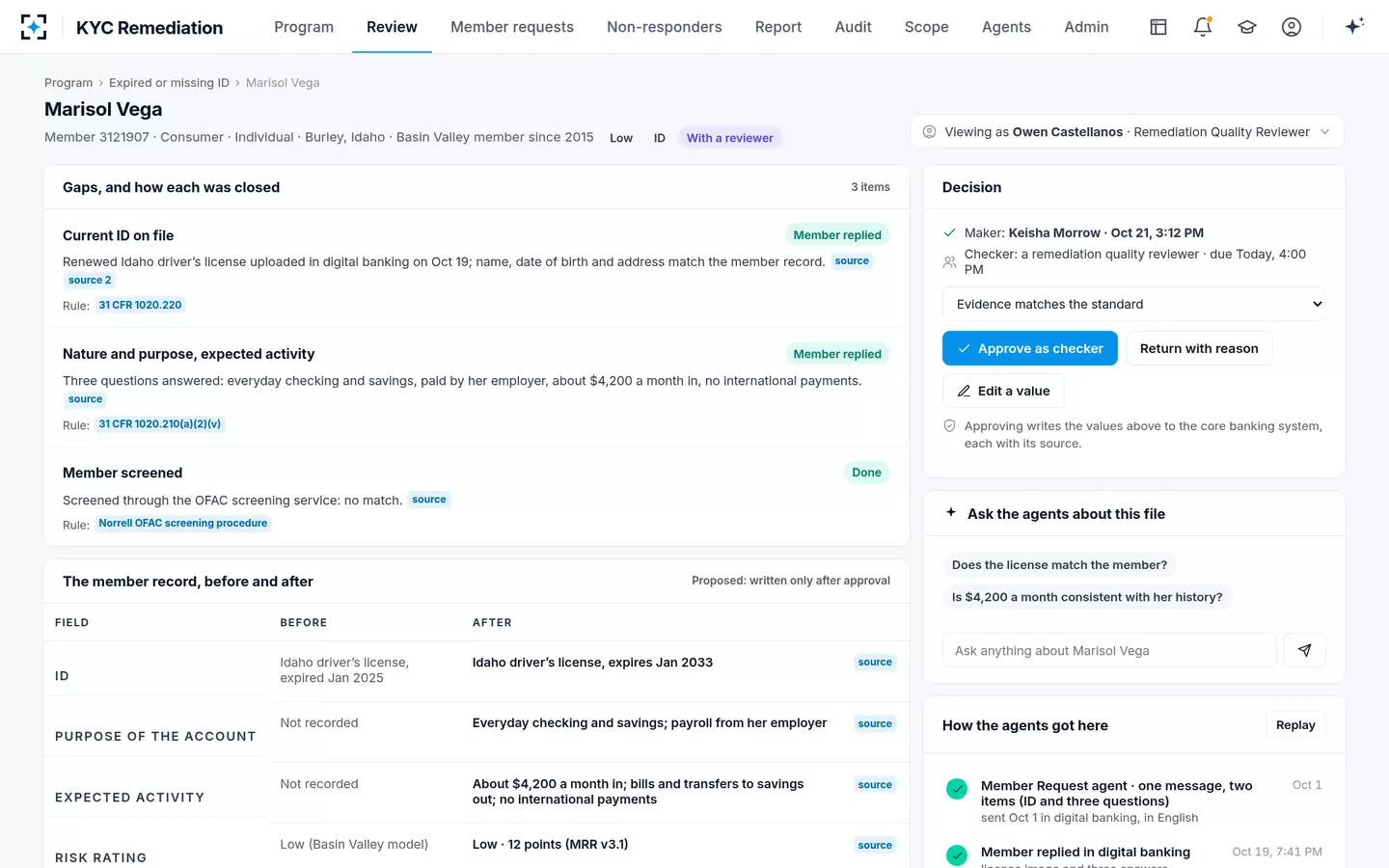
What a contractor may decide, and what goes back to staff
A contractor analyst may prepare any file and approve it as maker; staff check it, and some decisions never sit with the desk at all. The split below is one way to write that into a programme's procedures. It follows how the sample programme assigns approvals, with one assumption added: that the analysts are contractors and the checkers are employees.
Decision rights on a contractor-staffed KYC remediation desk
| Decision | Contractor analyst | Bank staff |
|---|---|---|
| Which gaps a file has, under the approved scope | Confirms the test result | Owns the scope and every change to it |
| Closing a gap from the bank’s own records | Proposes and approves as maker, citing the record | A different person checks; beneficial owner batches go to the BSA officer |
| Accepting a customer’s reply as sufficient | Prepares, with the reply beside the standard | Quality reviewer approves as checker, with a reason code |
| A change in risk rating | May propose | A higher rating always goes to a reviewer; the bank’s model applies |
| A possible sanctions match | Never clears it | Goes to a named person in the BSA function |
| Wording of a customer request or notice | Uses approved templates only | A reviewer checks every notice; the week’s release is approved |
| Limiting services or closing accounts | May prepare the case | A reviewer checks the notice and the BSA officer approves |
| Anything that suggests a SAR | Escalates and stops | The BSA function decides; the file becomes restricted |
The table puts the contractor's signature where the work is mechanical and checkable, and the bank's where the decision changes a customer's position or touches suspicion. It also makes the checker's sample meaningful. If the contractor is the maker on every file, the bank's quality reviewers and the BSA officer are the control, and the size of their sample decides what the bank can say about the rest; KYC quality assurance for remediation sets out what a sample of 20 or 40 files proves.
One file’s path through a contractor desk: the agents search, the contractor prepares, staff decide
Agent
Test the fileTests the file against the approved scope and logs every gap.
Never: closes a gap
Agent
Search the bank’s recordsSearches loan files, imaging, account history and state filings, and proposes closures with each source cited.
Never: closes when two records disagree
A person decides
Contractor analyst, makerChecks the cited closures, prepares the cases that need a person and approves the batch as maker.
A person decides
Staff checkerA quality reviewer, or the BSA officer for large and beneficial owner batches, samples and approves or returns.
Agent
Draft the requestDrafts one plain message per customer for what is still missing, after a tipping-off check.
Never: sends without the week’s approved release
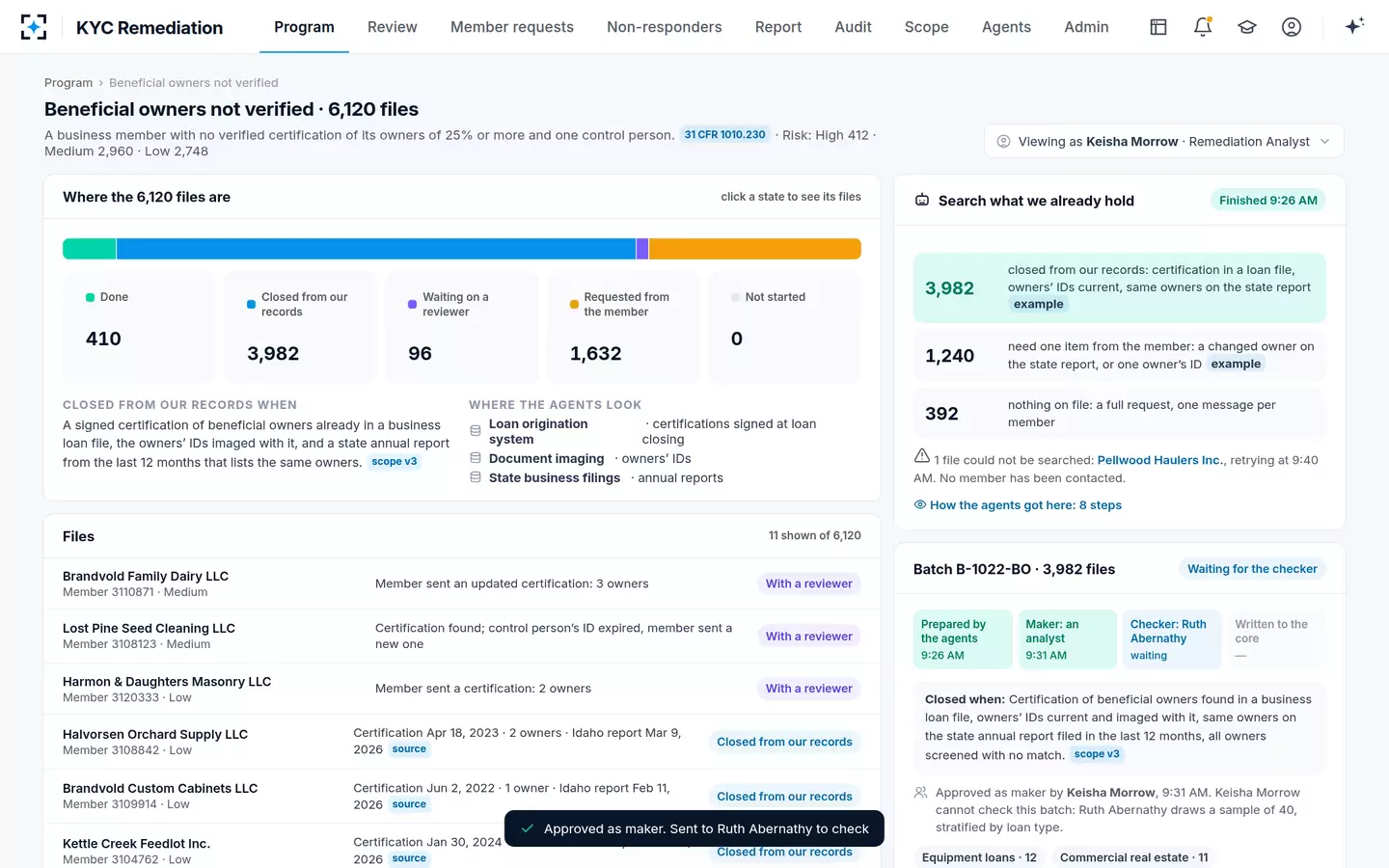
The maker approves, and the stepper shows who checks
KYC remediation analyst salary and job outlook in public data
There is no official salary series for a KYC remediation analyst, and any figure that claims to be one comes from job boards or recruiters. The nearest federal data is for compliance officers: a median of $80,730 a year in 2025, across all industries, with employment projected to grow 3.8% from 2025 to 2035 (BLS). That covers far more than KYC work, and it does not separate banks from other employers or contractors from staff.
The people across the table from the analyst are counted more precisely. Financial examiners, who include the bank examiners who test remediation files, numbered 70,000 in 2025 with a median of $94,160, and BLS projects 9% growth to 2035, "much faster than average" (BLS Occupational Outlook Handbook). For a reader weighing whether KYC remediation is a good job, the honest summary is that the demand follows enforcement and mergers, so it arrives in waves, and that the skills it builds, reading files against a rule and explaining the gap, are the ones both banks and examiners pay for.
KYC remediation interview questions that test judgment
The useful interview questions for a remediation analyst are about judgment under a rule, not definitions. Anyone can recite what CIP and CDD stand for. The questions below separate an analyst who will close files defensibly from one who will close them fast, and each has an answer that can be checked against the rules.
Six interview questions for a KYC remediation analyst, and what a good answer contains
| Question | What a good answer contains |
|---|---|
| A loan file holds a signed beneficial ownership certification from 2023, but this year’s state annual report lists an extra member. Can you close the file? | No. The records disagree. Ask the customer for the one item that settles it, and record both sources. |
| The file is for a business account opened in 2015. Does the CDD rule require a beneficial ownership certification? | Not by itself. FinCEN’s FAQ says the rule does not cover accounts opened before May 11, 2018; the requirement here comes from the bank’s risk-based standard. |
| The relationship manager says she knows who owns the company. Can you record that? | Not as evidence. It can tell you where to look; the file needs a document, a system of record or the customer. |
| Your queue shows a file marked restricted. The customer has called asking why the bank wants information. What do you say? | Nothing about the review. Pass the call to the BSA function; SAR confidentiality binds agents of the bank too. |
| A customer’s data is missing for three risk factors. What score do you give them? | None until the data is in. Defaulting missing data to low risk is how a bank rates millions of customers and finds none high. |
| You have approved a batch as maker. Can you check a sample from it to save time? | No. A maker never checks their own work, however small the batch. |
The second question is the one most candidates miss, because many programmes treat the back book as if the 2016 rule reached it. Beneficial owner declarations for existing customers follow that distinction through FinCEN's FAQs and the 2026 relief order.
How KYC Remediation changes the analyst's seat
KYC Remediation changes the analyst's job from finding to deciding. Its agents test every file against the approved scope, search the bank's records and close a gap only when the sources agree at a set confidence, with each line they used cited; the analyst reviews what they found and approves batches as maker. On the sample programme, one search of business loan files found signed certifications for 5,222 of 5,614 business files without verified owners and closed 3,982 of them from the credit union's own records, so 3,982 requests were never written.
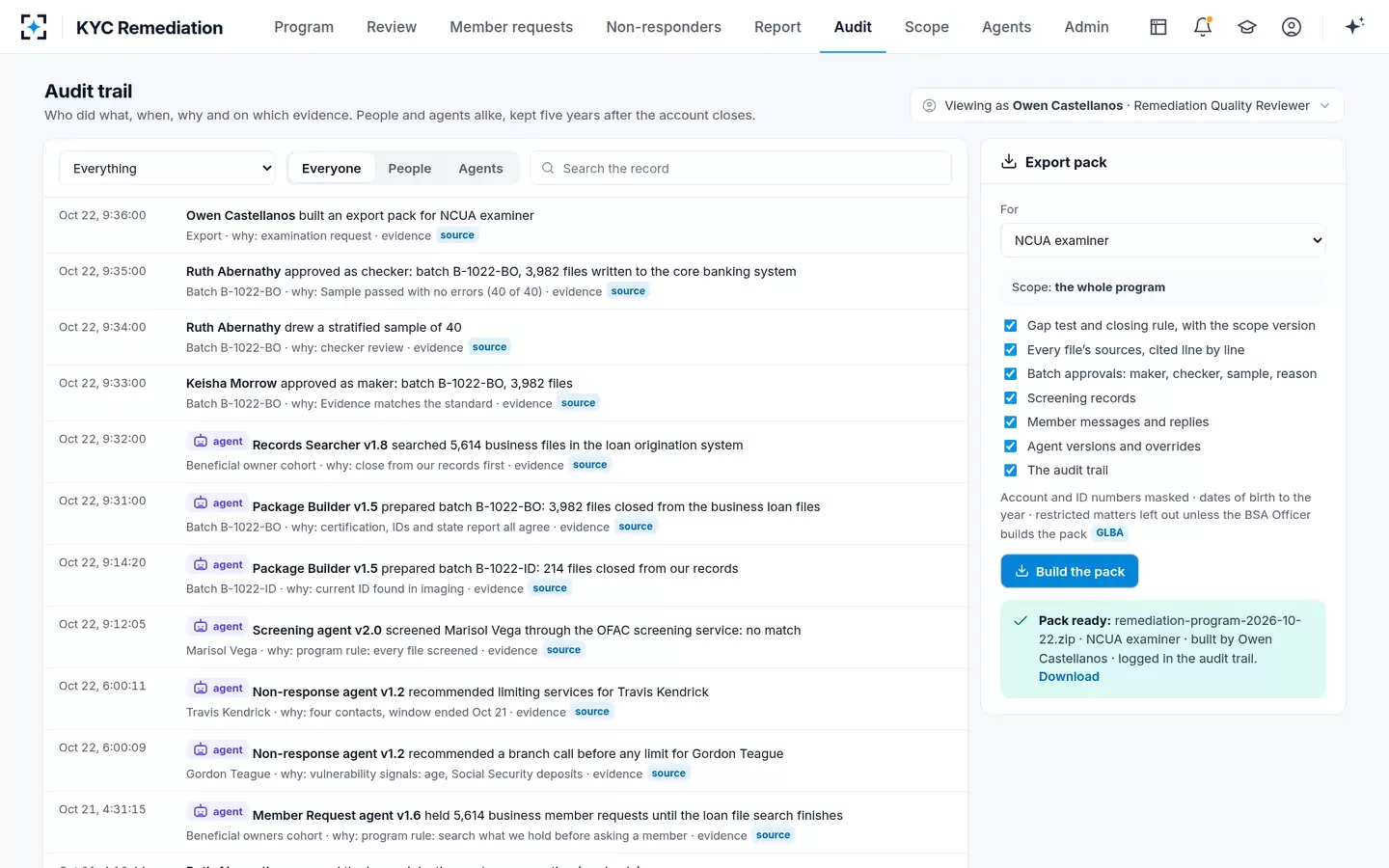
Three things stay with people by design. The agents never write to a customer record, never send a message without the week's approved release and never limit services or close an account; each of those has a named maker and a different checker. The audit trail records who did what on each file, people and agents alike, so an examiner can see which decisions a contractor made and which the bank did.
The audit trail separates what people decided from what agents prepared
Where the solution does not fit is just as clear. It does not replace the desk; a programme still needs analysts to prepare cases, take calls and handle the files the agents cannot close. And it does not make the contractor question go away. It narrows it to the decisions in the table above, which a bank can then assign on purpose. To see the analyst's queue, the checker's sample and the audit trail together, start from KYC Remediation.
Questions people ask
Is KYC remediation a good job?
It is project work that follows enforcement and mergers, so contracts often end when the programme does. The skills carry over: compliance officer employment is projected to grow 3.8% from 2025 to 2035, and financial examiner employment 9%, according to BLS. Analysts who learn to write a defensible file, not just a fast one, move into quality review and BSA roles.
What is the difference between a KYC analyst and a KYC remediation analyst?
A KYC analyst usually works new customers or scheduled reviews in steady state. A remediation analyst works the existing book against a new or corrected standard, under a programme deadline, and spends far more time searching old records and chasing customers who did not expect to be asked. The remediation file also has to show what was wrong and how it was fixed.
Can a contractor sign off a KYC file?
A contractor can prepare a file and approve it as maker, but the bank remains responsible for the decision, and its procedures should require a staff checker. In the sample programme, batches under 500 files go to a quality reviewer with a sample of 20, and larger batches and every beneficial owner batch go to the BSA officer with a sample of 40.
Do remediation contractors have to keep SARs confidential?
Yes. 31 CFR 1020.320(e) applies to any "director, officer, employee, or agent" of a bank, and prohibits disclosing a SAR or any information that would reveal one. Remediation programmes usually keep restricted files off contractors' queues and hold customer messages on them.
How many files can a KYC remediation analyst review in a week?
It depends on the cohort: an expired ID closes faster than an unverified ownership chain. On the fictional sample programme, six analysts and two quality reviewers review about 1,100 files a week with agents searching first. For comparison, GAO found banks spent about 30 minutes collecting and reviewing CDD on a new consumer account and over an hour on a business account.
Who reviews a KYC remediation analyst's work?
A second person, as at onboarding. GAO's study of 11 banks found the common pattern: front-line staff collect the information and a second person, often the BSA/AML officer, reviews it (GAO-20-574). Remediation programmes formalise that as maker and checker, with a sample size stated for each batch.