HMDA reporting software compiles, checks and files the loan/application register, and the part that decides an exam is the check: proving that each field matches the loan file behind it before the register is filed. That is hard because a register carries dozens of reportable fields per application, drawn from a dozen different documents. Botminds' HMDA and 1071 Data Validation does that check on every field of every record: agents trace each register value to the page it came from, apply the examiners' tolerances and your written procedure, and show your team only the fields that break, while people decide and sign every change. Implementing it needs your HMDA procedure, your register extract and a sample of loan files. The safest way in is a back-test on a quarter your team has already scrubbed, then four checkpoints, then nightly runs. How long that takes depends mostly on how quickly your team settles the back-test differences, not on the software, so this plan is written as checkpoints rather than a promised number of weeks.
The go-live path: five stages, four checkpoints
- Gather three inputs
Your HMDA procedure, the register extract and loan files from a quarter you scrubbed.
- Checkpoint 1 · Source coverage
Every field has a source page, or a stated reason why not.
- Back-test the scrubbed quarter
The agents check every field of the sample; your team compares with its own findings.
- Checkpoint 2 · Back-test
Nothing your scrub found goes unflagged, and every extra break is explained.
- Turn the procedure into settings
Tolerances, field sources, signers and schedule, kept as a numbered rule version.
- Checkpoint 3 · Procedure mapped
Every rule is a setting, and no tolerance is looser than the examiners'.
- First full run on the open register
People work the breaks: correct and sign, keep with a reason, second review, sign-off.
- Checkpoint 4 · Sign-off paths
Each way a person decides has been used once on real records.
- Nightly runs, full run at quarter end
New and changed records checked overnight; the 1071 practice register runs alongside.
What should HMDA reporting software do? Five jobs, and the one that finds errors
It should carry the register from the origination system to a certified filing: compile it, geocode it, check it against the loan file, run the filing edits and leave a record an examiner can read. The third is the job that decides whether an examiner's sample finds four errors in one field, and it is the one to test hardest.
Five jobs HMDA reporting software does, and the rule behind each
| Job | What the rule asks | What to look for |
|---|---|---|
| Compile the register | Record each quarter's data within 30 calendar days of quarter end; quarterly filers (60,000+ entries) also submit within 60 days. | A read-only extract from every origination system, refreshed at least monthly, with applications reconciled to the pipeline. |
| Geocode | Report the census tract; a wrong tract is a bona fide error if procedures are reasonably adapted to avoid it. | Geocoding from the property address against the census tract boundaries in force for that year, and a record of the tool and date used. |
| Check against the loan file | Examiners verify sample entries against the loan files and count differences outside tolerance. | Every field traced to the page your procedure names, on every record, with the tolerances no looser than the FFIEC's. |
| Run the filing edits | Fix every syntactical and validity edit; fix or confirm every quality and macro-quality flag. | All edits run before the HMDA Platform does, with each confirmation tied to a document. |
| Support certification | An authorized officer certifies accuracy and completeness; keep a copy for three years. | A corrections list with before, after, page, reason and signer, exportable for the examiner. |
Where this solution fits is the third and fourth jobs and the evidence behind the fifth. It does not replace your origination system or file for you: it reads the extract and the loan file documents, checks every field, runs the edits on the corrected register, and exports the register in the FFIEC pipe-delimited format with its corrections log, for a person to file after sign-off. Applications that never reached the extract are outside what a field check can see, so the reconciliation to the pipeline stays with your HMDA management process.
What questions should you ask an HMDA software vendor?
Ask for evidence on your own records, not a description. The ten questions below separate a product that checks the register against itself from one that checks it against the file, and they surface the costs that sit outside the licence. The Federal Reserve's Vice Chair for Supervision asked the same kind of question of the industry in 2026: "How should we consider third-party risk-management expectations for vendor-provided AI tools or partnerships?" (speech, 1 May 2026). Your third-party risk team will ask it of you.
Ten questions for an HMDA software vendor, and what a good answer shows
Ask: Which document is each field checked against?
A good answer shows: A field-by-field list naming the adverse action notice, income worksheet, Closing Disclosure, rate lock and demographic addendum, matching your procedure.
Ask: What share of records and fields is checked against the file?
A good answer shows: Every record, with the fields marked "no source" listed and explained, not averaged away.
Ask: Can anyone loosen a tolerance?
A good answer shows: Three days, $1,000 and income rounding as the outer limit, tightenable only, each change kept as a rule version.
Ask: Who changes a register value?
A good answer shows: Only a named person, with a reason and the page; a second reviewer on ethnicity, race and sex.
Ask: Is rate spread recomputed or copied?
A good answer shows: Recomputed from the APR and the APOR table for the lock date and loan type.
Ask: How do we measure what it misses?
A good answer shows: A back-test on a quarter you scrubbed, and a seeded-error test you design, scored by your people.
Ask: Where does borrower data go?
A good answer shows: Read-only access; data kept in your environment; reviewers limited to the branches they cover.
Ask: What does IT have to build?
A good answer shows: A read-only register extract and access to the document store, named by system, before the contract is signed.
Ask: Does it handle Section 1071 data?
A good answer shows: A small-business record checked against its file, including verified gross annual revenue, under the 2026 rule.
Ask: What do we keep if we leave?
A good answer shows: The corrected register in FFIEC format and the full corrections log, in files you can open without the product.
What do you need to implement HMDA data validation software?
Three inputs and the names of the people who sign. Almost all of it already exists in a lender that files a register: the procedure is the document your examiners read, the extract comes from the origination systems that already feed your filing, and the loan files sit where your reviewers open them today. The work in the first stage is choosing the right versions, not creating anything.
What HMDA and 1071 Data Validation needs from you before the first run
- Your HMDA procedure, current version
With section numbers. Each rule that decides a reported value becomes a setting, and the setting cites the section, so a break can quote it.
- The register extract, read-only
From your mortgage and commercial origination systems. The agents read it; they never write to the system of record.
- Loan files for a sample of records
From a quarter your team has already scrubbed. Ask for every action type: originations, denials, withdrawals, files closed for incompleteness.
- Your scrub results for that quarter
What your reviewers found and corrected, record by record. This is the answer key the back-test is scored against.
- The people who sign
Who corrects and signs, who gives the second review on ethnicity, race and sex, and who signs off the register before filing.
- Branches and loan officers
So errors can be counted where they start, and each reviewer is invited with the branches they cover.
Pick the sample with care. A sample of clean originations proves little. The typical breaks sit elsewhere: a denial reported on a status-change date instead of the notice date, income that counts a bonus the underwriter excluded, a rate spread computed against the wrong APOR table or date, a demographic form completed online but never keyed. If your last scrub flagged a problem field, such as income relied on or the action taken date for denials, make sure the sample carries enough of those records to test it.
How do you test HMDA software before you buy it? Back-test a quarter you scrubbed
Run it on a quarter your team has already worked, because that is the only first run you can score. On a quarter your team has already worked, you know which records held errors and what the right values were, so every break the agents raise can be checked against an answer you trust, and every error your team found can be looked for in the agents' output. A first run on a live quarter gives you a list of breaks and no way to tell what it missed.
The back-test also shows your procedure's gaps before they matter. When the agents flag a value your reviewers accepted, one of three things is true: the reviewer missed an error, the procedure says something the settings do not yet carry, or the source document itself was wrong. Sorting each difference into one of those three is the substance of the second checkpoint, and it is the step that most decides how fast the rest goes.
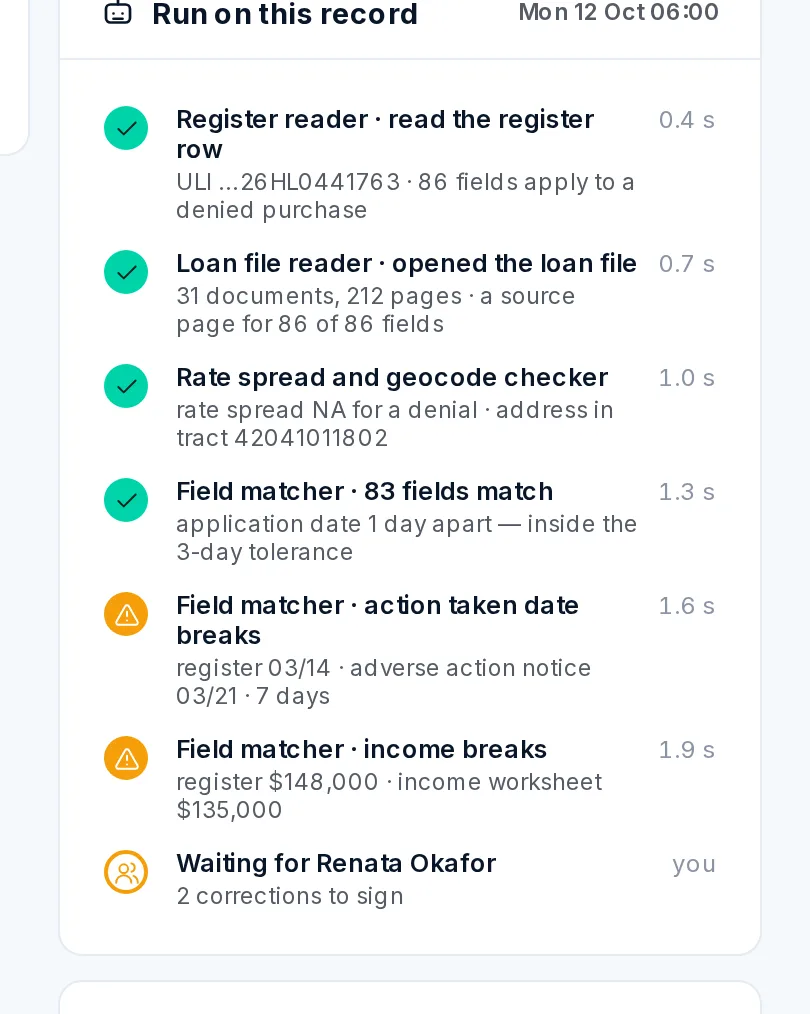
Take a sample bank's denied home-purchase application as it runs through the solution. The register reader finds 86 applicable fields; the loan file reader opens 31 documents and 212 pages and finds a source page for all 86; the matcher closes one difference as within tolerance and breaks two. One break is the action taken date: the register holds the day the file was moved to "Suspended", seven days before the adverse action notice. If your scrub of that quarter caught it, the back-test confirms the agents see what your people see. If it did not, you have learned something about your scrub.
What a back-test shows on one record: every step, before anyone decides
The four checkpoints before HMDA validation goes live
Each checkpoint is a measurement with a pass condition and a named person who decides. None is a checkbox that passes because the step was done. The pass conditions below are a starting proposal; your compliance testing manager may set them tighter, and the evidence each one produces is the same evidence model risk and internal audit will ask for, as set out on the page on how to measure an agent's accuracy on HMDA data.
Four checkpoints, each with what is measured, when it passes and who decides
Checkpoint 1
Source coverage
- Measured
- For each record in the sample, how many of its applicable fields were traced to a document and page, and which were marked "no source".
- Passes when
- Every "no source" field is explained: a document missing from the file, a document type the reader was not given, or a field your extract fills from a system note.
- Decides
- HMDA data manager, with IT for missing document types
Checkpoint 2
Back-test against your scrub
- Measured
- Each error your own scrub found on the sample, set against the breaks the agents raised on the same records. Then every break your scrub did not record.
- Passes when
- No error from your scrub goes unflagged without a reason. Each extra break is classed: a real error the scrub missed, or a procedure rule still to be set.
- Decides
- HMDA data manager and compliance testing manager
Checkpoint 3
Procedure mapped
- Measured
- Every section of your HMDA procedure that decides a reported value, set against the setting that carries it.
- Passes when
- Each rule is a setting or is written down as out of scope. Tolerances sit at or inside the examiners' limits, and the rule version is approved.
- Decides
- Compliance testing manager
Checkpoint 4
Sign-off paths tested
- Measured
- Whether each decision path has been used once on live records: a correction, a kept value, a demographic second review, filing edits, sign-off and export.
- Passes when
- Each path ends where it should: in the corrections list, at sign-off, and in the export the examiner would receive.
- Decides
- Data manager, second reviewer, compliance testing manager
Checkpoint 2 is not a recall percentage to beat. A back-test sample is small, and a single missed error on a key field matters more than a high average. Treat any unexplained miss as a stop: find why the agents did not raise it, fix the setting or the document type, and re-run those records before moving on.
Turning your HMDA procedure into settings
Every rule in your procedure that decides a reported value becomes a setting, and the setting carries the rule's section number so that a break can quote it. Changes apply from the next run and are kept as a new rule version, which gives the compliance testing manager one place to approve how the register is checked, and gives an examiner a record of which rules were in force for which run.
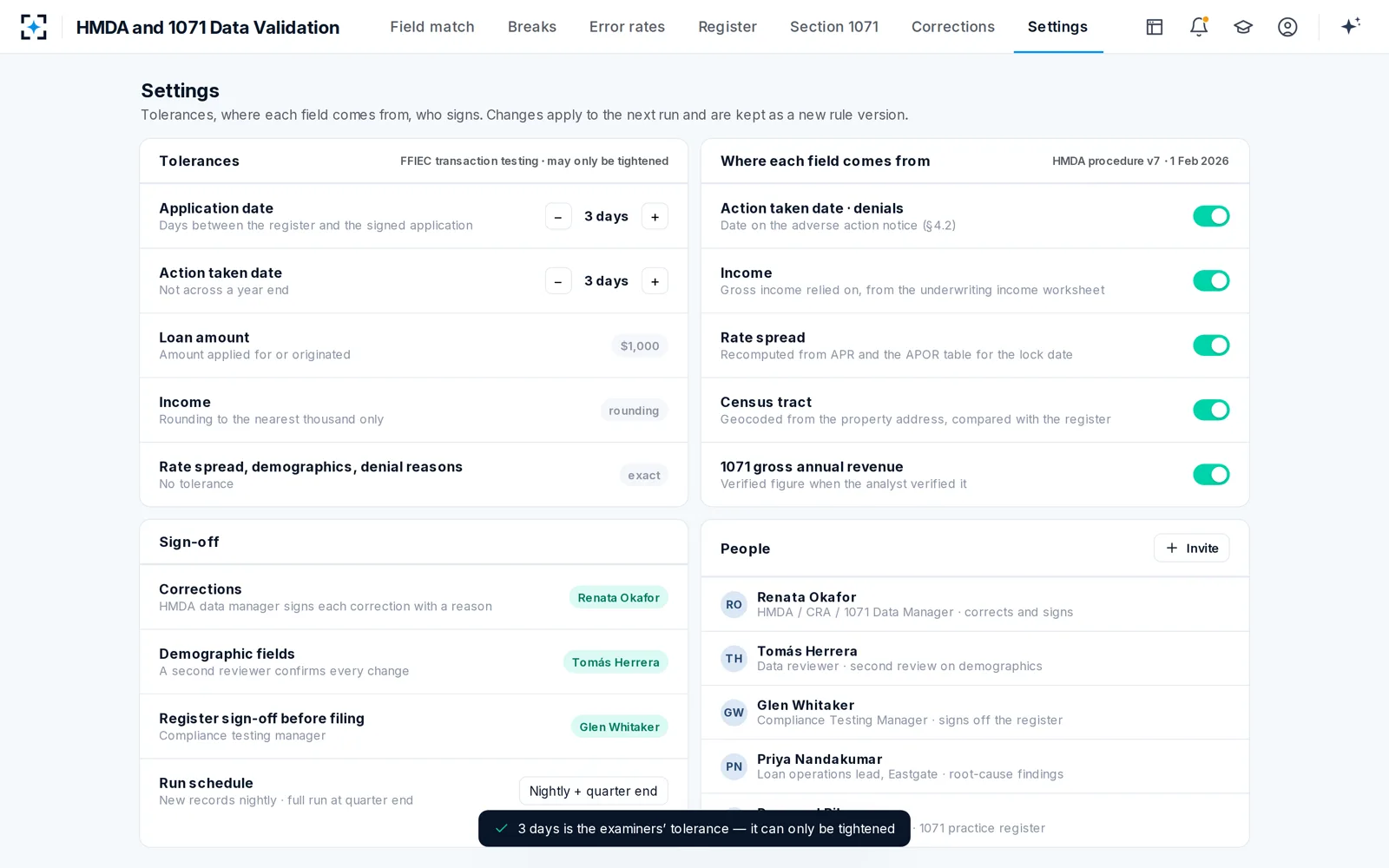
The examiners' tolerances are the outer limit. Under the FFIEC transaction testing guidelines, a difference of three calendar days or less in the application date or the action taken date, $1,000 or less in the loan amount, and rounding to the nearest thousand in income relied on are not counted as errors; the action-taken-date allowance does not apply where the difference puts data in the wrong calendar year. The solution starts at those limits and lets you tighten them, never loosen them. A lender whose procedure holds the action taken date to the exact day can set that; no one can set four days.
From procedure to settings: each rule becomes one setting
Your procedure says: A denial is reported on the date of the adverse action notice (§4.2 of the sample procedure).
The setting it becomes: Action taken date for denials: the date on the adverse action notice. On, citing §4.2.
Your procedure says: Report the gross annual income relied on in the credit decision.
The setting it becomes: Income source: the underwriting income worksheet. Tolerance: rounding to the nearest thousand only.
Your procedure says: Compute it against the APOR for the date the rate was set.
The setting it becomes: Recomputed from the APR and the APOR table for the lock date and loan type. No tolerance.
Your procedure says: Geocode the property address; do not copy the tract from the appraisal.
The setting it becomes: Census tract geocoded from the property address and compared with the register.
Your procedure says: We hold application and action dates to one day.
The setting it becomes: Application and action taken date tolerances set to 1 day. The screen refuses anything past the examiners' 3.
Your procedure says: Every change to ethnicity, race or sex has a second reviewer.
The setting it becomes: Sign-off chain: data manager per correction, second reviewer on demographics, compliance testing manager before filing.
Your procedure says: Data is reviewed monthly and in full at quarter end.
The setting it becomes: Run schedule: nightly and at quarter end, weekly and at quarter end, or quarter end only.
The settings screen: tolerances that only tighten, and each field's source
The first full run: what changes for the team in the first quarter
After the checkpoints, the solution checks the open register in full, and the team's work changes shape. Reviewers stop pulling a sample and comparing one field at a time across systems; they work a queue of breaks, each showing the register value, the loan file value, the rule and the page. The data manager's job moves from finding errors to deciding them. Anyone who will act on a break should be in the room for checkpoint 4, because that is where the new habits are learned on real records.
Who does what differently once every field is checked
Today
Scrubs a sample each quarter and much of the register in the weeks before filing.
With agents
Sees only the fields that break, with the page that disagrees, and corrects and signs each, or keeps the register value with a reason.
Still theirs: every correction and its reason
Today
Opens loan files in several systems to compare one field at a time.
With agents
Works a queue ranked by exam weight, and gives the second review on every demographic change.
Still theirs: the second review on ethnicity, race and sex
Today
Tests a sample and reconstructs who changed what at exam time.
With agents
Approves the rule version, sees every kept value at sign-off, and exports the corrections list for the examiner.
Still theirs: sign-off before the register is filed
Today
Hears about errors one file at a time, months after the step that made them.
With agents
Receives root-cause findings with the records attached, for the branches they run.
Still theirs: changing the step that creates the error
The first full run produces a backlog, and that is expected. In the same sample bank's third-quarter run of 1,846 records, the matcher found 214 breaks: 37 closed as within tolerance with a note, and 177 that needed a person. Plan reviewer time for that first queue; it is the largest single block of human work in the rollout, and it falls in stage 4, not in the weeks before filing.
Two habits need explicit teaching. The first is the kept value: when the document is wrong, or a later document supports the register, the right decision is to keep the register value and say why, and that reason is shown to the compliance testing manager at sign-off. A team that only ever corrects is not reviewing. The second is the root-cause finding. When one branch carries a disproportionate share of one field's errors, the finding goes to the person who runs that branch's process, with the records behind it, and the fix happens upstream rather than in the register.
Checkpoint 4 ends here: filing edits run, quality edits confirmed, register sent for sign-off
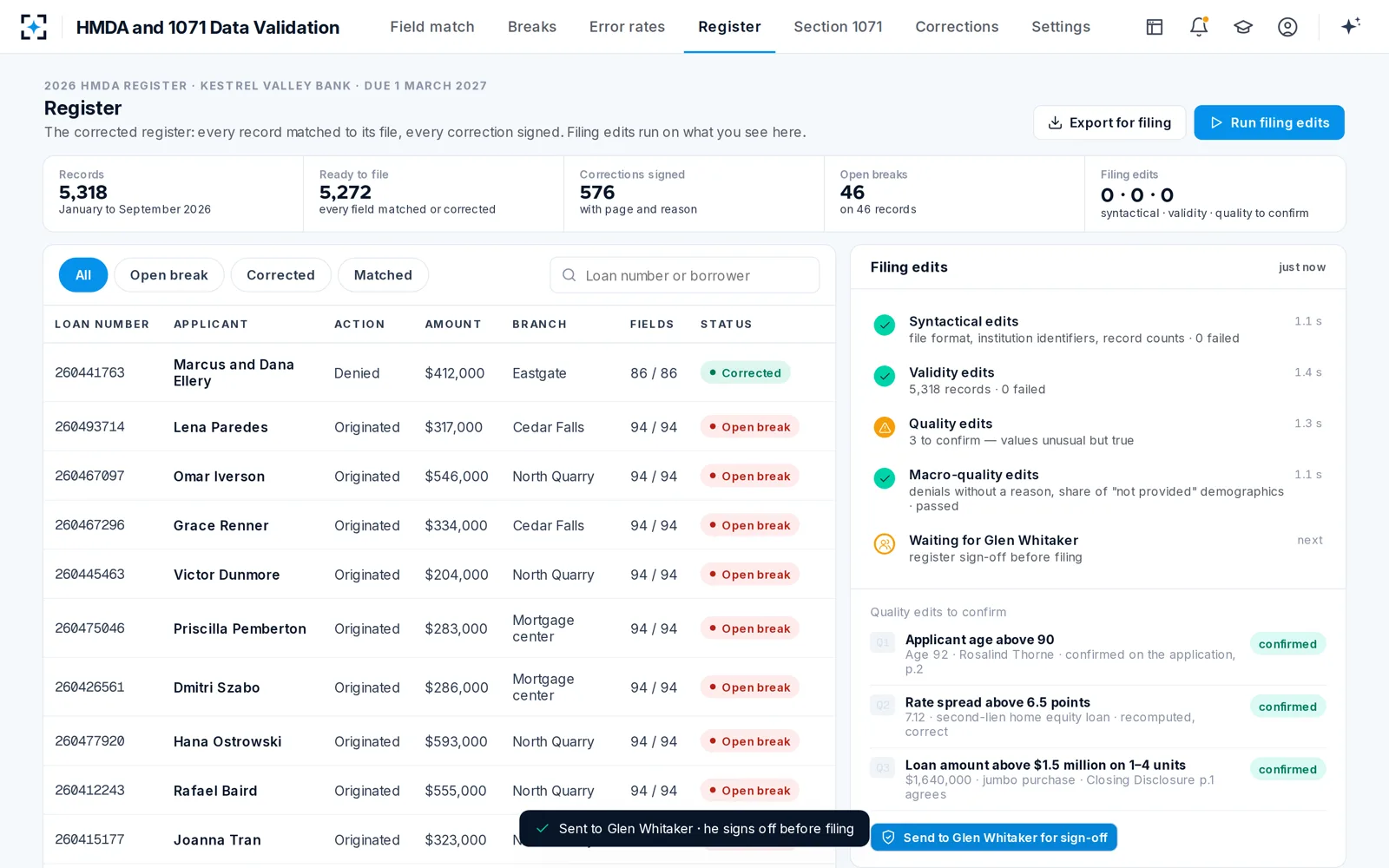
Regulation C asks that an authorized representative with knowledge of the data certify its accuracy and completeness when the annual register is filed. A corrections list in which every change has its page and its signer is what lets that person sign from evidence rather than assurance. The filing edits still run before sign-off: the solution runs the FFIEC syntactical, validity, quality and macro-quality edits on the corrected register and drafts explanations, a person confirms each quality edit, and the register is filed by a person after the compliance testing manager has signed it off.
When to go live: the filing calendar sets the deadline
Go live early enough that the full run before your next deadline is the solution's, not your old scrub's. The annual register is due by 1 March for the year before. A lender that reported at least 60,000 covered loans and applications, excluding purchased loans, in the preceding year also files within 60 calendar days after the end of each of the first three quarters. For those quarterly filers, nightly runs should be in place before a quarter closes, so the quarter-end run and its breaks land inside the 60-day window rather than across it.
Starting mid-year is normal, and it changes one thing: the first full run covers the year to date, so it will raise breaks on records your team already scrubbed and some it has not. Read the first error counts with that in mind. They describe the register as it stands after your earlier scrubs, not as it was first entered, so the baseline for counting errors at source starts with records entered after go-live. In the sample bank, the year-to-date register held 5,318 records from January to September when its third-quarter run finished.
Adding the Section 1071 practice register
The same field match runs on small-business applications, and a practice register is worth starting before the rule bites. Under the CFPB's revised small-business lending rule, published on 1 May 2026, the compliance date is 1 January 2028, coverage is limited to lenders with at least 1,000 covered originations in each of two consecutive years, a small business is one with gross annual revenue of $1 million or less, and the first full year of data is submitted by 1 June 2029. Coverage is decided by origination counts, so a lender near the line is counting now.
The practice track needs the same three inputs: your 1071 procedure, the commercial origination extract and a sample of application files. It has its own sharp edge. Revenue decides whether an application belongs on the register at all, and when the verified revenue on a tax return differs from the owner's estimate, the setting decides which one counts. In the sample bank's third quarter, nine of 412 practice applications had verified revenue above $1 million and were removed from the register, each removal signed. The rule itself, and how to prepare for it, are on the page on Section 1071 under the 2026 rule.
What to measure at 30, 60 and 90 days
Measure whether the agents are reading your files, whether people are deciding well, and whether the register is getting better where errors start. The first two tell you the rollout worked; the third is the reason to have done it.
Three checkpoints after go-live, each asking a different question
Day 30
Is it reading your files?
- Share of fields with a source page, by document type
- "No source" fields and why
- Breaks closed as within tolerance, by field
- Open breaks by age
Day 60
Are people deciding well?
- Corrected versus kept, with the reasons for each kept value
- Demographic changes with a second review
- Breaks per field compared with the back-test
- Settings changed, and why
Day 90
Is the register getting better at source?
- Errors as first entered by field, branch and officer, against day 30
- Root-cause findings sent, and the steps changed
- Estimated exam odds, as first entered and after review
- Review hours per quarter against your last scrub
Keep "within tolerance" separate from "error" in every count you report; a register with many small date differences inside three days is not a register with many errors. Keep errors as first entered separate from errors still open; the first measures your origination process, the second measures your review. The exam odds the solution estimates are a model built on your own error counts, and are worth tracking as a trend rather than quoting as a result. Which of these to report to management, and how to put a value on them, is the subject of the page on the cost of HMDA data errors and the return on checking every record.
Questions people ask
How long does it take to implement HMDA validation software?
The plan is a sequence of checkpoints rather than a fixed number of weeks. What sets the pace is how quickly the inputs are assembled, how many back-test differences need a decision, and how much reviewer time is protected for the first full run. You can see the first stage on your own data by running HMDA and 1071 Data Validation on a sample of your register.
Do we pause our current scrub while we implement?
No. The back-test runs on a quarter you have already scrubbed, so the current process carries on until checkpoint 4 has passed. Retire the old scrub only once the first full run's breaks have been worked and signed.
Does the solution change our origination system?
No. The agents read the register extract and the loan file documents and never write to the system of record. A change to the register happens only through a signed correction with a reason, and the corrected register is exported in the FFIEC pipe-delimited format for filing.
Does HMDA reporting software connect to our loan origination system?
It should read from it, not write to it. What it needs is a register extract and access to the document store where the loan files sit, and both should be named by system before a contract is signed, because a document type the software never receives shows up as a field it cannot check.
Who certifies the register when software has checked it?
The same person as before. Regulation C requires an authorized representative with knowledge of the data to certify its accuracy and completeness, and no software changes that. What changes is the evidence: a corrections list in which every change carries its page, its reason and its signer.
Is HMDA software worth it for a small reporter?
It depends on volume. The CFPB's 2015 estimate put the annual cost of HMDA reporting at about $2,500 for a lender with 50 records, and an insured bank or credit union that originated fewer than 500 closed-end loans in each of the two preceding years is partially exempt from many fields. At that scale a hand check of every file may cost less; the case for software grows with the register.