HMDA transaction testing is how examiners from the Federal Reserve, FDIC, OCC, NCUA and CFPB check that a lender's HMDA Loan Application Register (LAR) matches its loan files. For a register of 501 to 100,000 entries, the FFIEC guidelines have them check 35 randomly chosen files. If any single field shows two errors, they check 44 more, for 79 in all. Four errors in one field among the 79 and the lender must correct that field on every record in the register and resubmit. Botminds' HMDA and 1071 Data Validation checks every reportable field on every record against its loan file before filing. This page explains the examiner's test. It also shows what the test means in probability, because a lender that knows its true error rate in each field can work out its odds of a resubmission in advance.
The short version: below about 1% errors in a field, a resubmission order for that field is very unlikely. At 3% the chance is about one in seven, and at 5% it is close to a coin toss. The register's other fields add their own risk, and they add more than intuition suggests, because one field's errors can send the examiner on to the second stage of testing for every field.
The examiner's test for a register of 501 to 100,000 entries
35
files in the initial sample, each checked field by field against the loan file
2
errors in any one field send the examiner on to the rest of the sample
79
files in the total sample once the examiner reads on
4
errors in one field among the 79, and that field is corrected across the whole register
What do the FFIEC HMDA transaction testing guidelines require?
They set a random sample sized to the register, a two-stage review, and a per-field error count that triggers resubmission. The FFIEC member agencies issued the HMDA Examiner Transaction Testing Guidelines in August 2017 (the Federal Reserve sent them with letter CA 17-2; the FDIC with FIL-36-2017). They apply to HMDA data collected from 1 January 2018, which covers every register filed under the current Regulation C fields. Examiners pull the sample, ask for the loan files, and document every difference between the LAR and the file. A difference becomes an error when it is "not adequately explained" by anything else the lender can show.
The two stages are written precisely, and the details matter for the arithmetic. In the guidelines' own words: "If the number of errors identified in the Initial Sample falls below the Initial Sample Threshold in Column C of the HMDA Table for each and every data field reviewed, no further sample review is required." If any field reaches that threshold, examiners review the rest of the sample, and "must review all data fields that had one or more errors in the Initial Sample and may review any or all" the others. Then the trigger: "If, after reviewing the remainder of the Total Sample in Stage 2, the total number of errors in any data field equals or exceeds the Resubmission Threshold… examiners should direct the financial institution to correct any such data field in its full HMDA LAR and resubmit."
The sample and the thresholds depend on the size of the register. The initial-sample threshold is two errors in every size band. The resubmission threshold is three errors up to 500 entries and four above that. Expressed as a share of the sample, it falls from 10% for the smallest registers to 2.5% for the largest.
The bigger the register, the less error the test tolerates
The same document gives examiners room on both sides of the table. They "may prioritize designated fields for review". In practice that means the 37 "HMDA key data fields" that the Federal Reserve, FDIC and OCC designated in 2018, of which a partially exempt institution remains responsible for 21 (Federal Reserve CA 18-9). They may also order a field resubmitted below the threshold. The guidelines' example is withdrawn applications coded as denials "to such an extent that it likely prevents reliable analysis of underwriting disparities in a fair lending examination." Omitted applications can also be ordered back onto the register. The four-error rule decides most outcomes, but examiners can order a resubmission in other cases too.
The test matters because examiners find errors often. HMDA data collection was the most-cited violation in Federal Reserve consumer compliance examinations in 2022: "Over 59 percent of all violations cited by the Federal Reserve in 2022 involved inaccurate collection of residential mortgage data" (Consumer Compliance Outlook, 2023).
What counts as an HMDA error, and what the tolerances forgive
An error is any difference from the loan file that the lender cannot explain, except four kinds of difference the guidelines tell examiners not to count. Paragraph 9 lists them, and they apply "for the sole purpose of determining whether the number of errors equals or exceeds" a threshold. Every other field is compared exactly. That includes rate spread, the ethnicity, race and sex fields, and the reasons for denial.
Four differences an examiner does not count, and what still counts
Not counted as an error: Three calendar days or less from the date in the file.
Still an error: Four days or more. The guidelines' example: against 4 June, 1 June and 7 June pass; 31 May and 8 June fail.
Not counted as an error: Three calendar days or less, provided the difference does not put the record in the wrong calendar year.
Still an error: Any gap of four days or more, and any difference that moves the action across 31 December.
Not counted as an error: $1,000 or less, on the amount of the loan or the amount applied for.
Still an error: More than $1,000.
Not counted as an error: Rounding to the nearest thousand dollars on gross annual income relied on.
Still an error: Any other difference, such as net income for gross, or a bonus the underwriter did not rely on.
Not counted as an error: No tolerance.
Still an error: Any unexplained difference from the file: rate spread, demographics, denial reasons, census tract, property value and the rest.
Two further counting rules change the arithmetic. The ethnicity and race information is grouped: the six applicant ethnicity fields in the Filing Instructions Guide count as one data field, and so do the eight applicant race fields. The co-applicant fields form two more groups. "If one or more of the six Ethnicity of Applicant or Borrower FIG fields have errors, they would count as one (and only one) error for that data field group." So a record with two race fields wrong adds one error, not two. The fields recording whether ethnicity or race was collected by visual observation or surname sit outside the groups and are counted on their own.
The other rule is in paragraph 11. Examiners "may direct the financial institution to make any appropriate changes" to policies, procedures or audit "even if the number of errors does not equal or exceed" either threshold, "or even if the errors fall within the tolerances". A register can pass the count and still leave the exam with a finding about the process that produces it. A lender's own checking should apply the same tolerances and no wider ones. The key fields and their source documents takes the tolerances field by field, with the page each value should come from.
The examiners' tolerances, set as the outer limit
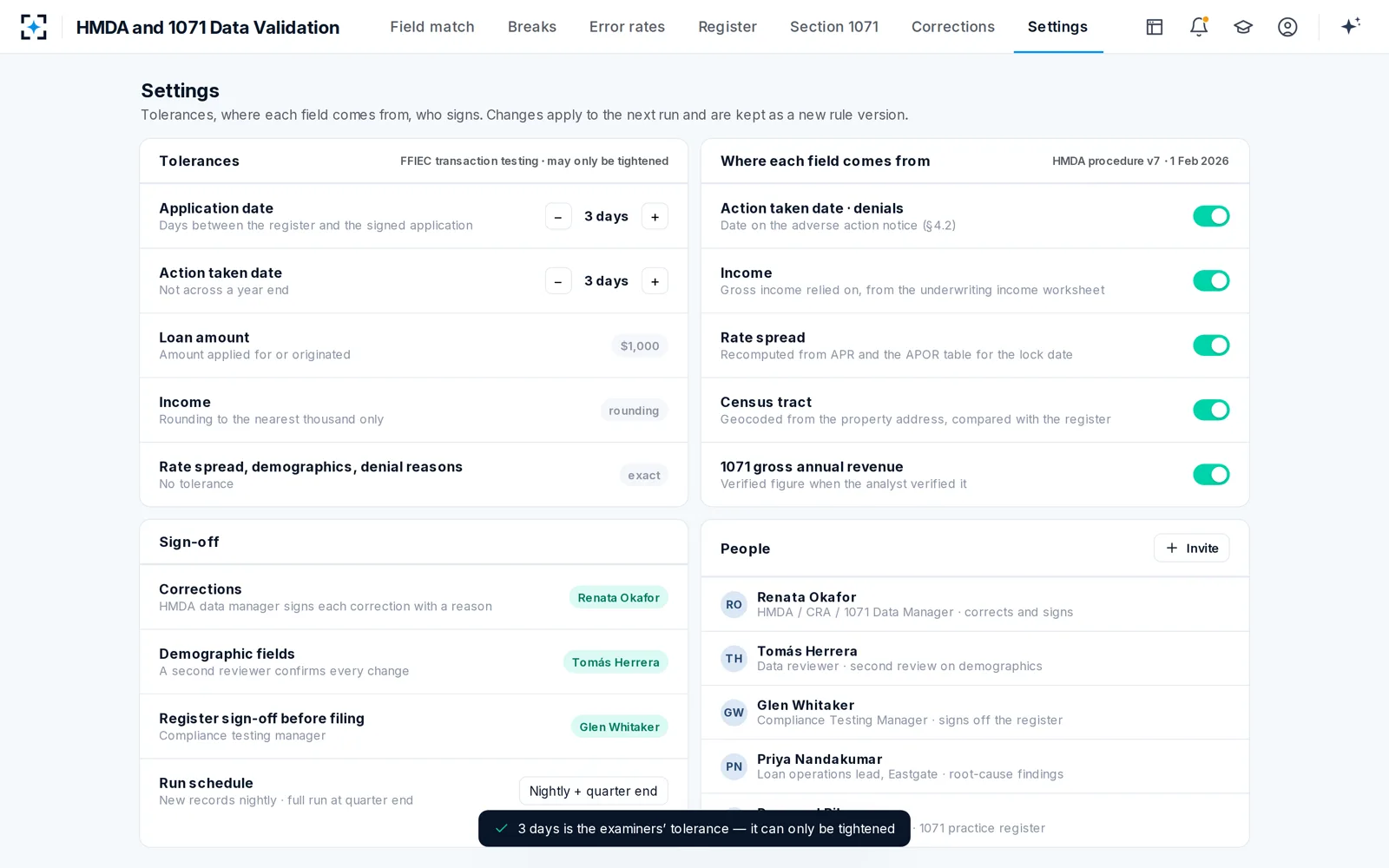
Look at the message at the bottom: pressing + past three days is refused.
What is the HMDA resubmission threshold? Errors per field since 2018, not a share of files
For data collected in 2018 and later, the threshold is a count of errors in one field: three or four in the total sample, depending on register size, as the table above shows. It is not a share of files with any error, which is how the test used to work and how any scrub that counts files rather than fields still reports its result.
Before the FFIEC guidelines, each agency set its own schedule. The CFPB's 2013 schedule told its examiners that lenders with fewer than 100,000 entries "should correct and resubmit HMDA data when 10 percent or more of a sample of HMDA LAR entries contains errors", and lenders with 100,000 or more at four percent, with lower rates in a single field (five and two percent) able to trigger resubmission where the errors prevented accurate analysis (CFPB Bulletin 2013-11). That was a file-level test: a record with one wrong field counted the same as a record with ten.
The resubmission test, before and after the FFIEC guidelines
CFPB schedule, 2013: Sampled entries containing any error
FFIEC guidelines, 2018 data onward: Errors in each data field, counted separately
CFPB schedule, 2013: 10% of sampled entries (4% at 100,000+ entries)
FFIEC guidelines, 2018 data onward: 3 or 4 errors in one field in the total sample
CFPB schedule, 2013: The register, corrected
FFIEC guidelines, 2018 data onward: The failing field, corrected on every record
CFPB schedule, 2013: One agency's examiners
FFIEC guidelines, 2018 data onward: All FFIEC agencies: Fed, CFPB, FDIC, NCUA, OCC, and state supervisors through the State Liaison Committee
The change matters for how you measure yourself. A register where 8% of files carry one error each, spread across twenty fields, can pass the current test; a register where 3% of files carry the same wrong field can fail it. A scrub report that says "our LAR error rate is 6%" answers the old question. The question the examiner asks now is the error rate of each field, and the odds that follow from it, which is where the rest of this page goes.
A 3% error rate in one field means about a one-in-seven chance of resubmission
Model the published rule as probability and the chance of a resubmission rises steeply with the error rate. For a register of 5,318 entries, our model puts the chance that one field is ordered resubmitted at about 0.5% when 1% of records carry an error in that field. The chance is about 5% at 2%, 14% at 3%, 42% at 5% and 75% at 8%. These are our estimates, not the agencies' figures. The method is in the caption below.
The odds of a resubmission order, by a field's true error rate (our estimate)
Read the curve against the table, not against intuition. The table's 5.1% looks like a pass mark, but it is only the count of four errors divided by 79. A field whose true error rate is exactly 5.1% is ordered resubmitted about 43% of the time, and a field at 3%, well under the line, about 14% of the time. The flat start of the curve comes from the first stage. A field with 1% errors shows two errors in 35 files only about 5% of the time, so most exams stop before the 44 further files that could produce a third and fourth.
The largest registers face a different curve. At 159 files and four errors, the line for registers above 100,000 entries reaches about one in four at a 2% error rate and about one in two at 3%. That band is not theoretical. When the CFPB tested Freedom Mortgage's 2020 submission, which covered more than 700,000 applications, it "found 51 errors in an initial review of 159 files", and the company had to resubmit (CFPB, October 2023).
Why many fields multiply the risk: one field can open the second stage for all of them
A register with many moderately wrong fields is at greater risk than its worst field suggests. One reason is plain addition: each field is another chance to reach four errors. The other is in the rule itself. Two errors in any field send the examiner to stage 2, and stage 2 must cover every field that had an error in the first 35 files. A field with one early error, which would have ended the exam on its own, gets the extra 44 files because a different field opened them.
Several fields at modest error rates add up (our estimate)
5%
one field at a 2% error rate, the others clean
24%
five fields, each at 2%
46%
ten fields, each at 2%. The second stage opens in 81 exams in 100
21%
all 37 key fields, each at only 1%
Errors also tend to come in many fields at once. Paragraph 23 of the CFPB's 2020 consent order with Washington Federal states the regulator's reading: "The occurrence of errors in many different fields, rather than concentrated in one or two fields, indicates broad CMS failures and a lack of adequate resources" (CFPB consent order, October 2020). For the arithmetic, the point is simpler. To lower the odds you have to know the error rate in each field, and the sum of errors across all fields does not tell you that.
A sample register run through HMDA and 1071 Data Validation: 37 in 100 as first entered
Take a fictional lender's register as it runs through the solution. Kestrel Valley Bank, with $6.8 billion in assets, holds 5,318 HMDA records for January to September 2026, so it sits in the 501–100,000 band. Because the solution compares every reportable field on every record with its page in the loan file, it can count errors as they were first entered, by field: 622 across ten exam fields this year. Income has 166 (3.1% of records) and action taken date 127 (2.4%). Rate spread has 84, ethnicity, race and sex 61, property value 48 and census tract 37. Four smaller fields bring the total to 622.
The solution's error-rate screen turns those rates into odds and shows 37 in 100 that an examiner's 79-file sample of the register as first entered would order at least one field resubmitted. It reckons cautiously, as if the examiner read all 79 files for every field. Run through the full two-stage rule above, the same rates give about 29 in 100. Either way, roughly one exam in three would end with a resubmission order. Income alone carries most of the risk: 23 in 100 on the screen's reckoning and about 18 on the two-stage one. Action taken date is next, at 12 and about 9.
Where the sample register's risk sits, field by field (our estimate)
After the solution's check, every break that a person has corrected and signed is out of the count. 48 breaks are still open on the sample register, so the error rates fall to between zero and 0.24% a field. The odds fall to under 1 in 100 on either reckoning. That figure assumes the check found every error, since it treats the open breaks as the only errors left. It describes this sample register, not a promised result. The assumption is the one internal audit should test first, and measuring the validation's accuracy sets out how.
One simulated exam sample, before and after the check
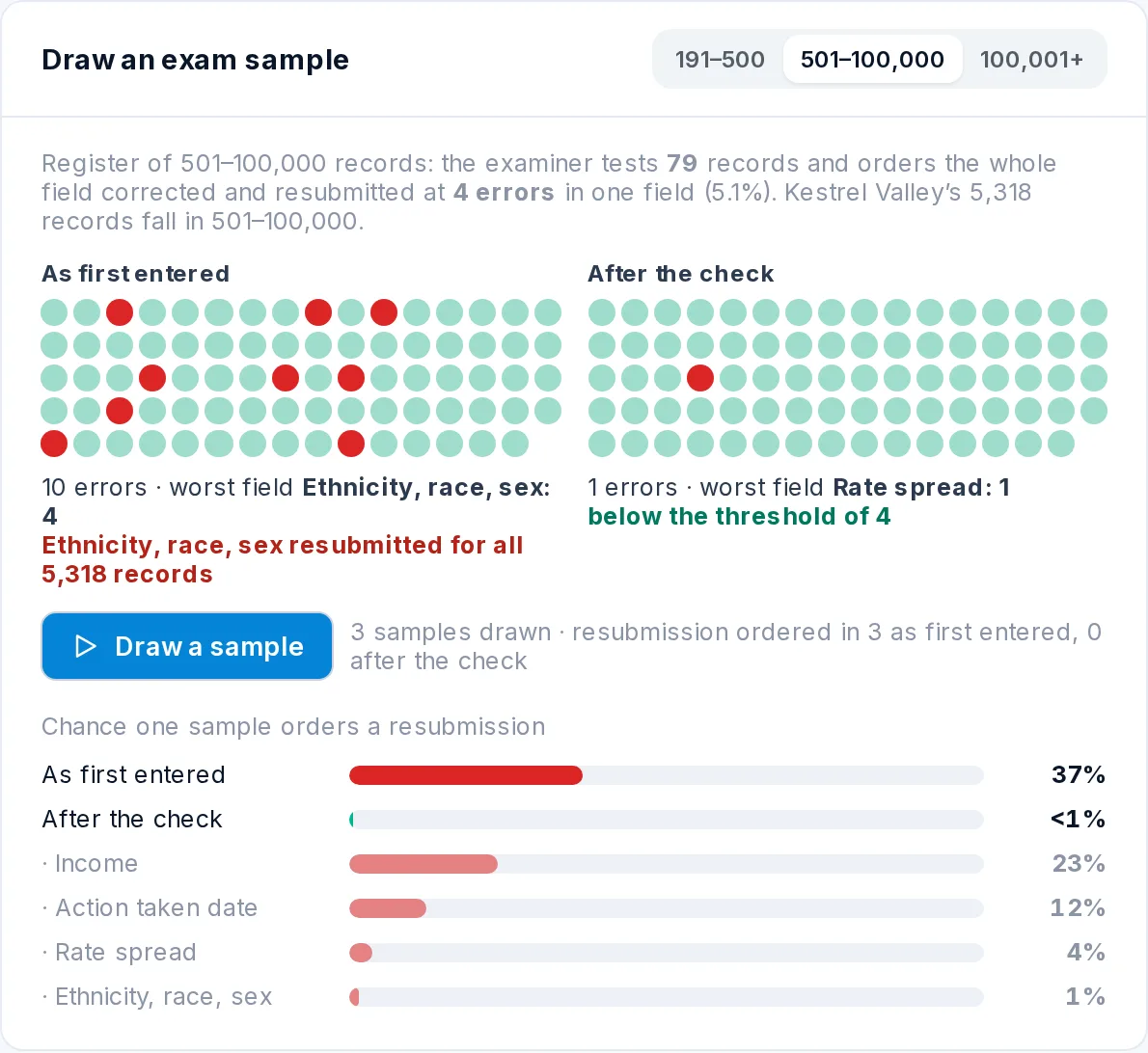
A single draw tells you little. The bars below the dots show the long-run frequency over many draws, and that is the figure to plan on.
The odds are useful mainly for showing where to work. Income and action taken date carry more than four-fifths of the sample register's risk, so a quarter spent on those two fields lowers the odds more than a quarter spent evenly across all of them. The breaks queue is ordered the same way, by exam weight, with the fields nearest the threshold first. Lowering a rate at its source is a separate job: in the sample register, 38 of one branch's 41 action taken date errors came from a single workflow status, a case the root-cause case study follows from the first error to the changed step.
How to run a mock HMDA exam, and why a clean one proves less than it seems
You can run the examiner's test yourself. Draw a random sample of the examiner's size, check every key field against the loan file, apply the paragraph 9 tolerances and nothing wider, and count errors field by field through both stages. Knowing the outcome of one draw is not the same as knowing your odds, though. A sample of 79 is too small to measure a field's error rate with any precision.
The numbers show why. If a mock exam of 79 files finds no errors in a field, the 95% upper bound on that field's true error rate is still 3.7%. At 3.7%, the curve gives nearly one in four. A clean mock exam therefore cannot tell a field at 0.5% from one at 3.5%, and those two fields carry very different risks. One error in 79 leaves the upper bound at 5.9%. To know which part of the curve you are on, you need a much larger sample for each field, or every record. A 300-file review with three errors in a field bounds it at about 2.6%. A full check needs no bound, because it counts the errors.
A mock exam of 79 files with no errors still allows a true error rate of 3.7%, and at that rate the odds of a resubmission are nearly one in four.
A self-exam that estimates your odds rather than just one draw
- Use the examiner's frame
Size the sample from the table for your register. If your data comes from several origination systems, know that examiners may sample each system separately.
- Check against the file, not the worksheet
Compare each field with the page in the loan file it came from. The Federal Reserve's sound practices say to "review source documents; do not rely on information on HMDA worksheets".
- Count the way examiners count
Apply the four tolerances and no wider ones. Count each ethnicity or race group as one field. Treat action taken dates that cross 31 December as errors.
- Estimate a rate per field, with its bound
Use the largest sample you can afford, or every record, and write down each key field's error rate and its 95% upper bound. A count of zero is not a rate of zero.
- Read the odds off the curve, then add the fields together
Use the curve for your size band for each field, then account for the shared second stage. Several fields at 2% are a bigger risk than any one of them.
- Re-run after every fix and every quarter
Odds measured in January are stale once a branch changes a step. Lenders that reported 60,000 or more covered loans and applications the year before file quarterly under Regulation C, and need a figure every quarter.
This is the practical limit of the sample-based scrub. A team that can check 300 files a quarter gets narrower bounds than one that checks 79, but for most fields it still cannot tell 1% from 3%, and the curve changes sharply between those two rates. The methods compared works through what a 5% scrub sample can and cannot see.
After an order to resubmit: what correcting one field across a register takes
A resubmission order applies to the whole register, not to the sample. The guidelines direct the lender "to correct any such data field in its full HMDA LAR". That means going back to the source document for that field on every record, not only the 79 the examiner read. For an ethnicity or race group, all six or eight FIG fields in the group are corrected. On a 5,318-record register, an income resubmission means finding the gross income relied on in 5,318 underwriting files and comparing each one with the LAR.
The enforcement record shows how badly this can go. Freedom Mortgage's resubmission of its 2020 data "corrected errors in 35 different required HMDA data fields", amounting to "errors in over 174,000 data entries affecting nearly 20 percent" of its applications (CFPB, October 2023). Because the company was already under a 2019 order, the CFPB proposed a $3.95 million penalty and an order to "regularly audit, test, and correct" its HMDA data (CFPB, June 2024). At Washington Federal, the CFPB reviewed 84 files from the 2017 LAR and found 58 errors in 27 of them. It then reviewed 81 files from the resubmitted LAR and still found 21 errors in 13. The cause was "an incorrect policy, which directly led to the errors in its resubmitted LAR" (consent order). The order carried a $200,000 penalty (CFPB).
What a resubmission can turn into
35
HMDA fields corrected in one lender's resubmission of its 2020 data
Freedom Mortgage
174k
more than 174,000 data entries corrected, affecting nearly 20% of the lender's applications
Freedom Mortgage
16%
sample error rate the CFPB still found in another lender's resubmitted LAR
Washington Federal, 2017 LAR
Lenders who come through an order well treat it as a correction method that has to be checked itself. Write down the source document and rule for the field. Apply them to every record. Check the corrected field against a fresh sample before refiling, because a resubmission is tested as well. Keep each change with its before and after values, the evidence and the person who signed it, so that the examiner can follow it. This is the same discipline that makes the odds knowable before the exam: one rule, every record, every change signed. The cost of HMDA data errors estimates what a resubmission costs in time and money. The HMDA and 1071 Data Validation page shows how the check, the corrections and the record for the examiner fit together.
The breaks queue, ordered by distance from the threshold
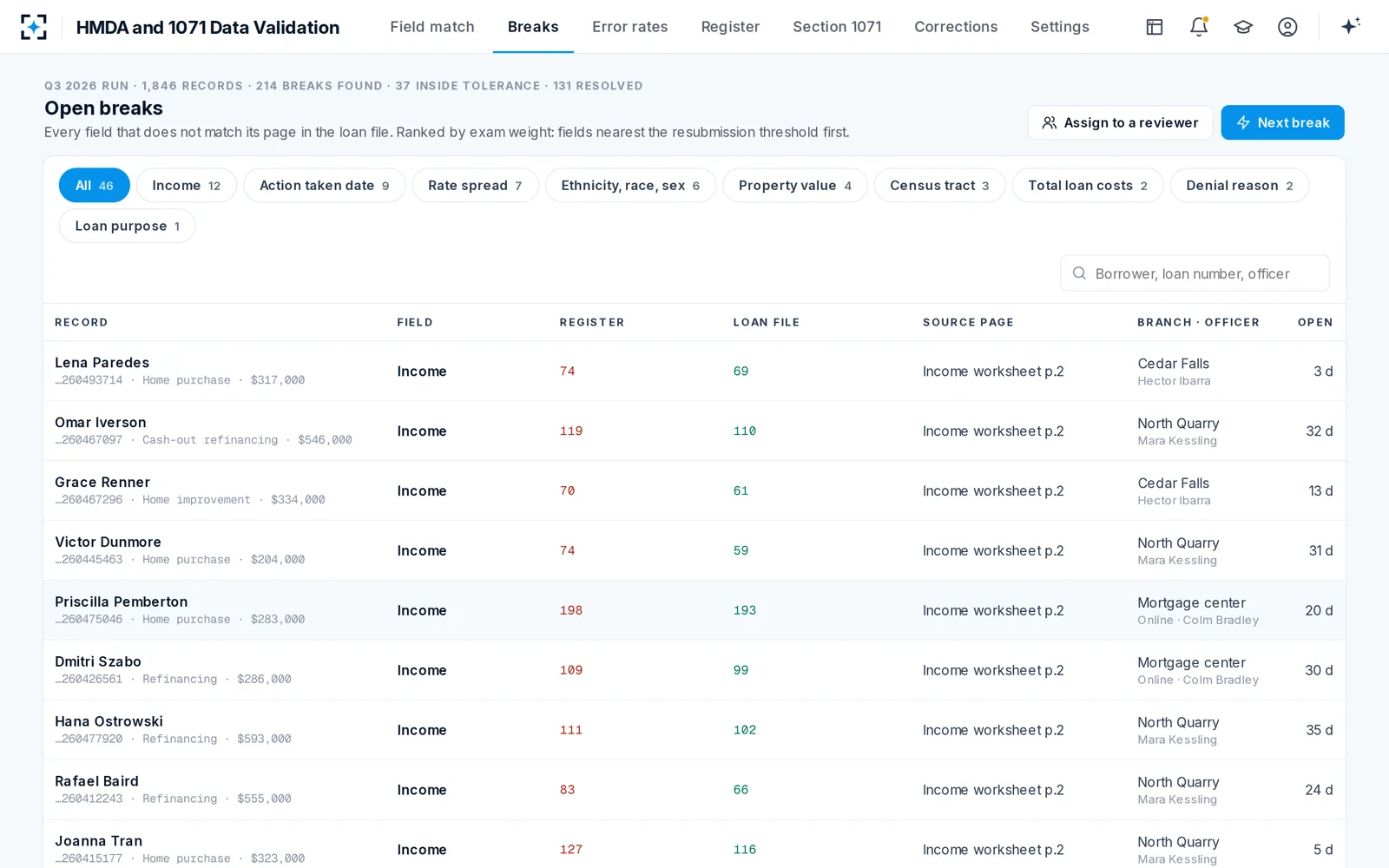
Income comes first because it is the field closest to the threshold, not because it was found first.
Questions people ask
Is the HMDA resubmission threshold 5.1% or four errors?
Four errors in one field among the 79 files, for registers of 501 to 100,000 entries. The 5.1% in the FFIEC table is simply 4 divided by 79. It is not a tolerance on your true error rate: a field with a true rate below 5.1% can still produce four errors in the sample, and the curve above shows how often.
Does a tolerance difference count toward resubmission?
No. Differences within the four paragraph 9 tolerances are not counted against either threshold. Examiners can still ask for process changes under paragraph 11, though, so a pattern of two-day date gaps is still worth fixing.
Can examiners order a resubmission with fewer than four errors?
Yes, under paragraph 7, where they have "a reasonable basis to believe" a field's errors would make the HMDA data unreliable for analysis, such as fair lending review. They can also order a resubmission to add applications that were left off the register.
Do the FFIEC guidelines apply to credit unions and nonbank lenders?
Yes. The guidelines were adopted by the FFIEC member agencies together, so the same sample sizes and thresholds are used by NCUA examiners for credit unions, by the CFPB for the nonbank mortgage lenders it supervises, and by the banking agencies. State supervisors take part through the State Liaison Committee.
Which HMDA fields do examiners test?
The guidelines let examiners test any field, but the Federal Reserve, FDIC and OCC have designated key data fields they focus on, with a shorter list for partially exempt banks. The field-to-document map for each is in the HMDA key data fields guide.
Will Section 1071 small-business data be tested the same way?
Very likely in shape, though no examiner guidelines have been published. The revised rule's Appendix F already borrows the HMDA table: for a small-business register of 1,000 to 100,000 applications, errors in a field count as bona fide only while a random sample of 79 holds fewer than four, and 159 with four for larger registers. The Section 1071 final rule guide covers the rest of the 2026 rule.