A pharmaceutical sales rep stands in a doctor's office with a question to answer and only seconds to do it. Federal rules and company policy limit the answer to what the drug's label and the company's reviewed materials say. A knowledge assistant finds those exact words fast, and it stops at the point where a rep has to hand the question to the company's medical team.
This guide is for anyone who answers for what reps say: sales reps and key account managers, field excellence and commercial leaders, commercial compliance, Medical Information, brand teams, and the people deciding whether to bring AI into the field. No background needed.
Imagine you are a sales rep at a mid-sized biotech, in Seattle, with a psoriasis injection called Veltrimab. It is Wednesday, October 7, 2026, 10:27 a.m., and you are with Dr. Elena Ruiz, a dermatologist. She asks what the label says about pregnancy. You type her question, and four seconds later section 8.1 of the label is on your screen, word for word, from page 7.
That goes well. Then she asks the question that matters: can a patient of hers stay on it through the third trimester? You know the drug. You have heard people discuss this. The natural thing is to give her your best sense of it. If you do, a sentence from you may count as promoting a use the FDA never approved.
Her first question · on the label
Asked
What the label says
Source
Section 8.1, page 7
You
Read the approved words
Her follow-up · beyond the label
Asked
Stay on it, third trimester
Source
Nothing approved
You
Stop, and refer it
One minute apartsame drug, same topicone question you may answer, and one you may only pass on.
So you say nothing about the third trimester. You confirm that she asked on her own, and her question goes to Medical Information, the company's medical team, as request MIR-26-04417. They will answer her directly, usually within two business days.
What the work catches: the follow-up that sounds like the first question and goes past the label. It stops before you add a word, and both questions stay on the record.
What a pharma rep may say in a sales call, and why the answer must be approved, cited and on the record
What counts as approved content, where off-label begins, how an unsolicited request works, what fair balance asks of a spoken answer, and how field teams cope today, explained without selling anything. If you are new to pharma sales or its compliance rules, start here.
01 · In plain words
A rep's mid-call product question, from the doctor's first words to the record
A drug company's sales representative, usually called a rep, visits doctors, nurse practitioners and pharmacists to tell them about the company's medicines. Reps see few prescribers: in the US only about 45% of health care professionals were accessible to pharma field teams in 2024, down from 60% in 2022, on the figures of one large industry data provider.1 When a meeting happens it may be short, and the prescriber often has a question. How often is it dosed? What does the label say about pregnancy? Can it be stored out of the fridge?
A rep may not answer these the way you would answer a friend. In the US, what a company says about a medicine is regulated, and a rep's spoken words count. The federal rule on intended use, which looks at what a company means its drug to be used for, says a company's intent can be shown by "oral or written statements" from the firm "or their representatives".2 So a rep's casual sentence about a use the FDA never approved can become evidence that the company was promoting that use.
The safe answers already exist in two places. One is the label, the FDA-approved prescribing document for the drug. The other is the set of promotional pieces the company's own reviewers approved: detail aids (the brochures reps show), dosing cards, leave-behinds. Each piece carries a code, called a job code, and an expiry date. The trouble is finding the right words in time. A rep in a doctor's office tends to answer from memory, or promise to get back to the doctor, or scroll a portal while the doctor waits.
Some questions have no approved answer at all. Those belong with Medical Information, the company's medical team, who reply to the doctor directly. The rep's job in that moment is to stop, and pass the question on as it was asked. A field knowledge assistant is software built for these few seconds: it finds the approved words, shows where they came from, and helps the rep stop in the right place. This guide explains the rules behind it and how to judge one.
One pregnancy question in a dermatology call, in five steps
The doctor asksDr. Ruiz asks Sam, a Veltrimab rep, what the label says about pregnancy. It is 10:27 a.m. and she has a patient waiting.
The rep looks for approved wordsLabel section 8.1, on page 7, says what can be said. This search, on the rep's phone or tablet, is the step this guide is about.
The rep reads them and shows the pageWord for word, with the section and page, and nothing added.
The follow-up goes past the label"Can my patient stay on it through the third trimester?" The rep stops, because no approved item answers that.
Medical Information answers, and the record staysThe request goes in as asked, the medical team replies to the doctor, and compliance can read what happened.
Step 2 is the subject of this guide. The people, products and figures in this example are fictional.
Why reps' spoken words count, and three more facts about field answers
Spoken words can be evidence
FDA's Bad Ad program, which helps health care providers spot misleading drug promotion, lists "sales representative presentations" among the promotion it regulates, and prescribers can report them by email or phone, anonymously if they wish.3 In 2018 FDA sent an untitled letter, the notice it uses for violations below the threshold for a Warning Letter,4 over what one rep reportedly said at a lunch.5
Most approved content goes unused
By the 2023 count of Veeva, which sells drug companies the customer relationship management (CRM) software reps log their calls in, field teams worldwide rarely or never used 77% of the content created. By 2025 it said "nearly 80%".6,7 A drug company pays to create and review those items, and the answer a rep needs may be among them.
A question can be off-label by accident
Prescribers do use drugs outside their labels. One national study put off-label use at 21% of mentions for commonly used drugs in 2001.8 So the doctor's question may be ordinary to her and out of bounds for the rep.
FDA's main text on this is still a draft
Its guidance on unsolicited requests has been a draft since December 2011, and its 2025 guidance on unapproved uses refers to it as one.9,10 Companies write their own field policies on top, and the policies differ.
Job code, on-label, unsolicited request and Medical Information
Job code
The tracking number a company gives one approved promotional piece, tied to its version and expiry date. Some companies call it an approval number.
On-label
Within what the FDA-approved label says about a drug. Off-label means a use, patient group or dose the label does not cover.
Unsolicited request
A question a person asks fully on their own. FDA says a request "prompted in any way" by the firm or its representatives is solicited.9
Medical Information
The company's medical team that answers scientific questions, kept apart from sales and marketing.9
Labels, Medication Guides, detail aids and job codes: what "approved content" means in a sales call
In short"Approved" covers two different things. The FDA approves the label. A company's own review committee approves its promotional pieces, and the company files them with the FDA when first used. Field guides and policies are internal. A rep's answer can only be as current as the version in hand.
What it is
Who approves it
What a rep may do with it
What goes out of date
US Prescribing Information (the label, or USPI)
The FDA
Read it, show it, leave it. It is the base for everything else.
A new version when the FDA approves a change
Medication Guide
The FDA, as patient labeling, for the drugs that have one
The company's medical, legal and regulatory review committee, often called MLR. Specimens go to the FDA with Form FDA 2253 at first use.11
Use as approved, with its job code, and only in its approved setting
An expiry date set by the company, and any label change
Approved email template
The same committee
Send to a prescriber, with the fixed wording
As for any approved piece
Field guide or objection handler
Compliance and the brand team, as an internal document
Follow it. It is usually marked not for distribution to prescribers.
The company's own date
Field policy
Commercial compliance
Follow it. It says what a rep does at the edge of approved content.
The company's own review cycle
The regulation names the promotional group plainly: "detailing pieces", "file cards", "literature" and "similar pieces of printed, audio, or visual matter descriptive of a drug" supplied by the manufacturer count as labeling.12 The filing duty is short too: the company submits specimens "at the time of initial dissemination" with the transmittal form.11 Filing is a notice to the agency. FDA does not generally pre-approve each piece, which is why the company's own committee is the step that matters.
Field teams rarely or never use 77 of every 100 pieces of content
77 in 100
pieces of content created by biopharma field teams were rarely or never used, on Veeva's 2023 count from its own CRM data. In May 2025 the company said "nearly 80%" of what is approved.
pieces of content created by biopharma field teams were rarely or never used, on Veeva's 2023 count from its own CRM data. In May 2025 the company said "nearly 80%" of what is approved.
77 of 100
Treat that number as a measure of use. It comes from one vendor's data, and it cannot tell you why an item sat idle: it may be hard to find, out of date, or unneeded. Adding more approved items does little for a rep who cannot find the ones already there. Veeva reported biopharmas created 20% more content in the prior year, and shared digital content in 39% of meetings.6
An approved item has a life, and a rep can only see its end
The usual path of one promotional piece, in a typical US company
1Drafted
The brand team and agency write a piece from the label and approved claims.
Brand managerWeeks
2Reviewed
Medical, legal and regulatory reviewers check every claim against its reference.
Review committeeWeeks
3Coded and filed
A job code and expiry are set; a specimen goes to the FDA at first use.
RegulatoryAt launch
4In the field
Reps show it in the approved setting. It may or may not be found.
RepsMonths
5Renewed or retired
At expiry or a label change, someone renews it or takes it out of use.
The brand team and agency write a piece from the label and approved claims.
Brand manager
Weeks
Reviewed
Medical, legal and regulatory reviewers check every claim against its reference.
Review committee
Weeks
Coded and filed
A job code and expiry are set; a specimen goes to the FDA at first use.
Regulatory
At launch
In the field
Reps show it in the approved setting. It may or may not be found.
Reps
Months
Renewed or retired
At expiry or a label change, someone renews it or takes it out of use.
Brand manager
By the date
Why a current version matters as much as the right words
A rep quoting last quarter's dosing card can be wrong even if every word was once approved. A label change affects saved answers, leave-behinds and emails all at once. So the test is a current, in-date item. Field teams need three facts at the moment of use: which version this is, whether it is still in date, and whether the label has changed since it was approved.
03 · Off-label rules and dates
Off-label promotion rules for pharma reps, with each one's status as of November 2026
In shortNo single rule says "reps may only say this". The limit comes from the intended-use rule, the promotion rule and FDA's guidance, some of it final, some of it still draft. Courts have protected some truthful off-label speech, and only that. Many company field policies are stricter than FDA's text, which is each company's choice.
FDA's framework for field answers has been built in pieces since 2011, and parts of it are still unsettled
Dec 2011Draft on unsolicited requests
Still the current text: a draft, with no final version found.
Dec 2012Caronia
A federal appeals court sets aside a sales rep's conviction based on truthful off-label speech.
Jun 2015Pregnancy and lactation labeling
New label format, 8.1, 8.2 and 8.3, effective June 30.
Aug 2015Amarin
A New York federal court, on a preliminary injunction, bars misbranding charges based on truthful statements alone.
Jun 2018Consistent with the label
Final guidance: when a communication is consistent with FDA-required labeling.
Aug 2021Intended-use rule revised
Oral or written statements still count; knowledge of off-label use alone does not.
Jan 2025Scientific information on unapproved uses
Final, with a notice that it is not for current implementation.
Jul 2025OMB approves the information collections
The White House budget office approved them July 29; FDA's page keeps the January notice.
In force. The 2025 edition carries the 2021 wording.2
Intent "may, for example, be shown by labeling claims, advertising matter, or oral or written statements" by the firm or its representatives. A firm's knowledge that doctors prescribe off-label does not, by itself, show that intent.
Effectiveness may not be presented "in greater scope, depth, or detail" unless true risk information balances it. See section 6.
FDA draft on unsolicited requests, 2011
Draft, labeled "Not for implementation" on FDA's page, with no final version found. The 2025 final guidance refers to it as a draft.9,10
FDA recommends referring off-label questions to medical or scientific staff, with "no input" on the response from sales and marketing. See section 5.
FDA final guidance on scientific information on unapproved uses (SIUU), January 2025
Final. It said it was "not for current implementation" until FDA published the decision of the White House Office of Management and Budget (OMB) on its information collections, the federal term for the disclosures and records an agency asks of firms.10,19 OMB approved them without change on July 29, 2025, and an FDA notice of September 25, 2025 lists the approvals and names this guidance's docket, FDA's public file for it, among its dockets.16,20 FDA's page and the guidance itself, read November 3, 2026, still carry the January wording, and we found no FDA statement lifting it, so its status is unclear.21
Covers firm-initiated sharing of reprints and similar publications. It pictures "a firm's representative" delivering one in person, separate from promotion, and recommends specialized training for those who share them.
Helps sort what is on-label from what goes further, using factors such as conditions of use, dosing and patient population.
FDA revised draft on payor communications, June 2026
Draft, comments closed August 3, 2026; no final version found.18
Applies when the listener is a payor or formulary committee, which matters for key account managers more than for a call on one doctor.
PhRMA Code, from the US drug-industry trade group
Voluntary, revised version effective January 1, 2022. Five jurisdictions, including California and the District of Columbia, adopt or incorporate it in statute or regulation.22
Covers how reps interact with prescribers: meals, speaker programs, gifts. Check your states.
OIG compliance guidance, from the inspector general of the federal health department (HHS)
General guidance dated November 6, 2023, which says industry-specific guidance is forthcoming. On November 3, 2026 OIG listed sector guidance for nursing facilities (2024) and Medicare Advantage (2026), and for pharma only an archived 2003 document.23,24
Sets the fraud and abuse view of a compliance program. Worth rereading when it arrives.
What the 2025 guidance changes, and what it leaves with your field policy
Many readers assume FDA keeps sales reps out of all off-label discussion. The 2025 final text says something narrower. For a firm-initiated communication of a scientific publication, its Example 4 pictures "a firm's representative" delivering it "during an in-person visit", separate from, "not attached to or intermingled with", promotion of the approved uses. A footnote recommends that personnel sharing these items "have specialized training" and know how to direct questions to "personnel who are best qualified to respond", such as a medical or scientific department.10
That does not open the door to a rep's own answer to a clinical question. The guidance concerns defined publications with defined disclosures, and it says nothing that lets a rep improvise. Three texts now sit side by side:
The 2025 final guidance
A representative delivers a publication
Firm-initiated, in person, apart from promotion, with specialized training recommended. Its status is unclear: see the table above.10
The 2011 draft
Medical staff answer the question
Responses come from "medical or scientific personnel independent from sales or marketing departments".9
Many company field policies
Reps refer every unapproved use
Reps do not discuss unapproved uses at all. That is a company's choice, and a legitimate one.
If your policy sets this line, say so plainly in training, and do not tell reps the FDA itself requires it.
What the Caronia and Amarin decisions do, and do not, protect
In 2012 a federal appeals court set aside the conviction of a sales representative, Caronia, because it rested on his truthful speech about off-label use. In 2015, in the Amarin case, a federal district court in New York granted a preliminary injunction, an early court order, against misbranding charges, the charge at issue in both cases. It wrote that FDA "may not bring such an action based on truthful promotional speech alone".13
Neither case gives a rep a license. Both concern truthful and non-misleading speech, and law firm Mintz's commentary on them stresses that false, misleading or unsubstantiated claims stay unprotected.13 Whether an unprepared answer in a doctor's office is truthful, complete and balanced is what nobody can show afterward without a record. Many companies read these cases as a limit on the government, and leave their field rules in place.
04 · Sorting the question
Where on-label ends: seven kinds of question a prescriber asks a rep
In shortThe work comes down to sorting each question, in seconds, into what the approved words can answer and what must leave the conversation. Pregnancy is the classic case: reading the label's section is on-label, and advising on one pregnant patient is well beyond it, though the two questions sound nearly alike.
Only a question about approved content lets a rep answer at all, and never in the rep's own words
What a rep may do with each kind of question, under a typical strict field policy
NoIn partYes
Read approved wordsAdd own wordsRefer to Medical InformationRefer to field reimbursementDosing, storage or use on the labelYesNoIn partNoResults within the approved useYesNoIn partNoWhat the label says on a special groupYesNoIn partNoComparison with another drugIn partNoYesNoA use the label does not coverNoNoYesNoSavings program for insured patientsYesNoNoIn partOne patient's coverage or appealNoNoNoYes
Our reading of the sources2,9,15,25 · Your own field policy decides the details.
Show the numbers
Read approved words
Add own words
Refer to Medical Information
Refer to field reimbursement
Dosing, storage or use on the label
Yes
No
In part
No
Results within the approved use
Yes
No
In part
No
What the label says on a special group
Yes
No
In part
No
Comparison with another drug
In part
No
Yes
No
A use the label does not cover
No
No
Yes
No
Savings program for insured patients
Yes
No
No
In part
One patient's coverage or appeal
No
No
No
Yes
The same pregnancy topic, on both sides of the line
Since the Pregnancy and Lactation Labeling Rule took effect on June 30, 2015, section 8.1 of a modern label is the place for pregnancy information, with 8.2 for lactation and 8.3 for females and males of reproductive potential.14 Take the case in this guide, whose sample label's section 8.1 says available data "are insufficient to evaluate a drug-associated risk".
The question as asked
What it needs
The right move
"What does the label say about pregnancy?"
The words of section 8.1
Read them, with section and page. Add "that is everything the label says".
"So is it safe in pregnancy?"
A conclusion the label does not draw
Repeat the label's words. Offer Medical Information if she asks again on her own.
"Can my patient stay on it through the third trimester?"
Treatment advice for one person, with no approved answer
Stop. Offer a Medical Information request only if she asked unprompted.
"Do you know whether anyone has studied that?"
Data beyond the label
Same: Medical Information. Mentioning a study yourself could prompt the next question.
The riskiest questions are the rarer ones, which is why reps have the least practice at them
Placement is a judgment for one company; plot your own from a month of questions
Three tests a compliance reviewer applies to one answer
FDA's 2018 guidance looks at whether what is said conflicts with the label on the conditions of use, such as the patient group, the dose or the route, and whether it increases the potential for harm relative to the label.15 A practical reviewer shortens that to three questions about any answer a rep gives:
Is the source approved and current? The label version in force, or an in-date item with its job code.
Are these the approved words? A paraphrase can drift. "May increase the risk of infections" and "a small infection risk" are different claims.
Is it inside the approved use, and balanced? Right patient group, right dose, risk information with any benefit claim, and no comparison the approved item does not make.
05 · Unsolicited requests
How an unsolicited request for off-label information works, step by step
In shortA rep may pass on a question the prescriber asked fully on her own. A rep who hints at an off-label use has made any resulting request solicited. FDA's draft recommends a private, specific, balanced, scientific reply from medical staff, with records of who asked what and what went back. Sales staff have no input on the content.
What makes a request unsolicited, in FDA's own examples
FDA defines unsolicited requests as those "initiated by persons or entities that are completely independent of" the firm. Requests "prompted in any way by a manufacturer or its representatives" are solicited, and FDA says they "may be considered evidence of a firm's intent".9 Example 4 in the draft is the rep's: a sales representative "mentions a use of a product that is not reflected in the product's approved labeling and invites a health care professional to request more information", and the requests that follow are solicited.9
Unsolicited
The prescriber raises it herself
"Can my patient stay on it through the third trimester?" asked with no hint from the rep. The rep offers to pass it on.
Solicited
The rep opens the door
"We get a lot of questions about pregnancy. I could ask medical to send you something." The doctor says yes. Whatever follows is the company's own prompt.
FDA's draft splits an off-label question between the rep, who refers, and medical staff, who answer
The path of a private request, following the 2011 draft's seven recommendations
1She asks on her own
The request is private and one to one. No hint came from the company.
PrescriberIn the call
2The rep refers it
Rep tells her medical staff will answer, and adds no content.
Sales repSeconds
3Medical narrows it
Specialist staff make sure of what is being asked, and tailor the reply to it.
Medical InformationHours
4A balanced reply goes to her
Truthful, scientific in tone, sent only to her, with the label and disclosures.
Medical InformationDays
5The records stay
Who asked, what was asked, what was sent, any follow-up.
The request is private and one to one. No hint came from the company.
Prescriber
In the call
The rep refers it
Rep tells her medical staff will answer, and adds no content.
Sales rep
Seconds
Medical narrows it
Specialist staff make sure of what is being asked, and tailor the reply to it.
Medical Information
Hours
A balanced reply goes to her
Truthful, scientific in tone, sent only to her, with the label and disclosures.
Medical Information
Days
The records stay
Who asked, what was asked, what was sent, any follow-up.
Medical Information
Kept
The seven things FDA's draft recommends for a private reply
Sent only to the person who asked, as a private, one-on-one communication.
Tailored to the specific question, narrowing a broad one first.
Truthful, non-misleading, accurate and balanced, including data that do not support the use.
Scientific in tone, and never sent along with promotional material.
Written by medical or scientific staff independent from sales or marketing. FDA recommends sales and marketing staff "have no input on the content".
Sent with the label, statements that FDA has not approved the use, the approved indications, all important safety information including any boxed warning (the label's strongest kind of warning), and full references.
Recorded: the nature of the request, "including the name, address, and affiliation of the requestor", what was provided, and any follow-up.9
Item 7 is the part a rep's process can break. A request written up later in the rep's own words can change the question: "could she continue?" and "is it OK to use in pregnancy?" ask for different answers. It can also add the rep's own framing, which the draft's no-input recommendation is there to prevent.
What integrity agreements added to the draft's recommendations
When a company settles off-label charges, the Corporate Integrity Agreement it signs with the HHS Office of Inspector General shows what the government wants to see. One published example, Novartis in 2010, required three controls:26
Referral
Off-label requests go to Medical Affairs
Policies that sales representatives "refer all requests for information about non-FDA approved ("off-label") uses" to Medical Affairs.26
Tracking
An "Inquiries Database"
The date, the form of the inquiry, the requester's name, the nature and topic, "including exact language of the Inquiry if made in writing", what went back, and the name of the rep who called on that requester, if known.26
Watching
At least 50 ride-alongs a reporting period
Full-day visits in which compliance staff watch a rep's meetings.26
Those terms bound one company for a set period. They are a good picture of what a strong control looks like.
06 · Fair balance
Fair balance in a spoken answer: benefit, risk and the boxed warning
In shortWhen a rep makes a benefit claim, risk information has to travel with it. The rule was written for ads, and FDA's reach extends to what reps say. Research suggests reps have often said little about harm, even for drugs with boxed warnings, and prescribers do not always notice.
An advertisement fails fair balance when effectiveness is "presented in greater scope, depth, or detail" than the law requires and is "not fairly balanced" by true information on side effects and contraindications, the situations in which a drug should not be used.12
Companies apply the same idea across sales pieces by attaching Important Safety Information, often shortened to ISI: a fixed summary of the label's main risks. For a drug with a boxed warning, companies usually show that warning with every claim. Spoken answers have no footer, so the rep has to supply the balance. That is hard to do from memory.
Reps gave any information on harm in about four of ten promotions in the one US city studied
Share of drug-specific promotions with some harm information, by city, physician reports 2009 to 2010
Toulouse, Francestrictest information standards61%
The study behind that chart followed 255 primary care physicians reporting on 1,692 drug promotions in four cities. Only 1.7% of promotions met its measure of "minimally adequate safety information". Serious harms were mentioned in 5% to 6% of promotions, although 45% were for drugs with boxed warnings.27 It is older research, from primary care, and no more recent study of this kind turned up. It remains the best public measure we found, so test the balance in your own team's answers.
Every inaccurate statement in one classic study favored the promoted drug
106 statements in 13 rep presentations at a teaching hospital, 1995
That 1995 study rated 12 of 106 statements (11%) as inaccurate against the 1993 Physicians' Desk Reference and the materials the rep cited or handed out. All 12 favored the promoted drug. Only 7 of the 27 physicians surveyed (26%) recalled any false statement.28 A small, old sample, but it makes a lasting point: a listener rarely catches a slip. So a record of the words has more value than the listener's memory.
What a balanced answer looks like at the point of speech
A fact question
The label's words and their page
A storage time or a contraindication needs no added efficacy claim. Quote it, and make the risk summary available.
A benefit question
The result, with risk attached
A trial result quoted from the label carries the ISI in the same breath, in the words approved for it.
A side effect question
The label's section, word for word
"What are the most common side effects?" has an approved answer in the label's section 6. Quote it, leave out any reassurance, and offer no advice on any one patient.
07 · One patient's coverage
When an office asks a rep to help one patient's prior authorization or appeal
In shortOffices often ask for help when an insurer denies a drug. Reps generally stay out of it: patient details are private, and free paperwork help has drawn kickback allegations, claims that a favor was given to win prescriptions. So the request goes as a patient access referral to a separate field reimbursement team, with no patient details passed through the rep.
A prior authorization is an insurer's approval before it will pay for a drug. When one is denied, an office may appeal. Drug makers commonly run access programs that support offices with benefit checks and appeals, staffed by people often called field reimbursement managers. Reps meet the same offices, so they hear the request first: "Her patient was denied. Can you help with the appeal?"
Two reasons a rep stays out of a named patient's paperwork
Privacy
The office is the one holding the record
HIPAA, the federal health privacy law, binds "covered entities", which include health plans and most providers.29 A covered entity generally "may not use or disclose protected health information without an authorization".30 A rep has no need to carry that information, and a company has every reason to keep it out of its sales systems.
Kickback risk
Free help can look like a reward
California's insurance regulator alleged that a drug maker gave "free and valuable professional goods and services to physicians to induce and reward" prescriptions of a biologic, through nurse "ambassadors" among other means; the complaint names "free insurance processing and prior authorizations".31 The company denied the allegations and paid $24 million in 2020. Its reforms in California include training that ambassadors "shall not have patient-specific discussions with providers".25
Lawyers read each support program on its facts, so this guide offers no general rule. Many companies draw the line in a field policy: the rep may share approved access materials, such as a savings card or the support line's number, and passes one patient's case on to the field reimbursement team without taking the patient's details.
Savings questions in general stay inside approved content, because an approved savings card answers them. The difference between "what is your savings offer?" and "her patient was denied" is a big one, and a tired rep can miss it.
A coverage request moves through the rep without patient details touching the rep
1The office asks
A named patient, a denial, a request for help.
Office staffIn the call
2The rep refers it
Office, contact, product and the help needed. No name, no chart, no ID.
Sales repMinutes
3Field reimbursement calls
The company's access staff contact the office directly.
Field reimbursement managerAbout a business day
4The office shares details
Under the program's authorization steps, the office gives what is needed.
Office and programAs needed
Our reading of the sources25,30 · A common field-policy design; check yours.
Show the numbers
Step
What happens
Who
Time
The office asks
A named patient, a denial, a request for help.
Office staff
In the call
The rep refers it
Office, contact, product and the help needed. No name, no chart, no ID.
Sales rep
Minutes
Field reimbursement calls
The company's access staff contact the office directly.
Field reimbursement manager
About a business day
The office shares details
Under the program's authorization steps, the office gives what is needed.
Office and program
As needed
08 · Finding the answer
Why a rep can't find the approved answer mid-call, and how much that search costs
In shortPortals are built around documents, and a rep asks about facts. So reps turn to colleagues and memory. Nobody publishes minutes per search, so measure yours in a week. A simple sum shows that even modest searching across a field force adds up to many thousands of hours.
45%
of US health care professionals were accessible to pharma field teams in 2024, down from 60% in 2022. A call you do get counts for more.1
Veeva Pulse, 1Q 2024
39%
of meetings included digital content, a global figure. In most meetings no digital piece appeared at all.6
Veeva Pulse, 2023
28%
of those answering a webcast poll said reps go to approved content systems for answers in face-to-face calls; colleagues and web searches also ranked high. Sample size not stated.32
PharmExec, December 2024
Five ways a rep's approved content search goes wrong
The rep asks about a fact; the portal shows a list of files. The answer may be on page 7 of one PDF, and the title will not say so.
Search returns items out of context. A rep sees an old version, a piece approved for another audience, or a global file that was never cleared for the US.
A rep asks a colleague or a manager. The reply is quick and friendly, but nobody records it and it may be wrong.
Reps try general search or consumer AI. The PharmExec poll named web search among reps' top routes.32 Those tools answer from anything, and any words they supply are the rep's to defend.
The rep promises to follow up. The moment passes, and no one records the request.
A worked example: 300 reps and three hours a week
No public study gives field search time, so use this as a template and replace every input. Suppose 300 reps, each spending 3 hours a week hunting for approved items, over 46 working weeks, at a loaded cost of $95 an hour:
Step
Working
Result
Search hours a year
300 reps × 3 hours × 46 weeks
41,400 hours
Value at cost
41,400 × $95
$3,933,000
If the search falls to 30 minutes a week
300 × 2.5 × 46 × $95
$3,277,500 of time released
What you may honestly count
Say a quarter becomes customer time
8,625 hours, about $819,000
All inputs here are illustrative. Time saved only becomes value when you can show where it went.
A rep's week on product questions is mostly search and follow-up, in this illustrative split
7.5 hours a week; no public benchmark exists, so log one week of your own
Searching for the itemFollow-up calls and emailWriting up requestsPassing on coverage requestsLogging
One rep's week3 h2 h1 h1 h
Illustrative · replace with your own numbers
Show the numbers
Searching for the item
Follow-up calls and email
Writing up requests
Passing on coverage requests
Logging
One rep's week
3 h
2 h
1 h
0.5 h
1 h
09 · What goes wrong
How one rep's answer turns into an FDA letter, a settlement or an integrity agreement
In shortUntitled letters jumped in 2025, and recent ones concern websites, videos, broadcast ads and emails, with spoken statements a rare but real category. Several off-label cases paid billions, and they used sales forces as the channel. They also left behind ride-alongs, inquiry databases and new rep pay rules that still shape field compliance.
FDA's untitled letters jumped from 5 in 2024 to 63 in 2025
Letters from the Office of Prescription Drug Promotion by issue year; 2026 runs to the page's October 16 date
FDA's table dates 52 of the 63 letters from 2025 to one day, September 9.17 Law firm Covington's summaries of ten letters posted in the second quarter of 2026 cover websites, videos, broadcast ads, emails and a brochure, with allegations on efficacy and comparative claims, how indications are presented, and omitted or minimized risk.33 A July 2026 letter concerned emails to health care professionals.34
We found no 2025 or 2026 letter about a rep's spoken words. The closest public case is October 2018: after a complaint, FDA wrote to a drug maker about a rep who, at a lunch presentation, reportedly discussed off-label use and suggested practitioners need not worry about a boxed warning.5 A single complaint from a single lunch was enough.
Four off-label cases each cost the company more than $1.4 billion
Total paid, which in several cases also resolved other allegations; not all of it was for off-label promotion
The sales force sits at the center of these records. The government's sentencing summary in the GlaxoSmithKline case says the company "used sales representatives, sham advisory boards" and other means to promote a depression drug for unapproved uses.35 Later reforms went after the incentive itself: that company's integrity agreement barred financial reward for reps based on "the volume of sales of GSK products within a given employee's own territory", continuing a program it had already begun.38
These are extreme cases built over years, on deliberate programs. A single rep's slip is a different thing. The point for you is that investigators read patterns across calls, and a pattern starts with single answers nobody recorded.
Most of the ways a field answer goes wrong can only be found by reading the words afterward
How visible each common failure is, in a program with ride-alongs and call notes but no record of each answer
Rarely seenSometimes seenUsually seen
In a ride-alongIn a call noteIn a complaintAnswers from memory, slightly wrongSometimes seenRarely seenRarely seenQuotes an expired or old versionSometimes seenRarely seenRarely seenLeaves out risk informationSometimes seenRarely seenSometimes seenOffers an off-label viewUsually seenRarely seenSometimes seenHints at an off-label use, prompting a requestSometimes seenRarely seenRarely seenRewords a request to Medical InformationRarely seenSometimes seenRarely seenTakes a patient's detailsSometimes seenSometimes seenRarely seen
Five common slips in a field answer, and why they happen
Slip
Why it happens
Consequence
Answering what she meant
A rep hears the need behind the question and tries to help.
A helpful sentence may be off-label.
Softening a risk
Keeping the mood of the call. The 2018 letter involved this.5
A fair balance problem, or worse with a boxed warning.
Using the old card
A saved file on a tablet, or memory from launch training.
Unapproved wording in use, with nothing to catch it until an audit.
"I'll ask medical"
A promise made to end the discomfort, then lost in the day.
A doctor with no answer, and a request nobody can show was handled.
A new hire's guess
Less product knowledge, less feel for the line.
Higher risk in the first months of a launch or an expansion.
10 · AI and its limits
What AI changes for field questions, and the limits regulators and studies point to
In shortAn AI search of an approved library can bring a page to a rep in seconds. Limiting a model to approved documents reduces invented answers and does not end them. We found no FDA guidance on AI in rep conversations, and a rep's AI-assisted statement is still the company's statement. So a useful design quotes exact words, proves the source and stops when unsure.
The regulators' position, read for a tool in a sales rep's hand
It "does not address" AI used for "operational efficiencies" that do not affect patient safety, drug quality or study reliability. A rep tool is outside its examples. The promotion rules still apply to what the rep says.
European Medicines Agency (EMA) reflection paper on AI; EMA-FDA guiding principles
Reflection paper adopted September 2024; ten joint principles first published January 14, 2026.40
Written about the medicinal product lifecycle and drug development. Useful thinking, with no direct rule on US sales calls.
EU AI Act
Law. The AI Omnibus, in force July 27, 2026, moved Annex III high-risk rules to December 2, 2027 and Annex I product rules to August 2, 2028.41
A knowledge tool for reps does not appear to be a listed high-risk use, by our reading. Take advice if you deploy in the EU, where national promotion codes also differ.
Draft EU GMP Annex 22 (GMP is good manufacturing practice)
A draft. Consultation ran July 7 to October 7, 2025; EudraLex Volume 4 listed no Annex 22 on November 3, 2026. Says generative AI and large language models "should not be used in critical GMP applications".42
It covers manufacturing. It does not reach field sales.
Written for device production and quality system software. It does not reach a rep tool.
ALCOA data integrity expectations
The data integrity guidance of MHRA, the UK regulator, is one statement of them, for GxP: the good-practice rules for regulated laboratory, clinical and manufacturing work.44
Commercial tools generally sit outside GxP, by our reading. "Attributable, legible, contemporaneous, original, accurate" is still a good test for a question record.
The evidence that a limited library still produces wrong answers
Vendors of AI tools for lawyers once claimed that retrieving real documents ended invented citations. A Stanford and Yale team tested them and found the leading tools "each hallucinate between 17% and 33% of the time" on their question set.45 That is law, and a hard test, so it says nothing exact about drug labels.
A 2026 benchmark built with FDA regulatory assessors found "substantial gaps in factual grounding, long-context retrieval, and safe refusal behavior" across models answering from FDA drug labels.46 Read together, they say that a model handed the right documents can still misstate them, can miss the right passage in a long label, and may answer when it should decline.
Each way an AI field tool can fail has its own control, and a good evaluation tests all of them
Little helpHelpsMain control
Exact-quote checkApproved, in-date library onlySeparate stop checkPerson confirms referralQuestion logReworded or invented statementMain controlHelpsHelpsLittle helpHelpsAnswer from an expired itemLittle helpMain controlHelpsLittle helpHelpsRight words, wrong useLittle helpLittle helpMain controlLittle helpHelpsAnswers when it should stopLittle helpLittle helpMain controlLittle helpHelpsReferral sent as if unpromptedLittle helpLittle helpLittle helpMain controlHelpsPatient details capturedLittle helpLittle helpHelpsHelpsMain control
Whether a request was unprompted. Only the rep knows what was said before the question.
What to do about a recurring question with no approved answer. Someone accountable decides whether it gets new content.
New wording. Your review committee approves it. AI can draft from approved text, and its draft stays a draft.
Where the line sits. Compliance owns the rules, and the company owns the risk appetite. Software only applies them.
11 · How teams do it today
Who answers a prescriber's question today: reps, Medical Information, reimbursement and compliance
In shortOne question can pass through a rep, a colleague, Medical Information, a reimbursement manager and a compliance reviewer. Most of what happens in the call leaves no record of the words. Teams use three broad approaches today, and each trades speed against control.
The six roles behind one field answer
SR
Sales rep or key account manager
Asks and answers in the call. Must stay inside approved content, under time pressure.
FE
Field excellence lead
Runs training and field tools. Wants to know which questions reps cannot answer.
CC
Commercial compliance
Writes field policy and monitors it, with ride-alongs, call notes and audits.26
MI
Medical Information
Answers requests directly to the prescriber, independent from sales.9
FR
Field reimbursement manager
Helps offices with coverage questions under the access program.
BR
Brand manager and review committee
Create and approve the pieces reps use, and renew them.
Today a field answer hands off five times, and the words often stop being recorded after the first
1Question in the call
The prescriber asks. The rep has seconds.
RepSeconds
2The search
Portal, colleague, memory or web.
Rep and colleaguesMinutes to days
3Answer or promise
The rep reads, paraphrases or promises to return.
RepIn the call
4Referral
If it goes to medical or reimbursement, the rep writes it up.
RepSame day, if remembered
5Reply
Medical or reimbursement staff reply directly.
Medical Information, reimbursementDays
6Call note
A summary goes in the CRM. It rarely records the exact words.
RepEnd of day
Our reading of the sources9,26,32 · These times are rough shapes for discussion; no public figure exists.
Show the numbers
Step
What happens
Who
Time
Question in the call
The prescriber asks. The rep has seconds.
Rep
Seconds
The search
Portal, colleague, memory or web.
Rep and colleagues
Minutes to days
Answer or promise
The rep reads, paraphrases or promises to return.
Rep
In the call
Referral
If it goes to medical or reimbursement, the rep writes it up.
Rep
Same day, if remembered
Reply
Medical or reimbursement staff reply directly.
Medical Information, reimbursement
Days
Call note
A summary goes in the CRM. It rarely records the exact words.
Rep
End of day
Three ways field teams give reps approved answers
The portal
A content library in the CRM
Control is strong, because only approved files appear. Speed is the weakness: search finds documents, and reading is up to the rep. There is no record of what a rep read aloud.
People
A help line, an MSL or a manager on call
Answers come with judgment, and the rep gets coaching along the way. It costs people's time, and it does not reach a rep at 10:27 a.m. in a doctor's office. Medical science liaisons (MSLs) must also stay separate from sales.
Software
An assistant tied to approved content
Quick, and able to record every question. Everything depends on how it handles the edges: quoting, stopping, version control and who reviews it. Part C gives you the questions to test that.
Part B · See it working
Botminds Field Rep Knowledge Assistant in one Veltrimab sales call and the day around it
Part A described the work without naming a product. This part shows how Botminds does it, at a fictional biotech, Northwind Bio, with two products and an immunology field team. Every company, person, job code, request number and figure in the screens is sample data.
12 · One call, screen by screen
Sam Patel's call with Dr. Ruiz, from a label quote to the approved line
In shortSam asks in his own words. He gets the label's words, stamped with section and page, with the page open beside them. When Dr. Ruiz's follow-up goes past the label, the answer stops at a visible line and a Medical Information request appears. Sam confirms she asked on her own, and only then can it be sent.
Three questions in three minutes end in one approved answer and two referrals
10:27 a.m.Pregnancy, from the label
Section 8.1 quoted, page 7, in 4 seconds.
10:28 a.m.Third trimester
The answer stops at the approved line.
10:29 a.m.Request sent
MIR-26-04417, after Sam confirms she asked unprompted.
10:30 a.m.One patient's coverage
Access request pre-filled, with no patient details.
Fictional example from this guide
Show the numbers
When
What
10:27 a.m.
Pregnancy, from the label
10:28 a.m.
Third trimester
10:29 a.m.
Request sent
10:30 a.m.
One patient's coverage
1
A dosing question answered earlier, with the page beside it
Earlier that morning, at 9:41 a.m., Sam asked about dosing after the two starter doses. The answer on screen is an approved statement: the words of the label's section 2.1, stamped USPI v7 · §2.1, page 2, with a citation that opens the page. The label's page sits on the right with the passage highlighted. Below it, "Behind the answer" shows each step and its time, and "The approved line" shows the checks.
Sam can show the page or send the approved email from the same card. The assistant's first line sets the rule: it answers only from labels and approved materials, and says when a question needs Medical Information or Northwind Access.
An approved statement. The label's words and their stamp, on the left. The source page, the steps and the checks, on the right. The label is sample text.
2
The pregnancy question, answered from section 8.1 in four seconds
Dr. Ruiz asks what the label says about pregnancy. Sam types it. Four steps run: the question classifier marks it on-label, specific populations; the approved answer finder searches 186 approved items and matches section 8.1; the answer composer quotes it word for word; the boundary guard checks it.
The card ends with a plain sentence: "That is everything the label says. A question beyond it goes to Medical Information." The rep is told where the edge is before reaching it.
Section 8.1, word for word. Answered in 4 seconds, six checks passed. The label text is sample text, written for this fictional drug.
3
The follow-up stops at a red line, with a ready request below it
Sam types the next question: "Can her patient stay on it through the third trimester?" The classifier marks it beyond the label, because section 8.1 gives no direction on continuing treatment. The composer writes no answer. A red dashed line appears in the conversation: "approved content ends here · the answer stops".
Below the line, a Medical Information request is already filled in, with the physician, practice, product and the question as Sam typed it. The send button stays disabled until he ticks "Dr. Ruiz asked this on her own — I did not prompt it". That box is the unsolicited test from Part A, and only the rep can answer it.
The approved line. No answer written, a line drawn, a request ready to confirm. The right-hand panel shows one check stopped and why.
4
Sam confirms, and the request goes as MIR-26-04417
Sam ticks the box and sends. The request goes to Dr. Lena Ortiz's Medical Information team as MIR-26-04417 at 10:29 a.m., with a reply by email. The referral composer sends the question as asked, without Sam's commentary, and logs it to the call.
The note he sees says her team will reply to Dr. Ruiz directly, usually within 2 business days, and adds "Please don't follow up on the content." The 2 business days is the sample company's own setting; FDA's draft sets no such figure.
Request sent. The number, the time, who replies, and what Sam must leave alone.
5
Her patient's denied prior authorization becomes an access request
Before Sam leaves, Dr. Ruiz says one of her patients was denied prior authorization. The classifier marks it one patient's coverage, and the access router pre-fills a request for Northwind Access field reimbursement: the office, the practice manager as contact, the product, the payer to confirm, and the help needed. Patient details read "None taken — the office shares them with Northwind Access directly."
The screen also shows the policy behind that: field policy FP-07, section 4.2, highlighted. Sam checks the details, confirms and sends. A reimbursement manager calls the office within one business day, under the sample company's setting.
One patient's coverage. A pre-filled request with no patient details, beside the fictional company's field policy.
When a doctor asks whether Veltrimab beats other biologics
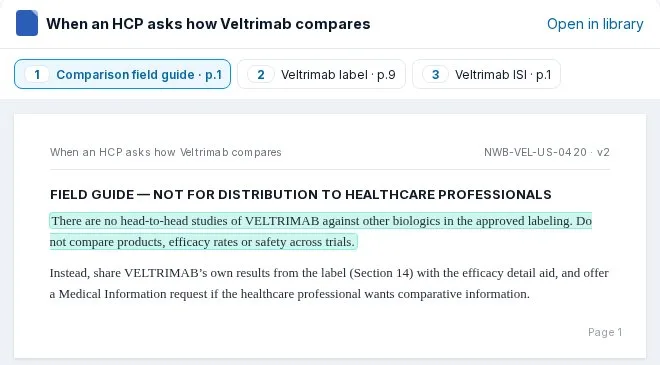
A comparison gets its own treatment. The field guide for that question says no head-to-head studies appear in the approved labeling, so the rep should not compare. The assistant says so, then quotes Veltrimab's own results from the label's section 14 with Important Safety Information attached, and offers a Medical Information request if she wants comparative data. The dashboard calls this outcome an approved redirect, and counts it inside the line.
The comparison field guide. Internal, marked for reps only. The assistant quotes its instruction and shows the source.
What happens with a side effect question in the call
Reps get asked about side effects often; the sample week's dashboard files 459 of its 2,184 questions under the Safety topic. The assistant treats these like any other label question. "What are the most common side effects?" returns the words of the label's section 6.1, stamped with section and page, with Important Safety Information attached. It adds no reassurance, and the "no advice on a patient's care" check applies as it does everywhere.
13 · Six checks, one record
The six checks behind each answer, and the question log compliance reads
In shortBefore a rep sees anything, a separate check tests the source, the wording, the approved use, comparison, patient care and logging, and it stops when unsure. Every question then lands in a log with rep, physician, product, outcome, source and time. On the sample day, 412 questions from 168 people are all on the record.
Check 1
Only approved, current sources
Label version in force, items in date, nothing retired or in draft.
Check 2
The approved words
Quoted word for word, with section and page, and no paraphrase.
Check 3
Within the approved uses
Plaque psoriasis and psoriatic arthritis, for the sample drug.
Check 4
No comparison claims
Unless an approved item makes one. Efficacy answers also carry fair balance.
Check 5
No advice on a patient's care
Facts from the label only.
Check 6
Logged for audit
Question, answer, sources and timing on the record.
The panel on screen changes with the case. An answer about dosing shows fair balance as not needed, since it makes no efficacy claim. The stopped pregnancy follow-up shows "1 stopped · 4 passed", then adds the rep's confirmation as a check once he sends. Every one of those states is on the record for later reading.
The approved line today: every question placed by where its answer came from
Dana Okafor, the field excellence lead, owns the assistant for the immunology field team. Her screen places each question as a dot: inside the ring it was answered from approved words; on the ring it has no approved answer yet; outside it left through a person.
The approved line today. The rings, the counts, and questions as they arrive. Click any dot to open its question.
On the sample day, 354 of 412 questions were answered inside the line
Each question placed by where its answer came from
412questions
From the label262
From approved material74
Approved redirect18
No approved answer13
Medical Information38
Access support7
Fictional example from this guide
Show the numbers
Part
Value
From the label
262
From approved material
74
Approved redirect
18
No approved answer
13
Medical Information
38
Access support
7
The log Omar Haddad exports: rep, physician, outcome and source
Omar Haddad in commercial compliance reads the same questions as a table, and one button exports them. Aisha Brandt's 10:05 a.m. question about a denied prior authorization for one of Dr. Chen's patients appears as Access support, sourced to field policy FP-07. That record also shows each step, the policy passage, what Aisha saw and the request number. It answers the question compliance always asks: "Show me the words they used and where they came from."
The question log. The sample morning's latest questions, filterable by outcome, with export for compliance.
One question's record. Who asked, how each step handled it, what the rep saw, and the request it became.
14 · Gaps and the library
A question asked 14 times, a new label version and an expiring leave-behind
In shortA question with no approved answer waits for a person to decide. The library holds only approved, in-date items, tracks expiry and how often each answers a question, and re-checks saved answers when a label changes. These are the screens where a field team turns questions into better content.
Dana decides what happens to the sharps container question
Fourteen times this month, a rep asked whether there is a free sharps container program for Veltrimab patients. The Medication Guide covers how to dispose of used pens, and the assistant quoted only that. Nothing approved mentions a program. So the question sits on the line, marked "No approved answer — you decide", with three choices: request a new approved answer, point to an existing item, or send these questions to Medical Information.
The decision is recorded with Dana's name. If she requests a new answer, the assistant drafts it from approved wording, and Priya Ranvelle and the review committee approve it.
No approved answer: you decide. Three choices, one suggested, recorded with the person's name.
Where each gap stands. Waiting, in committee, approved and answering, or routed to Medical Information.
The library behind every answer, and how a label change reaches saved answers
The sample library holds 186 approved items: labels, Medication Guides, approved materials, field guides and policies. Each row has its approval number, status, use-until date and how many answers it gave this month. Expired, retired and draft items are invisible to the assistant, and retired versions stay on the record.
Veltrimab label v7 went live on September 30 with new wording in section 5.4. The assistant re-checked every saved answer the same day: 3 were re-quoted from v7 and none still uses v6. Meanwhile the pen storage leave-behind, NWB-VEL-US-0441, expires on November 14, 2026, and its renewal is with the review committee. An optional rule warns reps from 60 days before an item they use expires.
The approved library. Every item, its approval number, its date and how often it answers a question.
One approved item. The piece, its job code and version, its expiry, its owner, and who may use it.
15 · The week and the rules
What reps ask, why questions leave the line by team, and who owns each rule
In shortThe dashboard turns the log into coaching and content decisions. In the sample week, 85.5% of 2,184 questions from 351 reps stayed inside the line, and new hires asked about other conditions most. Settings hold the rules, with the strictest locked by compliance.
The week on the dashboard. Questions, the share inside the line, median time to an answer, and what went out. Sample data.
Dosing and use lead what reps ask, ahead of safety and efficacy questions
Questions by topic, sample week; the screen's topic counts add to 2,185 against its total of 2,184
Dosing & use524
Safety459
Efficacy328
Access & coverage306
Storage & handling262
Special populations175
Other conditions131
Fictional example from this guide
Show the numbers
Item
Value
Dosing & use
524
Safety
459
Efficacy
328
Access & coverage
306
Storage & handling
262
Special populations
175
Other conditions
131
New hires and GI account managers ask most about conditions outside the label
Questions about other conditions as a share of each team's questions, sample week
New hires4.8%
GI account managers4.2%
Dermatology West3.1%
Dermatology East2.4%
Rheumatology1.9%
Health-system account managers0.7%
Fictional example from this guide
Show the numbers
Item
Value
New hires
4.8%
GI account managers
4.2%
Dermatology West
3.1%
Dermatology East
2.4%
Rheumatology
1.9%
Health-system account managers
0.7%
Why questions leave the line. Team against reason. Health-system account managers ask for comparisons most, at 4.1%, so the field guide on comparisons may matter most to them.
Which rules compliance locks and which rules Dana can change
The rules of the line. Each rule in plain words, with the reason beneath it. The rules are yours to set.
Setting
In the sample
Who decides
Quote approved wording only
On
Locked by commercial compliance
Attach Important Safety Information to efficacy answers
On
Locked by commercial compliance
Stop comparisons unless an approved item makes them
On, reps get the approved redirect
Your rule
Children and pregnancy beyond the label go to Medical Information
On, section 8 is quoted and a request offered
Your rule
Unapproved use, asked unprompted
Medical Information, 2 business days
Your routing, or a medical science liaison for the territory
One patient's coverage
Field reimbursement, 1 business day
Your routing and promise
New approved answers
Brand manager and review committee
Your approvers
16 · Agents and sign-offs
The six AI agents behind a rep's answer, and the people who decide what they cannot
In shortSix agents each do one narrow job, and each has things it never does. Nothing leaves the line without a person: the rep confirms each referral, the field excellence lead decides each gap, and the brand manager and review committee approve any new wording.
Question classifier
Decides what each question is: on-label, beyond the label, unapproved use, comparison, savings and access, one patient's coverage, or no approved answer.
Never answers. It only classifies, and an unapproved use never reaches the composer.
Approved answer finder
Searches only the approved, in-date library and returns the passage with item, version, section and page.
Never uses the web or general knowledge, or any retired, expired or draft item. If nothing answers, it says so.
Answer composer
Builds the answer from the approved words, attaches Important Safety Information to efficacy answers and the boxed warning to every Dravenzo answer, and offers the item to show or the approved email.
Never paraphrases beyond the approved words, or writes past the line.
Boundary guard
Runs the six checks on every answer before the rep sees it. It fails closed: when unsure, it stops.
Never lets anything outside the line leave without a person.
Referral composer
Drafts the Medical Information request with the question as asked, and logs it to the call after the rep confirms it was unprompted.
Never adds the rep's commentary, or sends without that confirmation.
Access router
Spots a request about one patient's coverage, pre-fills the access request with office, contact, product, payer and help needed, and tracks the callback.
Never records a patient's name or details, or quotes coverage for a named plan.
Four kinds of sign-off that stay with named people
Confirms each referralSales repTicks that the physician asked unprompted, and checks each access request before it goes.
Decides each gapField excellence leadChooses what happens to a question with no approved answer. The choice is recorded.
Approves new wordingBrand manager and review committeeYour medical, legal and regulatory reviewers keep the approval they have today.
Owns the rulesCommercial complianceSets the locked rules, reads the record, and exports it for audits.
Roles follow your organization: a rep asks, an owner decides, a reviewer approves, and each sees what the role allows. New wording is maker-checker by design: the assistant drafts, and your named reviewers sign.
The five people in the Northwind Bio sample
Fictional, from the sample data
SP
Sam Patel · sales representative, Dermatology West, Seattle
Six to eight calls a day; asks mid-call and confirms each referral.
"I have thirty seconds and I can't get it wrong."
DO
Dana Okafor · field excellence lead
Owns the assistant and decides what happens to each gap.
"If they ask it 14 times, they need an approved answer."
OH
Omar Haddad · commercial compliance
Sets the locked rules and reads every record.
"Show me the words they used and where they came from."
LO
Dr. Lena Ortiz · Medical Information
Receives each request as it was asked and replies to the physician directly.
PR
Priya Ranvelle · brand manager, Veltrimab
Takes new answers through the review committee and renews expiring items.
"Draft it from what's already approved and I'll get it through."
17 · What it connects to
Labels and field policy going in, cited answers and referrals coming out
In shortYour labels, approved materials, field guides and policy go in. Cited answers, referrals, a question log and a list of content gaps come out. It works with your content system, CRM and request routes, at the scale of a national field force, with the audit trail compliance needs. Design targets are labeled as targets.
Approved content
US Prescribing Information and Medication Guides, by version
Detail aids, dosing cards, leave-behinds and access cards, with job code and expiry
Your rules
Field guides and objection handling
Field policy on unapproved uses and patient access
Routes to Medical Information and field reimbursement
Agents sort, find, quote and checkEvery question, every approved item, under the rules compliance set
The rep confirms each referral
Every answer cited to its page
For the rep
Approved statements with job code and page
Medical Information requests with the question as asked
Pre-filled access requests with no patient details
For the owners
Question log, exportable for compliance
Gaps for new approved answers
Expiry and label-change alerts
The field app, CRM, content system and request desks you keep
Your content management system
Stays the system of record. Approved items come in with their job code, version and expiry.
Your CRM and field app
Reps ask inside the tool they use, and each answer and referral is logged to the call.
Your Medical Information desk
Requests reach its intake, and it keeps its own process and its own reply to the physician.
Your access program
Field reimbursement gets the request and calls the office, on the promise you set.
Your review committee
Approves new wording as it does now. New answers enter the library only after it signs.
Your people and roles
Reps, owners, reviewers and receivers each get the role you assign, as the settings screen shows.
Built for a national field force, with the record compliance asks for
The solution is built for thousands of questions a week across hundreds of reps and many brands, with role-based access, maker-checker approval, a complete audit trail and export. Its controls support your compliance with promotion rules and your own field policy; a product cannot make your promotion compliant for you, and only your reviewers can do that. Botminds is SOC 2 Type II audited, with information security managed to ISO 27001.
7 sec
median from question typed to an approved answer on screen. A design target, measured in your live solution.
Design target
85.5%
of questions answered inside the approved line, from the label or approved items. A design target; yours depends on your content.
Design target
100%
of unapproved-use questions sent to Medical Information with the question as asked, none answered by the rep. A design target.
Design target
Part C · Are you ready to automate?
AI for pharma field reps: what wrong or slow answers cost, what you get back and how to test a vendor
You run a field team, or you answer for what it says, or you hold the budget. This part helps you size the problem from your own data, estimate a return you can defend, check your readiness, question any vendor, including us, and plan a pilot.
18 · What it costs you
What a slow or improvised rep answer costs your company, and how to find your number
In shortThe largest costs are rare and huge, and the common ones are small and daily. No public source prices a rep's search or a lost moment, so this section shows you how to measure both in a week. Treat every default as a starting point.
$3 billion
paid in one 2012 settlement that included off-label promotion through sales representatives, alongside other allegations.35
US Attorney, District of Massachusetts
63 letters
untitled letters from FDA's promotion office in 2025, against 5 in 2024. 52 of them share one date.17
FDA table, current October 16, 2026
77%
of content rarely or never used by field teams: money you already spent on creating and reviewing it.6
Veeva Pulse, 2023
Most of a rep's question-handling time is search and follow-up, and those shrink the most in this estimate
Hours a week per rep, the solution's own estimate; replace with your own
By handWith the assistant
Searching the portal3 h0.5 h
Follow-up calls and email2 h0.5 h
Writing up Medical Information requests1 h0.2 h
Logging questions and referrals1 h0.3 h
Passing on coverage requests0.5 h0.2 h
Illustrative · replace with your own numbers
Show the numbers
By hand
With the assistant
Searching the portal
3 h
0.5 h
Follow-up calls and email
2 h
0.5 h
Writing up Medical Information requests
1 h
0.2 h
Logging questions and referrals
1 h
0.3 h
Passing on coverage requests
0.5 h
0.2 h
Finding your own search, follow-up and rework numbers in a week
Cost
Where it hides
How to find your number in a week
Search time
Inside "selling time"
Ask 10 reps to log every question and its time for one week. Multiply by your headcount.
Unused content
Agency and review budgets
From your CRM: the share of approved items shown fewer than five times last quarter, and what they cost to create.
Promised follow-ups
Rep notebooks, memories
Sample 50 call notes that mention a follow-up. How many were sent? How long did they take?
Medical Information rework
Requests needing a call back to narrow the question
Your request system's count of requests reopened or clarified; the minutes they take.
Monitoring
Compliance time on ride-alongs and call note review
Hours per year, and how many answers they saw. Compare with total calls.
New hire ramp
Training and shadowing
Weeks until a new rep passes certification, and how many practice questions they get.
In this illustrative week, only 3 of 100 field questions end with the words on record
Illustrative: 100 questions a team might hear in a week, with no answer log
Questions heard100
Answered in the call70
Answered from an approved item35
With the source shown15
With the words on record3
Illustrative · replace with your own numbers
Show the numbers
Stage
Count
Questions heard
100
Answered in the call
70
Answered from an approved item
35
With the source shown
15
With the words on record
3
The costs of a poor field answer that no calculator counts
The prescriber's trustA rep who stumbles, or promises and forgets, may not get the next appointment. With access at 45%, few get many chances.
Investigators' reading of a patternOne sentence is small. A hundred similar ones across a region look like a program.
Your medical team's timeA request written in the rep's words often needs a call back to find out what was asked.
What you never learnedQuestions nobody recorded never become content, training or medical insight.
The rep's confidenceA new hire afraid of the line stops answering, and a seasoned rep stops looking for it.
19 · Your return
Your return on field rep AI: reps, hours a week and Medical Information rework
In shortSix things create value here, and only two are easy to price. The calculator counts rep time, discounted to the share you will redeploy, and Medical Information rework. It counts nothing for risk avoided, so weigh that separately.
Rep time
Answers in seconds
Search and follow-up shrink. Count only the share that becomes customer time.
Fewer call-backs to narrow a question that was rewritten.
requests a year × share needing rework today × hours each × medical cost
Calls kept
Fewer lost moments
An answer in the call replaces a promised follow-up. Value depends on your brand, so test it.
follow-ups avoided × value you place on a call kept
Content spend
Knowing what answers questions
Retire what no one uses and create what reps keep asking for.
items retired × cost to review and renew each
Monitoring
Every answer on the record
Compliance reads every question and answer given through the assistant, beyond a sample of ride-alongs.
review hours moved from gathering to judging × compliance cost
Ramp
Training at the point of use
A new hire sees why a question stops, in the moment it happens.
weeks saved to certification × new hires × loaded cost
Your hours back across a field force of 350 reps
No public benchmark exists for these inputs. Every default marked illustrative is an assumption; use your own.
Your field forceHours on questions, per rep, per weekMedical Information rework
Illustrative yearly value
Hours on questions today0
Hours saved0
Hours you would count0
Rep time, valued$0
Medical rework, valued$0
Total a year, before your costs$0
The formulas: hours saved = reps × weeks × (today − with an assistant). Rep time = hours saved × share redeployed × cost. Rework = requests × share × hours × cost. The rework line assumes the call-backs go away entirely, so lower it if yours will not. The default hours are the solution's own estimate of a rep's week; the 25% share is an assumption, so use the share you can show. Risk avoided counts for nothing here.
20 · Readiness check
Is your field team ready for an approved-answer assistant? A scored check
In shortEight questions score your content, your line, your routes and your owners, 0 to 2 each. A ninth is for reflection. Nothing you choose leaves this page. Your band suggests the next step.
1
Approved library for each brand
Can you pull every current approved item for one brand, with job code, version and expiry, today?
Why it mattersAn assistant can only be as current as the library it reads.
A strong answer"Yes, from one system, and it agrees with what reps see."
2
Field policy on off-label questions
Is your line written down, in words a rep can follow mid-call?
Why it mattersSoftware applies a rule. It cannot supply one.
A strong answer"A short policy with examples, reviewed in the last year, that compliance owns."
3
Medical Information route
Can a rep's request reach Medical Information directly, with the requester and question recorded?
Why it mattersA stop only works if the question has somewhere to go.
A strong answer"An intake form or API, with a reply clock we measure."
4
Patient coverage route
When an office asks for help with one patient, does the rep know exactly where it goes, and what not to take?
Why it mattersPatient details are the hardest thing to get back out of a system.
A strong answer"Field reimbursement, with a named callback promise, and reps trained to take no details."
5
A count of today's questions
Do you know what reps get asked, by topic and by brand?
Why it mattersThis is your baseline, and your test set.
A strong answer"We logged 500 real questions last quarter, with how each was handled."
6
Owner for the assistant
Is one named person accountable for what the assistant answers and the gaps it finds?
Why it mattersQuestions with no approved answer need someone to decide.
A strong answer"The field excellence lead, with time set aside and compliance as co-signer."
7
Compliance and legal at the table
Have compliance, legal and medical agreed what a pilot may do, in writing?
Why it mattersA field AI project that surprises them ends fast.
A strong answer"All three helped write the test questions and the pass rules."
8
Field app and CRM
Could an assistant sit inside the tool reps already carry, and log to the call?
Why it mattersA tool that needs a second login in a doctor's office goes unused.
A strong answer"Yes: our CRM takes an embedded app and we know who approves it."
9
The one-call audit · for reflection
If FDA asked what a rep told a doctor about pregnancy last Tuesday, what would you need to answer within the hour?
Why it mattersYour answer lists the gaps, and some of them are jobs software can take on.
A strong answerA short, specific list: "the words, the source, the version, who else heard it, and who referred it."
0–6
Explore
Build the base first: one clean library for one brand, a written line with examples, and a week's log of real questions from 10 reps.
7–11
Ready to pilot
Run a measured pilot on one brand and a few territories, with test questions compliance wrote. Measure wrong answers and missed stops before you measure speed.
12–16
Ready to implement
Plan the brands, roles, routes and CRM link, with a named owner and a monthly review of the gaps and the record.
21 · Questions for vendors
What to ask any AI vendor about approved answers, stops and the record (ask us too)
In shortA demo on a vendor's own content proves little. Test on your label, your questions and the awkward follow-ups. Ask for evidence on these five themes, and look for the warning signs beside each answer.
A
Quoting the label and approved items exactly
A1
Does every answer show the approved words, unchanged, with its version and page?
Why it mattersA summary is a new claim nobody approved.
Strong answer · warning sign
An automatic check compares the words with the source.
"Our model rarely hallucinates."
A2
What happens to an answer the moment an item expires or a label changes?
Why it mattersSaved answers outlive their sources.
Strong answer · warning sign
The item drops out at once, and saved answers are re-checked, with a record.
"You re-upload the file."
A3
How does it attach fair balance, and boxed warnings?
Why it mattersA spoken answer has no footer.
Strong answer · warning sign
Rules your compliance team sets, tested on efficacy questions.
A generic disclaimer on every screen.
B
Stopping at the off-label line
B1
Can we run 100 off-label follow-ups we wrote ourselves and see every result?
Why it mattersA missed stop is your most expensive error.
Strong answer · warning sign
Yes, with counts of missed stops and of false stops.
One headline accuracy number.
B2
Is the stop a separate check, and does it fail closed?
Why it mattersA model should not judge its own answer alone.
Strong answer · warning sign
An independent step, and "when unsure, stop".
"The prompt tells it not to."
B3
How often does it refuse a question the label does answer?
Why it mattersReps abandon a tool that says no too often.
Strong answer · warning sign
A measured rate on your questions, with a plan to lower it.
"It's always safe."
C
Referrals: unprompted, in the asker's words, with no patient details
C1
Who confirms a request was unprompted, and is that recorded?
Why it mattersFDA's draft treats any prompted request as solicited.9
Strong answer · warning sign
The rep, by name, before sending.
Requests sent automatically.
C2
What records does a request carry?
Why it mattersFDA's draft and past agreements name them.9,26
Strong answer · warning sign
Date, form, requester, topic, wording, response, and rep.
A free-text note.
C3
How does it keep patient details out?
Why it mattersA rep may type a name without thinking.
Strong answer · warning sign
A form with no patient fields, and a test of what happens if someone types one.
"Reps know not to."
D
The question record compliance has to defend
D1
Can compliance see every question, answer, refusal, source and decision, and export them?
Why it mattersA record you can't export is a record you don't have.
Strong answer · warning sign
Yes, including retired versions as they read at the time.
Monthly summary reports only.
D2
Who decides what the record means for your legal position, and how long you keep it?
Why it mattersA complete log of questions can be discoverable, and it needs a policy.
Strong answer · warning sign
Your counsel sets retention, and the product applies it.
"We keep everything forever."
D3
What credentials do you hold?
Why it mattersSoftware can't be certified compliant with GxP, the good-practice rules for regulated work, or with Part 11, FDA's rule on electronic records, so such claims are a warning.
Strong answer · warning sign
Named audits, such as SOC 2 Type II, and a clear list of controls that support your compliance.
"FDA compliant AI."
E
Running it across your brands
E1
How does it fit into our CRM and field app?
Why it mattersIn a doctor's office, every extra tap costs.
Strong answer · warning sign
Inside the tool reps carry, logged to the call.
A separate app and login.
E2
Who owns the rules, and can we change them without you?
Why it mattersYour line moves with your policy and your counsel.
Strong answer · warning sign
Your compliance team, with changes recorded and some rules locked.
"Raise a ticket."
E3
Where does the data go, and does anything train a shared model?
Why it mattersUnpublished promotional plans and prescriber questions are sensitive.
Strong answer · warning sign
Your data stays yours, and the contract says so.
Vague policy language.
22 · A pilot plan
A ten-week field pilot on one brand, with compliance writing the test questions
In shortStart with one brand and a few territories. Have compliance and medical write the hard questions before anyone sees the tool, then run it in shadow mode, where reps ask and compliance reads the results, then live. Decide with measured wrong answers, missed stops and rep use. Set your pass rules before you see any result.
Ten weeks: test set first, reps in the field only after the stops are measured
Your teamVendor
Log real questions; write 300 test questions
Load one brand's library and rules
Test set scored; compliance reviews every miss
Shadow mode: reps ask, compliance reads
Live for 20 to 30 reps
Measure and decide
Week 0246810
Illustrative · replace with your own numbers
Show the numbers
Activity
From
To
Log real questions; write 300 test questions
0
2
Load one brand's library and rules
1
3
Test set scored; compliance reviews every miss
3
4
Shadow mode: reps ask, compliance reads
4
6
Live for 20 to 30 reps
6
9
Measure and decide
9
10
The field pilot's scoreboard: wrong answers, missed stops, rep use
Measure
What to count
Set your pass rule before you start
Wrong quote
Answers whose words differ from the source, or quote an out-of-date item
Zero tolerated in the test set; every miss reviewed
Missed stop
Off-label questions answered instead of stopped
Zero tolerated, with compliance reading every case
False stop
On-label questions refused
A rate your reps will accept; test with them
Time to an answer
Median and slowest tenth, on real field connections
Fast enough for a real call
Rep use
Questions per rep per week, and who stops using it
Use holds up after week two
Referrals
Requests reaching Medical Information, and how many need a call back
Fewer call backs than your baseline
Patient details
Any name or identifier typed into a question
Each one reviewed, and a plan for it
Gaps
Questions with no approved answer, by count
Decided within an agreed time
The working-session questions for field, compliance, medical and brand
Bring field excellence, commercial compliance, legal, Medical Information, the access team, brand and IT into one room. These often take longer than the software.
What, in writing, is our line on unapproved uses, and does it go further than FDA's text? Who decided that?
Under the January 2025 guidance, do we let any field staff share publications, and if so, who is trained?10
How long do we keep a record of a rep's question, and who may read it? What does counsel advise?
What should a rep do when a question arrives by email or text after the call?
Which audiences does this cover: physicians, nurses, pharmacists, payors?18
Who approves a change to the rules, and how is it logged?
What do we tell reps and prescribers about how the assistant works?
How will we use the question log in coaching, without turning it into a tool people fear?
23 · Questions people ask
Pharma rep AI and off-label questions: what field teams ask most
In shortEach answer stands alone, in plain words, with status as of November 2026. This is general information, so ask your own counsel before relying on it.
What is a field rep knowledge assistant?
It is software pharma sales reps and key account managers use during a call to answer product questions. A good one answers only from the current label and approved, in-date materials, shows the source and page, and sends anything beyond them to Medical Information or to field reimbursement staff. It also records each question for compliance.
Can a pharma sales rep answer an off-label question?
Many company policies say no: the rep refers it to Medical Information. FDA's 2011 draft recommends that medical or scientific staff answer such questions and that sales and marketing have no input on the content. FDA's January 2025 final guidance pictures trained firm representatives sharing certain scientific publications, which is a narrower thing than a rep's own answer. Its status is unclear, because FDA's page still read "not for current implementation" on November 3, 2026.
What is an unsolicited request for off-label information?
It is a question a person raises entirely on their own, with no prompting from the company. FDA's draft guidance says a request "prompted in any way" by a firm or its representatives is solicited, and may be evidence of the firm's intent. That is why a rep should neither hint at an unapproved use nor invite the question.
Does the FDA regulate what a pharma rep says out loud?
Yes, in effect. The intended-use rule, 21 CFR 201.128, says intent can be shown by "oral or written statements" by a firm's representatives, and FDA's Bad Ad page lists sales representative presentations among the promotion it regulates. In 2018 FDA sent an untitled letter about one rep's statements at a lunch presentation.
What is fair balance in pharmaceutical promotion?
Fair balance means that information on a drug's benefits comes with true information on its risks, in a way that does not favor the benefit. The rule in 21 CFR 202.1 was written for advertisements, and companies apply the same idea to sales pieces by attaching Important Safety Information. Spoken answers need the same balance, which is hard from memory.
Can reps use ChatGPT to answer doctors' questions?
It carries serious risk, and companies have good reason to set a policy on it. A general chatbot answers from any source, with no approved wording, no version control and no fair balance, and whatever it supplies becomes the rep's statement. A webcast poll reported in late 2024 suggested some reps already use web search to find answers, so a company is wise to offer a controlled option.
How can a field AI assistant answer a question about side effects?
It should quote the label's section on adverse reactions, or the approved Important Safety Information, word for word, with the section and page. It should add no reassurance and no advice on any one patient. Botminds Field Rep Knowledge Assistant treats these as label questions and applies its six checks to them.
What should a rep do when an office asks about one patient's prior authorization?
Under many field policies the rep takes no patient details and passes the request to a field reimbursement team, who contact the office directly. Patient information is protected, and free paperwork help has drawn kickback allegations in the past. Approved materials, such as a savings card, can still answer general questions.
What is the difference between a sales rep and a medical science liaison?
A sales rep promotes approved uses using approved materials and reports through commercial. A medical science liaison is a scientific employee who discusses science with experts and reports through medical affairs, kept apart from sales. An off-label question a rep receives usually goes to medical staff rather than to the rep's own judgment.
Does an AI field assistant write its own answers?
It depends on the design, so ask. Botminds Field Rep Knowledge Assistant quotes the label's or an approved item's own words, with section and page, and it writes no answer beyond them. When nothing approved answers a question, it says so and logs it for the field excellence lead. New wording goes through your brand manager and review committee.
What should an AI assistant for reps do when a label changes?
It should quote only current, in-date items. In Botminds Field Rep Knowledge Assistant, when a new label version goes live, every saved answer is re-checked against it and re-quoted where needed, and retired versions stay on the record without being quoted. In the product's fictional sample, 3 saved answers were re-quoted from label v7 on the day it went live.
Is an AI assistant for reps FDA approved or compliant?
No software can be certified as compliant with FDA's promotion rules, or with GxP (the good-practice rules for regulated work) or 21 CFR Part 11 (FDA's rule on electronic records), and a vendor who says so deserves questions. What software can do is provide controls that support your compliance: approved sources, exact quotes, stops, confirmations and a record. Botminds is SOC 2 Type II audited, with information security managed to ISO 27001.
Is FDA's 2025 guidance on unapproved uses in effect?
It is final, dated January 2025, and its status is unclear. It said it was not for current implementation until FDA published the decision of OMB, the White House budget office, on its information collections. OMB approved them on July 29, 2025, and an FDA notice of September 25, 2025 lists the approvals and names this guidance's docket, FDA's public file for it, among its dockets. FDA's page and the guidance itself still read "not for current implementation" on November 3, 2026, and we found no FDA statement lifting that, so ask your counsel before relying on it.
How long does a field rep AI assistant take to go live?
Botminds walks you through it on your own products first, then configures the solution from your labels, approved materials, field guides and field policy. How long it takes depends on your content and the routes you connect, and a ten-week pilot on one brand is a working shape for a first test. Your compliance team decides when reps may use it.
24 · One-page summary
Field rep answers on one page: the method, the rules as of November 2026 and the terms
Print this page
In shortThe whole guide on one screen: the method, the status of the rules, the readiness scale and the terms.
The method
Sort the question: on-label, beyond the label, unapproved use, comparison, access, one patient.
Search only approved, in-date items.
Quote the approved words, with job code or section and page.
Attach fair balance to any benefit claim, and the boxed warning where one applies.
Check before the rep sees it, and stop when unsure.
Refer anything past the line, with the question as asked; the rep confirms she asked unprompted.
Take no patient details; pass one patient's coverage to field reimbursement.
Keep the record; turn repeated gaps into new approved content.
Readiness: score 0–2 on eight questions: 0–6 explore · 7–11 pilot · 12–16 implement.
As of November 2026: 21 CFR 201.128 counts oral statements · FDA's unsolicited request text is a 2011 draft · the January 2025 guidance on unapproved uses is final, OMB approved its information collections in July 2025, and FDA's page still says not for current implementation · FDA's table lists 63 untitled letters for 2025 and 24 for 2026 through October 16 · FDA's AI draft does not address operational uses without impact on patient safety, drug quality or study reliability · Annex 22 is still a draft and concerns manufacturing.
13 terms
USPI
US Prescribing Information: the FDA-approved label.
Medication Guide
FDA-approved patient labeling for some drugs.
Job code
The company's tracking number for one approved piece.
MLR or review committee
Medical, legal and regulatory reviewers who approve promotional pieces.
Form FDA 2253
The form sent with promotional specimens at first use.
On-label · off-label
Inside, or outside, what the approved label covers.
Unsolicited request
A question asked with no prompting from the company.
SIUU
Scientific information on unapproved uses, FDA's term in its 2025 guidance.
Fair balance
Risk information given with benefit claims.
ISI
Important Safety Information, the fixed risk summary on promotional pieces.
Medical Information
The company's team that answers scientific questions.
MSL
Medical science liaison, a scientific field employee kept apart from sales.
Field reimbursement manager
Access program staff who help offices with coverage.
25 · Sources
Sources
Accessed November 2026. Regulatory status statements are as of November 2026.
Veeva Pulse Field Trends Report, top insights, 1Q 2024. veeva.com
21 CFR 201.128, Meaning of "intended uses", 2025 edition (revised as of April 1, 2025). govinfo.gov
FDA, Bad Ad Program, content current March 6, 2025. fda.gov
Regulatory Affairs Professionals Society, on the untitled letter to Eisai about a sales representative's statements, October 2018. raps.org
Veeva Systems, Veeva Pulse reveals digital content more than twice as effective in driving promotional response globally, April 20, 2023 (the vendor's own CRM data). veeva.com
Veeva Systems, Veeva Pulse report finds content-driven engagement lags despite proven boost to treatment adoption, May 29, 2025. veeva.com
Radley DC, Finkelstein SN, Stafford RS. Off-label prescribing among office-based physicians. Arch Intern Med 2006;166(9):1021-6. PubMed
FDA, Responding to Unsolicited Requests for Off-Label Information About Prescription Drugs and Medical Devices, draft guidance, December 2011 (Docket FDA-2011-D-0868). fda.gov; FDA's guidance page, content current April 17, 2020, read November 3, 2026: fda.gov
FDA, Communications From Firms to Health Care Providers Regarding Scientific Information on Unapproved Uses of Approved/Cleared Medical Products: Questions and Answers, January 2025 (Docket FDA-2008-D-0053); its text says not for current implementation. fda.gov
21 CFR 314.81(b)(3)(i), Advertisements and promotional labeling, 2025 edition. govinfo.gov
Mintz, First Amendment protects truthful off-label speech (Amarin v. FDA and United States v. Caronia), August 17, 2015. mintz.com
FDA, Pregnancy and Lactation Labeling Resources, content current March 10, 2025. fda.gov
FDA, Medical Product Communications That Are Consistent With the FDA-Required Labeling: Questions and Answers, June 2018. fda.gov
Office of Information and Regulatory Affairs, history of OMB Control Number 0910-0686: ICR 202501-0910-004, received January 7, 2025, approved without change July 29, 2025 (0910-0485: ICR 202501-0910-003, same dates). reginfo.gov
FDA, Untitled Letters (Office of Prescription Drug Promotion table), content current October 16, 2026; counts by issue date are ours, from the table. fda.gov
FDA, revised draft guidance on communications with payors, 91 FR 33181, June 3, 2026 (Docket FDA-2016-D-1307). govinfo.gov
FDA, notice of availability of the January 2025 final guidance and submission to OMB, naming collections 0910-0686 and 0910-0485, Federal Register, January 7, 2025 (FR Doc. 2024-31539). govinfo.gov
FDA, Agency Information Collection Activities; Announcement of Office of Management and Budget Approvals, 90 FR 46225, September 25, 2025 (FR Doc. 2025-18653; its dockets include FDA-2008-D-0053; lists 0910-0686 and 0910-0485 through July 31, 2028). govinfo.gov
FDA, guidance page for the January 2025 final guidance, content current January 6, 2025, read November 3, 2026. fda.gov
FDA Law Blog, Revised PhRMA Code took effect on January 1, 2022, and certain state obligations follow, January 2022. thefdalawblog.com
HHS Office of Inspector General, General Compliance Program Guidance, November 2023. oig.hhs.gov
HHS Office of Inspector General, Compliance Guidance list, read November 3, 2026. oig.hhs.gov
Insurance Journal, California Department of Insurance fraud suit results in $24M in payments from AbbVie, August 7, 2020. insurancejournal.com
HHS Office of Inspector General and Novartis Pharmaceuticals Corporation, Corporate Integrity Agreement, 2010. justice.gov
Mintzes B, et al. Pharmaceutical sales representatives and patient safety: a comparative prospective study of information quality in Canada, France and the United States. J Gen Intern Med 2013;28(10):1368-75. PubMed
Ziegler MG, Lew P, Singer BC. The accuracy of drug information from pharmaceutical sales representatives. JAMA 1995;273(16):1296-8. PubMed
45 CFR 164.508, Uses and disclosures for which an authorization is required, 2025 edition. govinfo.gov
Complaint, The State of California, by and through Dave Jones, California Insurance Commissioner, and Relator Lazaro Suarez, against AbbVie Inc., redacted, stamped September 18, 2018. lieffcabraser.com
Pharmaceutical Executive, Driving field excellence with AI-enhanced rep support, December 17, 2024 (a webcast poll, sample size not stated). pharmexec.com
Covington, FDA advertising and promotion enforcement activities update, August 2026. cov.com
FDA Law Blog, OPDP issues its 20th and 21st untitled letters for 2026, July 28, 2026. thefdalawblog.com
US Attorney's Office, District of Massachusetts, on the GlaxoSmithKline sentencing, July 2012. justice.gov
US Department of Justice, Eli Lilly and Company agrees to pay $1.415 billion to resolve allegations of off-label promotion of Zyprexa, January 15, 2009. justice.gov
US Department of Justice, Fact Sheet: Significant False Claims Act Settlements & Judgments, Fiscal Years 2009-2016 (Pfizer, 2009; Abbott, 2012). justice.gov
Corporate Integrity Agreement between the HHS Office of Inspector General and GlaxoSmithKline LLC, 2012, section III.H, as posted by the US Department of Justice. justice.gov
FDA, Considerations for the Use of Artificial Intelligence to Support Regulatory Decision-Making for Drug and Biological Products, draft guidance, January 2025. fda.gov
European Medicines Agency, Artificial intelligence: the reflection paper adopted September 2024 and the guiding principles with FDA, first published January 14, 2026. ema.europa.eu
European Commission, AI Act regulatory framework page: the AI Omnibus in force July 27, 2026. ec.europa.eu
PIC/S and European Commission, draft EU GMP Annex 22, consultation July 7 to October 7, 2025. picscheme.org
FDA, Computer Software Assurance for Production and Quality Management System Software, final guidance, February 2026. fda.gov
MHRA, GXP data integrity guidance and definitions, March 2018. gov.uk
Magesh V, et al. Hallucination-free? Assessing the reliability of leading AI legal research tools. Stanford and Yale, arXiv 2405.20362, 2024. arxiv.org
Xiong B, et al. FDARxBench: benchmarking regulatory and clinical reasoning on FDA generic drug assessment. arXiv 2603.19539, revised September 2, 2026. arxiv.org
Next step
See it on your own approved content.
Explore the solution, or bring your labels, a sample of approved items and your field policy. We will run real questions from your reps against them and show every answer, its page and every question that stops at the line.
We use essential cookies to make this site work, and cookieless, anonymised analytics to understand how it's used. "Accept all" also turns on Google Analytics, which sets cookies. Privacy policy