A Truth in Savings disclosure is the account disclosure Regulation DD requires a bank to give before a consumer deposit account is opened: the interest rate and annual percentage yield, how interest is compounded and credited, minimum balances and how they are computed, fees, transaction limits, and, for time accounts, maturity, penalties and renewal. A sample disclosure shows what the document looks like. To test one, each figure on it has to be traced to its source, usually the core's product set-up, the rate table and the fee schedule, because a disclosure that disagrees with the core describes an account the customer does not have. Botminds' Consumer Compliance Testing reads every new account's disclosure image against those sources; the sample below shows the map it works from.
A Truth in Savings disclosure sample, annotated: what each line answers and where it comes from
Fictional Community Bank
Statement Savings: Truth in Savings disclosure
Rule, and where the value comes from
Rate information. Interest rate 3.45%. Annual percentage yield (APY) 3.51%. Rates as of October 1, 2026.
1030.4(b)(1)(i)
The rate sheet and the product’s rate table in the core
Variable rate. Your rate and APY may change at any time, at our discretion. There is no limit on the amount the rate may change.
1030.4(b)(1)(ii)
The account agreement and the product set-up
Compounding and crediting. Interest is compounded daily and credited monthly. If you close the account before interest is credited, you will not receive the accrued interest.
1030.4(b)(2)
Core accrual and crediting parameters
Minimum balances. Minimum deposit to open: $100. Keep a minimum daily balance of $500 to avoid the monthly fee.
1030.4(b)(3)(i)
Product set-up and the fee table
Balance computation. We use the daily balance method: a daily periodic rate applied to the principal in the account each day.
1030.4(b)(3)(ii) and 1030.7
The core’s interest accrual method
Accrual on noncash deposits. Interest begins to accrue no later than the business day we receive credit for the deposit of noncash items such as checks.
1030.4(b)(3)(iii)
Core accrual rule, checked against the funds availability policy
Fees. Monthly maintenance fee $5.00 if the balance falls below $500 on any day of the cycle. Excess withdrawal fee $10.00 each.
1030.4(b)(4)
The fee schedule and the core fee table
Transaction limitations. No more than six withdrawals or transfers per monthly cycle; each one over six incurs the excess withdrawal fee.
1030.4(b)(5)
Product rules in the core
What is in a Truth in Savings disclosure?
The list is in section 1030.4(b), and every item applies "as applicable" to the product. Rate information comes first: "The 'annual percentage yield' and the 'interest rate,' using those terms", the period a fixed rate is in effect, and, for variable-rate accounts, the fact that the rate may change, how it is determined, how often it may change and any limit on the change (12 CFR 1030.4(b)). Then compounding and crediting, and whether interest is forfeited if the account closes before it is credited.
Balance information follows: any minimum balance to open, to avoid a fee or to earn the stated APY, how that balance is determined, the balance computation method, and when interest begins to accrue on noncash deposits. Then fees with their amounts and conditions, limits on the number or amount of withdrawals or deposits, the features of time accounts (maturity date, early withdrawal penalty and how it is calculated, renewal and any grace period) and any bonus with its conditions. The disclosures must be clear and conspicuous, in writing and in a form the customer may keep (12 CFR 1030.3(a)).
Where each field comes from
Every line on a disclosure is a copy of something the bank keeps elsewhere. The rate and APY come from the rate sheet in force on the day; compounding, crediting and the balance method from the core's product parameters; fees from the fee schedule and the core's fee table; limits and penalties from product rules. Naming that source for each field is what turns a sample disclosure into a test, because the test becomes a comparison of two systems rather than a reading of one page.
Field-to-source map: each Reg DD disclosure item, the system it should match, and the test
| Disclosure item | Section | Should match | How to test it |
|---|---|---|---|
| Interest rate and APY | 1030.4(b)(1)(i); 1030.3(f) | Rate table on the account-opening date | Recompute the APY from the rate and compounding; within 0.05 of a point |
| Variable-rate terms | 1030.4(b)(1)(ii) | Account agreement and product set-up | Present for variable products; how and how often the rate may change |
| Compounding and crediting | 1030.4(b)(2) | Core accrual and crediting parameters | Same frequency on the disclosure and in the core |
| Minimum balances | 1030.4(b)(3)(i) | Product set-up and fee table | Each threshold equals the core’s, with how the balance is determined |
| Balance computation method | 1030.4(b)(3)(ii) | Core interest accrual method | Daily balance or average daily balance, as the core computes |
| Accrual on noncash deposits | 1030.4(b)(3)(iii) | Core accrual rule | Consistent with when the core starts accruing |
| Fees | 1030.4(b)(4) | Fee schedule and core fee table | Every fee the core can charge, with the same amount and condition |
| Transaction limits | 1030.4(b)(5) | Product rules in the core | Same number or amount, and the consequence |
| Time-account features | 1030.4(b)(6) | Certificate product set-up | Maturity, penalty formula, renewal and grace period |
| Bonuses | 1030.4(b)(7) | Campaign terms | Amount, timing, balance and time conditions |
| When it was given | 1030.4(a) | Account-opening record and channel | Before opening; by mail within 10 business days if not present; before opening if online |
Does the APY have to match the core?
It has to be right, and the core is usually where right is computed. Regulation DD rounds the APY to the nearest hundredth of a percentage point and treats it as accurate if it is "not more than one-twentieth of one percentage point (.05%) above or below" the APY computed under Appendix A (12 CFR 1030.3(f)). The formula is APY = 100 [(1 + Interest/Principal)(365/Days in term) − 1] (Appendix A to Part 1030). On the sample above, a 3.45% rate compounded daily gives 3.51%; a disclosure printing 3.45% as the APY would be off by 0.06 of a point and fail.
The deeper requirement is that disclosures "reflect the terms of the legal obligation of the account agreement" (12 CFR 1030.3(b)). A disclosure can be internally consistent and still wrong if the core charges a fee the schedule does not list, compounds monthly when the page says daily, or carries a minimum balance the page has rounded. Those are the mismatches a field-to-source test finds and a read-through of the page alone cannot.
A disclosure is accurate when it matches the account the core will actually run, not when it reads well.
When must disclosures be given, including for online accounts?
Before the account is opened or a service is provided, "whichever is earlier", and a service counts as provided when a fee is assessed (12 CFR 1030.4(a)(1)). If the customer is not present and has not already received them, the bank may mail or deliver them no later than 10 business days after. If the customer opens the account electronically, for example on the bank's website, the disclosures have to come first, before the account is opened or any service is provided. Electronic delivery is subject to the E-Sign Act's consent requirements.
So the timing test has three branches, chosen by channel: in branch, by mail or phone, and online. The channel comes from the core's account-opening record; the delivery date from the e-sign record, the mail log or the signature on the receipt. Disclosures on request follow their own rule: within a reasonable time if the person is not present, and the FDIC's procedures look at whether staff are trained to provide them at the time of an in-person request (FDIC Consumer Compliance Examination Manual VI-3, May 2023).
Disclosure basics are where Truth in Savings citations concentrate
74
Truth in Savings violations cited by FDIC examiners in 2025
61%
of them in disclosure form and delivery (1030.3) and account disclosures (1030.4)
0.05pt
the most an APY may differ from the Appendix A figure and still be accurate
How long must disclosures be kept?
At least two years. Regulation DD requires evidence of compliance to be kept for two years or more, counted from the date the disclosure or action was due, and an agency may require longer (12 CFR 1030.9(c)). The FDIC's examination chapter describes how a bank shows compliance: procedures for paying interest and giving timely disclosures, sample disclosures for each type of account, and enough rate and balance information to verify the interest paid. It adds that a bank must be able to reconstruct the disclosures, though not necessarily on paper (FDIC VI-3).
For testing, two years is a floor, not a plan. A test run each quarter needs the image of each account's disclosure, not just the form version in force; a version table says what should have been given, the image says what was. Many banks keep workpapers longer than the rules require; the solution's default is seven years.
From one sample to every new account
The map above tests one disclosure. A testing program applies it to every account opened in the quarter: match each new account to its disclosure image, check the timing for its channel, and compare each field with the source in force on the opening date. The FDIC's examination procedures ask the same questions, including whether disclosures use consistent terminology and whether they reflect the legal obligation of the account agreement (FDIC VI-3).
The obstacle is the images. At the fictional sample bank, the new-account disclosure test covered 1,184 accounts, matched to the account-opening report, and stopped because 43 disclosure images had failed to index in one imaging batch. Running on the 1,141 that were readable would have passed nothing wrongly but would have left 43 accounts untested without saying so. Consumer Compliance Testing treats that as a decision for a person: retry indexing, ask document imaging, or approve a partial run that is labelled partial.
1,184 new accounts, 1,141 disclosure images: the test waits for a decision
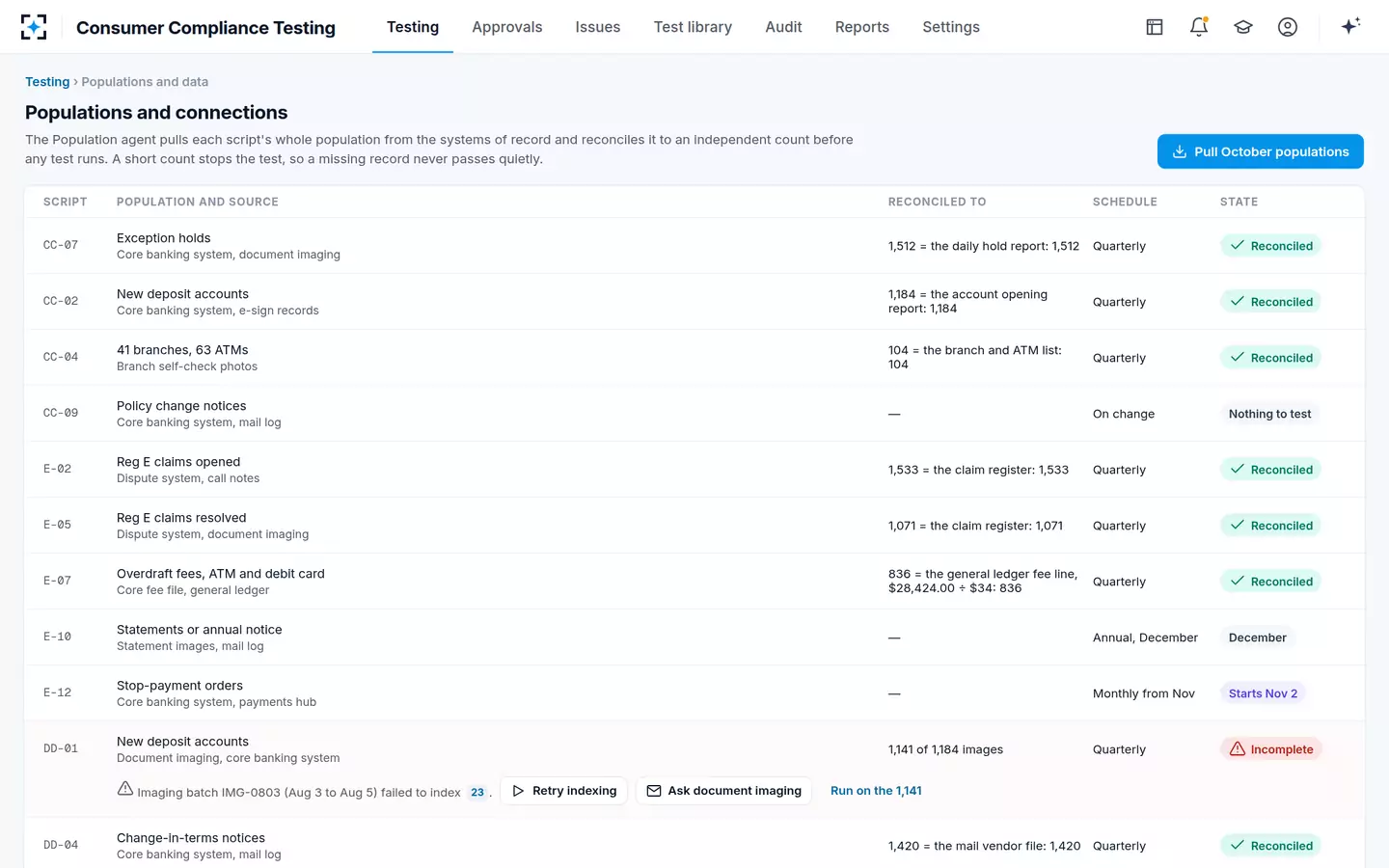
Testing every account disclosure: the attributes
- Given before opening, or within 10 business days
By channel: in person, not present, or online, where it must come before opening.
- Right form for the product and date
The disclosure version in force on the opening date, for that product.
- Rate and APY as of opening
Match the rate table; APY recomputed and within 0.05 of a point.
- Every fee the core can charge
Same amount and condition on the page and in the fee table.
- Balances and methods agree
Minimums, how they are determined, the computation method, when accrual starts.
- Time-account features complete
Maturity, penalty and how it is calculated, renewal and grace period.
- Consistent terms throughout
The same name for the same thing, and the terms "annual percentage yield" and "interest rate".
- The image exists and is kept
A missing image is a finding about evidence, kept at least two years.
Time accounts: the extra fields, and the notices before maturity
Certificates add four fields, each with its own source in the certificate product's set-up: the maturity date; a statement that an early withdrawal penalty will or may apply, how it is calculated and when; where interest compounds and can be withdrawn early, a statement that the APY assumes it stays on deposit; and whether the account renews automatically, with any grace period (12 CFR 1030.4(b)(6)). A penalty described as "three months' interest" on the disclosure and computed as 90 days in the core is the kind of mismatch only a field-to-source test finds.
Time accounts also bring their own notices. An automatically renewing account longer than one month needs disclosures at least 30 calendar days before maturity, or at least 20 days before the end of a grace period of five days or more; one longer than a year that does not renew needs the maturity date and whether interest is paid after it at least 10 calendar days before maturity (12 CFR 1030.5(b) and (c)). Those are tested on maturities, not on openings, and the mail log is the evidence.
Disclosures on request, and the one rate staff may quote
A bank must give account disclosures to anyone who asks, customer or not. If the person is not present, it mails or delivers them within a reasonable time, and it may quote a rate and APY offered within the most recent seven calendar days, say they were accurate as of a date and give a number to call for current rates (12 CFR 1030.4(a)(2)). Oral answers have a narrower rule: asked about rates, staff must state the APY, may add the interest rate, and "No other rate may be stated" (12 CFR 1030.3(e)). Call monitoring, not document testing, is where that last attribute gets checked.
One workpaper per exception, whatever the regulation
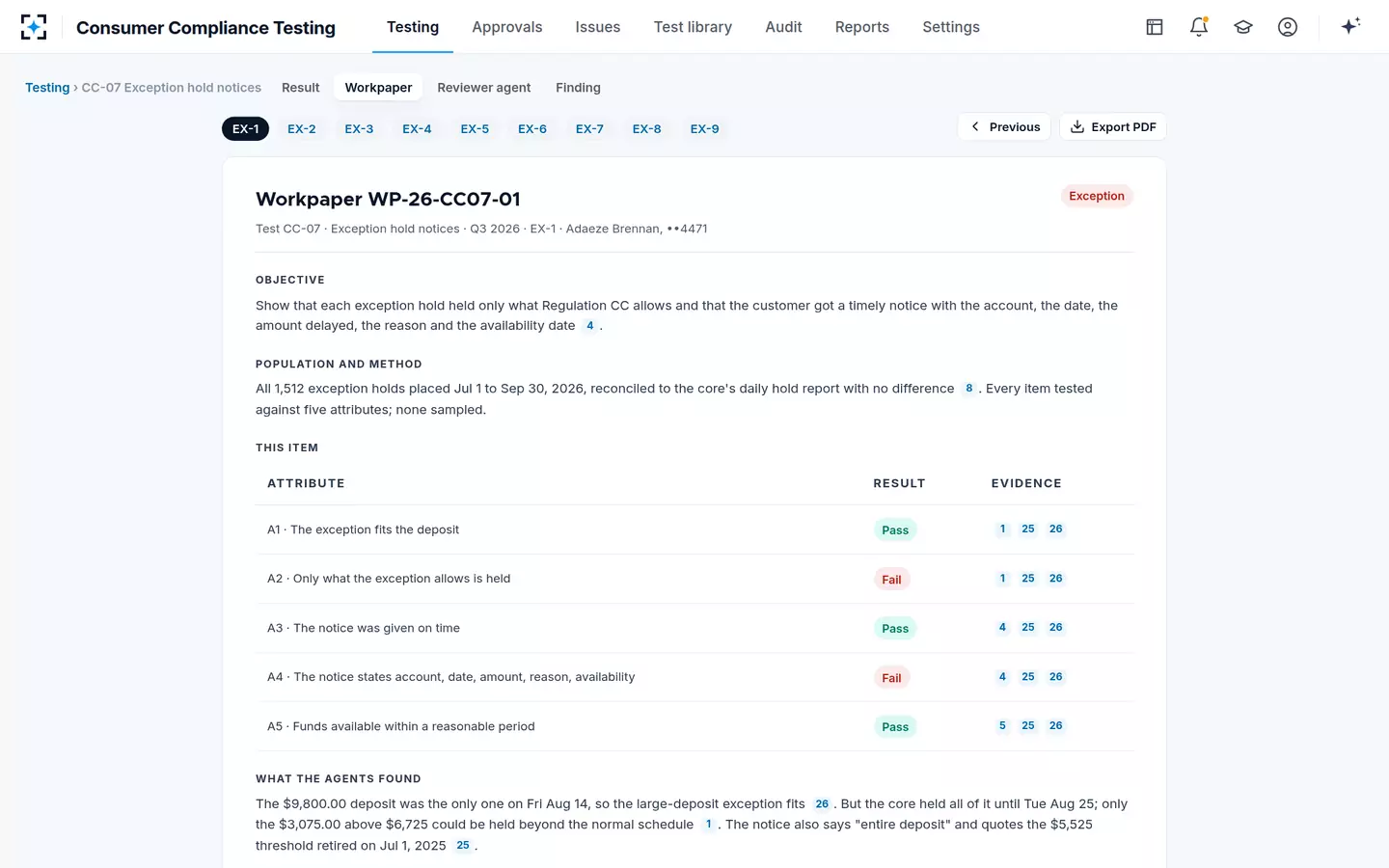
What goes wrong most often
At FDIC-supervised banks in 2025, the two most-cited Truth in Savings sections were exactly the ones this page maps: the general disclosure requirements and the account disclosures themselves, together 61% of the 74 citations (FDIC Consumer Compliance Supervisory Highlights, March 2026). The usual causes are mundane: a fee added to the core and not to the schedule, a product launched on an old template, an online journey that shows the disclosure after the account is opened, and missing images.
Account disclosures are one of several Regulation DD documents. Change-in-terms notices, statements and advertising each have their own clocks and content, and Reg DD compliance testing, piloted on last quarter's notices takes them in turn. The same field-to-source discipline applies to Regulation CC hold notices, where the number most likely to be wrong is the threshold printed on an old form; see transactional testing of Reg CC availability. The Consumer Compliance Testing page shows the whole library.
Questions people ask
What must a Reg DD account disclosure include?
As applicable to the product: the interest rate and APY using those terms, variable-rate terms, compounding and crediting, minimum balances and how they are determined, the balance computation method, when interest starts on noncash deposits, fees, transaction limits, time-account features and bonuses (12 CFR 1030.4(b)).
Is the fee schedule part of the Truth in Savings disclosure?
The fees are. Section 1030.4(b)(4) requires the amount of any fee that may be imposed in connection with the account, or how it is determined, and the conditions for it. Many banks put them in a separate schedule given with the disclosure; either way, every fee the core can charge should be on it.
Do certificates of deposit need different disclosures?
They need more. Time accounts add the maturity date, any early withdrawal penalty with how it is calculated and when it applies, whether the account renews automatically and any grace period, and, where interest can be withdrawn before maturity, a statement that the APY assumes it stays on deposit.
Can disclosures be given in another language?
Yes. Regulation DD allows disclosures in languages other than English, provided they are available in English on request (12 CFR 1030.3(b)). A test of non-English disclosures should check the English version exists and says the same thing.
Where can I find the official Truth in Savings sample forms?
In Appendix B to Regulation DD, 12 CFR part 1030, which carries model clauses for account disclosures and sample forms, including the aggregate overdraft and returned-item fee table (Sample Form B-10). Banks adapt them to their products; the model clauses are a starting point, not a substitute for matching the bank's own terms.