Transactional testing of Reg CC availability means taking actual deposits and holds and checking each against the funds availability rules of Regulation CC: that the next-day amount was released on time, that the rest followed the schedule, that any exception hold fit the deposit, held only what the exception allows, came with a proper notice and lasted no longer than a reasonable period. On July 1, 2025 the rule's dollar amounts changed for the first time since 2020, and they change again on July 1, 2030. Every hold notice form, core parameter and procedure that carries a number is a place the old amount can survive, which is what Botminds' Consumer Compliance Testing looks for when it tests every hold beside its notice.
Regulation CC's amounts, period by period, to the next adjustment in 2030
- $200 (July 2011 to June 2020)$200
- $225 (July 2020 to June 2025)$225
- $275 (from July 1, 2025)$275
- $400 (before July 2020)$400
- $450 (July 2020 to June 2025)$450
- $550 (from July 1, 2025)$550
- $5,000 (before July 2020)$5,000
- $5,525 (July 2020 to June 2025)$5,525
- $6,725 (from July 1, 2025)$6,725
What is transactional testing of Reg CC availability?
It is testing deposits and holds item by item, as opposed to reviewing the bank's policy, disclosures and training. The FDIC's examination procedures show both halves. The policy half asks whether procedures exist; the transactional half reads like an instruction to test: "Sample deposit accounts with deposits subject to the $225 availability rule and the $450 cash withdrawal rule and verify the bank's compliance with the rules. Verify that actual practices and policies match" (FDIC Consumer Compliance Examination Manual VI-1, chapter last updated March 2024). The amounts in that sentence are the old ones; more on that below.
A bank's own transactional testing usually covers five attributes for each exception hold: the exception fits the deposit; only what it allows is held; the notice was given on time; the notice states what the rule requires; and the funds were released within a reasonable period. Separately, it tests next-day availability on ordinary deposits, new-account deposits, and the posted and written disclosures. Each attribute has a number in it, and since July 2025 several of those numbers are new.
Which Reg CC amounts must a test check since July 2025?
From July 1, 2025: $275 for the next-day amount, $550 for the cash withdrawal amount, and $6,725 for the new-account amount, the large-deposit threshold and the repeated-overdraft threshold (12 CFR 229.11(c)). The civil liability amounts in section 229.21(a) moved too. The Federal Reserve Board and the CFPB published the change jointly on May 20, 2024, explaining it as the result of a 21.8% increase in the CPI-W between July 2018 and July 2023 (Federal Register, 89 FR 43737).
The Reg CC amounts a test checks, before and after July 1, 2025
| What it governs | Section | July 2020 to June 2025 | From July 1, 2025 |
|---|---|---|---|
| Next-day availability of the first part of a day’s check deposits | 229.10(c)(1)(vii) | $225 | $275 |
| Cash withdrawal amount when cash availability is extended | 229.12(d) | $450 | $550 |
| New accounts: next-day items available next day up to this amount | 229.13(a) | $5,525 | $6,725 |
| Large-deposit exception: only the day’s deposits above this may be held | 229.13(b) | $5,525 | $6,725 |
| Repeated overdrafts: negative balances of this size on two days | 229.13(d)(2) | $5,525 | $6,725 |
| Civil liability: individual minimum and maximum; class action cap | 229.21(a) | $100, $1,100; $552,500 | $125, $1,350; $672,950 |
Building the July 2030 change into the test now
On July 1, 2030, and every five years after. The regulation fixes the method: the change in the CPI-W over an inflation measurement period, which for 2030 runs from July 2023 to July 2028, applied to each amount and rounded to the nearest multiple of $25; no change if the index falls or the rounded change is zero, with any small increase carried forward to the next period (12 CFR 229.11(a) and (b)). The new amounts are published in the Federal Register after the measurement period ends.
For a testing program that means the scripts need a dated amount table rather than a number typed into each test. At the sample bank, the hold-notice test's third version took effect on July 1, 2025 with the new amounts, approved a week earlier; its second version, from January 2024, would have tested the old threshold correctly until June 30, 2025 and wrongly the day after.
Two examiner manuals, three sets of numbers
A test should cite the regulation, not a secondary text, because secondary texts lag. The two most widely used examiner references for Regulation CC are a case in point. The FDIC's chapter, last updated in March 2024, still asks: "If the bank invokes the large-deposit rule, does it do so for only that portion of the aggregate local check deposits that exceed $5,525 on any one banking day?" (FDIC VI-1, checklist item 36). The OCC's Depository Services booklet, dated August 2010, whose only noted revision since, in March 2025, removed references to reputation risk, still describes a "special $100 rule" and a "Large Deposit Exception (Deposits Exceeding $5,000)" (OCC Comptroller's Handbook, Depository Services).
Same rule, three numbers, depending on where a tester looks
The regulation (eCFR, current)
$275 next day
$550 cash withdrawal
$6,725 large deposit
In force since July 1, 2025
FDIC exam manual VI-1
$225 next day
$450 cash withdrawal
$5,525 large deposit
Chapter last updated March 2024
OCC Depository Services booklet
$100 next day
$400 cash withdrawal
$5,000 large deposit
Dated August 2010
None of this changes what the rule requires; examiners test against the regulation in force. It shows how easily an old number survives in a text people trust, which is precisely how it survives in a bank: in a hold notice form, a teller platform's template, a training deck or the test script itself.
What if a hold notice shows the old threshold?
Then the notice fails on its content, and usually the hold fails on its amount, because the same old form tends to drive both. The rule requires an exception notice to identify the account and state the date of the deposit, the amount being delayed, the reason the exception was invoked and when the funds will be available for withdrawal (12 CFR 229.13(g)(1)). A notice that says the deposits that day exceeded $5,525 gives a reason the rule no longer recognises.
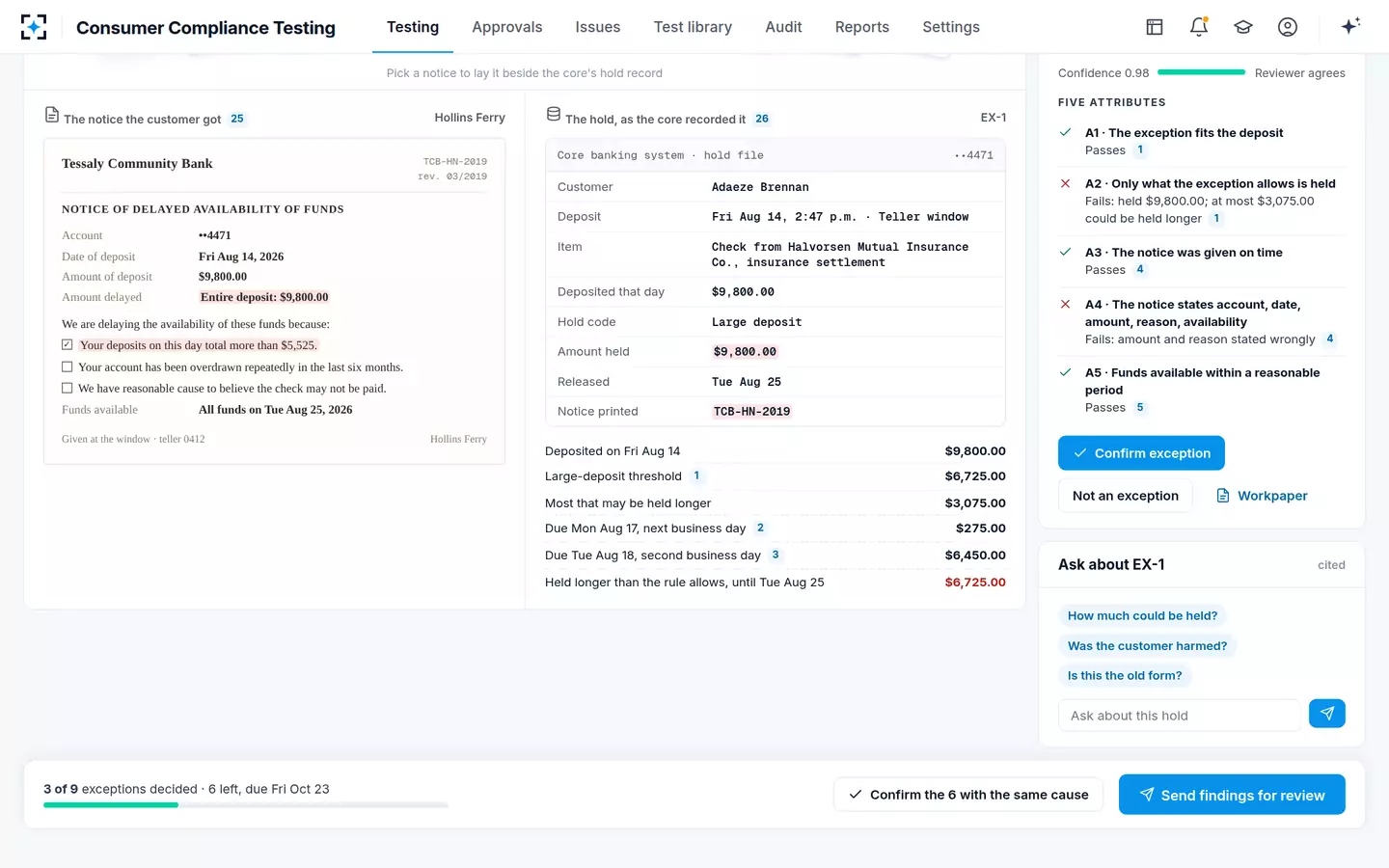
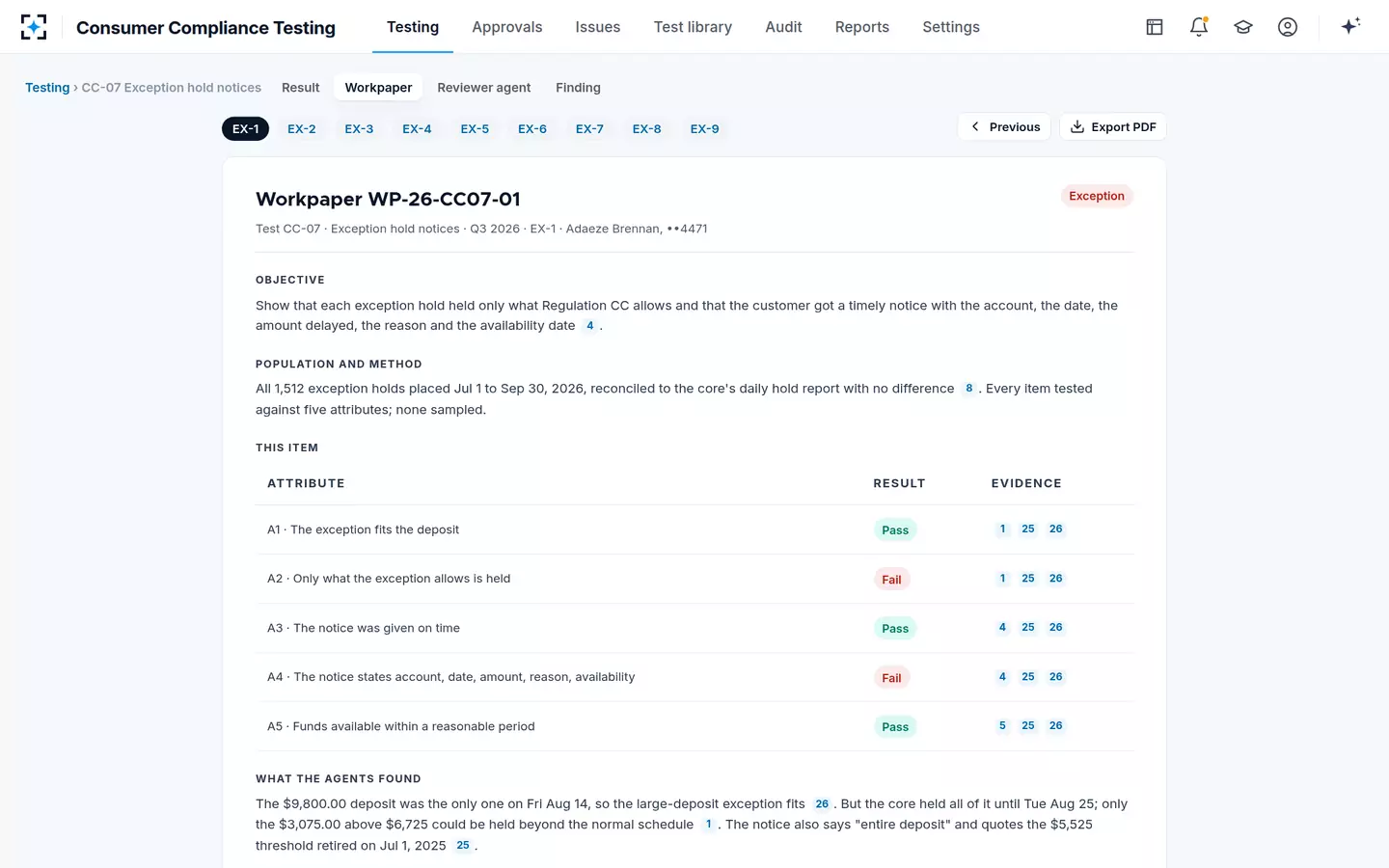
Take the fictional sample bank's first exception of its third quarter. A customer deposited a $9,800.00 insurance settlement check on Friday, August 14, 2026, her only deposit that day. The teller printed form TCB-HN-2019, which said "Amount delayed: entire deposit" and ticked the reason "Your deposits on this day total more than $5,525". The core held all $9,800.00 until Tuesday, August 25. Two attributes failed: what was held, and what the notice said.
A 2019 hold notice form, the old threshold, and the arithmetic the rule allowed
How do you test next-day availability on ordinary deposits?
Start from the deposit type and the channel. Cash deposited in person to an employee is due the next business day, and by the second business day if not deposited in person (12 CFR 229.10(a)). Electronic payments are due the business day after the banking day the bank received them. Certain checks deposited into the payee's own account are next-day items, most of them only when deposited in person: Treasury checks, Postal Service money orders, Federal Reserve and Federal Home Loan Bank checks, in-state government checks, and cashier's, certified and teller's checks, some only with a special deposit slip if the bank requires one. Checks drawn on another branch of the same bank in the same state or check processing region are next-day items too (12 CFR 229.10(c)).
Everything else gets the $275 next day and the rest by the second business day for local checks. A transactional test therefore needs each deposit's item types, the channel, the banking day and the cut-off, and compares them with the availability date the core assigned. The $275 line is the one the July 2025 change touched, and the one a stale core parameter would get wrong on every affected deposit.
New accounts: the $6,725 and the ninth business day
For the first 30 calendar days after an account is established, the schedules loosen. Cash and electronic payments stay next-day. The next-day check types, with traveler's checks added, are next-day only for the first $6,725 deposited on a banking day, and the excess must be available by the ninth business day; other checks fall outside the schedules (12 CFR 229.13(a)). An account is not new if every customer on it already had another account at the bank for at least 30 days in the 30 days before it opened. A new-account test needs the opening date, each customer's relationship history and, since July 2025, the new figure.
How do you test large deposit holds?
Rebuild the day, then rebuild the schedule. First aggregate the customer's check deposits for the banking day, since the threshold applies to the day's total, not to one check. Only the part above $6,725 may be held beyond the normal schedule (12 CFR 229.13(b)). The first $275 is due the next business day (12 CFR 229.10(c)(1)(vii)); the rest of the first $6,725 follows the normal schedule, the second business day for a local check (12 CFR 229.12(b)). The excess may be held a reasonable period, presumed to be up to five more business days for those checks; longer is possible only if the bank can show it is reasonable (12 CFR 229.13(h)(4)).
The sample bank's $9,800.00 deposit, rebuilt the way the rule allows
Next business day
$275.00 by Mon Aug 17
The next-day amount since July 1, 2025.
229.10(c)(1)(vii)
Second business day
$6,450.00 by Tue Aug 18
The rest of the first $6,725, on the normal schedule for a local check.
229.12(b)
Large-deposit excess
$3,075.00 by Tue Aug 25
$9,800.00 − $6,725.00, held up to five more business days.
229.13(b), (h)(4)
Held too long
$6,725.00 until Aug 25
Everything the exception did not cover was held to the date only the excess could reach.
The exception
The test has to hold for every large-deposit hold, not just the one in front of the analyst. At the sample bank, the other 39 branches held only the excess on all 214 of their large-deposit holds; the two branches still printing the 2019 form held the whole deposit on all six of theirs. That contrast is the cause, and only a test of every hold shows it. What a 59-item sample can prove puts odds on finding six in 1,512 by sampling.
Test where the number comes from, not only the number
An amount is right on a hold because it was right in the system that produced the hold, and right on a notice because it was right in the form that printed it. Testing the hold catches the error after a customer met it; testing the source catches it before. The Federal Reserve's examiners have long suggested that validating platform defaults and settings up front can cut how many transactions need testing (Consumer Compliance Outlook, 2013). After a dated rule change, the sources are where to start.
Where Reg CC numbers live in a bank, to check after each adjustment
- Core availability parameters
Next-day amount, cash withdrawal amount, new-account and large-deposit thresholds, effective dates.
- Exception hold notice templates
Every version still printable, at the window and in mailed notices.
- Teller platform settings, branch by branch
Which form each branch actually prints; at the sample bank, two of 41 still printed the old one.
- The availability policy disclosure
Given before an account is opened, and on request.
- Lobby and ATM notices
Posted where employees take consumer deposits and at ATMs.
- Procedures, job aids and training
The hold calculator a teller uses and the deck they learned from.
- The test scripts themselves
A dated amount table, versioned and approved, not a number typed into each test.
Getting ready for July 1, 2030
The next change is predictable enough to plan. Its measurement period runs from July 2023 to July 2028, and the new amounts are published in the Federal Register after it ends; for 2025, the final rule appeared in May 2024, more than a year ahead. A bank can use that lead time: keep the amounts in one dated table that every script reads, list every form, template, parameter and training item that prints a number, dry-run the hold tests with the new amounts before the effective date, and test the first month of holds after it at every branch. The sample bank's two-branch error is what happens when that list misses one teller platform.
Does a Reg CC policy change need notice?
Yes, with timing that depends on direction. A bank must notify consumer account holders 30 days or more before a change to its availability policy takes effect, except that a change that speeds up availability may be disclosed within 30 days after it takes effect (12 CFR 229.18(e)). The July 2025 amounts made more money available sooner, so a bank whose policy disclosure quoted the old amounts could update it within 30 days after implementation. A test of policy changes checks both clocks: notices before adverse changes, and timely updates after favourable ones.
Record keeping runs alongside. A depositary bank must keep evidence of compliance with the availability rules for at least two years (12 CFR 229.21(g)), and for each hold under the reasonable-cause exception it must keep the notice with a brief statement of the facts behind its doubt. Workpapers that cite those records, rather than describe them, are what lets a test be re-performed. How agents and people split a Reg CC test covers who does each step; the Consumer Compliance Testing page shows the rest of the quarter.
One workpaper per exception: objective, population, method and each attribute's evidence
Questions people ask
Which next-day amount applies to a deposit made before July 1, 2025?
$225, the amount in force on the banking day of deposit; $275 applies to deposits from July 1, 2025. A test whose period spans the change must apply each deposit's own amount: the lesser of that amount or the day's check deposits not otherwise due next day (12 CFR 229.10(c)(1)(vii), 229.11(c)).
How often must a Reg CC test script be updated?
At least whenever the amounts move, which is every five years: the CPI-W adjustments took effect on July 1, 2020 and July 1, 2025, and the next is due on July 1, 2030, rounded to the nearest $25. A script that reads the amount from the regulation's table by date, rather than typing it, needs no edit on the day.
What is a reasonable period for an exception hold?
Up to one more business day for checks described in 229.10(c)(1)(vi), five for the checks in 229.12(b), and six for those in 229.12(c) or (f). A longer extension may be reasonable, but the bank carries the burden of showing it (12 CFR 229.13(h)(4)).
Must the exception notice show the account number?
It must identify the account, but a number or code of no more than four digits is enough. The notice also needs the deposit date, the amount being delayed, the reason and when the funds will be available.
When must an exception hold notice be given?
At the time of the deposit if it is made in person to an employee. Otherwise, or if the facts behind the exception become known later, it must be mailed or delivered as soon as practicable and no later than the first business day after the facts become known or the deposit is made, whichever is later.
Do examiners still use the old amounts?
Examiners apply the regulation in force. Some published procedures still print the earlier figures: as read in October 2026, the FDIC's Regulation CC chapter shows $225, $450 and $5,525, and the OCC's Depository Services booklet $100, $400 and $5,000. Build scripts from the regulation and date every amount.